Ginsan vs MagnaCut
An Independent Guide
Ginsan vs MagnaCut is one of the most interesting comparisons for anyone choosing a high-performance stainless knife.
Both steels offer excellent corrosion resistance, strong edge performance, and the ability to achieve high hardness. Yet they approach knife performance from different directions.
Ginsan is particularly well known for its combination of stainless properties, fine edge performance, and relatively easy sharpening. MagnaCut is designed around a broader balance of toughness, corrosion resistance, wear resistance, and edge stability.
The result is that neither steel is simply “better.”
Instead, each has a different set of strengths.
If you want a refined stainless kitchen knife that is pleasant to sharpen and capable of taking an excellent fine edge, Ginsan is extremely attractive.
If you want a modern stainless steel with exceptional toughness, very high corrosion resistance, and strong edge retention, MagnaCut has a major advantage.
This detailed comparison examines the two steels without focusing on individual brands, manufacturers, makers, or personalities. The goal is to understand the metallurgy and practical performance of the steels themselves.
Ginsan vs MagnaCut at a Glance
| Property | Ginsan | MagnaCut |
|---|---|---|
| Steel category | Stainless | Stainless |
| Carbon | Approximately 1% | Approximately 1.15% |
| Chromium | Approximately 13–14% | Approximately 10.7% |
| Molybdenum | Approximately 0.6–0.8% | Approximately 2% |
| Vanadium | Very low | Approximately 4% |
| Niobium | Minimal/none | Approximately 2% |
| Typical hardness | Around 59–62 HRC | Around 60–64 HRC |
| Toughness | Very good | Exceptional |
| Wear resistance | Good to very good | Very good |
| Corrosion resistance | Excellent | Exceptional |
| Sharpening | Excellent | Very good |
| Fine edge performance | Excellent | Excellent |
| Edge stability | Excellent | Excellent |
| Maintenance | Low | Very low |
| Best suited to | Fine cutting and kitchen knives | Broad, demanding applications |
The figures above are approximate and should not be treated as universal values for every knife.
Heat treatment matters enormously.
Two knives made from the same steel can behave quite differently if their hardness, geometry, edge thickness, and heat treatment differ.
What Is Ginsan Steel?
Ginsan is a Japanese stainless knife steel commonly associated with the designation Gingami #3 or GIN-3.
It occupies an unusual position among stainless steels.
Its composition is relatively simple compared with many modern high-alloy steels, but it contains enough carbon and chromium to produce a useful combination of hardness and corrosion resistance.
The steel is particularly appreciated for:
- stainless performance
- fine edge capability
- relatively easy sharpening
- good edge stability
- good toughness
- pleasant sharpening feedback
- suitability for thin cutting edges
One of the reasons Ginsan has become popular for kitchen knives is that it can provide some of the characteristics that enthusiasts appreciate in traditional carbon steels while requiring considerably less maintenance.
It does not behave exactly like a carbon steel.
Rather, it offers a practical compromise:
high performance without demanding constant rust prevention.
That makes it especially attractive for people who want a refined cutting tool but do not want to deal with the reactivity of traditional carbon steel.
What Is MagnaCut Steel?
MagnaCut is a modern powder-metallurgy stainless knife steel designed around a balanced combination of properties.
Its composition is considerably more complex than Ginsan.
Its approximate alloy composition includes:
- about 1.15% carbon
- about 10.7% chromium
- about 4% vanadium
- about 2% molybdenum
- about 2% niobium
The interesting feature is not any individual element.
It is how the elements interact.
The steel was designed to provide a combination of:
- high toughness
- high corrosion resistance
- useful wear resistance
- high hardness
- good edge stability
Traditionally, increasing wear resistance in stainless knife steels could come at the expense of toughness.
Likewise, maximizing corrosion resistance could involve compromises elsewhere.
MagnaCut takes a different approach by carefully controlling the carbide structure and the distribution of alloying elements.
This gives the steel an unusually broad performance envelope.
Check Our Guide MagnaCut Steel Review
Why Compare Ginsan and MagnaCut?
At first glance, the two steels appear quite different.
One is a relatively simple stainless steel widely associated with Japanese kitchen knives.
The other is a modern powder-metallurgy steel designed to balance several competing properties.
Yet they overlap in important areas.
Both can provide:
- high hardness
- excellent corrosion resistance
- fine cutting edges
- good edge stability
- relatively low maintenance
- excellent knife performance
The important differences appear when you examine toughness, wear resistance, carbide structure, sharpening behavior, and intended use.
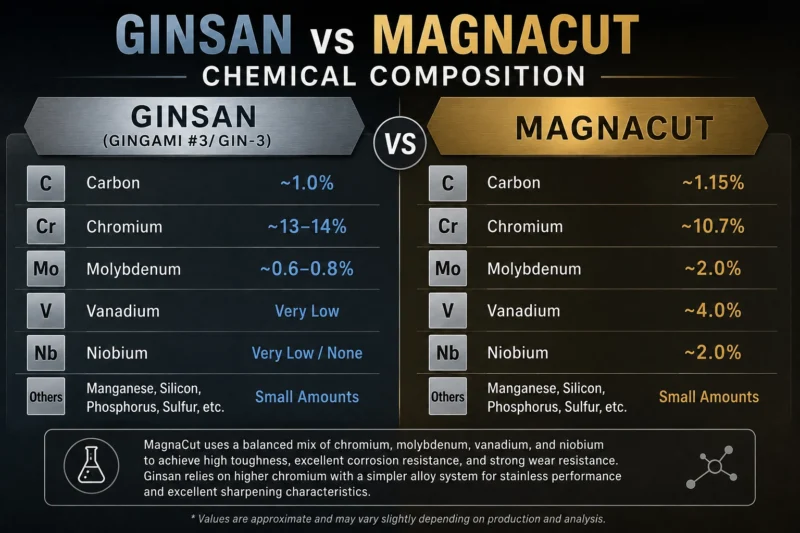
Ginsan vs MagnaCut: Chemical Composition
Chemical composition provides the foundation for understanding the difference.
| Element | Ginsan | MagnaCut |
|---|---|---|
| Carbon | ~1.0% | ~1.15% |
| Chromium | ~13–14% | ~10.7% |
| Molybdenum | ~0.6–0.8% | ~2.0% |
| Vanadium | Very low | ~4.0% |
| Niobium | Very low/none | ~2.0% |
These differences are significant.
Ginsan relies heavily on chromium for stainless behavior while maintaining a comparatively straightforward alloy structure.
MagnaCut uses chromium together with molybdenum, vanadium, and niobium.
The vanadium and niobium are particularly important because they form extremely hard carbides.
Those carbides contribute to wear resistance.
At the same time, the alloy was designed to avoid excessive chromium carbide formation.
That distinction is critical.
Why Chromium Content Does Not Tell the Whole Story
A common mistake when comparing stainless steels is to assume:
More chromium automatically means better corrosion resistance.
That is not necessarily true.
The important question is how much chromium remains available in the steel matrix.
If large quantities of chromium are tied up in chromium carbides, less chromium is available to support corrosion resistance.
MagnaCut was designed specifically to avoid this problem.
Although its total chromium content is lower than Ginsan’s, its microstructure allows a substantial amount of chromium to remain available for corrosion resistance.
This is one reason MagnaCut can achieve extremely high corrosion resistance despite containing less chromium overall.
Carbon in Ginsan vs MagnaCut
Carbon is essential for achieving high hardness in knife steels.
Ginsan contains roughly 1% carbon.
MagnaCut contains approximately 1.15%.
Both therefore have enough carbon to support high hardness.
However, carbon does much more than simply increase hardness.
It interacts with alloying elements to form carbides.
In Ginsan, the carbide population is relatively modest.
In MagnaCut, carbon participates in forming vanadium and niobium carbides.
These carbides are extremely hard.
That gives MagnaCut an advantage in abrasive wear resistance.
Chromium in Ginsan vs MagnaCut
Ginsan contains considerably more chromium than MagnaCut.
This contributes to its stainless character.
MagnaCut uses a lower chromium percentage but compensates through its carefully engineered microstructure.
The result is that both steels can be highly corrosion resistant.
In ordinary kitchen use, Ginsan already offers more corrosion resistance than most users will ever require.
MagnaCut becomes particularly interesting when corrosion exposure becomes more severe.
Molybdenum and Corrosion Resistance
Molybdenum contributes to corrosion resistance and is particularly useful in environments where localized corrosion can become a problem.
Ginsan contains a relatively small amount.
MagnaCut contains approximately 2%.
This contributes to MagnaCut’s strong corrosion performance.
The combination of chromium and molybdenum helps explain why MagnaCut can remain highly corrosion resistant under demanding conditions.
Vanadium and Wear Resistance
This is one of the most obvious differences.
Ginsan contains very little vanadium.
MagnaCut contains approximately 4%.
Vanadium forms extremely hard vanadium carbides.
These carbides resist abrasive wear.
As a result, MagnaCut generally has better wear resistance than Ginsan.
This does not mean that Ginsan has poor edge retention.
It means that, all else being equal, MagnaCut has more resistance to abrasive edge wear.
Niobium and MagnaCut
Niobium is another important element in MagnaCut.
It forms very hard niobium carbides.
These carbides help provide wear resistance without requiring large quantities of chromium carbide.
This is important because excessive chromium carbide formation can reduce corrosion resistance and toughness.
The use of niobium is therefore part of the overall design strategy.
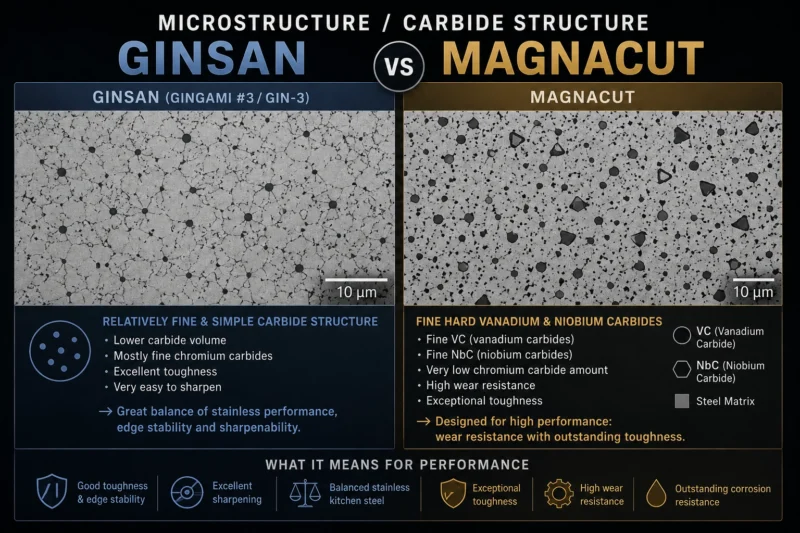
Carbide Structure
The carbide structure is one of the most important differences between these steels.
Ginsan has a relatively fine and simple carbide structure.
MagnaCut has a more complex structure involving hard vanadium and niobium carbides.
Hard carbides improve resistance to abrasive wear.
However, carbide volume and carbide size can also influence toughness and edge stability.
The goal is not simply to maximize carbide content.
The ideal structure depends on the intended performance.
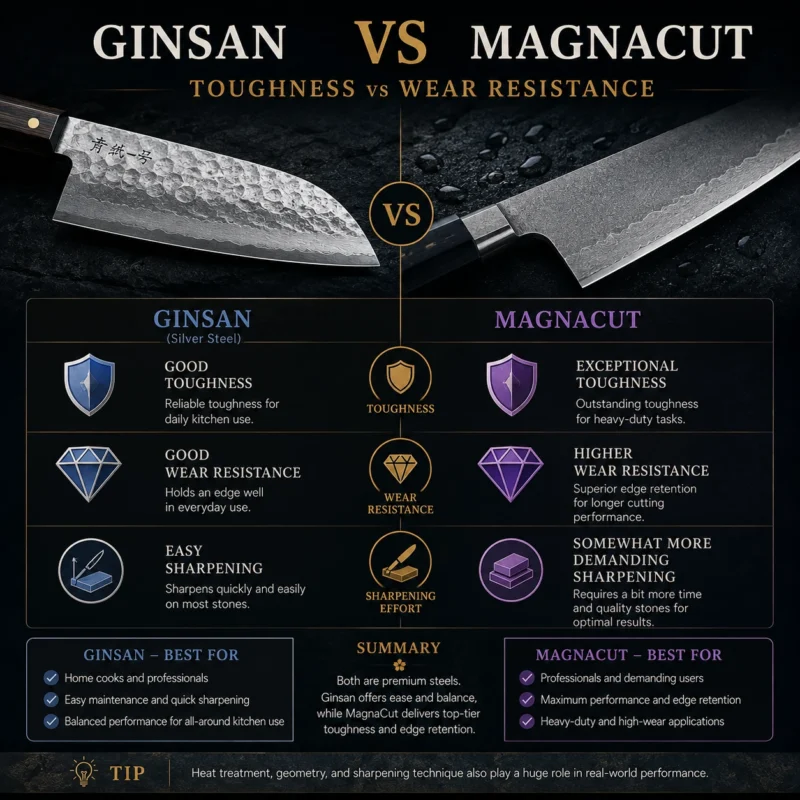
Why More Carbides Are Not Always Better
It might seem logical that more hard carbides should always produce a better knife.
That is not true.
Large or excessive carbide populations can make a steel more vulnerable to:
- chipping
- fracture
- reduced toughness
- difficulty sharpening
- unstable thin edges
This is why simply increasing alloy content isn’t a perfect recipe for better knife steel.
A good steel must balance carbide formation with the properties of the surrounding steel matrix.
MagnaCut is interesting precisely because it achieves useful wear resistance while maintaining unusually high toughness for a stainless high-performance steel.
Ginsan vs MagnaCut: Hardness
Hardness is normally measured using the Rockwell C scale.
Ginsan kitchen knives are commonly found around 59–62 HRC, although actual values vary.
MagnaCut can commonly be heat treated to approximately 60–64 HRC.
Both steels therefore have excellent hardness potential.
But hardness alone doesn’t tell you which knife will perform better.
A harder blade is not automatically better.
Increasing hardness can improve:
- edge retention
- edge stability
- resistance to deformation
But excessive hardness can potentially reduce toughness.
The ideal hardness depends on the application.
Check Our Guide What Is HRC? Understanding Rockwell Hardness in Kitchen Knives
Why Heat Treatment Matters
Steel composition establishes a potential performance range.
Heat treatment determines how much of that potential is realized.
Heat treatment influences:
- hardness
- toughness
- carbide structure
- retained austenite
- corrosion behavior
- edge stability
This is why two knives made from Ginsan can perform differently.
The same applies to MagnaCut.
When comparing two actual knives, the steel designation is only the beginning.
Check Our Guide Steel Heat Treatment Explained
Ginsan vs MagnaCut: Toughness
MagnaCut is the clear winner in toughness.
This is one of its defining characteristics.
Toughness describes a steel’s ability to absorb energy and resist cracking or breaking.
For knives, this translates into greater resistance to:
- chipping
- impacts
- accidental lateral stress
- edge damage
- sudden fracture
Ginsan is not a fragile steel.
Its relatively simple composition and moderate carbide content give it good toughness.
But MagnaCut is designed specifically to achieve an unusually high toughness level while retaining excellent corrosion resistance.
Why Toughness Matters
Toughness is especially important when a knife encounters unexpected forces.
Examples include:
- hitting a hard spot in food
- accidental contact with another object
- cutting tougher materials
- outdoor use
- lateral loading
- occasional impacts
For delicate kitchen work, extreme toughness may not be necessary.
For general-purpose knives, it becomes much more important.
Check Our Guide Wear Resistance vs Toughness: Understanding the Most Important Knife Steel Trade-Off
Ginsan vs MagnaCut: Edge Retention
Edge retention describes how long a knife maintains useful cutting performance.
MagnaCut generally has the advantage.
Its hard vanadium and niobium carbides provide greater resistance to abrasive wear.
Ginsan can still provide very good edge retention, particularly when heat treated well.
However, if both knives have comparable geometry and hardness, MagnaCut will generally maintain its working edge longer during abrasive cutting.
Check Our Guide Edge Retention Explained: 10 Factors What Makes a Knife Stay Sharp Longer
Why Edge Retention Is Not One Simple Number
Different cutting tasks wear an edge differently.
Cutting:
- tomatoes
- meat
- cardboard
- rope
- vegetables
- plastic
- wood
can produce different results.
Abrasive materials generally favor steels with high wear resistance.
For kitchen work, geometry and edge stability may be equally important.
Therefore, a laboratory wear-resistance difference does not necessarily translate into an enormous difference in everyday kitchen performance.
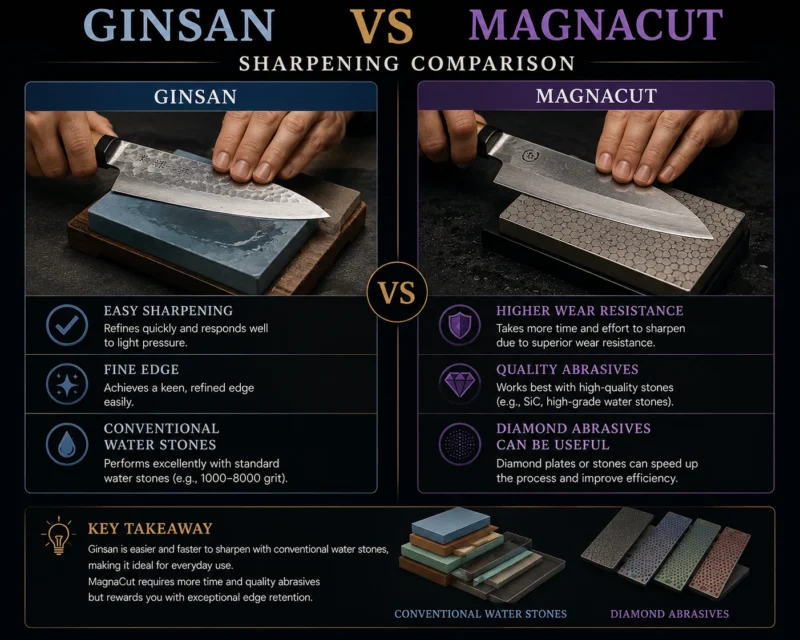
Ginsan vs MagnaCut: Sharpening
This is where Ginsan has a major advantage.
Ginsan is generally easier to sharpen.
Its relatively low carbide volume allows conventional sharpening stones to remove material efficiently.
The steel tends to provide a predictable sharpening experience.
MagnaCut is still comparatively manageable for a modern high-performance powder steel.
It is not among the most difficult steels to sharpen.
However, its hard carbides increase the abrasive demands placed on the sharpening system.
Winner: Ginsan
Sharpening Ginsan
Ginsan is very well suited to conventional Japanese-style water stones.
A typical progression might involve:
- coarse stone for repairs
- medium stone for establishing the edge
- fine stone for refinement
- optional stropping
Because Ginsan does not contain a huge volume of extremely hard carbides, sharpening can feel relatively fast.
This makes it attractive to people who enjoy frequent edge maintenance.
Sharpening MagnaCut
MagnaCut can be sharpened successfully using quality synthetic stones.
The process may simply take somewhat longer than with Ginsan.
Diamond abrasives can be particularly effective because they are harder than the vanadium and niobium carbides.
However, diamond is not mandatory.
A good conventional sharpening system can maintain MagnaCut perfectly well.
Check Our Guide All Kinds of Knife Sharpening Tools
Ginsan vs MagnaCut: Fine Edge Performance
Both steels can take an excellent fine edge.
Ginsan has long been appreciated for its ability to support refined kitchen-knife edges.
MagnaCut is also capable of very fine edges, and its toughness makes this particularly impressive.
A properly heat-treated MagnaCut blade can combine:
- high hardness
- thin geometry
- excellent corrosion resistance
- strong edge stability
- high toughness
That combination gives it a very broad performance envelope.
Which Steel Gets Sharper?
Neither steel is inherently “sharper.”
Sharpness depends primarily on:
- apex geometry
- sharpening quality
- edge angle
- burr removal
- finishing technique
A properly sharpened Ginsan knife can be extraordinarily sharp.
A properly sharpened MagnaCut knife can be equally sharp.
The difference is usually how easily the user reaches that state and how long the edge remains there.
Ginsan vs MagnaCut: Edge Stability
Edge stability describes how well the apex resists deformation and damage.
This is particularly important when using very thin edges.
Ginsan performs well because its carbide structure is relatively fine and uncomplicated.
MagnaCut performs extremely well because of its combination of hardness and toughness.
The ideal balance depends on heat treatment and edge geometry.
At suitable hardness, MagnaCut can provide exceptional edge stability.
Ginsan vs MagnaCut: Chipping Resistance
Chipping is a common concern with high-hardness knife steels.
The risk increases when:
- the edge is extremely thin
- hardness is very high
- the steel is brittle
- the knife encounters lateral force
- hard carbides are poorly distributed
MagnaCut’s toughness provides an advantage.
Ginsan is also capable of supporting thin edges, especially when heat treated appropriately.
For delicate kitchen knives, both can perform extremely well.
Ginsan vs MagnaCut: Corrosion Resistance
Both are excellent stainless steels.
Ginsan’s high chromium content provides strong resistance to rust and staining.
MagnaCut’s corrosion resistance is one of its most impressive properties.
Despite having less total chromium than Ginsan, its alloy design allows it to retain excellent corrosion resistance.
Overall winner: MagnaCut
But the practical difference for ordinary kitchen use may be very small.
Ginsan is already highly corrosion resistant.
Corrosion in Kitchen Use
Kitchen knives encounter many potentially corrosive substances:
- tomato juice
- citrus
- vinegar
- onions
- salt
- fruit acids
- moisture
Ginsan handles these conditions extremely well.
MagnaCut also handles them extremely well.
Neither should be left wet indefinitely.
Stainless does not mean completely corrosion-proof.
Corrosion in Humid Environments
Humidity can become more important outside the kitchen.
A knife carried outdoors may encounter:
- rain
- sweat
- humidity
- wet vegetation
- saltwater
- condensation
This is where MagnaCut’s corrosion resistance becomes particularly valuable.
For severe environments, its combination of corrosion resistance and toughness is difficult to ignore.
Ginsan vs MagnaCut: Maintenance
Both steels are low-maintenance.
Basic care includes:
- wash after use
- dry thoroughly
- avoid prolonged moisture
- use an appropriate cutting surface
- maintain the edge regularly
Ginsan requires little maintenance.
MagnaCut requires even less concern about corrosion under demanding conditions.
Neither should be treated as completely maintenance-free.
Ginsan vs MagnaCut: Patina
Traditional carbon steels are often chosen specifically because they develop patina.
Ginsan is not a traditional reactive carbon steel.
MagnaCut is also highly stainless.
Therefore, neither is the ideal choice if you specifically want dramatic patina development.
If you want a low-maintenance blade that maintains a relatively clean appearance, both are excellent.
Ginsan for Japanese Kitchen Knives
Ginsan is particularly well suited to Japanese kitchen knives.
It works very well for:
- gyuto
- santoku
- nakiri
- petty
- sujihiki
- bunka
The steel supports thin geometry and fine edges while remaining relatively easy to maintain.
For someone who wants the experience of a refined Japanese knife without the maintenance of reactive carbon steel, Ginsan is an excellent option.
MagnaCut for Japanese Kitchen Knives
MagnaCut can also make an excellent kitchen knife.
Its advantages include:
- high toughness
- excellent corrosion resistance
- strong edge retention
- high hardness potential
- good edge stability
Its main disadvantage compared with Ginsan is sharpening effort.
For someone who sharpens infrequently, this may be almost irrelevant.
For someone who enjoys sharpening regularly, Ginsan may be more satisfying.
Ginsan vs MagnaCut for Gyuto
A gyuto typically benefits from:
- thin geometry
- good edge stability
- corrosion resistance
- fine edge capability
Ginsan is therefore a natural fit.
MagnaCut is also excellent, particularly for people who want additional toughness and longer edge life.
For a delicate, carefully used gyuto:
Ginsan is extremely attractive.
For a harder-working, more forgiving gyuto:
MagnaCut has a strong advantage.
Ginsan vs MagnaCut for Santoku
Santoku knives are commonly used for vegetables, meat, and fish.
This makes:
- corrosion resistance
- edge stability
- fine edge performance
particularly important.
Both steels perform well.
Ginsan offers easier sharpening.
MagnaCut offers greater toughness and wear resistance.
Ginsan vs MagnaCut for Nakiri
Nakiri knives often have thin edges and are used extensively on vegetables.
Ginsan is an excellent match.
Its easy sharpening and fine edge capability make it particularly pleasant for this role.
MagnaCut is also excellent, especially when the knife is used heavily.
Ginsan vs MagnaCut for Petty Knives
Small utility kitchen knives can encounter many different foods and cutting situations.
MagnaCut’s toughness provides additional protection against accidental edge damage.
Ginsan’s sharpening characteristics make routine maintenance very easy.
Both are excellent choices.
Ginsan vs MagnaCut for Fish Preparation
Fish preparation strongly benefits from corrosion resistance.
Both steels are excellent here.
Ginsan has a long association with fine Japanese kitchen knives and is very well suited to delicate cutting.
MagnaCut adds exceptional corrosion resistance and toughness.
If the knife is exposed to moisture for long periods, MagnaCut becomes increasingly attractive.
Check Our Guide How to Prepare and Cut Seafood
Ginsan vs MagnaCut for Meat
For boneless meat preparation, both steels perform very well.
MagnaCut’s wear resistance can provide longer edge life.
Ginsan’s sharpening response makes edge maintenance easier.
Neither should be used to chop through hard bones with a thin kitchen edge.
Ginsan vs MagnaCut for Vegetables
Both are excellent vegetable-cutting steels.
For vegetables, blade geometry can be more important than the steel difference.
A thin, well-ground Ginsan blade can glide through produce beautifully.
A thin MagnaCut blade can provide the same level of cutting performance while potentially retaining the edge longer.
Ginsan vs MagnaCut for Outdoor Knives
This category strongly favors MagnaCut.
Outdoor knives can experience:
- impact
- moisture
- abrasion
- dirt
- accidental lateral forces
- prolonged exposure to harsh environments
Toughness and corrosion resistance are extremely valuable.
MagnaCut combines both.
Ginsan is stainless and capable, but it was not designed around the same broad performance target.
Winner: MagnaCut
Check Our Guide Best Hunting Knife Features Explained
Ginsan vs MagnaCut for Everyday Carry
For everyday-carry knives, MagnaCut is generally the stronger option.
An everyday knife may cut:
- cardboard
- packaging
- plastic
- food
- rope
- miscellaneous materials
It may also remain inside a pocket for long periods.
Sweat and moisture can contribute to corrosion.
MagnaCut’s combination of toughness, corrosion resistance, and wear resistance makes it particularly suitable.
Ginsan vs MagnaCut for Heavy Use
Heavy use favors MagnaCut.
The steel’s toughness provides additional security.
Its wear resistance reduces the frequency of sharpening.
Its corrosion resistance reduces maintenance requirements.
Ginsan can certainly handle regular use.
But MagnaCut has a broader safety margin for demanding conditions.
Ginsan vs MagnaCut for Fine Cutting
Fine cutting favors Ginsan slightly.
Not because MagnaCut cannot produce an excellent edge.
It absolutely can.
The difference is that Ginsan is particularly easy to bring to a highly refined edge.
For users who regularly sharpen and appreciate a polished apex, Ginsan can be extremely satisfying.
Ginsan vs MagnaCut for Beginners
For someone learning knife sharpening, Ginsan has a significant advantage.
It is relatively cooperative on conventional stones.
This makes it easier to learn:
- burr formation
- apex control
- angle consistency
- deburring
- edge refinement
MagnaCut can also be learned successfully, but it may require more patience.
Ginsan vs MagnaCut for Experienced Sharpeners
Experienced sharpeners may appreciate both for different reasons.
Ginsan provides a straightforward, responsive sharpening experience.
MagnaCut provides the challenge of maintaining a highly wear-resistant steel while still being much easier than many extreme powder steels.
Ginsan vs MagnaCut: Water Stones
Ginsan is particularly compatible with traditional water-stone sharpening.
It can respond beautifully to:
- medium stones
- fine stones
- polishing stones
MagnaCut can also be sharpened on water stones.
However, stone quality and abrasive selection become somewhat more important.
Ginsan vs MagnaCut: Diamond Stones
Diamond stones are particularly useful for MagnaCut.
They cut the hard vanadium and niobium carbides efficiently.
For Ginsan, diamond is generally unnecessary for routine sharpening.
Conventional stones are usually more than adequate.
Ginsan vs MagnaCut: Stropping
Both steels can benefit from controlled stropping.
The important word is controlled.
Excessive stropping can round the apex instead of improving it.
A light finishing pass can be useful after sharpening.
For either steel, proper stone technique is more important than aggressive stropping.
Ginsan vs MagnaCut: Edge Angle
There is no universal perfect edge angle.
The appropriate angle depends on:
- blade thickness
- hardness
- geometry
- cutting task
- toughness
- user technique
A very thin kitchen knife may work beautifully at a relatively acute angle.
A harder-use knife should generally use a more robust edge.
MagnaCut’s toughness gives it more flexibility, but it is still possible to damage an extremely thin edge.
Ginsan vs MagnaCut: Blade Geometry Matters More Than Most People Think
Steel receives most of the attention in knife discussions.
But geometry can have an enormous influence on actual cutting performance.
Important characteristics include:
- edge thickness
- blade thickness
- grind
- blade height
- distal taper
- behind-the-edge thickness
- edge angle
A thin Ginsan knife may cut dramatically better than a thick MagnaCut knife.
Conversely, a well-ground MagnaCut knife can outperform a poorly designed Ginsan blade.
This is why steel should never be evaluated independently from geometry.
Edge Thickness and Performance
The thinner the edge, the less force is normally required to initiate a cut.
But thinner edges are also more vulnerable to:
- chipping
- rolling
- impact damage
Ginsan performs very well at thin geometry.
MagnaCut’s toughness provides an additional advantage when pushing thin geometry into more demanding use.
Check Our Guide Best Blade Thickness for Different Uses
Ginsan vs MagnaCut: Edge Rolling
Edge rolling happens when the apex deforms instead of breaking.
Hardness has a major influence.
A properly heat-treated high-hardness Ginsan blade can resist rolling well.
MagnaCut can also achieve excellent edge stability at high hardness.
The actual result depends strongly on heat treatment.
Ginsan vs MagnaCut: Micro-Chipping
Micro-chipping can occur when the apex is too hard or brittle for the application.
MagnaCut’s toughness gives it an advantage here.
Ginsan can also perform very well if the hardness is appropriate.
A thin kitchen knife should always be used with appropriate technique regardless of steel.
Ginsan vs MagnaCut: Cutting Boards
Both steels deserve an appropriate cutting surface.
Good choices include:
- wood
- soft synthetic boards
- quality rubber boards
Avoid very hard surfaces such as:
- glass
- stone
- ceramic
A premium steel cannot protect an edge from an unsuitable cutting board.
Check Our Complete Guide to Cutting Boards
Ginsan vs MagnaCut: Dishwasher Use
Neither knife should normally go into a dishwasher.
The issue isn’t simply rust.
Dishwashers can damage:
- edge geometry
- handles
- finishes
- blade surfaces
- overall knife construction
Hand washing and immediate drying are much safer.
Ginsan vs MagnaCut: Salt and Acid
Both steels perform well around acidic foods.
MagnaCut has an advantage in particularly aggressive environments.
Ginsan is already sufficiently corrosion resistant for normal cooking.
If you regularly work with:
- citrus
- vinegar
- tomatoes
- salt
- seafood
either steel is a strong choice.
Ginsan vs MagnaCut: Food Safety and Maintenance
Both steels can be used for food preparation.
The important factors are normal knife hygiene:
- wash after use
- dry thoroughly
- maintain a clean cutting surface
- avoid prolonged moisture
The stainless classification makes both convenient choices for kitchen use.
Ginsan vs MagnaCut: Which Steel Is More Versatile?
MagnaCut.
Its combination of properties makes it useful across a wider range of applications.
It can be used successfully for:
- kitchen knives
- outdoor knives
- folding knives
- fixed blades
- utility knives
- everyday-carry knives
Ginsan is more strongly associated with precision cutting and kitchen applications.
Ginsan vs MagnaCut: Which Steel Is More Traditional?
Ginsan.
Its characteristics fit naturally into the Japanese kitchen-knife tradition.
It offers stainless convenience without relying on an extremely complex alloy.
For enthusiasts who enjoy Japanese knife geometry and traditional sharpening methods, it is particularly appealing.
Ginsan vs MagnaCut: Which Steel Is More Modern?
MagnaCut.
Its composition and powder-metallurgy production represent a modern approach to steel design.
The objective isn’t simply maximum hardness or maximum wear resistance.
The goal is to balance several competing properties.
Ginsan vs MagnaCut: Which Steel Is Better for a Chef?
There is no universal answer.
A chef who values:
- fine cutting
- easy sharpening
- thin edges
- frequent maintenance
may prefer Ginsan.
A chef who values:
- longer edge life
- toughness
- corrosion resistance
- minimal maintenance
may prefer MagnaCut.
The working environment matters more than the steel’s reputation.
Ginsan vs MagnaCut: Which Is Better for Home Cooks?
Both.
For a home cook, Ginsan offers an excellent combination of:
- stainless performance
- easy sharpening
- fine cutting
- low maintenance
MagnaCut offers:
- longer edge life
- extreme corrosion resistance
- greater toughness
- versatility
The decision comes down largely to personal preference.
Ginsan vs MagnaCut: Which Is Better for Knife Enthusiasts?
This is subjective.
Someone who enjoys sharpening may find Ginsan particularly satisfying.
Someone fascinated by modern metallurgy may prefer MagnaCut.
Someone who wants one knife that can perform across many environments may prefer MagnaCut.
Someone who wants the classic experience of a refined Japanese kitchen knife may prefer Ginsan.
Ginsan vs MagnaCut: Which Has Better Wear Resistance?
MagnaCut.
The hard vanadium and niobium carbides provide a clear advantage.
This is particularly noticeable when cutting abrasive materials.
However, higher wear resistance comes with increased sharpening requirements.
Ginsan vs MagnaCut: Which Is Easier to Repair?
Ginsan.
If the edge suffers significant damage, Ginsan generally removes more easily on conventional stones.
MagnaCut can also be repaired, but the process may require more time and better abrasives.
Ginsan vs MagnaCut: Which Is Easier to Maintain?
Both are easy.
For sharpening:
Ginsan wins.
For corrosion resistance:
MagnaCut wins.
For overall maintenance:
Both are excellent.
Ginsan vs MagnaCut: Which Has Better Toughness-to-Hardness Balance?
MagnaCut has a particularly impressive combination of hardness and toughness.
This is one of its most important characteristics.
A steel that is very hard but brittle can be problematic.
A steel that is extremely tough but soft may lose its edge quickly.
MagnaCut aims for a middle ground that is unusually strong.
Ginsan vs MagnaCut: Is More Hardness Always Better?
No.
A knife at 64 HRC is not automatically better than a knife at 60 HRC.
Higher hardness can improve edge retention and deformation resistance.
But toughness may decrease depending on the steel and heat treatment.
For kitchen knives, the optimal hardness depends on:
- edge geometry
- cutting technique
- intended use
- blade thickness
Ginsan vs MagnaCut: Does Steel Determine Cutting Ability?
No.
Steel is only one component.
The actual cutting experience depends heavily on geometry.
A well-ground blade with excellent steel can be exceptional.
A poorly ground blade made from premium steel can be disappointing.
When choosing a knife, evaluate:
- steel
- heat treatment
- geometry
- edge thickness
- grind
- handle and construction
- sharpening requirements
Ginsan vs MagnaCut: Long-Term Ownership
Both steels are excellent long-term choices.
Ginsan has an advantage for owners who enjoy regular sharpening.
MagnaCut has an advantage for owners who want less frequent sharpening and more resistance to accidental damage.
Neither steel requires complicated corrosion maintenance.
Ginsan vs MagnaCut: Sustainability of Use
A knife’s useful lifespan depends more on maintenance and geometry than steel designation.
A good knife can last many years if:
- sharpened correctly
- not abused
- stored properly
- used on appropriate boards
- maintained regularly
Both Ginsan and MagnaCut are capable of long service lives.
Ginsan vs MagnaCut: Common Misconceptions
“More chromium always means better stainless performance.”
Not necessarily.
The state of chromium in the steel matrix matters.
“MagnaCut is impossible to sharpen.”
False.
It is more demanding than Ginsan but remains reasonably manageable.
“Ginsan has poor edge retention.”
False.
Ginsan can provide very good edge retention.
“The hardest knife is the best.”
False.
Hardness must be balanced with toughness and edge geometry.
“A powder steel is automatically better.”
False.
Powder metallurgy enables certain microstructural advantages, but the final knife still depends on heat treatment and geometry.
Ginsan vs MagnaCut: Performance Summary
Toughness
MagnaCut
Corrosion resistance
MagnaCut
Wear resistance
MagnaCut
Edge retention
MagnaCut
Sharpening ease
Ginsan
Fine-edge performance
Tie
Edge stability
Very close
Kitchen use
Both excellent
Outdoor use
MagnaCut
Traditional Japanese kitchen knives
Ginsan
General versatility
MagnaCut
Ginsan vs MagnaCut: Overall Scorecard
| Category | Ginsan | MagnaCut |
|---|---|---|
| Corrosion resistance | 9/10 | 10/10 |
| Toughness | 8/10 | 10/10 |
| Wear resistance | 7.5/10 | 9/10 |
| Edge retention | 8/10 | 9/10 |
| Sharpening ease | 10/10 | 8/10 |
| Fine edge | 9.5/10 | 9.5/10 |
| Edge stability | 9/10 | 9.5/10 |
| Kitchen performance | 9.5/10 | 9.5/10 |
| Outdoor performance | 7.5/10 | 10/10 |
| Maintenance | 9.5/10 | 10/10 |
| Versatility | 8/10 | 10/10 |
These scores are intended as a practical comparison rather than laboratory measurements.
Which Steel Should You Choose?
The simplest way to decide is to ask what matters most.
Choose Ginsan if you want:
- easy sharpening
- excellent stainless performance
- a fine kitchen edge
- excellent cutting feel
- thin geometry
- Japanese-style kitchen performance
- frequent sharpening without frustration
- relatively simple metallurgy
- low maintenance
Choose MagnaCut if you want:
- exceptional toughness
- excellent corrosion resistance
- higher wear resistance
- longer edge retention
- high hardness
- strong edge stability
- outdoor versatility
- everyday-carry versatility
- resistance to demanding use
Ginsan vs MagnaCut for a Thin Kitchen Knife
For a very thin kitchen knife, both steels can be excellent.
Ginsan has the advantage of sharpening simplicity.
MagnaCut has the advantage of toughness.
If the knife will be used carefully, Ginsan is an excellent choice.
If the knife will be used aggressively or by several people with different cutting habits, MagnaCut may provide a larger margin of safety.
Ginsan vs MagnaCut for a Workhorse Knife
A workhorse knife generally benefits from:
- toughness
- corrosion resistance
- edge retention
- moderate edge stability
That strongly favors MagnaCut.
Ginsan can certainly serve as a workhorse, but MagnaCut has the more appropriate overall performance profile for demanding use.
Ginsan vs MagnaCut for Minimal Maintenance
Both require little maintenance.
But MagnaCut’s exceptional corrosion resistance provides additional confidence when the knife may remain damp or encounter aggressive environments.
Still, proper care remains important.
No knife steel should be deliberately left wet.
Ginsan vs MagnaCut: The Role of Heat Treatment
This deserves repeating.
A well-treated steel will usually outperform a poorly treated steel regardless of its reputation.
A properly heat-treated Ginsan blade can have:
- excellent hardness
- excellent edge stability
- fine grain
- excellent sharpening response
A properly heat-treated MagnaCut blade can have:
- high hardness
- exceptional toughness
- excellent corrosion resistance
- excellent wear resistance
Therefore, when comparing actual knives, don’t look only at the steel designation.
Ginsan vs MagnaCut: The Role of Edge Geometry
The thinner the edge, the more important toughness becomes.
A very thin MagnaCut blade can take advantage of its toughness.
A very thin Ginsan blade can provide outstanding cutting performance.
The correct choice depends on how aggressively the knife will be used.
Ginsan vs MagnaCut: The Role of Sharpening Frequency
If you sharpen often, Ginsan becomes more attractive.
If you sharpen rarely, MagnaCut becomes more attractive.
This is one of the simplest practical distinctions.
Frequent sharpening:
Ginsan
Infrequent sharpening:
MagnaCut
Ginsan vs MagnaCut: The Role of Cutting Material
For relatively soft food materials, the difference in wear resistance may not be dramatic.
For abrasive materials, MagnaCut’s advantage becomes more significant.
This is why the same two steels can feel almost identical in one application and noticeably different in another.
Ginsan vs MagnaCut: What About Price?
Steel cost is only one part of knife pricing.
The final price can depend on:
- blade geometry
- heat treatment
- grinding
- finishing
- handle construction
- thickness
- production method
- quality control
Therefore, a more expensive steel does not automatically produce a better knife.
A well-made Ginsan knife can be an exceptional value.
Ginsan vs MagnaCut: The Best Choice for a Kitchen Collection
If you’re building a collection of kitchen knives, both steels can have a place.
A Ginsan knife can be ideal for:
- gyuto
- nakiri
- santoku
- petty
A MagnaCut knife can be ideal for:
- general-purpose work
- heavy-use knives
- utility knives
- outdoor food preparation
The two steels complement each other rather than directly replacing one another.
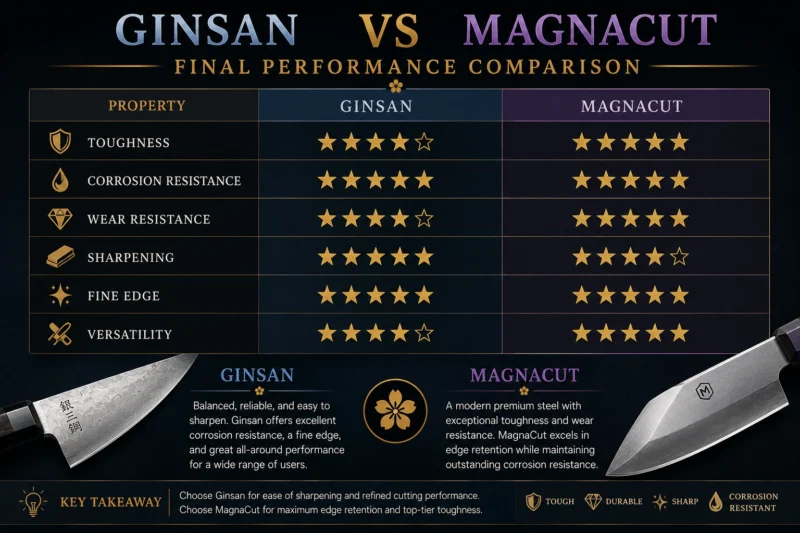
Ginsan vs MagnaCut: Final Verdict
There is no single winner.
MagnaCut is the stronger all-around performer.
It offers:
- greater toughness
- higher wear resistance
- excellent edge retention
- exceptional corrosion resistance
- high hardness
- broad versatility
But Ginsan remains an outstanding choice for precision kitchen knives.
Its strengths are:
- easy sharpening
- excellent fine-edge performance
- stainless convenience
- good edge stability
- good toughness
- refined cutting characteristics
For a carefully used Japanese kitchen knife, Ginsan can be every bit as satisfying as a more modern high-performance steel.
For a knife expected to work in unpredictable, demanding conditions, MagnaCut has the stronger performance envelope.
Ginsan vs MagnaCut: The Short Answer
If you want the answer in one sentence:
Choose Ginsan for easy sharpening and refined kitchen performance; choose MagnaCut for maximum versatility, toughness, corrosion resistance, and longer edge life.
Or, in a simple table:
| If your priority is… | Better choice |
|---|---|
| Easy sharpening | Ginsan |
| Fine kitchen edge | Ginsan |
| Traditional Japanese knife feel | Ginsan |
| Corrosion resistance | MagnaCut |
| Toughness | MagnaCut |
| Wear resistance | MagnaCut |
| Edge retention | MagnaCut |
| Outdoor use | MagnaCut |
| EDC | MagnaCut |
| General versatility | MagnaCut |
| Low-maintenance kitchen knife | Both |
Frequently Asked Questions
Is Ginsan better than MagnaCut?
Ginsan is better in some areas, particularly sharpening ease and refined kitchen-knife performance. MagnaCut is better in toughness, wear resistance, corrosion resistance, and overall versatility.
Is MagnaCut harder than Ginsan?
Both can reach high hardness. Actual hardness depends heavily on heat treatment, but MagnaCut is commonly used around 60–64 HRC while Ginsan is frequently around 59–62 HRC.
Which holds an edge longer?
MagnaCut generally holds an edge longer because of its greater wear resistance.
Which is easier to sharpen?
Ginsan.
Which is tougher?
MagnaCut.
Which has better corrosion resistance?
MagnaCut generally has the advantage, although Ginsan is already highly corrosion resistant.
Is Ginsan stainless?
Yes. Ginsan is a stainless knife steel.
Is MagnaCut stainless?
Yes. MagnaCut is a stainless knife steel.
Which is better for a gyuto?
Both are excellent. Ginsan is particularly attractive for a refined Japanese kitchen knife, while MagnaCut offers additional toughness and edge retention.
Which is better for a nakiri?
Ginsan is an excellent choice because it combines stainless performance with easy sharpening and fine-edge capability. MagnaCut is also excellent for users who prioritize toughness and longer edge life.
Which is better for outdoor use?
MagnaCut.
Which is better for everyday carry?
MagnaCut generally has the advantage because of its combination of toughness, corrosion resistance, and wear resistance.
Can Ginsan be sharpened with water stones?
Yes. Ginsan is particularly friendly to conventional water stones.
Can MagnaCut be sharpened with water stones?
Yes. Quality sharpening stones can sharpen MagnaCut effectively.
Are diamond stones necessary for MagnaCut?
No. They can be useful, particularly because of the hard carbides, but they are not absolutely necessary.
Does Ginsan rust?
Ginsan has excellent corrosion resistance, but like all steels it should still be cleaned and dried properly.
Does MagnaCut rust?
MagnaCut has exceptional corrosion resistance but should not be considered completely immune to corrosion.
Which steel is better for beginners?
Ginsan is particularly friendly for someone learning sharpening.
Which steel is better for professionals?
It depends on the work. Ginsan is excellent for precision kitchen work, while MagnaCut is especially attractive for demanding use and long intervals between sharpening.
Which steel is more versatile?
MagnaCut.
Which steel is more traditional?
Ginsan.
Which steel is more modern?
MagnaCut.
Final Thoughts
The comparison between Ginsan vs MagnaCut demonstrates why there is no universal “best knife steel.”
Ginsan takes a relatively simple approach and produces an exceptionally useful combination of stainlessness, hardness, fine-edge performance, and sharpening friendliness.
It is particularly impressive when used in a thin, well-ground kitchen knife.
MagnaCut takes a more complex approach.
Its alloy design and powder-metallurgy structure allow it to combine properties that historically involved more significant compromises.
The result is a steel with:
exceptional toughness + excellent corrosion resistance + strong wear resistance + high hardness.
That makes MagnaCut one of the most versatile choices for modern knives.
But versatility isn’t everything.
For someone who enjoys sharpening a Japanese kitchen knife on water stones, Ginsan can be the more enjoyable steel.
For someone who wants to use one knife in many different environments without worrying about corrosion or edge damage, MagnaCut can be the better choice.
The most important lesson is that steel designation alone does not determine knife performance.
Heat treatment matters.
Blade geometry matters.
Edge thickness matters.
Sharpening matters.
Cutting technique matters.
A beautifully ground Ginsan blade can deliver extraordinary cutting performance.
A well-designed MagnaCut blade can deliver an extraordinary combination of durability and edge retention.
So the real question isn’t:
“Which steel is the best?”
The better question is:
“Which steel’s characteristics match the way I use my knife?”
For refined kitchen performance and easy sharpening, Ginsan is an excellent choice.
For toughness, corrosion resistance, edge retention, and versatility, MagnaCut is the stronger choice.
And when both are properly heat treated and correctly ground, either can make an outstanding knife.
This article is for independent informational purposes only and is not affiliated with, sponsored by, or endorsed by any steel manufacturer. All product names, trademarks, and registered trademarks are the property of their respective owners.