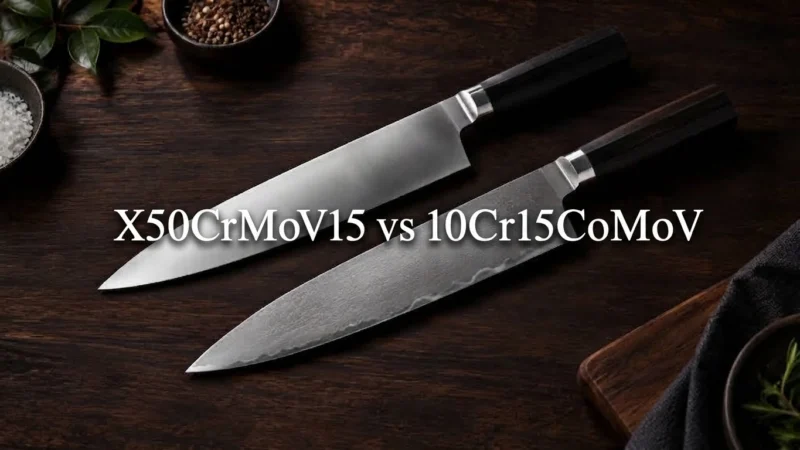
X50CrMoV15 vs 10Cr15CoMoV
An Independent Guide
X50CrMoV15 and 10Cr15CoMoV are two stainless steels that appear frequently in kitchen knives, yet they represent noticeably different approaches to knife-steel design.
X50CrMoV15 is a conventional martensitic stainless steel with a relatively moderate carbon content and a long history of use in cutting tools and kitchen knives. It is commonly identified by the European material number 1.4116.
10Cr15CoMoV, by contrast, is a high-carbon stainless steel designation associated with a substantially higher carbon content and additions of molybdenum, vanadium, and cobalt. Published composition data commonly place its carbon content around 1%, chromium around 15%, molybdenum around 1%, vanadium around 0.3%, and cobalt around 1.3–1.8%.
On paper, that difference in chemistry suggests a meaningful change in potential hardness, carbide formation, edge retention, and sharpening behavior.
But knife steel cannot be evaluated from the alloy formula alone.
Heat treatment, hardness, blade geometry, edge angle, stock thickness, grinding quality, and the way a knife is used can all change the practical result. A well-treated X50CrMoV15 blade can be an excellent kitchen knife, while a poorly heat-treated 10Cr15CoMoV blade can fail to deliver the performance its chemistry suggests.
So which steel is better?
The more useful question is:
Which steel’s characteristics better match the knife and the person using it?
This article examines X50CrMoV15 vs 10Cr15CoMoV in detail, including chemistry, hardness, edge retention, toughness, corrosion resistance, sharpening, edge stability, kitchen performance, maintenance, and practical use.
X50CrMoV15 vs 10Cr15CoMoV at a Glance
The two steels overlap in their intended use, but their alloy designs are quite different.
X50CrMoV15 contains roughly 0.45–0.55% carbon, 14–15% chromium, 0.50–0.80% molybdenum, and 0.10–0.20% vanadium in commonly referenced EN 10088 compositions.
10Cr15CoMoV is commonly published with approximately 0.95–1.05% carbon, 14.50–15.50% chromium, 0.80–1.20% molybdenum, 0.25–0.35% vanadium, and 1.30–1.80% cobalt.
Those numbers immediately reveal the central difference.
10Cr15CoMoV contains roughly twice as much carbon as X50CrMoV15.
That does not automatically mean twice the edge retention or twice the hardness. Steel properties do not scale linearly with individual alloying elements. However, the higher carbon level gives 10Cr15CoMoV substantially more potential for a harder martensitic structure and a larger population of hard carbides.
X50CrMoV15 takes a more moderate approach. Its lower carbon content and relatively simple alloy design make it well suited to conventional heat treatment and practical kitchen use.
The result is two steels with overlapping applications but somewhat different performance priorities.
What Is X50CrMoV15?
X50CrMoV15 is a martensitic stainless steel designated 1.4116.
The name itself provides useful information.
The “X” indicates a high-alloy steel in the European designation system. The numbers and symbols describe the approximate composition: carbon, chromium, molybdenum, and vanadium are the principal elements emphasized by the designation.
Published EN 10088 composition data place X50CrMoV15 at approximately:
- Carbon: 0.35–0.55% depending on the product standard, with flat-product specifications commonly showing 0.45–0.55%
- Chromium: approximately 14–15.5%
- Molybdenum: approximately 0.50–0.80%
- Vanadium: approximately 0.10–0.20%
The steel is classified among martensitic stainless grades.
That classification matters because the steel is designed to achieve hardness through heat treatment rather than relying on the softer austenitic structure used in many corrosion-resistant stainless steels.
The combination of carbon and chromium gives the steel its basic characteristics.
Chromium provides stainless behavior through the formation of a protective passive surface film while also participating in carbide formation. Carbon allows the steel to transform into a hard martensitic structure during quenching. Molybdenum contributes to hardenability and corrosion performance, while the small vanadium addition can influence carbide formation and microstructure.
X50CrMoV15 is therefore not an exotic powder-metallurgy steel.
Its appeal is largely the opposite.
It is a relatively straightforward, established martensitic stainless grade that can produce a practical combination of corrosion resistance, hardness, toughness, sharpening ease, and affordability.
Check Our Guide X50CrMoV15 Steel Review: The German Best Standard for Kitchen Knives(DIN 1.4116)
What Is 10Cr15CoMoV?
10Cr15CoMoV is a high-carbon stainless steel designation commonly encountered in modern kitchen knives and other cutting products.
The name again contains useful clues.
The “10” at the beginning is associated with approximately 1% carbon in the naming convention. “Cr15” indicates roughly 15% chromium, while Mo and V identify molybdenum and vanadium. Co indicates cobalt.
Published composition data for 10Cr15CoMoV commonly show approximately:
- Carbon: 0.95–1.05%
- Chromium: 14.50–15.50%
- Molybdenum: roughly 0.80–1.20%
- Vanadium: approximately 0.25–0.35%
- Cobalt: approximately 1.30–1.80%
- Manganese: approximately 0.30–0.50%
The exact published chemistry can vary between references, which is important when discussing this steel. Some databases and supplier documents give slightly different ranges for individual elements.
For that reason, it is safer to discuss 10Cr15CoMoV using representative published ranges rather than pretending there is one universally identical chemistry in every knife carrying the designation.
The most important difference compared with X50CrMoV15 remains clear regardless:
10Cr15CoMoV has substantially more carbon and generally somewhat higher alloy additions associated with hard carbides.
That gives it greater potential for higher hardness and stronger wear resistance.
It also means that heat treatment becomes especially important.
A high-carbon stainless steel can provide excellent cutting performance when properly treated, but its final behavior depends heavily on how the alloy is austenitized, quenched, tempered, and finished.
Check Our Ultimate Guide to Chinese Knife Steels: From Budget 3Cr to Premium 10Cr15CoMoV
The Chemistry Difference
The chemistry is the best place to start because it explains why these steels can behave differently.
X50CrMoV15 is essentially a moderate-carbon chromium-molybdenum-vanadium martensitic stainless steel.
10Cr15CoMoV moves toward a higher-carbon, higher-alloy design.
Carbon
Carbon is one of the most important elements in a knife steel.
Increasing carbon can increase the amount of carbon available to form martensite and carbides. With appropriate heat treatment, this can allow higher hardness and better resistance to abrasive wear.
X50CrMoV15 has around half the carbon content of 10Cr15CoMoV.
That is a major difference.
It helps explain why 10Cr15CoMoV has greater potential for high hardness and longer edge retention.
But there is an important qualification.
More carbon does not automatically produce a better knife.
If the heat treatment is poor, if excessive retained austenite remains, if the blade geometry is unsuitable, or if the steel is pushed beyond a useful hardness range, the additional carbon does not magically turn into superior cutting performance.
The carbon has to be used correctly through heat treatment.
Chromium
Both steels contain approximately 15% chromium.
This is why both can provide good stainless behavior when properly heat treated and maintained.
X50CrMoV15 generally sits around 14–15% chromium, while representative 10Cr15CoMoV specifications commonly sit around 14.5–15.5%.
The difference is therefore much smaller than the difference in carbon.
Chromium serves two important purposes.
First, enough chromium remains available in the steel matrix to support the passive oxide layer responsible for stainless corrosion resistance.
Second, some chromium combines with carbon to form chromium-rich carbides.
This creates an interesting balance.
The chromium that is locked inside carbides is not contributing to corrosion resistance in exactly the same way as chromium remaining dissolved in the matrix.
Therefore, simply looking at total chromium percentage does not tell you exactly how corrosion resistant a knife will be.
Heat treatment and carbide formation influence the final microstructure.
Molybdenum and Vanadium
Both steels also contain molybdenum and vanadium, but 10Cr15CoMoV generally has higher levels.
X50CrMoV15 commonly contains approximately 0.50–0.80% molybdenum and 0.10–0.20% vanadium.
10Cr15CoMoV is commonly published around 0.80–1.20% molybdenum and 0.25–0.35% vanadium.
These additions are not enormous compared with the quantities found in premium high-alloy powder steels, but they are significant in this comparison.
Vanadium can form very hard vanadium carbides and can influence grain refinement and wear behavior.
Molybdenum contributes to hardenability and can improve resistance to certain forms of corrosion while also participating in carbide formation.
The important point is not that one element independently “creates” one property.
Knife-steel performance is the result of the entire microstructure.
What Does Cobalt Do in 10Cr15CoMoV?
Cobalt is one of the elements that makes 10Cr15CoMoV look different from X50CrMoV15.
Cobalt is not simply another carbide-forming element.
Its role is more closely associated with the behavior of the steel matrix and heat treatment. In high-alloy steels, cobalt can influence the transformation behavior and allow certain heat-treatment strategies to produce higher hardness.
This is one reason it is important not to look at the name “CoMoV” and assume that cobalt directly creates dramatically greater edge retention.
The benefit is indirect as much as direct.
The steel’s final performance comes from the interaction between carbon, chromium, molybdenum, vanadium, cobalt, the iron matrix, and the heat-treatment process.
X50CrMoV15 vs 10Cr15CoMoV: Hardness
Hardness is one of the most obvious differences between these steels in real knives.
X50CrMoV15 is commonly used in the general range of approximately the mid-50s to high-50s HRC, although actual finished-knife hardness varies.
Technical information for 1.4116 shows that the steel can be heat treated to useful martensitic hardness.
10Cr15CoMoV is frequently used around the upper-50s to low-60s HRC in kitchen knives.
However, there is no single hardness value that applies to every 10Cr15CoMoV knife.
This distinction is critical.
A steel designation describes chemistry.
A knife has a specific heat treatment.
Two knives made from nominally identical steel can perform differently if one is hardened to a lower level and the other is heat treated to a higher level.
For this reason, claims such as “10Cr15CoMoV is always 60–62 HRC” should be treated cautiously.
A manufacturer or maker may choose a different target depending on blade thickness, intended use, heat-treatment equipment, and desired balance between edge retention and toughness.
The same principle applies to X50CrMoV15.
What does higher hardness mean?
Higher hardness can support:
- better edge retention
- better resistance to deformation at the edge
- the ability to maintain a thin cutting edge
- greater resistance to abrasive wear
But higher hardness can also reduce the margin for abuse.
A hard edge is not necessarily a fragile edge.
Toughness and hardness are different properties.
Nevertheless, when comparing two steels with similar geometry, pushing one to a significantly higher hardness can change how the knife reacts to impacts, twisting, accidental contact with hard objects, and aggressive cutting.
Check Our Guide What Is HRC? Understanding Rockwell Hardness in Kitchen Knives
Edge Retention: X50CrMoV15 vs 10Cr15CoMoV
This is where the higher carbon and alloy content of 10Cr15CoMoV becomes particularly relevant.
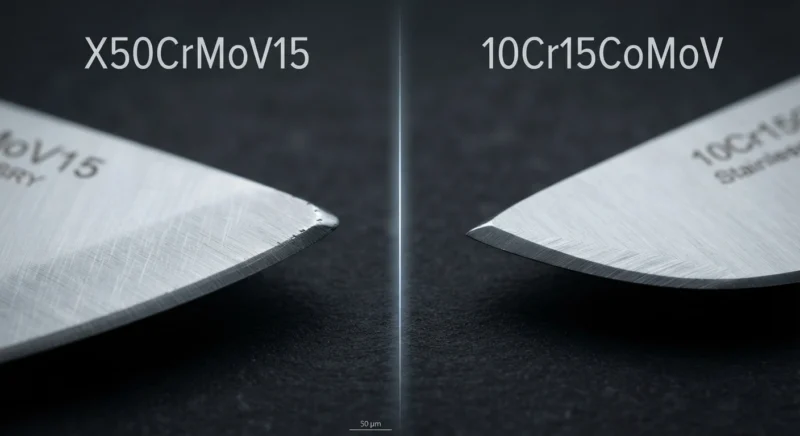
In general, 10Cr15CoMoV has the potential for better edge retention than X50CrMoV15 when both knives are properly heat treated and have comparable geometry.
Why?
There are several reasons.
The higher carbon content allows a harder martensitic structure.
The higher vanadium content can contribute hard vanadium carbides.
The higher molybdenum content also contributes to the alloy’s carbide and hardenability characteristics.
Higher attainable hardness combined with a greater population of hard carbides can improve resistance to abrasive wear.
This does not mean the difference will always be dramatic in a kitchen.
A chef’s knife does not normally experience the same abrasive environment as a cutting tool processing hard industrial materials.
Food, wood, plastic, and ordinary kitchen work produce relatively modest wear compared with industrial abrasion.
The practical difference may therefore appear as:
X50CrMoV15: more frequent touch-ups.
10Cr15CoMoV: potentially longer intervals between sharpening.
That difference becomes more noticeable for people who use their knives heavily.
It can also become less noticeable when both knives are sharpened frequently and maintained properly.
Check Our Guide Edge Retention Explained: 10 Factors What Makes a Knife Stay Sharp Longer?
Why Geometry Can Beat Steel Choice
This is one of the most important points in the entire comparison.
A knife’s cutting performance is not determined by steel chemistry alone.
Imagine two chef knives.
Knife A is made from 10Cr15CoMoV but has a thick edge and poor grinding.
Knife B is made from X50CrMoV15 but has a thin, consistent edge and excellent geometry.
Knife B may cut better.
This is not a contradiction.
Cutting ability depends heavily on geometry.
The thickness immediately behind the edge affects how much material must be displaced during cutting.
Edge angle influences sharpness, edge stability, and resistance to deformation.
Blade thickness, grind type, distal taper, surface finish, and sharpening quality all matter.
This is why steel comparisons should be used to understand tendencies rather than to predict the exact performance of an individual knife.
Toughness
Toughness describes the ability of a material to resist cracking and catastrophic fracture under stress.
It is different from hardness.
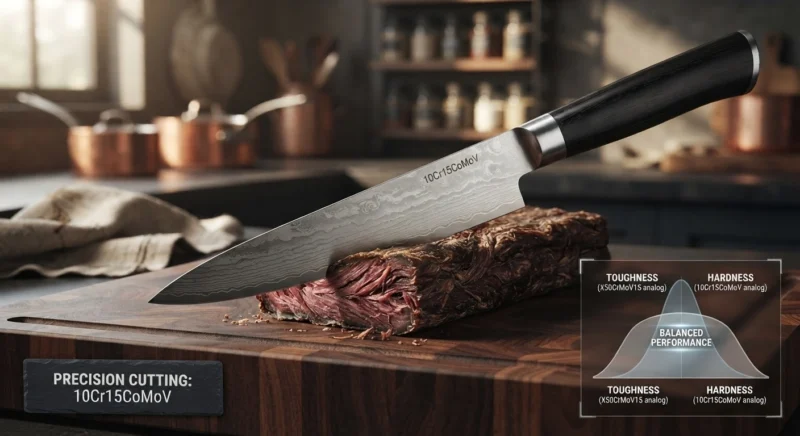
X50CrMoV15’s lower carbon content and relatively conventional alloy design can give it a useful toughness advantage over harder, higher-carbon alternatives, especially when the X50CrMoV15 blade is heat treated for a moderate hardness.
10Cr15CoMoV can still be tough enough for normal kitchen work.
It should not be described as an inherently fragile steel.
However, the higher hardness potential changes the balance.
A high-hardness 10Cr15CoMoV edge may be less forgiving of abuse than a softer X50CrMoV15 edge.
That distinction matters particularly when a kitchen knife is used incorrectly.
Neither steel should be used for:
- prying
- twisting through hard material
- chopping bones with a thin chef’s knife
- cutting frozen food with excessive force
- striking hard surfaces
- scraping aggressively with the edge
The important difference is the margin for error.
X50CrMoV15 can be an attractive choice when the user values a forgiving working edge.
10Cr15CoMoV becomes more attractive when the user wants greater hardness and edge retention and is prepared to treat the edge accordingly.
Check Our Guide Wear Resistance vs Toughness: Understanding the Most Important Knife Steel Trade-Off
Corrosion Resistance
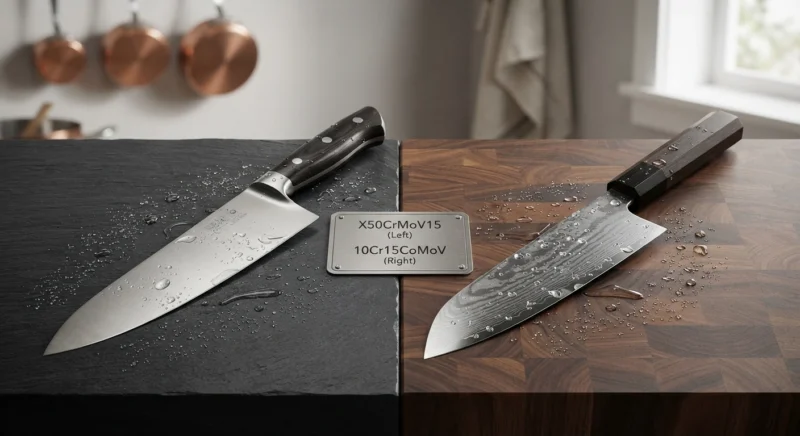
Both steels are stainless steels with good corrosion resistance when properly heat treated and maintained.
Their chromium contents are quite similar.
10Cr15CoMoV generally contains around 14.5–15.5% chromium, while X50CrMoV15 contains roughly 14–15.5%, depending on the specification being considered.
That means neither should be classified as a high-risk rusting carbon steel.
However, “stainless” does not mean “cannot corrode.”
Kitchen knives regularly encounter:
- salt
- acids
- tomato
- citrus
- onions
- vinegar
- moisture
- food residues
- dishwasher chemicals
The condition of the blade surface also matters.
A clean, polished, well-maintained blade can resist corrosion much better than a damaged or contaminated one.
Heat treatment affects corrosion behavior because the distribution of chromium between the matrix and carbides influences how much chromium remains available for passive-film formation.
Therefore, it is not appropriate to predict corrosion resistance from chromium percentage alone.
Which has better corrosion resistance?
The two steels are relatively close.
10Cr15CoMoV’s higher alloy content can support very good corrosion resistance, but X50CrMoV15 is also a proven stainless kitchen-steel choice.
In normal kitchen use, maintenance and surface condition may matter more than the modest chemistry difference between them.
If a knife is washed, dried, and stored correctly, both can provide very good service.
Sharpening
Sharpening is another area where the difference becomes practical.
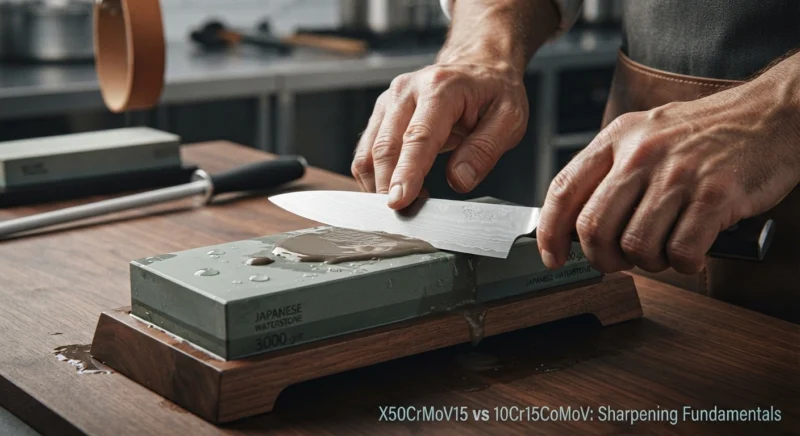
X50CrMoV15 is generally straightforward to sharpen on conventional water stones, ceramic abrasives, or other common knife-sharpening systems.
Its moderate hardness and relatively modest carbide volume make it accessible to ordinary sharpening equipment.
10Cr15CoMoV is also not an especially difficult steel to sharpen.
This is important.
It should not be placed in the same sharpening category as very high-wear powder-metallurgy steels containing large amounts of extremely hard vanadium carbides.
Nevertheless, a properly hardened 10Cr15CoMoV blade can take more work to reshape than a softer X50CrMoV15 blade.
The difference becomes particularly noticeable if the knife has been allowed to become seriously dull.
For routine maintenance, however, both are quite manageable.
A good sharpening system is more important than chasing tiny differences between the steels.
Check Our Guide All Kinds of Knife Sharpening Tools
Edge Stability
Edge stability is often confused with edge retention.
They are not the same thing.
Edge retention asks how long an edge remains effective during use.
Edge stability asks how well the edge maintains its shape under stress.
A steel can have excellent wear resistance but still develop microscopic damage at an extremely thin edge.
This is one reason that a harder steel is not automatically suitable for the thinnest possible edge.
10Cr15CoMoV can support a relatively fine kitchen edge when properly heat treated.
X50CrMoV15 can also take a fine edge, but its lower hardness may make it more prone to gradual edge deformation rather than maintaining the same geometry under prolonged use.
In practice, the ideal edge angle depends on:
- blade thickness
- hardness
- heat treatment
- intended food
- cutting technique
- board material
- user’s habits
A professional cook who uses a knife carefully can exploit a thinner edge.
Someone who regularly hits the board aggressively may benefit from a more conservative edge.
Food Preparation Performance
For everyday kitchen work, both steels can perform extremely well.
Neither is dependent on exotic sharpening equipment.
Neither requires unusual maintenance.
Both can support a fine, clean edge.
The differences become more apparent over time.
Cutting vegetables
For vegetables, geometry often dominates the experience.
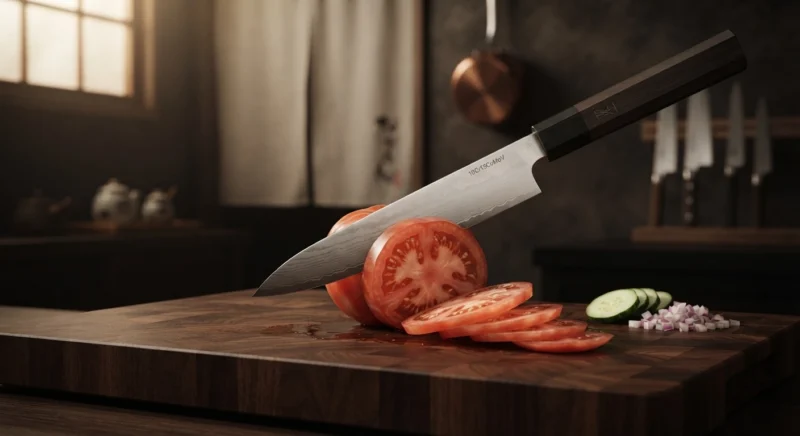
A thin, well-ground knife made from either steel can slice carrots, onions, peppers, herbs, and similar ingredients extremely well.
10Cr15CoMoV may retain its edge longer during extended use.
X50CrMoV15 may be easier to restore quickly when the edge eventually becomes dull.
Meat preparation
Both steels are suitable for ordinary meat preparation.
A properly heat-treated 10Cr15CoMoV knife can provide excellent edge retention when repeatedly processing meat and fibrous ingredients.
X50CrMoV15 remains attractive for users who prioritize easy maintenance.
Neither steel is an excuse to use a chef’s knife for bones.
Fish
Both steels can work well for fish preparation.
Corrosion resistance becomes particularly useful because fish, moisture, and salt create a more demanding environment.
Cleaning and drying remain important regardless of which steel is used.
Check Our Guide How to Prepare and Cut Seafood
Herbs
For herbs and delicate ingredients, edge geometry matters enormously.
A thin, keen edge can produce a noticeably cleaner cut.
The difference between these steels may be much less obvious than the difference between a thinly ground knife and a thickly ground knife.
X50CrMoV15 for Beginner Cooks
X50CrMoV15 has a strong practical argument for beginners.
It is predictable.
It is stainless.
It is relatively easy to sharpen.
It does not demand extremely careful handling.
It can produce a very good working edge without requiring expensive sharpening equipment.
If a beginner accidentally lets the knife become dull, restoring it is generally straightforward.
If the user makes a minor mistake with edge angle during sharpening, the steel is forgiving enough to make correction manageable.
This makes X50CrMoV15 particularly suitable for people who want a functional kitchen knife without turning maintenance into a hobby.
10Cr15CoMoV for More Experienced Users
10Cr15CoMoV becomes attractive when the user wants more hardness and potentially longer edge life.
It can produce a refined, high-performance kitchen edge while remaining significantly easier to maintain than many extreme wear-resistant steels.
That middle position is important.
10Cr15CoMoV is not an ultra-hard powder steel.
It is still a relatively practical stainless knife steel.
For someone who wants:
- good corrosion resistance
- high hardness potential
- good edge retention
- a fine kitchen edge
- reasonable sharpening requirements
10Cr15CoMoV can be a compelling combination.
The user does, however, benefit from understanding proper knife technique.
Maintenance Requirements
Neither steel is maintenance-free.
The most important habits are simple.
Wash the knife after use
Food residues should not be left on the blade unnecessarily.
Dry the blade
Water sitting on any steel surface for long periods increases corrosion risk.
Avoid the dishwasher
High heat, detergents, impacts, and contact with other objects can damage the edge and finish.
Use an appropriate cutting board
Very hard surfaces can damage a fine knife edge.
Avoid twisting
Even a tough stainless steel can be damaged if the edge is twisted laterally.
Store the knife safely
A sheath, magnetic system, block, or other suitable storage method is preferable to throwing knives loosely into a drawer.
These habits will usually have a greater effect on knife longevity than small theoretical differences in corrosion resistance between two stainless steels.
Heat Treatment Matters More Than the Steel Name Suggests
One of the most important lessons from knife-steel comparisons is that chemistry defines potential, not finished performance.
X50CrMoV15 can be heat treated to useful hardness.
10Cr15CoMoV can also be heat treated to higher hardness.
But a steel that is theoretically capable of excellent performance cannot compensate for poor heat treatment.
Heat treatment determines:
- hardness
- martensite formation
- retained austenite
- carbide distribution
- grain structure
- toughness
- dimensional stability
- final edge behavior
A knife made from a theoretically superior steel can therefore perform poorly if it has been overheated, improperly quenched, inadequately tempered, or otherwise badly processed.
This is why two knives made from the same steel can feel completely different.
Check Our Guide Different Heat Treatment Methods Explained
Why HRC Numbers Should Be Treated Carefully
Hardness ratings are useful, but they are not a complete performance specification.
Suppose one knife is 60 HRC and another is 61 HRC.
That one-point difference does not automatically tell you which knife will cut better.
You still need to know:
- the steel composition
- heat treatment
- carbide structure
- edge geometry
- sharpening quality
- blade thickness
- intended use
Hardness is one variable.
It is an important variable, but not the entire equation.
This is particularly relevant to 10Cr15CoMoV because published knife hardness varies between products.
Rather than saying that every 10Cr15CoMoV knife is a particular HRC value, it is more accurate to say that the steel is commonly capable of being used in a relatively hard kitchen-knife range.
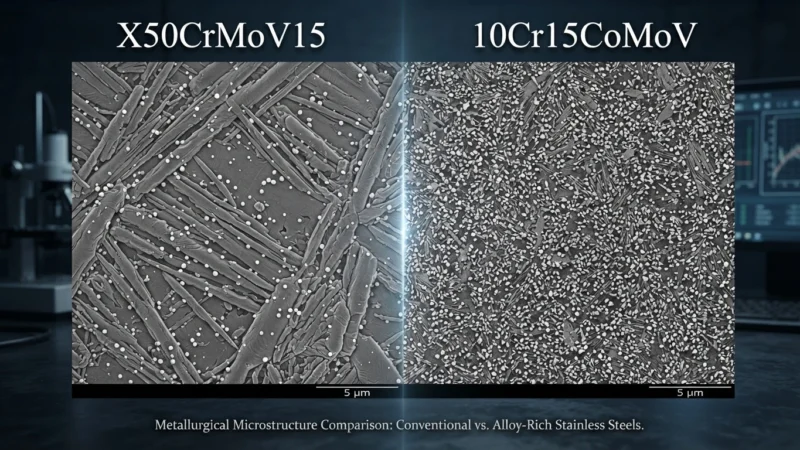
Microstructure: The Hidden Difference
Two knives can have the same chemistry and still behave differently because their microstructures are different.
Microstructure describes the internal arrangement of phases, grains, and carbides.
X50CrMoV15 generally has a relatively conventional martensitic structure with chromium-rich carbides and smaller vanadium additions.
10Cr15CoMoV has more carbon and greater carbide-forming potential.
That can produce a harder, more wear-resistant structure when properly processed.
The important point is that the microscopic structure determines how the edge behaves.
Imagine the edge under a microscope.
The edge is not a perfectly solid block of uniform hardness.
It contains a matrix and hard particles.
During cutting, abrasion interacts with these structures.
A steel with greater wear resistance can resist material removal for longer.
A steel with greater toughness can tolerate mechanical stress better.
A steel with an excellent balance of both can produce a very useful knife.
That is why “which steel is better?” is ultimately a question about trade-offs.
Does 10Cr15CoMoV Hold an Edge Better?
In general, yes.
When comparing properly heat-treated knives with similar geometry, 10Cr15CoMoV has the chemistry and hardness potential to provide better edge retention than X50CrMoV15.
The primary reasons are:
- higher carbon content
- higher hardness potential
- greater vanadium content
- higher overall alloying
- greater potential for hard carbide formation
But the practical difference should not be exaggerated.
A knife used lightly may show little noticeable difference.
A knife used for hours every day may show a more obvious difference.
A poorly ground 10Cr15CoMoV blade may still cut worse than a well-ground X50CrMoV15 blade.
And a thin X50CrMoV15 blade can feel extremely sharp despite having lower theoretical wear resistance.
Does X50CrMoV15 Sharpen More Easily?
Generally, yes.
X50CrMoV15’s moderate hardness and relatively conventional carbide structure make it particularly approachable.
It works well with ordinary sharpening stones.
It can be maintained quickly.
It does not demand highly specialized abrasives for routine kitchen maintenance.
10Cr15CoMoV remains relatively easy to sharpen compared with many modern high-wear premium steels.
The difference is therefore not:
easy vs impossible.
It is closer to:
easy vs somewhat more demanding.
For someone who sharpens frequently, this distinction may barely matter.
For someone who hates sharpening, the longer edge life of 10Cr15CoMoV may be more valuable.
Does X50CrMoV15 Have Better Toughness?
Generally, its lower carbon content and moderate hardness make X50CrMoV15 a more forgiving choice.
That does not mean every X50CrMoV15 knife is tougher than every 10Cr15CoMoV knife.
Heat treatment changes the result.
Hardness changes the result.
Geometry changes the result.
But if both steels are processed for sensible kitchen-knife use, X50CrMoV15’s design gives it a useful toughness-oriented character.
This can be beneficial for:
- general household use
- shared kitchen knives
- users with inconsistent technique
- knives used for larger quantities of food
- applications where easy maintenance matters
10Cr15CoMoV is better suited to users who are comfortable treating a harder edge with more care.
Which Steel Is More Corrosion Resistant?
This category is close.
Both are stainless.
Both contain approximately 15% chromium.
10Cr15CoMoV has somewhat higher alloying in several areas, but the practical corrosion performance of a finished blade depends on much more than nominal composition.
Surface finish matters.
Heat treatment matters.
Contamination matters.
Cleaning matters.
Exposure matters.
A polished 10Cr15CoMoV blade that is washed and dried after use should provide very good corrosion resistance.
A neglected X50CrMoV15 blade can still develop staining or corrosion.
The best conclusion is therefore not that one is “rust proof.”
Neither is.
Both should be treated as stainless kitchen steels that benefit from normal care.
Which Steel Takes a Finer Edge?
Both can take a very fine edge.
10Cr15CoMoV’s higher hardness potential makes it particularly attractive for a refined, thin edge.
X50CrMoV15 can also produce an excellent edge, especially when the blade is ground thin and sharpened carefully.
In real kitchen use, the geometry often determines more than the alloy.
A thin X50CrMoV15 edge can feel dramatically sharper than a thick 10Cr15CoMoV edge.
Sharpness is not simply a property of the steel.
It is the result of:
steel + heat treatment + geometry + sharpening.
X50CrMoV15 vs 10Cr15CoMoV for Home Kitchens
For a typical home cook, both steels can be excellent.
The better choice depends on what the cook values.
X50CrMoV15 makes sense when:
- easy sharpening is important
- toughness matters
- the knife may be shared by several people
- maintenance should be simple
- moderate edge retention is sufficient
- the user prefers a forgiving working knife
10Cr15CoMoV makes sense when:
- longer edge retention is desirable
- higher hardness is preferred
- the user wants a fine cutting edge
- the knife will receive regular care
- the user is comfortable with slightly more demanding sharpening
- stainless performance remains important
Neither choice is inherently wrong.
They simply emphasize different characteristics.
X50CrMoV15 vs 10Cr15CoMoV for Professional Kitchens
Professional kitchens introduce another variable: time.
A cook who uses a knife for several hours every day may appreciate longer edge retention.
Repeated sharpening consumes time.
In that environment, 10Cr15CoMoV’s greater hardness potential and wear resistance can become useful.
However, professional cooks also value fast maintenance.
A knife that can be quickly restored during a busy shift can have an advantage.
That is where X50CrMoV15 remains relevant.
The ideal choice depends on the individual kitchen workflow.
Someone who touches up an edge frequently may prefer X50CrMoV15.
Someone who wants longer intervals between sharpening sessions may prefer 10Cr15CoMoV.
Is 10Cr15CoMoV a Premium Steel?
The answer depends on what “premium” means.
10Cr15CoMoV is not in the same category as every modern ultra-high-performance powder-metallurgy steel.
Its alloy design is comparatively conventional.
But that does not make it poor.
A knife steel does not need extreme alloy content to be useful.
10Cr15CoMoV can provide a very good balance of:
- hardness
- corrosion resistance
- edge retention
- sharpening ability
- kitchen performance
In practical terms, it occupies a useful position between basic stainless knife steels and much more demanding high-wear alloys.
Is X50CrMoV15 Outdated?
No.
The age of a steel designation does not determine whether it makes a good knife.
X50CrMoV15 remains useful because its characteristics are well matched to many kitchen applications.
Not every cook needs extreme edge retention.
Not every cook wants a very hard edge.
Not every user wants to spend additional time learning specialized sharpening techniques.
A practical steel with predictable behavior can be more appropriate than a technically more advanced steel.
The continued use of X50CrMoV15 is therefore not evidence that the steel is obsolete.
It reflects a real design philosophy:
balanced performance rather than maximum performance in one category.
Common Misconceptions
“10Cr15CoMoV is automatically better because it has more carbon.”
Not necessarily.
More carbon increases potential for hardness and carbide formation, but the final knife depends on heat treatment and geometry.
“X50CrMoV15 is cheap steel, so it cannot be good.”
Incorrect.
Cost and performance are not identical.
X50CrMoV15 can make an excellent practical kitchen knife.
“Both contain about 15% chromium, so they perform the same.”
No.
Carbon, vanadium, molybdenum, cobalt, heat treatment, carbide structure, and hardness all differ.
“60 HRC is always better than 56 HRC.”
No.
Higher hardness can improve edge retention and deformation resistance, but toughness and ease of sharpening can change in the opposite direction.
“Stainless means it cannot rust.”
No.
Stainless steels resist corrosion; they are not absolutely immune to it.
“The steel determines how sharp a knife is.”
Not by itself.
Geometry and sharpening are critical.
The Importance of Blade Geometry
If you are comparing two finished knives rather than buying raw steel, geometry deserves serious attention.
A knife’s performance depends on the physical shape of the blade.
A thin edge can reduce cutting resistance.
A thin blade can move through food more efficiently.
A consistent grind can make the knife feel smoother.
A properly finished apex can improve perceived sharpness.
This means that the steel comparison should never be isolated from the knife itself.
A mediocre knife made from a more expensive steel is still a mediocre knife.
A well-designed knife made from a conventional steel can be exceptionally satisfying.
Sharpening Angles
Neither X50CrMoV15 nor 10Cr15CoMoV has one universal correct sharpening angle.
The correct angle depends on the knife and its use.
A thin kitchen knife intended for delicate slicing can generally tolerate a finer edge than a knife expected to encounter harder food or rougher treatment.
10Cr15CoMoV can make good use of a relatively fine edge because its hardness potential supports edge stability.
X50CrMoV15 can also be sharpened finely, but a more conservative angle may be useful if the knife is used aggressively.
The key is not to chase the smallest possible angle.
A smaller angle is not automatically better.
The goal is to create an edge that remains stable under the actual forces encountered during cutting.
Honing vs Sharpening
Another practical distinction is the difference between honing and sharpening.
Honing attempts to restore the alignment of an edge that has become slightly displaced.
Sharpening removes material to create a new apex.
A harder knife may remain stable for longer, reducing the frequency of full sharpening.
A softer or more forgiving knife may benefit from more frequent maintenance.
X50CrMoV15 can respond well to regular maintenance.
10Cr15CoMoV may hold its working edge longer before requiring significant abrasive sharpening.
Again, this is one of the reasons that individual preference matters.
What Happens When the Knife Gets Dull?
X50CrMoV15 generally has an advantage in simplicity.
A standard whetstone can quickly restore a dull edge.
10Cr15CoMoV can also be sharpened effectively with common stones, but its higher hardness and carbide content can make the process somewhat more demanding.
The difference becomes more noticeable when the edge is badly damaged.
If the knife has chips or a severely rolled edge, the sharpening process will depend more on the damage than on the steel name.
A coarse abrasive may be necessary to establish a new geometry before finer stones are used.
Which Steel Is More Forgiving?
For general kitchen use, X50CrMoV15 is generally the more forgiving option.
That comes from its overall balance of moderate hardness, toughness, stainless behavior, and sharpening ease.
10Cr15CoMoV offers a harder and more wear-resistant alternative, but the user benefits from better technique.
This does not mean that 10Cr15CoMoV requires delicate treatment.
It simply means that if a knife will be abused, neither steel should be chosen solely on edge retention.
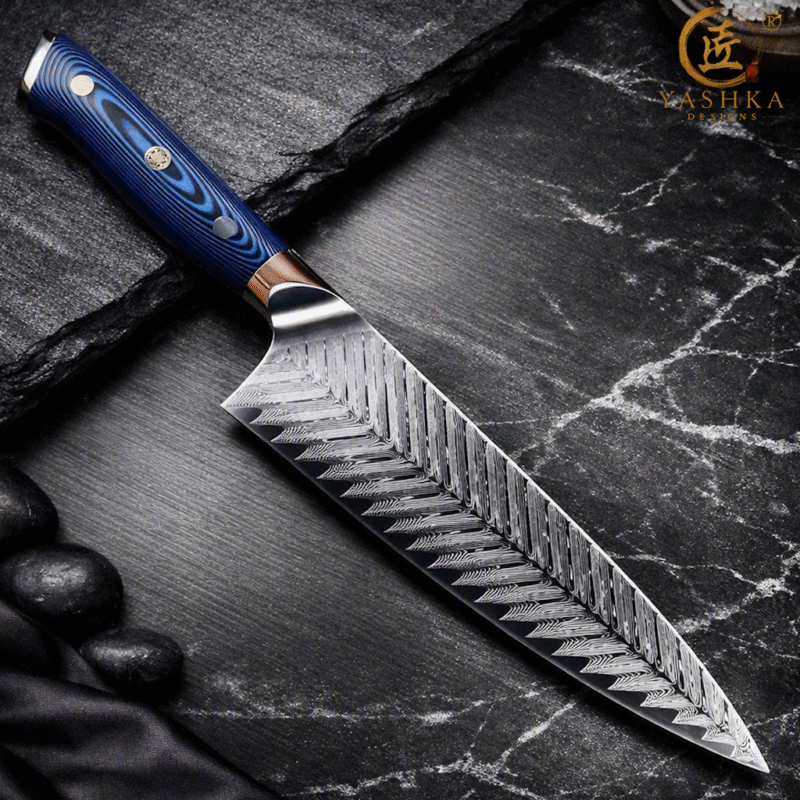
https://yashkadesigns.com/8-inch-chef-knife-kitchen-cleaver
X50CrMoV15 vs 10Cr15CoMoV: The Real Trade-Off
The comparison can ultimately be reduced to a few fundamental trade-offs.
X50CrMoV15 emphasizes:
balance, toughness, easy sharpening, and predictable kitchen performance.
10Cr15CoMoV emphasizes:
higher hardness potential, greater wear resistance, and longer edge life while retaining good stainless behavior.
Neither philosophy is universally superior.
A chef who sharpens regularly may find the characteristics of X50CrMoV15 ideal.
Another cook may prefer to sharpen less frequently and appreciate the higher hardness potential of 10Cr15CoMoV.
What About Price?
Steel chemistry can influence the cost of raw material, but finished knife price is affected by many other factors.
These include:
- manufacturing method
- grinding
- polishing
- handle materials
- construction
- labor
- heat treatment
- quality control
- design
- distribution
Therefore, the steel name alone should never be used to judge whether a knife is reasonably priced.
A more expensive knife does not automatically perform better simply because its steel contains more alloying elements.
How to Choose Between Them
Start with your usage.
Choose a knife using X50CrMoV15 if you want:
A practical stainless kitchen knife that is easy to maintain, easy to sharpen, and relatively forgiving.
Consider 10Cr15CoMoV if you want:
A harder stainless kitchen knife with stronger edge-retention potential and you are comfortable giving the edge appropriate care.
If you are buying a high-quality finished knife:
Look beyond the steel name.
Check:
- edge thickness
- grind
- blade profile
- heat treatment information
- sharpening system
- intended use
- overall construction
The steel is only one part of the knife.
Frequently Asked Questions
Is X50CrMoV15 better than 10Cr15CoMoV?
Neither steel is universally better.
10Cr15CoMoV generally has greater hardness and edge-retention potential, while X50CrMoV15 offers a more forgiving combination of toughness and sharpening ease.
Is 10Cr15CoMoV better for kitchen knives?
It can be an excellent kitchen-knife steel, particularly for users who value edge retention and higher hardness.
Is X50CrMoV15 easy to sharpen?
Yes. It is generally considered a practical steel for conventional sharpening systems.
Does 10Cr15CoMoV rust?
It is stainless and offers good corrosion resistance, but no stainless steel should be treated as completely corrosion-proof.
Is X50CrMoV15 tough?
It offers a useful balance of toughness and hardness and is generally forgiving for ordinary kitchen use.
Does 10Cr15CoMoV hold an edge longer?
Generally, yes, assuming comparable geometry and appropriate heat treatment.
Can both steels take a very sharp edge?
Yes. Edge geometry and sharpening technique have a major influence on final sharpness.
Is 10Cr15CoMoV difficult to sharpen?
No. It is not an extreme wear-resistant steel. However, a harder 10Cr15CoMoV blade can require more work than a softer X50CrMoV15 blade.
Which steel is better for beginners?
X50CrMoV15 can be particularly forgiving for beginners because it is easy to maintain and sharpen.
Which steel is better for professional cooks?
It depends on workflow. 10Cr15CoMoV may reduce sharpening frequency, while X50CrMoV15 can be attractive for fast, simple maintenance.
Final Thoughts
X50CrMoV15 and 10Cr15CoMoV are both capable stainless knife steels, but they approach the problem differently.
X50CrMoV15 is a relatively moderate-carbon martensitic stainless steel with a long-established balance of corrosion resistance, hardness, toughness, and sharpening ease.
10Cr15CoMoV uses a much higher carbon content together with additional molybdenum, vanadium, and cobalt. That chemistry gives it greater potential for high hardness and wear resistance.
In a properly made knife, this generally translates into longer edge retention.
But that advantage should not be isolated from the rest of the knife.
A thin, well-ground X50CrMoV15 blade can outperform a poorly designed 10Cr15CoMoV knife in actual cutting.
Likewise, a well-treated 10Cr15CoMoV blade can provide a very satisfying combination of hardness, edge stability, corrosion resistance, and long working edge life.
The practical distinction is therefore straightforward:
X50CrMoV15 is the more forgiving, maintenance-friendly choice.
10Cr15CoMoV is the higher-hardness, stronger-edge-retention-oriented choice.
For everyday kitchen use, both can work extremely well.
The right choice ultimately depends not on which steel has the more impressive specification sheet, but on how the finished knife is made and how the user intends to sharpen, maintain, and use it.
https://einsal.com/en/materials/material-database/material/1.4116#-