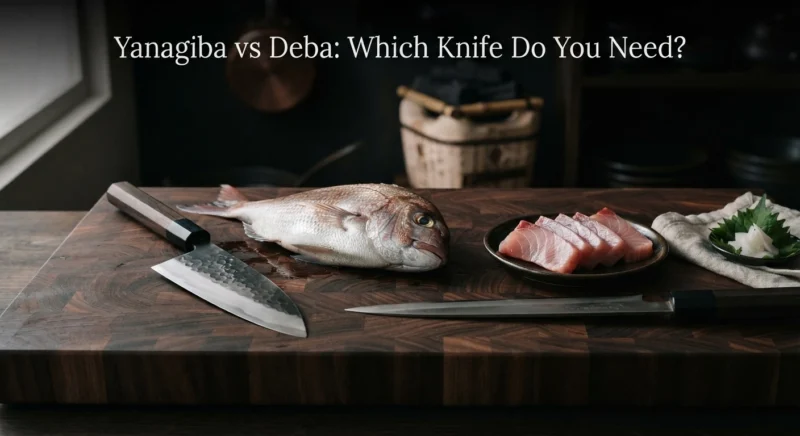
Yanagiba vs Deba
If you are interested in traditional Japanese kitchen knives, two names appear again and again when the subject turns to fish: yanagiba and deba.
At first glance, the two knives may seem closely related. Both are strongly associated with Japanese fish preparation. Both are traditionally made as single-bevel knives. Both are specialized rather than general-purpose kitchen tools. And both can be found in kitchens where fish preparation is taken seriously.
But yanagiba and deba are not interchangeable.
They were designed around two very different problems.
The deba is a fish-processing knife. Its job begins with the whole fish. It is built to remove heads, separate flesh from the frame, work around bones, and perform the structural cutting required to turn a whole fish into usable fillets.
The yanagiba, by contrast, is primarily a slicing knife. Its job begins after the fish has already been cleaned and prepared into boneless portions or blocks. Its long, narrow blade is designed for controlled pulling cuts that produce clean, smooth slices of raw fish.
That difference explains almost everything about their geometry.
The deba needs mass, thickness, stability, and enough structural strength to work around fish bones.
The yanagiba needs length, a fine edge, low cutting resistance, and geometry that allows a long pulling cut through delicate flesh.
So asking “Yanagiba vs Deba: which is better?” is slightly misleading.
A better question is:
Which stage of fish preparation are you trying to perform?
If you regularly buy whole fish and break them down yourself, a deba addresses a problem that a yanagiba does not.
If your fish is already filleted and your goal is to turn a prepared block into sashimi, a yanagiba addresses a problem that a deba does not solve nearly as well.
And if you routinely do both, the traditional workflow is not really yanagiba versus deba at all. It is deba first, yanagiba second.
This guide explains the differences in detail, including blade geometry, single-bevel construction, cutting technique, edge behavior, sharpening, fish preparation, maintenance, common mistakes, and how to decide which type actually makes sense for your kitchen.
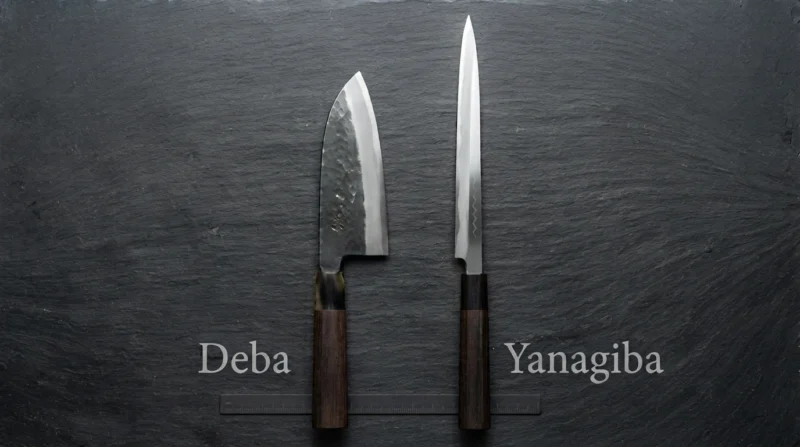
Yanagiba vs Deba at a Glance
The easiest way to understand the difference is to forget about steel for a moment.
Think about the physical job each knife performs.
A deba is designed to break down fish.
A yanagiba is designed to slice fish.
That sounds simple, but the distinction has major consequences.
A traditional deba has a relatively short, wide, heavy blade. The spine is substantially thicker than that of a slicing knife, and the blade carries considerable mass. This construction gives the knife the structural strength needed for fish butchery.
A yanagiba has a long, narrow blade with a much more delicate cutting profile. The length allows the user to make a long pulling cut instead of repeatedly sawing back and forth through the fish.
Japanese culinary references describe the deba as a knife for preparing fish, including work around heads and harder bones, while the yanagiba is associated with slicing raw fish for sashimi.
The two knives therefore represent different parts of the same workflow.
The deba is primarily for:
- Scaling and preliminary fish preparation in some traditional workflows
- Removing the head
- Opening the fish
- Separating the fillets
- Working along the backbone
- Cutting through appropriate fish bones
- Removing flesh from the frame
- Breaking down whole fish into manageable portions
The yanagiba is primarily for:
- Slicing prepared fish blocks
- Cutting sashimi
- Producing long, clean slices
- Controlling slice thickness
- Preserving the appearance of the cut surface
- Making repeated pulling cuts through boneless fish
The most important point is that neither knife was designed to replace the other.
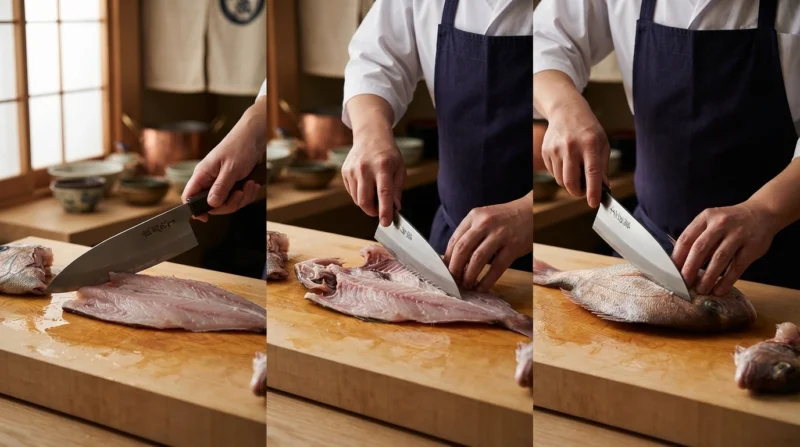
What Is a Deba Knife?
The deba, commonly referred to as deba bocho, is one of the traditional Japanese specialist knives associated with fish preparation.
Its defining characteristic is its substantial construction.
Compared with a yanagiba, a deba generally looks almost oversized in thickness. The blade is wider, heavier, and much more robust.
That is intentional.
When preparing a whole fish, the knife encounters structures that a delicate slicing knife should not be expected to handle.
There may be:
- Skin
- Ribs
- Vertebrae
- Small bones
- Larger bones
- The head
- Dense connective tissue
- Areas where the blade must work close to hard structures
The deba is designed around those conditions.
Japanese government information describing traditional Japanese kitchen knives specifically identifies the deba as a fish knife with a wide, thick, heavy blade suited to tougher cutting tasks such as removing fish heads and working through hard bones.
That doesn’t mean a deba should be treated like a general-purpose cleaver.
This is an important distinction.
A deba is heavy because fish preparation requires structural strength, not because it is intended to smash indiscriminately through anything in its path.
Good deba technique is controlled.
The knife is used to exploit the anatomy of the fish rather than simply applying brute force.
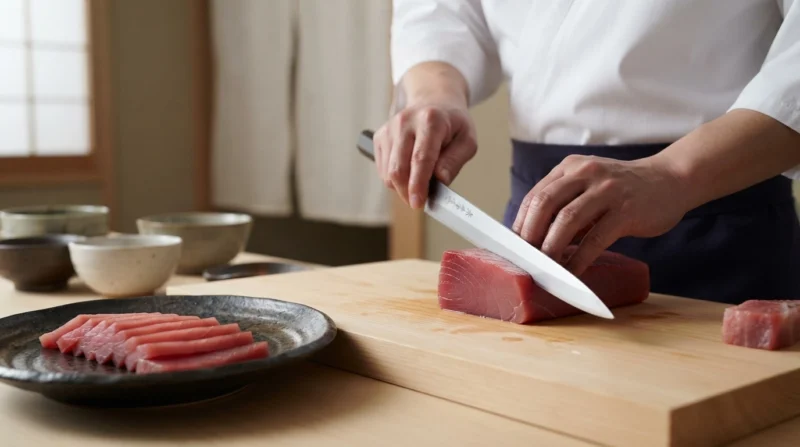
What Is a Yanagiba?
The yanagiba is a very different tool.
The name refers to its characteristic long, narrow blade profile, traditionally associated with the shape of a willow leaf.
Its primary purpose is precision slicing.
The knife is especially associated with sashimi preparation, where the visual and textural quality of the cut matters.
A traditional yanagiba is long enough to make a substantial pulling cut through a portion of fish.
Instead of moving the knife rapidly backward and forward like a Western saw, the user typically establishes the cut and draws the blade toward themselves in a controlled motion.
Japanese cultural sources describe the long yanagiba blade specifically in relation to this pulling action and the desire to produce a smooth cut surface without unnecessarily crushing the fish fibers.
This is one of the most important concepts to understand about the knife.
The yanagiba isn’t simply a very long kitchen knife.
Its length is functional.
It gives the user enough cutting travel to complete a slice with one deliberate movement.
That is why a yanagiba can feel strange if you approach it like a conventional chef’s knife.
The correct motion is part of the design.
Yanagiba vs Deba: The Fundamental Difference
The easiest way to remember the distinction is:
Deba = fish butchery.
Yanagiba = fish slicing.
The deba takes a whole fish and helps transform it into fillets.
The yanagiba takes prepared fish and transforms it into slices.
This is why the two knives look so different.
A knife intended to work around bones benefits from thickness and mass.
A knife intended to make clean cuts through delicate flesh benefits from a long, thin cutting profile.
Trying to make the deba perform the yanagiba’s job means using a relatively heavy blade for a task that benefits from a long, delicate slicing edge.
Trying to make the yanagiba perform the deba’s job means exposing a delicate cutting edge to forces it was never designed to withstand.
The mismatch becomes especially obvious when cutting fish.
Why the Deba Is Thick
The thickness of a deba is not merely a sign of durability.
It is part of its mechanical design.
When the blade approaches a fish bone, the knife needs enough structural strength to resist unwanted bending and damage.
The blade also needs enough mass to maintain control when working through areas of the fish where resistance changes suddenly.
A thin slicing blade can become damaged if it is forced sideways against bone.
The deba’s robust geometry provides considerably more support.
But there is a trade-off.
Thickness is not ideal for delicate slicing.
A thick blade creates more material behind the cutting edge and can produce more resistance when passing through soft food.
That’s acceptable for the deba because precision slicing is not its primary job.
The deba is optimized for a different stage of preparation.
Why the Yanagiba Is Long and Thin
The yanagiba’s geometry solves almost the opposite problem.
Imagine taking a prepared piece of salmon and trying to produce attractive sashimi slices.
You don’t want to crush the fish.
You don’t want to repeatedly saw through it.
You don’t want to tear the surface.
You want the blade to travel through the flesh smoothly and predictably.
A long blade makes that possible.
Instead of repeatedly moving a short knife backward and forward, the cook can establish the cutting line and draw the blade through the fish.
The result is a clean, deliberate slice.
The long blade also provides room to control the angle and thickness of the cut.
This is why the yanagiba is particularly associated with sashimi preparation rather than general fish butchery.
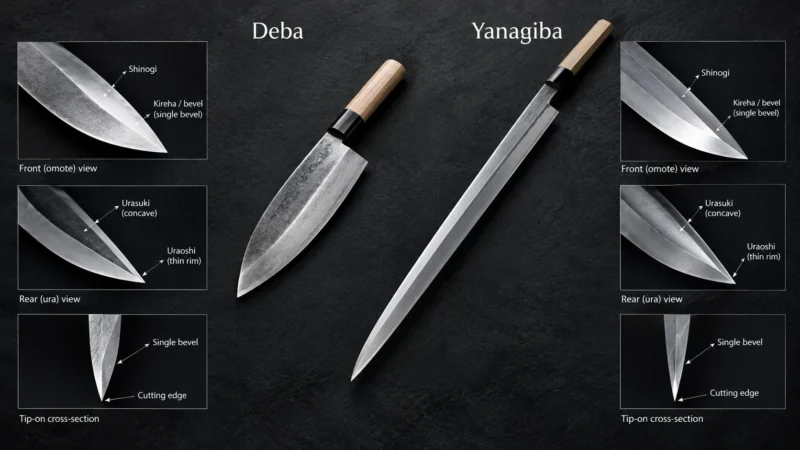
Single-Bevel Construction
One of the most important similarities between traditional yanagiba and deba knives is their use of single-bevel geometry.
A conventional Western-style kitchen knife is usually double-beveled.
Both sides of the blade are ground toward the cutting edge.
A traditional single-bevel knife works differently.
One side contains the primary cutting bevel.
The opposite side is comparatively flat and traditionally incorporates a shallow hollow known as the urasuki.
This geometry has major consequences for cutting and sharpening.
It also means that using a traditional yanagiba or deba is not simply a matter of picking up the knife and cutting normally.
The knife has a directional character.
What Does Single-Bevel Actually Mean?
It is easy to misunderstand the term.
“Single bevel” does not mean that one side of the knife is completely featureless.
The cutting side contains a broad bevel that runs toward the edge.
The opposite side is comparatively flat.
On many traditional examples, the back is slightly concave rather than perfectly flat.
The geometry creates a very different relationship between the blade and the food.
When properly sharpened, the cutting bevel establishes the primary cutting geometry while the relatively flat back helps the blade track in a controlled manner.
For delicate slicing, that directional geometry can be extremely useful.
But it also creates a learning curve.
A person accustomed to sharpening double-bevel knives may initially try to treat the entire knife as though it were symmetrical.
That is a mistake.
Urasuki and Uraoshi
Two Japanese terms are particularly useful when learning about traditional single-bevel knives.
Urasuki refers to the shallow concavity on the back of the blade.
Uraoshi refers to the narrow flat area around that concavity.
The geometry is important because the back is not normally sharpened by grinding the entire surface flat.
Instead, sharpening focuses on maintaining the intended relationship between the bevel and the back.
This is one reason traditional single-bevel sharpening requires more understanding than simply running a double-bevel knife across a stone at a guessed angle.
The geometry itself provides much of the guide.
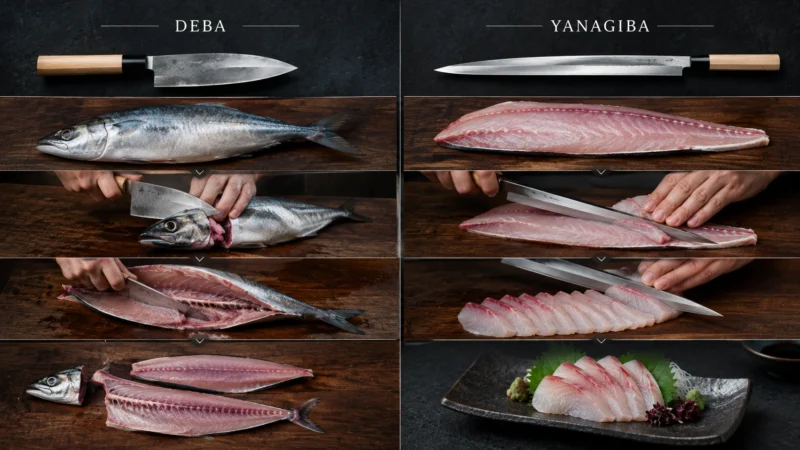
How Yanagiba and Deba Single Bevels Differ in Practice
Both knives may use single-bevel geometry, but their cutting behavior is not identical.
The deba is designed around controlled fish butchery.
The yanagiba is designed around controlled slicing.
Consequently, the geometry of the blade, its thickness, taper, profile, and edge construction all work together differently.
A deba can have a substantial blade behind its edge while still maintaining a fine cutting edge.
A yanagiba has a much more delicate overall cutting structure.
That difference matters when applying force.
A deba can tolerate the kind of contact that would be inappropriate for a yanagiba.
A yanagiba rewards light, controlled movement.
Neither should be interpreted simply as “sharper” or “stronger.”
They are optimized for different forms of cutting.
Yanagiba vs Deba for Whole Fish
If you buy whole fish, the deba is usually the relevant specialist knife.
Imagine bringing home a whole sea bream, mackerel, snapper, or another fish with the head, skin, bones, and frame still intact.
The first problem is not producing sashimi slices.
The first problem is breaking the fish down.
You may need to:
- Prepare the fish.
- Remove the head.
- Open the body.
- Separate the flesh from the backbone.
- Work around the rib bones.
- Remove the fillets.
- Trim the resulting portions.
This is where the deba earns its place.
The traditional Japanese three-piece fish preparation method, known as san-mai oroshi, involves producing two fillets and leaving the backbone as the third piece. A Japanese cultural reference describing the process shows the knife being used along the belly, backbone, and tail during the filleting sequence.
The knife is therefore interacting with the structure of the fish.
That is a completely different job from slicing an already prepared block.
Check Our Guide How to Prepare and Cut Seafood
Yanagiba for Prepared Fish
Once the fish has been cleaned, filleted, trimmed, and prepared into a suitable block, the problem changes.
Now the cook wants to divide the flesh into attractive portions.
This is yanagiba territory.
The blade can be positioned at the desired cutting point and drawn through the fish.
The objective is not to overpower the food.
It is to make the cut with minimal unnecessary movement.
The long edge allows the cook to complete the slice in a single continuous pull.
This approach is especially useful when appearance matters.
Sashimi is not simply about getting a piece of fish separated from another piece.
The surface of the cut is part of the presentation.
Texture matters as well.
A clean cut can produce a different surface from a piece that has been repeatedly sawn through with a short knife.
Check Our Guide How to Prepare Fish for Sushi, Sashimi & Ceviche
Why Cutting Motion Matters
A common mistake is to think that owning a yanagiba automatically produces sashimi-quality cuts.
It doesn’t.
The knife is a tool designed around a particular technique.
A user who applies aggressive forward-and-back sawing movements may completely defeat the purpose of the blade.
The traditional cutting motion is generally a controlled pull.
The blade enters the fish, travels through it, and exits with one deliberate movement.
The exact technique depends on the food, blade geometry, slice thickness, and the cook’s training.
The important principle is simple:
Let the length of the blade perform the work.
This is very different from the way many people use a typical chef’s knife.
Can a Deba Slice Sashimi?
Technically, a deba can cut fish.
Almost any sharp knife can cut fish.
But that does not mean it is the appropriate tool for producing refined sashimi slices.
The deba is considerably thicker and heavier.
Its geometry is optimized for fish preparation rather than long precision slicing.
If you try to use it for delicate sashimi, you are asking the knife to solve a problem it was not designed to solve.
You may still obtain edible slices.
But the experience is different.
The blade does not provide the same combination of length, thinness, and controlled pulling action associated with a yanagiba.
This is an important distinction between possible and purpose-built.
A kitchen knife can perform many tasks outside its intended role.
That doesn’t make those tasks optimal.
Can a Yanagiba Fillet a Fish?
Again, technically, a skilled cook can perform some fish preparation with many different knives.
But that is not the same as saying a yanagiba is a suitable replacement for a deba.
The yanagiba’s long, thin blade is not intended for forceful contact with fish bones.
The risk is not simply that the knife might become dull.
A thin, hard cutting edge can be damaged by inappropriate contact with hard structures.
That is especially important with traditional single-bevel knives because their edges can be very fine.
A yanagiba should therefore be treated as a precision slicing instrument.
It is not a substitute for a fish butchery knife.
Deba vs Yanagiba Blade Geometry
The visual difference between the knives tells you a great deal about their intended functions.
Deba geometry
A typical deba has:
- A short-to-moderate blade length
- A relatively tall blade
- A thick spine
- Considerable mass
- A robust single-bevel edge
- A pronounced taper toward the cutting edge
- A profile suited to fish butchery
Yanagiba geometry
A typical yanagiba has:
- A long blade
- A narrow blade profile
- A relatively thin cutting structure
- A long continuous edge
- Single-bevel geometry
- A pointed or gently tapered tip
- A profile suited to pulling cuts
These differences aren’t cosmetic.
They represent two different engineering solutions.
Blade Length: Why It Matters
Blade length is particularly important with yanagiba knives.
Traditional examples commonly fall into the range of roughly 240–300 mm, although considerably more variation exists depending on the knife, cuisine, user, and intended fish.
Longer blades allow longer continuous cuts.
However, longer does not automatically mean better.
A 300 mm yanagiba can be more difficult to control than a shorter one.
It requires more workspace.
It requires more confidence.
It requires the user to understand the relationship between the blade and the fish.
For someone learning the technique, an excessively long blade can become awkward rather than advantageous.
Deba Blade Length
Deba knives are generally much shorter than yanagiba knives.
The reason is practical.
Fish butchery does not require a 300 mm slicing edge.
The cook needs control near the fish.
A shorter, deeper blade provides leverage and maneuverability while working around the head, backbone, ribs, and other structures.
The appropriate size depends strongly on the fish being prepared.
A small fish may be awkward to handle with an unnecessarily large deba.
A large fish may require a larger specialist knife.
Therefore, choosing a deba should begin with the size and type of fish you actually process rather than simply choosing the largest blade available.
Yanagiba vs Deba for Salmon
Salmon is a good example because it can involve both knives.
If you purchase a whole salmon, the initial work is fish butchery.
A deba is appropriate for much of that stage.
Once you have a cleaned and prepared fillet or sashimi block, the problem becomes slicing.
That is where the yanagiba becomes relevant.
If you buy salmon already filleted, you may have no practical need for a deba.
You might instead benefit from a yanagiba if your goal is sashimi-style slicing.
This illustrates a broader principle:
Choose the knife based on the starting condition of the food.
Whole fish and prepared fish are different jobs.
Yanagiba vs Deba for Tuna
Tuna presents another interesting situation.
A large tuna can require specialized tools and techniques beyond the normal home-kitchen setup.
For smaller prepared tuna blocks, however, a yanagiba can be highly appropriate for slicing.
The long blade provides the cutting travel necessary for clean portions.
A deba is not primarily a tuna slicing tool.
Likewise, the traditional home-sized deba is not automatically the right instrument for processing very large fish.
Knife choice must therefore consider both the preparation stage and the scale of the food.
Yanagiba vs Deba for Mackerel
Mackerel is frequently prepared as a whole fish and is therefore a good example of where the deba has an obvious role.
The fish needs to be opened and filleted.
Once the fillet is prepared, a yanagiba can be used for slicing.
This is a perfect illustration of why these knives complement one another.
The deba does not become unnecessary because the yanagiba exists.
The yanagiba does not make the deba obsolete.
They solve sequential problems.
Check Our Guide 15 Most Popular Seafood Recipes: Easy Fish, Shrimp, Shellfish & More
What About Small Fish?
Not every fish requires a full-size deba.
For smaller fish, traditional Japanese kitchens also use smaller specialized knives, including ko-deba.
That matters because buying a large deba for tiny fish can be unnecessarily cumbersome.
The principle is the same as choosing a yanagiba length.
The knife should correspond to the scale of the task.
A smaller blade can provide better control on a small fish.
A larger blade becomes more useful as the size of the fish and the quantity of flesh being processed increase.
Edge Retention
It is tempting to compare yanagiba and deba in terms of edge retention.
But that comparison is complicated because the knives can be made from many different steels and heat treatments.
There is no single “yanagiba steel” or “deba steel.”
Traditional examples may use carbon steels, while modern versions can also be made from stainless or other steel families.
Therefore, the knife type itself does not determine edge retention.
Steel composition, heat treatment, geometry, sharpening quality, cutting board, food, technique, and maintenance all matter.
The practical difference is that the edge on a yanagiba is generally expected to support extremely clean slicing.
The deba’s edge must balance sharpness with a more structurally demanding job.
Check Our Guide Edge Retention Explained: 10 Factors What Makes a Knife Stay Sharp Longer
Why Edge Geometry Can Matter More Than Steel
A common mistake in knife discussions is to focus entirely on steel.
Steel matters.
But geometry matters enormously.
Consider two knives made from the same steel.
One could be a thick deba.
The other could be a long, thin yanagiba.
They would behave very differently.
The difference is not primarily the steel.
It is the entire blade system.
Thickness, grind, edge angle, bevel geometry, blade width, taper, and cutting motion all influence performance.
This is particularly obvious when comparing specialist Japanese knives.
The shape of the knife is part of the technology.
Toughness and Edge Stability
Deba and yanagiba also have different mechanical demands.
A deba may encounter bone and other hard structures.
Therefore, its blade needs enough structural strength and edge stability for controlled fish butchery.
The yanagiba generally operates in a less mechanically aggressive environment.
Its edge can therefore be optimized heavily toward precision slicing.
But this does not mean a yanagiba is “weak” in general.
It means its strength is being used differently.
A well-designed yanagiba is strong enough for its intended task.
Problems arise when users ask it to perform outside that task.
Check Our Guide Wear Resistance vs Toughness: Understanding the Most Important Knife Steel Trade-Off
Why a Yanagiba Can Chip
One of the most common mistakes with traditional yanagiba knives is treating the fine edge as though it were indestructible.
It isn’t.
The edge can be damaged by:
- Contact with bones
- Cutting frozen food
- Twisting during a cut
- Contact with hard cutting surfaces
- Side-loading the edge
- Dropping the knife
- Improper sharpening
- Using excessive force
A sharp knife does not automatically equal a fragile knife.
But a highly refined edge does require appropriate handling.
This is one reason yanagiba technique emphasizes control rather than force.
Why a Deba Can Also Be Damaged
A deba is tougher and more robust, but it is not invulnerable.
The most important mistake is assuming that because a deba is thick, it can be used like a cleaver on any bone.
Fish anatomy matters.
Cutting technique matters.
The type and size of bone matter.
The knife should be used deliberately rather than with uncontrolled chopping.
A deba’s strength is designed around fish preparation.
That is not a license to use it on frozen food, hard non-food materials, or tasks unrelated to its intended purpose.
Sharpening a Yanagiba
Sharpening is one of the biggest differences a new owner notices.
A traditional yanagiba should not be sharpened like a standard double-bevel chef’s knife.
The broad bevel on the cutting side is maintained against the stone according to the knife’s existing geometry.
The back is treated differently.
The goal is to preserve the original single-bevel construction rather than flattening or radically changing it.
The exact sharpening progression depends on the condition of the knife.
A lightly dull knife may require much less work than one with chips or significant edge damage.
Sharpening a Deba
The same basic single-bevel principles apply to a traditional deba.
However, the deba’s robust geometry means the sharpening experience can feel different.
There is more steel.
The blade may have a larger and heavier bevel.
The edge can also experience more demanding use.
A beginner should learn the geometry before attempting aggressive repair work.
One of the biggest mistakes is removing too much material from the back or changing the bevel geometry unnecessarily.
Traditional single-bevel knives reward consistency.
Check Our Guide All Kinds of Knife Sharpening Tools
Should Beginners Buy a Single-Bevel Knife?
This depends entirely on what the person wants to learn.
If someone simply wants an everyday kitchen knife, neither a yanagiba nor a deba is necessarily the obvious starting point.
Both are specialist tools.
A double-bevel gyuto, chef’s knife, or similar general-purpose knife is usually easier to understand for ordinary kitchen work.
But if someone specifically wants to learn Japanese fish preparation, a deba or yanagiba can be a logical specialist purchase.
The important thing is to understand that buying the knife is only the beginning.
Technique matters.
Sharpening matters.
Maintenance matters.
And the knife should be used for the job it was designed to perform.
Which One Is Easier to Learn?
There is no universal answer because the two knives involve different skills.
A deba requires learning fish anatomy and controlled butchery.
A yanagiba requires learning precise slicing technique.
For someone who has never prepared a whole fish, the deba can initially feel intimidating.
For someone accustomed to ordinary chef’s knives, the yanagiba’s pulling motion and single-bevel tracking can feel unfamiliar.
The learning curve is therefore task-specific.
The right question is not “Which knife is easier?”
It is:
Which skill are you trying to learn?
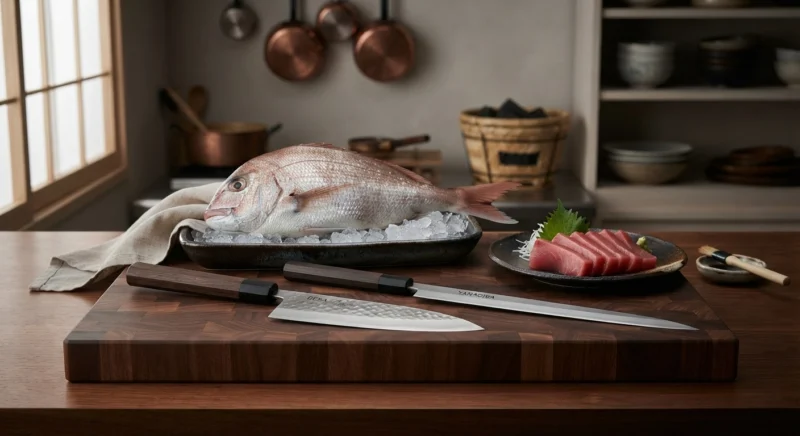
Yanagiba vs Deba for Home Cooks
For most home cooks, the decision becomes much easier once you look at actual buying habits.
If you buy whole fish regularly
A deba makes more sense.
You have a practical reason to own a fish-butchery knife.
If you buy prepared fillets
A deba may not add much value.
A yanagiba may be more relevant if you want sashimi-style slicing.
If you buy sashimi blocks
A yanagiba is the more directly relevant specialist knife.
If you rarely prepare fish
Neither may be necessary.
A good general-purpose knife can handle many occasional fish tasks without requiring the maintenance and technique associated with traditional single-bevel knives.
Can You Own Only One?
Yes.
But the answer depends on the kind of fish preparation you do.
If you buy whole fish and want to process it completely yourself, the deba is generally the more fundamental specialist tool.
You can then use another suitable knife for slicing.
If your fish is already prepared and your primary goal is sashimi, the yanagiba is more directly aligned with the task.
The traditional two-knife workflow becomes useful when you regularly perform the entire process:
whole fish → fillets → prepared block → sashimi slices
The deba handles the first major transformation.
The yanagiba handles the second.
Why the Two Knives Work So Well Together
The best way to understand the relationship is to follow a fish through the kitchen.
Imagine a whole fish arriving at the cutting board.
The first challenge is structural.
The head needs to be removed.
The fish needs to be opened.
The flesh must be separated from the backbone.
The ribs need to be addressed.
This is where the deba works.
Once the fish is transformed into clean portions, the structural problem is over.
Now the challenge becomes presentation.
How thick should the slices be?
How should the blade travel?
How can the surface remain clean?
How can the flesh be sliced without unnecessary sawing?
This is where the yanagiba takes over.
The knives are not competitors.
They are stages in a workflow.
The Importance of Fish Preparation Before Yanagiba Slicing
Even the best yanagiba cannot compensate for poorly prepared fish.
Before slicing, the fish needs to be appropriately cleaned and trimmed.
Bones should be removed where appropriate.
The block should have a suitable shape.
The fish should be handled carefully.
The surface should be clean.
Temperature and freshness also matter.
A knife can only do so much.
If the flesh is poorly prepared, excessively warm, damaged, or badly cut before the yanagiba reaches it, the final result will suffer.
This is why traditional fish preparation treats knife technique as part of a larger process rather than an isolated piece of equipment.
Why the Cut Surface Matters
Sashimi is often judged not only by flavor but also by appearance and texture.
The cut surface can influence how the fish looks on the plate.
A rough or torn surface can be visually obvious.
A smooth surface can appear more refined.
This is one reason the yanagiba’s pulling action is so important.
The long blade allows the cook to perform a continuous cut rather than repeatedly changing direction.
Japanese cultural sources specifically describe the yanagiba’s long blade and pulling motion in relation to producing a smooth surface and preserving the desired texture of the fish.
Yanagiba vs Deba and Food Texture
Texture is another reason the distinction matters.
Fish muscle is delicate.
Repeated sawing can disturb the surface more than a controlled slicing motion.
The objective of a yanagiba is therefore not simply speed.
It is controlled separation.
The knife should pass through the flesh rather than repeatedly work against it.
This is one of the reasons the traditional technique feels slower and more deliberate than ordinary chopping.
The result is supposed to justify the controlled movement.
Can You Use a Yanagiba for Vegetables?
You can physically cut vegetables with a yanagiba.
That doesn’t make it a good vegetable knife.
Traditional Japanese knife design is highly specialized.
The same culinary tradition that produced the yanagiba and deba also developed knives such as the usuba specifically for vegetable work.
This specialization is important.
The idea isn’t that every ingredient requires a completely different knife.
Rather, traditional Japanese knife design often optimizes the geometry of the tool around the specific cutting problem.
Using the correct knife can make the intended task more controlled.
Can You Use a Deba for Vegetables?
Again, technically yes.
Practically, there are usually better choices.
The deba is thick and heavy.
That makes it less pleasant for fine vegetable work.
A thinner vegetable knife provides better control for delicate slicing and chopping.
Trying to make the deba an all-purpose kitchen knife largely defeats the reason for its specialized geometry.
Carbon Steel vs Stainless Steel
The choice between carbon and stainless steel is separate from the choice between yanagiba and deba.
Either knife type can be made using different steels.
Carbon steel can offer excellent sharpening response and traditional characteristics, but it requires more careful maintenance against corrosion.
Stainless steel generally reduces maintenance demands.
For a fish knife, this can be particularly relevant because the blade frequently encounters moisture.
However, “stainless” does not mean “maintenance-free.”
Any quality knife should be washed appropriately, dried, and stored properly.
A carbon steel blade should receive even more attention because corrosion can develop quickly if moisture or food residue is left on the surface.
Check Our Guide Carbon Steel vs Stainless Steel Knives: Which Is Better?
Why Maintenance Matters More Than Many Beginners Expect
Fish preparation involves water, proteins, salt, and other residues.
That environment is not ideal for leaving a knife wet.
After use, a specialist knife should be cleaned appropriately and dried thoroughly.
Do not leave it sitting in a sink.
Do not store it wet.
Do not leave fish residue on the blade.
For carbon steel, prompt drying is especially important.
Proper maintenance also protects the edge.
A knife that is repeatedly exposed to poor storage conditions can develop corrosion or edge damage long before the steel itself becomes the limiting factor.
Honing and Traditional Single-Bevel Knives
Another common misunderstanding comes from applying Western knife maintenance habits to Japanese single-bevel knives.
A traditional yanagiba or deba should not automatically be treated like a double-bevel chef’s knife with a honing rod.
The cutting edge geometry is different.
Improper honing can alter the bevel or create unwanted damage.
For these knives, regular whetstone maintenance is generally a more appropriate way to preserve the intended edge geometry.
If the knife has developed a significant chip or geometry problem, more substantial sharpening may be required.
Cutting Boards Matter
A fine Japanese knife deserves an appropriate cutting surface.
Very hard boards and unsuitable surfaces can increase impact on the edge.
This matters particularly for a fine yanagiba edge.
A deba is more tolerant because it is designed for more demanding fish preparation, but even a deba benefits from a suitable work surface.
Avoid cutting directly on:
- Stone
- Glass
- Ceramic
- Metal
- Other extremely hard surfaces
A suitable cutting board reduces unnecessary shock and helps preserve the edge.
Common Mistake: Treating Yanagiba Like a Chef’s Knife
This is probably the most common mistake new owners make.
They pick up a yanagiba and start chopping.
That is not what the knife is designed for.
The long blade becomes awkward.
The cutting motion becomes inefficient.
The edge may experience forces it was never intended to handle.
Instead, learn the pulling motion.
Use the blade length.
Keep the movement controlled.
Avoid unnecessary contact with hard surfaces.
The knife becomes much more intuitive once its intended movement is understood.
Common Mistake: Treating Deba Like a Cleaver
The opposite mistake happens with deba knives.
Because the blade is thick and heavy, users sometimes assume it can be used like a meat cleaver.
That is also incorrect.
A deba is specialized for fish.
The knife’s mass is there to support controlled fish butchery, not uncontrolled chopping.
Fish bones have different shapes, sizes, and structures.
Good technique uses the anatomy of the fish rather than simply applying maximum force.
Common Mistake: Choosing the Knife by Appearance
This happens frequently with Japanese knives.
A long yanagiba looks impressive.
A heavy deba looks powerful.
But appearance is a poor way to decide which knife belongs in your kitchen.
Instead, start with the task.
Ask:
What do I actually want to cut?
Then ask:
What condition is the food in when I start?
If the answer is “whole fish,” think deba.
If the answer is “prepared fish block,” think yanagiba.
That simple distinction eliminates much of the confusion.
Common Mistake: Thinking a More Expensive Knife Fixes Technique
It doesn’t.
A beautifully finished yanagiba cannot compensate for poor cutting technique.
A premium deba cannot compensate for not understanding fish anatomy.
Steel, craftsmanship, finish, and geometry can all matter.
But the user’s technique remains fundamental.
A modest specialist knife in competent hands can often outperform a much more expensive knife used incorrectly.
That is especially true for highly specialized tools.
Common Mistake: Focusing Too Much on Steel
Steel specifications are interesting.
They can help explain sharpening response, corrosion resistance, toughness, and edge retention.
But they don’t change the fundamental purpose of the knife.
A yanagiba made from one steel is still a yanagiba.
A deba made from the same steel is still a deba.
The geometry and intended task remain fundamentally different.
This is an important lesson for anyone researching Japanese knives.
Knife type comes before steel choice.
First choose the geometry and function.
Then consider steel.
Yanagiba vs Deba: Which Has Better Edge Retention?
There is no meaningful universal answer.
Edge retention depends on the specific steel, hardness, heat treatment, geometry, edge angle, cutting conditions, and maintenance.
A particular yanagiba may hold an edge longer than a particular deba.
Another pair may show the opposite.
The knife type alone doesn’t establish an objective winner.
What can be said is that the two edges experience different working conditions.
A yanagiba is normally performing precision slicing.
A deba can encounter more mechanically demanding contact during fish processing.
Therefore, the edge requirements are different even if the steel happens to be identical.
Yanagiba vs Deba: Which Is Sharper?
This question is also more complicated than it sounds.
Both can be sharpened to extremely high levels.
The yanagiba is specifically designed around fine slicing, so its geometry and intended use make an exceptionally refined edge particularly relevant.
But “sharpness” is not one single property.
There is:
- Initial keenness
- Edge geometry
- Cutting resistance
- Edge stability
- Retention
- Surface finish
- User technique
A deba can be extremely sharp.
Its purpose simply requires that sharpness to coexist with a more robust blade structure.
Yanagiba vs Deba: Which Is More Durable?
Again, the answer depends on what “durable” means.
If you mean resistance to the mechanical demands of fish butchery, the deba is designed for that environment.
If you mean maintaining a refined slicing edge under appropriate sashimi use, the yanagiba can be extremely durable when used correctly.
A knife can be highly durable within its intended operating conditions and vulnerable outside them.
That is a better way to think about durability than assigning a single ranking.
Which Knife Is Better for Sashimi?
For traditional sashimi slicing, the yanagiba is the specialist tool.
Its long, narrow blade and pulling-cut technique are designed specifically around the task.
The deba belongs earlier in the preparation process.
Japanese sources consistently distinguish the two roles: deba for fish preparation and yanagiba for slicing raw fish.
So if the question is specifically:
“Which knife should I use to slice sashimi?”
The answer is the yanagiba.
Which Knife Is Better for Filleting Fish?
For traditional fish butchery, the deba is the specialist tool.
Its heavy construction and geometry are designed for working through the structure of the fish.
That includes separating flesh from the frame and dealing with appropriate bones.
If the starting point is a whole fish, the deba is therefore the more directly relevant knife.
Which Knife Should You Buy First?
There is no universal answer because it depends on your starting point.
Choose a deba first if:
- You regularly buy whole fish.
- You want to learn Japanese fish butchery.
- You need to remove fish heads.
- You want to fillet fish yourself.
- You work with fish containing bones.
- You are interested in the complete whole-fish workflow.
Choose a yanagiba first if:
- You already buy prepared fish.
- You primarily make sashimi.
- You want to learn traditional sashimi slicing.
- You value long, clean pulling cuts.
- You don’t need a heavy fish-butchery knife.
Consider both if:
- You regularly buy whole fish.
- You prepare sashimi from scratch.
- You want to learn the traditional workflow.
- You are comfortable maintaining single-bevel knives.
What If You Only Cook Fish Occasionally?
In that situation, you may not need either knife.
This is worth saying because specialized Japanese knives can be fascinating.
It is easy to become interested in them and conclude that owning the complete traditional set is necessary.
It isn’t.
If you prepare fish only a few times per year, a good general-purpose kitchen knife may be sufficient for many tasks.
The specialized tools become more compelling when the specialized work becomes a regular part of your cooking.
A knife should solve a real problem in your kitchen.
It doesn’t need to exist simply because it is interesting.
What If You Want to Learn Traditional Japanese Fish Preparation?
Then the deba and yanagiba make much more sense.
They allow you to experience the division of labor built into traditional Japanese knife design.
The deba teaches you to understand fish anatomy and controlled butchery.
The yanagiba teaches you to understand slicing direction, blade travel, pressure, and presentation.
Together they form a useful learning system.
But the learning process should be gradual.
Start with appropriate fish.
Learn the anatomy.
Learn safe handling.
Learn the correct cutting motion.
Then develop sharpening skills.
The knife should become an extension of the technique rather than something you fight against.
How to Think About Yanagiba and Deba as Tools
A useful mental model is to compare them to woodworking tools.
You wouldn’t use a large plane where you need a fine carving knife.
You wouldn’t use a delicate carving tool to remove large amounts of material.
The problem determines the tool.
Yanagiba and deba work the same way.
The deba is a structural tool.
The yanagiba is a finishing tool.
The deba transforms the fish from whole to prepared.
The yanagiba transforms prepared fish into finished slices.
Once you see the knives this way, the difference becomes much easier to understand.
The Role of Technique
Knife geometry does not operate independently from the person holding the knife.
A skilled cook understands:
- Where the fish bones are
- How much resistance to expect
- When to change direction
- How to position the blade
- How much pressure to apply
- How to control the knife
- When to stop cutting
- How to maintain the edge
The same principle applies to the yanagiba.
A skilled user knows how to establish the slice and make the blade travel smoothly.
The knife’s design provides the capability.
Technique turns that capability into results.
Safety Considerations
Both knives deserve respect.
A yanagiba’s long blade provides a large cutting surface.
A deba’s weight means that careless movement can create significant force.
When learning either knife:
- Keep the cutting area organized.
- Maintain a stable cutting board.
- Keep your supporting hand out of the blade path.
- Avoid rushing.
- Don’t use excessive force.
- Keep the blade properly maintained.
- Store the knife safely.
- Never attempt to catch a falling knife.
For deba work especially, understand the fish before cutting.
For yanagiba work, keep the blade path controlled and predictable.
Yanagiba vs Deba: A Practical Workflow
For someone who wants to prepare a whole fish and serve sashimi, the traditional workflow can be understood as a sequence.
Stage 1: Whole fish
The fish arrives intact.
Stage 2: Initial preparation
The fish is cleaned and prepared.
Stage 3: Fish butchery
The deba helps remove the head, separate the flesh, and work around the frame.
Stage 4: Fillets
The result is two usable portions of flesh plus the remaining frame in a traditional three-piece filleting approach.
Stage 5: Trimming
Bones, skin, and unwanted portions are addressed according to the intended dish.
Stage 6: Saku
The flesh is prepared into an appropriate block.
Stage 7: Sashimi
The yanagiba takes over.
Stage 8: Slicing
The blade is drawn through the fish to produce individual portions.
The important point is that the two knives appear at different moments because the nature of the cutting problem has changed.
Does the Deba Replace a Fillet Knife?
Not exactly.
Western-style fillet knives and traditional Japanese deba knives approach fish preparation differently.
A fillet knife is typically thin and flexible.
A deba is thicker, heavier, and structurally more substantial.
The flexible Western fillet knife can follow curves around bones in a way that differs from the controlled, more rigid approach of a deba.
Neither design is automatically superior.
They represent different traditions and techniques.
If you are specifically learning Japanese fish preparation, the deba is the relevant traditional tool.
If your existing technique is based around flexible filleting, the transition may require learning a different way of handling the fish.
Does the Yanagiba Replace a Slicing Knife?
Again, it depends on the task.
A yanagiba is excellent for its intended purpose.
But it is not necessarily the most convenient knife for every slicing job.
For example, cooked meats, large roasts, bread, or general-purpose slicing may be better handled by other knife designs.
The yanagiba is a specialist.
Its strength lies in precision fish slicing.
That specialization is precisely why it can perform its intended task so well.
Why Traditional Japanese Knives Are So Specialized
Japanese cuisine developed a particularly strong relationship between knife geometry and ingredient.
Different foods require different cutting actions.
Fish preparation is an obvious example.
A fish has skin, flesh, bones, connective tissue, and a particular anatomical structure.
Sashimi has an entirely different requirement.
The goal is not to break the fish down.
The goal is to create clean, attractive portions.
Traditional Japanese culinary sources describe the deba, yanagiba, and usuba as specialist knives covering different fundamental preparation tasks.
The specialization is therefore not accidental.
It is part of the culinary system.
Yanagiba vs Deba and Modern Kitchens
Modern home kitchens often favor versatility.
One chef’s knife might handle vegetables, meat, herbs, fish, and many other ingredients.
That approach is practical.
Traditional Japanese specialist knives take another approach.
Instead of asking one blade to do everything reasonably well, they can assign specific jobs to different knives.
Neither philosophy is inherently necessary for every cook.
The important thing is understanding what you are buying.
A yanagiba isn’t disappointing because it doesn’t behave like a chef’s knife.
A deba isn’t poorly designed because it isn’t comfortable for chopping vegetables.
They are simply specialized tools.
https://yashkadesigns.com/chef-knife-japanese-yanagiba
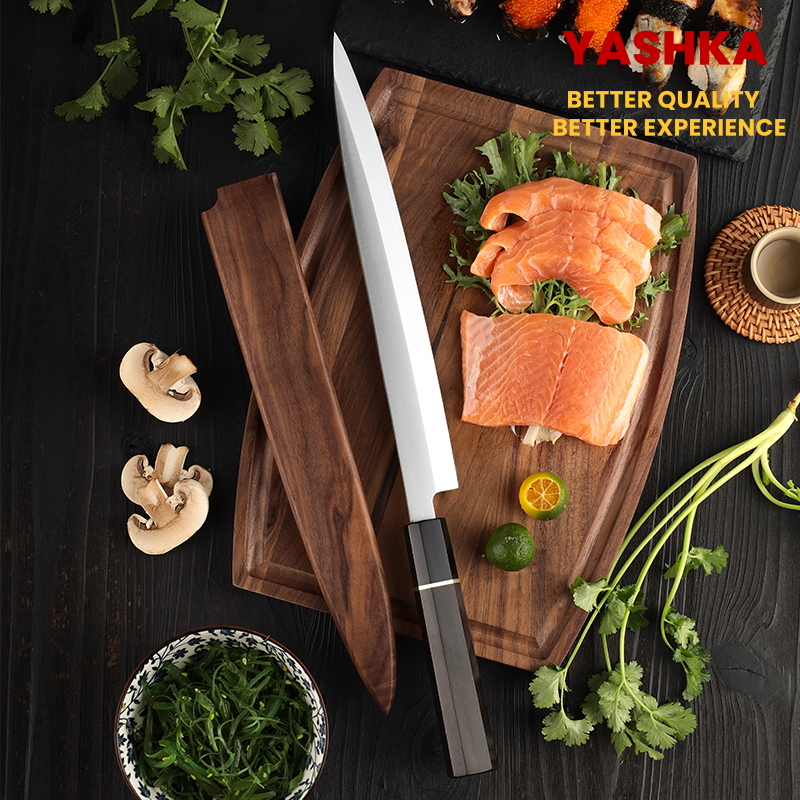
Is a Yanagiba Worth It?
For someone who regularly prepares sashimi and wants to learn the traditional technique, a yanagiba can be an extremely useful specialist knife.
For someone who rarely eats or prepares raw fish, it may see very little use.
The value comes from matching the knife to the user’s actual cooking.
The same principle applies to a deba.
If you regularly break down whole fish, the knife can become an important part of the kitchen.
If you buy fish already prepared, the need may be much lower.
https://yashkadesigns.com/japanese-deba-knife-sashimi-sushi-making-tools
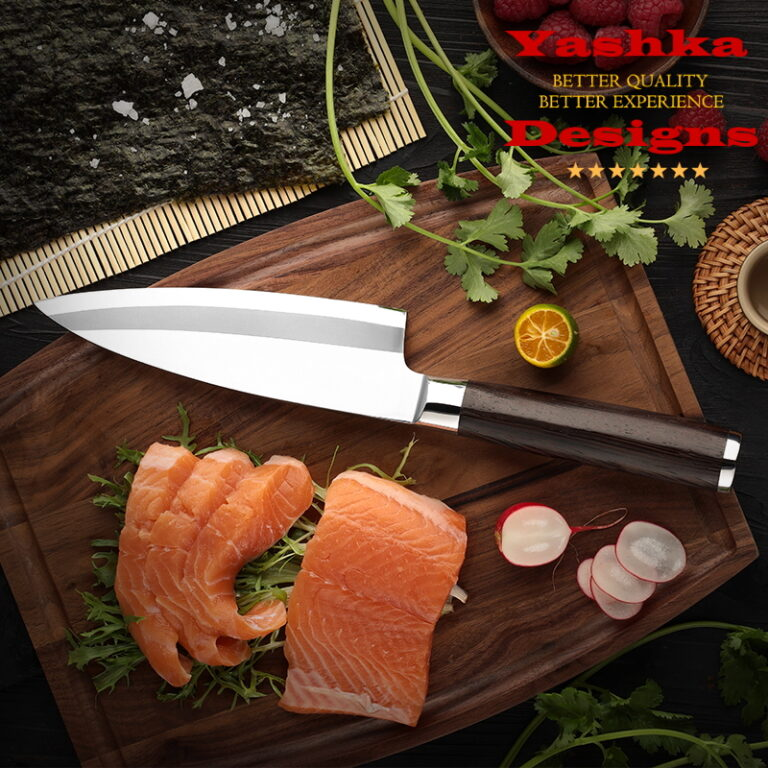
Is a Deba Worth It?
A deba makes sense when whole-fish preparation is a real part of your cooking.
Its robust construction is not something you need simply because you like Japanese knives.
It becomes valuable when you actually encounter the tasks it was designed to handle.
For occasional fish preparation, another knife may be more practical.
For regular whole-fish work, however, the specialized geometry can make the process much more controlled.
Final Comparison: Think Function, Not Competition
The most important conclusion in the yanagiba vs deba discussion is that these knives aren’t really rivals.
They are specialists.
The deba is designed around fish butchery.
The yanagiba is designed around fish slicing.
The deba is relatively thick, wide, and heavy because it needs structural strength.
The yanagiba is long, narrow, and refined because it needs controlled slicing performance.
The deba is used earlier in the fish-preparation process.
The yanagiba is used later.
The deba deals with the fish’s structure.
The yanagiba deals with the finished flesh.
This is why asking which one is “better” doesn’t lead to a useful answer.
If you need to break down whole fish, the deba addresses that problem.
If you need to turn prepared fish into sashimi, the yanagiba addresses that problem.
If you do both regularly, they can form a logical pair.
Frequently Asked Questions
Is a yanagiba the same as a deba?
No.
Both are traditional Japanese fish-related knives, but their primary functions are different. A deba is designed for fish preparation and butchery, while a yanagiba is designed primarily for slicing prepared fish, especially sashimi.
Can I use a deba to make sashimi?
You can cut fish with a deba, but it is not optimized for refined sashimi slicing. The yanagiba’s long, narrow geometry and pulling-cut technique are better suited to that task.
Can I use a yanagiba to fillet fish?
A skilled cook can perform some fish preparation with many knives, but a yanagiba is not intended for forceful work around bones. A deba is the appropriate traditional specialist knife for whole-fish butchery.
Which knife is thicker?
The deba is substantially thicker and heavier than a yanagiba.
Which knife is longer?
The yanagiba is generally much longer than the deba.
Are both knives single bevel?
Traditional versions of both yanagiba and deba commonly use single-bevel construction.
Which is easier to sharpen?
Neither should be treated like a conventional double-bevel chef’s knife. Both require an understanding of single-bevel geometry. The exact difficulty depends on the knife’s condition, bevel, steel, and the user’s sharpening experience.
Which one is better for whole fish?
The deba is the traditional specialist choice for whole-fish preparation.
Which one is better for sashimi?
The yanagiba is the traditional specialist choice for sashimi slicing.
Do I need both?
Not necessarily. If you rarely prepare fish, probably not. If you regularly process whole fish and make sashimi from scratch, owning both can make sense because they perform different stages of the workflow.
Can a yanagiba cut bones?
It should not be used for bone-cutting. Its fine edge is intended for precision slicing and can be damaged by inappropriate contact with hard structures.
Can a deba be used like a cleaver?
It should not be treated as a general-purpose cleaver. Its robust construction is intended for controlled fish preparation, not indiscriminate chopping through hard materials.
Is a longer yanagiba always better?
No. Longer blades can provide longer cutting strokes, but they also require more control and workspace. The appropriate length depends on the user, fish size, technique, and working environment.
Is a heavier deba always better?
No. A deba should be matched to the fish being processed. Excessive size and weight can reduce control, especially when working with smaller fish.
Does steel determine which knife I should buy?
No. Steel affects characteristics such as sharpening response, corrosion resistance, toughness, and edge retention, but it does not change the fundamental purpose of the knife. Choose the knife type according to the task first.
Conclusion
Yanagiba and deba represent two different solutions to two different fish-cutting problems.
The deba is the structural tool. Its heavy, thick construction is intended for breaking down fish, working around bones, removing heads, and separating flesh from the frame.
The yanagiba is the precision tool. Its long, narrow blade is designed for controlled pulling cuts through prepared fish, especially when making sashimi.
Understanding that distinction is more important than comparing the knives by steel, price, hardness, or appearance.
If your kitchen starts with a whole fish, the deba is the logical specialist.
If your kitchen starts with a prepared fish block and ends with sashimi, the yanagiba is the logical specialist.
And if your goal is to experience the complete traditional workflow, the two knives make sense together because they are designed to take over at different stages.
The simplest way to remember the entire comparison is:
Deba breaks the fish down. Yanagiba brings the prepared fish to the plate.
That is the real difference between yanagiba and deba—and once you understand it, choosing between them becomes much easier.