X50CrMoV15 vs M390
An Independent Guide
When comparing knife steels, it is tempting to look at the chemical composition and immediately decide that the steel with more carbon, chromium, vanadium, or molybdenum must be better.
That approach works only up to a point.
X50CrMoV15 and M390 are designed around very different priorities. X50CrMoV15 is a conventional martensitic stainless steel that has become extremely common in kitchen knives because it offers a practical combination of corrosion resistance, toughness, sharpening ease, edge stability, and reasonable edge retention. M390 belongs to a much more wear-resistant class of powder-metallurgy stainless steels and is engineered to hold a refined cutting edge for substantially longer under abrasive cutting conditions.
That does not automatically make M390 the better steel for every knife.
A chef who values easy sharpening, predictable maintenance, and a forgiving edge may prefer the characteristics of X50CrMoV15. A knife enthusiast who wants long edge life, high wear resistance, and the ability to maintain a very refined geometry may find M390 much more attractive.
The important question is therefore not simply:
“Which steel is better?”
A better question is:
“Which steel is better for the way the knife will actually be used?”
That distinction becomes particularly important in kitchen knives. A knife used mainly for vegetables, boneless meat, herbs, and ordinary food preparation has different requirements from a knife used for prolonged slicing, abrasive materials, packaging, or other applications where edge wear dominates.
This article examines X50CrMoV15 vs M390 from that practical perspective. It looks at chemistry, microstructure, hardness, edge retention, toughness, corrosion resistance, sharpening, edge stability, geometry, heat treatment, kitchen performance, maintenance, and long-term ownership.
X50CrMoV15 vs M390 at a Glance
The simplest way to understand this comparison is to recognize that the two steels occupy different positions in the knife-steel spectrum.
X50CrMoV15 is a balanced stainless martensitic steel. Its composition includes approximately 0.45–0.55% carbon, 14–15% chromium, 0.50–0.80% molybdenum, and a small vanadium addition. It is designated as 1.4116 in the European steel system. [1][2]
M390 has a much more alloy-rich composition. Its chemistry is approximately 1.9% carbon, 20% chromium, 1% molybdenum, 4% vanadium, with additional tungsten and other alloying elements depending on the specification. Its powder-metallurgy production route allows this high-alloy composition to be processed into a relatively fine and homogeneous structure compared with what would normally be practical using conventional melting and solidification alone. [3][4]
In practical knife use, the difference can be summarized like this:
- X50CrMoV15 emphasizes balance.
- M390 emphasizes wear resistance and edge retention.
- X50CrMoV15 is generally easier to sharpen.
- M390 normally requires more patience and better abrasives.
- X50CrMoV15 is generally more forgiving of rough treatment.
- M390 can support excellent edge retention when heat treatment and geometry are appropriate.
- Both are stainless steels, but their corrosion behavior is not identical.
- M390’s higher carbide content can improve wear resistance while creating trade-offs in toughness and sharpening.
- Geometry and heat treatment can significantly change the real-world performance of either steel.
So the comparison is not really between a “cheap steel” and a “premium steel.”
It is a comparison between a balanced conventional stainless steel and a high-wear powder stainless steel.
What Is X50CrMoV15?
X50CrMoV15 is a European designation for the stainless martensitic steel 1.4116.
The name itself gives useful information about the composition. The steel contains roughly 0.5% carbon, around 14–15% chromium, a moderate amount of molybdenum, and a small amount of vanadium.
The British Stainless Steel Association lists X50CrMoV15 as 1.4116 and gives a carbon range of approximately 0.45–0.55%, chromium around 14–15%, molybdenum around 0.50–0.80%, and vanadium around 0.10–0.20%. [1]
This chemistry is very different from the extremely high-alloy composition of M390.
The relatively moderate carbon content of X50CrMoV15 allows it to develop useful hardness without producing the enormous carbide population associated with many modern high-wear powder steels.
That matters.
A knife blade is not simply a piece of metal that should be made as hard as possible. It has to survive repeated contact with food, cutting boards, ingredients, sharpening equipment, and occasional mistakes.
A good kitchen knife needs a combination of:
- hardness,
- strength,
- toughness,
- corrosion resistance,
- edge stability,
- sharpenability,
- and adequate wear resistance.
X50CrMoV15 has traditionally been successful because it does not attempt to maximize one property at the expense of everything else.
It is a relatively straightforward steel to understand.
When properly heat treated, it can produce a useful kitchen-knife edge with good corrosion resistance and reasonably easy maintenance.
That makes it especially suitable for users who value practicality over extreme edge longevity.
Check Our Guide X50CrMoV15 Steel Review: The German Best Standard for Kitchen Knives(DIN 1.4116)
What Is M390?
M390 belongs to a very different family of stainless knife steels.
Its chemistry contains substantially more carbon, chromium, vanadium, and molybdenum than X50CrMoV15. The approximate composition includes about 1.9% carbon, 20% chromium, 4% vanadium, 1% molybdenum, and a smaller tungsten addition. [3][4]
The most important word in understanding M390 is not actually “stainless.”
It is wear resistance.
M390 contains a large amount of alloying material capable of forming hard carbides. Those carbides contribute strongly to the steel’s resistance to abrasive wear.
Knife Steel Nerds has documented the relationship between carbide content, hardness, geometry, and edge-retention behavior in M390. In CATRA testing, M390 has demonstrated high edge retention, with its performance strongly influenced by hardness, carbide volume, carbide type, and edge geometry. [3]
This is one of the reasons M390 became popular among users who want long-lasting edges.
But there is a catch.
The same metallurgical characteristics that make M390 resistant to wear also make it less forgiving when sharpening and potentially less tolerant of impacts than a simpler stainless steel.
That is not a defect.
It is a design trade-off.
M390 is essentially saying:
“I will give you a lot of wear resistance, but you need to treat the edge accordingly.”
Check Our Guide M390 Steel Review: Pros, Cons, Edge Retention, Toughness & Real-World Performance
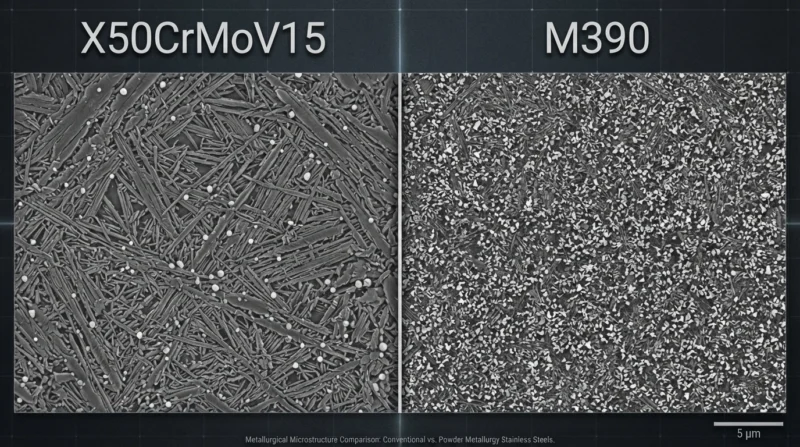
The Biggest Difference: Microstructure
If you want to understand X50CrMoV15 vs M390 properly, chemistry is only the beginning.
The deeper difference is microstructure.
Steel is not a perfectly uniform material at microscopic scale. Different elements combine with the iron matrix to form various phases and carbides.
Those carbides are extremely important in knife performance.
A simplified way to think about them is this:
The steel matrix provides much of the toughness and structural support, while hard carbide particles provide significant resistance to abrasive wear.
X50CrMoV15 contains a relatively modest amount of carbide-forming alloy compared with M390.
M390 contains considerably more.
That creates a very different balance.
When a knife cuts abrasive material, the edge gradually loses material. The harder carbide particles in a high-wear steel can resist that process better than the softer surrounding matrix.
This is a major reason why M390 can maintain useful cutting performance for a long time.
But there is no free performance.
A higher carbide population can also mean:
- more difficult sharpening,
- greater sensitivity to edge damage,
- potentially lower toughness,
- and different behavior at extremely thin edge geometries.
This is why “more carbides” should never automatically be translated into “better knife.”
It means better resistance to a particular type of damage: abrasive wear.
That distinction is extremely important.
X50CrMoV15 vs M390: Carbon Content
Carbon is one of the most important elements in knife steel.
X50CrMoV15 contains roughly 0.45–0.55% carbon.
M390 contains approximately 1.9% carbon.
That is a dramatic difference.
Carbon contributes to the formation of a hard martensitic structure during heat treatment and also participates in carbide formation.
With M390, the higher carbon level works together with large amounts of chromium and vanadium to create a much more carbide-rich steel.
This is one of the foundations of its high wear resistance.
X50CrMoV15 has far less carbon available for this purpose.
That does not mean X50CrMoV15 cannot become hard enough for a very good kitchen knife.
It can.
But its performance is achieved with a much more moderate alloy system.
This gives the steel a different character.
Think of X50CrMoV15 as a balanced road car rather than a specialized racing machine.
It may not dominate one particular category, but it works well across many everyday conditions.
M390 is more specialized.
Its design puts much greater emphasis on resisting wear and maintaining an edge.
Chromium: Both Are Stainless, but That Does Not Make Them Identical
Both X50CrMoV15 and M390 are stainless steels.
However, the amount of chromium in the steel is very different.
X50CrMoV15 contains approximately 14–15% chromium.
M390 contains approximately 20% chromium.
At first glance, that might suggest that M390 must have dramatically better corrosion resistance.
The reality is more complicated.
Chromium contributes to stainless behavior when sufficient chromium remains dissolved in the steel matrix to support the protective passive film.
Not all chromium in a high-alloy steel is necessarily available in the same way because some can participate in carbide formation.
This is one reason that simply looking at the chromium percentage can produce misleading conclusions.
M390 nevertheless has excellent corrosion resistance for a high-hardness knife steel, and its combination of chromium and other alloying elements makes it highly resistant to many ordinary kitchen environments.
X50CrMoV15 also performs very well in normal kitchen use.
For either steel, corrosion resistance is affected by:
- heat treatment,
- surface finish,
- edge condition,
- exposure time,
- salts,
- acids,
- moisture,
- and maintenance.
So the practical difference is not:
X50CrMoV15 rusts while M390 does not.
That would be wrong.
A properly maintained X50CrMoV15 kitchen knife can be highly corrosion resistant.
M390 simply gives the user a larger corrosion-resistance margin in many environments.
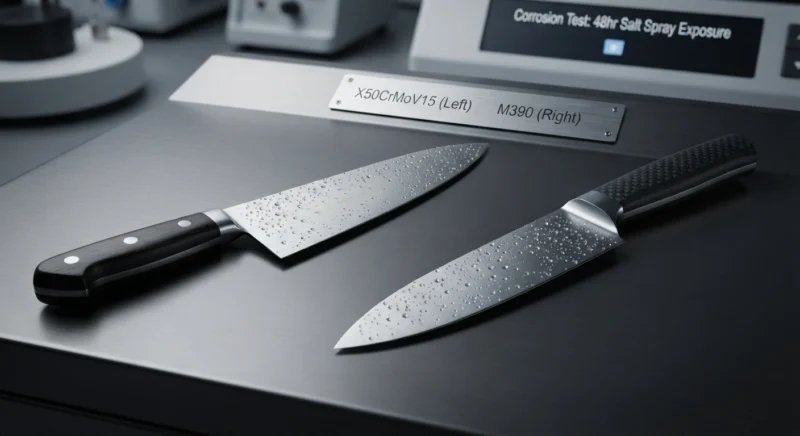
Which Has Better Corrosion Resistance?
If all other variables are reasonably controlled, M390 generally has the advantage in corrosion resistance.
Its high chromium content and alloy design give it excellent stainless behavior.
However, this advantage is less important in an ordinary kitchen than many people imagine.
Suppose you use a chef knife to cut:
- carrots,
- onions,
- potatoes,
- herbs,
- chicken,
- boneless meat,
- fruit,
- and bread.
Then rinse and dry the knife after use.
X50CrMoV15 already has more than enough corrosion resistance for this environment.
M390’s additional corrosion resistance does not necessarily produce a noticeable improvement in everyday cooking.
The difference becomes more interesting when the knife is exposed to:
- prolonged moisture,
- salty foods,
- acidic ingredients,
- humid storage,
- outdoor environments,
- or infrequent maintenance.
In those circumstances, M390’s corrosion resistance can become a more meaningful advantage.
But stainless does not mean maintenance-free.
Neither steel should be left wet indefinitely.
Hardness: M390 Has the Higher Potential
Hardness is another major difference.
X50CrMoV15 is commonly used in kitchen knives at moderate hardness levels. Technical references for 1.4116 show a range of approximately 50–58 HRC for certain hardened applications, while particular knife heat treatments can produce different results. [2][5]
M390 is commonly used at significantly higher hardness, often around the low 60s HRC when properly heat treated.
That difference affects almost everything.
Higher hardness can improve:
- wear resistance,
- edge retention,
- resistance to deformation,
- and the ability to maintain a very fine edge.
But higher hardness does not automatically mean greater toughness.
This is one of the most misunderstood concepts in knife steel.
A harder edge can resist deformation better.
At the same time, an edge that is harder and less tough may be less tolerant of impacts.
Imagine two pieces of metal.
One bends slightly under stress.
The other maintains its shape until a higher stress level is reached, but then breaks or chips.
Hardness and toughness are not the same property.
This is why M390 can provide excellent cutting performance while still requiring more disciplined use than a conventional kitchen steel.
Check Our Guide What Is HRC? Understanding Rockwell Hardness in Kitchen Knives
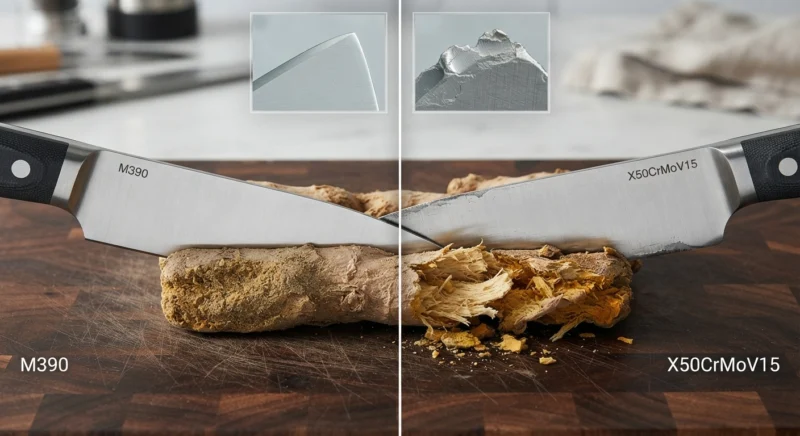
Edge Retention: M390 Wins Clearly
If the main question is:
“Which steel will stay sharp longer?”
M390 is the clear winner.
Its combination of high hardness and substantial hard-carbide content gives it a major advantage in abrasive wear resistance.
Independent CATRA testing of M390 has demonstrated strong edge-retention performance, and metallurgical analysis links this behavior to its carbide content, hardness, and cutting geometry. [3][6]
X50CrMoV15 is not a poor edge-retaining steel.
It simply operates at a different level.
A well-made X50CrMoV15 knife can stay sharp for a useful period under normal kitchen conditions.
But if two knives have:
- similar geometry,
- similar edge angles,
- similar heat-treatment quality,
- and are used under comparable conditions,
the M390 blade will generally retain its cutting ability significantly longer.
This becomes particularly noticeable when cutting abrasive materials or performing large amounts of repetitive slicing.
For a home cook preparing dinner for four people, the difference may not feel dramatic.
For someone cutting continuously for hours, it can be substantial.
Check Our Guide Edge Retention Explained: 10 Factors What Makes a Knife Stay Sharp Longer?
Why M390 Keeps Its Edge Longer
It is useful to understand why.
Edge retention is not determined by one number.
A knife edge can lose performance through several mechanisms.
It can:
- wear away gradually,
- deform,
- roll,
- chip,
- fracture,
- or become damaged through corrosion.
M390 is especially strong against abrasive wear.
Its hard carbides resist being removed during cutting.
The high hardness of the matrix also helps prevent the edge from deforming under moderate loads.
X50CrMoV15 relies much more on the balance between matrix hardness, toughness, and moderate carbide content.
That makes it less extreme.
A useful analogy is tire design.
One tire may be designed for maximum mileage.
Another may be designed for maximum grip.
Another may balance both.
M390 is closer to the first type in this analogy.
X50CrMoV15 is more of an all-rounder.
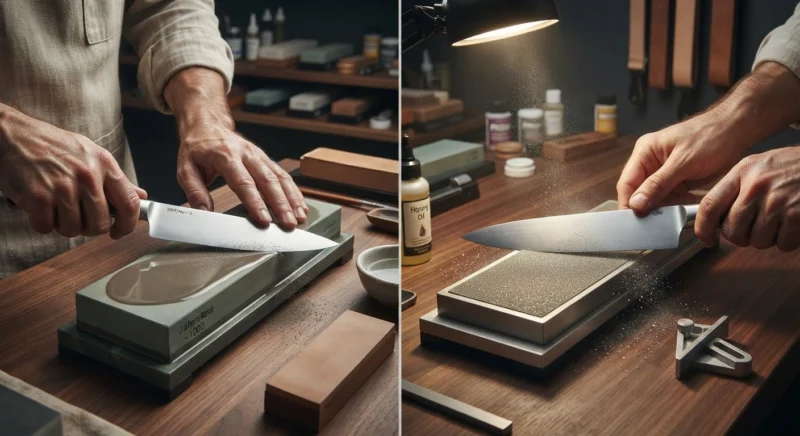
Sharpening: X50CrMoV15 Is Much Easier
This is where the comparison becomes more interesting.
The same characteristics that give M390 impressive edge retention can make sharpening more demanding.
X50CrMoV15 is comparatively easy to sharpen.
A normal waterstone, ceramic system, guided sharpener, or other conventional sharpening method can handle it without unusual difficulty.
M390 benefits from good sharpening technique and appropriate abrasives.
The problem is not simply hardness.
The carbide structure also matters.
Very hard carbides can resist conventional abrasive systems, particularly if the sharpening equipment is not especially aggressive.
A cheap or worn abrasive may feel frustrating against M390.
The knife may appear to sharpen slowly even though you are working correctly.
This is one reason some users initially dislike high-wear steels.
They become accustomed to sharpening ordinary stainless steels and then expect the same sharpening speed from M390.
That expectation is unrealistic.
Does M390 Need Diamond Stones?
Not necessarily.
But diamond or other highly effective abrasives can make sharpening M390 much easier.
The important point is that the abrasive must be capable of efficiently removing the hardened steel and carbide-rich material.
A high-quality conventional sharpening system may work perfectly well.
However, diamond abrasives can provide a noticeable advantage when reprofiling or repairing an M390 edge.
This is especially relevant if the knife has become significantly dull.
For routine touch-ups, the situation is easier.
You do not want to wait until an M390 knife is completely blunt.
Maintaining the edge regularly means removing less material each time.
That is true of almost every knife steel, but it becomes especially valuable with high-wear steels.
Honing: Another Important Difference
Traditional honing rods need some explanation.
Honing does not necessarily remove large amounts of steel.
Depending on the type of rod and the steel involved, honing can realign or modify a fine edge.
X50CrMoV15 generally responds well to appropriate honing.
This is one reason traditional European kitchen knives can be maintained so easily in professional kitchens.
M390 is different.
A very hard M390 edge should not be treated as if it were a soft conventional kitchen knife.
Aggressive honing can create problems if the edge is extremely thin.
A fine ceramic rod can be more appropriate than a traditional coarse steel for many high-hardness knives, but even then technique matters.
The better approach is usually:
sharpen correctly, use the knife correctly, and touch up the edge before it becomes seriously dull.
Check Our Guide All Kinds of Knife Sharpening Tools
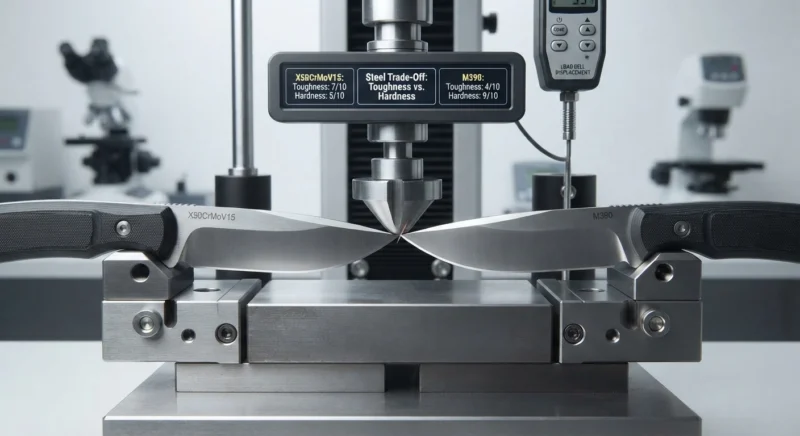
Toughness: X50CrMoV15 Has the Advantage
If edge retention is M390’s strongest argument, toughness is one of X50CrMoV15’s strongest advantages.
X50CrMoV15 is generally more forgiving.
That does not mean it is impossible to chip.
Any hardened knife can chip.
But its overall combination of moderate hardness and relatively modest carbide content gives it a more forgiving character.
M390 is harder and more wear resistant, but its carbide-rich structure means the user should be more careful with impacts.
This is especially important at very thin edge geometries.
A thin M390 edge can be spectacular for slicing.
It can also be less tolerant of:
- twisting,
- lateral force,
- bones,
- frozen food,
- hard pits,
- glass cutting boards,
- and chopping through inappropriate materials.
The same warning applies to any thin high-hardness knife.
The mistake is to assume that because the steel is expensive and wear resistant, the edge is indestructible.
It is not.
Check Our Guide Wear Resistance vs Toughness: Understanding the Most Important Knife Steel Trade-Off
Edge Chipping: Why Geometry Matters
When people say that a steel “chips easily,” the statement is often incomplete.
Chipping depends on much more than steel chemistry.
Important factors include:
- hardness,
- toughness,
- carbide structure,
- edge angle,
- edge thickness,
- heat treatment,
- cutting technique,
- and impact intensity.
An M390 knife with a very thin edge and aggressive geometry can behave differently from another M390 knife with a thicker, more conservative edge.
This is why two knives made from the same steel can have completely different reputations.
One may be extremely stable.
Another may develop microchips.
The difference may not be the steel grade.
It may be the design.
This is one of the most important lessons when comparing knife steels.
Steel is only one part of a knife.
Edge Stability: Where the Real Comparison Gets Complicated
Edge stability describes how well the very edge of a blade maintains its shape under stress.
This is different from overall toughness.
Imagine a knife sharpened to a very acute angle.
The actual metal at the apex becomes extremely thin.
Even a very strong steel can have difficulty supporting that geometry.
If the edge is too thin for the steel and intended use, it can:
- roll,
- microchip,
- deform,
- or fracture.
X50CrMoV15 generally works very well with conventional kitchen geometry.
M390 can support excellent thin edges, but the exact geometry must be matched to the heat treatment and application.
A carefully heat-treated M390 blade with sensible geometry can have outstanding edge stability.
A poorly designed M390 edge can perform worse than a well-designed X50CrMoV15 edge.
This is why simply asking which steel is “stronger” is not enough.
X50CrMoV15 vs M390 for a Chef’s Knife
Now we can move from metallurgy to actual kitchen use.
For a chef’s knife, X50CrMoV15 has several advantages.
It is:
- easy to maintain,
- reasonably easy to sharpen,
- corrosion resistant,
- forgiving,
- relatively inexpensive,
- and capable of excellent kitchen performance.
For many home cooks, that combination is difficult to beat.
You can sharpen it quickly.
You can maintain it without specialized equipment.
If the edge becomes dull, restoring it is relatively straightforward.
And if you accidentally damage the edge, repair does not usually become an enormous project.
M390 offers a different experience.
A good M390 chef’s knife can stay sharp for a very long time.
If you prepare large quantities of vegetables, meat, herbs, or other ingredients, that can be a major advantage.
But the owner needs to accept:
- more demanding sharpening,
- more expensive abrasives,
- greater care around impacts,
- and a higher price for the finished knife.
For an enthusiast who enjoys premium knives, that trade-off may be worthwhile.
For a beginner who simply wants a dependable kitchen knife, it may not be necessary.
X50CrMoV15 for Vegetable Preparation
Vegetable preparation is an interesting example because not all vegetables are equally demanding.
Soft vegetables such as:
- tomatoes,
- zucchini,
- peppers,
- mushrooms,
- and herbs
do not require extreme wear resistance.
A well-sharpened X50CrMoV15 knife can perform beautifully here.
Harder vegetables such as:
- carrots,
- squash,
- sweet potatoes,
- and large root vegetables
place greater demands on edge geometry.
Again, geometry matters more than many people realize.
A thin, well-ground X50CrMoV15 knife can cut very efficiently.
M390 may maintain that edge longer, but it does not necessarily make the initial cut dramatically better.
This is an important distinction.
Edge retention is not the same as cutting ability.
A dull M390 knife can cut worse than a freshly sharpened X50CrMoV15 knife.
Steel does not replace sharpening.
X50CrMoV15 vs M390 for Meat
For boneless meat, both steels can perform very well.
M390’s long edge life can be particularly attractive for repetitive slicing.
If you are preparing large amounts of meat, the ability to maintain a sharp edge for longer can reduce sharpening interruptions.
X50CrMoV15, however, has an advantage in ease of maintenance.
For occasional home cooking, this can be more important than maximum edge retention.
Neither steel should be used carelessly around bones.
Bones and hard joints create impact and lateral stresses that are more dependent on blade geometry and toughness than on simple sharpness.
A knife should be selected according to the job rather than the prestige of the steel.
M390 for Slicing
Slicing is where M390 can really demonstrate its strengths.
A properly heat-treated M390 blade with good geometry can combine:
- high hardness,
- excellent wear resistance,
- good corrosion resistance,
- and a refined edge.
That combination makes it particularly attractive for users who perform a lot of slicing.
Examples include:
- large amounts of vegetables,
- boneless meat,
- fruit,
- prepared foods,
- and repetitive kitchen work.
The longer edge life becomes more noticeable as cutting volume increases.
If you only use the knife for ten minutes each evening, the advantage is less dramatic.
If you use it continuously for hours, it becomes much more valuable.
M390 Is Not Automatically Better at Chopping
This is a common misunderstanding.
A steel with excellent edge retention is not automatically the ideal steel for heavy chopping.
Chopping creates different stresses.
Impact loads become more important.
Edge geometry becomes critical.
Toughness becomes more important.
A thin M390 edge can be fantastic for slicing but inappropriate for heavy chopping.
X50CrMoV15 may be more forgiving in this situation.
This does not mean X50CrMoV15 is a chopping steel in the same sense as a tough tool steel.
It simply means that its balanced characteristics can make it a less demanding choice for general kitchen use.
Heat Treatment Can Change the Entire Comparison
One of the biggest mistakes in online knife discussions is treating the steel name as the final specification.
It is not.
Heat treatment can dramatically change the performance of a steel.
Two knives made from M390 can behave differently.
Two knives made from X50CrMoV15 can also behave differently.
The steel grade defines the potential.
Heat treatment determines how much of that potential becomes usable performance.
Poorly treated M390 can disappoint.
Excellent M390 can be exceptional.
Poorly treated X50CrMoV15 can be soft and disappointing.
Well-treated X50CrMoV15 can be an excellent kitchen steel.
This is why experienced knife users often discuss heat treatment alongside steel selection.
The question should not simply be:
“What steel is this?”
It should be:
“What steel, what heat treatment, what hardness, and what geometry?”
Check Our Guide Different Heat Treatment Methods Explained
Why Hardness Numbers Can Be Misleading
Rockwell hardness is useful.
But it should not be treated as a complete performance score.
Suppose one knife is 58 HRC and another is 62 HRC.
It would be tempting to conclude that the 62 HRC knife is automatically better.
That is not correct.
Hardness is only one part of the system.
The 58 HRC knife may be tougher.
The 62 HRC knife may have better wear resistance.
The 58 HRC knife may be easier to sharpen.
The 62 HRC knife may hold a fine edge longer.
The best choice depends on the application.
This is especially important when comparing X50CrMoV15 with M390 because their intended performance balance is so different.
Sharpening Experience: X50CrMoV15 vs M390
For many owners, sharpening is the biggest practical difference between these steels.
X50CrMoV15
X50CrMoV15 is relatively friendly to conventional sharpening.
It responds well to:
- waterstones,
- ceramic abrasives,
- guided systems,
- conventional sharpening stones,
- and routine edge maintenance.
Removing material is comparatively easy.
That makes it suitable for people who sharpen frequently.
M390
M390 is more demanding.
A dull M390 blade can take significantly longer to restore using weak abrasives.
Diamond abrasives or other high-performance sharpening media can make the process considerably easier.
However, once you understand the steel, sharpening M390 does not need to be intimidating.
The trick is to avoid allowing the knife to become excessively dull.
Small maintenance sessions are easier than major repairs.
Which Steel Is Better for Beginners?
For a beginner, X50CrMoV15 is usually the easier choice.
The reasons are practical rather than glamorous.
A beginner is more likely to:
- use the wrong cutting board,
- sharpen at an inconsistent angle,
- accidentally twist the blade,
- leave the knife wet,
- use an unsuitable honing rod,
- or misunderstand what a sharp knife should feel like.
X50CrMoV15 is relatively forgiving of the learning process.
M390 asks for more discipline.
That does not mean beginners should avoid M390.
It means the user should understand what they are buying.
A premium steel does not eliminate the need for proper knife technique.
Which Steel Is Better for Experienced Knife Users?
For an experienced user, the answer becomes more complicated.
M390 becomes much more attractive when the user knows how to:
- maintain a consistent edge,
- choose appropriate geometry,
- use good sharpening abrasives,
- avoid lateral stress,
- maintain the blade properly,
- and recognize early signs of edge damage.
Under those conditions, M390 can deliver excellent long-term performance.
The user can exploit its high wear resistance without unnecessarily damaging the edge.
This is why M390 is particularly popular among enthusiasts.
The steel rewards correct use.
Which Steel Is Easier to Maintain?
X50CrMoV15 wins.
That is not controversial.
It is easier to sharpen.
It is more forgiving.
It works well with ordinary maintenance equipment.
M390 can certainly be maintained successfully, but it benefits from better equipment and more attention.
If you want a knife that you can quickly restore on an ordinary sharpening stone, X50CrMoV15 is the simpler option.
If you want a knife that may go much longer between sharpening sessions and you are willing to spend more time sharpening when necessary, M390 becomes more appealing.
Which Steel Is Better for Busy Kitchens?
This depends on what “busy” means.
If a professional kitchen means very high cutting volume, M390’s edge retention can be attractive.
Long periods of slicing can expose the difference between moderate and very high wear resistance.
However, professional kitchens also involve:
- frequent washing,
- fast handling,
- hard cutting boards,
- occasional impacts,
- sharpening under time pressure,
- and multiple users.
Those conditions can make a more forgiving steel attractive.
The ideal professional knife therefore depends heavily on workflow.
There is no universal winner.
Which Steel Is Better for Home Cooks?
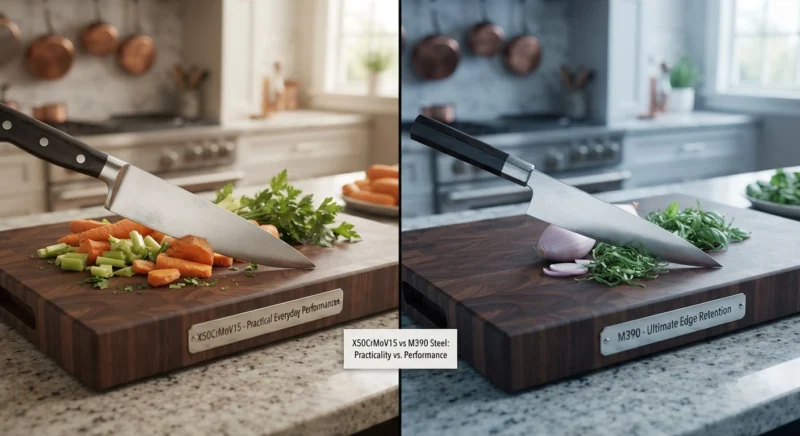
For the average home cook, X50CrMoV15 may actually be the more practical choice.
Why?
Because the average home cook does not sharpen a knife hundreds of times per year.
They may use the knife for a few minutes each day.
In that situation, the enormous edge-retention advantage of M390 may not justify the added sharpening difficulty and price.
If the user loves premium knives and enjoys long edge life, M390 is still an excellent choice.
But performance should be evaluated relative to the user’s actual cutting volume.
Which Steel Has Better Corrosion Resistance in the Kitchen?
M390 generally has the advantage.
Its high chromium content and alloy design give it excellent corrosion resistance.
But X50CrMoV15 is already very corrosion resistant for normal kitchen use.
A properly maintained X50CrMoV15 knife should not be considered a “rust-prone” steel.
In fact, its corrosion resistance is one of the reasons it became such a practical choice for kitchen knives.
If your kitchen knife is routinely rinsed, dried, and stored properly, the corrosion difference between the two may be difficult to notice.
What About Acidic Foods?
Acidic ingredients can include:
- tomatoes,
- citrus,
- vinegar,
- wine,
- certain fruits,
- and fermented foods.
M390’s corrosion resistance gives it a useful advantage here.
However, neither steel should be treated as immune to corrosion.
The edge is particularly important because sharpening exposes fresh metal.
A knife that is repeatedly exposed to acidic food and then left wet can eventually develop staining or corrosion even if the steel is considered highly stainless.
The best maintenance strategy remains simple:
wash, rinse, dry, and store properly.
Dishwasher Use
Neither steel should be selected with dishwasher use as the goal.
A dishwasher exposes knives to:
- heat,
- moisture,
- detergents,
- chemical exposure,
- movement,
- and potential contact with other objects.
Even highly corrosion-resistant steels can suffer cosmetic or edge damage under repeated dishwasher exposure.
More importantly, the knife edge itself can be damaged.
A good kitchen knife deserves hand washing.
That recommendation applies equally to X50CrMoV15 and M390.
Does M390 Need More Care?
Yes, but not because it is fragile in every sense.
It needs more care because its strengths encourage users to push the edge into geometries and applications where the steel’s limitations become more obvious.
A high-performance M390 knife is often made with an aggressive cutting geometry.
That creates excellent slicing performance.
But the thinner the edge becomes, the more important edge stability and toughness become.
A conservative M390 blade can be very robust.
A very thin M390 blade can be spectacularly sharp but less forgiving.
Again:
steel + heat treatment + geometry + use = actual performance.
Edge Angle: A Major Factor in This Comparison
Imagine two knives made from identical M390.
One is sharpened at a relatively robust angle.
The other has an extremely thin edge.
They will not behave the same way.
The thin knife will probably cut more efficiently.
The thicker knife will generally tolerate abuse better.
This principle applies to X50CrMoV15 as well.
The difference is that X50CrMoV15’s more forgiving characteristics often make it easier to use at conventional kitchen angles without worrying excessively about edge damage.
M390 rewards users who understand geometry.
Can X50CrMoV15 Outperform M390?
Absolutely.
This sounds strange, but it is important.
A well-designed X50CrMoV15 knife can outperform a poorly designed M390 knife in actual kitchen use.
Suppose the X50CrMoV15 knife has:
- excellent geometry,
- good heat treatment,
- a thin edge,
- a high-quality finish,
- and a sharp apex.
Suppose the M390 knife has:
- poor geometry,
- excessive edge thickness,
- mediocre heat treatment,
- and a poorly finished edge.
The X50CrMoV15 knife can cut better.
Steel does not override geometry.
This is why experienced knife buyers should not choose solely by steel name.
Can M390 Outperform X50CrMoV15?
Of course.
When the knives are similarly well made, M390’s wear resistance and higher achievable hardness give it a major advantage in edge retention.
For high-volume cutting, that advantage can become substantial.
The M390 knife can remain useful for longer before requiring sharpening.
That is its main reason for existing.
X50CrMoV15 vs M390 for Thin Kitchen Knives
Thin kitchen knives present an interesting challenge.
Thin geometry improves cutting performance because there is less material behind the edge.
That reduces resistance as the blade passes through food.
M390 can be very impressive in this role.
Its high hardness allows a refined edge to remain sharp for a long time.
However, the geometry must be appropriate.
An extremely thin edge can become vulnerable to microchipping if the knife is used aggressively.
X50CrMoV15 is somewhat less extreme but can still produce an excellent thin kitchen edge.
The practical difference is that M390 requires greater attention to how thin the edge becomes.
Check Our Guide Best Blade Thickness for Different Uses
X50CrMoV15 vs M390 for Outdoor Knives
The comparison changes outside the kitchen.
Outdoor knives may encounter:
- wood,
- rope,
- cardboard,
- plastic,
- food,
- dirt,
- moisture,
- and occasional impact.
M390’s edge retention is attractive when cutting abrasive materials such as cardboard or rope.
X50CrMoV15’s toughness and easy sharpening can be more useful when field maintenance and occasional abuse are expected.
The best choice depends on whether the knife is primarily a slicer or a general-purpose working tool.
For long cutting sessions where wear dominates, M390 has a strong advantage.
For unpredictable use, X50CrMoV15’s forgiving nature becomes more attractive.
Check Our Guide Best Hunting Knife Features Explained
Cardboard and Abrasive Materials
This is one of the environments where M390’s advantage becomes especially obvious.
Cardboard contains abrasive material and can wear a knife edge surprisingly quickly.
Repeated cutting can expose differences in wear resistance that are less obvious when preparing ordinary food.
M390 is very well suited to this kind of work.
X50CrMoV15 can certainly cut cardboard.
It simply will not normally maintain its edge for as long.
This is exactly the type of application where high-carbide steels make sense.
What About Fine Slicing?
For fine slicing, both steels can be excellent.
The deciding factors include:
- edge geometry,
- sharpening quality,
- blade thickness,
- heat treatment,
- and technique.
M390 has the advantage of maintaining that refined edge longer.
X50CrMoV15 has the advantage of being easier to restore.
So the choice becomes:
Do you want maximum time between sharpening sessions, or maximum ease when sharpening?
That is a much more useful question than simply asking which steel is superior.
Cost and Value
M390 is generally positioned as a premium steel.
That does not mean every M390 knife is automatically better value.
A premium steel increases material and manufacturing demands, but the finished knife still depends on:
- heat treatment,
- grinding,
- geometry,
- edge finishing,
- handle construction,
- quality control,
- and overall design.
X50CrMoV15 can offer excellent value because it is capable of very good performance without requiring an exotic steel system.
For someone who wants a dependable kitchen knife, this can be a major advantage.
For someone who values long edge retention above almost everything else, paying more for M390 can make sense.
Why M390 Is Not Simply “A Better X50CrMoV15”
It is tempting to think of steel development as a ladder:
basic steel → better steel → premium steel → best steel.
Knife steels do not work that way.
Each steel is a collection of compromises.
X50CrMoV15 gives you a relatively balanced combination of:
- corrosion resistance,
- toughness,
- hardness,
- sharpenability,
- edge stability,
- and wear resistance.
M390 shifts the balance toward:
- wear resistance,
- high hardness,
- edge retention,
- and corrosion resistance.
The trade-off is greater sharpening difficulty and generally less forgiveness than the simpler steel.
So M390 is not simply an upgraded X50CrMoV15.
It is a different engineering solution.
The Importance of Heat Treatment in M390
M390’s composition provides substantial potential, but realizing that potential requires appropriate heat treatment.
The target hardness needs to be matched to the intended application.
Too soft and the knife loses some of the advantages expected from the steel.
Too hard or improperly treated and toughness and edge stability can suffer.
This is why the best M390 knives are not necessarily the ones with the highest advertised hardness number.
A balanced heat treatment can be more useful than chasing an extreme specification.
The goal is not to create the hardest possible M390.
The goal is to create the best-performing M390 blade for the intended geometry and application.
The Importance of Heat Treatment in X50CrMoV15
The same principle applies to X50CrMoV15.
Although it is a relatively conventional steel, heat treatment still matters enormously.
A poorly treated blade may feel soft.
It may lose its edge quickly.
It may roll rather than cut cleanly.
A well-treated blade can feel completely different.
Technical documentation for 1.4116 specifies controlled hardening and tempering conditions, demonstrating that the steel’s final properties depend on processing rather than chemistry alone. [2]
This is one reason experienced knife buyers often care about the maker’s manufacturing quality as much as the steel designation.
Which Steel Is Easier to Polish?
X50CrMoV15 is generally easier to work with.
M390 is more difficult because of its high alloy content and hard carbides.
This matters during:
- grinding,
- polishing,
- reprofiling,
- sharpening,
- and repair.
For the end user, the biggest consequence is sharpening.
For the maker, the consequences are much broader.
Producing a high-quality M390 blade requires suitable equipment and careful processing.
That helps explain why premium powder steels tend to appear in more expensive knives.
Does M390 Hold a Sharper Edge?
Not necessarily in the sense of initial sharpness.
This is another important distinction.
A knife can be sharpened extremely sharp regardless of whether it is made from X50CrMoV15 or M390.
Initial sharpness depends heavily on:
- edge geometry,
- apex refinement,
- sharpening technique,
- burr removal,
- and finishing.
M390’s advantage is that it can retain that sharpness for longer.
So the correct statement is:
M390 generally offers better edge retention, not magically greater initial sharpness.
Which Steel Feels Sharper?
This depends heavily on geometry and sharpening.
A thin X50CrMoV15 knife can feel incredibly sharp.
A thick M390 knife can feel mediocre.
If both are sharpened equally well and have similar geometry, M390 can maintain its cutting performance for longer.
But the user will experience the geometry first.
The steel’s chemistry becomes increasingly important as the edge wears.
X50CrMoV15 vs M390 for Everyday Kitchen Maintenance
For everyday ownership, the difference can be summarized in two different routines.
X50CrMoV15 routine
Use the knife.
Wash it.
Dry it.
Sharpen it occasionally.
Maintain the edge with normal equipment.
Repeat.
M390 routine
Use the knife.
Wash it.
Dry it.
Avoid unnecessary impacts.
Maintain the edge before it becomes seriously dull.
Use appropriate abrasives when sharpening.
Repeat.
Neither routine is difficult.
But the M390 routine requires slightly more awareness.
Common Mistakes With M390
The most common mistake is assuming:
“It is premium steel, so I can abuse it.”
That is exactly backwards.
The more performance-oriented the steel and geometry become, the more important correct use can be.
Other common mistakes include:
Waiting too long to sharpen
A severely dull M390 knife can take considerably longer to restore.
Using poor abrasives
Weak abrasives may make sharpening unnecessarily frustrating.
Using a coarse honing rod aggressively
A high-hardness fine edge does not need brute force.
Cutting hard materials
No premium steel makes a kitchen knife appropriate for bones, frozen food, glass, or other unsuitable materials.
Using an inappropriate edge angle
An extremely thin edge can be spectacularly sharp but vulnerable to damage.
Common Mistakes With X50CrMoV15
The biggest mistake is assuming that because X50CrMoV15 is easy to sharpen, it can tolerate anything.
It cannot.
You can still damage the edge through:
- twisting,
- chopping inappropriate materials,
- using a glass cutting board,
- hitting bones,
- or sharpening at an unsuitable angle.
Its forgiving nature should not be confused with indestructibility.
Which Steel Is Better for a Knife Block?
If you want several kitchen knives that are easy for different users to maintain, X50CrMoV15 is a very practical choice.
It works well for:
- chef knives,
- utility knives,
- paring knives,
- carving knives,
- and general-purpose kitchen blades.
M390 can also be used for these applications, especially when premium edge retention is desired.
But for a shared household knife collection, the simplicity of X50CrMoV15 can be an advantage.
Not everyone who uses a knife will understand the maintenance requirements of a high-hardness premium steel.
Which Steel Is Better for a Premium Chef Knife?
Here the answer depends on what “premium” means.
If premium means:
easy to sharpen, balanced, reliable, and forgiving
X50CrMoV15 can absolutely qualify.
If premium means:
very high edge retention, high hardness, refined geometry, and long intervals between sharpening
M390 has the stronger argument.
The word “premium” should describe the complete knife rather than only the steel.
A beautifully engineered X50CrMoV15 knife can be more enjoyable than a poorly made M390 knife.
Does M390 Rust?
M390 is highly corrosion resistant, but “rust proof” is not a useful way to describe any knife steel.
Under ordinary kitchen conditions, corrosion should not be a major concern.
However, neglect can still create problems.
Moisture, salts, acids, contamination, and poor storage can eventually affect almost any steel.
The correct approach is to treat M390 as highly stainless rather than completely immune to corrosion.
Does X50CrMoV15 Rust?
X50CrMoV15 is also highly stainless in ordinary knife use.
Its 14–15% chromium content gives it good corrosion resistance.
However, it is not immune to staining or corrosion.
Keeping the knife clean and dry is still important.
The practical difference between the two becomes more significant in demanding environments than in ordinary home cooking.
X50CrMoV15 vs M390: Which One Keeps Its Edge Longer?
M390.
This is the easiest category to decide.
Its high carbide volume and hardness give it a major wear-resistance advantage.
If long edge life is your highest priority, M390 is the better choice.
X50CrMoV15 vs M390: Which One Is Easier to Sharpen?
X50CrMoV15.
Its simpler microstructure and lower hardness make sharpening substantially more straightforward.
For users who sharpen by hand, this can be a major advantage.
X50CrMoV15 vs M390: Which One Is Tougher?
X50CrMoV15 generally has the more forgiving toughness profile.
M390 can be tough enough for many demanding applications, but its high hardness and carbide-rich structure shift the balance toward wear resistance.
The exact result depends on heat treatment and geometry.
X50CrMoV15 vs M390: Which One Has Better Corrosion Resistance?
M390 generally has the advantage, although X50CrMoV15 is already highly suitable for normal kitchen environments.
For most home cooks, the difference will be less important than proper cleaning and drying.
X50CrMoV15 vs M390: Which One Is Better for Kitchen Knives?
There is no universal winner.
For a general-purpose kitchen knife, X50CrMoV15 makes a tremendous amount of sense.
It is:
- easy to sharpen,
- corrosion resistant,
- reasonably tough,
- stable,
- practical,
- and inexpensive compared with high-end powder steels.
M390 makes more sense for users who specifically value:
- very long edge retention,
- high hardness,
- premium steel performance,
- and reduced sharpening frequency.
The best choice depends on the owner.
The Most Important Question: How Do You Use Your Knife?
Consider two users.
User A
They cook dinner five nights per week.
They cut vegetables, meat, herbs, and fruit.
They sharpen their knife occasionally.
They want something simple.
They sometimes lend the knife to family members.
They do not want special sharpening equipment.
X50CrMoV15 is an excellent fit.
User B
They love knives.
They use them extensively.
They appreciate thin geometry.
They dislike frequent sharpening.
They are comfortable using diamond abrasives.
They understand how to avoid lateral stress.
They want maximum edge retention.
M390 is a much better fit.
Neither user is wrong.
They simply have different priorities.
Final Verdict: X50CrMoV15 vs M390
So, which knife steel is better?
The honest answer is:
M390 is the superior steel for edge retention and wear resistance, while X50CrMoV15 is the more balanced and user-friendly steel.
If your priority is keeping an edge sharp for as long as possible, M390 wins.
If your priority is easy sharpening, good toughness, practical corrosion resistance, and straightforward maintenance, X50CrMoV15 wins.
If you want a premium knife for extended cutting sessions, M390 is extremely attractive.
If you want a dependable kitchen knife that is easy to maintain for years, X50CrMoV15 remains an excellent choice.
The difference becomes even clearer when the knives are used incorrectly.
A very thin M390 blade can chip if abused.
A thick X50CrMoV15 blade can feel dull and inefficient.
A poorly heat-treated M390 blade can disappoint.
A beautifully heat-treated X50CrMoV15 blade can be outstanding.
That is why the best knife decision should never be based on the steel name alone.
Look at the entire system:
steel + heat treatment + hardness + geometry + edge angle + intended use + sharpening method.
That is what determines the knife you actually hold in your hand.
X50CrMoV15 vs M390: Frequently Asked Questions
Is M390 better than X50CrMoV15?
For edge retention and wear resistance, yes. M390 is designed for substantially higher wear resistance and is normally used at higher hardness. X50CrMoV15 is more balanced and easier to sharpen.
Is X50CrMoV15 a good kitchen knife steel?
Yes. X50CrMoV15 is a practical stainless martensitic steel with good corrosion resistance, useful hardness, reasonable toughness, and easy sharpening characteristics.
Is M390 good for kitchen knives?
Yes. M390 can make an excellent kitchen knife, particularly for users who value long edge retention. Its main disadvantages are greater sharpening difficulty and the need for more careful edge management.
Which steel stays sharp longer?
M390.
Its higher hardness and carbide-rich microstructure give it significantly greater wear resistance than X50CrMoV15.
Which steel is easier to sharpen?
X50CrMoV15.
It can be sharpened efficiently with conventional sharpening equipment.
Does M390 need diamond sharpening stones?
It does not strictly require diamond stones, but diamond or similarly effective abrasives can make sharpening and reprofiling considerably easier.
Which steel is more corrosion resistant?
M390 generally has the advantage, but both steels offer good corrosion resistance when properly maintained.
Which steel is tougher?
X50CrMoV15 generally offers the more forgiving combination of hardness, carbide content, and toughness. Exact performance still depends on heat treatment and geometry.
Can M390 chip?
Yes. M390 can chip if the edge is made very thin and subjected to impacts, twisting, or unsuitable materials. No knife steel should be considered immune to chipping.
Is X50CrMoV15 too soft for a good chef knife?
No. A properly heat-treated X50CrMoV15 chef knife can have excellent cutting performance. It simply does not offer the same level of wear resistance as M390.
Does M390 make a knife sharper?
Not automatically. Sharpness depends heavily on geometry and sharpening. M390’s major advantage is that it can retain a sharp edge for longer.
Is M390 worth the extra cost?
For users who value long edge retention and premium performance, it can be. For ordinary home cooking, the easier maintenance and lower cost of X50CrMoV15 may provide better overall value.
Which steel is better for beginners?
X50CrMoV15 is generally the easier choice because it is forgiving and easy to sharpen.
Which steel is better for knife enthusiasts?
M390 is particularly attractive to enthusiasts who understand edge geometry and sharpening and want very high wear resistance.
Final Takeaway
X50CrMoV15 and M390 represent two very different approaches to knife steel.
X50CrMoV15 is about balance.
It offers a practical combination of corrosion resistance, toughness, hardness, edge stability, and sharpening ease. It is an excellent choice for users who want dependable performance without demanding maintenance.
M390 is about maximizing wear resistance.
Its high-alloy, powder-metallurgy design allows it to retain an edge exceptionally well. It is especially attractive when long cutting sessions and infrequent sharpening are more important than simple maintenance.
If you want the easiest knife to live with, choose the characteristics of X50CrMoV15.
If you want maximum edge retention and are willing to accept more demanding sharpening, choose M390.
And if you are choosing between two actual knives rather than two steel names, remember the most important rule of all:
A great knife is not made by steel alone.
Heat treatment, geometry, edge thickness, sharpening quality, and intended use can matter just as much as the designation stamped on the blade.
https://einsal.com/en/materials/material-database/material/1.4116