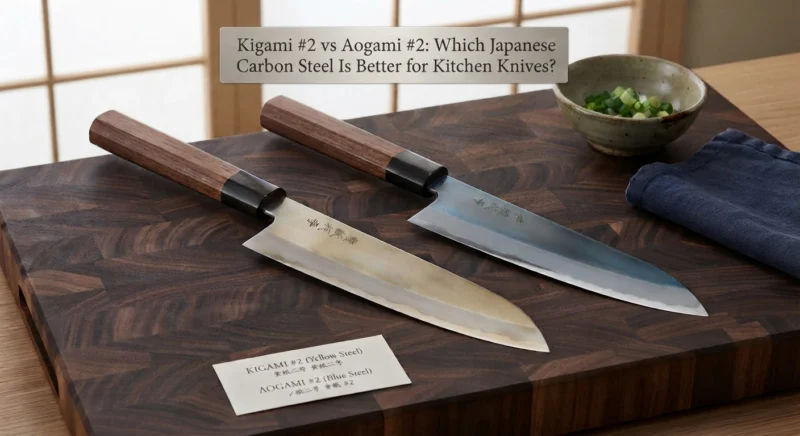
Kigami #2 vs Aogami #2
An Independent Guide
When choosing a traditional Japanese kitchen knife, the steel designation can be just as important as the blade shape, grind, or construction. Two steels that frequently appear in Japanese knife discussions are Kigami #2 and Aogami #2.
At first glance, the comparison may seem straightforward. Both are traditional high-carbon Japanese steels. Both can produce extremely sharp edges. Both are capable of reaching high hardness when properly heat-treated. Neither should be treated like stainless steel, and both reward careful sharpening and maintenance.
Yet the knives can feel noticeably different in use.
The reason is not simply that one steel is “better” than the other. Their compositions and metallurgical goals are different.
Kigami #2 takes a relatively simple high-carbon-steel approach. Aogami #2 keeps a similar carbon level but introduces tungsten and chromium. Those alloying additions encourage the formation of harder carbide structures and change the steel’s resistance to wear. The result is generally longer edge retention, but also a somewhat different sharpening response.
This makes the comparison particularly interesting for cooks who care about the entire life of an edge rather than simply asking which steel is harder.
Kigami #2 can be an excellent choice when easy sharpening, responsive maintenance, and traditional carbon-steel behavior are priorities. Aogami #2 is usually more attractive when longer edge retention and greater resistance to abrasive wear matter more.
Neither steel is universally superior.
The better choice depends on how you use a knife, how often you sharpen, what foods you prepare, how thin the edge is, and how much maintenance you are willing to perform.
This guide examines Kigami #2 vs Aogami #2 from the perspective of real knife use: composition, hardness, sharpening, edge retention, toughness, corrosion, edge stability, food preparation, maintenance, and long-term ownership.
Kigami #2 vs Aogami #2 at a Glance
The simplest way to understand the difference is to look at what each steel is trying to accomplish.
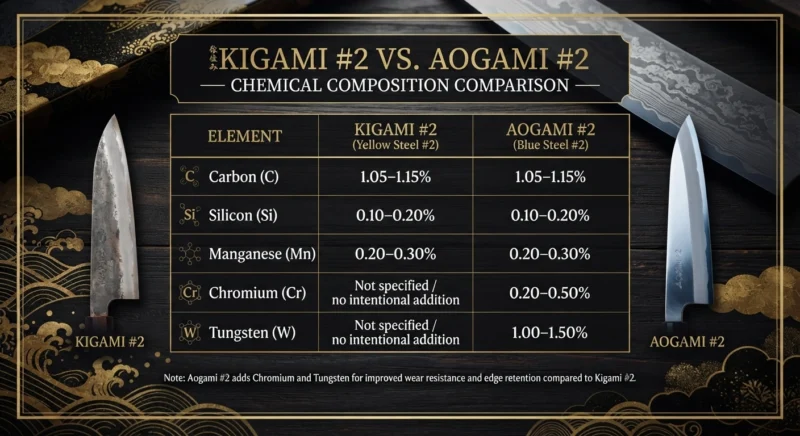
Kigami #2 is a relatively uncomplicated high-carbon steel with approximately 1.05–1.15% carbon and relatively small amounts of silicon and manganese. Its chemistry contains no intentional tungsten or chromium additions comparable to those found in Aogami #2.
Aogami #2 has a similar carbon range, approximately 1.05–1.15%, but adds roughly 1.00–1.50% tungsten and 0.20–0.50% chromium. These alloying additions increase wear resistance and contribute to longer edge life.
That distinction is more important than the names “yellow” and “blue.”
The names do not mean that one steel is inherently harder, sharper, or more premium simply because of its color designation.
Instead, they identify different steel families and compositions.
A practical summary is:
- Kigami #2: simple, responsive, easy to maintain, excellent sharpening behavior
- Aogami #2: more wear-resistant, longer edge retention, still highly sharpenable
- Both: high-carbon, reactive, capable of very high sharpness
- Neither: stainless
- Both: highly dependent on heat treatment and blade geometry
Aogami #2 therefore represents an alloyed development of the traditional high-carbon Japanese steel concept rather than a completely different type of knife steel.
What Is Kigami #2?
Kigami #2 is part of the traditional Japanese “yellow paper” family of carbon steels.
The steel has approximately 1.05–1.15% carbon, with relatively small amounts of silicon and manganese and tightly controlled impurity levels. Unlike Aogami #2, it does not intentionally rely on substantial additions of tungsten or chromium to create additional wear-resistant carbides.
That relatively simple chemistry has an important consequence.
The steel does not have to overcome a large population of hard alloy carbides when it is sharpened.
This is one reason traditional simple carbon steels are often appreciated by people who sharpen Japanese knives by hand.
A waterstone can remove steel efficiently, the abrasive feedback is easy to recognize, and refining the edge can feel very direct.
This does not mean Kigami #2 is a soft steel.
Properly heat-treated, it can reach a hardness suitable for high-performance kitchen knives. Published references generally place Japanese high-carbon paper steels in the neighborhood of 60 HRC and above, although the actual hardness of an individual knife depends on heat treatment, tempering, geometry, and the maker’s target.
This distinction is important.
Steel composition establishes possibilities.
Heat treatment determines much of what the finished knife actually becomes.
Two knives made from the same nominal steel can therefore behave differently.
Check Our Guide Kigami #2 Steel
What Is Aogami #2?
Aogami #2 is an alloyed Japanese high-carbon steel designed to provide greater wear resistance and edge retention while retaining the ability to produce a very refined cutting edge.
Its carbon content is broadly similar to Kigami #2, around 1.05–1.15%.
The important difference is the presence of alloying elements, particularly tungsten and chromium.
Typical published composition ranges put tungsten around 1.00–1.50% and chromium around 0.20–0.50%.
These amounts may look small compared with the composition of modern stainless or powder metallurgy steels.
Metallurgically, however, they are significant.
Tungsten contributes to the formation of hard carbides. Those carbides increase resistance to abrasive wear, which is directly relevant to how long an edge can continue cutting effectively.
Chromium also affects hardenability and carbide formation, although the relatively low chromium content means Aogami #2 remains a reactive carbon steel rather than becoming stainless.
This is a critical point:
Aogami #2 contains chromium, but it is not a stainless steel.
Its chromium level is nowhere near the concentration normally associated with stainless behavior. Aogami #2 can develop patina and can rust if it is neglected.
The purpose of the alloying additions is primarily performance rather than corrosion protection.
Check Our Guide Aogami Steel N2
The Most Important Chemical Difference
The most useful way to understand Kigami #2 vs Aogami #2 is not to memorize every element.
Instead, focus on one fundamental distinction:
Kigami #2 is a relatively simple high-carbon steel, while Aogami #2 is an alloyed high-carbon steel containing tungsten and chromium.
The carbon content is remarkably similar.
That means the difference between the two cannot simply be explained as “Aogami has more carbon.”
It doesn’t.
Instead, the alloying additions change how the steel behaves.
Tungsten is particularly important because it participates in carbide formation.
Carbides are harder particles within the steel matrix. Depending on their type, size, distribution, and volume, they can substantially influence wear resistance.
For knife users, this means that Aogami #2 generally resists abrasive dulling better than a simpler carbon steel.
That does not automatically mean Aogami #2 cuts better.
Sharpness is not determined by alloy content alone.
A beautifully sharpened Kigami #2 knife can be every bit as sharp as an Aogami #2 knife.
In fact, the simpler steel can feel particularly satisfying during sharpening because the edge responds quickly to the abrasive.
Kigami #2 vs Aogami #2: Sharpness
Both steels can take an exceptionally sharp edge.
This is one of the reasons Japanese carbon steels remain popular despite the availability of modern stainless and powder metallurgy alternatives.
The final sharpness of a knife depends on several factors:
- steel composition
- heat treatment
- hardness
- grain structure
- carbide structure
- blade geometry
- edge angle
- sharpening technique
- abrasive choice
- finishing technique
Therefore, saying that one steel is “sharper” than another is usually too simplistic.
A properly prepared Kigami #2 edge can be extremely fine.
A properly prepared Aogami #2 edge can also be extremely fine.
The more meaningful difference is what happens after sharpening.
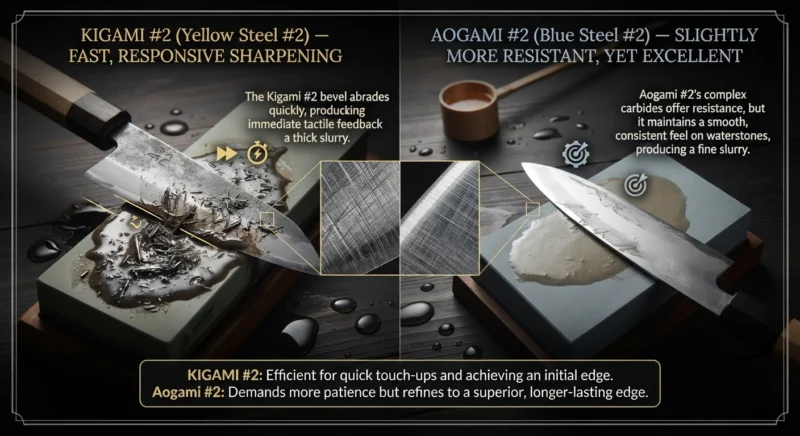
Kigami #2 generally offers a very responsive sharpening experience and can produce a clean, refined edge without requiring the user to fight substantial wear-resistant carbide content.
Aogami #2 can reach a similarly refined edge, but the alloyed structure tends to make sharpening somewhat more resistant.
That difference becomes more noticeable as the abrasive becomes finer.
Check Our Guide All Kinds of Knife Sharpening Tools
Sharpening Kigami #2
Kigami #2 is attractive to people who enjoy sharpening.
On a waterstone, the steel can feel relatively quick and responsive.
The stone removes material efficiently, allowing the user to establish a bevel, repair a small amount of edge damage, raise a burr, and refine the edge without spending excessive time.
This is particularly useful for cooks who sharpen frequently.
Imagine two users.
The first user sharpens every few weeks and wants the process to be quick.
The second user enjoys sharpening and does not mind spending additional time refining an edge.
Both may appreciate Kigami #2, but for different reasons.
The first benefits from efficiency.
The second benefits from feedback.
A simple carbon steel often gives the sharpening process a very direct feel.
The user can clearly feel the stone engaging with the bevel.
This is one reason Japanese carbon knives are often recommended to people who want to learn freehand sharpening.
They provide useful feedback.
Sharpening Aogami #2
Aogami #2 is still considered quite manageable on waterstones.
It is not an extreme wear-resistant steel.
This is important because modern knife discussions sometimes create the impression that any alloyed steel must be difficult to sharpen.
That is not true.
Aogami #2 occupies a useful middle ground.
Its tungsten-containing structure provides greater wear resistance than a simpler carbon steel, but it remains far more approachable on conventional waterstones than many highly alloyed modern steels.
Independent references commonly describe Aogami #2 as retaining excellent sharpening characteristics despite its improved wear resistance.
The practical difference is therefore not:
“Kigami can be sharpened, Aogami cannot.”
The difference is closer to:
Kigami #2 is more immediately responsive, while Aogami #2 asks for somewhat more work in exchange for longer edge life.
That is a much more useful distinction.
Which Is Easier to Sharpen?
If sharpening speed and responsiveness are the priority, Kigami #2 has the advantage.
If you want good sharpening characteristics but also want more edge retention, Aogami #2 is the stronger compromise.
The difference should not be exaggerated.
Aogami #2 is not an exceptionally difficult steel to sharpen.
It simply has more wear resistance.
That means that the amount of time required to remove metal during sharpening can be somewhat greater.
The exact experience depends heavily on:
- stone type
- stone grit
- pressure
- edge condition
- hardness
- bevel geometry
- whether you are repairing or simply refreshing the edge
A badly damaged Aogami #2 knife may require substantially more work than a lightly dulled Kigami #2 knife.
But that is partly because the starting condition is different.
Edge Retention: The Major Advantage of Aogami #2
This is where Aogami #2 normally pulls ahead.
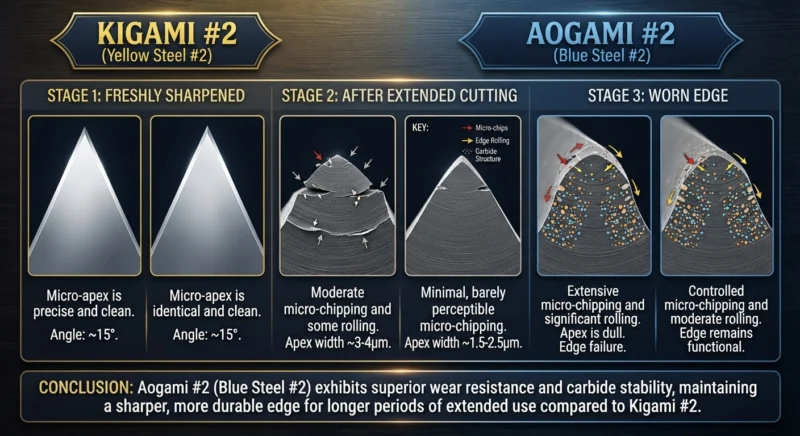
Its tungsten-containing alloy structure gives it greater resistance to abrasive wear.
In practical terms, that means an Aogami #2 edge generally stays effective for longer under comparable use.
This advantage becomes particularly relevant for cooks who use the same knife continuously throughout a busy preparation session.
Consider a chef preparing large quantities of vegetables.
Every cut creates some degree of abrasive interaction between the edge and the food, board, and microscopic contaminants.
Over time, the edge changes.
The knife may still be sharp, but the initial bite becomes less aggressive.
Aogami #2’s increased wear resistance helps slow that process.
This does not mean the knife remains perfectly sharp indefinitely.
No steel does.
It means the decline can be slower.
Independent steel references consistently identify Aogami #2’s tungsten additions as a major reason for its improved wear resistance and edge retention compared with simpler high-carbon steels.
Check Our Guide Edge Retention Explained: 10 Factors What Makes a Knife Stay Sharp Longer
Does Kigami #2 Have Poor Edge Retention?
No.
This is another misconception worth correcting.
Kigami #2 is not a low-performance steel.
It can produce a very capable kitchen-knife edge.
Its limitation is relative.
If Aogami #2 holds an edge longer under otherwise comparable conditions, that does not mean Kigami #2 loses its edge quickly.
It simply means that the alloyed steel has a greater resistance to wear.
A very thin Kigami #2 knife with excellent heat treatment can outperform a poorly made Aogami #2 knife in real kitchen use.
That is because the steel name is only one part of the equation.
Edge Retention Is Not the Same as Sharpness
This distinction is extremely important.
Suppose you have two knives.
Knife A takes an extremely sharp edge but loses some of that initial sharpness relatively quickly.
Knife B takes an equally sharp edge but maintains that cutting performance for longer.
Knife B has better edge retention.
It is not necessarily sharper.
This is why comparing steel only by “sharpness” can be misleading.
Kigami #2 and Aogami #2 can both be sharpened to excellent levels.
Aogami #2’s major advantage is maintaining the edge rather than creating some magical level of sharpness unavailable to Kigami #2.
Toughness and Chipping
Toughness is one of the most misunderstood properties of knife steel.
It describes resistance to cracking and fracture, not simply resistance to dulling.
A very hard edge can hold its shape well but still be vulnerable to chipping if the geometry is extremely thin or the knife is used improperly.
Kigami #2 and Aogami #2 are both high-carbon steels intended for fine cutting performance.
Neither should be treated like a heavy-duty chopping steel.
Neither is appropriate for:
- bones
- frozen food
- hard cutting boards
- twisting through food
- prying
- chopping hard materials
Aogami #2 is often regarded as offering a useful balance between hardness, edge retention, and practical toughness. Independent descriptions frequently position it as a relatively forgiving member of the Aogami family.
However, toughness cannot be predicted from the steel name alone.
Heat treatment and geometry matter enormously.
Check Our Guide Wear Resistance vs Toughness: Understanding the Most Important Knife Steel Trade-Off
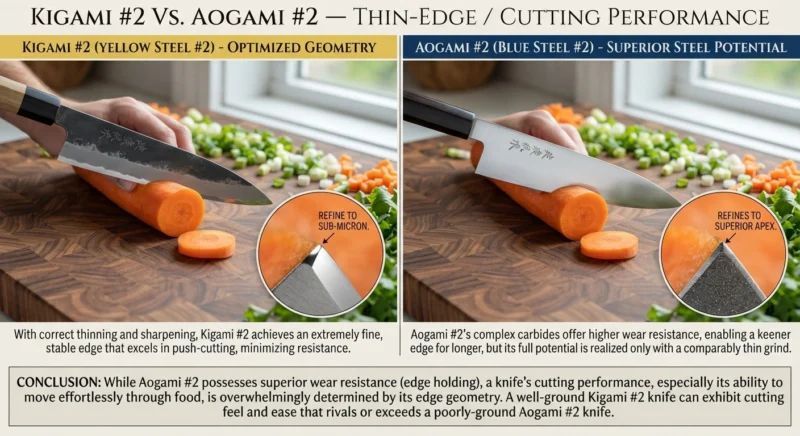
Geometry Can Matter More Than Steel
This is perhaps the most important point for anyone buying a Japanese knife.
Suppose you compare:
- a thin, well-ground Kigami #2 gyuto
- a thick, poorly ground Aogami #2 gyuto
The Kigami knife may feel dramatically better.
It may cut more easily.
It may feel sharper.
It may require less force.
It may even seem to have better edge retention because the geometry is optimized for the food being cut.
This is why steel comparisons should never be treated as absolute rankings.
The knife is a system.
Steel provides the material properties.
Heat treatment establishes much of the steel’s final behavior.
Geometry determines how the edge interacts with food.
Sharpening determines the condition of the edge.
The user determines how that edge is treated.
All four matter.
Hardness: Kigami #2 vs Aogami #2
Hardness is another area where simplistic comparisons can create confusion.
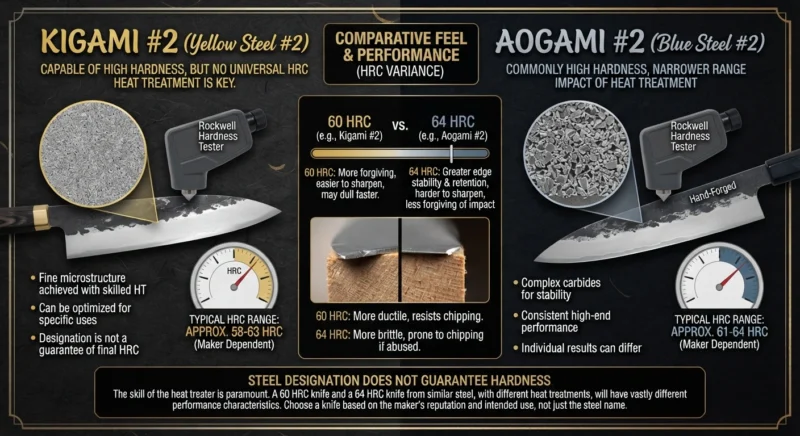
Aogami #2 knives are commonly found around the low-to-mid 60s HRC, depending on the maker and heat treatment. Published references give ranges such as approximately 61–63 or 62–64 HRC for Aogami #2, although individual knives can differ.
Kigami #2 is also capable of reaching high hardness suitable for fine Japanese kitchen knives.
But there is no universal HRC value for every Kigami #2 knife.
This is why a steel designation should never be interpreted as a guarantee of hardness.
Heat treatment can shift the final result considerably.
A 60 HRC knife and a 64 HRC knife made from similar steel can feel very different.
The harder edge may provide greater edge stability and retention but can also become less forgiving of impact.
Check Our Guide What Is HRC? Understanding Rockwell Hardness in Kitchen Knives
Is Aogami #2 Harder Than Kigami #2?
Not necessarily.
This is an important distinction.
Aogami #2 is designed to provide improved wear resistance through alloying.
That does not mean every Aogami #2 knife is automatically harder than every Kigami #2 knife.
Hardness is determined by heat treatment.
If a Kigami #2 knife is properly hardened to a high target and an Aogami #2 knife is deliberately tempered softer, the Kigami knife may have the higher measured hardness.
The more useful statement is:
Aogami #2 has greater alloy-related wear resistance, while actual knife hardness depends on heat treatment.
That distinction makes steel comparisons much more accurate.
Corrosion Resistance
Neither steel should be selected if your main objective is corrosion resistance.
Both are reactive carbon steels.
Kigami #2 contains little intentional chromium and should be treated as a carbon steel.
Aogami #2 contains chromium, but its chromium content is only a fraction of what would be required for stainless behavior. Sources discussing Aogami #2 specifically emphasize that its chromium addition does not make it stainless.
Therefore:
Aogami #2 can rust.
It can also develop patina.
Many owners consider patina part of the character of a carbon-steel knife.
The surface may gradually change color from bright metal to shades of grey, blue, brown, or dark grey depending on use and exposure.
A stable patina can provide some additional surface protection, but it should not be treated as a substitute for proper care.
Does Aogami #2 Rust Less Than Kigami #2?
Possibly, but the difference should not be exaggerated.
Aogami #2’s chromium content can have some influence on corrosion behavior.
However, it is nowhere near stainless-steel territory.
In practical kitchen use, both should be treated as reactive carbon steels.
That means:
- Do not leave the blade wet.
- Wipe acidic foods from the blade.
- Avoid leaving the knife in a sink.
- Dry it after washing.
- Do not put a reactive carbon knife in a dishwasher.
- Keep the edge clean during long preparation sessions.
A cook who follows these habits can comfortably use either steel.
A cook who wants to leave a knife wet and unattended should choose stainless steel instead.
Patina on Kigami #2 and Aogami #2
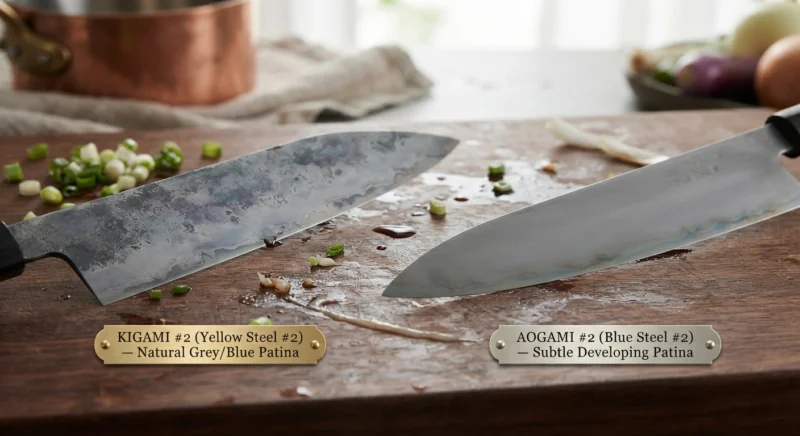
Patina is a controlled surface reaction rather than ordinary red rust.
Many Japanese knife enthusiasts deliberately allow a patina to develop.
Acidic ingredients such as:
- onions
- citrus
- tomatoes
- apples
- vinegar
- certain fish
- other acidic foods
can accelerate patina formation.
Kigami #2 can develop patina readily.
Aogami #2 can also develop patina.
The visual difference depends heavily on the blade’s finish, cladding, heat treatment, use, and environment.
Patina is not evidence that a steel is defective.
It is part of the normal behavior of reactive carbon steel.
Rust, however, is different.
Red or orange corrosion should be removed rather than ignored.
Cutting Feel
Cutting feel is difficult to quantify but very important to knife users.
Two steels can both be extremely sharp while feeling different on the cutting board.
Kigami #2 can have a particularly clean and direct cutting sensation when paired with a thin geometry.
The edge responds quickly during sharpening, and the finished edge can feel very lively.
Aogami #2 can offer a somewhat more durable edge sensation.
The difference is not necessarily dramatic on the first cut.
It becomes more apparent after repeated use.
As the edge begins to wear, Aogami #2 may retain its useful cutting character for longer.
This is one reason professional cooks often appreciate the alloyed steel.
They may not care whether the knife feels marginally better immediately after sharpening.
They care about how it performs several hours later.
Kigami #2 for Home Cooks
Kigami #2 makes a lot of sense for home cooks who enjoy maintaining their knives.
A home kitchen often has an important advantage:
There is time.
If a knife is used for dinner preparation and sharpened periodically, edge retention may not be the dominant concern.
Suppose you use a knife for 20 or 30 minutes a day.
You may prefer a steel that is extremely easy to refresh rather than one that remains sharp for as long as possible.
Kigami #2 can fit this style very well.
It is also attractive for people learning traditional Japanese knife sharpening.
The sharpening response can make it easier to understand:
- where the bevel is
- how pressure changes the cutting action
- when a burr has formed
- how to refine the edge
- how different stones change the finish
The steel becomes part of the sharpening experience.
Aogami #2 for Professional Cooks
Aogami #2 can make more sense when the knife is used intensively.
A professional cook may perform hundreds or thousands of cuts during a working day.
Even modest differences in wear resistance can become significant over time.
If sharpening takes the knife out of service, edge retention becomes more valuable.
Aogami #2’s alloyed structure gives it an advantage here.
The cook can sharpen less frequently while maintaining useful cutting performance.
This is not an absolute rule.
Professional kitchens vary enormously.
A cook working primarily with soft vegetables may prefer a very fine simple carbon edge.
Another working with dense produce and large quantities may prioritize wear resistance.
The best choice depends on the cutting environment.
Kigami #2 for Knife Enthusiasts
Knife enthusiasts often appreciate Kigami #2 for a different reason.
It provides a connection to traditional Japanese carbon-steel behavior without requiring the complexity of more highly alloyed steels.
The steel responds noticeably to sharpening.
It develops patina.
It can take a very fine edge.
And it rewards careful technique.
For someone who considers sharpening part of knife ownership rather than merely maintenance, those qualities can be more important than maximum edge retention.
The experience matters.
A knife is not only a tool.
For many enthusiasts, it is also a precision object that is maintained and refined over years.
Aogami #2 for Knife Enthusiasts
Aogami #2 offers another kind of appeal.
It is a bridge between traditional carbon-steel behavior and greater wear resistance.
You still get:
- reactive carbon-steel behavior
- high hardness potential
- excellent sharpening capability
- refined edge performance
- traditional Japanese knife characteristics
But you also gain more resistance to abrasive wear.
That combination is one reason Aogami #2 has become such a popular traditional knife steel.
It does not attempt to maximize one property at the expense of everything else.
Instead, it occupies a useful middle ground.
Food Preparation and Steel Choice
The food you prepare can influence which steel makes more sense.
For delicate vegetable preparation, fish, herbs, fruit, and precision slicing, both steels can perform exceptionally well.
For acidic ingredients, both require careful wiping.
For very large amounts of dense produce, Aogami #2’s edge retention can become more valuable.
For users who sharpen frequently between cooking sessions, Kigami #2’s sharpening response can become more valuable.
There is therefore no food that automatically requires one steel.
The better question is:
What happens to your knife between sharpenings?
If your answer is “I sharpen often,” Kigami #2 becomes attractive.
If your answer is “I want the edge to last as long as possible before sharpening,” Aogami #2 becomes more attractive.
Waterstones: Which Steel Works Better?
Both steels are excellent candidates for traditional waterstone sharpening.
Kigami #2 is particularly comfortable on stones because its simpler structure provides relatively straightforward feedback.
Aogami #2 also responds well, but its additional wear resistance means that the stone may remove material somewhat more slowly.
This difference becomes especially noticeable when repairing damage.
A small chip in an Aogami #2 knife may require patience.
However, the same is true of any hard knife with a substantial chip.
Stone choice matters.
Coarse stones are useful for:
- repairing chips
- changing bevel geometry
- establishing a new edge
- removing substantial amounts of steel
Medium stones are useful for:
- routine sharpening
- establishing a clean apex
- removing coarse scratches
Fine stones are useful for:
- refinement
- polishing
- finishing
- producing a more refined edge
The correct sequence depends on the condition of the knife.
There is no reason to use an extremely coarse stone every time a knife becomes slightly dull.
Can You Sharpen Both to the Same Angle?
Yes.
The steel does not dictate one mandatory sharpening angle.
Edge angle should be selected according to:
- blade geometry
- hardness
- thickness behind the edge
- intended use
- cutting technique
- desired durability
A very thin Japanese knife can support a relatively acute edge if it is used carefully.
A harder or thinner edge requires more disciplined technique.
Neither Kigami #2 nor Aogami #2 should be used as a lever.
If you twist the blade while cutting, even a very tough steel can chip.
Which Steel Holds a Finer Edge?
This question needs careful wording.
Both can hold a very fine edge.
The quality of the heat treatment and geometry is critical.
Aogami #2’s alloy content can improve wear resistance and edge stability.
Kigami #2’s relatively simple composition can make it exceptionally responsive during refinement.
Some users may prefer the final feel of Kigami #2 because it can be sharpened very quickly and cleanly.
Others will prefer Aogami #2 because the edge remains functional for longer.
There is no universal test showing that one always produces a sharper knife.
A sharpness comparison without controlling geometry, hardness, edge angle, stone finish, and cutting test conditions is not a meaningful steel comparison.
Edge Stability
Edge stability refers to how well the apex maintains its shape during use.
This is different from simply measuring hardness.
An edge can lose performance through:
- abrasive wear
- rolling
- micro-chipping
- deformation
- corrosion
Aogami #2’s alloyed structure can provide excellent resistance to abrasive degradation.
Kigami #2 can also produce a very stable edge when correctly heat-treated and appropriately sharpened.
The important word is appropriately.
An extremely thin edge used aggressively against a hard board can fail regardless of whether the knife uses Kigami #2 or Aogami #2.
Geometry must match usage.
The Importance of Heat Treatment
No steel comparison is complete without discussing heat treatment.
This is where many internet discussions become misleading.
People sometimes assume:
“Aogami #2 is 63 HRC.”
But the more accurate statement is:
“An Aogami #2 knife may be heat-treated to approximately this hardness.”
The steel itself does not guarantee the final hardness.
Heat treatment determines how carbon and alloying elements interact within the microstructure.
Quenching and tempering establish the final condition of the blade.
Small differences in heat treatment can influence:
- hardness
- toughness
- edge retention
- sharpening feel
- chipping behavior
- edge stability
This means a superbly heat-treated Kigami #2 knife can be a better performer than a mediocre Aogami #2 knife.
Steel selection matters.
Manufacturing quality matters too.
Check Our Guide Steel Heat Treatment Explained
Why the Same Steel Can Feel Different
Suppose you own two Aogami #2 knives.
One feels smooth and controlled during sharpening.
The other feels more resistant.
One holds its edge beautifully.
The other chips.
Does that mean one is fake?
Not necessarily.
Possible explanations include:
- different hardness
- different heat treatment
- different blade thickness
- different edge geometry
- different grinding
- different sharpening history
- different stone choice
This is why experienced knife users often discuss the entire knife rather than just the steel designation.
The steel is the starting point.
The finished blade is the product.
Kigami #2 vs Aogami #2 for Thin Japanese Knives
Thin Japanese knives are a particularly interesting application.
A thin blade reduces cutting resistance.
That can make the knife feel dramatically sharper even if two steels have similar measured sharpness.
Kigami #2 can work beautifully in this context.
Its sharpening response makes it easy to maintain a very refined apex.
Aogami #2 is also well suited to thin geometry because its increased wear resistance can help preserve the edge.
But thinness introduces risk.
A very thin edge can chip if:
- you hit a bone
- you cut frozen food
- you twist during cutting
- you use excessive lateral force
- you strike the board aggressively
The steel cannot compensate for inappropriate use.
Which Steel Is More Forgiving?
“Forgiving” can mean several things.
If you mean forgiving during sharpening:
Kigami #2 generally has the advantage.
If you mean forgiving in terms of edge retention:
Aogami #2 generally has the advantage.
If you mean forgiving of careless impact:
Neither should be considered a heavy-duty steel.
If you mean forgiving for beginners learning Japanese carbon-steel maintenance:
Kigami #2 can be an excellent starting point because the sharpening process is straightforward.
Aogami #2 is also perfectly manageable, particularly for someone already comfortable with waterstones.
Maintenance Requirements
Both steels require approximately the same basic maintenance philosophy.
After cutting:
Wipe the blade.
After washing:
Dry the blade completely.
During acidic food preparation:
Wipe the blade more frequently.
For storage:
Store the knife dry and safely.
This sounds simple, but it makes a huge difference.
Reactive carbon steel becomes difficult only when its maintenance is neglected.
A carbon-steel knife that is wiped and dried regularly can remain attractive and functional for decades.
Can Aogami #2 Be Left Wet?
No.
The chromium content should not create a false sense of security.
Aogami #2 is not stainless.
Leaving it wet can result in corrosion.
The same applies to Kigami #2.
If you want a knife that can tolerate careless wet storage, choose a stainless or highly corrosion-resistant steel instead.
The advantage of carbon steel is not maintenance-free ownership.
The advantage is the combination of cutting performance, sharpening behavior, and traditional character.
Can You Use Dish Soap?
Yes.
Mild dish soap and water are appropriate for cleaning both steels.
The important part is what happens afterward.
Wash the knife.
Rinse it.
Dry it.
Do not leave it sitting wet.
Do not put it in the dishwasher.
Do not use abrasive household cleaning products on a polished knife unless you deliberately understand their effect.
A simple cleaning routine is enough.
Kigami #2 vs Aogami #2 for Beginners
A beginner might assume that Aogami #2 is automatically the better purchase because it is more alloyed.
That is not necessarily true.
If you are learning Japanese knife maintenance, Kigami #2 can actually be a very satisfying choice.
You will learn:
- how quickly carbon steel can sharpen
- how a burr forms
- how different grits behave
- how patina develops
- how quickly an edge changes
- how proper drying prevents rust
Aogami #2 teaches the same skills but gives you somewhat more wear resistance.
If you are completely new to carbon steel, the simplest steel can sometimes be the best teacher.
Which One Is Better for Professional Sharpeners?
A professional sharpener may appreciate both.
Kigami #2 offers efficient metal removal and predictable sharpening behavior.
Aogami #2 offers greater resistance to wear but remains sufficiently stone-friendly for professional maintenance.
If a sharpener is processing many knives, the difference in sharpening speed can become economically meaningful.
But the amount of work depends heavily on what is being done.
Refreshing a lightly dull edge is very different from:
- removing a chip
- thinning a blade
- changing the bevel
- repairing a damaged tip
- polishing the entire blade
Aogami #2’s additional wear resistance matters more during heavy stock removal than during a quick touch-up.
Is Aogami #2 Worth the Extra Cost?
This depends on what the additional cost buys you.
If the price difference is modest, Aogami #2 may be attractive because you are paying for improved wear resistance while retaining excellent sharpening capability.
If the difference is substantial, Kigami #2 may offer better value for someone who does not need extended edge retention.
Remember that steel is not the only thing determining knife performance.
A well-made Kigami #2 knife with excellent geometry can outperform a more expensive Aogami #2 knife with poor geometry.
Therefore, do not buy the steel name alone.
Look at:
- blade geometry
- grind
- thickness
- heat treatment
- handle construction
- sharpening access
- intended use
- overall build quality
Kigami #2 vs Aogami #2: Cost-to-Performance
Kigami #2 can be particularly attractive from a value perspective.
Its chemistry is relatively straightforward, yet it can produce excellent cutting performance.
You are not paying for a large quantity of expensive alloying elements.
Instead, you are buying a traditional high-carbon steel whose performance depends heavily on heat treatment and geometry.
Aogami #2 adds alloying complexity to improve wear resistance.
That makes sense for users who benefit from longer edge life.
But if you sharpen frequently, some of that advantage may be less important.
A cook who owns good waterstones and enjoys sharpening may reasonably prefer Kigami #2.
A cook who wants maximum time between sharpening sessions may reasonably prefer Aogami #2.
What About Chipping?
Neither steel should be described simply as “chip-proof.”
Hard Japanese knives can chip.
The likelihood depends on:
- hardness
- edge angle
- edge thickness
- heat treatment
- lateral stress
- impact
- cutting surface
- food hardness
Aogami #2 is often considered a well-balanced carbon steel and can provide good practical durability, but no high-performance Japanese knife should be abused.
If you see small chips developing repeatedly, the solution may not be changing steel.
You may need to:
- increase the edge angle
- leave more steel behind the edge
- reduce cutting force
- change the cutting board
- avoid twisting
- avoid hard foods
Sometimes technique is the real solution.
Which Steel Is Better for a Gyuto?
Both.
A gyuto is versatile enough that either steel can make an excellent knife.
Choose Kigami #2 if you prioritize:
- sharpening response
- easy maintenance
- traditional carbon feel
- frequent sharpening
- value
Choose Aogami #2 if you prioritize:
- edge retention
- wear resistance
- longer working intervals
- professional use
- a balanced alloyed carbon steel
The blade’s grind may matter more than the steel once both are properly made.
Check Our Guide Kiritsuke vs Gyuto: Which Japanese Knife Is Better for Everyday Cooking?
Which Steel Is Better for a Santoku?
Again, both are excellent candidates.
A santoku is commonly used for vegetables, meat, and general kitchen preparation.
If the knife is thin and finely ground, Kigami #2 can provide an excellent cutting experience.
Aogami #2 may be particularly attractive for a user who wants to spend less time sharpening.
There is no technical reason that one steel must be used for one knife shape.
Steel and geometry should be considered separately.
Which Steel Is Better for a Nakiri?
Kigami #2 can be particularly enjoyable in a nakiri because vegetable preparation often rewards a very fine, responsive edge.
Aogami #2 can also be excellent when the knife is used heavily.
For someone preparing large quantities of vegetables every day, longer edge retention may be more valuable.
For a home cook who prepares vegetables for dinner and enjoys sharpening on weekends, Kigami #2 may be more satisfying.
Check Our Guide Santoku vs Nakiri: Which Japanese Kitchen Knife Is Better?
Which Steel Is Better for Fish?
Both can work exceptionally well.
The important considerations are blade geometry, edge refinement, and maintenance.
A reactive carbon knife can develop discoloration or patina when exposed to moisture and fish residue, so careful wiping is important.
Aogami #2’s increased wear resistance can help maintain the edge during repeated slicing.
Kigami #2’s easy sharpening can be advantageous for frequent edge maintenance.
Check Our Guide Japanese Fish Knives
Which Steel Should You Choose?
The decision becomes much easier when reduced to priorities.
Choose Kigami #2 when you value:
- easy sharpening
- fast edge maintenance
- direct waterstone feedback
- traditional carbon-steel behavior
- excellent sharpness
- value
- frequent sharpening
Choose Aogami #2 when you value:
- longer edge retention
- greater wear resistance
- extended working time
- professional-level use
- a balance between traditional carbon behavior and alloyed performance
- good sharpening ability without moving into extremely wear-resistant steel
Neither choice is wrong.
They simply optimize different aspects of knife ownership.
Kigami #2 vs Aogami #2: The Real Trade-Off
The comparison can ultimately be reduced to one fundamental trade-off.
Kigami #2 emphasizes simplicity and sharpening responsiveness.
Aogami #2 adds alloying elements to improve wear resistance and extend edge life.
That sounds simple, but it has important consequences.
The Kigami knife may spend more time on the stone but less time resisting the stone.
The Aogami knife may spend less time between sharpening sessions but somewhat more time during sharpening.
This is the central ownership trade-off.
If you sharpen every week, the difference in edge retention may not matter much.
If you sharpen once every few months, it may matter considerably.
Why “Better Steel” Is the Wrong Question
Knife enthusiasts often ask:
“Which steel is better?”
A more useful question is:
Which steel is better for the way I use my knife?
A professional chef working eight hours a day may value edge retention.
A home cook may value sharpening speed.
A knife enthusiast may value sharpening feedback.
A collector may value traditional steel history.
A beginner may value easy maintenance.
The same steel cannot be optimal for all five people.
That is why Kigami #2 remains relevant even when Aogami #2 offers superior wear resistance.
The simpler steel has a different set of advantages.
Kigami #2 vs Aogami #2: Common Myths
Myth 1: Aogami #2 is always sharper
Not true.
Both steels can take extremely sharp edges.
The final result depends heavily on sharpening, geometry, heat treatment, and finishing.
Myth 2: Kigami #2 is a low-quality steel
That is too simplistic.
Kigami #2 is a traditional high-carbon steel capable of excellent knife performance.
Its lower alloy complexity does not make it useless.
It simply gives it different characteristics.
Myth 3: Aogami #2 is stainless because it contains chromium
False.
Its chromium concentration is far below stainless-steel levels.
Aogami #2 can rust and should be maintained like carbon steel.
Myth 4: Harder always means better
False.
More hardness can improve edge retention and edge stability, but it can also reduce tolerance for impact and improper use.
The best knife is not necessarily the hardest knife.
Myth 5: Edge retention is determined only by steel
False.
Geometry, heat treatment, edge angle, food, cutting technique, board material, and sharpening all influence real-world edge life.
How to Maintain a Kigami #2 Knife
A simple routine works well.
During cooking
Keep the blade reasonably clean.
When working with acidic ingredients, wipe the blade regularly.
Do not allow food residue to remain on the blade unnecessarily.
After cooking
Wash by hand.
Dry immediately.
Do not store the knife wet.
During storage
Use a knife block, saya, magnetic storage system, or another method that protects the edge and keeps the blade dry.
Sharpening
Use appropriate waterstones.
Do not wait until the knife becomes severely dull if you prefer easy maintenance.
Frequent light sharpening generally requires less work than occasional heavy sharpening.
How to Maintain an Aogami #2 Knife
The same basic routine applies.
Aogami #2 is not maintenance-free simply because it contains chromium.
Wipe it.
Wash it.
Dry it.
Store it dry.
If patina develops, decide whether you want to keep it.
If rust develops, remove it promptly.
Sharpen before the knife becomes severely dull.
Aogami #2 rewards careful maintenance in exactly the same way other traditional carbon steels do.
Long-Term Ownership
Both steels can provide decades of service.
In fact, the ability to repeatedly sharpen a high-quality carbon-steel knife is one of its greatest advantages.
A knife may gradually become thinner as material is removed during sharpening and thinning.
Eventually, geometry becomes more important than the original steel designation.
A well-maintained knife can therefore outlive several generations of owners.
The key is not to abuse it.
Avoid:
- dishwasher cleaning
- soaking
- twisting
- prying
- frozen food
- bones
- glass cutting boards
- careless storage
Use the knife for cutting.
Maintain the edge.
Protect the blade.
That is enough.
Kigami #2 vs Aogami #2: Which One Has Better Value?
For pure performance per sharpening effort, Kigami #2 can be extremely attractive.
You receive:
- high carbon content
- excellent sharpness
- responsive sharpening
- traditional carbon-steel characteristics
- good performance without extensive alloying
Aogami #2 adds another performance dimension:
- increased wear resistance
- longer edge retention
- alloyed carbide structure
- still excellent sharpening capability
The question is whether you need the additional wear resistance.
If you do, Aogami #2 can justify its position.
If you don’t, Kigami #2 may be the more rational choice.
Final Verdict: Kigami #2 vs Aogami #2
There is no single winner.
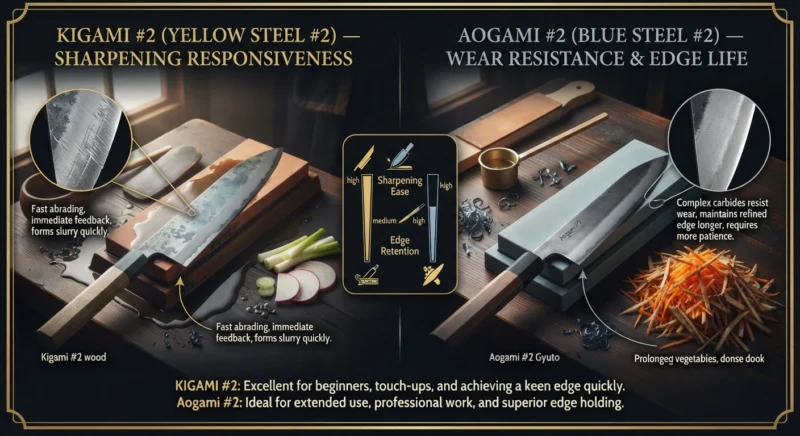
Kigami #2 wins for sharpening simplicity and responsiveness.
Aogami #2 wins for wear resistance and edge retention.
Both can produce exceptional cutting performance.
Both can take extremely sharp edges.
Both can be hardened to levels suitable for high-performance Japanese kitchen knives.
Both require care because neither is stainless.
The fundamental difference is their alloy philosophy.
Kigami #2 uses a relatively simple high-carbon composition.
Aogami #2 keeps a similar carbon level but introduces tungsten and chromium, increasing wear resistance and changing the way the edge behaves during sharpening.
For the cook who loves sharpening, Kigami #2 can be hard to beat.
For the cook who wants to sharpen less frequently, Aogami #2 is often the more attractive option.
And for someone who wants a traditional Japanese carbon-steel knife but does not want to move into highly wear-resistant modern steels, Aogami #2 occupies a particularly useful middle ground.
The most important lesson is that steel names do not determine the entire knife.
A beautifully heat-treated, thinly ground Kigami #2 knife can be extraordinary.
A beautifully heat-treated, well-ground Aogami #2 knife can be extraordinary in a different way.
The right choice is the one whose characteristics match your priorities.
Quick Decision Guide
If your priority is the easiest sharpening experience, choose Kigami #2.
If your priority is longer edge retention, choose Aogami #2.
If your priority is maximum sharpening responsiveness, choose Kigami #2.
If your priority is greater wear resistance, choose Aogami #2.
If you enjoy traditional carbon-steel maintenance, either works.
If you want stainless performance, neither is the correct choice.
If you are a home cook who sharpens frequently, Kigami #2 may be ideal.
If you are a professional cook who wants longer intervals between sharpening, Aogami #2 may be preferable.
If you want a balanced traditional alloyed carbon steel, Aogami #2 is particularly compelling.
If you want simplicity, excellent sharpness, and an enjoyable stone experience, Kigami #2 deserves serious consideration.
Frequently Asked Questions
Is Kigami #2 better than Aogami #2?
Not universally. Kigami #2 is easier and more responsive to sharpen, while Aogami #2 generally provides better wear resistance and edge retention.
Is Aogami #2 harder to sharpen?
Usually somewhat, because its alloyed structure provides greater wear resistance. However, Aogami #2 remains relatively manageable on conventional waterstones compared with much more wear-resistant modern steels.
Does Aogami #2 hold an edge longer?
Generally yes. Its tungsten-containing composition provides greater resistance to abrasive wear, which normally translates into longer edge retention under comparable conditions.
Does Kigami #2 get sharper?
Not inherently. Both steels can be sharpened to extremely high levels. Geometry, heat treatment, sharpening technique, and finishing are major factors.
Is Aogami #2 stainless?
No. Its chromium content is far below the level associated with stainless behavior. It should be maintained as a reactive carbon steel.
Does Kigami #2 rust?
Yes. Kigami #2 is a reactive carbon steel and requires drying and sensible maintenance.
Can both steels develop patina?
Yes. Both can develop patina during normal use, particularly around acidic foods and moisture.
Which steel is better for beginners?
Kigami #2 can be particularly attractive for beginners who want to learn sharpening because of its responsive behavior. Aogami #2 is also manageable and may be preferable for someone who values longer edge life.
Which steel is better for professional chefs?
Aogami #2 may have an advantage when long edge retention is important, particularly during extended preparation sessions. But professional preferences vary, and Kigami #2 can be excellent for chefs who sharpen frequently.
Does Aogami #2 chip easily?
No steel should be described that simply. Chipping depends on hardness, heat treatment, edge geometry, cutting technique, and impact. A hard Japanese knife should not be used for bones, frozen food, or twisting cuts.
Which one should I buy?
Choose Kigami #2 if you prioritize sharpening ease and traditional carbon-steel feel. Choose Aogami #2 if you prioritize longer edge retention and greater wear resistance.
Conclusion
Kigami #2 and Aogami #2 represent two different approaches to high-performance Japanese carbon steel.
Kigami #2 keeps the chemistry relatively simple. Its appeal comes from its responsive sharpening characteristics, high-carbon performance, and ability to take an exceptionally refined edge.
Aogami #2 adds tungsten and chromium to the high-carbon foundation. Those additions create a more wear-resistant steel that generally maintains useful edge performance for longer.
The difference is therefore not simply good steel versus better steel.
It is a difference in priorities.
Kigami #2 asks the user to accept somewhat shorter edge life in exchange for a highly responsive sharpening experience.
Aogami #2 asks the user to accept somewhat greater sharpening resistance in exchange for increased wear resistance.
For someone who enjoys maintaining a knife, Kigami #2 can be immensely rewarding.
For someone who wants to spend more time cutting and less time sharpening, Aogami #2 can be the better match.
And that is ultimately why both steels continue to make sense.
Kigami #2 is about responsiveness. Aogami #2 is about endurance.
Neither needs to replace the other.
They simply serve different kinds of knife users.
This article is for independent informational purposes only and is not affiliated with, sponsored by, or endorsed by any steel manufacturer. All product names, trademarks, and registered trademarks are the property of their respective owners.