Ginsan Steel
An Independent Guide
There is a particular moment that many knife enthusiasts eventually experience.
You sharpen a traditional Japanese carbon-steel knife on a good waterstone, feel the edge becoming finer with every pass, and realize why experienced cooks become fascinated with sharpening in the first place. The steel responds to the stone. The burr develops predictably. The edge becomes extremely keen. It feels almost alive under the fingers.
Then reality returns.
The knife can rust.
You have to wipe it during preparation. Acidic ingredients need attention. Leaving the blade wet on the counter is no longer an innocent mistake. For some cooks, that maintenance is part of the pleasure. For others, it becomes an unnecessary compromise.
This is where Ginsan steel becomes particularly interesting.
Ginsan belongs to the Japanese Yasugi Specialty Steel family and is also known as GIN 3, Ginsanko, Gin-san, Silver #3, or Silver Paper #3. It was developed as a stainless knife steel capable of combining substantial carbon content and high hardness with the corrosion resistance expected from stainless steel. Proterial, the company that succeeded Hitachi Metals in the specialty-steel business, lists GIN 3 specifically for kitchen knives and scissors.
That combination explains why this steel has developed such a loyal following among Japanese knife makers, professional cooks, sharpeners, and enthusiasts.
It does not try to win every category.
Instead, it aims for something more useful: a refined, stainless knife that can take a very keen edge, feels pleasant on a whetstone, and does not demand the maintenance routine of a reactive carbon blade.
And that makes it one of the most interesting steels in Japanese kitchen knives.
What Is Ginsan Steel?
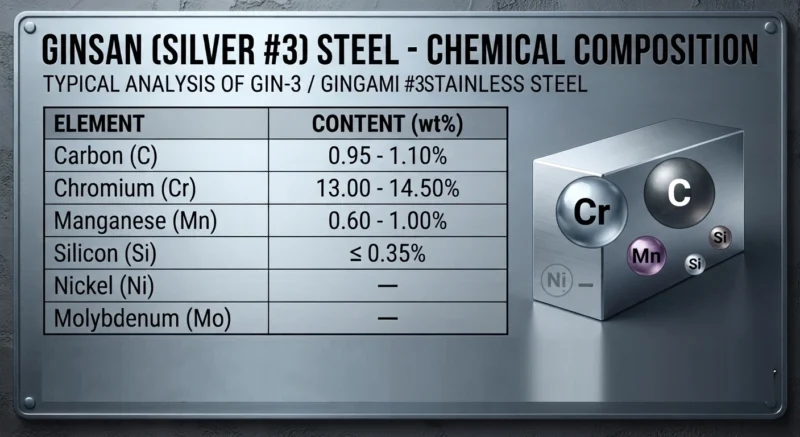
Ginsan steel is a high-carbon stainless steel made by Hitachi’s Yasugi Specialty Steel tradition and now listed by Proterial as GIN 3. The manufacturer’s current specification gives the steel a typical chemical composition of approximately 0.95–1.10% carbon and 13.00–14.50% chromium, with manganese at 0.60–1.00% and silicon at a maximum of 0.35%. Phosphorus is limited to 0.030% and sulfur to 0.020%.
That chemistry is important because it explains much of the steel’s personality.
Carbon is present at a relatively high level for a stainless knife steel. Carbon allows the steel to become hard after heat treatment and contributes to its ability to support a fine cutting edge.
Chromium is the ingredient that changes the maintenance equation. At roughly 13–14.5%, there is enough chromium for the steel to behave as a stainless alloy in normal knife use.
Unlike many modern premium stainless steels, GIN 3 does not rely on large additions of vanadium, molybdenum, tungsten, cobalt, or other alloying elements. Proterial’s published composition lists no intentional additions of those elements.
This is one of the reasons the steel is so interesting.
It is comparatively simple.
That simplicity does not mean the material is primitive. Quite the opposite. A relatively clean alloy can be extremely attractive for a knife when the target is a fine, controllable edge rather than maximum wear resistance.
A useful way to think about it is this:
Ginsan is stainless steel designed with the priorities of a traditional Japanese blade in mind.
That is a different philosophy from simply taking a highly alloyed stainless steel and making it into a knife.
The Meaning Behind the Name
The terminology surrounding Japanese knife steels can be confusing because the same material may appear under several names.
GIN 3 is commonly written as:
- Ginsan
- Ginsanko
- Gin-san
- Gin 3
- GIN3
- Silver #3
- Silver Steel #3
- Silver Paper #3
- Gingami #3
These names are used somewhat interchangeably in the knife world.
The Japanese designation is associated with the 銀三 family, commonly transliterated as Ginsan or Ginsanko. The “silver” terminology comes from the traditional paper identification system used for Yasugi steels. The steel is not silver, of course; the name refers to the classification and historical identification of the steel.
This is worth understanding because shoppers sometimes see “Silver #3” and assume it is a different steel from Ginsan.
It is not.
When a Japanese knife description says Silver 3, Ginsanko, Gin-3, or Ginsan, it is generally referring to the same GIN 3 steel family.
Proterial’s own current product page calls it GIN(TM) 3 and identifies it as an original Yasugi Specialty Steel product intended for applications including kitchen knives and scissors.
Chemical Composition of GIN 3
The chemistry of a knife steel is not just a collection of numbers. Each element influences what happens when the steel is heated, cooled, sharpened, and used.
Here is the manufacturer’s published typical composition:
| Element | GIN 3 composition |
|---|---|
| Carbon (C) | 0.95–1.10% |
| Silicon (Si) | ≤ 0.35% |
| Manganese (Mn) | 0.60–1.00% |
| Chromium (Cr) | 13.00–14.50% |
| Nickel (Ni) | — |
| Molybdenum (Mo) | — |
| Tungsten (W) | — |
| Vanadium (V) | — |
| Cobalt (Co) | — |
| Phosphorus (P) | ≤ 0.030% |
| Sulfur (S) | ≤ 0.020% |
These are the figures currently published by Proterial for GIN 3.
The numbers tell an interesting story.
Carbon: approximately 1%
Carbon is the foundation of the steel’s hardness potential.
At approximately 0.95–1.10%, there is enough carbon to produce a hard martensitic structure during heat treatment. This is a significant amount for a stainless steel intended for fine cutting tools.
It also helps explain why knives made from this steel can reach hardness in the low 60s HRC when appropriately heat treated.
But carbon alone does not determine knife performance.
Two knives made from the same steel can feel dramatically different if one receives a superior heat treatment or has a completely different blade geometry.
That distinction becomes extremely important later.
Chromium: approximately 13–14.5%
Chromium is the defining addition that moves the alloy into stainless territory.
Chromium improves corrosion resistance by allowing a passive oxide layer to form on the surface of the steel. That layer is extremely thin, but it protects the underlying metal from ordinary atmospheric corrosion.
The result is a knife that is dramatically easier to live with than a reactive carbon-steel blade.
But “stainless” should never be interpreted as “impossible to damage.”
Salt, acids, moisture, heat, chemicals, poor cleaning practices, and prolonged exposure to aggressive environments can still affect stainless steels. Even manufacturers and specialist knife retailers generally describe stainless as stain-resistant rather than literally immune to corrosion.
For normal kitchen use, however, the difference is enormous.
Manganese: 0.60–1.00%
Manganese contributes to hardenability and strength and plays an important role in the steel’s overall metallurgical behavior.
It is not the element people usually mention when discussing knife steels, but it is part of the carefully controlled chemistry that allows GIN 3 to achieve its intended properties.
Silicon: maximum 0.35%
Silicon is used in steelmaking as a deoxidizing element and contributes to the steel matrix.
At this relatively modest level, it is part of the supporting chemistry rather than the feature that defines the knife.
Phosphorus and sulfur
These are controlled as impurities.
Proterial specifies maximum levels of 0.030% phosphorus and 0.020% sulfur.
Keeping unwanted elements controlled is particularly important when producing fine cutting steels where consistency and cleanliness of the steel are valuable.
Why the Chemistry Matters for a Knife
A knife edge is a remarkably small structure.
When you look at a polished blade, it appears solid and perfectly smooth. At the microscopic level, however, the edge consists of a complex arrangement of grains, carbides, and steel matrix.
The geometry of the edge may be only fractions of a millimeter wide.
That means the steel’s microstructure matters enormously.
A steel with very high wear resistance may contain large populations of hard carbides. These can improve resistance to abrasive wear, but they also change how the steel behaves on a sharpening stone.
A relatively clean, fine-grained stainless steel can behave very differently.
This is part of the attraction of GIN 3.
The steel has enough alloying to provide stainless behavior, but it does not pursue the extreme carbide volume associated with some powder-metallurgy steels.
That helps explain why sharpeners often describe it as unusually pleasant for a stainless steel.
One recent specialist steel guide describes Ginsan as a stainless answer to the “white-paper” carbon-steel experience, emphasizing its fine-grained character and relatively clean alloy design.
The comparison should not be interpreted literally—Ginsan is not simply stainless Shirogami—but it captures an important part of the sharpening experience.
Ginsan Steel Hardness
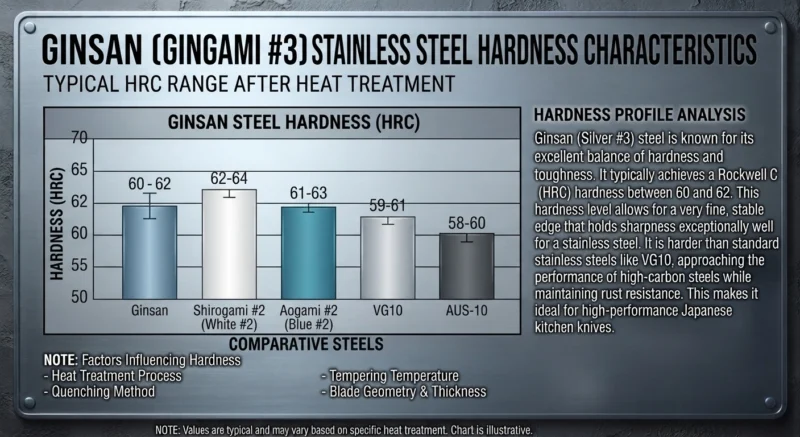
Proterial specifies a hardening hardness of 59 HRC or higher for GIN 3 after its standard heat-treatment process. Its recommended heat treatment includes quenching at approximately 1,000–1,050°C followed by tempering at 100–150°C.
In finished Japanese kitchen knives, hardness commonly falls around the low 60s HRC, although the actual value depends on the maker’s heat treatment, blade thickness, geometry, and intended use.
That last point is critical.
There is no single universal “Ginsan hardness.”
A manufacturer may heat treat a particular knife to around 60 HRC for a more forgiving working edge. Another maker may aim for 61–62 HRC. A different knife may fall outside those numbers depending on the production process.
Therefore, when a seller says that a Ginsan knife is 62 HRC, that does not mean every Ginsan knife is 62 HRC.
The steel provides a range of possibilities.
The maker determines the final result.
Sakai Ichimonji, for example, describes Silver Steel #3 as a traditionally styled stainless material valued for sharpness and a balance between edge retention and sharpening behavior.
Suncraft’s current catalog similarly describes Gin-san/Silver 3 as a stainless Yasuki steel with good sharpening characteristics and gives one knife application at HRC 60.
This is a useful reminder that the number printed on a specification sheet is only one part of the story.
Check Our Guide What Is HRC? Understanding Rockwell Hardness
How Does Ginsan Feel on a Sharpening Stone?
This may be the single most interesting characteristic of the steel.
A good knife is not only about how long it stays sharp.
It is also about what happens when it finally becomes dull.
Sharpening is where many stainless steels reveal their personality.
Some steels feel soft and quick to sharpen. Others feel noticeably resistant. Highly wear-resistant powder steels can require more patience and may feel quite different from simple carbon steels.
Ginsan occupies an attractive middle ground.
Many sharpeners report that it feels unusually responsive on waterstones for a stainless steel. Knife enthusiasts frequently describe it as easy to deburr and capable of producing a very clean edge. Community discussions repeatedly mention its pleasant sharpening response and easy burr removal.
This does not mean it magically sharpens itself.
A hard blade still requires a suitable abrasive and reasonable technique.
But the sharpening process tends to feel familiar to people who enjoy traditional Japanese steels.
That matters more than many beginners realize.
Imagine two knives.
Knife A stays sharp for a very long time but becomes unpleasant and time-consuming to sharpen.
Knife B becomes slightly duller sooner but takes only a few minutes to restore to excellent sharpness.
For a home cook who sharpens regularly, Knife B can actually be the more enjoyable knife.
This is one of the reasons Ginsan steel has become popular among cooks who care about sharpening rather than simply maximizing theoretical edge retention.
Why Ginsan Can Feel Different From Other Stainless Steels
“Stainless steel” is not a single category of behavior.
There are many stainless alloys, and they can be dramatically different.
Some are optimized for corrosion resistance.
Some emphasize toughness.
Some are designed for extremely high wear resistance.
Some are engineered using powder metallurgy.
Some are designed for easy machining.
Others are specifically developed for fine cutting edges.
Ginsan’s design priorities make it particularly interesting for Japanese knives.
It contains enough chromium for strong corrosion resistance, but its carbon content remains high enough to support a hard cutting edge. Its relatively simple alloy composition also avoids turning the steel into an extremely carbide-heavy material. Proterial explicitly lists it for kitchen knives and scissors.
That combination creates a steel that many users describe as “carbon-like” in sharpening behavior while remaining stainless in everyday maintenance.
That phrase should be understood as a practical description, not a claim that the metallurgies are identical.
Edge Retention: How Long Does Ginsan Stay Sharp?
Edge retention is one of the most misunderstood subjects in knife discussions.
People often ask:
“How many days will this knife stay sharp?”
There is no honest universal answer.
Edge retention depends on:
- hardness
- edge angle
- edge thickness
- blade geometry
- cutting board material
- ingredients
- cutting technique
- frequency of use
- lateral stress
- abrasive particles in food
- how sharp the edge was originally
- heat treatment
A Ginsan knife used to slice vegetables on a soft cutting board will experience a completely different life from a Ginsan knife used in a busy restaurant to process thousands of ingredients.
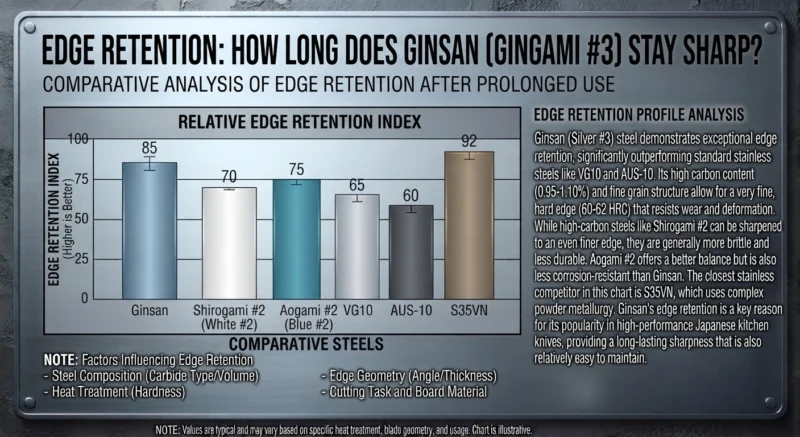
That is why steel charts should be treated as general guides rather than guarantees.
Ginsan provides respectable edge retention for a fine Japanese stainless knife, particularly when heat treated properly. Its strength is not extreme wear resistance. Instead, it provides a useful combination of hardness, fine edge capability, corrosion resistance, and manageable sharpening.
Japanese Knife Archive rates Silver 3 around 60–62 HRC and gives it strong ratings for edge retention, corrosion resistance, sharpening, and toughness, illustrating why it is often viewed as a balanced steel rather than a specialist extreme-performance alloy.
This balance is exactly why it works so well for everyday kitchen knives.
Check Our Ultimate Guide to Caring for a Damascus Steel Knife
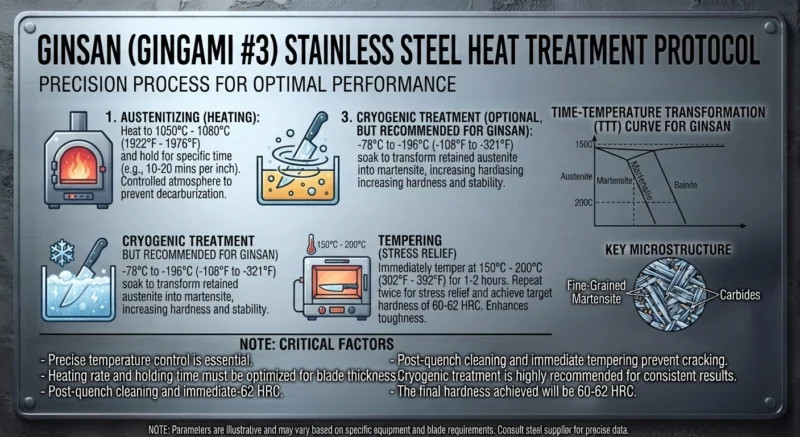
The Importance of Heat Treatment
If you remember only one technical point from this article, remember this:
The name of the steel does not determine the entire performance of the knife.
Heat treatment can dramatically change the final properties of a blade.
The steel manufacturer supplies the alloy.
The knife maker turns that alloy into a functional cutting tool.
During heat treatment, the steel is heated, transformed, quenched, and tempered in a carefully controlled sequence. The objective is to create the desired microstructure and hardness while maintaining enough toughness for the intended application.
Proterial publishes specific heat-treatment recommendations for GIN 3, including an austenitizing/quenching range of 1,000–1,050°C and tempering at 100–150°C.
A professional maker does not simply throw a blade into an oven and hope for the best.
Temperature control, soaking time, cooling method, section thickness, furnace atmosphere, and subsequent tempering all matter.
That is why two knives made from the same steel can have noticeably different sharpening behavior and edge stability.
If one Ginsan knife chips easily and another feels extremely durable, the explanation may not be the steel name.
Heat treatment and geometry may be more important.
Check Our Guide Different Heat Treatment Methods Explained
Is Ginsan Really Stainless?
Yes.
But stainless does not mean corrosion-proof.
With chromium in the approximate 13–14.5% range, GIN 3 has the chromium content needed for stainless behavior under normal conditions.
For kitchen use, this is a major advantage.
A carbon-steel knife can develop orange rust surprisingly quickly if left wet. A Ginsan knife is much more tolerant.
You can cut tomatoes, citrus, onions, fruit, meat, and other wet ingredients without immediately worrying about discoloration.
You should still wash the blade and dry it after use.
That is not because the steel is fragile.
It is simply good knife care.
Salt and acidic foods can be aggressive over long periods. A knife left wet in a sink for hours is not being treated well, regardless of the steel.
Think of Ginsan as low-maintenance stainless, not as an indestructible material.
Check Our Guide Stainless Steel Myths
Can Ginsan Rust?
Under ordinary kitchen conditions, rust is unlikely when the knife is properly maintained.
However, stainless steels can corrode under sufficiently aggressive conditions.
Extended exposure to salt water, acidic residues, chemicals, or moisture can eventually cause staining, pitting, or other forms of corrosion. Specialist knife guidance also notes that “stainless” means stain-resistant rather than literally stain-proof.
The best care routine is simple:
- Wash the knife after use.
- Rinse away food residue.
- Dry the blade.
- Do not leave it submerged.
- Store it somewhere dry.
- Avoid the dishwasher unless the manufacturer specifically says otherwise.
That’s it.
You do not need to treat a Ginsan knife like a fragile carbon-steel laboratory instrument.
That low-maintenance character is one of its greatest strengths.
Ginsan and Acidic Foods
Acidic ingredients are one of the situations where stainless steel becomes particularly attractive.
Tomatoes, lemons, limes, vinegar, apples, citrus fruits, and many other ingredients can react with reactive carbon steel.
A carbon blade can develop discoloration or patina.
Ginsan is much more resistant.
This does not mean that acidic ingredients cannot affect it at all. Long exposure should still be avoided.
But during normal food preparation, the difference in maintenance is significant.
For professional cooks working quickly, that can be extremely valuable.
A chef can cut acidic ingredients, rinse the knife, wipe it dry, and continue working without constantly thinking about whether the blade is beginning to react.
Ginsan for Professional Kitchens
Professional kitchens are demanding environments.
Knives are used repeatedly, sometimes for hours.
They encounter moisture, salt, acids, meat juices, vegetables, cutting boards, towels, sinks, and occasionally less-than-perfect handling.
That environment rewards practicality.
This is one reason Ginsan makes so much sense.
A professional cook may appreciate the cutting characteristics of traditional Japanese carbon steel but not want the maintenance burden.
A stainless Ginsan knife offers a compromise that is very easy to understand:
high-end Japanese cutting characteristics with much less corrosion anxiety.
Sakai Ichimonji describes Silver Steel #3 as a material trusted by chefs because of the sharpness it can deliver, while Sakai manufacturers have used the steel in professional-style knives including gyuto, santoku, petty, and other forms.
That does not mean every professional chef should use it.
Knife choice is personal.
But the material makes sense for cooks who value fine edges and regular sharpening while wanting stainless convenience.
Which Knife Types Suit Ginsan?
One of the advantages of Ginsan is its versatility.
It is not a steel limited to one specific knife style.
You can find it in:
- Gyuto
- Santoku
- Bunka
- Petty knives
- Nakiri
- Yanagiba
- Kiritsuke
- Sujihiki
- Other Japanese kitchen knives
Proterial itself lists kitchen knives and scissors among the applications for GIN 3.
The steel can therefore be used in both double-bevel and single-bevel traditions, although the finished knife’s performance will depend heavily on geometry and the maker’s skill.
A thin Ginsan gyuto can feel very different from a thick Ginsan honesuki.
The steel is only one part of the tool.
Ginsan in Single-Bevel Knives
Single-bevel Japanese knives deserve special attention.
Yanagiba, deba, usuba, and related knives are often sharpened differently from ordinary double-bevel kitchen knives.
The quality of the steel matters because these knives are frequently expected to produce extremely clean cuts.
Ginsan is attractive here because it offers stainless convenience without abandoning the traditional sharpening experience.
For chefs working with fish or other ingredients where cleanliness of the cut is important, that combination can be very appealing.
But there is an important distinction:
The steel does not automatically make a knife produce a better cut.
The geometry, bevel construction, sharpening quality, and maker’s skill are still fundamental.
A poorly ground Ginsan knife can perform poorly.
A beautifully made Ginsan knife can be extraordinary.
Check Our Guide How to Prepare Fish for Sushi, Sashimi & Ceviche
Ginsan and Knife Geometry
This is perhaps the most important subject that gets ignored in online steel discussions.
A knife is not a piece of steel with a handle attached.
The blade geometry determines how the knife moves through food.
Two knives made from identical steel can behave completely differently.
One might have:
- a thin behind-the-edge geometry
- a polished edge
- a carefully designed convex grind
- a precise distal taper
The other might be:
- thicker
- more robust
- less refined
- heavier behind the edge
Even though both are technically Ginsan knives, the user experience will be completely different.
That is why experienced knife buyers often pay as much attention to the maker and geometry as they do to the steel.
The community discussion around Ginsan repeatedly reinforces this point: experienced users note that grind and heat treatment can matter more than the steel label itself.
This is not unique to Ginsan.
It is true of virtually every knife steel.
What Kind of Edge Can Ginsan Take?
A properly heat-treated Ginsan blade can take a very fine edge.
That is one of the reasons sharpeners enjoy it.
A fine edge is not merely about making a knife “sharper.”
It can improve the way the blade enters food.
A polished, well-supported edge can feel smooth when cutting onions, herbs, vegetables, fish, and other ingredients.
However, there is a limit.
If you continually push an edge thinner and thinner, eventually the geometry becomes more delicate than the intended use can tolerate.
At that point, even an excellent steel can develop microchips or edge deformation.
This is where sharpening technique and edge angle matter.
The right question is not:
“How thin can I make Ginsan?”
The better question is:
“How thin can I make this particular knife for the way I actually use it?”
A professional fish slicer and a home cook chopping vegetables do not necessarily need the same edge.
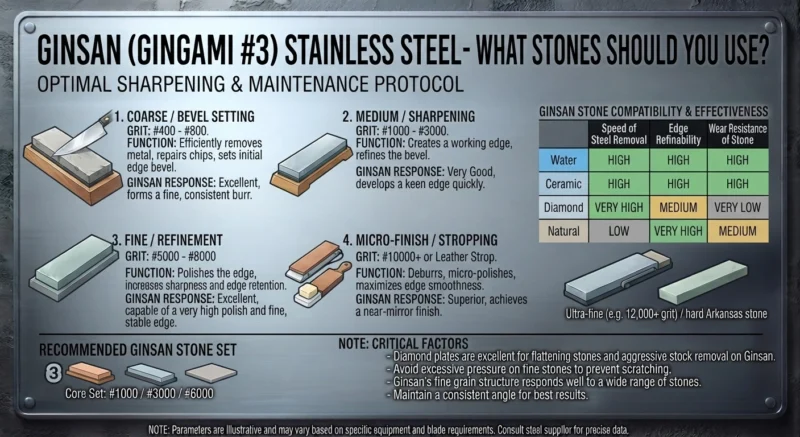
Sharpening Ginsan: What Stones Should You Use?
You do not need a complicated sharpening setup.
A basic waterstone progression can work extremely well.
For routine maintenance, many users can accomplish almost everything with a medium stone and a finishing stone.
For example:
1000 grit: useful for establishing or repairing the edge.
2000–3000 grit: excellent for regular sharpening and refinement.
4000–6000 grit: useful when a more polished edge is desired.
The exact progression is not sacred.
You can sharpen Ginsan successfully with many different abrasive systems.
The important part is consistency.
Use controlled pressure.
Maintain a consistent angle.
Raise a burr when establishing the bevel.
Remove the burr carefully.
Finish with light strokes.
Do not assume that more stones automatically produce a better edge.
A well-executed 1000/3000 progression can produce a superb kitchen edge.
Why Deburring Matters
Deburring is one of the most overlooked parts of sharpening.
When you sharpen one side of a blade, the abrasive removes metal and pushes material toward the opposite side. Eventually, a small burr forms.
That burr can make a knife feel deceptively sharp.
If you do not remove it properly, the edge may roll or become unstable quickly.
Ginsan is often praised for its relatively cooperative deburring behavior. Knife users frequently report that it is easy to cleanly remove the burr and produce a refined edge.
That is particularly enjoyable for people who sharpen frequently.
A steel that responds predictably to a stone gives you better feedback.
You can feel what is happening.
That is one reason Ginsan has developed such a good reputation among sharpening enthusiasts.
Is Ginsan Difficult to Sharpen?
No.
For a steel in the low-60s HRC range, it is generally considered quite manageable.
It is not a soft European stainless steel that can be sharpened almost instantly, but it is also not designed around extreme wear resistance.
A quality waterstone will remove material effectively.
The exact feel depends on the stone.
Some stones will feel faster.
Some will feel smoother.
Some will produce more tactile feedback.
The sharpening experience is therefore partly about the combination of steel and abrasive.
That is another reason why two sharpeners can describe the same knife differently.
Ginsan and Chipping
No knife steel is completely immune to chipping.
A hard, thin edge can chip if it encounters lateral force, hard bones, frozen food, a hard cutting board, or inappropriate technique.
Ginsan’s relatively balanced characteristics make it practical for normal kitchen work, but it should not be treated as a heavy-duty chopping steel.
Avoid:
- twisting the knife in food
- cutting bones with a fine chef’s knife
- chopping frozen products
- using the edge against glass or ceramic
- scraping aggressively with the cutting edge
- striking the board unnecessarily
These rules apply to many high-performance kitchen knives.
A good steel cannot compensate for bad technique.
Is Ginsan Tough?
The word “toughness” needs careful interpretation.
Toughness is the ability of a material to resist cracking or breaking under stress.
It is not the same as hardness.
It is not the same as edge retention.
It is not the same as corrosion resistance.
A knife can be hard and still reasonably tough.
A knife can hold an edge well and still chip if abused.
Ginsan is generally regarded as a balanced knife steel rather than an extreme toughness steel. Japanese Knife Archive, for example, places its practical characteristics around a balanced range, while user reports often describe it as capable of taking a fine edge without being excessively fragile under ordinary use.
Still, the actual toughness of a finished knife depends heavily on heat treatment and geometry.
This is why an HRC number should never be used as a complete description of knife durability.
Ginsan for Home Cooks
For a home cook, one of the biggest advantages is convenience.
You can have a Japanese knife with:
- high hardness
- a fine edge
- excellent sharpening response
- stainless corrosion resistance
- relatively simple maintenance
That is a powerful combination.
You do not have to choose between a traditional Japanese cutting experience and easy ownership quite as strongly as you would with some carbon steels.
This is particularly useful for people who are buying their first serious Japanese knife.
The user can learn to sharpen.
The user can enjoy a very fine edge.
And the user does not need to develop a complicated routine for preventing rust.
That makes Ginsan an unusually approachable premium steel.
Ginsan for Beginners
Beginners sometimes assume that the best knife steel is automatically the most expensive or technologically advanced.
That is not necessarily true.
A beginner may actually learn more from a steel that sharpens easily and provides good feedback than from an extremely wear-resistant steel that takes much longer to restore.
Ginsan can be an excellent learning platform.
You can learn:
- how to create a burr
- how to control sharpening pressure
- how to deburr
- how to polish an edge
- how different stones affect the edge
- how edge angles change cutting behavior
And because the steel is stainless, the learning process is less stressful.
You can concentrate on sharpening rather than worrying about rust every time the blade touches a tomato.
Ginsan and Japanese Knife Making
The steel also has a cultural significance within modern Japanese knife making.
Yasugi Specialty Steel has deep roots in Japan’s cutting-tool tradition. Proterial describes Yasugi Specialty Steel as a high-grade specialty steel produced at the Yasugi works and associated with traditional Japanese cutting-tool applications.
The Yasugi family includes several famous Japanese steels, including White, Blue, and Silver grades.
GIN 3 occupies a particularly interesting position within that family.
The traditional Japanese knife world was historically dominated by carbon steels.
Stainless steel changed the market because cooks wanted easier maintenance.
GIN 3 provides a bridge between those two worlds.
It retains a high-carbon composition and the potential for traditional fine-edge performance while adding substantial chromium for corrosion resistance.
That is a very Japanese approach to the problem:
Instead of abandoning the old characteristics, preserve as many of them as possible while solving the practical weakness.
Why Knife Makers Like Ginsan
For a maker, steel selection is a series of compromises.
A steel needs to be:
- available
- consistent
- workable
- heat treatable
- suitable for the intended geometry
- capable of producing the desired edge
- appropriate for the customer’s expectations
GIN 3 has a long history in Japanese cutting tools and is explicitly listed for kitchen knives and scissors by its manufacturer.
That history matters.
A steel with a well-understood heat-treatment process and established reputation is valuable to a maker.
The maker can concentrate on what really makes a knife special:
geometry, grinding, heat treatment, finishing, sharpening, handle construction, and overall balance.
Check Our Guide How to Choose a Custom Knife Maker
The Beauty of a Stainless Japanese Knife
There is also an aesthetic argument.
A traditional carbon-steel knife can develop a patina.
Some people love that.
The blade changes color over time, reflecting the ingredients and environment in which it has been used.
A stainless Ginsan blade usually remains much cleaner-looking.
For a polished or kasumi-finished knife, this can be particularly attractive.
It allows the maker’s finishing work to remain visible.
Ginsan is frequently used with stainless or stainless-clad constructions, creating Japanese knives that combine traditional visual elements with modern maintenance convenience. Reviews of Ginsan knives from makers such as Satoshi Nakagawa show how the steel is used with kasumi-style finishes and traditional Japanese handles.
So the appeal is not only technical.
It is also visual and tactile.
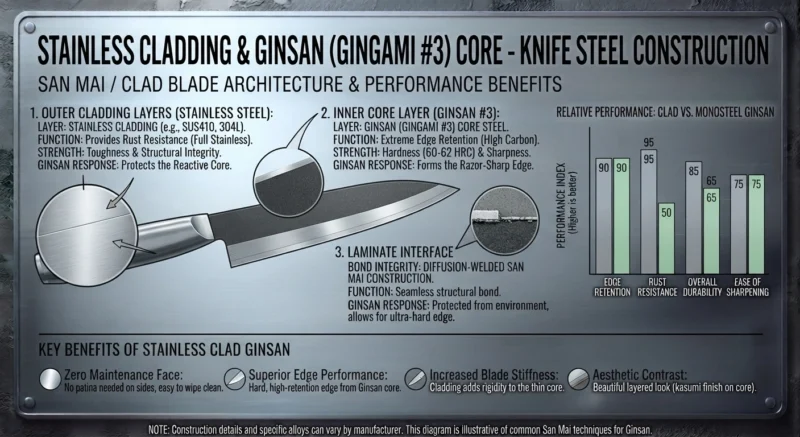
Stainless Cladding and Ginsan Core
Many Japanese knives use laminated construction.
The cutting steel forms the core while another steel surrounds it.
In a stainless-clad knife, the cladding can provide additional corrosion resistance while the Ginsan core supplies the cutting edge.
This creates an interesting visual line where the core meets the cladding.
Depending on the finish, the boundary may be subtle or highly visible.
A kasumi finish can emphasize this contrast.
The important point is that you should distinguish between the core steel and the cladding steel when reading specifications.
If a listing says “Ginsan knife,” it does not necessarily mean the entire blade is made from Ginsan.
It may mean that Ginsan forms the cutting core.
That is perfectly normal in Japanese knife construction.
What Ginsan Is Not
It is useful to remove several misconceptions.
It is not a carbon steel.
Although its sharpening behavior can remind users of carbon steel, its chromium content places it in the stainless category.
It is not rust-proof.
It is highly corrosion resistant for kitchen use, but no ordinary stainless knife should be treated as immune to corrosion.
It is not a powder steel.
Proterial lists the manufacturing technology for GIN 3 as conventional rather than powder metallurgy.
It is not the hardest knife steel available.
Its appeal comes from balance rather than maximum hardness.
It does not automatically make a knife sharp.
The steel provides potential.
The maker, heat treatment, geometry, and sharpening determine how that potential becomes performance.
It is not maintenance-free.
You should still wash, dry, sharpen, and store the knife properly.
How to Care for a Ginsan Knife
The care routine is pleasantly simple.
After cutting food, rinse the blade.
Use a mild dish soap when necessary.
Dry it thoroughly.
Store it safely.
Do not leave it sitting in a sink.
Do not put a high-quality Japanese knife into a dishwasher unless the manufacturer explicitly permits it.
Do not use the knife to pry, twist, or chop through hard materials.
That is essentially the maintenance philosophy.
The stainless nature of Ginsan means you do not need to apply the same rust-prevention routine used with reactive carbon steels.
For most cooks, that is a major quality-of-life improvement.
How Often Should You Sharpen Ginsan?
Sharpening frequency depends entirely on usage.
A home cook may need only occasional maintenance.
A professional chef may sharpen far more frequently.
The key is not to wait until the knife becomes completely dull.
Small maintenance sessions are usually easier than major sharpening sessions.
If the knife still cuts well but feels slightly less aggressive, a few light passes on an appropriate stone may be enough.
If the edge has become damaged or rounded, move to a more abrasive stone and rebuild the bevel.
Because the steel is relatively pleasant to sharpen, regular maintenance does not need to be a major event.
This is one of the most practical advantages of the material.
The Role of Edge Angle
There is no universal “correct” edge angle for every Ginsan knife.
The ideal angle depends on:
- blade thickness
- grind
- hardness
- intended use
- edge stability
- user’s technique
A thin Japanese kitchen knife may perform beautifully with a relatively acute edge.
A thicker utility knife may benefit from a more robust edge.
The important thing is to match the edge to the knife.
If you repeatedly experience microchipping, the solution may not be to blame the steel.
You may simply have an edge that is too delicate for the way you use it.
Why Some Ginsan Knives Feel Better Than Others
This is where the world of Japanese knives becomes fascinating.
Two knives can have the same steel name engraved on the blade and feel completely different.
One may be made by a highly experienced smith and sharpener.
Another may come from a factory with less sophisticated grinding.
One may have excellent distal taper.
Another may be thick and heavy.
One may have a perfectly balanced bevel.
Another may require immediate thinning.
One may be heat treated exceptionally well.
Another may simply meet the minimum specification.
Therefore, buying a Ginsan knife should never be reduced to checking whether the listing says “Ginsan.”
Look at the maker.
Look at the grind.
Look at the blade thickness.
Look at reviews.
Look at the reputation of the sharpener.
Look at how the knife is constructed.
Steel is important.
It is not everything.
Ginsan and the Sharpening Experience
There is a reason sharpening enthusiasts often become attached to particular steels.
Sharpening is tactile.
You can feel the abrasive working.
You can hear the sound change as the bevel becomes established.
You can feel the burr develop.
You can feel when the edge becomes cleaner.
A steel that communicates clearly through the stone makes the process enjoyable.
That is a major part of the attraction of Ginsan.
The steel’s relatively straightforward chemistry and practical hardness make it responsive enough that sharpening feels like a controlled process rather than a battle.
That is particularly valuable for cooks who enjoy maintaining their knives themselves.
Is Ginsan a Good Choice for a First Japanese Knife?
For many people, yes.
Especially if the user wants a stainless knife.
The ideal first Japanese knife should not be so demanding that the owner becomes afraid to use it.
A Ginsan knife can offer:
Japanese-style cutting performance + stainless maintenance + manageable sharpening.
That combination is hard to dislike.
The owner can learn proper cutting technique without worrying excessively about rust.
They can learn sharpening without immediately investing in an elaborate collection of specialized abrasives.
And they can enjoy a high-quality edge.
That makes Ginsan a particularly sensible choice for someone moving from ordinary stainless kitchen knives into the world of Japanese blades.
Is Ginsan Good for Professional Chefs?
Again, for many chefs, yes.
The strongest argument is not that Ginsan is “the best steel.”
There is no universal best steel.
The argument is that it offers a very useful set of characteristics.
A professional kitchen often values reliability more than theoretical maximum performance.
A knife that:
- cuts cleanly
- resists corrosion
- sharpens predictably
- holds a useful edge
- can be maintained quickly
can be more valuable than a steel that wins a laboratory wear test but takes considerably longer to restore.
This practical balance is one reason Ginsan continues to appear in Japanese professional knives.
Is Ginsan Worth Paying More For?
That depends on the knife.
You should not pay a large premium merely because a listing contains the word “Ginsan.”
The steel is excellent, but the complete knife determines value.
A beautifully made Ginsan knife from a respected maker can be worth considerably more than a poorly executed knife made from a supposedly more exotic steel.
When evaluating a knife, consider the entire package:
- Steel
- Heat treatment
- Geometry
- Grinding
- Finish
- Handle
- Fit and finish
- Maker reputation
- Sharpening quality
- Intended use
Ginsan should be viewed as one component of that equation.
Common Ginsan Terminology You Will See Online
Shopping for Japanese knives can become confusing because different sellers use different terminology.
Here is a quick translation guide:
| Term | Usually refers to |
| Ginsan | GIN 3 |
| Ginsanko | GIN 3 |
| Gin-san | GIN 3 |
| Gin 3 | GIN 3 |
| GIN3 | GIN 3 |
| Silver 3 | GIN 3 |
| Silver Steel #3 | GIN 3 |
| Silver Paper #3 | GIN 3 |
| Gingami #3 | GIN 3 |
The exact spelling may vary between Japanese and English-language sources, but these terms generally point toward the same Yasugi GIN 3 steel.
What Makes Ginsan Different From “Generic Stainless”?
The phrase “stainless steel” tells you surprisingly little.
A cheap kitchen knife and a high-end Japanese knife can both be called stainless.
But that does not mean they behave the same.
Steel composition, heat treatment, hardness, grain structure, geometry, and sharpening all matter.
Ginsan is interesting because it was specifically designed as a high-grade cutting steel.
Proterial identifies it as a Yasugi Specialty Steel product and specifically lists kitchen knives and scissors among its applications.
That places it in a very different context from the generic stainless steel used in mass-market kitchenware.
The Philosophy Behind Ginsan
Perhaps the best way to understand Ginsan is not through a hardness number.
It is through the problem it tries to solve.
Traditional Japanese carbon steels can produce extraordinary edges.
But they react with moisture and acids.
Modern stainless steels solve the corrosion problem.
But some highly alloyed stainless steels can feel different on stones and may be more difficult to sharpen.
Ginsan takes another route.
It says:
What if we make a stainless steel with enough carbon and a relatively clean alloy design to preserve the qualities that sharpeners love?
That is the idea.
And it works well enough that Ginsan has become a respected material in Japanese knife making.
Ginsan Is a Steel for People Who Actually Sharpen
There is an interesting distinction between people who want a knife that stays sharp and people who enjoy sharpening.
The first group often prioritizes maximum edge retention.
The second group may care about the entire lifecycle of the edge.
They enjoy the knife when it is fresh.
They notice the moment the edge starts to decline.
They put the knife on a stone.
They rebuild the bevel.
They remove the burr.
They polish the edge.
And then they return to the kitchen.
For these users, sharpening is not maintenance in the negative sense.
It is part of owning the knife.
That is exactly where Ginsan becomes particularly appealing.
It provides stainless convenience without turning sharpening into an unpleasant chore.
The Human Side of Knife Steel
Knife steel discussions can become overly technical.
Carbon percentages.
Chromium levels.
Hardness numbers.
Carbides.
Powder metallurgy.
Wear resistance.
Toughness.
All of these things matter.
But a knife ultimately exists to cut food.
The real question is:
How does it feel when you use it?
Does it enter an onion cleanly?
Does it glide through a tomato?
Does it make slicing fish feel effortless?
Does it respond quickly when you touch it to a sharpening stone?
Does it survive an ordinary professional kitchen?
Does it demand constant attention?
For many users, the answer with Ginsan is pleasantly balanced.
That is why the steel continues to attract people who have already tried many other Japanese steels.
Ginsan for People Who Love Carbon Steel but Hate Rust
This may be the most accurate description of its target audience.
Imagine someone who loves the feel of a traditional Japanese carbon-steel knife.
They love sharpening.
They love a clean edge.
They appreciate the way the blade responds to a stone.
But they dislike:
- rust
- patina
- constant wiping
- reactive foods
- worrying about leaving the knife wet
Ginsan addresses that frustration directly.
It does not reproduce every characteristic of carbon steel.
Nothing does.
But it provides enough of the sharpening and edge experience that many carbon-steel enthusiasts find it deeply satisfying.
That is a powerful niche.
Ginsan and the Modern Japanese Knife Market
Japanese knife buyers today have more choices than ever.
There are traditional carbon steels.
There are stainless steels.
There are powder steels.
There are semi-stainless steels.
There are proprietary alloys.
There are steels developed specifically for high wear resistance.
And there are steels designed around fine-grained edge behavior.
Ginsan remains relevant because it occupies a middle position that is difficult to replace.
It is traditional enough to appeal to Japanese knife purists.
It is modern enough for cooks who demand stainless maintenance.
It is hard enough for serious cutting.
It is easy enough to sharpen for enthusiasts.
And it has decades of history behind it.
That combination gives it staying power.
What Should You Look for When Buying a Ginsan Knife?
Do not stop at the steel name.
Instead, ask these questions:
Who made the knife?
The maker’s reputation matters.
What is the heat-treated hardness?
If the manufacturer provides the figure, it can help you understand the intended character of the knife.
How is the blade ground?
Geometry can matter more than the difference between two closely related steels.
Is the Ginsan the core steel?
Check whether the blade is solid Ginsan or laminated construction.
What is the intended use?
A gyuto, petty, yanagiba, and honesuki have different requirements.
How thick is the blade?
Thickness influences cutting feel and edge stability.
Who sharpened it?
A good steel deserves a good edge.
What do long-term owners say?
First impressions are useful.
Long-term experience is better.
How to Store a Ginsan Knife
Storage is simple.
A knife block, magnetic strip, saya, or suitable protective sheath can all work.
The most important thing is that the edge should not contact hard objects unnecessarily.
Keep the knife dry.
Keep it separated from other metal objects where possible.
Avoid throwing it into a drawer with forks, spoons, and other knives.
Good storage protects both the edge and the user.
Because Ginsan is stainless, there is less concern about ambient humidity than with highly reactive carbon steels, but dry storage is still the sensible approach.
Can You Use a Ginsan Knife Every Day?
Absolutely.
In fact, everyday use is one of the strongest arguments for the steel.
A knife does not need to be treated like a collector’s object simply because it uses a premium steel.
A properly made Ginsan kitchen knife can be an everyday working tool.
Cut vegetables.
Slice meat.
Prepare fruit.
Prepare fish.
Sharpen it when necessary.
Wash it.
Dry it.
Put it away.
Repeat.
That is what good knife design should ultimately achieve: making the tool disappear into the cooking process.
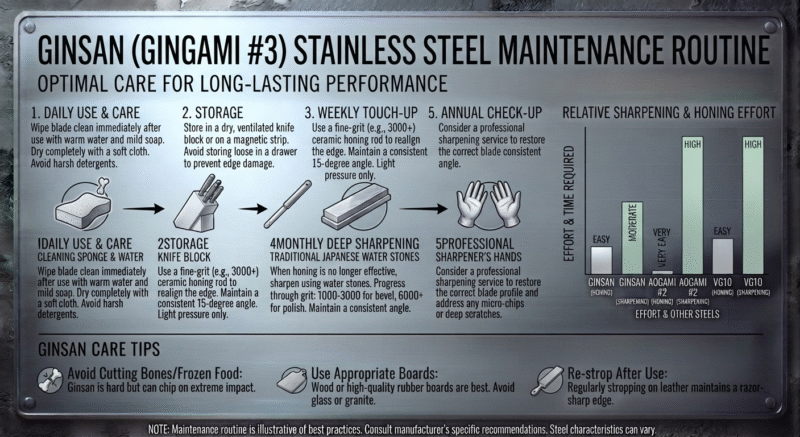
A Practical Ginsan Maintenance Routine
If you want the shortest possible routine, use this:
During cooking: keep the blade reasonably clean.
After cooking: wash it.
Immediately afterward: dry it.
When cutting performance declines: sharpen it.
When storing: protect the edge.
That’s all.
No special rust-prevention ritual is normally required.
No complicated oiling routine is necessary for ordinary kitchen use.
No need to avoid tomatoes or citrus.
That simplicity is one of the steel’s biggest practical advantages.
The Biggest Mistake People Make When Choosing Knife Steel
They focus on the steel and forget the knife.
A brilliant steel cannot rescue poor geometry.
A mediocre heat treatment can waste an excellent alloy.
A beautiful blade can still be uncomfortable if the handle is poorly designed.
A very hard knife can be frustrating if it is too delicate for the owner’s cutting style.
The best knife is the one whose characteristics match the person using it.
Ginsan happens to fit a remarkably broad range of users.
That is why it deserves attention.
Not because it is the most exotic steel.
Because it is useful.
Frequently Asked Questions
What is Ginsan steel?
Ginsan is the common knife-industry name for Hitachi/Proterial GIN 3, a high-carbon stainless Yasugi Specialty Steel used for kitchen knives and scissors. It is also called Ginsanko, Gin-3, Silver #3, or Silver Paper #3.
Is Ginsan stainless?
Yes. Its chromium content is specified at approximately 13.00–14.50%, giving it strong stainless corrosion resistance for normal kitchen use.
What is the carbon content?
The manufacturer’s current specification lists 0.95–1.10% carbon.
What is the chromium content?
The published range is 13.00–14.50% chromium.
How hard is Ginsan?
Proterial specifies a hardening hardness above 59 HRC. Finished kitchen knives commonly fall around the low 60s, depending on heat treatment.
Is Ginsan easy to sharpen?
Yes. One of its most appreciated characteristics is its relatively pleasant sharpening response for a stainless steel. Experienced users commonly report that it sharpens and deburrs easily.
Does Ginsan hold an edge well?
It offers good practical edge retention for a fine Japanese kitchen steel, but it is not designed to compete solely through extreme wear resistance. Edge retention depends heavily on heat treatment, geometry, edge angle, and use.
Can Ginsan rust?
It is highly corrosion resistant, but no stainless steel should be considered completely corrosion-proof. Extended exposure to moisture, salt, acids, or chemicals can still cause corrosion.
Is Ginsan a carbon steel?
No. It is a stainless steel, although its high carbon content and sharpening characteristics can remind users of traditional carbon steels.
Is Ginsan a powder steel?
No. Proterial identifies GIN 3 as a conventional steel rather than a powder-metallurgy steel.
What does Silver #3 mean?
Silver #3 is another name for the same GIN 3/Silver 3 steel family.
What does Ginsanko mean?
Ginsanko is another commonly used name for GIN 3. In English-language knife discussions, Ginsan, Ginsanko, Gin-3, and Silver 3 are generally used for the same material.
Is Ginsan good for Japanese kitchen knives?
Yes. The manufacturer specifically lists GIN 3 for kitchen knives and scissors, and Japanese knife makers use it across many knife styles.
Does Ginsan need to be oiled?
Not for ordinary kitchen use. Wash and dry the blade after use. Additional corrosion protection may be appropriate for long-term storage, but routine kitchen maintenance is simple.
Can I cut tomatoes with a Ginsan knife?
Yes. Its stainless nature makes it well suited to acidic foods compared with reactive carbon steels.
Is Ginsan brittle?
Not inherently. The final balance between hardness and toughness depends on heat treatment and geometry. A very thin, hard edge can still chip if abused.
Can Ginsan take a very sharp edge?
Yes. Its ability to take and maintain a fine edge is one of the reasons it is popular among Japanese knife enthusiasts and professional users.
Is Ginsan suitable for beginners?
It can be an excellent choice because it combines stainless maintenance with a sharpening experience that is generally approachable.
Final Verdict: Why Ginsan Remains So Interesting
The knife world is full of extremes.
There are steels designed to be unbelievably hard.
There are steels designed to survive abuse.
There are steels designed to resist wear for an exceptionally long time.
There are steels designed to resist corrosion almost regardless of the environment.
Ginsan takes a different approach.
It asks what a serious cook actually needs.
A hard enough edge.
Good edge stability.
Strong corrosion resistance.
A fine cutting edge.
Pleasant sharpening.
Reasonable maintenance.
And a material with a long history in Japanese cutting tools.
Proterial’s own specifications reinforce this practical identity: GIN 3 contains approximately 0.95–1.10% carbon and 13.00–14.50% chromium, is specified for kitchen knives and scissors, and has a recommended hardening hardness above 59 HRC.
Those numbers explain the foundation.
The finished knife explains the experience.
And that distinction is important.
A great Ginsan knife is not great merely because the steel is called Ginsan. It is great because the steel, heat treatment, geometry, grinding, sharpening, and handle all work together.
That is ultimately what makes Japanese knives so fascinating.
The material matters.
But the person who transforms that material into a blade matters too.
For cooks who want stainless convenience without giving up the pleasure of a finely sharpened Japanese edge, Ginsan steel remains one of the most compelling choices available.
It is not the loudest steel.
It is not the newest.
It does not need an exotic marketing story.
Its appeal is much simpler.
It works.
And after years of trying different steels, that may be the most valuable characteristic of all.
Ginsan Steel Specifications at a Glance
| Property | GIN 3 / Silver #3 |
| Steel family | Yasugi Specialty Steel |
| Manufacturer | Hitachi Metals / Proterial |
| Common names | Ginsan, Ginsanko, Gin-3, GIN3, Silver #3 |
| Steel type | High-carbon stainless |
| Carbon | 0.95–1.10% |
| Chromium | 13.00–14.50% |
| Manganese | 0.60–1.00% |
| Silicon | ≤0.35% |
| Vanadium | None specified |
| Molybdenum | None specified |
| Tungsten | None specified |
| Cobalt | None specified |
| Recommended application | Kitchen knives, scissors |
| Manufacturer hardening hardness | Above 59 HRC |
| Typical finished kitchen-knife hardness | Around 60–62 HRC, depending on maker |
| Corrosion resistance | High |
| Sharpening | Relatively easy for a stainless steel |
| Edge potential | Excellent |
| Maintenance | Low |
| Manufacturing route | Conventional steel |
Composition and heat-treatment figures in this table are based primarily on Proterial’s current GIN 3 specification. Finished-knife hardness and practical performance can vary with heat treatment and blade construction.
The Bottom Line
If you want a simple way to remember what this steel is about, forget the complicated steel charts for a moment.
Think of a traditional Japanese carbon knife.
Think about the wonderful edge.
Think about the sharpening experience.
Now remove most of the rust anxiety.
That is the idea behind Ginsan.
It is a stainless Japanese knife steel with enough carbon to produce a hard, refined cutting edge and enough chromium to make everyday ownership dramatically easier.
For the home cook, it means less maintenance.
For the professional chef, it means a practical stainless working knife.
For the sharpening enthusiast, it means a steel that remains enjoyable on the stone.
For the Japanese knife maker, it means a proven material with a long cutting-tool tradition.
And for anyone simply looking for a knife that cuts beautifully without demanding constant attention, it offers something even more important:
balance.
That balance is the real reason Ginsan steel deserves a place among the most respected Japanese knife steels.
Not because it wins every technical category.
But because it gets so many important things right at the same time.
This article is for independent informational purposes only and is not affiliated with, sponsored by, or endorsed by any steel manufacturer. All product names, trademarks, and registered trademarks are the property of their respective owners.