Shirogami #2
An Independent Guide
What Is Shirogami #2 Steel?
Shirogami #2, also known as White Steel #2, White Paper Steel #2, or 白紙二号, is one of the most respected traditional carbon steels used for Japanese kitchen knives.
It belongs to the Shirogami, or “White Paper,” family of Japanese carbon steels. The steel is valued not because it contains a complicated mixture of alloying elements, but because of its relatively simple composition, high carbon content, low levels of impurities, and excellent response to heat treatment and sharpening.
For knife enthusiasts, Shirogami #2 represents a traditional approach to knife making: start with a relatively simple carbon steel, forge and heat-treat it carefully, grind the blade accurately, and finish the edge on a whetstone.
The result can be an exceptionally sharp knife with a fine, refined cutting feel.
White Steel #2 is particularly popular in traditional Japanese kitchen knives, including gyuto, santoku, nakiri, yanagiba, deba, usuba, and other single- and double-bevel blades. It is also widely appreciated by professional chefs and sharpening enthusiasts who want a steel that responds predictably to whetstones.
Sakai Ichimonji describes White Steel #2 as a benchmark carbon steel because the material, forging, heat treatment, grinding, and sharpening processes all have a significant influence on the final performance of a knife.
One of the most important things to understand is that Shirogami #2 is not stainless steel. Its low alloy content means that the blade can react quickly with moisture, acids, and other substances. It can develop a patina and can rust if it is not properly maintained.
That apparent disadvantage is actually part of the appeal for many traditional Japanese knife users.
A Shirogami #2 knife is not designed to be completely maintenance-free. Instead, it is designed to offer an exceptionally responsive cutting and sharpening experience for users who are willing to care for a carbon-steel blade.
Shirogami #2 at a Glance
Before looking at the steel in detail, here is a quick overview.
| Property | Shirogami #2 |
|---|---|
| Common Name | White Steel #2 |
| Japanese Name | 白紙二号 |
| Steel Type | High-carbon, low-alloy carbon steel |
| Carbon | Approximately 1.1% |
| Chromium | Very low / not intentionally alloyed for stainless behavior |
| Tungsten | None as a principal alloying addition |
| Vanadium | None as a principal alloying addition |
| Hardness | Commonly around HRC 60–63, depending on maker and heat treatment |
| Sharpening | Excellent |
| Maximum Sharpness | Excellent |
| Edge Retention | Moderate |
| Corrosion Resistance | Very low |
| Patina Formation | Yes |
| Stainless? | No |
| Whetstone Feedback | Excellent |
| Typical Use | Japanese kitchen knives and traditional blades |
| Best For | Users who prioritize sharpness and easy sharpening |
Published specifications vary somewhat because steel composition is only one part of knife performance. Heat treatment, blade geometry, edge angle, grinding quality, and the individual maker all influence the finished knife. Some sources place practical Shirogami #2 hardness around 61–63 HRC, while broader descriptions may give a wider range.
The Meaning Behind the Name Shirogami
The word Shirogami literally refers to “white paper.” It is commonly translated as White Paper Steel or White Steel.
The name is associated with the way Japanese steel grades were historically distinguished using colored paper. White Paper Steel became associated with the relatively pure carbon-steel family, while Aogami is commonly translated as Blue Paper Steel.
This naming system can be confusing for people encountering Japanese knife steels for the first time.
The word “white” does not mean that the finished knife blade is white.
Likewise, “blue” in Aogami does not mean that the finished blade is blue.
These names describe the steel grades and their traditional identification rather than the visual color of the finished blade.
Shirogami is divided into several grades, with Shirogami #1 and Shirogami #2 being especially well known in Japanese knife making. Shirogami #3 also exists and has a lower carbon content.
The basic difference between White #1 and White #2 is carbon content. White #1 contains more carbon, while White #2 contains slightly less. That difference influences the potential hardness, edge behavior, and practical characteristics of the finished blade.
For many cooks, Shirogami #2 provides an especially useful balance.
It offers the characteristics people associate with traditional White Steel without pushing carbon content as high as White #1.
Shirogami #2 Chemical Composition
One of the defining characteristics of Shirogami #2 is its relatively simple chemical composition.
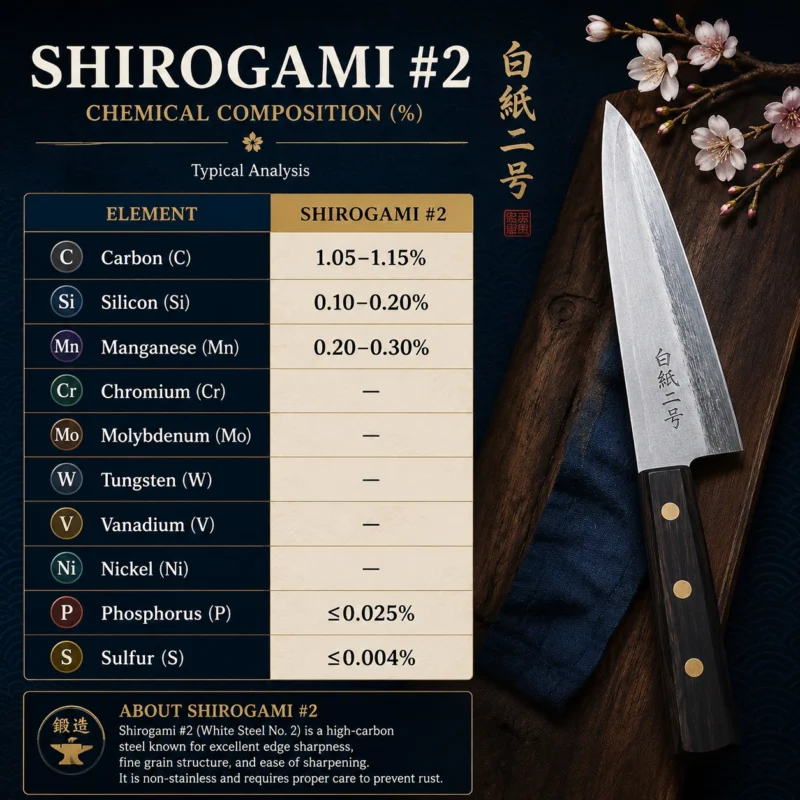
A commonly cited composition for Hitachi White Steel #2 is approximately:
- Carbon (C): around 1.1%
- Silicon (Si): around 0.15%
- Manganese (Mn): around 0.25%
- Phosphorus (P): very low
- Sulfur (S): very low
- Iron (Fe): balance
Sakai Ichimonji’s published comparison lists Hitachi White Steel #2 at approximately 1.1% carbon, 0.15% silicon, 0.25% manganese, with maximum phosphorus and sulfur values of 0.025% and 0.004%, respectively.
This simple composition is one of the reasons Shirogami #2 behaves differently from highly alloyed modern steels.
It contains very little chromium, tungsten, vanadium, or molybdenum compared with many modern knife steels.
That means it does not rely on large quantities of hard carbide-forming alloying elements to produce wear resistance.
Instead, its performance comes from its high carbon content, relatively clean composition, heat treatment, fine structure, and blade geometry.
This is a fundamentally different philosophy from steels such as S30V, S35VN, M390, MagnaCut, or SG2.
Modern powder metallurgy steels often pursue a combination of wear resistance, corrosion resistance, toughness, and high hardness.
Shirogami #2 takes a different route.
Its great attraction is the ability to produce a very fine, keen edge while remaining exceptionally pleasant to sharpen.
Why Is Shirogami #2 Considered a “Pure” Steel?
You will often see Shirogami #2 described as a pure carbon steel or a very pure Japanese carbon steel.
This should not be interpreted literally.
The steel is not chemically pure iron and carbon. It contains controlled amounts of elements such as silicon and manganese, as well as very small quantities of phosphorus and sulfur.
The important point is that it contains very few intentional alloying additions compared with modern alloy steels.
For knife making, this simplicity can be valuable.
Large quantities of carbide-forming elements can create hard carbide structures that contribute to wear resistance and edge retention. However, they can also make a steel more demanding to grind and sharpen.
Shirogami #2 has relatively little of that alloying complexity.
That is one reason it can feel so different on a whetstone.
The sharpening stone interacts with the steel in a relatively direct and predictable way. For many sharpening enthusiasts, this creates a particularly satisfying sensation.
How Hard Is Shirogami #2?
Shirogami #2 is a high-hardness knife steel, but there is no single universal HRC number for every Shirogami #2 knife.
A typical range for finished kitchen knives is approximately HRC 60–63, although individual makers and blades can fall outside that range.
Japanese Knife Archive lists Shirogami #2 at approximately 61–63 HRC, while other sources give broader practical ranges.
The important point is that the steel grade itself does not automatically determine the final hardness.
Heat treatment matters enormously.
Two knives made from nominally the same Shirogami #2 steel can behave differently if their heat treatment, tempering, grinding, geometry, and edge thickness are different.
This is why simply comparing two knives by steel name is not enough.
A well-made Shirogami #2 knife with excellent heat treatment can outperform a poorly treated knife made from a theoretically more advanced steel.
Check Our Guide What Is HRC? Understanding Rockwell Hardness in Kitchen Knives
Shirogami #2 and Sharpness
Sharpness is probably the characteristic most strongly associated with Shirogami #2.
A properly made and sharpened Shirogami #2 knife can take an exceptionally fine edge.
This is especially noticeable when cutting ingredients that benefit from a clean, controlled cut.
Examples include:
- Fresh vegetables
- Herbs
- Fruit
- Fish
- Boneless meat
- Garnishes
- Sushi ingredients
- Delicate proteins
Traditional Japanese knives are often designed around precise cutting rather than brute-force chopping.
A finely sharpened Shirogami #2 blade fits this philosophy extremely well.
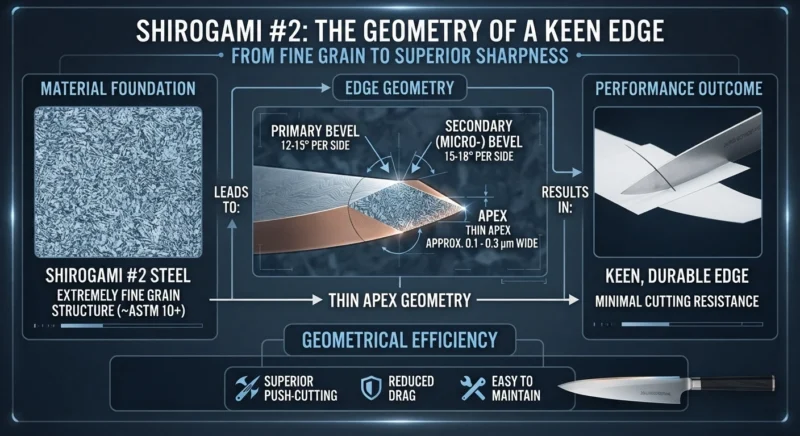
The combination of high carbon content, relatively simple composition, appropriate hardness, and fine geometry allows the edge to become extremely keen.
But there is an important distinction:
The steel does not make a knife sharp by itself.
The final sharpness depends on much more than the steel.
Blade geometry, grinding, edge thickness, sharpening skill, burr removal, polishing, and the quality of the heat treatment can all make a substantial difference.
A poorly sharpened Shirogami #2 knife will not magically cut better simply because “Shirogami” is written on the blade.
Check Our Guide All Kinds of Knife Sharpening Tools
Shirogami #2 Edge Retention
Edge retention is where Shirogami #2 becomes more interesting.
Many people assume that a steel capable of extreme sharpness must automatically have exceptional edge retention.
That is not necessarily true.
Shirogami #2 offers good but not exceptional wear resistance compared with highly alloyed modern knife steels.
It does not contain the significant tungsten, vanadium, or other carbide-forming additions found in many modern high-wear-resistance steels.
As a result, the initial edge can be extraordinary, but the knife may require sharpening more frequently than a high-wear-resistance powder steel.
This is not necessarily a disadvantage.
For professional chefs and sharpening enthusiasts, frequent light sharpening may actually be preferable to waiting until a knife becomes significantly dull.
Shirogami #2 is particularly attractive to people who enjoy maintaining their knives.
The steel is easy to refresh on a whetstone, so restoring the edge does not need to become a difficult or time-consuming task.
Check Our Guide Edge Retention Explained
Why Is Shirogami #2 So Easy to Sharpen?
This is one of the biggest advantages of White #2.
Compared with many highly alloyed knife steels, Shirogami #2 is very responsive to conventional water stones.
It can develop a burr relatively easily, and the sharpening process is straightforward for someone who understands basic whetstone technique.
It also provides excellent feedback.
The sensation of the stone contacting the steel is one of the reasons traditional carbon steels remain popular even in an age of extremely sophisticated powder metallurgy.
Sakai Ichimonji specifically highlights White Steel #2 as a steel that is particularly workable on whetstones and suitable for maintaining a clean, sharp edge with fine finishing stones.
For someone learning sharpening, Shirogami #2 can actually be an excellent educational steel.
You can see and feel what the stone is doing.
The burr develops predictably, the steel responds quickly, and the edge can be refined through progressively finer stones.
Shirogami #2 on a Whetstone
A basic sharpening progression for a Shirogami #2 kitchen knife might look like this:
800–1,000 grit
Use a medium or relatively coarse stone when the knife is genuinely dull or needs edge repair.
For routine maintenance, you may not need to start this low.
2,000–3,000 grit
This is useful for refining the working edge after a coarser stone.
4,000–6,000 grit
This range can produce a very refined kitchen edge suitable for many vegetables, meat, and general food preparation.
8,000+ grit
A very fine stone can be used when a highly polished edge is desired, especially for traditional Japanese knives and delicate cutting applications.
However, higher grit is not automatically better.
The ideal edge depends on the knife and the food being cut.
A chef who frequently cuts vegetables may prefer a slightly toothier edge rather than an extremely polished edge.
A traditional single-bevel knife used for delicate fish preparation may benefit from a much more refined finish.
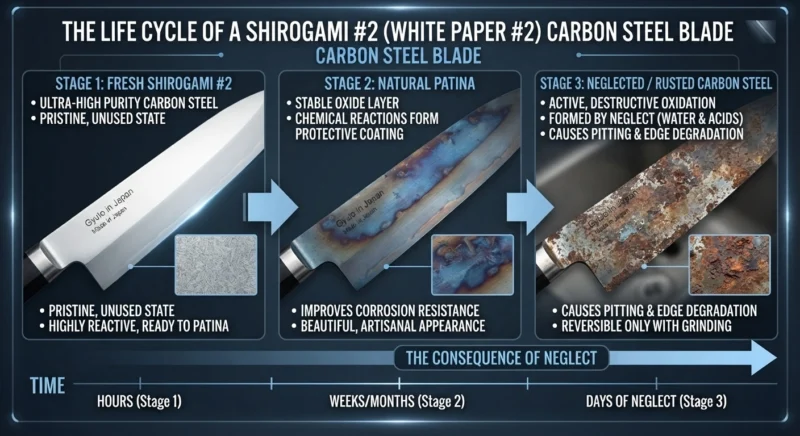
Does Shirogami #2 Rust?
Yes.
Shirogami #2 is a reactive carbon steel.
It should be treated very differently from stainless knife steels.
The lack of significant chromium means it does not have the corrosion resistance associated with stainless steel.
If you leave a Shirogami #2 knife wet, especially with acidic food residue on the blade, oxidation can develop quickly.
This is why proper care is essential.
After using the knife:
- Rinse or wipe away food residue.
- Wash the blade by hand when necessary.
- Dry it immediately.
- Do not leave it sitting wet on the counter.
- Do not put it in the dishwasher.
- Store it somewhere dry.
This routine quickly becomes second nature.
What Is Patina?
A patina is a thin layer that develops naturally on a reactive carbon-steel blade through controlled oxidation and interaction with food, moisture, and air.
Shirogami #2 commonly develops a grey, blue-grey, or sometimes darker patina over time.
For many knife enthusiasts, patina is not considered a defect.
It is part of owning a carbon-steel knife.
A patina can also reduce the steel’s exposure to further reaction, although it should not be treated as complete rust protection.
There is an important difference between patina and active rust.
A stable patina is generally thin and relatively uniform.
Rust is typically more aggressive and can appear orange, reddish-brown, or flaky.
The best way to prevent serious corrosion is simple:
Keep the blade clean and dry.
Shirogami #2 vs Stainless Steel
The biggest difference between Shirogami #2 and stainless steels is maintenance.
A stainless knife is generally much more forgiving.
You can wash it, dry it, and put it away with relatively little concern.
A Shirogami #2 knife demands more attention.
So why choose it?
Because some users value what they gain in return.
Shirogami #2 can offer:
- Extremely fine sharpening response
- Excellent whetstone feedback
- Very high potential sharpness
- Easy edge maintenance
- Traditional Japanese knife characteristics
- Excellent performance at fine edge geometries
Stainless steel offers:
- Better corrosion resistance
- Easier everyday maintenance
- Greater resistance to staining
- Often greater edge retention depending on the alloy
- More forgiving ownership
Neither is universally better.
They are designed around different priorities.
Check Our Guide Carbon Steel vs Stainless Steel Knives: Which Is Better?
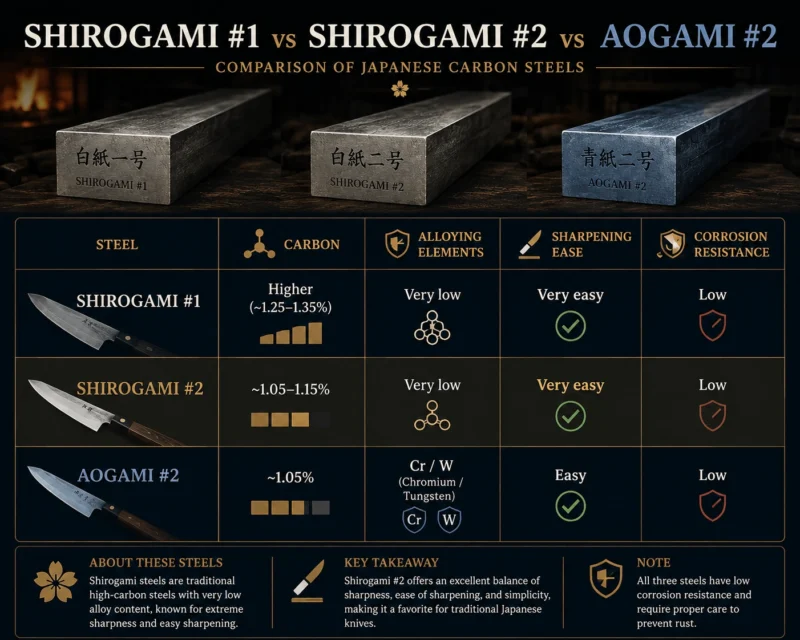
Shirogami #2 vs Aogami #2
This is one of the most common comparisons in Japanese knife steel.
Both steels are traditional Japanese carbon steels and both can produce excellent kitchen knives.
The fundamental difference is their alloying approach.
Shirogami #2 is a relatively simple high-carbon steel.
Aogami #2, or Blue #2, adds alloying elements including tungsten and chromium to the carbon-steel base. Sakai Ichimonji’s comparison lists approximately 1.1% carbon for both White #2 and Blue #2, while Blue #2 also contains tungsten and chromium.
The practical result is a different balance of characteristics.
Shirogami #2
- Easier to sharpen
- Excellent whetstone feedback
- Extremely fine edge potential
- Lower wear resistance
- Highly reactive
- Traditional sharpening experience
Aogami #2
- Higher wear resistance
- Generally longer edge retention
- Still capable of excellent sharpness
- More demanding to sharpen than White #2
- Still reactive and not stainless
- Excellent balance for professional use
A useful simplification is:
Choose Shirogami #2 if you prioritize sharpening feel and maximum refinement.
Choose Aogami #2 if you want more wear resistance and longer edge life while retaining traditional carbon-steel characteristics.
Of course, the exact behavior depends on the maker and heat treatment.
Check Our Guide Aogami Steel N2
Shirogami #2 vs Shirogami #1
White #1 and White #2 belong to the same family.
The main difference is carbon content.
White #1 contains more carbon than White #2.
That higher carbon content can support higher hardness and potentially greater edge retention, but it can also make the steel less forgiving.
Shirogami #2 is generally considered the more versatile choice.
It provides a very high level of sharpness while offering a practical balance of hardness, toughness, sharpening ease, and edge stability.
This is one reason White #2 is so common in Japanese kitchen knives.
Check Our Guide Shirogami #1 Steel
Shirogami #2 vs Shirogami #3
Shirogami #3 contains less carbon than White #2.
As the carbon content decreases, the potential hardness and edge characteristics change.
White #3 is less common in discussions of premium Japanese kitchen knives than White #1 and White #2.
For many users, Shirogami #2 occupies the middle ground that makes it particularly attractive.
It is high enough in carbon to deliver the characteristic White Steel performance but does not push carbon content as high as White #1.
Shirogami #2 vs 1095
Shirogami #2 is sometimes compared with 1095 carbon steel because both are simple high-carbon steels.
There are similarities, but they should not be treated as identical steels.
1095 is an American AISI steel specification with approximately 0.95% carbon, while Shirogami #2 is a Japanese steel specifically developed and used within Japanese knife-making traditions.
The differences are not only chemical.
The way a steel is forged, heat-treated, ground, and sharpened has a major impact on performance.
A Shirogami #2 Japanese kitchen knife is typically built around a very different geometry and cutting philosophy than a heavy 1095 outdoor or survival knife.
Therefore, simply comparing carbon percentages does not tell the entire story.
Shirogami #2 vs VG10
VG10 is one of the most recognizable Japanese stainless knife steels.
Unlike Shirogami #2, VG10 contains substantial chromium and is designed to provide much better corrosion resistance.
VG10 is therefore much easier for a user who wants a relatively low-maintenance kitchen knife.
Shirogami #2 has the advantage for those who want a traditional carbon-steel sharpening experience and exceptionally fine edge potential.
A simplified comparison looks like this:
| Feature | Shirogami #2 | VG10 |
| Type | Carbon steel | Stainless |
| Corrosion Resistance | Low | High |
| Sharpening | Excellent | Good |
| Fine Edge Potential | Excellent | Very good |
| Edge Retention | Moderate | Good |
| Maintenance | High | Low |
| Patina | Yes | Generally no |
| Traditional Japanese Character | Very high | Moderate/high |
The best choice depends on whether you value performance and sharpening experience or ease of maintenance.
Check Our Guide VG10 Steel Review: Pros, Cons, Edge Retention, Toughness & Real-World Performance
Shirogami #2 vs SG2
SG2 is a powdered metallurgy stainless steel used in many high-end Japanese kitchen knives.
It is almost the opposite philosophy from White #2.
SG2 can achieve very high hardness and strong wear resistance while maintaining excellent corrosion resistance.
Shirogami #2 is simpler, more reactive, and easier to sharpen.
SG2 generally makes more sense for someone who wants:
- Long edge retention
- Stainless performance
- High hardness
- Lower maintenance
Shirogami #2 makes more sense for someone who wants:
- Traditional carbon steel
- Easy sharpening
- Maximum refinement
- Strong whetstone feedback
- Patina development
- Traditional Japanese knife character
What Types of Knives Use Shirogami #2?
Shirogami #2 is versatile within Japanese kitchen knife making.
It can be found in many different knife styles.
Gyuto
A gyuto is the Japanese equivalent of a versatile chef’s knife.
Shirogami #2 works particularly well for gyuto knives because it allows the maker to create a thin, highly refined cutting edge.
Santoku
Santoku knives benefit from the steel’s excellent sharpening response and fine edge potential.
A White #2 santoku can be an excellent everyday kitchen knife for a cook who is comfortable with carbon-steel maintenance.
Nakiri
Nakiri knives are vegetable specialists.
Their straight edges and relatively thin geometry pair naturally with a steel capable of producing a keen edge.
Shirogami #2 is therefore a popular choice for traditional-style nakiri knives.
Yanagiba
Single-bevel yanagiba knives are strongly associated with traditional Japanese fish preparation.
The ability to create and maintain an extremely refined edge is particularly valuable for this application.
Deba
Deba knives are designed for fish preparation.
Shirogami #2 can be found in traditional deba, although users must understand the difference between a precise cutting tool and a knife intended for aggressive bone work.
Usuba
Traditional usuba knives are specialized vegetable knives.
Their single-bevel geometry and highly refined edges make White Steel an especially natural pairing.
Is Shirogami #2 Good for Beginners?
This depends on what kind of beginner you mean.
For someone who wants a completely maintenance-free knife, no.
Stainless steel would be easier.
But for someone who wants to learn knife sharpening and is willing to care for a carbon-steel blade, Shirogami #2 can be an excellent choice.
Its response to a whetstone is one of its greatest advantages.
It teaches the user the importance of:
- Maintaining a consistent sharpening angle
- Creating a controlled burr
- Removing the burr properly
- Choosing an appropriate grit
- Keeping the blade dry
- Understanding edge geometry
- Avoiding excessive force
In other words, Shirogami #2 encourages the owner to become involved in maintaining the knife.
For some people, that is precisely the attraction.
Is Shirogami #2 Good for Professional Chefs?
Yes.
Professional chefs have used traditional carbon-steel Japanese knives for generations.
The suitability depends on the chef’s workflow.
A chef who values:
- Extremely sharp edges
- Precise cutting
- Fast sharpening
- Traditional Japanese knives
- Regular knife maintenance
may love Shirogami #2.
A chef working in an environment where knives are frequently exposed to moisture and acidic foods, or where multiple staff members share knives, may prefer stainless steel.
The right steel is therefore determined not only by performance but also by the working environment.
How to Care for a Shirogami #2 Knife
Proper care is straightforward once it becomes a habit.
1. Keep the blade dry
This is the most important rule.
Do not leave a Shirogami #2 knife wet.
2. Wipe the blade frequently
When preparing acidic ingredients such as tomatoes, citrus, onions, or certain fruits, wiping the blade periodically can reduce staining and uncontrolled oxidation.
3. Wash by hand
Use mild dish soap and water.
Do not put a carbon-steel Japanese knife into the dishwasher.
4. Dry immediately
Use a clean towel and make sure the blade is completely dry before storage.
5. Use a whetstone
Avoid aggressive pull-through sharpeners.
A whetstone gives much better control and is particularly well suited to Shirogami #2.
6. Store correctly
A knife block, saya, magnetic rack, or other dry protective storage solution can work well.
If storing the knife for an extended period, a very light coat of food-safe mineral oil can provide additional protection.
How to Prevent Rust on Shirogami #2
Rust prevention is mostly about controlling moisture.
The following habits make a major difference:
Dry immediately after washing.
Never leave food residue on the blade for long periods.
Do not store the knife wet.
Do not put it in the dishwasher.
Use a protective oil coating for long-term storage.
If surface rust appears, address it early rather than allowing it to develop.
A mild abrasive appropriate for knife maintenance can help remove superficial oxidation, followed by thorough cleaning and drying.
Deep corrosion is a different problem and may require more aggressive restoration.
Does Shirogami #2 Need Oil?
Not necessarily during normal daily use.
If you wash, dry, and use the knife regularly, careful drying is usually the most important form of corrosion prevention.
Oil becomes particularly useful when:
- The knife will not be used for an extended period
- The environment is humid
- The knife is stored for several weeks or months
- You want additional corrosion protection
For food-contact applications, use an appropriate food-safe mineral oil or another product specifically intended for kitchen knives.
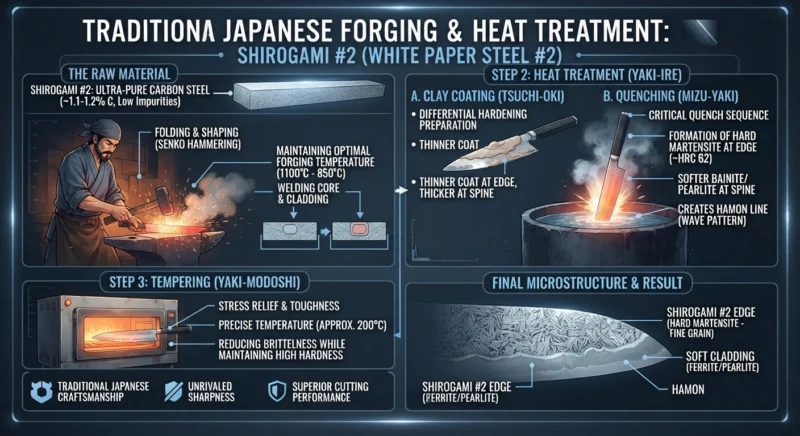
The Importance of Heat Treatment
It is impossible to discuss Shirogami #2 properly without discussing heat treatment.
The steel grade tells you what material was used.
It does not tell you exactly how the finished knife will perform.
Heat treatment transforms the steel’s microstructure and determines important properties such as hardness, edge stability, and toughness.
This is why two Shirogami #2 knives can feel surprisingly different.
One may have:
- Excellent edge stability
- Easy sharpening
- Strong performance
- Good resistance to micro-chipping
while another may be significantly more fragile.
The skill of the maker matters enormously.
This is particularly important with traditional Japanese knives, where forging, quenching, tempering, grinding, and sharpening are all parts of the final product.
Sakai Ichimonji notes that steel material is only one factor and that heat treatment and sharpening also have substantial effects on finished knife performance.
Check Our Guide Steel Heat Treatment Explained
Does Higher HRC Mean a Better Shirogami #2 Knife?
Not necessarily.
Hardness is useful information, but it should never be treated as the only measure of quality.
A knife at HRC 64 is not automatically better than one at HRC 61.
Higher hardness can improve edge stability and edge retention, but excessive hardness may also increase the risk of chipping depending on geometry and heat treatment.
The best hardness depends on:
- Blade geometry
- Edge angle
- Intended use
- Heat treatment
- User technique
- Knife style
A professional sushi chef using a yanagiba may have very different requirements from a home cook using a nakiri.
Therefore, when evaluating a Shirogami #2 knife, look at the complete knife, not only the HRC number.
Why Does Shirogami #2 Develop a Patina So Quickly?
The answer is its chemistry.
Because Shirogami #2 lacks the high chromium content required for stainless behavior, the exposed steel reacts readily with oxygen, moisture, and acids.
Food acids can accelerate the process.
This is why the blade may begin changing color soon after you start using it.
A new White #2 knife might initially have a bright, polished appearance.
After several weeks or months, it may develop shades of:
- Grey
- Blue-grey
- Purple-grey
- Dark grey
- Brown
The exact appearance depends on the foods being cut, humidity, cleaning habits, and the surface finish of the blade.
For many enthusiasts, this evolving appearance is one of the pleasures of carbon steel.
Is Patina Safe?
A normal stable patina is generally not something to fear.
The important thing is distinguishing patina from active rust.
Patina is typically thin and relatively stable.
Rust is more aggressive and can damage the steel if ignored.
If you see orange or reddish corrosion, clean it rather than allowing it to spread.
A properly maintained carbon-steel knife can develop a beautiful patina while remaining fully functional.
Shirogami #2 and Food Reactivity
Because Shirogami #2 is reactive, it can interact with certain foods.
Acidic ingredients are particularly noticeable.
Tomatoes, citrus, vinegar, apples, and other acidic foods can accelerate patina formation.
Some foods can also produce temporary discoloration or metallic odors, particularly with a new carbon-steel blade.
A simple solution is to wipe the blade frequently during food preparation.
As the patina develops, the knife generally becomes easier to manage.
What Makes Shirogami #2 Special?
The answer is not one single property.
Its appeal comes from the combination of several characteristics.
High carbon content
Approximately 1.1% carbon provides the basis for high hardness and fine edge formation.
Low alloy content
The relatively simple chemistry makes the steel responsive to sharpening.
Excellent whetstone behavior
It is easy to sharpen compared with many high-alloy steels.
Very fine edge potential
A well-made Shirogami #2 blade can become exceptionally sharp.
Traditional character
It is strongly associated with traditional Japanese knife making.
Patina
The blade changes naturally with use and develops its own appearance.
Maintenance
The need for care encourages the owner to become involved with the knife.
For enthusiasts, this entire combination is what makes White #2 special.
Is Shirogami #2 the Sharpest Japanese Steel?
It is better not to say that one steel is objectively “the sharpest.”
Sharpness depends heavily on:
- Heat treatment
- Edge geometry
- Edge angle
- Grinding
- Sharpening
- Finishing
- Cutting technique
However, Shirogami #2 has an excellent reputation for taking an exceptionally fine edge.
Its relative lack of alloying elements makes it particularly pleasant to refine on water stones.
So rather than saying Shirogami #2 is automatically the sharpest steel, it is more accurate to say:
Shirogami #2 is one of the steels most capable of producing an extremely fine and refined edge when properly heat-treated, ground, and sharpened.
That distinction matters.
Is Shirogami #2 Tough?
Shirogami #2 is not normally selected because it has exceptional toughness.
Its strength is its fine edge performance and sharpening response.
At appropriate hardness and geometry, it can be perfectly practical for kitchen use.
However, users should understand that a highly hardened Japanese kitchen knife is not a pry bar or heavy-duty chopping tool.
Avoid:
- Bones
- Frozen food
- Hard pits
- Twisting cuts
- Chopping through hard materials
- Using the edge for prying
This is especially important with thin Japanese kitchen knives.
The geometry of the knife is often more important to real-world durability than the steel name alone.
Shirogami #2 for Vegetable Knives
White #2 is an excellent candidate for vegetable-focused knives.
A thin nakiri or usuba can take advantage of the steel’s ability to support a refined edge.
Vegetables such as:
- Carrots
- Cabbage
- Cucumbers
- Potatoes
- Zucchini
- Peppers
- Onions
- Herbs
- Mushrooms
- Leafy greens
can all benefit from a sharp, thin blade.
The straight edge of a nakiri is particularly well suited to push-cutting and chopping.
A Shirogami #2 nakiri can therefore be a rewarding combination for someone who enjoys traditional Japanese knives.
Check Our Guide Best Japanese Kitchen Knife for Vegetables
Shirogami #2 for Fish Knives
Traditional Japanese fish knives are another major application.
A yanagiba requires a highly refined edge for slicing raw fish.
A deba requires a different type of geometry and is designed for fish preparation.
An usuba is designed for precision vegetable work.
The versatility of Shirogami #2 within traditional Japanese knife making demonstrates that the steel itself does not dictate the knife’s purpose.
The maker’s geometry and the knife’s design determine how the steel is used.
Check Our Guide Japanese Fish Knives
Why Knife Geometry Matters More Than Many Buyers Think
When shopping for a Japanese knife, consumers often focus heavily on steel names.
Steel matters.
But geometry may matter just as much.
A thin Shirogami #2 blade with a carefully ground edge can feel dramatically different from a thick blade made from the same steel.
The same is true for:
- Edge angle
- Blade thickness
- Grind
- Distal taper
- Bevel geometry
- Spine thickness
- Edge thickness
This is why two knives made from identical Shirogami #2 steel can perform very differently.
The steel provides the potential.
The maker determines how much of that potential becomes usable performance.
Why Shirogami #2 Remains Popular in the Age of Powder Steel
Modern knife steels have achieved remarkable performance.
Powder metallurgy steels such as SG2, SRS-13, R2, and various high-alloy stainless steels can provide excellent combinations of hardness, wear resistance, and corrosion resistance.
So why does a traditional carbon steel like Shirogami #2 remain popular?
Because knife performance is not only about how many hours an edge can remain sharp.
Many enthusiasts value:
- How quickly the knife sharpens
- How the stone feels against the blade
- How fine the edge can become
- How predictable the sharpening process is
- How the knife cuts delicate ingredients
- How the blade develops patina
- How the knife connects the user with traditional craftsmanship
Shirogami #2 offers a very different ownership experience.
It is a steel you interact with.
You sharpen it.
You maintain it.
You watch the blade change.
For some users, that is much more satisfying than owning a completely maintenance-free stainless knife.
Common Myths About Shirogami #2
Myth 1: Shirogami #2 is stainless
It is not.
It is a reactive carbon steel and requires proper care.
Myth 2: White Steel #2 is literally pure iron and carbon
It is better described as a low-alloy, high-purity carbon steel with controlled amounts of other elements.
Myth 3: Shirogami #2 never holds an edge
It does hold an edge.
Its edge retention is simply more moderate than that of many highly wear-resistant modern steels.
Myth 4: A higher HRC automatically means a better knife
Hardness is only one variable.
Heat treatment, geometry, sharpening, and edge stability all matter.
Myth 5: Patina means the knife is damaged
A normal patina is a natural characteristic of reactive carbon steel.
Active rust is different and should be removed.
Myth 6: Carbon steel is impossible to maintain
It requires more care than stainless steel, but the routine is simple: use, clean, dry, and store properly.
Myth 7: Shirogami #2 is only for professional chefs
Not at all.
Home cooks who enjoy sharpening and traditional Japanese knives can enjoy it just as much.
Who Should Buy a Shirogami #2 Knife?
Shirogami #2 is an excellent choice for someone who says:
“I want a knife that I can sharpen easily and keep extremely sharp.”
It is particularly suitable for:
- Japanese knife enthusiasts
- Professional chefs
- Home cooks who enjoy cooking
- Whetstone users
- Traditional knife collectors
- Sushi enthusiasts
- Vegetable specialists
- Users who appreciate carbon-steel patina
- People interested in traditional Japanese craftsmanship
It may not be the best choice for someone who wants to throw a knife into the dishwasher and forget about it.
For those users, a stainless steel knife is much more practical.
How to Choose a Shirogami #2 Knife
When buying a White #2 knife, don’t look only at the steel name.
Consider the entire knife.
1. Heat treatment
Look for a reputable maker with consistent heat treatment.
2. Geometry
A good grind can make a tremendous difference.
3. Edge thickness
A thinner edge can provide excellent cutting performance but may require more careful technique.
4. Knife style
Choose the geometry according to your intended use.
5. Handle
Traditional Japanese wa handles offer a different feel from Western-style handles.
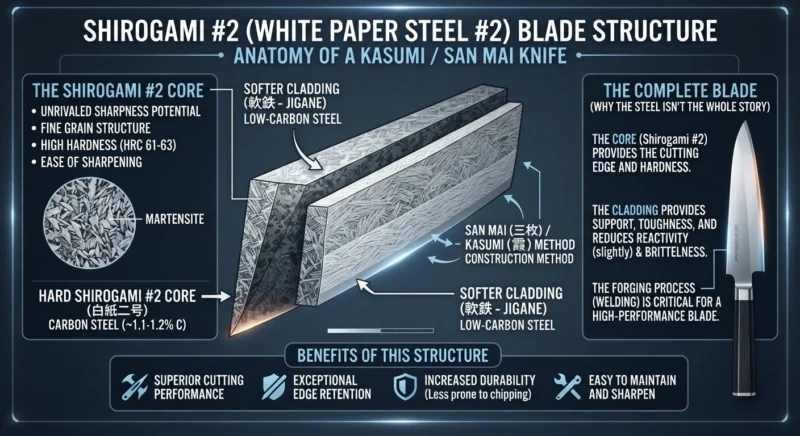
6. Cladding
Shirogami #2 may be used as a core steel with iron, stainless, or other cladding.
A stainless-clad White #2 knife can reduce maintenance on the exposed sides of the blade, although the exposed carbon-steel edge still requires care.
7. Sharpening equipment
If you buy a Shirogami #2 knife, a good whetstone is one of the most useful accessories you can own.
Stainless-Clad Shirogami #2
One particularly interesting construction is stainless-clad Shirogami #2.
In this design, the cutting core is White #2 while the outer layers are stainless steel.
The result can provide some of the performance characteristics of Shirogami #2 while reducing the amount of reactive steel exposed to the environment.
However, the cutting edge itself remains carbon steel.
Therefore, stainless cladding does not make the knife completely maintenance-free.
It simply makes the blade easier to live with.
For home cooks who want traditional carbon-steel performance but are concerned about corrosion, stainless-clad White #2 can be a very attractive compromise.
Iron-Clad Shirogami #2
Traditional knives can also use iron cladding.
This produces a classic carbon-steel appearance and allows the blade to develop patina across a larger portion of the surface.
Iron-clad knives can be beautiful, but they require more care than stainless-clad versions.
They are particularly attractive to enthusiasts who appreciate the visual evolution of a traditional carbon-steel blade.
Sharpening Shirogami #2: Common Mistakes
Even though White #2 is easy to sharpen, beginners can still make mistakes.
Using too much pressure
Heavy pressure is rarely necessary.
Let the stone and abrasive do the work.
Changing the angle constantly
Consistency is more important than obsessing over a specific number.
Over-sharpening
You do not always need to start with a coarse stone.
Routine maintenance can often be done with a medium or fine stone.
Leaving a burr
A large burr is not the goal.
The final edge should have the burr removed carefully.
Using very coarse stones unnecessarily
Coarse stones remove steel quickly.
Use them when needed, not automatically.
Ignoring the spine and blade geometry
Different Japanese knives require different sharpening approaches.
A single-bevel yanagiba is not sharpened in exactly the same way as a double-bevel gyuto or nakiri.
How Often Should You Sharpen Shirogami #2?
There is no universal schedule.
Sharpen when performance tells you that the knife needs it.
For some professional cooks, that may mean frequent light touch-ups.
For a home cook, a knife may go much longer between sharpening sessions.
The advantage of Shirogami #2 is that when the edge eventually becomes dull, bringing it back is usually straightforward.
This is one reason the steel can be so enjoyable for people who prefer maintaining their own knives.
Does Shirogami #2 Need a Polished Edge?
Not necessarily.
A highly polished edge can be excellent for some applications, but a slightly toothier edge may perform better for others.
For example, a medium-grit finishing stone can leave useful micro-serrations that help with certain vegetables and foods.
Traditional fish knives may be finished much more finely.
The best finish depends on the knife and its purpose.
One of the pleasures of Shirogami #2 is that it responds well to experimentation.
You can try different stones and discover which edge finish works best for your cooking style.
Shirogami #2 and the Art of Japanese Knife Making
Traditional Japanese knife making places enormous importance on craftsmanship.
Steel is only the beginning.
A skilled maker must understand:
- Forging
- Heat treatment
- Quenching
- Tempering
- Grinding
- Blade geometry
- Edge formation
- Polishing
- Sharpening
- Handle construction
Shirogami #2 is particularly revealing because its relatively simple chemistry places a greater emphasis on the maker’s ability to process the steel correctly.
This is one reason White #2 is often associated with traditional craftsmanship.
A well-made Shirogami #2 knife can become more than a kitchen utensil.
It can be a tool that demonstrates the relationship between material, craftsmanship, sharpening, and the cook.
Is Shirogami #2 Worth It?
For the right user, absolutely.
The value of White #2 is not based on being the most advanced modern steel.
It is valuable because it offers a particular combination of characteristics that is difficult to replicate:
high carbon + low alloy content + excellent sharpening response + exceptional fine-edge potential + traditional Japanese character.
It requires more care than stainless steel.
It may not retain its edge as long as a highly wear-resistant powder steel.
It can develop patina.
It can rust if neglected.
But it is also remarkably rewarding to sharpen.
For someone who enjoys the process of maintaining a knife, these characteristics are not drawbacks.
They are part of the experience.
Final Verdict: Is Shirogami #2 a Good Knife Steel?
Shirogami #2 is one of the classic Japanese carbon steels for a reason.
It offers an exceptional balance between high sharpness, fine edge potential, ease of sharpening, and traditional knife-making characteristics.
Its approximately 1.1% carbon content and relatively low alloy content make it very different from modern stainless and powder metallurgy steels. The steel is not designed to maximize corrosion resistance or extreme wear resistance.
Instead, it emphasizes a different set of priorities.
If your priority is easy sharpening, excellent whetstone feedback, and an extremely refined cutting edge, Shirogami #2 is difficult to overlook.
If your priority is maximum corrosion resistance and long edge retention with minimal maintenance, a modern stainless or high-alloy steel may be a better choice.
The beauty of Shirogami #2 is that it does not try to do everything.
It does a few things exceptionally well.
It can become extremely sharp.
It can be sharpened easily.
It responds beautifully to traditional Japanese water stones.
And when properly heat-treated and ground, it can provide a cutting experience that has kept traditional carbon-steel Japanese knives relevant even as modern steels continue to evolve.
For cooks and knife enthusiasts who appreciate the relationship between steel, craftsmanship, sharpening, and cutting performance, White Steel #2 remains one of the most interesting Japanese knife steels available.
Shirogami #2 FAQ
What is Shirogami #2?
Shirogami #2, also called White Steel #2 or White Paper Steel #2, is a high-carbon, low-alloy Japanese carbon steel used extensively for traditional kitchen knives.
Is Shirogami #2 stainless?
No. Shirogami #2 is a reactive carbon steel and can rust if it is exposed to moisture and not properly maintained.
What is the carbon content of Shirogami #2?
A commonly cited specification for Hitachi White Steel #2 is approximately 1.1% carbon.
What hardness is Shirogami #2?
Finished kitchen knives commonly fall around HRC 60–63, although actual hardness depends on the maker and heat treatment.
Is Shirogami #2 easy to sharpen?
Yes. Its excellent response to whetstones is one of its most appreciated characteristics.
Does Shirogami #2 hold an edge well?
It offers good practical edge retention, but its wear resistance is lower than that of many highly alloyed modern steels.
Does Shirogami #2 develop patina?
Yes. Patina is a normal characteristic of reactive carbon steel and develops naturally through use.
Is Shirogami #2 better than Aogami #2?
Neither is universally better. Shirogami #2 generally emphasizes sharpening ease and fine-edge performance, while Aogami #2 adds alloying elements that increase wear resistance and can improve edge retention.
Is Shirogami #2 better than VG10?
They serve different priorities. Shirogami #2 offers traditional carbon-steel characteristics and easier sharpening, while VG10 offers substantially better corrosion resistance.
Is Shirogami #2 good for a Nakiri?
Yes. Its ability to take a fine edge makes it particularly well suited to vegetable knives such as nakiri.
Can you use Shirogami #2 for a Gyuto?
Yes. Shirogami #2 is widely used in gyuto and other Japanese kitchen knife styles.
Does a Shirogami #2 knife need special care?
It requires more care than stainless steel. Keep the blade clean and dry, wash it by hand, and avoid prolonged exposure to moisture.
Can Shirogami #2 be sharpened on a whetstone?
Yes. Whetstones are one of the best sharpening methods for this steel.
Does higher HRC mean better Shirogami #2?
No. Hardness is only one factor. Heat treatment, geometry, edge thickness, sharpening, and the intended use of the knife are equally important considerations.
Conclusion
Shirogami #2 is a traditional Japanese carbon steel built around simplicity rather than complexity.
Its approximately 1.1% carbon content, very low levels of unwanted impurities, and minimal alloying additions give it a distinctive combination of properties. It can achieve an exceptionally fine edge, responds beautifully to whetstones, and is relatively easy to sharpen.
The trade-off is equally clear.
It is reactive.
It can develop patina.
It can rust.
It requires regular maintenance.
And its edge retention is not designed to compete directly with the most wear-resistant modern powder steels.
But that is exactly why Shirogami #2 remains so fascinating.
It represents a different idea of what a great knife should be.
Instead of maximizing every possible specification, it focuses on the fundamentals: a clean steel composition, excellent heat treatment, fine geometry, exceptional sharpness, and an enjoyable sharpening experience.
For cooks who want a traditional Japanese carbon-steel knife and are willing to give it the care it deserves, Shirogami #2 remains one of the most rewarding steels to own, use, and sharpen.
This article is for independent informational purposes only and is not affiliated with, sponsored by, or endorsed by any steel manufacturer. All product names, trademarks, and registered trademarks are the property of their respective owners.