VG10 vs N390: Which Knife Steel Is Better?
An Independent Guide
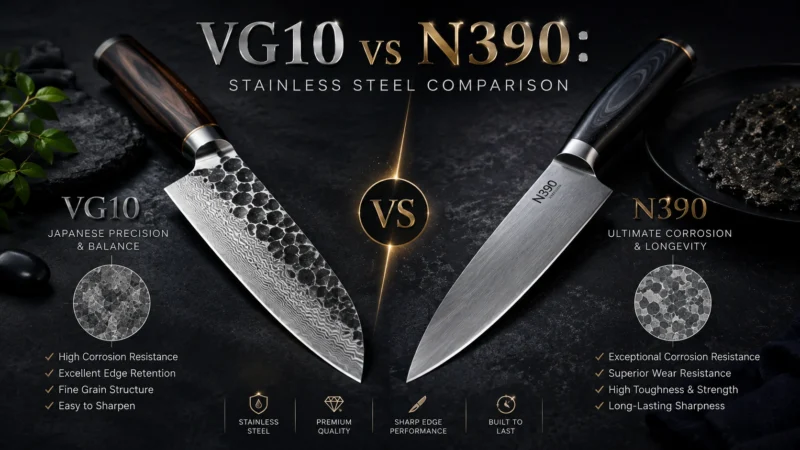
Choosing the right knife steel can significantly influence cutting performance, maintenance, durability, and long-term satisfaction. Among premium stainless steels, VG10 vs N390 is becoming an increasingly popular comparison because both steels offer excellent corrosion resistance, high hardness, and reliable cutting ability.
Although they belong to the premium stainless steel category, VG10 vs N390 reveals two materials designed with different priorities. One focuses on balanced performance and easy maintenance, while the other emphasizes superior wear resistance and long-lasting sharpness.
So, which steel should you choose?
The answer depends on how you plan to use your knife.
In this comprehensive VG10 vs N390 guide, we’ll compare every important characteristic, including:
- Chemical composition
- Hardness
- Edge retention
- Toughness
- Corrosion resistance
- Wear resistance
- Sharpening difficulty
- Kitchen performance
- Outdoor applications
- Everyday carry use
- Overall value
By the end of this article, you’ll understand the strengths and weaknesses of both steels and be able to choose the one that best fits your needs.
Understanding VG10 Steel
Before comparing VG10 vs N390, it’s important to understand what makes VG10 such a respected knife steel.
VG10 is a premium stainless steel developed to provide an excellent balance between hardness, toughness, corrosion resistance, and sharpening ease. Rather than maximizing one single property, it delivers dependable performance across nearly every category.
VG10 is known for:
- Excellent corrosion resistance
- Fine grain structure
- Razor-sharp cutting ability
- Easy sharpening
- Good toughness
- Reliable edge retention
- Balanced overall performance
Its fine carbide structure allows the blade to take a very refined edge, making VG10 especially popular for kitchen knives and precision cutting tools.
Because it combines durability with straightforward maintenance, VG10 has become one of the most trusted premium stainless steels for everyday use.
Check Our Guide VG10 Steel Review
Understanding N390 Steel
When discussing VG10 vs N390, N390 represents a more wear-resistant premium stainless steel designed for users who want exceptional edge retention without sacrificing corrosion resistance.
N390 contains higher levels of alloying elements that improve abrasion resistance while maintaining excellent stainless properties.
Typical characteristics include:
- Excellent edge retention
- Outstanding corrosion resistance
- High wear resistance
- Fine cutting performance
- High hardness
- Long service life
N390 performs particularly well during extended cutting sessions where maintaining sharpness is a priority.
For users who prefer sharpening less frequently, N390 is often considered one of the strongest choices among premium stainless knife steels.
Check Our Guide Powder Steels for Kitchen Knives
VG10 vs N390 Chemical Composition
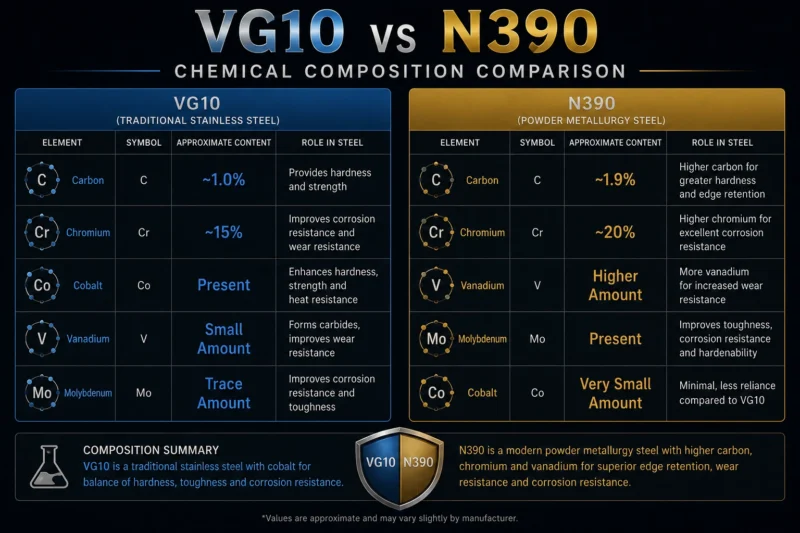
Although both steels are stainless, their alloy compositions differ enough to produce noticeable differences in performance.
VG10 Composition
VG10 typically contains:
- Carbon
- Chromium
- Vanadium
- Cobalt
- Molybdenum
- Manganese
This balanced composition provides:
- Good hardness
- Excellent corrosion resistance
- Fine grain structure
- Easy sharpening
- Stable cutting edge
The addition of cobalt helps improve hardness after heat treatment, while chromium provides outstanding resistance to rust.
N390 Composition
N390 contains:
- Carbon
- Chromium
- Vanadium
- Molybdenum
- Additional alloying elements that enhance wear resistance
Compared with VG10, N390 is optimized to improve:
- Abrasion resistance
- Edge longevity
- High-hardness stability
- Long-term cutting performance
These differences become more noticeable during prolonged cutting tasks.
VG10 vs N390 Hardness
Hardness is one of the first specifications many buyers compare.
Typical hardness ranges are:
| Steel | Typical Hardness |
|---|---|
| VG10 | 59–61 HRC |
| N390 | 60–62 HRC |
Although their hardness ranges overlap, N390 is often heat treated toward the higher end of the scale.
However, hardness alone does not determine knife performance.
The combination of hardness, carbide structure, and heat treatment determines how well a knife performs in real-world use.
This is why the VG10 vs N390 comparison requires looking beyond simple HRC numbers.
Check Our Guide What Is HRC? Understanding Rockwell Hardness
VG10 vs N390 Edge Retention
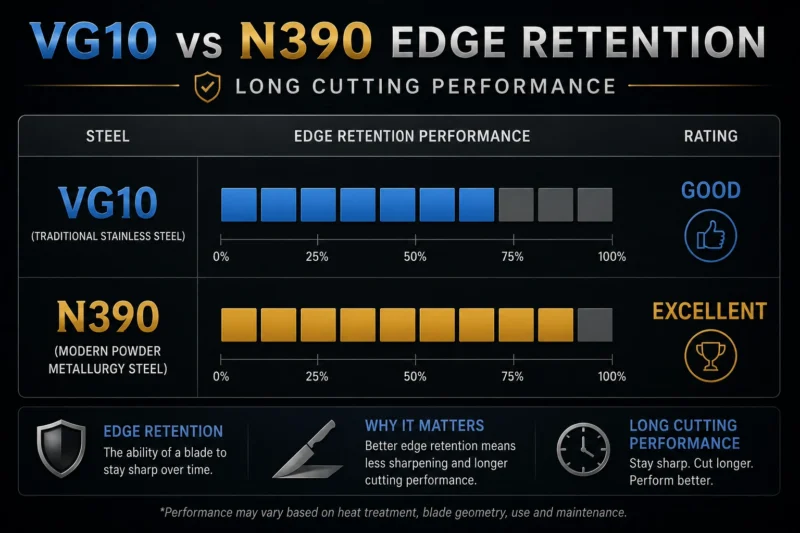
Edge retention is one of the biggest reasons people compare VG10 vs N390.
VG10 provides excellent cutting longevity for:
- Kitchen work
- Vegetables
- Fish
- Poultry
- Fruit
- Everyday utility tasks
Its edge remains sharp through extended food preparation and regular household use.
However, N390 is specifically designed to provide even longer edge life.
Its improved wear resistance allows the blade to maintain cutting performance through more demanding tasks such as:
- Cardboard
- Rope
- Leather
- Heavy packaging
- Repeated utility cutting
During prolonged use, the VG10 vs N390 comparison generally favors N390 for overall edge retention.
For users who dislike frequent sharpening, this can be a significant advantage.
Check Our Guide Edge Retention Explained
Initial Sharpness
Both steels are capable of achieving an extremely sharp edge.
VG10 has earned a reputation for taking a highly refined, razor-like edge thanks to its fine grain structure.
Many users appreciate its smooth slicing performance when cutting vegetables, herbs, fish, and boneless meat.
N390 is also capable of exceptional sharpness.
Its harder wear-resistant carbides provide a durable cutting edge that maintains its bite through extended use.
In terms of initial sharpness, VG10 vs N390 is effectively a tie.
Both steels can become impressively sharp when properly heat treated and sharpened.
Cutting Performance
One reason VG10 vs N390 remains a popular comparison is that both steels deliver outstanding cutting performance.
VG10 excels at:
- Precision slicing
- Fine kitchen work
- Controlled cutting
- Everyday food preparation
N390 excels at:
- Long cutting sessions
- Abrasive materials
- Heavy utility work
- Extended edge stability
Neither steel feels dull or sluggish during normal use.
Instead, the difference lies in how long each steel maintains peak cutting performance before sharpening becomes necessary.
VG10 vs N390: Toughness, Corrosion Resistance, Wear Resistance, and Sharpening
As we continue our VG10 vs N390 comparison, it’s important to look beyond hardness and edge retention. A premium knife steel should also provide excellent toughness, resist corrosion, sharpen efficiently, and maintain reliable performance over years of use.
This section of our VG10 vs N390 guide explores how these two stainless steels perform in real-world conditions and where each one has an advantage.
VG10 vs N390 Toughness
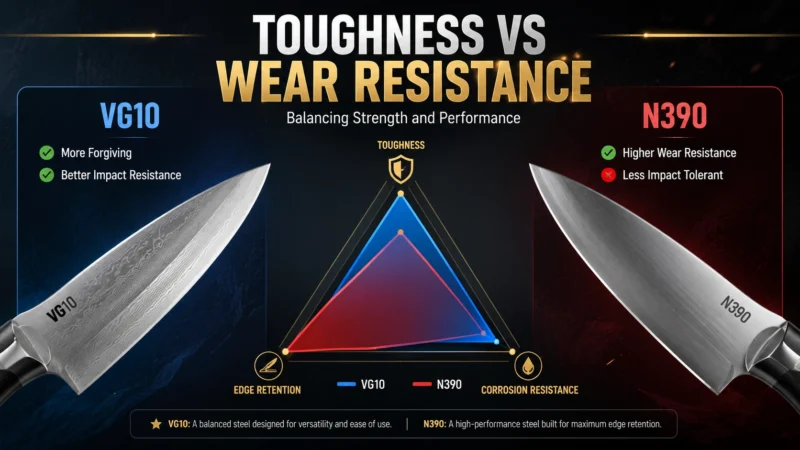
Toughness refers to a steel’s ability to resist chipping, cracking, or breaking when subjected to impact or lateral stress.
When comparing VG10 vs N390, both steels offer good toughness for premium stainless steels, but there are noticeable differences.
VG10 is well known for its balanced properties. It combines respectable hardness with a fine carbide structure, giving it reliable resistance to micro-chipping during normal kitchen and utility use.
This makes VG10 especially suitable for:
- Daily meal preparation
- Precision slicing
- Utility cutting
- Outdoor cooking
N390 also offers good toughness, but its primary design focuses more on wear resistance than impact resistance. Because it contains a greater volume of hard carbides, it can be slightly less forgiving if the blade is misused.
Neither steel should be subjected to excessive side loading or abusive cutting.
For normal cutting applications, both perform exceptionally well.
Check Our Guide Wear Resistance vs Toughness
Which Steel Is More Resistant to Chipping?
One of the most common questions during a VG10 vs N390 comparison is whether either steel chips more easily.
The answer depends largely on:
- Heat treatment
- Blade geometry
- Edge angle
- Intended use
VG10’s fine grain structure allows it to support thin, razor-sharp edges with excellent stability.
N390 also supports thin edges but is optimized for wear resistance rather than maximum toughness.
To avoid chipping with either steel:
- Never cut bones.
- Avoid frozen food.
- Do not pry with the blade.
- Avoid twisting the knife during cuts.
- Use appropriate cutting boards.
When properly used, both VG10 and N390 offer excellent durability.
VG10 vs N390 Corrosion Resistance
Corrosion resistance is one of the strongest qualities shared by both steels.
Because both contain high chromium content, they belong to the premium stainless steel category and perform exceptionally well in humid environments.
During the VG10 vs N390 comparison, both steels resist:
- Rust
- Food acids
- Kitchen moisture
- Fruit juices
- Vegetable acids
- Everyday humidity
VG10 has earned an excellent reputation for stain resistance during daily food preparation.
It performs particularly well when regularly exposed to:
- Tomatoes
- Citrus fruits
- Onions
- Apples
- Peppers
N390 also demonstrates outstanding corrosion resistance and is equally capable of resisting staining during everyday kitchen and outdoor use.
For most users, corrosion resistance is essentially equal in the VG10 vs N390 comparison.
Does N390 Rust?
Although N390 is highly corrosion resistant, no stainless steel is completely immune to rust.
Poor maintenance may eventually cause staining.
The same applies to VG10.
To keep either steel in excellent condition:
- Wash after use.
- Dry immediately.
- Store in a dry location.
- Avoid prolonged contact with saltwater.
- Never leave the knife soaking in water.
These simple habits allow both steels to maintain their appearance for many years.
VG10 vs N390 Wear Resistance
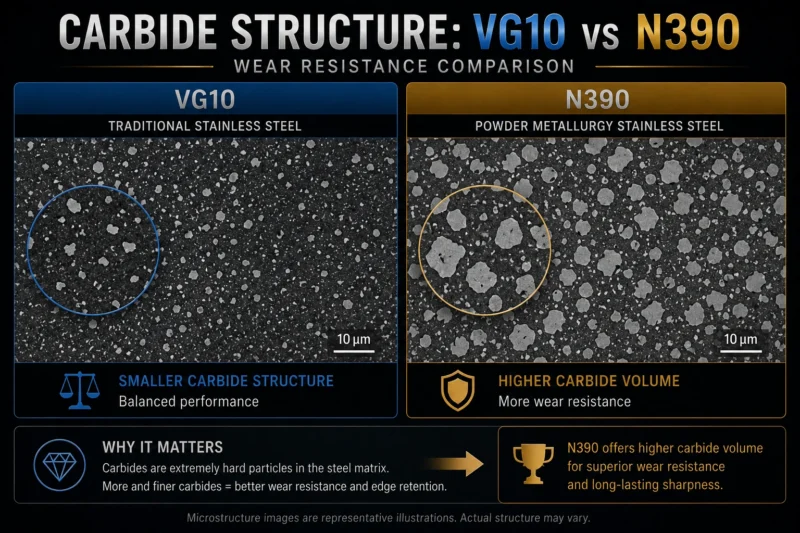
Wear resistance is one of the most significant differences between these steels.
VG10 offers excellent wear resistance for everyday users.
It easily handles:
- Food preparation
- Household tasks
- Rope
- Plastic packaging
- Cardboard
- General utility work
However, the VG10 vs N390 comparison generally favors N390 in this category.
N390’s alloy composition provides superior abrasion resistance, allowing the cutting edge to stay sharp through longer cutting sessions.
This becomes especially noticeable when repeatedly cutting abrasive materials such as:
- Thick cardboard
- Rope
- Leather
- Synthetic fibers
- Heavy packaging materials
For users who perform demanding cutting tasks every day, N390 typically requires less frequent sharpening.
Edge Stability
Edge stability refers to how well the cutting edge maintains its shape under normal use.
Both steels perform extremely well.
VG10’s fine carbide distribution allows the blade to maintain a clean, precise cutting edge throughout routine kitchen work.
N390 combines excellent edge stability with superior wear resistance, helping the edge remain effective even after prolonged use.
When comparing VG10 vs N390, both steels produce razor-sharp edges that remain stable during proper use.
Check Our Guide Blade Geometry Explained
VG10 vs N390 Sharpening
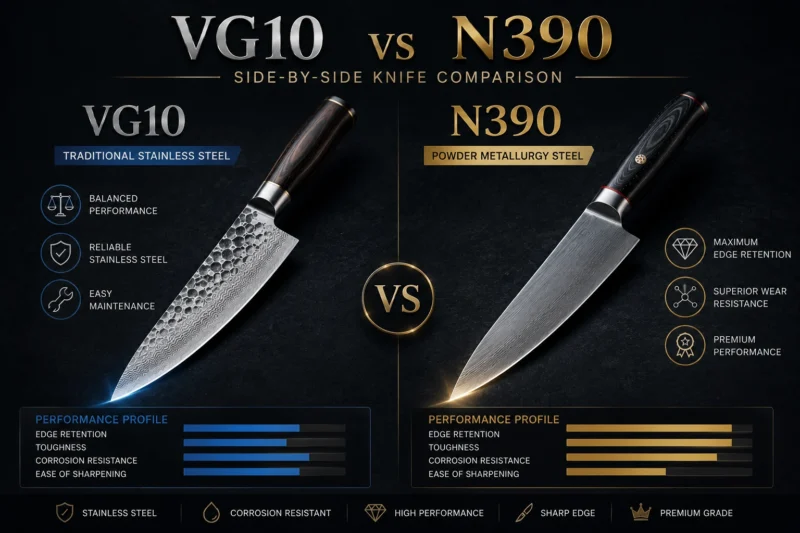
Sharpening is another area where these steels differ.
VG10 has long been recognized as one of the easier premium stainless steels to sharpen.
Its fine grain structure responds well to:
- Water stones
- Ceramic stones
- Guided sharpening systems
Many users appreciate how quickly VG10 returns to shaving sharpness.
This ease of maintenance is one reason VG10 remains extremely popular among home cooks and knife enthusiasts.
Is N390 Harder to Sharpen?
Yes.
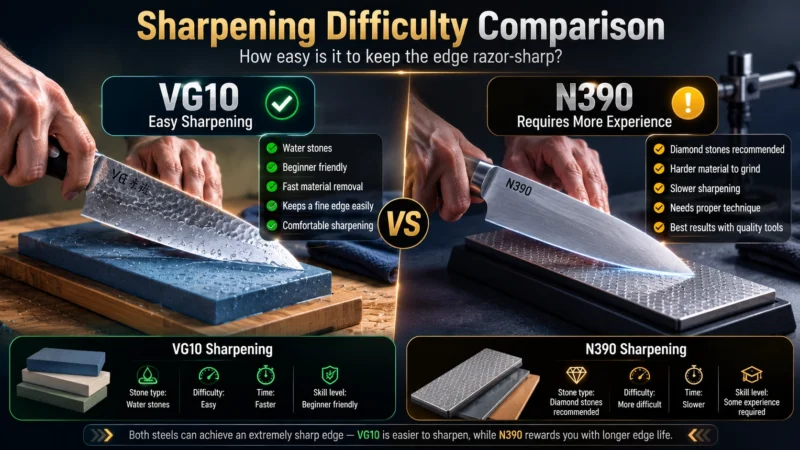
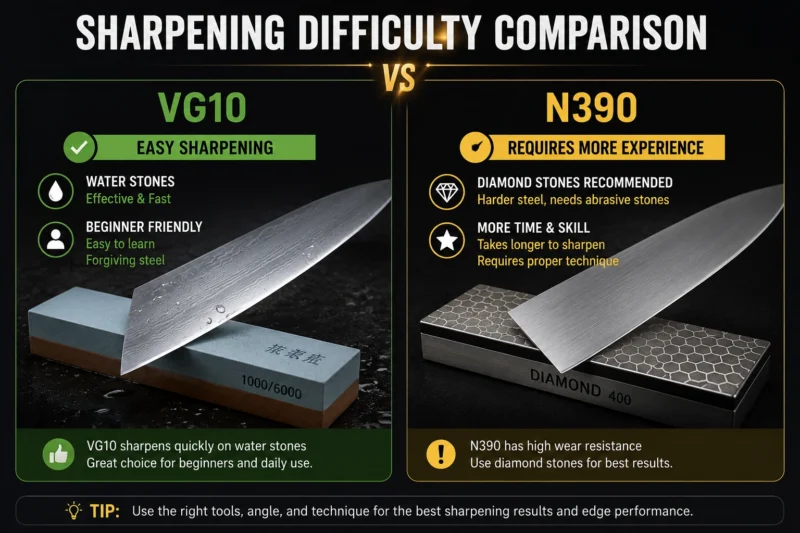
During the VG10 vs N390 comparison, N390 generally requires more effort to sharpen.
Its excellent wear resistance also means that sharpening stones remove material more slowly.
Many experienced users prefer:
- Diamond stones
- Premium ceramic abrasives
- High-quality guided sharpening systems
Although sharpening takes longer, the reward is significantly longer intervals between sharpening sessions.
This creates one of the biggest differences in VG10 vs N390:
VG10
- Easier sharpening
- Faster edge restoration
- More frequent maintenance
N390
- Harder sharpening
- Longer edge retention
- Less frequent maintenance
Neither approach is better for everyone—it depends entirely on user preference.
Burr Formation and Edge Refinement
Another important aspect of VG10 vs N390 is burr formation during sharpening.
VG10 develops a consistent burr that is relatively easy to detect and remove.
This makes it an excellent steel for users learning freehand sharpening.
N390 also produces excellent sharpening results but generally requires more patience to fully refine and polish the cutting edge.
Experienced sharpeners can achieve exceptional sharpness with both steels.
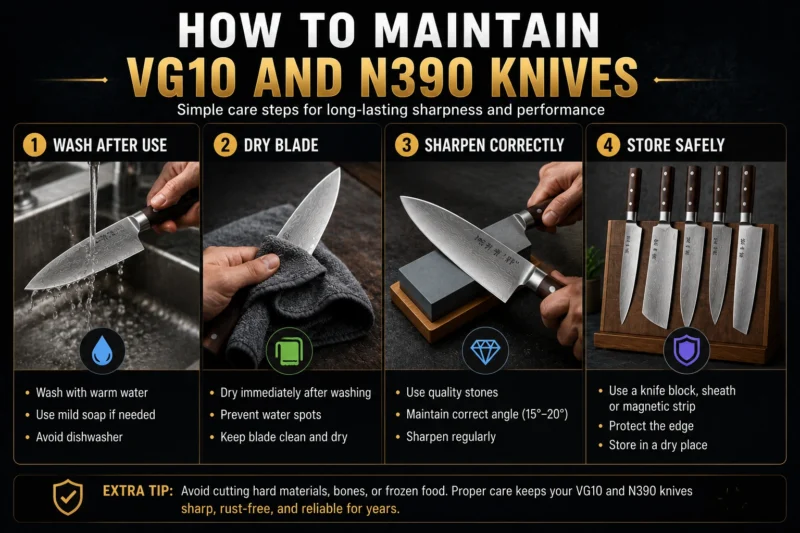
Maintenance Requirements
One reason VG10 vs N390 remains such a popular comparison is that both steels require relatively little maintenance compared to carbon steels.
Routine care simply includes:
- Hand washing
- Drying after use
- Proper storage
- Occasional honing
- Sharpening when needed
Neither steel requires frequent oiling or special rust prevention under normal conditions.
Check Our Guide The Ultimate Guide to Caring for a Damascus Steel Knife
VG10 vs N390 Performance Summary
After comparing toughness, corrosion resistance, wear resistance, and sharpening, the strengths of each steel become clear.
VG10 offers:
- Excellent corrosion resistance
- Easier sharpening
- Good toughness
- Balanced performance
- Fine cutting characteristics
- Excellent kitchen performance
N390 offers:
- Outstanding wear resistance
- Longer edge retention
- Excellent corrosion resistance
- High hardness
- Outstanding long-term cutting performance
- Less frequent sharpening
The VG10 vs N390 comparison does not reveal a universal winner. Instead, it highlights two premium stainless steels designed for different priorities. VG10 emphasizes balance and ease of maintenance, while N390 focuses on maximizing edge longevity and wear resistance.
VG10 vs N390: Kitchen Performance, Outdoor Use, EDC Applications, and Real-World Testing
Continuing our detailed VG10 vs N390 comparison, it is time to move from technical specifications to practical performance. Steel properties are important, but the real question is how these materials perform when used for actual cutting tasks.
A knife is not only a combination of hardness and chemistry. Blade geometry, heat treatment, sharpening quality, and intended purpose all influence performance.
In this section, we will compare VG10 vs N390 for:
- Kitchen knives
- Professional cooking
- Outdoor knives
- Everyday carry knives
- Hunting applications
- Utility cutting
- Long-term ownership
VG10 vs N390 for Kitchen Knives
Kitchen knives are one of the most common applications where people compare VG10 vs N390.
Both steels provide:
- Excellent corrosion resistance
- High sharpness potential
- Good edge stability
- Premium cutting performance
However, they offer different user experiences.
VG10 has become extremely popular for kitchen knives because it provides an excellent balance between sharpness, durability, and maintenance.
Its fine grain structure allows the blade to achieve a very refined edge that feels smooth during cutting.
VG10 performs exceptionally well for:
- Vegetables
- Fruits
- Herbs
- Fish
- Poultry
- Boneless meat
- General food preparation
Many home cooks appreciate how easily VG10 slices through delicate ingredients while remaining simple to maintain.
Check Our Guide Kitchen Knife Care Guide
N390 Kitchen Performance
When comparing VG10 vs N390 in a kitchen environment, N390 brings a different advantage.
Its main strength is longer-lasting edge retention.
For users who prepare large amounts of food every day, N390 can reduce the frequency of sharpening.
Typical applications include:
- Professional food preparation
- High-volume cooking
- Catering work
- Extended slicing tasks
The blade remains effective through long periods of cutting, especially when working with ingredients that cause gradual edge wear.
However, many kitchen users do not actually need extreme wear resistance.
For normal home cooking, VG10 already provides more than enough performance.
Cutting Feel: VG10 vs N390
Cutting feel is a subjective but important part of the VG10 vs N390 comparison.
VG10 often provides a very smooth and controlled cutting sensation.
Users commonly appreciate:
- Clean slicing
- Precise cuts
- Easy edge refinement
- Excellent food preparation control
N390 provides excellent cutting ability but feels slightly different.
Because of its high wear resistance, the edge tends to maintain its working bite for a longer time.
This makes N390 attractive for users who value performance consistency over many hours of cutting.
The difference is not that one steel cuts better.
The difference is how long each steel maintains its cutting characteristics.
VG10 vs N390 for Professional Chefs
Professional chefs often have different priorities compared with casual home cooks.
Important factors include:
- Reliable sharpness
- Easy maintenance
- Corrosion resistance
- Fast sharpening
- Long working life
VG10 is excellent for professional kitchens because it can quickly be restored with standard sharpening equipment.
During a busy work schedule, the ability to quickly refresh an edge is valuable.
N390 offers another approach.
A chef who wants maximum time between sharpening sessions may appreciate its superior edge retention.
The choice between VG10 vs N390 depends on whether the user prefers:
Fast and easy maintenance → VG10
Longer edge life → N390
VG10 vs N390 for Outdoor Knives
Outdoor knives require different characteristics from kitchen blades.
Camping, hiking, fishing, and survival tasks often involve:
- Rope cutting
- Wood preparation
- Packaging
- General utility work
- Food preparation outdoors
In outdoor environments, edge retention becomes increasingly important.
This is where the VG10 vs N390 comparison starts to favor N390.
N390’s excellent wear resistance allows the knife to continue cutting effectively during longer outdoor trips where sharpening equipment may not be available.
Check Our Guide How to Maintain an Outdoor Knife
VG10 Outdoor Performance
VG10 remains an excellent outdoor steel.
Its advantages include:
- Excellent corrosion resistance
- Good toughness
- Easy sharpening
- Reliable cutting performance
For:
- Camping meals
- Fishing trips
- Hiking
- General outdoor use
VG10 performs extremely well.
Its corrosion resistance is especially valuable near water environments.
N390 Outdoor Performance
N390 provides advantages for users who demand more from their outdoor knives.
It excels in situations involving:
- Long cutting sessions
- Abrasive materials
- Repeated utility tasks
- Extended trips
Because N390 holds an edge longer, it reduces the need to carry sharpening equipment.
For serious outdoor enthusiasts, this can be a significant benefit.
VG10 vs N390 for Everyday Carry (EDC)
Everyday carry knives experience many different tasks.
Common EDC uses include:
- Opening packages
- Cutting cardboard
- Opening tape
- Cutting rope
- Food preparation
- Household tasks
When comparing VG10 vs N390 for EDC, both steels perform very well.
VG10 provides:
- Excellent sharpness
- Easy maintenance
- Balanced performance
N390 provides:
- Longer edge retention
- Higher wear resistance
- Reduced sharpening frequency
For occasional EDC users, VG10 is more than sufficient.
For people who use their knife heavily every day, N390 offers a noticeable advantage.
VG10 vs N390 for Utility Work
Utility cutting is one area where steel differences become obvious.
Materials such as:
- Cardboard
- Plastic
- Rope
- Synthetic fibers
- Packaging materials
can quickly wear down many knife edges.
In these situations, the VG10 vs N390 comparison strongly favors N390.
The reason is simple:
N390 resists abrasive wear better.
The edge remains functional longer, reducing downtime for sharpening.
VG10 can still handle utility tasks, but users may notice that sharpening is required sooner.
VG10 vs N390 for Hunting Knives
Hunting knives require:
- Sharp cutting ability
- Corrosion resistance
- Reliable edge performance
- Good durability
Both steels are suitable for hunting applications.
VG10 provides:
- Easy maintenance
- Excellent slicing ability
- Good resistance to moisture
N390 provides:
- Longer edge retention
- Better performance during extended cutting sessions
- Less frequent sharpening
For occasional hunting use, VG10 performs very well.
For demanding field use, N390 may offer an advantage.
Long-Term Ownership Experience
A knife is a long-term investment, so ownership experience matters.
The VG10 vs N390 comparison shows two different philosophies.
VG10 Ownership Experience
Users often appreciate:
- Easy sharpening
- Predictable maintenance
- Excellent corrosion resistance
- Smooth cutting performance
VG10 is a steel that many people enjoy maintaining because sharpening feels straightforward and rewarding.
N390 Ownership Experience
N390 owners often value:
- Long-lasting sharpness
- Reduced maintenance frequency
- Premium performance
- Excellent durability
The trade-off is that sharpening requires more time and better equipment.
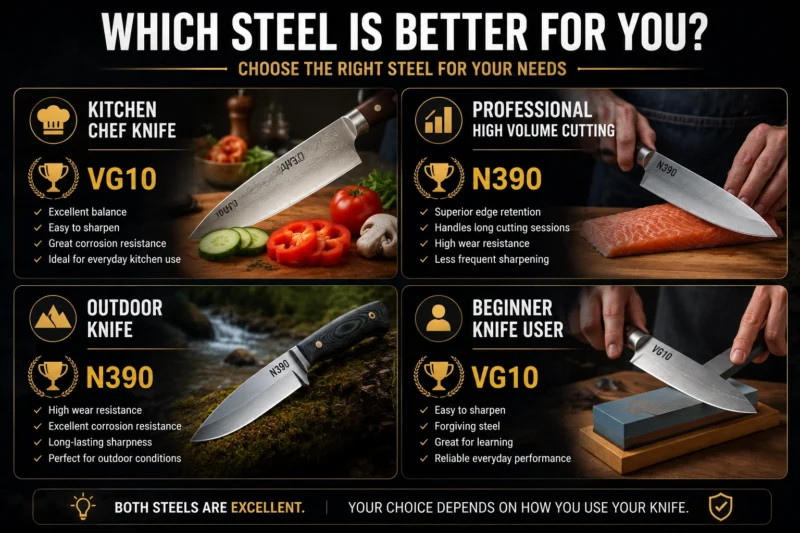
VG10 vs N390: Which Steel Is Better for You?
Choose VG10 if you want:
✔ A highly balanced stainless steel
✔ Easy sharpening
✔ Excellent kitchen performance
✔ Fine slicing ability
✔ Lower maintenance effort
✔ Great everyday usability
Choose N390 if you want:
✔ Maximum edge retention
✔ Superior wear resistance
✔ Longer cutting sessions
✔ Less frequent sharpening
✔ Premium outdoor and EDC performance
The VG10 vs N390 comparison shows that both steels are excellent choices, but they are optimized for different users.
VG10 is the balanced all-rounder.
N390 is the high-performance option focused on edge longevity.
VG10 vs N390: Comparison Table, Pros and Cons, Applications, Maintenance Guide, FAQ & Final Verdict
VG10 vs N390 Comparison Table
When comparing VG10 vs N390, it is important to understand that these steels were designed with different priorities. VG10 is a well-balanced stainless steel widely used for kitchen knives, while N390 belongs to the premium category of high-performance steels with exceptional wear resistance and edge retention.
| Feature | VG10 | N390 |
|---|---|---|
| Steel Type | Stainless steel | Premium stainless powder steel |
| Carbon Content | About 1.0% | About 1.9% |
| Chromium Content | About 15% | About 20% |
| Vanadium | Low amount | High amount |
| Steel Production | Traditional steelmaking | Powder metallurgy |
| Edge Retention | Very good | Excellent |
| Wear Resistance | Moderate-high | Extremely high |
| Toughness | Good | Moderate |
| Corrosion Resistance | Very good | Excellent |
| Sharpening Difficulty | Easy-medium | Medium-hard |
| Recommended Hardness | Around 59-61 HRC | Around 60-63 HRC |
| Best Use | Kitchen knives, everyday cutting | Premium knives, hard-use cutting |
| Maintenance Level | Low | Low-medium |
| Price Category | Mid-range | Premium |
The main difference between VG10 vs N390 comes down to balance versus maximum performance. VG10 offers a practical combination of sharpness, toughness, and easy maintenance. N390 focuses more on long-lasting sharpness and extreme wear resistance.
VG10 Pros and Cons
Advantages of VG10 Steel
Excellent Balance
One of the biggest strengths of VG10 is its balanced performance. It provides:
- Good edge retention
- Reliable corrosion resistance
- Comfortable sharpening
- Sufficient toughness for kitchen tasks
This makes VG10 a popular choice for chefs and everyday knife users.
Easy Maintenance
VG10 contains enough chromium to resist rust during normal kitchen use. With basic care, it can maintain its appearance for many years.
Recommended care:
- Wash after use
- Dry immediately
- Avoid leaving acidic food on the blade
- Store properly
Easier Sharpening
Compared with premium powder steels, VG10 is easier to restore at home. Standard whetstones work well, making it suitable for users who enjoy maintaining their own knives.
Disadvantages of VG10
Lower Wear Resistance
VG10 cannot compete with high-end powder steels in long cutting tests. When cutting abrasive materials, the edge will dull faster than N390.
Less Extreme Edge Retention
For professional users who need maximum cutting performance over long periods, VG10 may require more frequent sharpening.
Possible Chipping at High Hardness
When heat treated above the optimal range, VG10 can become less forgiving. Proper heat treatment is critical for achieving the best balance.
N390 Pros and Cons
Advantages of N390 Steel
Outstanding Edge Retention
The biggest advantage of N390 is its ability to maintain a sharp edge for a long time.
Its high carbide volume provides excellent resistance against abrasion, making it suitable for users who perform repetitive cutting tasks.
Excellent Corrosion Resistance
With high chromium content, N390 provides strong protection against rust and staining.
This makes it suitable for:
- Kitchen environments
- Outdoor knives
- Humid climates
- Everyday carry knives
Premium Cutting Performance
When properly heat treated and sharpened, N390 can deliver:
- Very high sharpness retention
- Smooth slicing ability
- Long working performance
Disadvantages of N390
More Difficult Sharpening
The same properties that give N390 excellent edge retention also make it harder to sharpen.
The high carbide content requires:
- Quality sharpening stones
- More patience
- Correct sharpening technique
Lower Toughness Compared With Simpler Steels
Although N390 is strong and durable, it is not designed for heavy impact use.
Avoid:
- Chopping hard materials
- Twisting the blade
- Cutting frozen food aggressively
Higher Cost
Powder metallurgy production increases manufacturing complexity, making N390 knives generally more expensive.
VG10 vs N390: Best Steel by Application
Different users have different priorities. The “best” steel depends on how the knife will be used.
Best Steel for Kitchen Knives
Winner: VG10
VG10 remains an excellent choice for:
- Chef knives
- Santoku knives
- Nakiri knives
- Slicing knives
- Everyday kitchen knives
Why?
Kitchen users usually value:
- Easy sharpening
- Stainless properties
- Balanced performance
- Comfortable daily maintenance
A VG10 kitchen knife can provide years of reliable service with proper care.
Best Steel for Professional Chefs
Winner: Depends on Preference
VG10:
Better for chefs who:
- Sharpen knives regularly
- Prefer easy maintenance
- Need dependable daily performance
N390:
Better for chefs who:
- Cut large quantities of ingredients
- Want longer edge life
- Prefer fewer sharpening sessions
Best Steel for Outdoor Knives
Winner: N390
N390 offers advantages for outdoor applications:
- Higher wear resistance
- Excellent corrosion resistance
- Longer-lasting edge
However, it should not replace tougher steels for extreme survival tasks.
For chopping, batoning, or impact work, toughness becomes more important than edge retention.
Best Steel for Everyday Carry Knives
Winner: N390
For everyday carry users, N390 provides:
- Long-lasting sharpness
- Excellent corrosion resistance
- Premium performance
A compact N390 knife can stay functional for extended periods without frequent sharpening.
Best Steel for Beginners
Winner: VG10
VG10 is more beginner-friendly because:
- Sharpening is easier
- Maintenance is simpler
- Performance is predictable
Users can learn proper knife care without needing specialized equipment.
Maintenance Guide: VG10 vs N390
Even premium stainless steels require proper maintenance.
VG10 Maintenance
VG10 requires simple care:
Cleaning
After use:
- Wash with warm water
- Use mild detergent if needed
- Dry completely
Avoid:
- Dishwasher cleaning
- Long exposure to moisture
- Storing while wet
Sharpening
Recommended sharpening angle:
- 15–20 degrees per side
Use:
- Water stones
- Ceramic sharpeners
- Fine sharpening systems
VG10 responds quickly to sharpening.
N390 Maintenance
N390 needs similar care but requires more attention during sharpening.
Cleaning
Although highly corrosion resistant:
- Do not leave food residue
- Dry after washing
- Avoid unnecessary exposure to chemicals
Sharpening
Recommended angle:
- Around 15–20 degrees per side for kitchen use
- Slightly higher for stronger edges
Recommended tools:
- Diamond stones
- High-quality ceramic stones
Traditional soft stones may work slowly because of N390’s wear resistance.
VG10 vs N390 Frequently Asked Questions
Is N390 better than VG10?
N390 offers better edge retention and wear resistance, but VG10 provides easier sharpening and better overall balance.
The better choice depends on the user’s priorities.
Which steel stays sharp longer?
N390 stays sharp longer than VG10 because of its higher carbide content and powder metallurgy structure.
Which steel is easier to sharpen?
VG10 is easier to sharpen.
N390 requires more time and better sharpening equipment.
Is VG10 good for kitchen knives?
Yes. VG10 is one of the most popular stainless steels for kitchen knives because it provides excellent balance between sharpness, durability, and corrosion resistance.
Is N390 stainless?
Yes. N390 has excellent corrosion resistance and performs well in humid environments.
However, no steel is completely rust-proof.
Does VG10 rust?
VG10 has strong rust resistance, but improper care can still cause staining or corrosion.
Can N390 be used for chef knives?
Yes. N390 can make excellent chef knives, especially for users who want maximum edge retention.
Which steel is sharper?
Both steels can achieve extremely sharp edges.
Actual sharpness depends more on:
- Blade geometry
- Heat treatment
- Sharpening quality
- Edge angle
Steel type alone does not determine sharpness.
Final Verdict: VG10 vs N390
The comparison between VG10 vs N390 shows two excellent stainless steels designed for different users.
VG10 is the practical all-round performer. It offers:
✓ Excellent corrosion resistance
✓ Easy sharpening
✓ Good toughness
✓ Reliable kitchen performance
✓ Great value
N390 represents the premium performance category. It provides:
✓ Superior edge retention
✓ Extreme wear resistance
✓ Excellent stainless properties
✓ Long-lasting cutting ability
For most kitchen users, VG10 remains the smarter choice because it delivers outstanding performance with easier maintenance.
For enthusiasts, professionals, and users who demand maximum cutting endurance, N390 provides a higher level of performance.
The final choice between VG10 vs N390 depends on your priorities:
- Choose VG10 for balance, simplicity, and everyday reliability.
- Choose N390 for premium performance and maximum edge retention.
Both steels are capable of producing excellent knives when combined with proper heat treatment, blade geometry, and craftsmanship. A well-designed knife made from either steel can provide years of dependable cutting performance.
VG10 vs N390: Pros and Cons Comparison
VG10 Steel Pros and Cons
✅ VG10 Advantages
1. Excellent Balance of Properties
VG10 is known for offering a balanced combination of:
- Good edge retention
- High corrosion resistance
- Decent toughness
- Easy sharpening
It is a practical steel that performs well in many everyday cutting applications.
2. Very Good Corrosion Resistance
With a high chromium content, VG10 provides strong resistance against rust and staining. It is especially suitable for kitchen knives where the blade frequently contacts water and acidic foods.
3. Easier to Sharpen
Compared with premium powder steels, VG10 is much easier to maintain. Most users can sharpen it successfully with standard whetstones.
4. Excellent Kitchen Knife Performance
VG10 is especially suitable for:
- Chef knives
- Santoku knives
- Nakiri knives
- Slicing knives
- Everyday kitchen tools
It can achieve a very fine edge while remaining practical for daily use.
5. Good Toughness
VG10 has better impact resistance than many high-wear powder steels. It is more forgiving during normal kitchen tasks.
6. Good Value
VG10 offers premium-level performance without the high cost of many advanced steels.
❌ VG10 Disadvantages
1. Lower Edge Retention Compared With N390
VG10 holds an edge well, but it cannot match N390 during long cutting sessions involving abrasive materials.
2. Lower Wear Resistance
The carbide structure of VG10 provides good performance, but it is not designed for maximum abrasion resistance.
3. Requires More Frequent Sharpening
Professional users who cut large volumes of food may need to touch up the edge more often compared with N390.
4. Can Chip at High Hardness
When heat treated aggressively, VG10 can become less forgiving and may develop micro-chipping if used incorrectly.
5. Not Ideal for Extreme Cutting Tasks
VG10 is not designed for:
- Heavy chopping
- Cutting hard materials
- Impact applications
N390 Steel Pros and Cons
✅ N390 Advantages
1. Outstanding Edge Retention
The biggest advantage of N390 is its ability to stay sharp for a very long time.
High carbide content provides excellent resistance against wear, allowing the knife to maintain cutting performance through extended use.
2. Extremely High Wear Resistance
N390 performs exceptionally well when cutting abrasive materials where ordinary steels lose sharpness faster.
3. Excellent Corrosion Resistance
The high chromium content provides strong protection against:
- Rust
- Staining
- Humidity
- Kitchen moisture
4. Premium Cutting Performance
A properly heat-treated N390 blade can provide:
- Long-lasting sharpness
- Smooth slicing performance
- Reduced sharpening frequency
5. Suitable for High-End Knives
N390 is a good choice for users looking for premium performance in:
- Kitchen knives
- EDC knives
- Outdoor knives
- Collector knives
6. Maintains a Fine Edge Well
Despite its high wear resistance, N390 can achieve a very refined edge when properly sharpened.
❌ N390 Disadvantages
1. More Difficult to Sharpen
The same properties that make N390 hold an edge longer also make sharpening more challenging.
Users may need:
- Diamond sharpening stones
- Quality ceramic stones
- More sharpening experience
2. Lower Toughness Than VG10
N390 is optimized for wear resistance, not maximum impact resistance.
It is less suitable for:
- Hard chopping
- Twisting cuts
- Heavy abuse
3. Higher Cost
Powder metallurgy production makes N390 more expensive than conventional stainless steels.
4. Requires Better Sharpening Equipment
Basic sharpening tools may work slowly because of the steel’s high wear resistance.
5. Less Forgiving for Beginners
New knife users may find maintenance more difficult compared with VG10.
Quick Winner Summary
| Category | Winner |
|---|---|
| Edge Retention | 🏆 N390 |
| Wear Resistance | 🏆 N390 |
| Corrosion Resistance | Slight advantage N390 |
| Ease of Sharpening | 🏆 VG10 |
| Toughness | 🏆 VG10 |
| Kitchen Use | VG10 / N390 (depends on user) |
| Professional Long Cutting Sessions | 🏆 N390 |
| Beginner Friendly | 🏆 VG10 |
| Price-to-Performance Ratio | 🏆 VG10 |
Conclusion:
VG10 is the better choice for users who want a balanced, easy-to-maintain stainless steel. N390 is the better choice for users who prioritize maximum edge retention and premium cutting performance. Both steels can produce excellent knives when combined with proper heat treatment and blade geometry.
This article is for independent informational purposes only and is not affiliated with, sponsored by, or endorsed by any steel manufacturer. All product names, trademarks, and registered trademarks are the property of their respective owners.