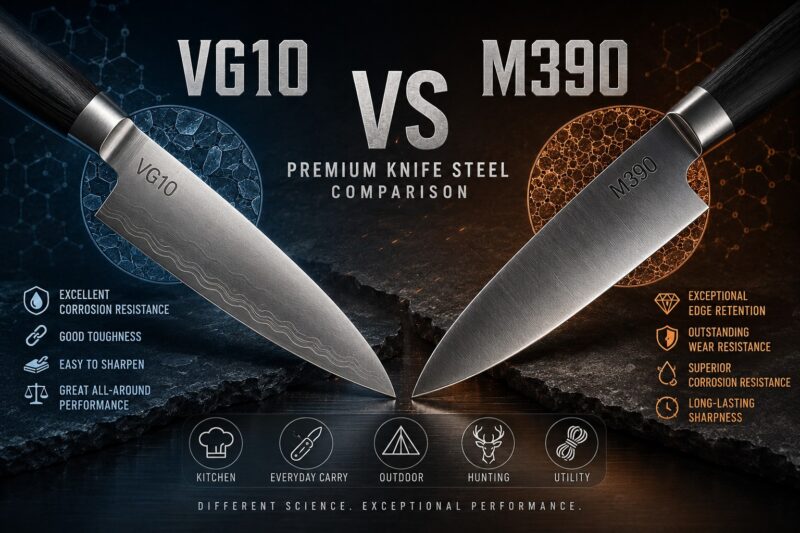
VG10 vs M390 Steel
An Independent Guide
Introduction
Selecting the right knife steel can significantly impact cutting performance, maintenance requirements, and the overall lifespan of a knife. Among the many stainless steels available today, VG10 and M390 are two of the most respected choices. Both are known for excellent corrosion resistance and outstanding cutting ability, but they achieve their performance through different metallurgical approaches.
VG10 is a high-carbon stainless steel that has earned a reputation for its balanced combination of hardness, toughness, corrosion resistance, and ease of sharpening. It has long been appreciated by both home users and outdoor enthusiasts for its reliable everyday performance.
M390, on the other hand, is a modern powder metallurgy stainless steel designed to maximize wear resistance, edge retention, and corrosion resistance. Its advanced manufacturing process creates an extremely fine carbide structure that allows the blade to maintain exceptional sharpness while remaining highly resistant to rust and abrasion.
Although both steels belong to the premium stainless category, they are intended for slightly different users. VG10 emphasizes balance and ease of maintenance, while M390 prioritizes maximum cutting performance and long edge life.
In this comprehensive comparison, you’ll learn:
- What VG10 and M390 are
- How their chemical compositions differ
- Powder metallurgy vs conventional steel production
- Hardness (HRC)
- Edge retention
- Wear resistance
- Toughness
- Corrosion resistance
- Ease of sharpening
- Real-world cutting performance
- Kitchen and outdoor applications
- Advantages and disadvantages
- Which steel is the better choice for your needs
By the end of this guide, you’ll understand the strengths of each steel and know which one best matches your intended use.
What Is VG10 Steel?
VG10 is a high-carbon stainless knife steel developed specifically for premium cutting tools.
It is widely respected because it successfully balances several important characteristics:
- Good edge retention
- Excellent corrosion resistance
- Reliable toughness
- Fine cutting edge
- Relatively easy sharpening
Unlike steels designed solely for maximum hardness or wear resistance, VG10 aims to deliver dependable performance across a wide variety of applications.
Common uses include:
- Chef knives
- Santoku knives
- Utility knives
- Everyday carry knives
- Outdoor knives
- Folding knives
Its versatility has made it one of the most recognized stainless knife steels in the world.
Check Our Guide VG10 Steel Review
What Is M390 Steel?
M390 is a powder metallurgy stainless steel engineered for maximum cutting performance.
Instead of being produced using conventional ingot casting, it is manufactured through powder metallurgy, a process that creates an extremely fine and uniform carbide structure.
This manufacturing method improves:
- Wear resistance
- Edge retention
- Corrosion resistance
- Edge stability
As a result, M390 is often selected for knives that require long-lasting sharpness with minimal maintenance.
Typical applications include:
- Premium everyday carry knives
- High-end kitchen knives
- Outdoor knives
- Hunting knives
- Utility knives
Its balanced combination of hardness, corrosion resistance, and wear resistance has made it one of the benchmark premium stainless steels.
Check Our Guide M390 Steel Review
Quick Comparison
| Property | VG10 | M390 |
|---|---|---|
| Steel Type | Conventional Stainless | Powder Metallurgy Stainless |
| Typical Hardness | 59–61 HRC | 60–62 HRC |
| Corrosion Resistance | Excellent | Outstanding |
| Edge Retention | Very Good | Excellent |
| Wear Resistance | Very Good | Excellent |
| Ease of Sharpening | Easy | Moderate |
| Overall Balance | Excellent | Excellent |
Both steels perform exceptionally well, but their priorities differ.
VG10 focuses on versatility and ease of maintenance, while M390 emphasizes maximum cutting performance.
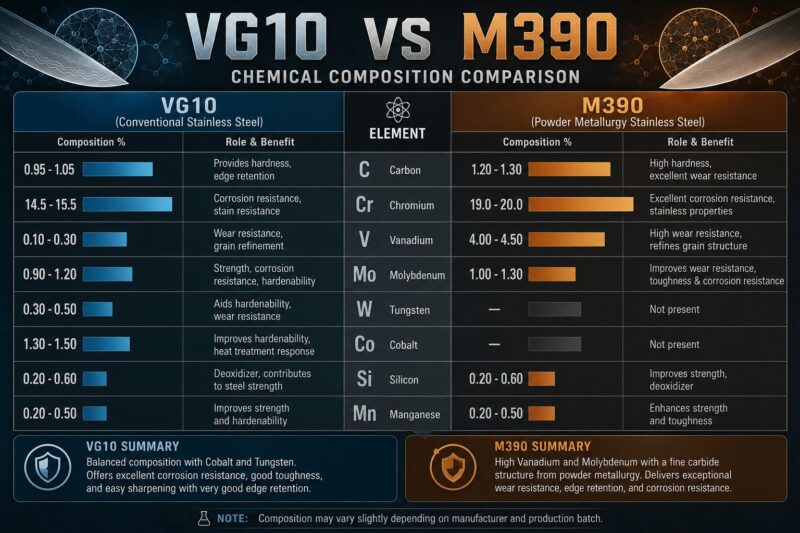
Chemical Composition Comparison
Although exact compositions vary slightly depending on production tolerances and heat treatment, the major alloying elements remain consistent.
| Element | VG10 | M390 |
|---|---|---|
| Carbon | High | Very High |
| Chromium | High | Very High |
| Vanadium | Moderate | High |
| Molybdenum | Moderate | High |
| Tungsten | Small Amount | — |
| Cobalt | Present | — |
| Silicon | Present | Present |
| Manganese | Present | Present |
Rather than memorizing percentages, understanding the function of each alloying element provides greater insight into knife performance.
Carbon – The Foundation of Hardness
Carbon is the most important alloying element in knife steel.
Its primary roles include:
- Increasing hardness
- Improving edge retention
- Forming hard carbides
- Enhancing wear resistance
Both VG10 and M390 contain enough carbon to achieve high hardness suitable for premium knives.
However, M390 contains more carbon overall, allowing it to produce a greater volume of wear-resistant carbides.
This contributes to its exceptional edge retention.
Chromium – Stainless Performance
Chromium gives both steels their stainless properties.
It helps form a protective oxide layer that resists:
- Rust
- Food acids
- Moisture
- Humidity
- Staining
Both steels offer outstanding corrosion resistance.
However, M390 generally provides even greater protection because of its optimized alloy balance and carbide distribution.
Vanadium – Wear Resistance and Fine Grain Structure
Vanadium contributes to several critical properties.
These include:
- Grain refinement
- Edge stability
- Wear resistance
- Fine carbide formation
VG10 contains enough vanadium to improve cutting performance while maintaining relatively easy sharpening.
M390 contains substantially more vanadium, creating an extremely wear-resistant edge that stays sharp much longer.
Molybdenum – Strength and Durability
Molybdenum enhances:
- Wear resistance
- Strength
- Hardenability
- Corrosion resistance
Both steels benefit from molybdenum additions, although M390 contains significantly more.
This contributes to its outstanding durability during extended cutting.
Tungsten in VG10
One unique feature of VG10 is the addition of a small amount of tungsten.
Tungsten helps:
- Increase hardness
- Improve wear resistance
- Support edge stability
Although present in relatively modest amounts, it contributes to the balanced cutting performance for which VG10 is known.
Cobalt in VG10
VG10 also contains cobalt.
Cobalt helps the steel respond more effectively to heat treatment, allowing it to achieve higher hardness while maintaining good stability.
Rather than directly increasing edge retention, cobalt supports the development of the steel’s overall mechanical properties.
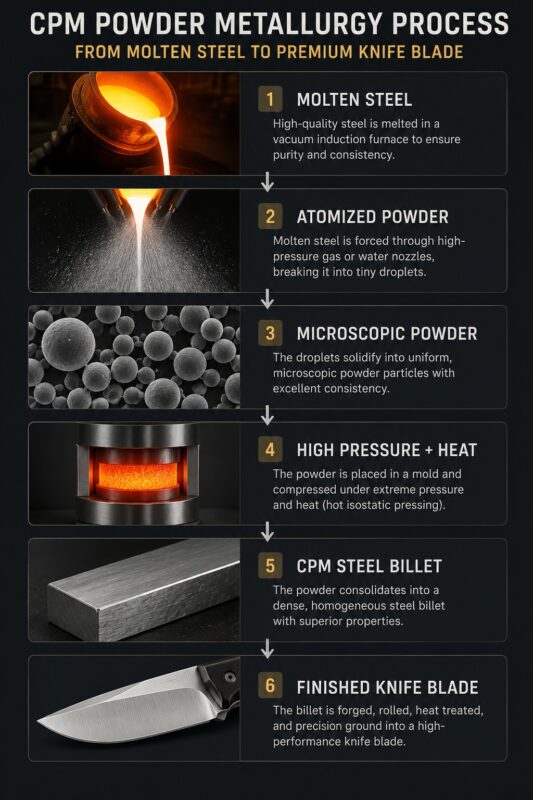
Powder Metallurgy vs Conventional Steel
Perhaps the biggest difference between these steels lies in how they are manufactured.
VG10 Manufacturing
VG10 is produced using a conventional steelmaking process.
Molten steel is cast into ingots before being forged, rolled, and heat treated.
This traditional method has been used successfully for decades and produces a reliable, durable knife steel.
M390 Manufacturing
M390 uses powder metallurgy.
Instead of casting large ingots, molten steel is atomized into microscopic powder particles.
These particles are then consolidated under high temperature and pressure.
The result is:
- Extremely fine carbide distribution
- Greater uniformity
- Improved wear resistance
- Better edge stability
- Enhanced overall performance
This advanced process explains why M390 consistently outperforms many conventional stainless steels in wear resistance and edge retention.
Check Our Guide Powder Steels for Kitchen Knives
Key Properties at a Glance
| Characteristic | VG10 | M390 |
|---|---|---|
| Hardness | ⭐⭐⭐⭐☆ | ⭐⭐⭐⭐⭐ |
| Edge Retention | ⭐⭐⭐⭐☆ | ⭐⭐⭐⭐⭐ |
| Wear Resistance | ⭐⭐⭐⭐☆ | ⭐⭐⭐⭐⭐ |
| Toughness | ⭐⭐⭐⭐☆ | ⭐⭐⭐⭐☆ |
| Corrosion Resistance | ⭐⭐⭐⭐⭐ | ⭐⭐⭐⭐⭐ |
| Ease of Sharpening | ⭐⭐⭐⭐⭐ | ⭐⭐⭐☆☆ |
| Overall Versatility | ⭐⭐⭐⭐⭐ | ⭐⭐⭐⭐⭐ |
While M390 clearly leads in wear resistance and edge retention, VG10 remains highly competitive thanks to its balanced properties, excellent corrosion resistance, and easier maintenance.
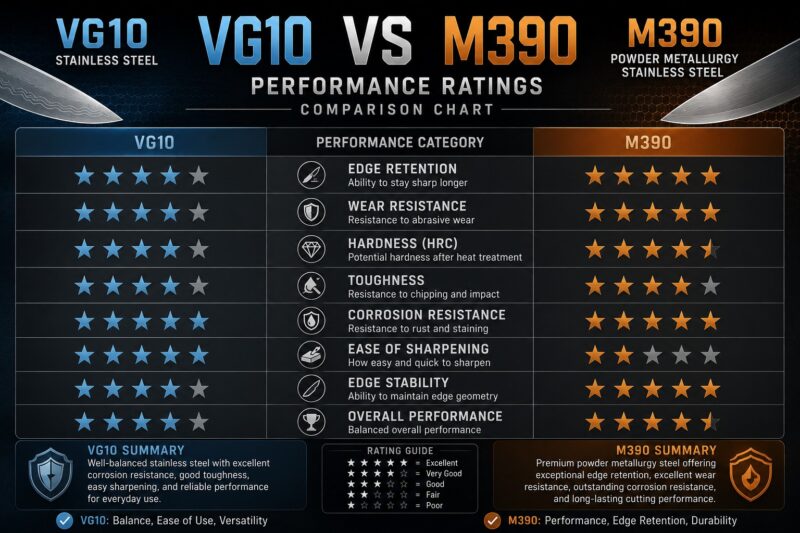
Performance Comparison
Understanding the chemical composition of a knife steel is important, but real-world performance ultimately determines whether a knife meets your expectations. Factors such as hardness, edge retention, toughness, corrosion resistance, and sharpening characteristics influence how enjoyable and practical a knife is to use every day.
Both VG10 and M390 are premium stainless steels, but they approach performance differently. VG10 emphasizes balance and ease of maintenance, while M390 focuses on maximizing wear resistance and long-lasting cutting performance through powder metallurgy.
Let’s compare each characteristic in detail.
Hardness (HRC)
Hardness is measured using the Rockwell Hardness Scale (HRC) and indicates a steel’s resistance to deformation.
A harder steel generally offers:
- Better edge retention
- Improved wear resistance
- Greater resistance to rolling
However, excessive hardness may reduce toughness.
Check Our Guide What Is HRC? Understanding Rockwell Hardness
VG10 Hardness
VG10 is commonly heat treated to:
59–61 HRC
This hardness provides an excellent compromise between:
- Edge retention
- Toughness
- Ease of sharpening
- Long-term durability
The steel is hard enough to maintain a sharp edge while remaining forgiving during everyday use.
M390 Hardness
M390 is typically hardened to:
60–62 HRC
Its higher hardness contributes to:
- Exceptional wear resistance
- Outstanding edge retention
- Excellent cutting efficiency
Despite its increased hardness, proper heat treatment allows M390 to retain respectable toughness.
Hardness Winner
| Steel | Typical HRC |
|---|---|
| VG10 | 59–61 |
| M390 | 60–62 |
Winner: M390
Edge Retention
Edge retention measures how long a knife remains sharp before requiring sharpening.
For many knife owners, this is the most important performance characteristic.
VG10 Edge Retention
VG10 delivers very good edge retention.
It performs well during repeated cutting of:
- Cardboard
- Rope
- Food
- Plastic packaging
- Leather
- Paper
For everyday users, VG10 maintains a sharp working edge through extended use while remaining relatively easy to resharpen.
M390 Edge Retention
M390 is widely recognized for exceptional edge retention.
Its fine carbide structure and high wear resistance allow the blade to continue cutting efficiently long after many conventional stainless steels begin losing sharpness.
It performs exceptionally well when cutting abrasive materials such as:
- Thick cardboard
- Synthetic rope
- Heavy packaging
- Fiber materials
For users who prefer sharpening less often, M390 offers a significant advantage.
Edge Retention Winner
Winner: M390
Wear Resistance
Wear resistance describes how well the cutting edge resists abrasion during prolonged use.
Higher wear resistance generally leads to longer edge life.
VG10 Wear Resistance
VG10 offers very good wear resistance.
Its combination of carbon, chromium, vanadium, cobalt, and tungsten creates a durable cutting edge suitable for everyday tasks.
Most users will find VG10 more than adequate for:
- Household use
- Kitchen work
- Outdoor activities
- Utility cutting
M390 Wear Resistance
Wear resistance is one of M390’s defining characteristics.
The powder metallurgy process creates a high concentration of extremely hard carbides distributed evenly throughout the steel.
Benefits include:
- Longer cutting life
- Reduced abrasive wear
- Exceptional durability
- Outstanding edge longevity
Even after prolonged cutting sessions, M390 often retains excellent slicing performance.
Wear Resistance Winner
Winner: M390
Toughness
Toughness measures a steel’s ability to resist:
- Chipping
- Cracking
- Impact damage
- Edge failure
A tougher steel tolerates demanding work more effectively.
VG10 Toughness
VG10 provides dependable toughness for most cutting applications.
It performs well during:
- Food preparation
- Everyday carry
- Outdoor use
- General utility work
Proper heat treatment allows VG10 to balance hardness with resistance to edge damage.
M390 Toughness
Although M390 is optimized for wear resistance rather than maximum toughness, it still performs very well in normal cutting applications.
Its fine carbide distribution improves edge stability compared with many conventional high-alloy steels.
However, because of its greater hardness, M390 is slightly less forgiving under heavy impact than steels specifically designed for maximum toughness.
Toughness Winner
For normal cutting tasks, both steels perform very well.
Neither should be used for:
- Prying
- Striking metal
- Heavy batoning
- Twisting cuts
Result: Tie
Corrosion Resistance
Corrosion resistance determines how well a blade withstands:
- Moisture
- Humidity
- Food acids
- Salt
- Everyday exposure
This characteristic is especially important for kitchen knives and outdoor use.
VG10 Corrosion Resistance
VG10 has long been respected for its excellent stainless performance.
It resists:
- Rust
- Staining
- Fruit acids
- Moisture
- Kitchen environments
Routine cleaning and drying are generally all that is required.
M390 Corrosion Resistance
M390 offers outstanding corrosion resistance.
Its alloy composition and powder metallurgy process allow it to perform exceptionally well even in humid conditions.
For users living near the coast or using knives frequently around water, M390 provides outstanding protection against corrosion.
Corrosion Resistance Winner
Both steels perform exceptionally well.
M390 holds a slight advantage in highly corrosive environments.
Winner: M390 (slight advantage)
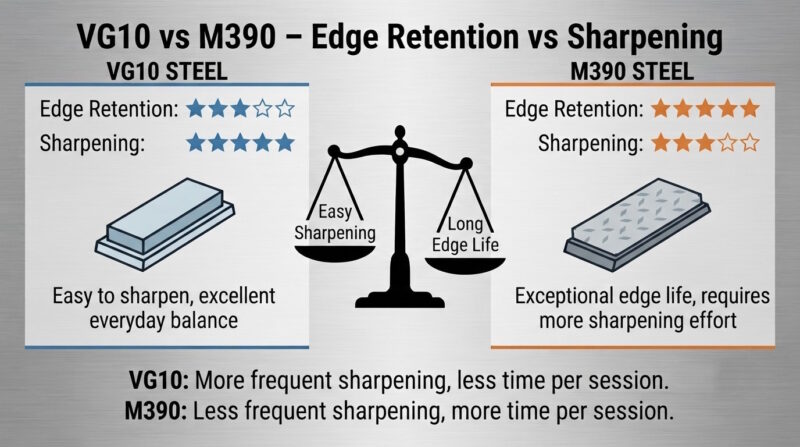
Ease of Sharpening
Every knife eventually requires sharpening.
The ease with which the edge can be restored greatly influences long-term ownership.
Sharpening VG10
VG10 is relatively easy to sharpen.
It responds well to:
- Water stones
- Ceramic stones
- Diamond stones
Many users appreciate how quickly it develops a refined, razor-sharp edge.
Sharpening M390
Because of its exceptional wear resistance, M390 requires more effort to sharpen.
Diamond abrasives are generally recommended for the fastest results.
Although sharpening takes longer, the edge also lasts significantly longer before maintenance becomes necessary.
Sharpening Winner
Winner: VG10
Edge Stability
Edge stability refers to how well the cutting edge maintains its geometry during demanding cutting tasks.
VG10 Edge Stability
VG10 develops a fine, precise edge that performs exceptionally well during slicing.
Its balanced carbide structure supports:
- Smooth cutting
- Fine edge refinement
- Excellent control
M390 Edge Stability
The powder metallurgy structure of M390 creates an extremely stable edge.
Benefits include:
- Consistent cutting
- Excellent slicing performance
- Long-lasting precision
- Reduced edge wear
Edge Stability Winner
Winner: M390
Overall Cutting Performance
VG10
Strengths:
- Smooth slicing
- Easy maintenance
- Excellent corrosion resistance
- Easy sharpening
- Reliable everyday performance
Ideal for:
- Home kitchens
- Everyday carry
- Utility work
- Outdoor recreation
M390
Strengths:
- Extremely long edge life
- Outstanding wear resistance
- Premium cutting performance
- Excellent corrosion resistance
- Minimal sharpening frequency
Ideal for:
- Premium everyday carry
- Professional use
- Heavy cardboard cutting
- Extended outdoor trips
Performance Ratings
| Property | VG10 | M390 |
|---|---|---|
| Hardness | ⭐⭐⭐⭐☆ | ⭐⭐⭐⭐⭐ |
| Edge Retention | ⭐⭐⭐⭐☆ | ⭐⭐⭐⭐⭐ |
| Wear Resistance | ⭐⭐⭐⭐☆ | ⭐⭐⭐⭐⭐ |
| Toughness | ⭐⭐⭐⭐☆ | ⭐⭐⭐⭐☆ |
| Corrosion Resistance | ⭐⭐⭐⭐⭐ | ⭐⭐⭐⭐⭐ |
| Ease of Sharpening | ⭐⭐⭐⭐⭐ | ⭐⭐⭐☆☆ |
| Edge Stability | ⭐⭐⭐⭐☆ | ⭐⭐⭐⭐⭐ |
| Overall Performance | ⭐⭐⭐⭐☆ | ⭐⭐⭐⭐⭐ |
Which Steel Performs Better?
If maximum edge retention and wear resistance are your priorities, M390 is the stronger performer. Its powder metallurgy construction provides exceptional cutting longevity and outstanding corrosion resistance.
If you value a steel that combines excellent cutting performance with easier sharpening and balanced everyday characteristics, VG10 remains one of the finest conventional stainless steels available.
Both steels are outstanding choices, but they appeal to slightly different users and priorities.
Real-World Performance
Laboratory data and chemical composition provide valuable insights into a knife steel’s capabilities, but the real measure of performance comes from everyday use. The way a knife behaves while preparing food, opening boxes, cutting rope, or working outdoors often matters more than laboratory numbers.
VG10 and M390 are both premium stainless steels, but they excel in slightly different areas. VG10 emphasizes versatility and ease of maintenance, while M390 focuses on maximum cutting performance and long-lasting edge retention.
Let’s examine how they compare in practical applications.
Everyday Carry (EDC)
An everyday carry knife should be capable of handling a wide variety of daily tasks, including:
- Opening packages
- Cutting cardboard
- Trimming rope
- Cutting plastic straps
- Food preparation
- Light utility work
- Emergency cutting tasks
An ideal EDC steel combines edge retention, corrosion resistance, toughness, and manageable maintenance.
VG10 for Everyday Carry
VG10 performs exceptionally well as an everyday carry steel.
Its strengths include:
- Excellent corrosion resistance
- Fine cutting edge
- Easy maintenance
- Quick sharpening
- Reliable toughness
VG10 is particularly appealing to users who sharpen their knives regularly and appreciate a razor-sharp edge without spending much time on maintenance.
M390 for Everyday Carry
M390 is one of the strongest performers for EDC applications.
Its outstanding wear resistance allows the knife to remain sharp through prolonged daily use.
Advantages include:
- Exceptional edge retention
- Outstanding corrosion resistance
- Excellent slicing performance
- Minimal sharpening frequency
Users who rely heavily on their knives throughout the day will appreciate how long M390 continues cutting efficiently.
Everyday Carry Winner
Both steels perform extremely well.
- Choose VG10 if you value easier sharpening and balanced performance.
- Choose M390 if long-lasting sharpness is your highest priority.
Winner: M390 (slight advantage)
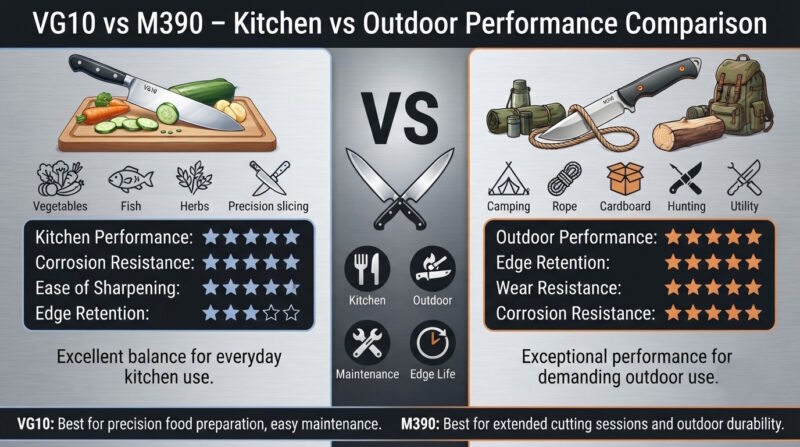
Kitchen Performance
Kitchen knives encounter demanding conditions every day.
Typical exposure includes:
- Water
- Fruit acids
- Salt
- Moisture
- Frequent washing
- Continuous slicing
Corrosion resistance and fine edge stability are especially important in this environment.
VG10 in the Kitchen
VG10 has become one of the most respected kitchen knife steels because it combines:
- Excellent corrosion resistance
- Fine edge refinement
- Smooth slicing
- Easy sharpening
It performs exceptionally well when preparing:
- Vegetables
- Fruit
- Fish
- Meat
- Herbs
VG10 can achieve an extremely refined edge, making it ideal for precision food preparation.
Check Our Guide Carbon Steel vs Stainless Steel Knives: Which Is Better?
M390 in the Kitchen
M390 also performs exceptionally well in kitchen applications.
Its superior wear resistance allows the edge to remain sharp through extended food preparation.
Advantages include:
- Outstanding slicing performance
- Excellent stain resistance
- Long edge life
- Reduced sharpening frequency
The trade-off is that sharpening requires more time and suitable abrasives.
Kitchen Winner
Both steels are excellent choices for kitchen knives.
VG10 has a slight advantage for users who enjoy maintaining a razor-sharp edge with regular sharpening, while M390 benefits those who prefer longer intervals between sharpening sessions.
Result: Tie
Outdoor and Camping
Outdoor knives often perform a wide range of tasks, including:
- Rope cutting
- Camp cooking
- Food preparation
- Shelter building
- Fire preparation
- General campsite chores
A practical outdoor steel should balance corrosion resistance, toughness, and edge retention.
VG10 Outdoors
VG10 performs reliably during:
- Camping
- Hiking
- General outdoor use
Its excellent corrosion resistance makes it suitable for wet environments and changing weather conditions.
Routine cleaning after use is usually sufficient.
M390 Outdoors
M390 excels during extended outdoor trips where sharpening equipment may not be available.
Its edge remains effective through prolonged cutting tasks involving:
- Rope
- Wood processing
- Food preparation
- Camp utility work
Combined with outstanding corrosion resistance, it is well suited to demanding outdoor conditions.
Outdoor Winner
Winner: M390
Its longer-lasting edge offers a noticeable advantage during multi-day trips.
Bushcraft Performance
Bushcraft places greater demands on a knife than ordinary camping.
Typical tasks include:
- Feather sticks
- Wood carving
- Camp cooking
- Fire preparation
- Shelter construction
These activities require a combination of toughness and edge stability.
Check Our Guide One Knife for Hunting and Bushcraft: Is It Really Possible?
VG10 for Bushcraft
VG10 performs well during light to moderate bushcraft.
It handles carving and slicing efficiently while resisting corrosion in damp environments.
However, like most stainless steels, it is not intended for heavy batoning or abusive impact work.
M390 for Bushcraft
M390 provides excellent cutting efficiency and edge retention during bushcraft activities.
Its wear resistance allows prolonged carving without frequent sharpening.
As with VG10, it should not be subjected to heavy prying or repeated impact against hard materials.
Bushcraft Winner
Because bushcraft often rewards long edge life during extended trips:
Winner: M390
Hunting Performance
Hunting knives encounter demanding cutting tasks such as:
- Field dressing
- Skinning
- Meat preparation
- Camp utility work
Corrosion resistance is especially valuable because blades are exposed to moisture and organic materials.
Check Our Guide What Size Knife Is Best for Camping?
VG10 for Hunting
VG10 provides:
- Excellent slicing ability
- Good toughness
- Easy maintenance
- Reliable corrosion resistance
Its fine edge performs very well during detailed cutting.
M390 for Hunting
M390 offers significant advantages during large processing jobs.
Its exceptional wear resistance allows the blade to maintain sharpness throughout extended use.
For hunters who process multiple animals before sharpening, this can be a major benefit.
Hunting Winner
Winner: M390
Fishing Performance
Fishing knives operate in environments involving:
- Freshwater
- Saltwater
- Fish oils
- High humidity
Corrosion resistance is critical.
Check Our Guide Best Blade Thickness for Different Uses
VG10 for Fishing
VG10 resists corrosion extremely well.
With simple rinsing and drying after use, it performs reliably for years.
M390 for Fishing
M390 also provides exceptional corrosion resistance.
Its advanced metallurgy offers excellent protection against rust while maintaining outstanding edge retention.
Fishing Winner
Both steels perform exceptionally well.
Result: Tie
Cardboard and Rope Cutting
Cardboard and synthetic rope are among the most abrasive materials encountered during everyday cutting.
These tasks quickly reveal differences in wear resistance.
VG10 Performance
VG10 handles:
- Shipping boxes
- Packaging materials
- Plastic straps
- Rope
very effectively.
It maintains good cutting performance while remaining easy to sharpen when needed.
M390 Performance
M390 excels during prolonged abrasive cutting.
Its high wear resistance significantly reduces edge wear when processing:
- Heavy cardboard
- Thick rope
- Fibrous materials
- Industrial packaging
Users cutting large quantities of abrasive materials will notice considerably longer edge life.
Abrasive Cutting Winner
Winner: M390
Maintenance Requirements
Maintenance influences long-term ownership satisfaction.
Caring for VG10
VG10 requires only basic care:
- Wash after use
- Dry thoroughly
- Sharpen when needed
- Store in a dry location
Sharpening is straightforward and does not require specialized equipment.
Caring for M390
M390 also requires minimal corrosion maintenance.
However, because of its exceptional wear resistance:
- Sharpening takes longer
- Diamond abrasives are recommended
- Less frequent sharpening offsets the additional effort
Which Steel Is Easier to Live With?
VG10 appeals to users who enjoy sharpening and maintaining a razor-sharp edge with minimal effort.
M390 appeals to users who prefer sharpening as infrequently as possible, even if each sharpening session takes longer.
Neither steel requires complicated corrosion prevention.
Common Myths
Myth 1: M390 Is Impossible to Sharpen
False.
Although M390 requires more time than VG10, modern diamond sharpening systems restore an excellent edge without excessive difficulty.
Myth 2: VG10 Is an Outdated Steel
False.
Despite being a conventional stainless steel, VG10 continues to deliver excellent real-world performance and remains highly competitive for kitchen and everyday carry knives.
Myth 3: Harder Steel Always Means Better Performance
False.
Knife performance depends on a combination of:
- Heat treatment
- Blade geometry
- Toughness
- Wear resistance
- Corrosion resistance
- Intended use
Hardness alone does not determine cutting quality.
Myth 4: Powder Metallurgy Automatically Makes a Knife Better
False.
Powder metallurgy improves carbide distribution and wear resistance, but it does not guarantee that every knife will outperform one made from a conventional steel. Proper heat treatment and blade design remain equally important.
Which Steel Is Better for Beginners?
Both steels are beginner-friendly, but for different reasons.
VG10 is ideal for those who want an easy-to-maintain knife that sharpens quickly and offers balanced performance.
M390 is well suited to users who prefer maximum edge retention and are comfortable spending a little more time sharpening when necessary.
For most first-time buyers, VG10 is the easier steel to own, while **M390 rewards users who prioritize long-term cutting performance.
Pros and Cons
Both VG10 and M390 are outstanding stainless knife steels, but they excel in different areas. Choosing between them depends on whether you prioritize maximum cutting performance or balanced everyday usability.
VG10 Pros
✔ Excellent corrosion resistance
✔ Very good edge retention
✔ Fine, razor-sharp edge
✔ Easy to sharpen
✔ Good toughness
✔ Low maintenance
✔ Excellent for kitchen knives
✔ Great for everyday carry
✔ More forgiving during regular use
✔ Excellent balance of performance and value
VG10 Cons
✘ Edge retention is lower than premium powder metallurgy steels
✘ Wear resistance is good but not exceptional
✘ Requires more frequent sharpening than M390
✘ Not designed for prolonged abrasive cutting
M390 Pros
✔ Outstanding edge retention
✔ Exceptional wear resistance
✔ Excellent corrosion resistance
✔ Extremely fine carbide structure
✔ Long-lasting cutting performance
✔ Excellent edge stability
✔ Requires less frequent sharpening
✔ Performs exceptionally well during extended cutting sessions
✔ Ideal for premium everyday carry and outdoor knives
M390 Cons
✘ More difficult to sharpen
✘ Diamond abrasives are recommended for best sharpening results
✘ Higher wear resistance means longer sharpening sessions
✘ Often found in higher-priced knives due to its advanced manufacturing process
Best Uses
VG10 Is Best For
- Kitchen knives
- Chef knives
- Santoku knives
- Utility knives
- Everyday carry (EDC)
- Folding knives
- General household use
- Food preparation
- Users who sharpen their knives regularly
M390 Is Best For
- Premium everyday carry (EDC)
- Outdoor knives
- Hunting knives
- Utility knives
- Rope and cardboard cutting
- Long cutting sessions
- Users who prefer infrequent sharpening
- Demanding everyday use
Side-by-Side Performance Summary
| Category | VG10 | M390 |
|---|---|---|
| Hardness | ⭐⭐⭐⭐☆ | ⭐⭐⭐⭐⭐ |
| Edge Retention | ⭐⭐⭐⭐☆ | ⭐⭐⭐⭐⭐ |
| Wear Resistance | ⭐⭐⭐⭐☆ | ⭐⭐⭐⭐⭐ |
| Toughness | ⭐⭐⭐⭐☆ | ⭐⭐⭐⭐☆ |
| Corrosion Resistance | ⭐⭐⭐⭐⭐ | ⭐⭐⭐⭐⭐ |
| Ease of Sharpening | ⭐⭐⭐⭐⭐ | ⭐⭐⭐☆☆ |
| Kitchen Performance | ⭐⭐⭐⭐⭐ | ⭐⭐⭐⭐⭐ |
| Outdoor Performance | ⭐⭐⭐⭐☆ | ⭐⭐⭐⭐⭐ |
| Maintenance | ⭐⭐⭐⭐⭐ | ⭐⭐⭐⭐☆ |
| Overall Versatility | ⭐⭐⭐⭐⭐ | ⭐⭐⭐⭐⭐ |
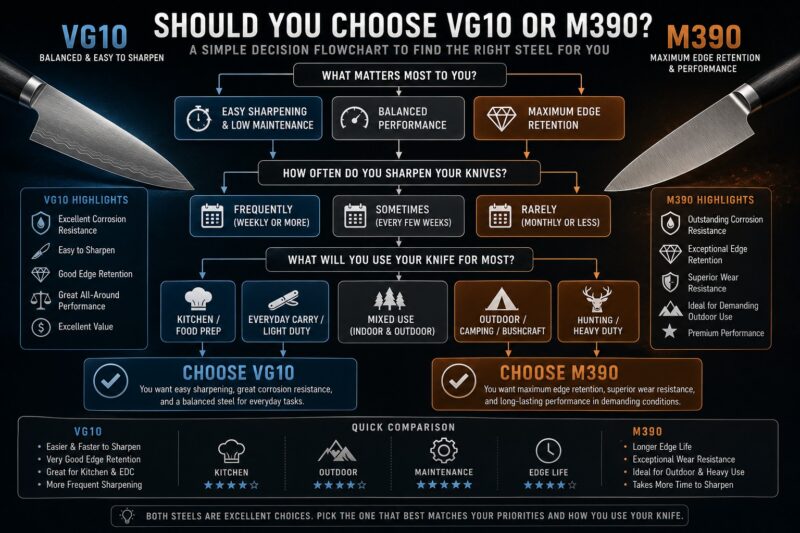
Which Steel Should You Choose?
Choose VG10 If You Want
- A knife that is easy to sharpen
- Excellent corrosion resistance
- A fine edge for precise slicing
- A versatile steel for kitchen and everyday use
- Balanced performance with straightforward maintenance
VG10 remains one of the best all-around conventional stainless steels available and is an excellent choice for users who value practicality and ease of ownership.
Choose M390 If You Want
- Maximum edge retention
- Outstanding wear resistance
- Longer intervals between sharpening
- Premium cutting performance
- A knife for demanding everyday or outdoor use
M390 rewards users who prioritize long-lasting sharpness and are willing to spend more time sharpening when maintenance is eventually required.
Frequently Asked Questions
Is M390 better than VG10?
Neither steel is universally better.
M390 outperforms VG10 in edge retention, wear resistance, and overall cutting longevity. VG10, however, is easier to sharpen and offers a more forgiving balance for everyday use.
Which steel stays sharp longer?
M390.
Its powder metallurgy construction and high wear resistance allow it to maintain a sharp edge significantly longer than VG10 under similar conditions.
Which steel is easier to sharpen?
VG10.
VG10 responds quickly to water stones, ceramic stones, and diamond stones, making it much easier to maintain than M390.
Which steel is more rust-resistant?
Both steels offer excellent corrosion resistance.
M390 has a slight advantage in harsh or highly humid environments, but for normal kitchen and outdoor use, both perform exceptionally well with basic care.
Which steel is better for kitchen knives?
Both are excellent choices.
VG10 is favored by users who enjoy maintaining an extremely sharp edge with regular sharpening, while M390 is ideal for those who want maximum edge retention and less frequent maintenance.
Which steel is better for everyday carry?
Both steels perform exceptionally well for EDC.
Choose:
- VG10 for easier maintenance and balanced performance.
- M390 for superior edge retention and extended cutting performance.
Is M390 worth the extra cost?
If your priority is long-lasting edge retention, exceptional wear resistance, and minimal sharpening frequency, M390 offers clear performance advantages.
If you prefer easier sharpening and outstanding all-around performance at a more accessible price point, VG10 remains an excellent option.
Final Verdict
VG10 and M390 are both premium stainless knife steels, but they are designed with different priorities in mind.
VG10 stands out for its balance. It combines excellent corrosion resistance, good toughness, very good edge retention, and easy sharpening into a steel that performs consistently across a wide range of tasks. Whether used in the kitchen, for everyday carry, or for general utility work, VG10 offers dependable performance with minimal maintenance.
M390 represents the next step in stainless steel technology. Thanks to its powder metallurgy manufacturing process, it delivers exceptional wear resistance, outstanding edge retention, and remarkable corrosion resistance. It is particularly well suited to users who demand maximum cutting performance and want to sharpen their knives as infrequently as possible.
For many users, the decision comes down to maintenance preferences:
- If you enjoy sharpening and want a highly versatile, easy-to-maintain knife, VG10 is an outstanding choice.
- If you prioritize long-lasting sharpness and premium cutting performance, M390 is the stronger option.
Neither steel is objectively “better” for every situation. Both are excellent, and the right choice depends on how you use and maintain your knife.
Conclusion
The comparison between VG10 and M390 highlights two different approaches to premium knife steel design.
VG10 demonstrates that a well-engineered conventional stainless steel can provide exceptional versatility, combining corrosion resistance, toughness, edge retention, and ease of sharpening into a practical package suitable for almost any cutting task.
M390 showcases the advantages of powder metallurgy, delivering superior wear resistance and edge retention while maintaining excellent corrosion resistance. It excels when maximum cutting longevity is the primary goal.
Whether you’re preparing meals, carrying a knife every day, or tackling demanding outdoor tasks, both steels are capable of outstanding performance. By matching the steel’s strengths to your intended use and maintenance habits, you can confidently choose the option that best fits your needs.
This article is for independent informational purposes only and is not affiliated with, sponsored by, or endorsed by any steel manufacturer. All product names, trademarks, and registered trademarks are the property of their respective owners.