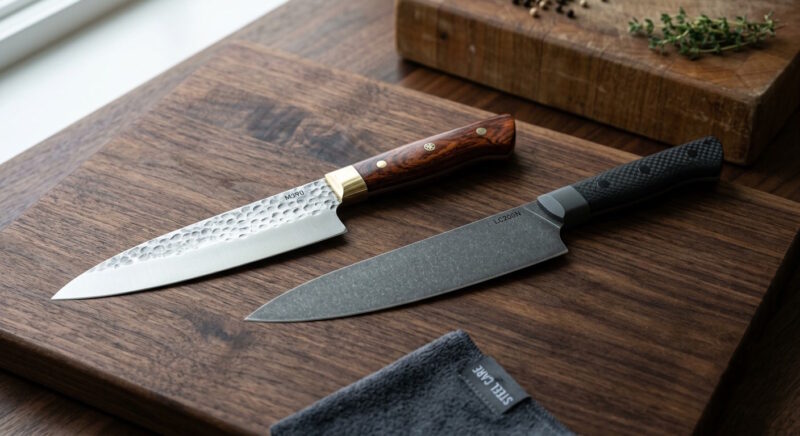
M390 vs LC200N: Complete Knife Steel Comparison
An Independent Guide
Choosing the right premium knife steel is no easy task. Modern metallurgy has produced steels that excel in different areas, making it important to understand their strengths before investing in a knife.
Among premium steels, M390 and LC200N are two outstanding options that often appear on buyers’ shortlists. While both are considered high-performance steels, they were designed with very different priorities.
M390 is widely recognized for its exceptional wear resistance, remarkable edge retention, and ability to maintain a razor-sharp edge through prolonged cutting tasks.
LC200N, on the other hand, was engineered to provide extraordinary corrosion resistance while still delivering excellent toughness and dependable cutting performance. It has become a favorite for knives exposed to saltwater, humid environments, and demanding outdoor conditions.
Neither steel is universally better than the other.
Instead, each excels in specific applications.
Understanding these differences helps ensure you select the steel that best matches your intended use.
In this comprehensive comparison, we’ll examine:
- Chemical composition
- Manufacturing process
- Hardness
- Edge retention
- Wear resistance
- Toughness
- Corrosion resistance
- Sharpening difficulty
- Kitchen performance
- Outdoor use
- Marine performance
- Everyday carry
- Maintenance requirements
- Overall value
By the end of this guide, you’ll understand which steel is the better choice for your needs.
Quick Comparison
| Property | M390 | LC200N |
|---|---|---|
| Steel Type | Powder Metallurgy Stainless | Nitrogen-Alloy Stainless |
| Hardness | ★★★★★ | ★★★★☆ |
| Edge Retention | ★★★★★ | ★★★☆☆ |
| Wear Resistance | ★★★★★ | ★★★☆☆ |
| Toughness | ★★★☆☆ | ★★★★★ |
| Corrosion Resistance | ★★★★★ | ★★★★★+ |
| Sharpening Ease | ★★☆☆☆ | ★★★★☆ |
| Marine Use | Excellent | Outstanding |
| Kitchen Use | Excellent | Outstanding |
What Is M390 Steel?
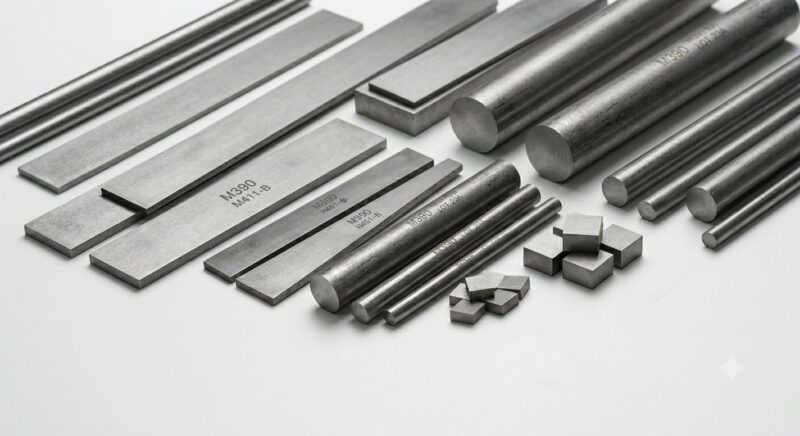
M390 is a premium powder metallurgy stainless steel developed for applications requiring exceptional wear resistance and long service life.
Its alloy design combines high levels of carbon, chromium, and vanadium to produce an exceptionally hard, wear-resistant microstructure.
Typical composition includes approximately:
- Carbon: 1.9–2.2%
- Chromium: 20–21%
- Vanadium: 4%
- Molybdenum: 1%
- Tungsten: 0.6%
These alloying elements create a dense network of hard carbides that significantly slow edge wear.
As a result, knives made from M390 are well known for:
- Outstanding edge retention
- Exceptional wear resistance
- Excellent corrosion resistance
- High hardness
- Fine edge capability
Proper heat treatment typically produces hardness between 60 and 62 HRC, although slight variations may occur depending on the knife’s intended purpose.
Because of its high carbide volume, M390 is more demanding to sharpen than many stainless steels, but it rewards users with very long intervals between sharpening sessions.
Check Our Guide M390 Steel Review
What Is LC200N Steel?
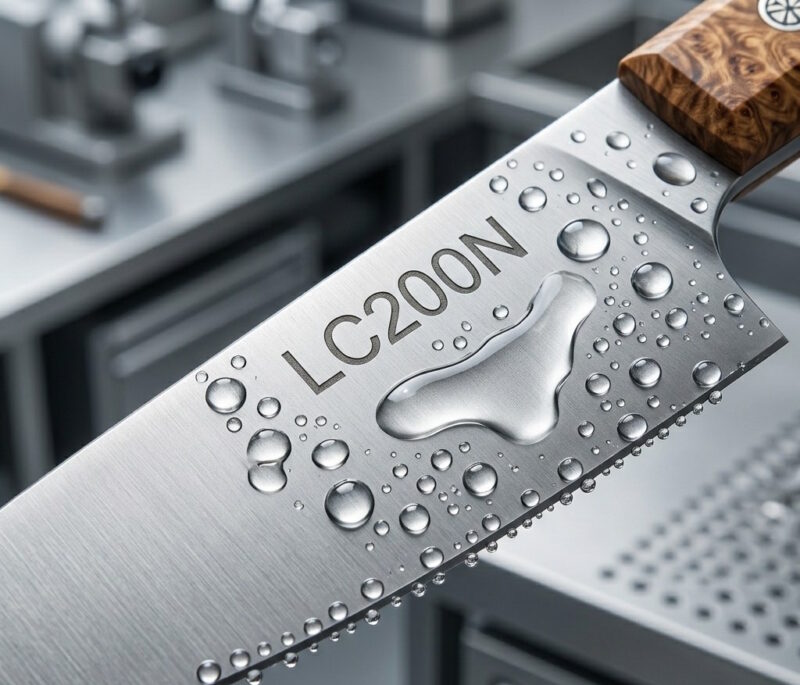
LC200N is a premium stainless steel designed to maximize corrosion resistance without sacrificing toughness or practical cutting performance.
Unlike many wear-focused steels, LC200N uses a nitrogen-alloyed composition rather than relying on extremely high carbon levels.
Nitrogen provides several important benefits:
- Improved corrosion resistance
- Excellent toughness
- Fine grain structure
- Stable cutting edges
Typical composition includes approximately:
- Carbon: 0.30%
- Chromium: 15%
- Nitrogen: 0.50%
- Molybdenum: 0.95%
- Manganese: 0.50%
- Silicon: 0.50%
Although LC200N contains much less carbon than M390, careful alloy design allows it to achieve hardness around 59–61 HRC while maintaining impressive toughness and one of the highest levels of corrosion resistance found in knife steels.
Its unique balance makes it especially popular for:
- Kitchen knives
- Diving knives
- Fishing knives
- Marine tools
- Outdoor knives
- Everyday carry
Check Our Guide LC200N Steel Review – The Ultimate Rust-Proof Knife Steel Explained
Chemical Composition Comparison
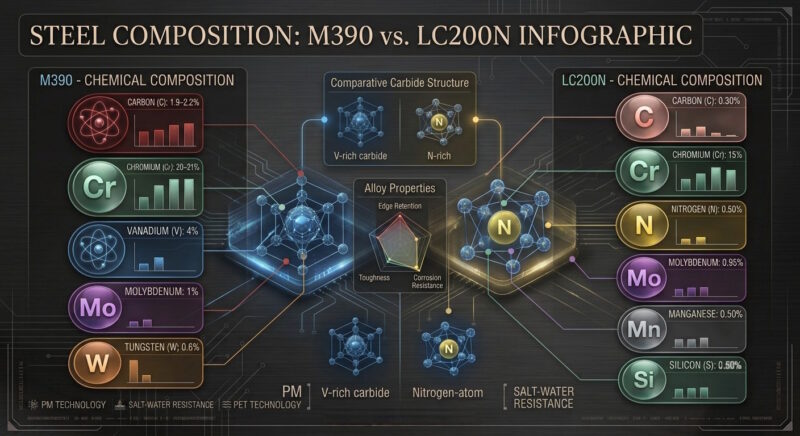
The alloy compositions clearly demonstrate the different design philosophies behind these steels.
| Element | M390 | LC200N |
|---|---|---|
| Carbon | 1.9–2.2% | 0.30% |
| Chromium | 20–21% | 15% |
| Vanadium | 4% | — |
| Molybdenum | 1% | 0.95% |
| Nitrogen | — | 0.50% |
| Tungsten | 0.6% | — |
The differences are significant.
M390
High carbon and vanadium promote the formation of extremely hard carbides.
This results in:
- Outstanding wear resistance
- Long edge retention
- High hardness
LC200N
Lower carbon combined with nitrogen produces a cleaner microstructure with fewer large carbides.
This results in:
- Exceptional corrosion resistance
- Better toughness
- Easier sharpening
- Stable cutting edges
Rather than competing directly, the steels were engineered to solve different problems.
Powder Metallurgy vs Nitrogen-Alloy Technology
Although both steels are considered premium materials, they achieve their performance using different metallurgical approaches.
M390
M390 is produced using powder metallurgy.
During manufacturing:
- Molten steel is atomized into microscopic powder particles.
- The particles rapidly solidify.
- The powder is compressed under high pressure.
- Heat and pressure fuse the particles into solid steel.
This process creates:
- Extremely fine carbide distribution
- Uniform microstructure
- Improved wear resistance
- Better toughness than conventional high-alloy steels
The fine carbide structure allows M390 to combine exceptional hardness with reliable cutting performance.
LC200N
LC200N follows a different path.
Rather than maximizing carbide volume, its alloy uses nitrogen to strengthen the steel while preserving chromium in solution.
This produces several advantages:
- Outstanding corrosion resistance
- High toughness
- Fine grain structure
- Excellent edge stability
- Easier maintenance
The cleaner microstructure also makes LC200N noticeably easier to sharpen than many premium wear-resistant steels.
Initial Performance Expectations
Even before comparing real-world cutting performance, the metallurgy reveals how these steels are likely to behave.
M390 excels in:
- Edge retention
- Wear resistance
- Hardness
- Long cutting sessions
- Abrasive materials
LC200N excels in:
- Corrosion resistance
- Toughness
- Marine environments
- Food preparation
- Ease of maintenance
- Sharpening
These strengths explain why both steels have developed excellent reputations despite targeting different types of knife users.
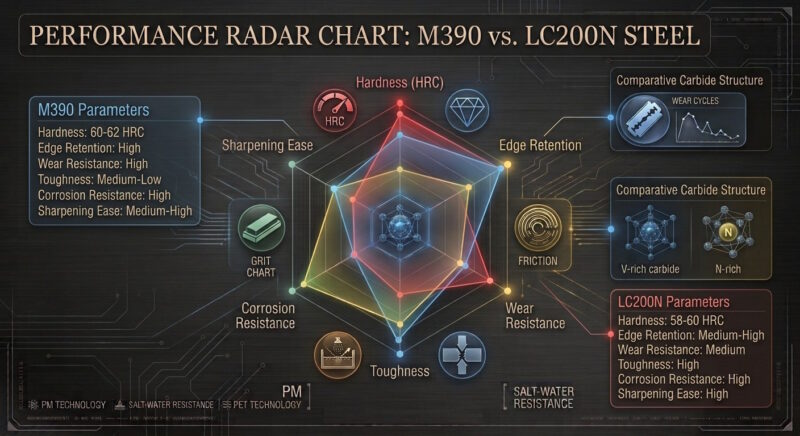
Hardness, Edge Retention, Toughness & Corrosion Resistance
In Part 1, we explored the metallurgy and chemical composition of M390 and LC200N. Although both belong to the premium class of knife steels, their alloy designs pursue different goals.
M390 is engineered to maximize wear resistance and edge retention, while LC200N focuses on corrosion resistance, toughness, and long-term reliability in harsh environments.
Now let’s compare how these differences affect real-world performance.
Hardness (HRC)
Hardness determines how well a steel resists deformation under load and plays an important role in edge retention.
However, hardness alone does not determine cutting performance. Proper heat treatment and blade geometry are equally important.
M390
M390 is commonly heat treated between 60 and 62 HRC.
At this hardness, it delivers:
- Outstanding edge retention
- Excellent wear resistance
- Stable cutting edges
- High slicing efficiency
Its refined powder metallurgy microstructure allows the steel to maintain excellent cutting performance despite its high hardness.
Check Our Guide What Is HRC? Understanding Rockwell Hardness in Kitchen Knives
LC200N
LC200N is generally heat treated between 59 and 61 HRC.
Although slightly softer on average than M390, LC200N offers excellent balance.
Benefits include:
- Better toughness
- Greater resistance to chipping
- Easier sharpening
- Reliable edge stability
The slightly lower hardness contributes to the steel’s outstanding durability during demanding use.
Hardness Rating
| Steel | Rating |
|---|---|
| M390 | ★★★★★ |
| LC200N | ★★★★☆ |
Winner: M390
Edge Retention
Edge retention is one of the biggest reasons many knife enthusiasts choose premium steels.
M390
M390 is famous for exceptional cutting longevity.
Its high concentration of vanadium and chromium carbides allows the edge to resist wear during prolonged cutting.
Users commonly notice outstanding performance when cutting:
- Cardboard
- Rope
- Leather
- Dense plastics
- Heavy packaging
- Fibrous materials
Even after extensive use, M390 often continues slicing effectively with minimal loss of sharpness.
LC200N
LC200N provides good edge retention but was never intended to compete directly with high wear-resistant steels.
Instead, it offers consistent cutting performance combined with outstanding toughness and corrosion resistance.
During everyday kitchen tasks and general utility cutting, many users find LC200N remains sharp long enough for normal maintenance schedules.
For prolonged abrasive cutting, however, M390 generally stays sharp considerably longer.
Edge Retention Rating
| Steel | Rating |
|---|---|
| M390 | ★★★★★ |
| LC200N | ★★★☆☆ |
Winner: M390
Wear Resistance
Wear resistance measures how slowly the cutting edge loses material through abrasion.
This property is especially important for professionals who perform repetitive cutting throughout the day.
M390
M390 is among the highest-performing stainless knife steels in this category.
Its abundant hard carbides dramatically slow abrasive wear.
Advantages include:
- Long cutting sessions
- Reduced sharpening frequency
- Excellent performance on abrasive materials
LC200N
LC200N offers respectable wear resistance but emphasizes balanced performance instead of maximum abrasion resistance.
Its cleaner microstructure contributes to easier sharpening and greater toughness.
For everyday users, wear resistance is more than adequate.
However, users cutting large volumes of cardboard or rope will likely notice that LC200N requires sharpening sooner than M390.
Wear Resistance Rating
| Steel | Rating |
|---|---|
| M390 | ★★★★★ |
| LC200N | ★★★☆☆ |
Winner: M390
Toughness
Toughness describes how well a steel resists cracking or chipping when subjected to impact or lateral force.
This characteristic becomes especially important during outdoor work and demanding utility tasks.
M390
Considering its exceptional hardness and wear resistance, M390 offers respectable toughness.
However, its high carbide volume naturally reduces impact resistance compared with steels designed specifically for toughness.
It performs best during slicing rather than heavy impact work.
LC200N
Toughness is one of LC200N’s greatest strengths.
Its fine nitrogen-alloyed microstructure contains fewer large carbides, allowing the edge to better absorb stress.
This makes LC200N an excellent choice for:
- Outdoor utility
- Fishing
- Camping
- Food preparation
- Everyday carry
It also reduces the likelihood of micro-chipping when very thin edge geometry is used.
Toughness Rating
| Steel | Rating |
|---|---|
| M390 | ★★★☆☆ |
| LC200N | ★★★★★ |
Winner: LC200N
Corrosion Resistance
Corrosion resistance is where LC200N separates itself from nearly every other premium knife steel.
M390
M390 is already considered an excellent stainless steel.
Its chromium-rich composition provides outstanding resistance to:
- Rust
- Staining
- Humidity
- Food acids
For most users, M390 offers all the corrosion resistance they will ever need.
LC200N
LC200N was specifically engineered for extreme corrosion resistance.
Its nitrogen-alloyed design allows more chromium to remain available for corrosion protection rather than being tied up in carbide formation.
As a result, LC200N performs exceptionally well in:
- Saltwater
- Marine environments
- Commercial kitchens
- Coastal climates
- Diving
- Fishing
- High humidity
Many users consider it one of the most corrosion-resistant knife steels available.
Corrosion Resistance Rating
| Steel | Rating |
|---|---|
| M390 | ★★★★★ |
| LC200N | ★★★★★+ |
Winner: LC200N
Sharpening Difficulty
Every premium steel involves some compromise.
In this comparison, sharpening is one of the biggest differences.
M390
The same hard carbides responsible for outstanding edge retention also make sharpening slower.
Best sharpening equipment includes:
- Diamond plates
- Diamond stones
- Premium ceramic stones
While sharpening takes longer, it occurs much less frequently.
LC200N
LC200N is noticeably easier to sharpen.
Its lower carbide volume allows abrasives to remove steel more efficiently.
Benefits include:
- Faster burr formation
- Simpler edge refinement
- Less sharpening time
- Easier maintenance for beginners
For users who sharpen regularly, LC200N is significantly more forgiving.
Sharpening Rating
| Steel | Rating |
|---|---|
| M390 | ★★☆☆☆ |
| LC200N | ★★★★☆ |
Winner: LC200N
Check Our Guide Best Blade Thickness for Different Uses
Edge Stability
Edge stability measures how well a thin cutting edge resists rolling or microscopic chipping.
M390
M390 supports very fine edge geometry and performs exceptionally well during precision slicing.
However, at extremely thin edge angles and under abusive use, the high carbide content can make the edge slightly more prone to micro-chipping than tougher steels.
LC200N
LC200N’s cleaner microstructure gives excellent support to thin cutting edges.
Benefits include:
- Stable apex
- Reduced micro-chipping
- Excellent control
- Reliable performance during repetitive cutting
Professional kitchen users often appreciate this predictable cutting behavior.
Edge Stability Rating
| Steel | Rating |
|---|---|
| M390 | ★★★★☆ |
| LC200N | ★★★★★ |
Winner: LC200N
Real-World Cutting Performance
Laboratory tests are valuable, but daily use is what matters most.
M390 Performs Best For
- Heavy cardboard cutting
- Rope
- Leather
- Warehouse work
- Utility cutting
- Long slicing sessions
- Users who sharpen infrequently
LC200N Performs Best For
- Food preparation
- Seafood
- Fishing
- Diving
- Marine environments
- Camping
- Humid climates
- Everyday utility
Its exceptional corrosion resistance allows users to focus on the task rather than worrying about blade maintenance.
Performance Summary
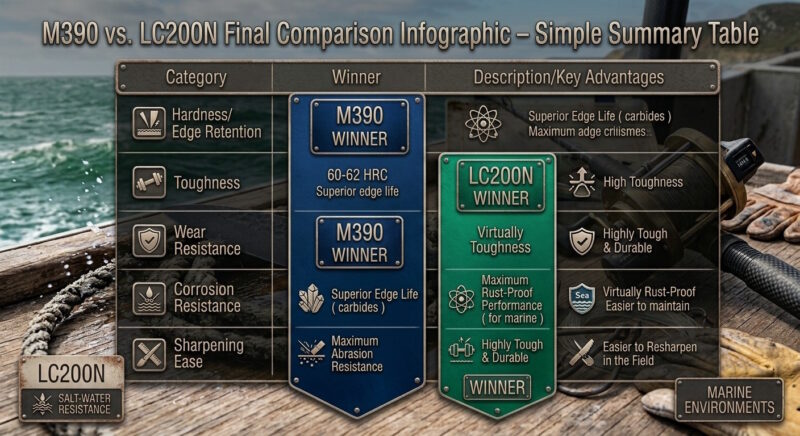
| Property | Winner |
|---|---|
| Hardness | 🏆 M390 |
| Edge Retention | 🏆 M390 |
| Wear Resistance | 🏆 M390 |
| Toughness | 🏆 LC200N |
| Corrosion Resistance | 🏆 LC200N |
| Sharpening Ease | 🏆 LC200N |
| Edge Stability | 🏆 LC200N |
The results show that neither steel dominates every category. M390 is the clear leader in edge retention and wear resistance, while LC200N excels in toughness, corrosion resistance, edge stability, and ease of sharpening.
Real-World Performance, Best Uses, Maintenance & Pros and Cons
In Parts 1 and 2, we compared the metallurgy, hardness, edge retention, toughness, corrosion resistance, and sharpening characteristics of M390 and LC200N. Although both are premium knife steels, they are designed for different priorities.
M390 is optimized for exceptional wear resistance and long-lasting sharpness, while LC200N focuses on corrosion resistance, toughness, and reliability in harsh environments.
Let’s see how those differences affect everyday use.
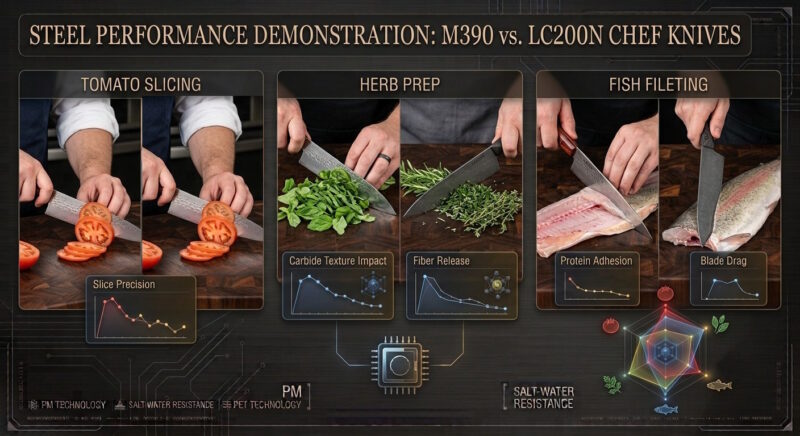
Kitchen Performance
Both steels perform extremely well in the kitchen, but they excel in different situations.
M390 in the Kitchen
M390 is an outstanding kitchen steel for users who value edge retention above everything else.
Its advantages include:
- Extremely long-lasting sharpness
- Excellent slicing performance
- Clean push cuts
- Fine polished edge
- Outstanding wear resistance
It performs exceptionally well when preparing:
- Vegetables
- Boneless meat
- Herbs
- Fruits
- Cheese
The primary advantage is that the knife stays sharp through many cooking sessions before requiring maintenance.
However, sharpening takes more time because of the steel’s high carbide content.
Kitchen Rating
★★★★★
LC200N in the Kitchen
LC200N was practically designed for wet food preparation.
Its exceptional corrosion resistance makes it ideal for:
- Seafood
- Fish
- Citrus fruits
- Tomatoes
- Onions
- Professional kitchens
- Commercial food preparation
Frequent washing presents virtually no concern, and acidic ingredients are much less likely to cause staining.
Many professional cooks appreciate being able to work throughout an entire shift without worrying about corrosion.
Although LC200N loses its edge sooner than M390, sharpening is faster and easier.
Kitchen Rating
★★★★★
Outdoor and Bushcraft Performance
Outdoor knives encounter a wide variety of demanding conditions.
Typical tasks include:
- Rope cutting
- Wood carving
- Camp cooking
- Feather sticks
- Shelter building
- General utility work
M390 Outdoors
M390 performs exceptionally well when prolonged cutting is required.
Advantages include:
- Outstanding wear resistance
- Excellent edge retention
- Long intervals between sharpening
- Fine slicing ability
However, heavy prying or twisting should be avoided because high wear-resistant steels generally sacrifice some toughness.
Outdoor Rating
★★★★☆
LC200N Outdoors
LC200N offers a different set of advantages.
Its combination of toughness and corrosion resistance makes it ideal for unpredictable outdoor conditions.
Users benefit from:
- Excellent toughness
- Easy maintenance
- Reliable edge stability
- Outstanding resistance to moisture
Camping in rainy weather or humid forests presents little concern for LC200N.
Outdoor Rating
★★★★★
Check Our Guide How to Choose a Hunting Knife for Fishing
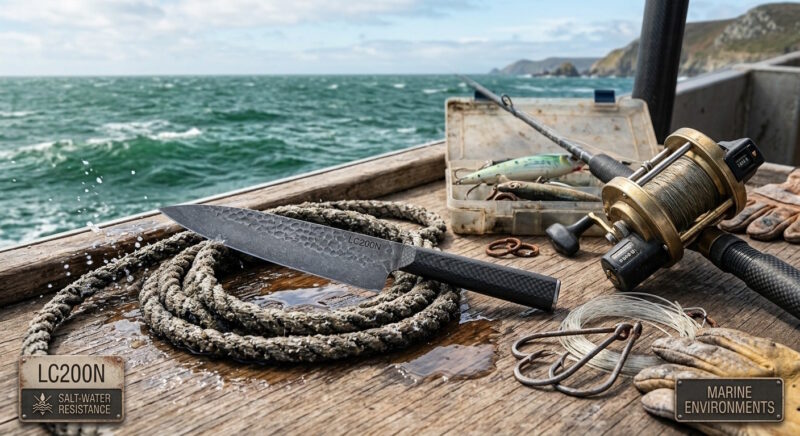
Fishing and Marine Use
This is where LC200N truly separates itself.
Marine environments expose knives to:
- Saltwater
- Fish blood
- Humidity
- Sand
- Constant moisture
M390
M390 performs very well around water.
However, prolonged saltwater exposure still requires rinsing and drying after use.
With proper maintenance, corrosion rarely becomes an issue.
Marine Rating
★★★★☆
LC200N
LC200N is widely recognized as one of the best steels available for marine environments.
Its extraordinary corrosion resistance makes it ideal for:
- Fishing
- Diving
- Boating
- Coastal living
- Kayaking
- Saltwater survival kits
Many users choose LC200N specifically because it remains highly resistant to rust even after repeated exposure to harsh conditions.
Marine Rating
★★★★★+
Everyday Carry (EDC)
Both steels make excellent everyday carry knives.
The best choice depends on how the knife will be used.
M390 for EDC
Excellent for:
- Opening packages
- Warehouse work
- Cardboard
- Plastic straps
- Utility cutting
- Daily work tasks
The long edge life is particularly appreciated by users who rely on their knife throughout the day.
LC200N for EDC
Excellent for:
- Humid climates
- Outdoor recreation
- Fishing trips
- Urban carry
- Food preparation
- General utility
The combination of corrosion resistance and easy maintenance makes it especially attractive for users living near the ocean.
Check Our Guide Knife Safety Tips for Outdoor Use
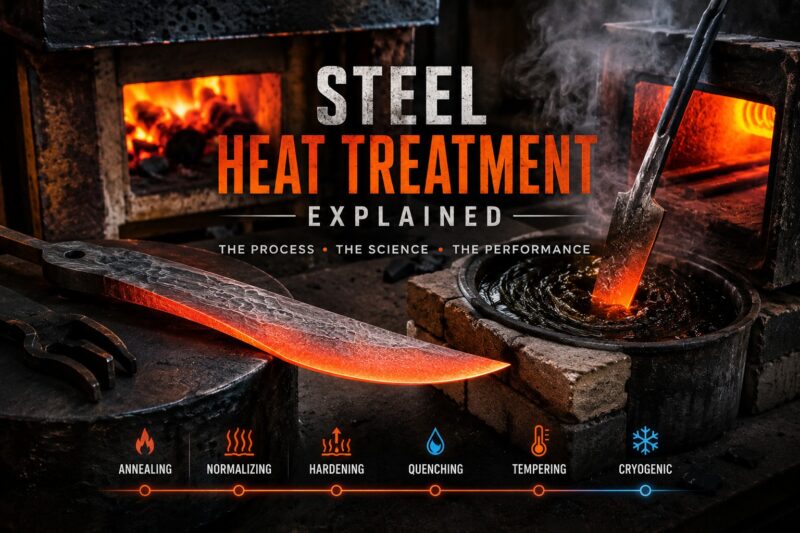
Heat Treatment
Heat treatment has a tremendous influence on knife performance.
Even premium steel cannot perform well without proper heat treatment.
M390
When properly heat treated around 60–62 HRC, M390 develops:
- Outstanding wear resistance
- Excellent edge retention
- Stable cutting geometry
- High hardness
LC200N
Properly heat treated around 59–61 HRC, LC200N offers:
- Excellent toughness
- Outstanding corrosion resistance
- Reliable edge stability
- Good cutting performance
In both cases, the skill of the knife maker is just as important as the steel itself.
Check Our Guide Different Heat Treatment Methods Explained
Maintenance Requirements
Both steels belong to the stainless category, but their maintenance needs are slightly different.
Caring for M390
Routine care includes:
- Hand washing
- Drying immediately after use
- Avoiding prolonged exposure to moisture
- Using wood or plastic cutting boards
With normal maintenance, M390 remains highly resistant to staining and corrosion.
Caring for LC200N
LC200N requires even less maintenance.
Typical care consists of:
- Basic washing
- Dry storage
- Occasional cleaning
Because of its remarkable corrosion resistance, LC200N tolerates humid conditions much better than most knife steels.
Advantages of M390
Pros
✔ Exceptional edge retention
✔ Outstanding wear resistance
✔ Excellent hardness
✔ Superb slicing performance
✔ Excellent corrosion resistance
✔ Long sharpening intervals
✔ Premium polished edge
Disadvantages of M390
Cons
✘ More difficult to sharpen
✘ Lower toughness than LC200N
✘ Less suitable for extreme marine environments
Advantages of LC200N
Pros
✔ Exceptional corrosion resistance
✔ Outstanding toughness
✔ Easy maintenance
✔ Easier sharpening
✔ Excellent edge stability
✔ Outstanding for saltwater use
✔ Great kitchen performance
Disadvantages of LC200N
Cons
✘ Lower wear resistance than M390
✘ Requires more frequent sharpening
✘ Slightly lower edge retention
Which Steel Should You Choose?
Choose M390 if you prioritize:
- Maximum edge retention
- Wear resistance
- Heavy daily cutting
- Long sharpening intervals
- Utility and warehouse work
Choose LC200N if you prioritize:
- Corrosion resistance
- Fishing
- Marine environments
- Outdoor adventures
- Professional kitchens
- Easy maintenance
- Greater toughness
Neither steel is universally superior.
Instead, they represent two different philosophies of premium knife steel design.
M390 focuses on maximum cutting longevity, while LC200N emphasizes reliability in harsh, wet environments without sacrificing practical cutting performance.
Final Verdict, FAQ, Buying Guide & SEO Recommendations
After comparing every major characteristic of M390 and LC200N, one conclusion becomes obvious:
Both are exceptional premium knife steels, but they are engineered for different priorities.
M390 was designed to maximize edge retention and wear resistance. It excels in applications where prolonged cutting performance is more important than quick sharpening.
LC200N follows a different philosophy. Rather than pursuing maximum wear resistance, it delivers one of the best combinations of corrosion resistance, toughness, and practical cutting performance available in a stainless knife steel.
Choosing between them depends less on which steel is “better” and more on how and where the knife will be used.
When M390 Is the Better Choice
M390 is ideal for users who want to sharpen as infrequently as possible.
Choose M390 if you regularly:
- Cut cardboard
- Process rope
- Open large numbers of packages
- Perform warehouse or utility work
- Value maximum edge retention
- Prefer premium slicing performance
Because of its outstanding wear resistance, M390 continues cutting efficiently through long work sessions with minimal loss of sharpness.
M390 Strengths
- Exceptional edge retention
- Outstanding wear resistance
- Excellent corrosion resistance
- High hardness
- Excellent fine-edge performance
- Long sharpening intervals
When LC200N Is the Better Choice
LC200N becomes the superior choice whenever moisture is part of everyday use.
It is particularly well suited for:
- Professional kitchens
- Seafood preparation
- Fishing
- Diving
- Boating
- Coastal living
- Camping in wet climates
- Everyday carry in humid environments
Its exceptional corrosion resistance reduces maintenance while its excellent toughness provides confidence during demanding tasks.
LC200N Strengths
- Outstanding corrosion resistance
- Excellent toughness
- Easier sharpening
- Stable cutting edges
- Low maintenance
- Excellent performance around saltwater
Overall Performance Comparison
| Property | Winner |
|---|---|
| Hardness | 🏆 M390 |
| Edge Retention | 🏆 M390 |
| Wear Resistance | 🏆 M390 |
| Toughness | 🏆 LC200N |
| Corrosion Resistance | 🏆 LC200N |
| Sharpening Ease | 🏆 LC200N |
| Edge Stability | 🏆 LC200N |
| Marine Use | 🏆 LC200N |
| Heavy Utility Cutting | 🏆 M390 |
| Kitchen Performance | Tie |
Frequently Asked Questions
Is M390 better than LC200N?
Neither steel is universally better.
M390 excels in edge retention and wear resistance, while LC200N offers superior corrosion resistance, toughness, and easier maintenance.
The best choice depends on how the knife will be used.
Which steel stays sharp longer?
M390 generally retains its edge significantly longer during abrasive cutting because of its high volume of hard vanadium carbides.
Which steel is better for saltwater?
LC200N.
Its nitrogen-alloy design provides exceptional resistance to corrosion, making it one of the best choices for marine environments.
Which steel is easier to sharpen?
LC200N is noticeably easier to sharpen.
Its lower carbide volume allows sharpening stones to remove material more efficiently, reducing sharpening time.
Which steel is better for kitchen knives?
Both perform exceptionally well.
Choose M390 if long edge life is your highest priority.
Choose LC200N if you frequently prepare seafood, acidic foods, or work in a busy kitchen where corrosion resistance and easy maintenance are especially valuable.
Which steel is better for outdoor use?
Both are excellent outdoor steels.
- M390 is better for long cutting sessions where edge retention is critical.
- LC200N is better for wet environments, fishing, kayaking, and coastal camping.
Does LC200N rust?
LC200N offers extraordinary corrosion resistance, but like any steel, basic care is still recommended.
Rinsing and drying after exposure to saltwater will help preserve the blade’s finish over many years.
Overall Ratings
| Category | M390 | LC200N |
|---|---|---|
| Hardness | ★★★★★ | ★★★★☆ |
| Edge Retention | ★★★★★ | ★★★☆☆ |
| Wear Resistance | ★★★★★ | ★★★☆☆ |
| Toughness | ★★★☆☆ | ★★★★★ |
| Corrosion Resistance | ★★★★★ | ★★★★★+ |
| Sharpening Ease | ★★☆☆☆ | ★★★★☆ |
| Kitchen Performance | ★★★★★ | ★★★★★ |
| Marine Use | ★★★★☆ | ★★★★★+ |
| Overall Balance | ★★★★☆ | ★★★★★ |
Final Verdict
M390 and LC200N represent two different approaches to premium knife steel design.
If your priority is maximum cutting longevity, M390 remains one of the strongest choices available. Its remarkable wear resistance and edge retention make it an excellent option for heavy daily use, utility work, and users who want to sharpen as infrequently as possible.
LC200N, however, excels where moisture, salt, and demanding environments are constant concerns. Its combination of exceptional corrosion resistance, impressive toughness, and easy maintenance makes it an outstanding choice for kitchen knives, fishing knives, outdoor tools, and everyday carry in humid climates.
For users working primarily in dry conditions, M390 offers superior long-term cutting performance.
For users around water or those who value low maintenance and reliability, LC200N is often the more practical and versatile option.
Ultimately, the best steel is the one that matches your environment, maintenance habits, and intended use.
This article is for independent informational purposes only and is not affiliated with, sponsored by, or endorsed by any steel manufacturer. All product names, trademarks, and registered trademarks are the property of their respective owners.