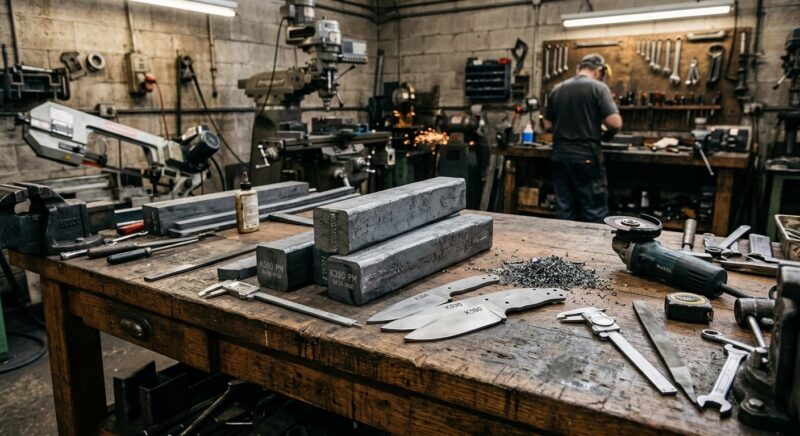
K390 Steel Review
An Independent Guide
Modern knife enthusiasts have access to an incredible variety of high-performance blade steels, each designed with different priorities. Some steels focus on corrosion resistance, others emphasize toughness, while certain premium steels are engineered to maximize edge retention above everything else.
K390 belongs firmly in the last category.
Widely respected among experienced knife users, K390 has earned a reputation as one of the best steels available for exceptional wear resistance and long-lasting cutting performance. Rather than being designed primarily as a stainless steel, it was developed as a premium powder metallurgy tool steel capable of maintaining a sharp edge through demanding cutting tasks.
This makes K390 particularly attractive for users who regularly cut abrasive materials such as cardboard, rope, wood, leather, and dense synthetic fibers.
However, outstanding wear resistance comes with trade-offs. K390 requires more maintenance than stainless steels, is more demanding to sharpen, and develops a natural patina if not properly cared for.
Understanding these strengths and limitations is essential before choosing a knife made from K390.
In this comprehensive guide, we’ll examine:
- Chemical composition
- Powder metallurgy manufacturing
- Hardness
- Edge retention
- Toughness
- Wear resistance
- Corrosion resistance
- Sharpening difficulty
- Kitchen performance
- Outdoor applications
- Everyday carry use
- Maintenance requirements
- Advantages and disadvantages
- Whether K390 is the right steel for your next knife
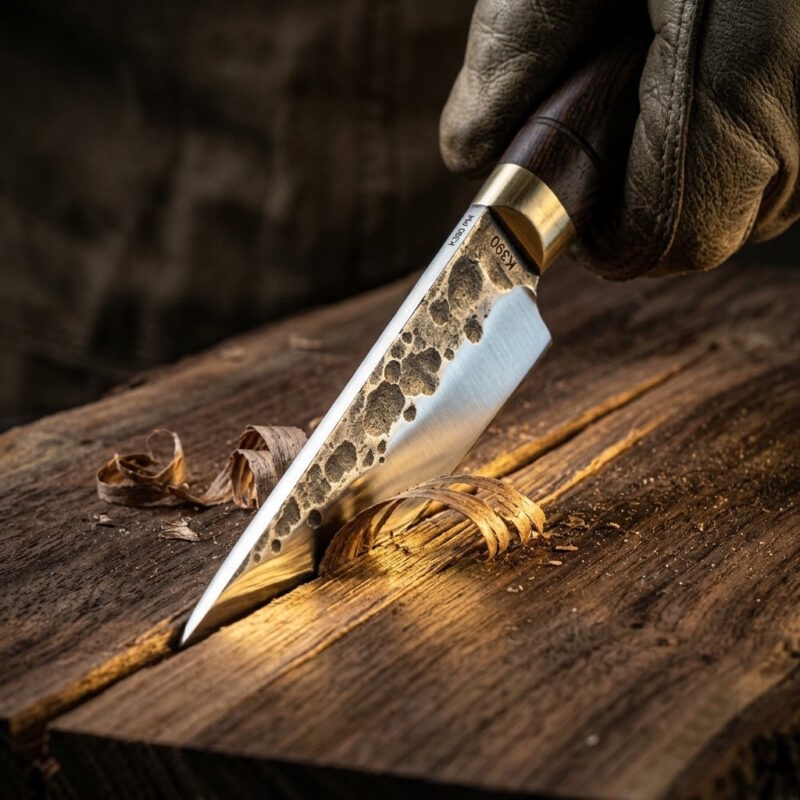
Quick Overview
| Property | Rating |
|---|---|
| Steel Type | Powder Metallurgy Tool Steel |
| Stainless | No |
| Hardness | ★★★★★ |
| Edge Retention | ★★★★★ |
| Wear Resistance | ★★★★★ |
| Toughness | ★★★★☆ |
| Corrosion Resistance | ★★☆☆☆ |
| Sharpening Ease | ★★☆☆☆ |
| Best For | Heavy Cutting & Outdoor Use |
What Is K390 Steel?
K390 is a premium powder metallurgy tool steel engineered for extreme wear resistance and long service life.
Unlike stainless knife steels, K390 was designed primarily for industrial cutting tools that experience constant abrasion and heavy workloads. These demanding applications require a steel capable of maintaining sharp cutting edges despite prolonged use.
Knife makers later recognized that these same characteristics translated exceptionally well into high-performance knives.
Today, K390 is appreciated for its remarkable ability to stay sharp even after prolonged cutting sessions.
Unlike many stainless steels, K390 contains relatively little chromium, which means it cannot rely on chromium alone for corrosion resistance.
Instead, its alloy design focuses on:
- Very high wear resistance
- Outstanding edge retention
- High hardness
- Excellent edge stability
- Good toughness for a wear-resistant tool steel
The result is a blade that excels in demanding cutting environments but requires more attention to prevent corrosion.
Powder Metallurgy Manufacturing
One reason K390 performs so well is its manufacturing process.
Rather than being conventionally cast, K390 is produced using powder metallurgy.
During production:
- Molten steel is atomized into microscopic powder particles.
- These powders rapidly solidify.
- The powder is compressed under extremely high pressure.
- Heat and pressure fuse the particles into solid steel.
This process creates an exceptionally fine and uniform microstructure.
Compared with traditional steelmaking, powder metallurgy offers several advantages:
- Smaller carbides
- Better carbide distribution
- Improved toughness
- More consistent hardness
- Better grindability
- Higher overall performance
Without powder metallurgy, a steel containing this much carbon and vanadium would develop coarse carbides that reduce toughness and make machining more difficult.
The refined microstructure is one of the reasons K390 delivers such impressive cutting performance despite its extremely high wear resistance.
Check Our Guide Powder Steels for Kitchen Knives
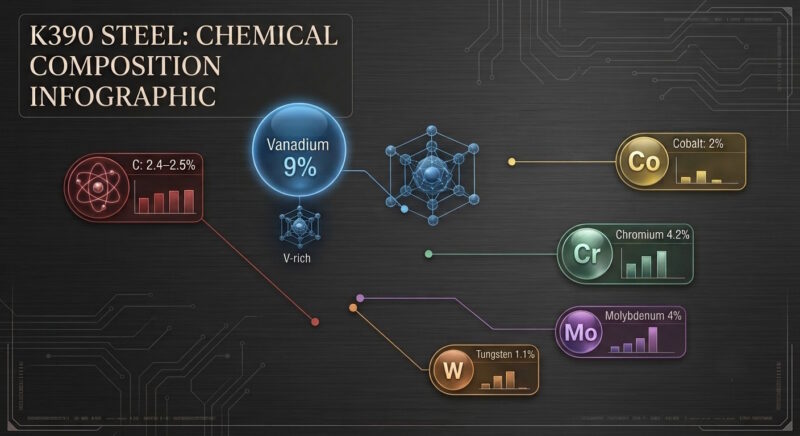
Chemical Composition
The composition of K390 reveals why it performs so differently from stainless knife steels.
| Element | Approximate Content |
|---|---|
| Carbon | 2.4–2.5% |
| Chromium | 4.0–4.2% |
| Vanadium | 9% |
| Tungsten | 1% |
| Molybdenum | 4% |
| Cobalt | 2% |
Each alloying element contributes to the steel’s overall behavior.
Carbon
Carbon is one of the most important components in knife steel.
K390 contains an exceptionally high carbon content compared with many premium steels.
This allows it to achieve:
- Very high hardness
- Outstanding wear resistance
- Excellent edge retention
- Strong carbide formation
High carbon content is one reason K390 can maintain sharpness for extended periods.
Chromium
Unlike stainless steels that often contain around 14–20% chromium, K390 contains only about 4%.
This amount improves hardenability and contributes to carbide formation but is insufficient to make the steel stainless.
As a result:
- The blade can rust if neglected.
- Moisture should not remain on the surface.
- Acidic foods require prompt cleaning.
- Regular maintenance is recommended.
Vanadium
Vanadium is one of the defining alloying elements in K390.
At approximately 9%, it creates an enormous volume of extremely hard vanadium carbides.
These carbides dramatically improve:
- Wear resistance
- Edge retention
- Cutting longevity
- Abrasion resistance
Vanadium carbides are significantly harder than chromium carbides, making them particularly effective for prolonged cutting.
Molybdenum
Molybdenum strengthens the steel while supporting hardness and improving wear resistance.
It also contributes to:
- High-temperature stability
- Better overall strength
- Improved hardenability
This helps K390 maintain excellent performance under demanding conditions.
Tungsten
Although present in smaller quantities, tungsten further enhances wear resistance and hardness.
It also contributes to excellent edge stability during extended cutting sessions.
Cobalt
K390 includes cobalt, which helps improve the response to heat treatment.
This allows the steel to achieve very high hardness while maintaining useful toughness.
The combination of cobalt with vanadium and molybdenum produces one of the most wear-resistant tool steels used for premium knives.
Why K390 Is Different
Many premium knife steels attempt to balance several properties equally.
K390 takes a different approach.
Its design clearly prioritizes:
- Maximum edge retention
- Exceptional wear resistance
- High hardness
- Outstanding cutting performance
Rather than trying to excel in every category, K390 accepts lower corrosion resistance in exchange for superior edge longevity.
For users who don’t mind a little extra maintenance, this trade-off can be well worth it.
Initial Performance Summary
Even before examining real-world cutting performance, K390 stands out for several reasons.
Major Strengths
- Extremely high wear resistance
- Outstanding edge retention
- Excellent hardness
- Fine carbide structure
- Strong edge stability
- Very good toughness for a high-wear tool steel
Trade-Offs
- Not stainless
- Requires regular maintenance
- More difficult to sharpen than many steels
- Can develop patina with use
These characteristics explain why K390 has become a favorite among experienced users who value cutting performance above minimal maintenance.
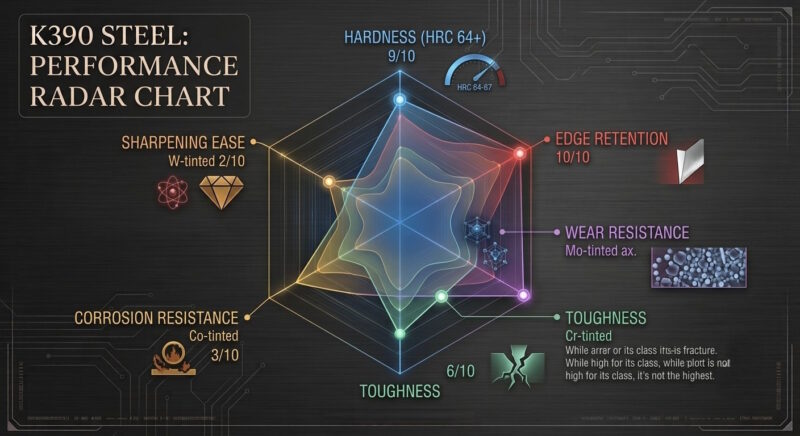
Hardness, Edge Retention, Toughness & Corrosion Resistance
In Part 1, we explored the metallurgy behind K390, including its chemical composition and powder metallurgy manufacturing process. Those characteristics explain why K390 has earned its reputation as one of the highest-performing tool steels available for premium knives.
Now let’s examine how these properties translate into real-world performance.
Hardness
Hardness is one of the most important characteristics of any knife steel because it directly affects edge retention, wear resistance, and cutting efficiency.
K390 is commonly heat treated between 62 and 64 HRC, although some knives may be slightly softer or harder depending on the intended application.
| Steel | Typical Hardness |
|---|---|
| K390 | 62–64 HRC |
This places K390 among the hardest premium knife steels available.
Higher hardness provides several advantages:
- Better edge stability
- Longer edge retention
- Improved slicing performance
- Greater resistance to edge deformation
However, high hardness alone does not determine overall knife performance. The heat treatment and blade geometry are equally important.
Fortunately, K390 responds exceptionally well to proper heat treatment, allowing it to achieve impressive hardness without becoming excessively brittle.
Hardness Rating
★★★★★
Check Our Guide What Is HRC? Understanding Rockwell Hardness
Edge Retention
Edge retention is the area where K390 truly shines.
Among experienced knife enthusiasts, K390 is widely regarded as one of the very best steels for maintaining a sharp working edge through prolonged cutting.
The reason lies in its exceptionally high concentration of hard vanadium carbides.
These microscopic particles dramatically reduce abrasive wear, allowing the cutting edge to remain effective for an extended period.
During heavy use, K390 often continues cutting efficiently long after many premium stainless steels require sharpening.
Typical cutting tasks where K390 excels include:
- Cardboard
- Rope
- Leather
- Dense plastics
- Wood carving
- Fibrous materials
- Outdoor utility work
For users who dislike frequent sharpening, K390 offers tremendous advantages.
Many owners report significantly longer intervals between sharpening compared with conventional stainless steels.
Edge Retention Rating
★★★★★
Wear Resistance
Wear resistance measures how slowly the cutting edge loses material during use.
This property becomes especially important when cutting abrasive materials.
The extremely high vanadium content gives K390 extraordinary wear resistance.
Each vanadium carbide is considerably harder than ordinary chromium carbides found in many stainless steels.
This creates an edge capable of resisting abrasion through prolonged cutting sessions.
Examples include:
- Warehouse work
- Construction
- Packaging
- Bushcraft
- Carpentry
- Food processing
For professionals who rely on their knives daily, this can translate into less downtime spent sharpening.
Very few knife steels exceed K390 in wear resistance.
Wear Resistance Rating
★★★★★
Toughness
High wear resistance often comes at the expense of toughness.
Fortunately, K390 performs remarkably well considering its extremely high hardness.
Although it is not designed as a dedicated impact-resistant steel, powder metallurgy allows K390 to maintain respectable toughness.
This makes it suitable for demanding tasks such as:
- Feather sticks
- Camp food preparation
- Wood carving
- General outdoor work
- Utility cutting
However, no high-hardness steel should be abused.
Avoid:
- Prying
- Twisting
- Hammering
- Striking nails
- Cutting hardened materials
Used appropriately, K390 demonstrates excellent durability.
Toughness Rating
★★★★☆
Corrosion Resistance
One of the few compromises with K390 is corrosion resistance.
Unlike premium stainless steels containing much higher chromium levels, K390 is not stainless.
This means the blade can:
- Develop a patina
- Show discoloration
- Rust if neglected
Moisture, acidic foods, and salt exposure should not remain on the blade for extended periods.
Fortunately, proper care is simple.
After use:
- Wash by hand.
- Dry thoroughly.
- Store in a dry place.
- Apply a light coat of food-safe oil if storing for long periods.
Many owners actually appreciate the natural patina that develops over time, as it gives the knife additional character while providing some protection against further oxidation.
Corrosion Resistance Rating
★★☆☆☆
Sharpening Difficulty
The same carbides that provide incredible edge retention also make sharpening more demanding.
K390 is not difficult because it is “hard.”
It is difficult because its wear-resistant carbides resist abrasion from conventional sharpening stones.
For best results, many experienced sharpeners prefer:
- Diamond stones
- Premium ceramic stones
- High-quality diamond plates
These abrasives remove metal efficiently while producing consistent edge geometry.
The good news is that sharpening sessions occur relatively infrequently because the edge lasts so long.
Sharpening Rating
★★☆☆☆
Check Our Guide The Ultimate Guide to Caring for a Damascus Steel Knife
Edge Stability
Edge stability refers to how well a very thin cutting edge resists rolling or microscopic chipping.
Despite its high hardness, K390 offers impressive edge stability thanks to its refined powder metallurgy structure.
This allows knife makers to grind relatively thin cutting edges without excessive fragility.
Benefits include:
- Cleaner slicing
- Better push cutting
- Excellent precision work
- Consistent cutting performance
For woodworking, food preparation, and utility tasks, K390 maintains crisp cutting geometry exceptionally well.
Edge Stability Rating
★★★★★
Heat Resistance
Although kitchen knives rarely experience high operating temperatures, heat resistance remains important during manufacturing and heavy industrial applications.
The alloy combination of molybdenum, tungsten, cobalt, and vanadium allows K390 to retain hardness even under elevated temperatures.
This contributes to:
- Stable heat treatment
- Excellent wear resistance
- Long service life
While most knife users will never notice this characteristic directly, it plays an important role in the steel’s overall durability.
Cutting Performance
The ultimate purpose of any knife is cutting.
K390 excels in virtually every slicing application.
Examples include:
- Breaking down cardboard boxes
- Cutting rope
- Food preparation
- Wood carving
- Bushcraft
- Leather work
- Utility tasks
The steel feels particularly impressive during prolonged cutting because its edge changes very slowly over time.
Rather than becoming dull quickly, K390 maintains consistent cutting performance throughout long work sessions.
This characteristic explains why it has become especially popular among users who perform repetitive cutting every day.
Performance Summary
| Property | Rating |
|---|---|
| Hardness | ★★★★★ |
| Edge Retention | ★★★★★ |
| Wear Resistance | ★★★★★ |
| Toughness | ★★★★☆ |
| Edge Stability | ★★★★★ |
| Corrosion Resistance | ★★☆☆☆ |
| Sharpening Ease | ★★☆☆☆ |
Strengths at a Glance
K390 delivers exceptional performance in several key areas:
- Outstanding edge retention
- Exceptional wear resistance
- High hardness
- Excellent edge stability
- Very good toughness for a high-wear tool steel
- Superb cutting efficiency during prolonged use
The primary trade-offs are its lower corrosion resistance and the additional effort required for sharpening and maintenance.
These compromises are often acceptable for users who prioritize cutting performance above all else.
Real-World Performance, Best Uses, Maintenance & Pros and Cons
In Parts 1 and 2, we explored the metallurgy, hardness, edge retention, wear resistance, toughness, and corrosion resistance of K390. Those technical characteristics explain why it has become one of the most respected premium tool steels for knives.
However, laboratory numbers tell only part of the story.
The real question is:
How does K390 perform during everyday use?
Let’s examine its performance in different applications.
Everyday Carry (EDC)
Many premium folding knives use K390 because of its remarkable cutting longevity.
Typical everyday carry tasks include:
- Opening packages
- Breaking down cardboard
- Cutting rope
- Plastic straps
- Utility work
- Food preparation
- General household tasks
These are exactly the kinds of jobs where K390 excels.
The edge remains aggressive through long cutting sessions, allowing users to complete significantly more work before needing to sharpen.
For people who rely on a knife every day at work, this reduced maintenance is a major advantage.
The only consideration is corrosion.
If you frequently carry a knife in humid climates or expose it to sweat, regular cleaning and drying become important.
EDC Rating
★★★★★
Kitchen Performance
Although K390 is not traditionally considered a kitchen steel, it performs surprisingly well for food preparation.
Its excellent edge stability allows extremely thin cutting geometry.
This produces:
- Smooth slicing
- Excellent push cutting
- Clean vegetable preparation
- Precise meat trimming
- Fine herb chopping
The knife stays sharp for an exceptionally long time, making it attractive for users who cook frequently.
However, there is an important limitation.
Because K390 is not stainless, acidic foods should not remain on the blade.
Examples include:
- Tomatoes
- Citrus
- Apples
- Onions
- Vinegar-based ingredients
After preparing food, simply wash and dry the blade promptly.
With proper care, K390 performs beautifully in the kitchen.
Kitchen Rating
★★★★☆
Bushcraft and Camping
Bushcraft is one of the environments where K390 truly shines.
Outdoor users frequently perform tasks such as:
- Feather sticks
- Fire preparation
- Rope cutting
- Wood carving
- Camp food preparation
- General camp chores
These jobs require:
- Long-lasting sharpness
- Good toughness
- Stable cutting edges
K390 delivers all three.
Its outstanding wear resistance allows users to process significant amounts of wood before edge maintenance becomes necessary.
For extended camping trips where sharpening equipment is limited, this can be a considerable advantage.
Bushcraft Rating
★★★★★
Check Our Guide One Knife for Hunting and Bushcraft: Is It Really Possible?
Hunting Performance
Hunters often require a knife capable of:
- Field dressing
- Skinning
- Meat preparation
- Camp utility work
K390 performs exceptionally well during skinning because its edge remains sharp throughout lengthy processing sessions.
Its fine edge also allows precise control during detailed cutting.
One important recommendation:
Avoid twisting the blade through joints or striking bone aggressively.
Although K390 possesses respectable toughness, it is optimized for cutting rather than impact.
Hunting Rating
★★★★☆
Woodworking
Woodworkers appreciate steels capable of maintaining clean cutting edges during prolonged carving.
K390 performs extremely well for:
- Whittling
- Spoon carving
- Detail carving
- General woodworking
- Fine trimming
The exceptional wear resistance means the edge continues slicing wood fibers cleanly with minimal degradation.
For many carving enthusiasts, this is one of K390’s strongest applications.
Woodworking Rating
★★★★★
Food Processing
Professional kitchens and food processing environments demand:
- Thin edges
- Long edge retention
- Consistent cutting performance
K390 certainly satisfies these requirements.
However, because it lacks stainless corrosion resistance, users should practice careful maintenance.
Frequent washing is not a problem as long as the knife is dried immediately afterward.
Those willing to maintain the blade properly often enjoy excellent cutting performance throughout extended food preparation sessions.
Maintenance Requirements
Maintenance is where K390 differs most from premium stainless steels.
Fortunately, proper care is straightforward.
Daily Care
After use:
- Hand wash only.
- Dry immediately.
- Store in a dry location.
Avoid:
- Dishwasher cleaning
- Leaving the blade wet
- Long-term moisture exposure
Long-Term Storage
If storing the knife for several weeks or months:
- Clean thoroughly.
- Dry completely.
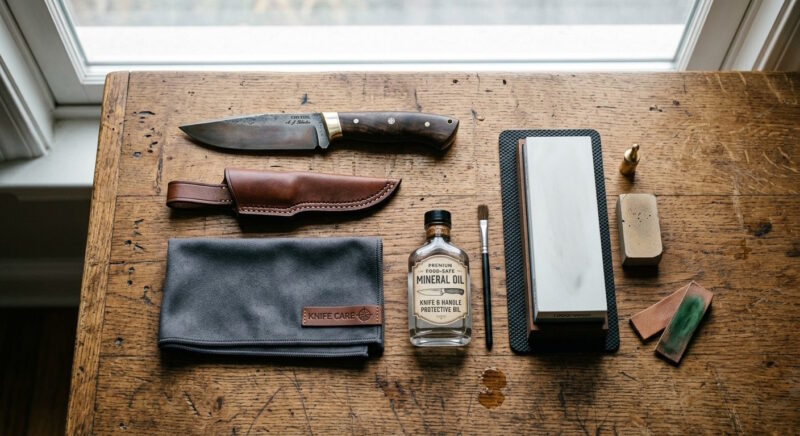
- Apply a light coat of food-safe mineral oil or another suitable protective oil.
- Store outside of leather sheaths, as leather can retain moisture.
These simple steps greatly reduce the likelihood of corrosion.
Patina Formation
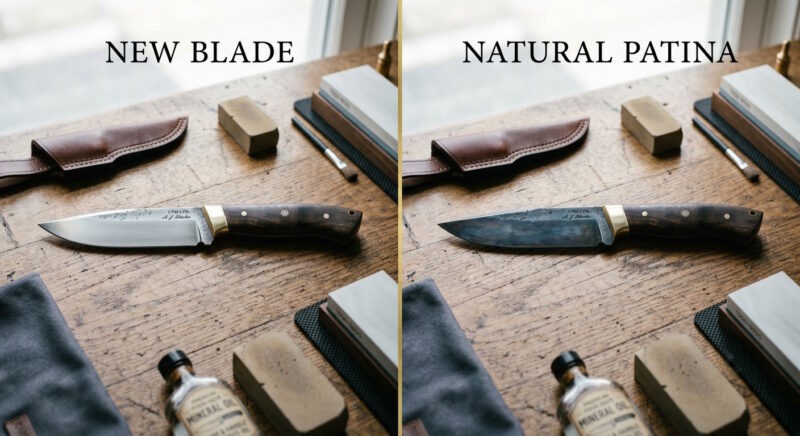
Many users notice that K390 gradually develops a darker gray or blue-gray patina.
This natural oxidation is normal.
A stable patina can actually provide limited additional protection against further surface oxidation while giving the knife a distinctive appearance.
Some owners intentionally allow this patina to develop because they appreciate its unique character.
Heat Treatment Matters
No discussion of premium steel is complete without mentioning heat treatment.
Even an outstanding steel can perform poorly if improperly heat treated.
Heat treatment influences:
- Hardness
- Toughness
- Edge retention
- Wear resistance
- Ease of sharpening
A properly heat-treated K390 blade typically demonstrates:
- Excellent edge stability
- High hardness
- Good toughness
- Predictable sharpening behavior
- Long service life
This is why experienced buyers often evaluate the overall quality of a knife rather than focusing solely on the steel itself.
Check Our Guide Steel Heat Treatment Explained
Advantages of K390
K390 offers numerous strengths that explain its popularity among experienced knife users.
Pros
✔ Exceptional edge retention
✔ Outstanding wear resistance
✔ Excellent cutting performance
✔ Very high hardness
✔ Fine edge stability
✔ Good toughness for a high-wear tool steel
✔ Outstanding performance during prolonged cutting
✔ Excellent for woodworking
✔ Superb for bushcraft
✔ Ideal for heavy daily use
Disadvantages of K390
Like every steel, K390 involves certain compromises.
Cons
✘ Not stainless
✘ Requires regular maintenance
✘ Can develop rust if neglected
✘ More difficult to sharpen
✘ Diamond abrasives are recommended
✘ Less suitable for saltwater environments
Who Should Choose K390?
K390 is particularly well suited for users who value cutting performance above minimal maintenance.
Ideal users include:
- Bushcraft enthusiasts
- Woodworkers
- Hunters
- Warehouse workers
- Tradespeople
- Everyday carry enthusiasts
- Experienced knife users
- Collectors of premium tool steels
Its remarkable edge retention rewards anyone who performs large amounts of cutting and prefers sharpening as infrequently as possible.
Who May Prefer Another Steel?
Some users may find a stainless steel more practical.
You may wish to consider a stainless alternative if you:
- Live in a tropical climate.
- Frequently work around saltwater.
- Prefer very low maintenance.
- Regularly prepare acidic foods.
- Rarely sharpen your knives.
For these users, corrosion resistance may outweigh the exceptional wear resistance that K390 provides.
Final Verdict, FAQ, Buying Guide & SEO Recommendations
After examining every major property of K390—from its metallurgy and hardness to its cutting performance and maintenance requirements—it becomes clear why this steel has earned such a loyal following among experienced knife enthusiasts.
K390 is not designed to be an all-purpose stainless steel.
Instead, it is engineered for one primary goal:
Deliver outstanding cutting performance with exceptional edge retention and wear resistance.
If your priority is maximum cutting longevity, few steels can match what K390 offers.
Quick Performance Summary
| Property | Rating |
|---|---|
| Hardness | ★★★★★ |
| Edge Retention | ★★★★★ |
| Wear Resistance | ★★★★★ |
| Toughness | ★★★★☆ |
| Edge Stability | ★★★★★ |
| Corrosion Resistance | ★★☆☆☆ |
| Sharpening Ease | ★★☆☆☆ |
| Overall Performance | ★★★★★ |
When K390 Is the Best Choice
K390 is an outstanding option if you want a knife that stays sharp through prolonged use.
It is particularly well suited for:
- Everyday carry
- Bushcraft
- Wood carving
- Warehouse work
- Rope cutting
- Cardboard processing
- Hunting
- General utility work
- Professional trades
If you dislike frequent sharpening, K390 is one of the best steels available.
Its exceptional wear resistance allows it to continue cutting efficiently long after many other steels begin to lose their edge.
When K390 May Not Be Ideal
Despite its impressive cutting ability, K390 is not the right choice for everyone.
A different steel may be more practical if you:
- Live in a humid coastal climate
- Frequently work near saltwater
- Want minimal maintenance
- Leave knives wet after use
- Need maximum corrosion resistance
Because K390 is not stainless, neglect can eventually lead to oxidation.
Fortunately, routine maintenance is simple and only takes a few moments.
Real-World Experience
One reason K390 enjoys such a strong reputation is that its performance is immediately noticeable.
Owners often report:
- Extremely long intervals between sharpening
- Excellent slicing performance
- Reliable edge stability
- Consistent cutting over months of regular use
- Outstanding woodworking capability
Many users describe K390 as a steel that becomes more enjoyable the longer it is used.
Its ability to maintain a keen edge often changes the way people think about knife maintenance.
Frequently Asked Questions
Is K390 stainless steel?
No.
K390 is a powder metallurgy tool steel, not a stainless steel.
Its chromium content improves wear resistance and hardenability but is too low to provide true stainless performance.
Regular cleaning and drying are recommended.
Does K390 rust easily?
Not if it is properly maintained.
Like most high-carbon tool steels, K390 can develop rust if left wet or exposed to corrosive environments for extended periods.
Simple maintenance greatly reduces this risk.
How hard is K390?
Most knives are heat treated between 62 and 64 HRC.
This high hardness contributes to excellent edge retention and wear resistance.
Is K390 difficult to sharpen?
Compared with conventional steels, yes.
Its extremely wear-resistant vanadium carbides require quality sharpening equipment.
Diamond stones generally produce the fastest and most consistent results.
The good news is that sharpening is needed much less frequently.
Is K390 good for kitchen knives?
Yes, provided the user is willing to maintain the blade.
It offers:
- Excellent slicing
- Outstanding edge retention
- Precise cutting
- Stable edges
However, the blade should be washed and dried promptly after preparing acidic foods.
Is K390 good for bushcraft?
Absolutely.
Its combination of:
- Edge retention
- Toughness
- Wear resistance
makes it one of the strongest choices for bushcraft, woodworking, and outdoor utility tasks.
Does K390 develop a patina?
Yes.
Many blades gradually develop a gray or blue-gray patina with use.
This natural oxidation is normal and often appreciated by enthusiasts because it gives each knife a unique appearance while offering a small degree of additional surface protection.
Pros and Cons
Advantages
- Exceptional edge retention
- Outstanding wear resistance
- Excellent edge stability
- Very high hardness
- Great toughness for a high-wear tool steel
- Outstanding bushcraft performance
- Excellent woodworking capability
- Long sharpening intervals
- Premium cutting performance
Disadvantages
- Not stainless
- Requires regular maintenance
- More difficult to sharpen
- Less suitable for saltwater environments
- Diamond sharpening equipment is recommended
Overall Category Winners
| Category | Rating |
|---|---|
| Hardness | 🏆 Excellent |
| Edge Retention | 🏆 Excellent |
| Wear Resistance | 🏆 Excellent |
| Toughness | 🏆 Very Good |
| Corrosion Resistance | 🏆 Fair |
| Sharpening | 🏆 Moderate Difficulty |
| Bushcraft | 🏆 Excellent |
| Woodworking | 🏆 Excellent |
| Everyday Carry | 🏆 Excellent |
| Kitchen Use | 🏆 Very Good |
Final Verdict
K390 is one of the finest choices for users who prioritize cutting performance over convenience.
Its extraordinary edge retention, exceptional wear resistance, and impressive edge stability make it an outstanding steel for demanding tasks where long-lasting sharpness matters most.
The trade-off is straightforward: it requires more care than stainless steels. Regular cleaning, drying, and occasional protective oiling are part of owning a K390 knife. For many enthusiasts, this extra maintenance is a small price to pay for the level of performance the steel delivers.
If your work involves extended cutting sessions, woodworking, bushcraft, hunting, or everyday utility tasks, K390 is capable of providing years of reliable service with remarkably infrequent sharpening.
Rather than trying to excel in every category, K390 focuses on what it does best: delivering exceptional cutting efficiency and outstanding edge longevity.
This article is for independent informational purposes only and is not affiliated with, sponsored by, or endorsed by any steel manufacturer. All product names, trademarks, and registered trademarks are the property of their respective owners.