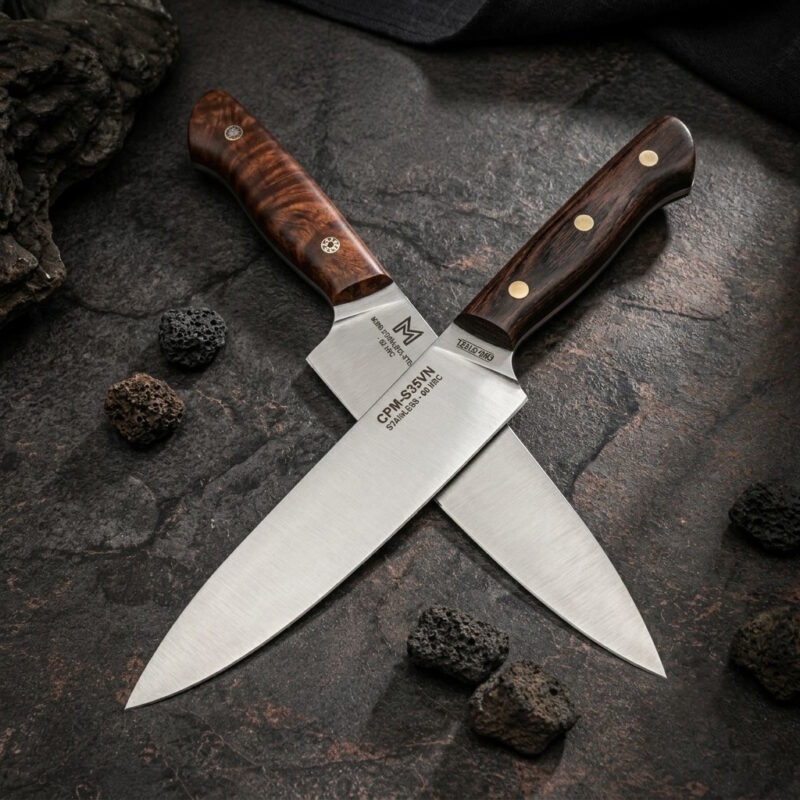
M390 vs S35VN Steel
An Independent Guide
Choosing the right knife steel can make a noticeable difference in how a knife performs over years of daily use. Among modern premium stainless steels, M390 and S35VN are frequently compared because both offer excellent edge retention, corrosion resistance, and durability while serving different priorities.
At first glance, these steels appear very similar. Both belong to the category of high-performance stainless steels made using powder metallurgy, both are capable of achieving high hardness, and both are commonly used in premium fixed blades, folding knives, outdoor tools, and custom kitchen knives.
However, once you begin looking deeper into their composition and real-world characteristics, important differences emerge. One steel generally favors maximum wear resistance and extended cutting performance, while the other offers improved toughness and easier maintenance.
This guide compares every important aspect of M390 and S35VN, including:
- Chemical composition
- Manufacturing process
- Hardness
- Edge retention
- Toughness
- Corrosion resistance
- Sharpening difficulty
- Food preparation performance
- Outdoor use
- Everyday carry applications
- Long-term value
By the end of this comparison, you’ll understand which steel better matches your needs instead of relying on marketing claims.
What Is M390 Steel?
M390 is a premium stainless powder metallurgy steel developed specifically for applications requiring exceptional wear resistance, corrosion resistance, and long edge life.
Its combination of high carbon content and large amounts of chromium, vanadium, and molybdenum allows it to produce an extremely hard matrix filled with fine carbides.
These carbides are responsible for the steel’s impressive cutting longevity.
Unlike many traditional stainless steels, powder metallurgy allows these carbides to remain extremely fine and evenly distributed throughout the blade.
This manufacturing process improves:
- Edge stability
- Uniform hardness
- Corrosion resistance
- Wear resistance
- Overall consistency
Because of these characteristics, M390 has become one of the most respected premium stainless steels for high-end knives.
Typical hardness ranges from 60–62 HRC, although some makers heat treat it slightly higher.
Check Our Guide M390 Steel Review
https://yashkadesigns.com/santoku-knife-7-inch-powder-steel
What Is S35VN Steel?
S35VN is another premium stainless powder metallurgy steel designed as an evolution of an earlier high-performance stainless steel.
Its development focused on improving toughness while maintaining excellent corrosion resistance and strong edge retention.
The addition of niobium carbides helps refine the grain structure and improves resistance to chipping without sacrificing much wear resistance.
Compared with many ultra-high wear steels, S35VN offers a more balanced combination of:
- Edge retention
- Toughness
- Corrosion resistance
- Sharpening ease
This balanced nature explains why S35VN remains one of the most popular premium steels for everyday carry and outdoor knives.
Most blades are heat treated between 59–61 HRC.
Check Our Guide S35VN Steel Review
Check Our Guide Powder Steels for Kitchen Knives
Understanding Powder Metallurgy
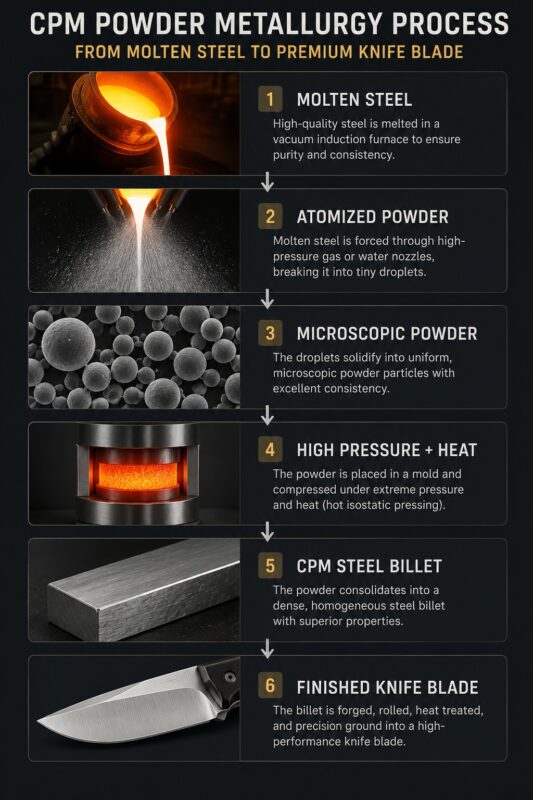
Both steels are produced using powder metallurgy, a manufacturing method that differs significantly from conventional steel production.
Instead of pouring molten steel directly into ingots, the molten alloy is atomized into microscopic powder particles.
These powders are:
- Uniform in chemistry
- Extremely fine
- Nearly identical in size
The powder is then compressed under enormous pressure before being sintered into solid steel.
The result is:
- Smaller carbides
- Better carbide distribution
- Improved toughness
- Better machinability
- More consistent heat treatment
Without powder metallurgy, steels containing very high levels of chromium and vanadium would develop massive carbides that reduce toughness and make sharpening much more difficult.
This advanced process is one reason both steels command premium prices.
Chemical Composition Comparison
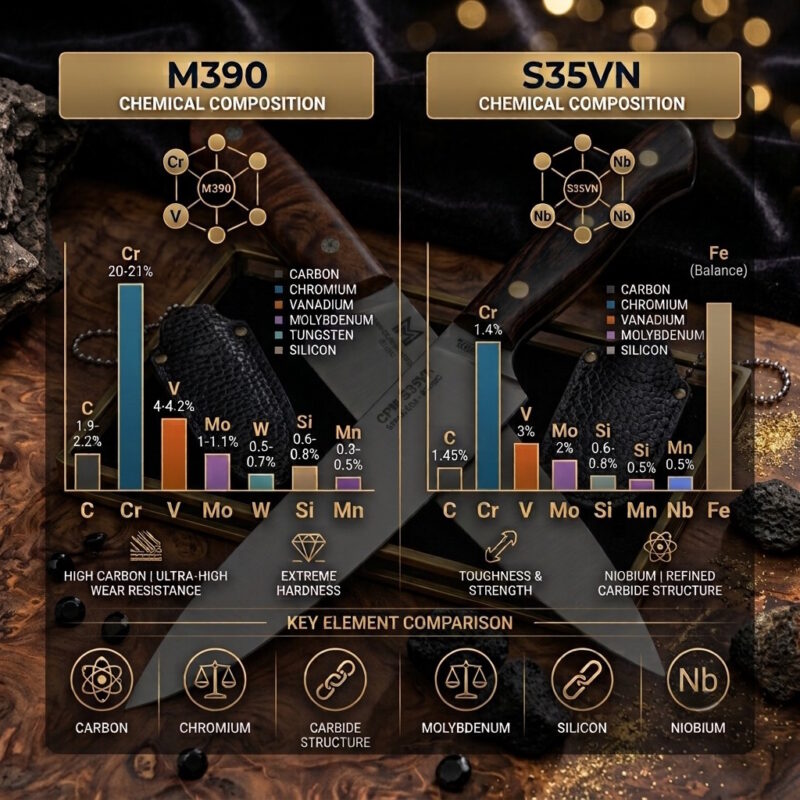
Although both steels are stainless and made through powder metallurgy, their alloy recipes differ enough to influence performance.
| Element | M390 | S35VN |
|---|---|---|
| Carbon | High | High |
| Chromium | Very High | High |
| Vanadium | High | Moderate |
| Molybdenum | Moderate | Moderate |
| Niobium | None | Present |
| Stainless | Yes | Yes |
The exact percentages matter less than understanding what each element contributes.
Carbon
Carbon is one of the most important ingredients in knife steel.
It enables:
- Higher hardness
- Better edge retention
- Greater wear resistance
Both steels contain enough carbon to achieve premium hardness levels suitable for demanding cutting applications.
Chromium
Chromium provides corrosion resistance while also contributing to carbide formation.
Both steels comfortably exceed the minimum chromium required to qualify as stainless steel.
M390 contains slightly more chromium, giving it a small advantage in corrosion resistance under harsh conditions.
Vanadium
Vanadium creates extremely hard carbides that significantly improve wear resistance.
These carbides help blades maintain sharpness over extended cutting sessions.
M390 contains noticeably more vanadium than S35VN.
This contributes to:
- Longer edge life
- Higher abrasion resistance
- Better slicing longevity
The trade-off is increased sharpening difficulty.
Molybdenum
Molybdenum improves:
- Corrosion resistance
- High-temperature stability
- Overall strength
Both steels use molybdenum to enhance stainless performance while supporting hardness during heat treatment.
Niobium
One major difference between these steels is the presence of niobium.
S35VN includes niobium carbides.
These carbides are smaller than many vanadium carbides and help improve:
- Toughness
- Edge stability
- Resistance to micro-chipping
This is one reason many users consider S35VN a better all-around steel for heavy everyday use.
Carbide Structure
Carbides determine much of a knife’s cutting performance.
Think of carbides as microscopic hard particles embedded throughout the steel.
These particles resist abrasion while supporting the cutting edge.
M390 contains:
- More total carbides
- Harder carbides
- Higher wear resistance
S35VN contains:
- Slightly fewer carbides
- Better carbide balance
- Greater toughness
This distinction becomes important when comparing edge retention and durability, which we’ll cover in the next section.
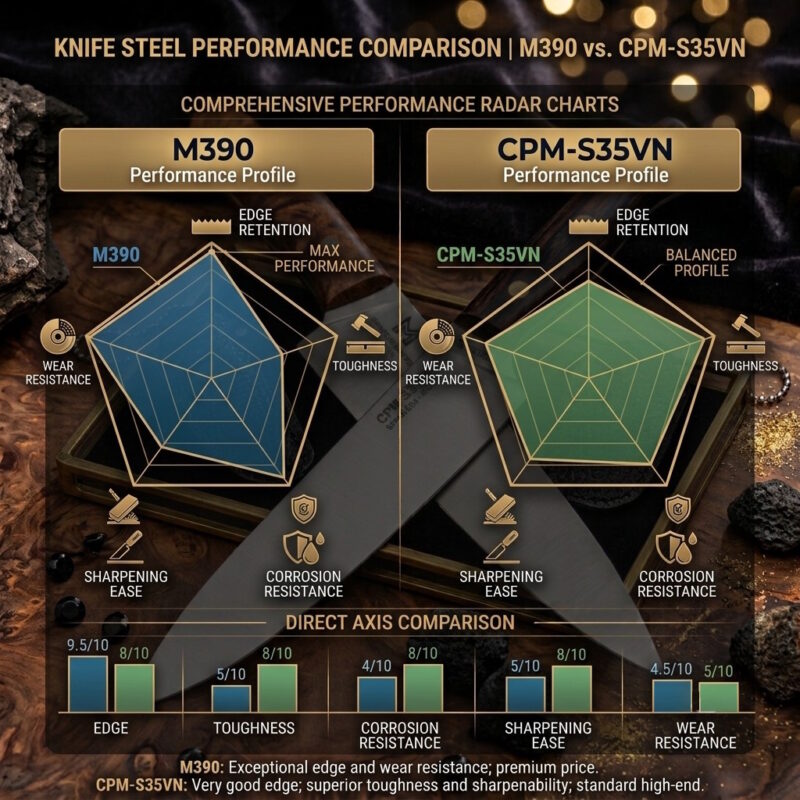
Initial Performance Summary
Even before discussing cutting performance, the differences become clear.
M390 Prioritizes
- Maximum wear resistance
- Exceptional edge retention
- Outstanding corrosion resistance
- Premium slicing performance
S35VN Prioritizes
- Better toughness
- Easier sharpening
- Excellent corrosion resistance
- Balanced everyday performance
Neither steel is objectively “better.” Instead, each excels in different situations depending on how the knife will be used.
Hardness, Edge Retention, Toughness & Corrosion Resistance
In Part 1, we explored the composition and manufacturing process behind M390 and S35VN. While their alloy chemistry explains why these steels perform differently, real-world users are usually more interested in practical questions:
- Which steel stays sharp longer?
- Which is less likely to chip?
- Which performs better outdoors?
- Which is easier to maintain?
- Which offers the best balance of performance?
Let’s examine each category in detail.
Hardness Comparison
Hardness is commonly measured using the Rockwell C (HRC) scale. A harder blade generally resists wear better and can support a finer cutting edge, but excessive hardness may reduce toughness.
Typical Hardness
| Steel | Typical Hardness |
|---|---|
| M390 | 60–62 HRC |
| S35VN | 59–61 HRC |
Although the numerical difference seems small, even one Rockwell point can noticeably affect edge retention and sharpening.
M390
M390 is often heat treated near the upper end of its hardness range, allowing it to maintain an extremely fine cutting edge for long periods.
Benefits include:
- Better slicing performance
- Reduced edge rolling
- Longer intervals between sharpening
S35VN
S35VN usually runs slightly softer.
This provides:
- Improved toughness
- Better resistance to impact
- Less risk of brittle fractures
Hardness Winner
🏆 M390
The higher achievable hardness gives M390 an advantage in edge retention and wear resistance.
Check Our Guide What Is HRC? Understanding Rockwell Hardness
Edge Retention
Edge retention refers to how long a knife remains sharp during normal cutting.
This is one of the biggest reasons people choose premium steels.
Several factors affect edge retention:
- Hardness
- Carbide volume
- Carbide type
- Heat treatment
- Edge geometry
Among these, carbide volume is particularly important.
Why M390 Excels
M390 contains a higher amount of extremely hard chromium and vanadium carbides.
These carbides resist abrasion during cutting, meaning the edge wears away much more slowly.
In practical terms, M390 can continue slicing efficiently long after many other stainless steels begin to dull.
This makes it especially useful for:
- Breaking down large amounts of cardboard
- Rope cutting
- Food preparation
- Extended outdoor trips
- Everyday carry with infrequent sharpening
S35VN Performance
S35VN also offers excellent edge retention.
Most users will find it dramatically outperforms traditional stainless steels.
However, compared with M390, it typically loses its shaving sharpness sooner during prolonged cutting.
The difference isn’t dramatic during light household tasks but becomes more noticeable during high-volume cutting.
Typical Edge Retention Ranking
- M390
- S35VN
Both steels perform at a premium level, but M390 generally remains sharp longer.
Edge Retention Winner
🏆 M390
Wear Resistance
Wear resistance measures how well a blade resists gradual material loss while cutting abrasive materials.
Materials that accelerate wear include:
- Cardboard
- Rope
- Carpet
- Plastic
- Fibrous materials
- Dirty wood
Since M390 contains more wear-resistant carbides, it excels in these applications.
Many users notice they sharpen M390 significantly less often.
S35VN
S35VN still demonstrates excellent wear resistance.
Its slightly lower carbide volume simply places it behind M390 in extremely demanding cutting situations.
Wear Resistance Winner
🏆 M390
Toughness
Toughness describes a steel’s ability to absorb impact without chipping or breaking.
This characteristic becomes important during:
- Wood carving
- Outdoor survival
- Batoning
- Twisting cuts
- Heavy utility work
Contrary to popular belief, the hardest steel is not always the strongest.
High wear resistance often comes at the expense of toughness.
Why S35VN Performs Better
The addition of niobium helps create a finer carbide structure.
Combined with slightly lower hardness, this allows S35VN to tolerate impacts better.
Benefits include:
- Lower chance of edge chipping
- Better resistance to lateral stress
- Improved durability during rough use
This makes S35VN particularly attractive for users who expect unpredictable tasks.
M390 Toughness
M390 is far from brittle.
It performs well in normal cutting applications.
However, compared with S35VN, it is somewhat less forgiving during hard impacts or misuse.
Very thin edges may chip if subjected to twisting or striking hard materials.
Toughness Winner
🏆 S35VN
Corrosion Resistance
Both steels belong to the premium stainless category.
Under normal conditions, either steel can remain rust-free with minimal maintenance.
However, corrosion resistance becomes especially important in:
- Humid climates
- Marine environments
- Food preparation
- Fishing
- Camping
- Everyday pocket carry
M390
Thanks to its higher chromium content and refined powder metallurgy structure, M390 offers exceptional corrosion resistance.
It tolerates:
- Moisture
- Sweat
- Acidic foods
- Salt exposure
better than most premium knife steels.
S35VN
S35VN also provides outstanding corrosion resistance.
Most owners will never experience rust if the knife receives basic care.
Only prolonged exposure to saltwater or highly corrosive environments tends to reveal M390’s small advantage.
Corrosion Resistance Winner
🏆 M390
Edge Stability
Edge stability refers to how well the very apex of the cutting edge resists rolling, deformation, and microscopic damage.
This characteristic determines whether a knife maintains a clean, aggressive cutting feel after repeated use.
M390
Its high hardness allows for extremely thin, laser-like edges.
When properly heat treated, these edges stay crisp for an impressive amount of time.
S35VN
S35VN’s improved toughness helps the edge survive impacts that might otherwise cause micro-chipping.
Instead of chipping, the edge may experience slight rolling, which is often easier to restore with honing.
Edge Stability Winner
🏆 Tie
Each steel performs differently depending on the task.
Performance During Food Preparation
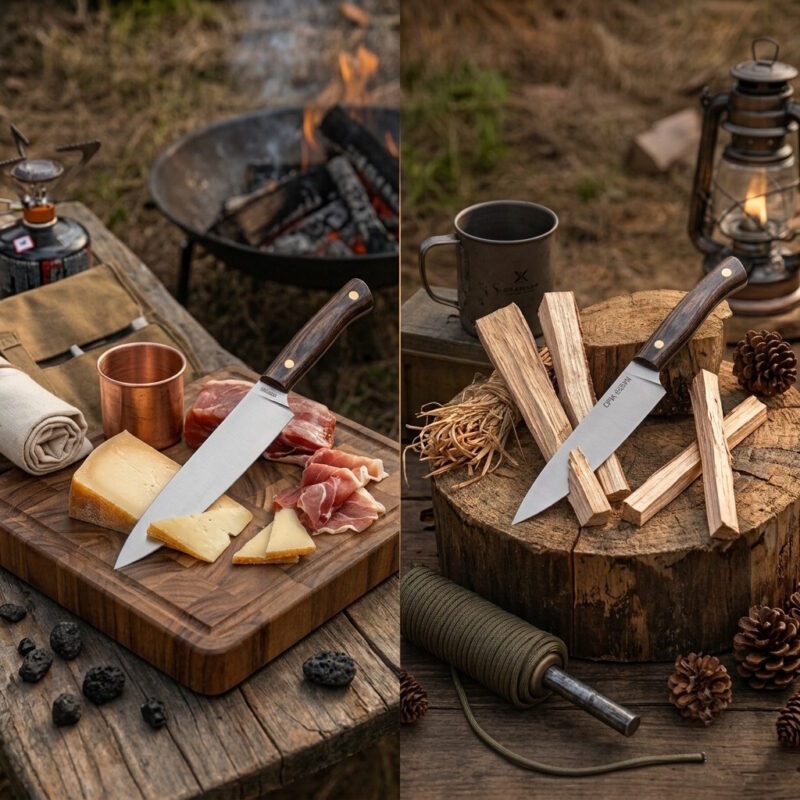
Kitchen users often ask whether either steel is better for food preparation.
Both steels perform extremely well because they:
- Resist staining
- Take fine edges
- Resist corrosion from acidic foods
However, their cutting characteristics differ slightly.
M390
Excellent for:
- Precision slicing
- Long prep sessions
- Fine vegetable cuts
- Boneless meat
- Fruit
Requires less frequent sharpening.
S35VN
Excellent for:
- General kitchen work
- Home cooking
- Utility preparation
- Mixed cutting tasks
Slightly easier to touch up when the edge eventually dulls.
Outdoor Performance
Outdoor knives experience more abuse than kitchen knives.
Typical tasks include:
- Feather sticks
- Rope
- Food preparation
- Firewood processing
- Shelter building
- Camp cooking
In these situations:
M390
Excels when:
- Maximum edge life matters
- Sharpening equipment isn’t available
- Long cutting sessions are expected
S35VN
Excels when:
- Toughness matters
- Hard impacts are possible
- The knife may experience twisting or rough treatment
Scorecard So Far
| Category | Winner |
|---|---|
| Hardness | 🏆 M390 |
| Edge Retention | 🏆 M390 |
| Wear Resistance | 🏆 M390 |
| Toughness | 🏆 S35VN |
| Corrosion Resistance | 🏆 M390 |
| Edge Stability | Tie |
| Kitchen Performance | Slight Edge: M390 |
| Outdoor Abuse | Slight Edge: S35VN |
At this stage, M390 leads in cutting performance and corrosion resistance, while S35VN distinguishes itself with greater toughness and resilience during demanding use.
Check Our Guide What Size Knife Is Best for Camping?
Sharpening, Maintenance, Everyday Carry & Real-World Performance
In Parts 1 and 2, we compared the metallurgy, hardness, toughness, wear resistance, and corrosion resistance of M390 and S35VN. While those technical characteristics explain much of their performance, most knife owners eventually ask a more practical question:
Which steel is easier to live with every day?
The answer depends on how often you sharpen your knife, what you cut, and whether you prioritize maximum edge retention or easier maintenance.
Let’s examine these real-world differences.
Sharpening Difficulty
One of the largest practical differences between these steels is sharpening.
Although both are premium powder metallurgy steels, they behave differently on sharpening stones because of their carbide structure.
Sharpening M390
M390 is widely known as one of the more challenging premium stainless steels to sharpen.
The reason is simple:
Its large amount of extremely hard vanadium carbides resists abrasion—even from sharpening stones.
As a result:
- Sharpening requires more time.
- Removing metal is slower.
- Reprofiling a damaged edge takes patience.
- Diamond or ceramic abrasives usually produce the best results.
The good news is that sharpening isn’t needed very often because the edge lasts so long.
Sharpening S35VN
S35VN is noticeably easier to sharpen.
Although it is still considered a premium steel, its lower carbide volume and balanced alloy composition make edge maintenance less demanding.
Many users report that:
- Burr formation is more predictable.
- Edge refinement happens faster.
- Touch-ups require less effort.
- Field sharpening is more practical.
This makes S35VN especially appealing for people who prefer maintaining their knives themselves.
Sharpening Frequency
One interesting trade-off exists between these steels.
M390
- Harder to sharpen
- Needs sharpening less often
S35VN
- Easier to sharpen
- Needs sharpening slightly more often
Many owners actually spend about the same total maintenance time over the life of the knife.
Sharpening Winner
🏆 S35VN
Ease of Maintenance
Knife maintenance extends beyond sharpening.
It includes:
- Cleaning
- Drying
- Rust prevention
- Edge care
- Long-term storage
Fortunately, both steels are extremely low-maintenance compared with carbon steels.
M390 Maintenance
Routine care is simple.
After use:
- Wash with warm water.
- Dry thoroughly.
- Store in a dry location.
Oil is generally unnecessary unless the knife is stored for extended periods in humid conditions.
S35VN Maintenance
Maintenance is nearly identical.
Basic cleaning is sufficient for most users.
Because both steels resist staining exceptionally well, neither requires constant attention.
Maintenance Winner
🏆 Tie
Everyday Carry Performance
For everyday carry (EDC), users often perform a wide variety of cutting tasks, including:
- Opening packages
- Cutting cardboard
- Rope
- Plastic straps
- Food preparation
- Utility work
- Household chores
A good EDC steel must balance:
- Edge retention
- Toughness
- Corrosion resistance
- Ease of maintenance
M390 for Everyday Carry
M390 excels if your goal is maximum cutting performance.
Advantages include:
- Extremely long-lasting edge
- Outstanding slicing ability
- Excellent corrosion resistance
- Minimal sharpening frequency
For office workers, warehouse employees, delivery drivers, and anyone frequently opening boxes, M390 is an outstanding choice.
S35VN for Everyday Carry
S35VN offers a more forgiving experience.
Advantages include:
- Better toughness
- Easier sharpening
- Excellent edge retention
- Reliable all-around performance
Many users appreciate knowing they can quickly restore a razor edge without spending excessive time sharpening.
EDC Winner
🏆 Tie
Your priorities determine the better choice.
- Want fewer sharpening sessions? Choose M390.
- Prefer easier maintenance? Choose S35VN.
Performance for Hunting Knives
Hunters often need knives capable of:
- Skinning
- Quartering
- Meat processing
- Camp chores
- Rope cutting
- Food preparation
These jobs require both edge retention and toughness.
Check Our Guide Knife Safety Tips for Outdoor Use
M390
Advantages:
- Outstanding slicing
- Excellent edge longevity
- High corrosion resistance around blood and moisture
Potential drawback:
- Less tolerant of accidental twisting or bone contact.
S35VN
Advantages:
- Better impact resistance
- Lower risk of edge chipping
- Easier sharpening in the field
Many hunters value toughness over maximum wear resistance.
Hunting Winner
🏆 S35VN
Performance in Kitchen Knives
Although both steels are frequently used for outdoor and folding knives, they also perform exceptionally well in premium kitchen cutlery.
Kitchen work typically includes:
- Vegetables
- Fruit
- Boneless meat
- Herbs
- Fish
These cutting tasks place greater emphasis on slicing efficiency than impact resistance.
M390 in the Kitchen
M390 shines in food preparation.
Its advantages include:
- Extremely fine edge
- Long-lasting sharpness
- Outstanding stain resistance
- Excellent slicing feel
Professional cooks who prepare large amounts of food often appreciate sharpening less frequently.
S35VN in the Kitchen
S35VN also performs well.
Its slightly lower wear resistance means sharpening occurs somewhat sooner, but many home cooks will never notice a significant difference.
Kitchen Winner
🏆 M390
Precision Cutting
For detailed cutting tasks such as:
- Leather work
- Craft projects
- Food garnishing
- Fine slicing
- Utility trimming
A stable, highly refined edge is desirable.
Because M390 maintains an extremely acute edge for long periods, it often feels sharper throughout extended use.
Precision Cutting Winner
🏆 M390
Heavy Utility Work
Heavy utility tasks involve greater stress than ordinary slicing.
Examples include:
- Thick cardboard
- Hardwood carving
- Plastic tubing
- Dense rope
- Outdoor shelter building
Under these conditions, toughness becomes increasingly important.
S35VN’s improved resistance to chipping gives it an advantage.
Heavy Utility Winner
🏆 S35VN
Long-Term Durability
Both steels are capable of lasting decades with proper care.
The blade’s lifespan depends far more on:
- Heat treatment
- Edge geometry
- Sharpening habits
- Proper use
than on alloy selection alone.
Neither steel wears out quickly under normal use.
Value for Money
Premium steels naturally increase the price of a knife.
When deciding whether either steel is “worth it,” consider your cutting habits.
M390 offers better value if you:
- Want the longest possible edge retention.
- Dislike frequent sharpening.
- Frequently cut abrasive materials.
- Appreciate premium cutting performance.
S35VN offers better value if you:
- Sharpen your own knives.
- Use your knife for demanding outdoor work.
- Prefer balanced performance.
- Value toughness as much as edge retention.
Neither steel represents poor value—they simply appeal to different priorities.
Which Steel Fits Different Users?
| User | Better Choice |
|---|---|
| Home Cook | M390 |
| Professional Chef | M390 |
| Everyday Carry User | Tie |
| Hunter | S35VN |
| Camper | S35VN |
| Backpacker | S35VN |
| Warehouse Worker | M390 |
| Package Opening | M390 |
| Outdoor Survival | S35VN |
| Wood Carving | S35VN |
| Precision Cutting | M390 |
| Collectors | Tie |
Common Myths
Myth 1: Harder Steel Always Means Better Steel
Not necessarily.
Higher hardness usually improves edge retention but often reduces toughness.
Balance is more important than maximum hardness.
Myth 2: Stainless Steel Never Rusts
Both steels are highly corrosion-resistant, but neither is completely immune to rust.
Saltwater, neglect, or prolonged moisture can eventually damage any stainless steel.
Myth 3: Powder Metallurgy Makes Every Steel Equal
The manufacturing process improves consistency, but alloy composition still determines overall performance.
Two powder metallurgy steels can behave very differently.
Myth 4: Only Professionals Benefit from Premium Steel
Even casual users notice advantages such as:
- Less frequent sharpening
- Better corrosion resistance
- Improved cutting performance
- Longer service life
Final Verdict, FAQ, Pros & Cons, and Buying Guide
After comparing every important characteristic, one thing becomes clear:
Both M390 and S35VN belong among the best premium stainless knife steels available today.
Neither steel is objectively superior in every category. Instead, each was engineered with different priorities. M390 focuses on maximizing wear resistance, edge retention, and corrosion resistance, while S35VN aims to deliver a more balanced combination of toughness, cutting performance, and ease of maintenance.
The best choice depends on how you plan to use your knife.
Quick Comparison Table
| Feature | M390 | S35VN |
|---|---|---|
| Steel Type | Powder Metallurgy Stainless | Powder Metallurgy Stainless |
| Typical Hardness | 60–62 HRC | 59–61 HRC |
| Edge Retention | ⭐⭐⭐⭐⭐ | ⭐⭐⭐⭐☆ |
| Toughness | ⭐⭐⭐☆☆ | ⭐⭐⭐⭐☆ |
| Corrosion Resistance | ⭐⭐⭐⭐⭐ | ⭐⭐⭐⭐☆ |
| Wear Resistance | ⭐⭐⭐⭐⭐ | ⭐⭐⭐⭐☆ |
| Sharpening Ease | ⭐⭐⭐☆☆ | ⭐⭐⭐⭐☆ |
| Edge Stability | ⭐⭐⭐⭐⭐ | ⭐⭐⭐⭐☆ |
| Food Preparation | Excellent | Excellent |
| Outdoor Use | Excellent | Excellent |
| Overall Balance | Excellent | Excellent |
Advantages of M390
M390 excels when long-lasting cutting performance is the highest priority.
Pros
✔ Outstanding edge retention
✔ Extremely high wear resistance
✔ Excellent corrosion resistance
✔ Supports very fine cutting edges
✔ Performs exceptionally well for slicing
✔ Requires less frequent sharpening
✔ Ideal for premium kitchen and EDC knives
Cons
✘ More difficult to sharpen
✘ Slightly lower toughness
✘ Less forgiving during hard impacts
✘ Edge repair may require diamond abrasives
Advantages of S35VN
S35VN focuses on delivering balanced performance across many different applications.
Pros
✔ Better toughness
✔ Easier sharpening
✔ Excellent corrosion resistance
✔ Very good edge retention
✔ Better resistance to edge chipping
✔ Excellent all-around steel
✔ Suitable for demanding outdoor use
Cons
✘ Doesn’t keep its edge quite as long as M390
✘ Slightly lower wear resistance
✘ Requires sharpening somewhat more frequently
Which Steel Is Better for Different Users?
Home Cooks
Winner: M390
Home cooks typically appreciate a knife that stays sharp through weeks or months of regular food preparation. M390’s excellent wear resistance means less time spent maintaining the edge and more time enjoying smooth, precise cutting.
Professional Chefs
Winner: M390
Professionals who spend hours preparing ingredients benefit from M390’s exceptional edge retention. Fewer sharpening sessions can help maintain consistent cutting performance throughout demanding kitchen work.
Everyday Carry (EDC)
Winner: Tie
For everyday carry, both steels perform exceptionally well.
Choose M390 if you want maximum cutting longevity and don’t mind a more challenging sharpening process.
Choose S35VN if you prefer easier maintenance and a blade that tolerates rougher use.
Outdoor Enthusiasts
Winner: S35VN
Camping, hiking, and survival tasks often involve impacts, twisting, and unpredictable cutting conditions. S35VN’s greater toughness makes it the safer option for these situations.
Hunters
Winner: S35VN
Field dressing and game processing sometimes expose the blade to bone, joints, or twisting forces. S35VN’s improved toughness reduces the risk of edge damage while still offering excellent corrosion resistance.
Collectors
Winner: Tie
Collectors often value craftsmanship, heat treatment quality, blade geometry, and overall design as much as steel choice. Either steel is an excellent addition to a premium collection.
Real-World Performance
Many online discussions focus heavily on laboratory measurements, but real-world performance often tells a different story.
For most users:
- Both steels stay sharp for a very long time.
- Both resist corrosion extremely well.
- Both outperform many traditional stainless steels.
- Both are capable of decades of service with proper care.
In everyday tasks such as preparing food, opening packages, cutting rope, or outdoor utility work, either steel will deliver outstanding performance.
The difference becomes more noticeable only during prolonged cutting or heavy-duty applications.
How Heat Treatment Affects Performance
One important point is often overlooked in steel comparisons:
Heat treatment can have as much influence on performance as the steel itself.
A well-executed heat treatment helps optimize:
- Hardness
- Toughness
- Edge stability
- Wear resistance
- Corrosion resistance
Conversely, even a premium steel can underperform if it is poorly heat treated.
For this reason, buyers should evaluate the overall quality of the knife rather than choosing based on steel alone.
Check Our Guide Different Heat Treatment Methods Explained
Frequently Asked Questions
Is M390 better than S35VN?
Not in every situation.
M390 offers superior edge retention, wear resistance, and corrosion resistance, while S35VN provides greater toughness and easier sharpening. The better choice depends on your intended use.
Which steel stays sharp longer?
M390 generally holds a working edge longer thanks to its higher wear resistance and greater carbide volume.
Which steel is easier to sharpen?
S35VN is typically easier to sharpen because its carbide structure is less abrasion-resistant than M390.
Which steel resists rust better?
Both steels provide excellent corrosion resistance, but M390 usually has a slight advantage, particularly in humid or marine environments.
Which steel is better for kitchen knives?
M390 is often preferred for kitchen knives because of its exceptional edge retention and resistance to staining during food preparation.
Which steel is better for outdoor knives?
S35VN is generally favored for outdoor use due to its higher toughness and better resistance to chipping under demanding conditions.
Is either steel suitable for beginners?
Yes.
Both steels are highly corrosion-resistant and relatively easy to maintain. Beginners who sharpen their own knives may find S35VN easier to live with, while those who value long-lasting sharpness may appreciate M390.
Final Verdict
Choosing between M390 and S35VN is not about finding a universally superior steel—it is about matching the steel to your priorities.
If your goal is maximum edge retention, exceptional wear resistance, and outstanding corrosion resistance, M390 is the stronger choice. It excels in precision cutting, kitchen work, and everyday tasks where long-lasting sharpness is highly valued.
If you prefer greater toughness, easier sharpening, and a well-balanced all-around performer, S35VN stands out. Its ability to handle demanding outdoor tasks and resist chipping makes it a dependable option for users who expect versatility and durability.
Ultimately, both steels represent the highest tier of modern stainless knife materials. When paired with proper heat treatment and thoughtful blade design, either one can provide years of reliable performance in the kitchen, the workshop, or the outdoors.
Overall Winners
| Category | Winner |
|---|---|
| Edge Retention | 🏆 M390 |
| Wear Resistance | 🏆 M390 |
| Corrosion Resistance | 🏆 M390 |
| Hardness | 🏆 M390 |
| Kitchen Performance | 🏆 M390 |
| Toughness | 🏆 S35VN |
| Sharpening Ease | 🏆 S35VN |
| Outdoor Use | 🏆 S35VN |
| Heavy-Duty Tasks | 🏆 S35VN |
| Overall Balance | 🏆 S35VN |
| Overall Cutting Performance | 🏆 M390 |
This article is for independent informational purposes only and is not affiliated with, sponsored by, or endorsed by any steel manufacturer. All product names, trademarks, and registered trademarks are the property of their respective owners.