Ginsan vs SG2
An Independent Guide
When choosing a Japanese kitchen knife, the steel is one of the first things enthusiasts look at. Two names that frequently appear in premium Japanese knives are Ginsan and SG2, also known as R2.
Both steels can produce exceptionally sharp kitchen knives. Both can reach high hardness. Both are popular in Japanese cutlery. And both can deliver excellent edge retention compared with many traditional stainless steels.
But they are designed around different priorities.
Ginsan is a conventional Japanese stainless steel known for its clean cutting feel, excellent sharpening response, and ability to take a very fine edge. It is often described as a stainless steel with some of the characteristics knife enthusiasts associate with traditional carbon steels.
SG2/R2, on the other hand, is a powder metallurgy stainless steel designed to offer substantially higher wear resistance while maintaining the fine edge capability expected from a premium Japanese kitchen knife.
That difference is the key to this comparison.
If your priority is easy sharpening and a refined, responsive edge, Ginsan is extremely attractive.
If your priority is edge retention and wear resistance, SG2/R2 has a clear advantage.
Neither steel is universally better. The right choice depends on how you use, sharpen, and maintain your knife.
In this guide, we’ll compare Ginsan and SG2/R2 in detail, including chemical composition, hardness, edge retention, toughness, corrosion resistance, sharpening, cutting feel, edge stability, maintenance, geometry, and practical kitchen performance.
Ginsan vs SG2 at a Glance
Before going into the technical details, here’s the short version.
| Property | Ginsan | SG2 / R2 |
|---|---|---|
| Steel type | Stainless tool/cutlery steel | Powder metallurgy stainless steel |
| Carbon | ~1% | ~1.4% |
| Chromium | ~13–14% | ~14% |
| Molybdenum | Low | ~2.5–3% |
| Vanadium | Very low/trace | ~2% |
| Typical kitchen-knife hardness | ~59–62 HRC | ~62–64 HRC |
| Edge retention | Very good | Excellent |
| Wear resistance | Moderate | Very high |
| Toughness | Good–very good | Moderate |
| Sharpening | Easy | More demanding |
| Corrosion resistance | Excellent | Excellent |
| Fine edge potential | Excellent | Excellent |
| Maintenance | Easy | Easy |
| Availability | Moderate | High |
| Best characteristic | Sharpening and cutting feel | Edge retention |
These figures are approximate because steel composition, heat treatment, grinding, and final hardness vary between manufacturers.
The table also reveals something important:
Ginsan and SG2 are not really competing for exactly the same job.
Ginsan emphasizes balance and sharpening performance.
SG2 emphasizes wear resistance and long-lasting edges.
What Is Ginsan Steel?
Ginsan is one of the best-known Japanese stainless steels used in kitchen knives.
It is commonly referred to as:
- Ginsan
- Gin-3
- Gin3
- Gingami No. 3
- Silver #3
- Ginsanko
The terminology can vary between manufacturers and knife retailers, but in Japanese kitchen-knife discussions these names generally refer to the same family of steel associated with Gingami No. 3.
Ginsan is particularly interesting because its composition is relatively simple compared with modern powder metallurgy steels.
It contains roughly 1% carbon and around 13–14% chromium, giving it stainless properties while allowing it to reach the hardness required for high-performance kitchen knives.
The result is a steel that can take an extremely fine edge without becoming excessively difficult to sharpen.
This is one of the main reasons Ginsan has become so popular among Japanese knife enthusiasts.
What Is SG2 Steel?
SG2 is a Japanese powder metallurgy stainless steel widely used in premium kitchen knives.
It is also commonly called R2.
The terms SG2 and R2 are often used interchangeably in the Japanese kitchen-knife market, although naming conventions can vary by manufacturer.
SG2 is fundamentally different from Ginsan because it is a powder metallurgy steel.
Powder metallurgy allows manufacturers to produce a highly refined and homogeneous microstructure with very fine carbide distribution.
This technology makes it possible to combine high hardness with substantial wear resistance.
SG2 typically contains significantly more carbon and vanadium than Ginsan.
Those alloying elements contribute to a much greater volume of hard carbides.
The result is a steel that can maintain a sharp working edge for a long time.
But there is a trade-off.
Those hard carbides also make SG2 more resistant to abrasion during sharpening.
In simple terms:
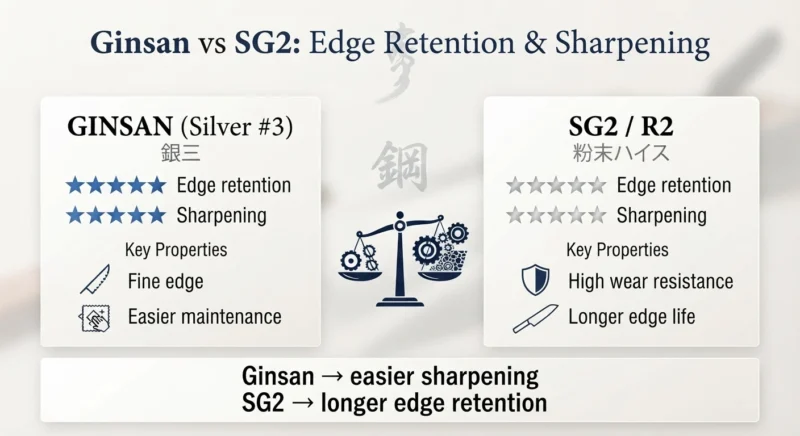
SG2 keeps its edge longer, but Ginsan is generally easier to bring back to a sharp edge.
Check Our Guide SG2 Steel Review
Ginsan vs SG2: Chemical Composition
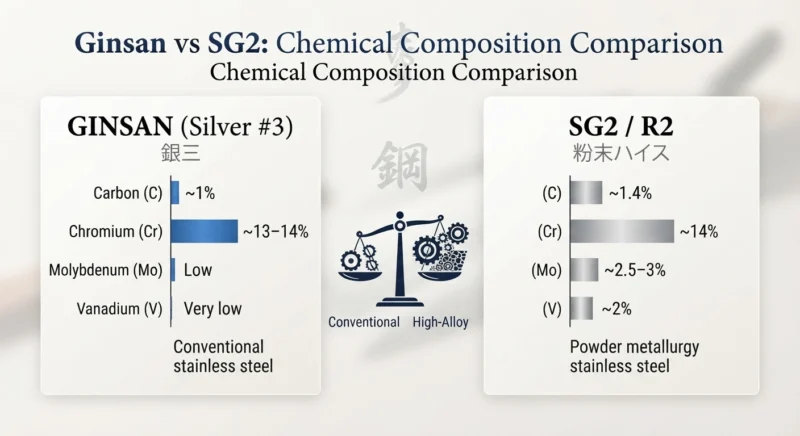
The chemical compositions explain much of the difference between these steels.
Exact specifications can vary, but typical compositions are approximately:
| Element | Ginsan | SG2 / R2 |
| Carbon | ~0.95–1.10% | ~1.4–1.5% |
| Chromium | ~13–14% | ~14% |
| Molybdenum | Low | ~2.5–3.0% |
| Vanadium | Very low/trace | ~1.8–2.2% |
| Manganese | ~0.5% | ~0.4% |
| Silicon | ~0.3–0.5% | ~0.5% |
The exact chemistry depends on the manufacturer’s specification.
But one difference is immediately obvious:
SG2 contains much more carbon and vanadium.
That is extremely important.
Carbon contributes to hardness and carbide formation.
Vanadium contributes to very hard vanadium carbides.
These carbides are highly resistant to wear.
That is a major reason SG2 can maintain an edge longer than Ginsan.
Why Does SG2 Have Better Edge Retention?
Edge retention is strongly influenced by wear resistance.
When you cut food, the apex of the knife experiences mechanical and abrasive stresses.
Every cut causes a small amount of wear.
The more resistant the steel is to that wear, the longer the edge can remain functional.
SG2’s higher alloy content and powder metallurgy structure produce a large population of fine hard carbides.
These carbides resist abrasive wear.
This gives SG2 a significant advantage over Ginsan when the comparison is specifically about edge retention.
However, edge retention is not determined by steel alone.
A thin Ginsan knife with excellent heat treatment can feel sharper for longer than a poorly made SG2 knife.
Edge angle also matters.
A very thin 10° edge may lose its ideal apex sooner than a stronger 15° edge even if the steel itself has greater wear resistance.
So when discussing edge retention, we should always consider:
steel + heat treatment + geometry + edge angle + cutting environment.
Ginsan vs SG2: Hardness
Hardness is another major difference.
Ginsan kitchen knives are commonly found around 59–62 HRC, although individual knives can vary.
SG2/R2 knives are frequently hardened around 62–64 HRC.
Some manufacturers may choose different targets.
The higher hardness of SG2 contributes to its ability to maintain a thin, stable edge.
But hardness should not be interpreted as a simple ranking system.
Higher HRC does not automatically mean a better knife.
Hardness can improve edge stability and wear resistance, but excessive hardness can reduce tolerance to impact and misuse.
For a precision kitchen knife, the ideal hardness is a balance.
Check Our Guide What Is HRC? Understanding Rockwell Hardness in Kitchen Knives
Is SG2 Harder Than Ginsan?
In typical Japanese kitchen knives, yes.
SG2/R2 is commonly hardened to a higher HRC than Ginsan.
But the steel designation alone does not determine the final hardness.
Heat treatment is critical.
A maker can deliberately heat-treat Ginsan to a relatively high hardness.
Another manufacturer can use SG2 at a somewhat lower hardness.
Therefore, there is overlap.
Still, if you compare typical premium Japanese kitchen knives, SG2 will usually be the harder steel.
Ginsan vs SG2: Edge Retention
This is probably the easiest category.
SG2 wins.
SG2 has substantially greater wear resistance than Ginsan.
Its powder metallurgy structure and high carbide content allow it to retain a working edge for longer.
This is especially useful for cooks who:
- use their knives every day
- prepare large quantities of food
- don’t sharpen frequently
- want long intervals between maintenance
- value wear resistance
Ginsan still provides very good edge retention.
But if edge retention is your number-one priority, SG2 is the obvious choice between the two.
Ginsan vs SG2: Sharpening
This is where the balance shifts dramatically.
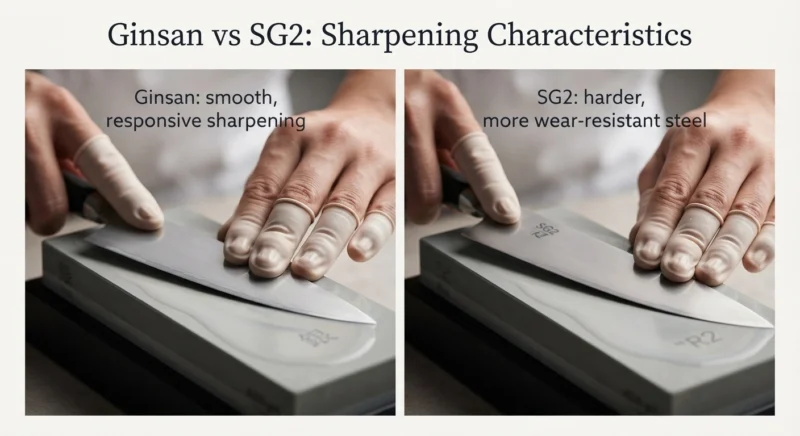
Ginsan is easier to sharpen.
Ginsan responds very well to conventional Japanese water stones.
The steel doesn’t have the same high volume of extremely hard carbides found in SG2.
As a result, removing steel and establishing a fresh apex is relatively straightforward.
SG2 is not impossible to sharpen.
Far from it.
But it requires more patience.
The high hardness and carbide structure increase resistance to abrasion.
A good sharpening system makes SG2 much easier to maintain, but someone accustomed to simple carbon steels will notice the difference.
For enthusiasts who enjoy sharpening, this may not be a problem.
For users who want quick maintenance, Ginsan has a clear advantage.
Check Our Guide All Kinds of Knife Sharpening Tools
Which Is More Pleasant to Sharpen?
This is subjective, but Ginsan generally wins.
Ginsan tends to provide a more familiar sensation on Japanese water stones.
The feedback can feel smooth and predictable.
SG2 may feel harder and less responsive.
The difference becomes particularly noticeable when trying to remove small chips or completely rebuild an edge.
For routine touch-ups, SG2 is manageable.
For major sharpening sessions, Ginsan is generally more pleasant.
Ginsan vs SG2: Toughness
Toughness is where the story becomes more complicated.
Toughness is the ability of a steel to resist cracking and chipping under impact or stress.
Ginsan generally has an advantage in toughness compared with SG2.
SG2 is a high-hardness, high-wear-resistance powder steel.
That combination is excellent for edge retention, but it does not make the steel ideal for abuse.
This is especially important when SG2 knives are ground extremely thin.
A very thin SG2 edge can be exceptionally sharp.
But it should be treated as a precision cutting tool.
Avoid:
- twisting the knife inside hard food
- cutting frozen food
- chopping bones
- prying
- cutting hard materials
- using the knife on glass cutting boards
Ginsan is not a heavy-duty steel either, but it generally offers a more forgiving balance.
Winner: Ginsan
Ginsan vs SG2: Corrosion Resistance
Both steels are highly corrosion resistant.
Ginsan contains roughly 13–14% chromium.
SG2 contains around 14% chromium along with molybdenum.
Both therefore perform very well in normal kitchen environments.
SG2’s alloy design gives it excellent stainless performance.
Ginsan is also extremely practical for cooks who don’t want to deal with patina.
For normal use, there is little reason to choose one over the other purely because of corrosion resistance.
Both should still be washed and dried after use.
Winner: Essentially a tie
SG2 may have a slight theoretical advantage depending on the exact composition, but the difference is rarely important in normal kitchen use.
Ginsan vs SG2: Does Either Steel Develop a Patina?
Not in the way traditional carbon steels do.
Ginsan and SG2 are stainless steels.
They are designed to resist the formation of the reactive patina associated with steels such as:
- Shirogami
- Aogami
- 1095
- White steel
- Blue steel
Under harsh conditions, either stainless steel can discolor or corrode.
But under normal kitchen use, both should remain relatively bright and clean.
If you specifically want a reactive blade that develops a patina, neither Ginsan nor SG2 is the ideal choice.
Ginsan vs SG2: Cutting Feel
Cutting feel is difficult to measure but very noticeable to experienced knife users.
Ginsan can provide an exceptionally clean, refined cutting sensation.
Its ability to take a fine edge and its relatively simple microstructure contribute to a smooth experience on the cutting board.
SG2 can feel extremely crisp.
A well-made SG2 knife with thin geometry can glide through food effortlessly.
However, the cutting feel is heavily influenced by the knife design.
The difference between two knives made from the same steel can be larger than the difference between Ginsan and SG2.
Factors such as:
- blade thickness
- grind
- edge angle
- distal taper
- convexity
- weight
- balance
can dramatically change cutting performance.
Ginsan vs SG2: Edge Stability
Edge stability is particularly important with Japanese kitchen knives.
A very thin edge needs enough strength to resist deformation.
SG2 has an advantage in hardness and wear resistance.
This allows it to maintain a very stable fine edge when properly heat-treated.
Ginsan also performs very well.
Its slightly lower hardness can actually be beneficial when the edge encounters occasional lateral stress.
The result is a subtle trade-off.
SG2: harder and more wear resistant.
Ginsan: somewhat more forgiving.
For precise slicing and controlled cutting, both are excellent.
Ginsan vs SG2: Micro-Chipping
Micro-chipping is one of the concerns sometimes associated with very hard powder steels.
It is important not to exaggerate this.
A properly heat-treated SG2 kitchen knife is not inherently fragile.
However, a 63–64 HRC blade with an extremely thin edge has less tolerance for abuse than a softer, tougher knife.
Micro-chipping can occur when the edge experiences:
- lateral force
- hard food
- twisting
- accidental contact with hard surfaces
- inappropriate cutting boards
Ginsan’s somewhat more forgiving behavior can make it attractive for users who occasionally put more stress on their knives.
But proper technique can largely eliminate these problems.
Ginsan vs SG2: Which Is Better for a Thin Edge?
Both steels are capable of supporting very thin edges.
SG2’s high hardness and wear resistance make it particularly attractive for extremely fine Japanese kitchen knives.
Ginsan is also excellent.
The difference is not simply whether the steel can support a thin edge.
The question is:
How will that edge behave under the user’s actual cutting technique?
For highly controlled cutting, SG2 can be phenomenal.
For users who want a very thin edge but also value some additional forgiveness, Ginsan can be the better choice.
Ginsan vs SG2: Corrosion and Kitchen Acids
Both steels handle acidic foods very well.
Tomatoes, citrus, vinegar, onions, and other acidic ingredients are common in kitchens.
Neither steel should normally develop the dramatic patina associated with carbon steel.
Still, acidic residue should not be left on the blade for hours.
The correct routine is simple:
- Cut the food.
- Rinse the blade.
- Wash if necessary.
- Dry thoroughly.
- Store safely.
This is sufficient for normal kitchen use.
Ginsan vs SG2: Maintenance
Maintenance is easy with both steels.
Neither requires oiling after every use.
Neither requires controlled patination.
Neither should be treated like a reactive carbon-steel blade.
The major maintenance difference is sharpening.
Ginsan:
Sharpen more easily, but may need sharpening sooner.
SG2:
Sharpen less frequently, but sharpening takes more effort.
That is the central maintenance trade-off.
Ginsan vs SG2 for Home Cooks
For home cooks, either steel can be an excellent choice.
But there are different types of home cooks.
If you enjoy sharpening
Ginsan is extremely attractive.
You can quickly restore the edge and enjoy the process.
If you dislike sharpening
SG2 may be preferable.
Its superior wear resistance means you can often go longer between full sharpening sessions.
If you want maximum sharpness
Both are capable of extremely sharp edges.
If you want easy maintenance
Both are stainless, but Ginsan has the sharpening advantage.
Ginsan vs SG2 for Professional Chefs
Professional chefs often have different priorities.
A busy professional may prefer edge retention because sharpening takes time.
In that situation, SG2 has an important advantage.
A chef who works continuously throughout the day can benefit from a steel that maintains its working edge longer.
However, professional chefs who sharpen frequently may appreciate Ginsan’s faster sharpening response.
The ideal choice depends on workflow.
If the knife is sharpened frequently during service, Ginsan can be very practical.
If the goal is to maximize the interval between sharpening sessions, SG2 is attractive.
Ginsan vs SG2 for Sushi
Sushi preparation emphasizes precision.
Sashimi preparation requires extremely clean cuts through delicate food.
Both steels can perform beautifully.
Ginsan is especially attractive for cooks who want stainless steel with a very fine, refined edge.
SG2 can maintain that fine edge for longer.
The main consideration is the knife geometry.
A properly ground yanagiba or slicer can make a much larger difference than choosing between these two steels.
For traditional Japanese sushi work, carbon steels remain extremely popular, but stainless steels such as Ginsan and SG2 offer a much easier maintenance routine.
Ginsan vs SG2 for Vegetables
Vegetable preparation is an excellent environment for both steels.
A thin blade can move through:
- onions
- carrots
- potatoes
- cucumbers
- tomatoes
- peppers
- cabbage
- herbs
with very little resistance.
SG2’s edge retention can be especially useful if you’re processing large quantities of vegetables.
Ginsan’s sharpening response is appealing if you like to refresh the edge frequently.
For a home cook, the difference may be relatively small.
Ginsan vs SG2 for Meat
Both steels work well for boneless meat.
They are suitable for:
- trimming
- slicing
- portioning
- preparing poultry
- cutting steaks
Neither should be used for chopping through bones.
SG2’s hardness makes careful technique particularly important.
Ginsan may be somewhat more forgiving if the knife encounters occasional lateral stress.
Ginsan vs SG2 for Fish
Fish preparation is another area where both steels shine.
Stainless corrosion resistance is especially convenient when working with wet ingredients.
Ginsan provides excellent sharpening response and fine-edge performance.
SG2 offers longer edge retention.
If you prepare fish regularly, either can be a superb choice.
Ginsan vs SG2 for a Gyuto
The gyuto is probably the most versatile Japanese chef’s knife.
Both steels work exceptionally well in gyuto construction.
Ginsan gyuto
Ideal for someone who wants:
- easy sharpening
- fine edges
- excellent corrosion resistance
- smooth cutting feel
- balanced performance
SG2 gyuto
Ideal for someone who wants:
- very high edge retention
- high hardness
- excellent wear resistance
- thin geometry
- less frequent sharpening
If you use your gyuto every day and hate sharpening, SG2 has a compelling advantage.
If you enjoy sharpening and want a particularly refined cutting experience, Ginsan may be more satisfying.
Check Our Guide Kiritsuke vs Gyuto: Which Japanese Knife Is Better for Everyday Cooking?
Ginsan vs SG2 for Santoku
Santoku knives are typically relatively thin and optimized for vegetables, meat, and fish.
SG2 works very well in this format.
The combination of high hardness and fine geometry can produce excellent cutting performance.
Ginsan is equally attractive for users who prefer easy sharpening.
The choice comes down to maintenance preference more than capability.
Ginsan vs SG2 for Petty Knives
Petty knives perform detailed work.
A sharp, thin edge is particularly useful.
Ginsan can be an excellent petty steel because it is easy to sharpen.
SG2 can also be excellent because small knives are often used frequently and benefit from long edge life.
If the petty is used for precision trimming throughout the day, SG2’s edge retention may be especially useful.
Check Our Guide Petty Knife vs Paring Knife: Key Differences Explained
Ginsan vs SG2 for Nakiri
A nakiri benefits from excellent edge geometry.
Both steels can support a very thin cutting edge.
SG2 is attractive for users who want maximum edge longevity.
Ginsan is attractive for those who enjoy regular sharpening and want a very responsive steel.
Neither is inherently better for vegetables.
The grind and geometry of the individual nakiri are more important.
Ginsan vs SG2: Powder Metallurgy Difference
One of the most important differences is manufacturing technology.
Ginsan is a conventional steel.
SG2 is produced using powder metallurgy.
Powder metallurgy involves producing very fine particles of steel alloy and consolidating them under controlled conditions.
This results in a highly uniform microstructure.
One advantage is the ability to distribute alloying elements and carbides more finely.
This is particularly useful for high-alloy steels.
In SG2, powder metallurgy enables high levels of carbon, chromium, molybdenum, and vanadium to coexist with a refined microstructure.
That combination contributes to its excellent wear resistance and edge retention.
Check Our Guide Powder Steels for Kitchen Knives
Why Powder Metallurgy Doesn’t Automatically Mean “Better”
Powder metallurgy is a technology, not a quality ranking.
A powder steel can be excellent for one application and unnecessary for another.
For example, a home cook who enjoys sharpening may not need the additional wear resistance of SG2.
In that case, Ginsan’s easier sharpening may actually be more valuable.
The best steel is the one that matches the application.
Ginsan vs SG2: Wear Resistance
Wear resistance is one of SG2’s greatest advantages.
Its carbide structure gives it considerably better resistance to abrasive wear.
This is useful when cutting:
- large quantities of vegetables
- fibrous ingredients
- meat
- repeated food portions
- abrasive materials within normal kitchen use
Ginsan has respectable wear resistance, but it is not designed to compete directly with SG2 in this category.
Winner: SG2
Ginsan vs SG2: Toughness vs Wear Resistance
This is the classic knife-steel trade-off.
Generally speaking:
More wear resistance → harder sharpening
and often:
More hardness and carbide content → lower tolerance for abuse
Ginsan sits closer to the balanced side.
SG2 moves further toward wear resistance.
This does not make one steel better.
It makes them different.
Think of Ginsan as a highly refined all-rounder.
Think of SG2 as a high-performance stainless steel optimized toward edge retention.
Check Our Guide Wear Resistance vs Toughness: Understanding the Most Important Knife Steel Trade-Off
Ginsan vs SG2: Which Is More Forgiving?
Ginsan is generally more forgiving.
If you occasionally make a mistake with technique, Ginsan’s combination of hardness and toughness may provide a little more tolerance.
SG2 demands more respect.
That doesn’t mean SG2 is delicate.
It means you should use it like a precision instrument.
Good technique includes:
- straight cutting motions
- no twisting
- appropriate cutting boards
- no bones
- no frozen food
- no prying
Follow those rules and SG2 can be an extremely reliable kitchen steel.
Ginsan vs SG2: Cutting Board Choice
The cutting board can affect the life of any fine Japanese knife.
Good choices include:
- soft to medium wood
- quality synthetic boards
- Japanese rubber cutting boards
Avoid:
- glass
- ceramic
- stone
- extremely hard surfaces
This is particularly important with high-hardness SG2 blades.
A fine SG2 edge can remain sharp for a very long time if the cutting environment is appropriate.
Check Our Complete Guide to Cutting Boards: Types, Materials, Sizes, Maintenance & the Best Boards for Your Knives
Ginsan vs SG2: Sharpening Angle
There is no single perfect sharpening angle.
The ideal angle depends on:
- blade thickness
- grind
- steel hardness
- intended use
- user’s technique
Many Japanese kitchen knives are sharpened relatively thin compared with Western chef’s knives.
SG2 can support a fine edge very well.
But making the edge excessively thin simply because the steel is hard is not always a good idea.
Ginsan can also be sharpened to very fine angles.
A slightly stronger edge may provide a better combination of sharpness and durability for everyday cooking.
Ginsan vs SG2: Stropping
Both steels can benefit from careful stropping.
However, the abrasive used matters.
Because SG2 contains hard carbides, simply stropping on plain leather may not always be the most effective method for significant edge maintenance.
A suitable fine abrasive can improve results.
Ginsan is generally more responsive to conventional stropping and fine finishing.
For either steel, excessive stropping can eventually round the apex.
The goal is to maintain the edge, not polish it indefinitely.
Ginsan vs SG2: Which Takes a Better Edge?
This is a difficult question because both can become extremely sharp.
Ginsan has an excellent reputation for taking a clean, refined edge.
SG2 can produce an equally impressive edge when sharpened correctly.
The difference is not maximum sharpness.
The difference is what happens afterward.
SG2 generally retains its edge longer.
Ginsan generally gets back to that edge more easily.
That’s the most useful distinction.
Ginsan vs SG2: Which Has Better Edge Retention in Real Life?
Laboratory-style wear resistance doesn’t always translate perfectly into kitchen performance.
Real-world edge retention depends on:
- ingredients
- cutting technique
- cutting board
- edge angle
- blade geometry
- sharpening quality
- food volume
For example, if two knives are used carefully for preparing vegetables at home, the difference may be less dramatic than a steel comparison chart suggests.
If one knife is used for several hours every day, the advantage of SG2 becomes much more noticeable.
Therefore:
The heavier the workload, the more valuable SG2’s wear resistance becomes.
Ginsan vs SG2: Which Is Better for Beginners?
This depends on what the beginner wants.
If this is someone’s first Japanese knife, Ginsan can be easier to learn with.
The steel is relatively forgiving and easy to sharpen.
SG2 is also perfectly suitable for a beginner who is willing to learn proper knife technique.
But because SG2 knives can be expensive and highly refined, beginners should understand that they are precision tools.
If you are buying your first Japanese knife and don’t want to worry about sharpening techniques, Ginsan may be the more comfortable introduction.
Ginsan vs SG2: Which Is More Premium?
SG2 is often positioned higher in the market because it is a powder metallurgy steel and offers very high performance.
But the term “premium” needs to be used carefully.
A knife’s quality depends on much more than steel.
A superbly made Ginsan knife can easily be better than a mediocre SG2 knife.
Look at:
- heat treatment
- grind
- geometry
- edge finish
- handle construction
- balance
- fit and finish
- maker reputation
Steel is important, but it isn’t the entire knife.
Ginsan vs SG2: Price
SG2 knives often cost more than Ginsan knives, although there are many exceptions.
The price difference can come from:
- powder metallurgy steel
- harder heat treatment
- more complex manufacturing
- premium finishing
- brand positioning
- handmade production
A higher price does not automatically mean better cutting performance.
If you don’t care about very long edge retention, spending extra for SG2 may provide little practical benefit.
Ginsan vs SG2: Which Is Better for Someone Who Sharpens Frequently?
Ginsan.
If you enjoy sharpening every few weeks—or even more frequently—Ginsan is very attractive.
You can quickly restore the edge.
This also makes it easy to experiment with different edge finishes.
SG2 makes more sense for people who prefer to sharpen less often.
Ginsan vs SG2: Which Is Better for Someone Who Hates Sharpening?
SG2.
Its higher wear resistance means that the knife can remain useful for longer between sharpening sessions.
Of course, every knife eventually needs maintenance.
There is no steel that never needs sharpening.
But SG2 can significantly extend the working period between full sharpening sessions.
Ginsan vs SG2: Which Is Better for an Everyday Kitchen Knife?
Both.
But there are two different interpretations of “everyday.”
If everyday means:
“I want a knife that is easy to maintain and enjoyable to sharpen.”
Choose Ginsan.
If everyday means:
“I want a knife that stays sharp as long as possible.”
Choose SG2.
Ginsan vs SG2: Which Is Better for Heavy Kitchen Use?
SG2 generally has the advantage because of its superior wear resistance.
However, “heavy kitchen use” doesn’t mean abuse.
Even a professional kitchen knife should not be used for:
- bones
- frozen products
- prying
- chopping through joints
- hard surfaces
If you need a knife for genuinely heavy impact work, neither Ginsan nor SG2 is the ideal choice.
Ginsan vs SG2: Which Is Better for Japanese Knives?
Both are excellent Japanese knife steels.
Ginsan has a traditional Japanese knife character.
It works particularly well for makers who want stainless steel but still want the knife to feel close to traditional carbon-steel cutlery.
SG2 represents a more modern approach.
It provides high hardness, high wear resistance, and powder metallurgy performance.
In that sense:
Ginsan represents the traditional stainless philosophy.
SG2 represents the modern high-performance stainless philosophy.
That distinction is perhaps the best way to understand the two.
Ginsan vs SG2: Pros and Cons
Ginsan Pros
- Excellent corrosion resistance
- Easy to sharpen
- Fine edge potential
- Excellent cutting feel
- Good toughness
- Good edge stability
- Stainless maintenance
- Very suitable for Japanese kitchen knives
- Excellent balance of properties
Ginsan Cons
- Lower wear resistance than SG2
- Shorter edge retention
- Less suitable for users who want very long intervals between sharpening
- Not as widely available as VG-10 or SG2 in some markets
SG2 Pros
- Excellent edge retention
- Very high wear resistance
- High hardness
- Excellent fine-edge capability
- Excellent corrosion resistance
- Powder metallurgy microstructure
- Premium performance
- Excellent for heavy cutting workloads
SG2 Cons
- More difficult to sharpen
- Less forgiving than Ginsan
- Can micro-chip if abused
- Often more expensive
- Requires more attention to sharpening technique
Ginsan vs SG2: Complete Performance Comparison
| Category | Ginsan | SG2 / R2 | Winner |
| Hardness | High | Very high | SG2 |
| Edge retention | Very good | Excellent | SG2 |
| Wear resistance | Moderate | Very high | SG2 |
| Toughness | Good–very good | Moderate | Ginsan |
| Sharpening | Excellent | Good | Ginsan |
| Corrosion resistance | Excellent | Excellent | Tie |
| Fine edge | Excellent | Excellent | Tie |
| Edge stability | Excellent | Excellent | SG2 |
| Cutting feel | Excellent | Excellent | Ginsan |
| Maintenance | Easy | Easy | Ginsan |
| Long-term edge life | Very good | Excellent | SG2 |
| Forgiveness | Higher | Lower | Ginsan |
| Availability | Good | Very good | SG2 |
| Price | Moderate–high | High | Ginsan |
Ginsan vs SG2: The Most Important Trade-Off
If you remember only one thing from this article, remember this:
Ginsan gives you an easier sharpening experience.
SG2 gives you longer edge retention.
That is the fundamental trade-off.
Everything else follows from that difference.
SG2’s higher carbon, vanadium, and alloy content create more hard carbides.
Those carbides resist wear.
But they also make sharpening more demanding.
Ginsan’s simpler composition gives it a more straightforward sharpening response.
The edge doesn’t last quite as long, but maintaining it is easier.
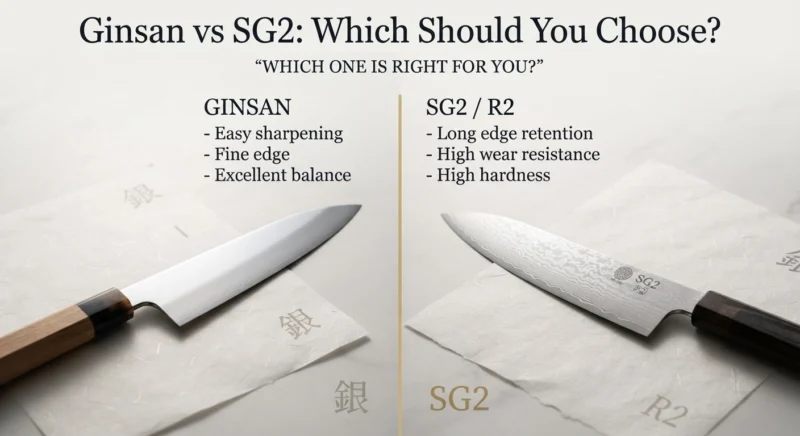
Which Steel Should You Choose?
Choose Ginsan if you:
- sharpen your own knives
- enjoy Japanese water stones
- want a very fine edge
- value cutting feel
- want excellent stainless performance
- prefer a more forgiving knife
- don’t mind sharpening somewhat more often
Choose SG2 if you:
- want maximum edge retention
- use your knife heavily
- sharpen infrequently
- want very high wear resistance
- appreciate high-hardness Japanese knives
- don’t mind spending more time sharpening
- are comfortable with careful knife technique
Ginsan vs SG2: The Verdict
So, which is better?
For edge retention: SG2.
For sharpening: Ginsan.
For wear resistance: SG2.
For toughness and forgiveness: Ginsan.
For corrosion resistance: essentially a tie.
For fine edges: both are excellent.
For maintenance convenience: Ginsan has the advantage because sharpening is easier.
If you want the most modern high-performance stainless steel between the two, SG2/R2 is the stronger choice.
If you want a stainless steel that provides an exceptionally refined Japanese cutting experience without making sharpening unnecessarily difficult, Ginsan may be the better choice.
Neither is objectively superior in every situation.
The ideal steel depends on the relationship you want to have with your knife.
Some cooks want to sharpen as little as possible.
For them, SG2 is extremely appealing.
Others enjoy maintaining a razor-sharp edge and want a steel that responds beautifully to a water stone.
For them, Ginsan can be hard to beat.
Final Recommendation
For the average home cook, I would give Ginsan a slight advantage if sharpening ability and overall balance are more important than maximum edge retention.
For a professional cook or heavy user, SG2 becomes increasingly attractive because its superior wear resistance can reduce the frequency of sharpening.
For a knife enthusiast who loves Japanese water stones, Ginsan is particularly rewarding.
For someone who wants a premium Japanese stainless knife that stays sharp for a long time, SG2/R2 is one of the strongest choices available.
The most important point is that you should not choose a knife solely because the specification sheet says “SG2” or “Ginsan.”
Look at the complete knife.
A beautifully heat-treated Ginsan blade with excellent geometry can outperform a mediocre SG2 knife.
A superb SG2 knife can likewise outperform an average Ginsan knife.
Steel creates potential. Heat treatment, geometry, grinding, sharpening, and craftsmanship turn that potential into actual performance.
Frequently Asked Questions
Is Ginsan better than SG2?
Not universally. Ginsan is easier to sharpen and generally more forgiving, while SG2 offers substantially better wear resistance and edge retention.
Is SG2 the same as R2?
In the Japanese kitchen-knife market, SG2 and R2 are commonly used as names for the same powder metallurgy stainless steel family. Exact specifications can vary by manufacturer.
Is SG2 harder than Ginsan?
Typically, yes. SG2/R2 kitchen knives are commonly heat-treated to around 62–64 HRC, while Ginsan knives are often around 59–62 HRC.
Which holds an edge longer, Ginsan or SG2?
SG2 generally holds an edge longer because of its greater wear resistance and carbide content.
Which is easier to sharpen, Ginsan or SG2?
Ginsan is generally easier and faster to sharpen.
Which is tougher, Ginsan or SG2?
Ginsan generally has better toughness and is somewhat more forgiving of accidental lateral stress.
Which is more corrosion resistant?
Both are highly corrosion resistant. In normal kitchen use, the practical difference is small.
Does Ginsan rust?
Ginsan is stainless and highly corrosion resistant, but no kitchen steel should be considered completely rust-proof.
Does SG2 rust?
SG2 is stainless and highly corrosion resistant. Proper cleaning and drying will help prevent staining and corrosion.
Is SG2 a super steel?
SG2 is often considered a premium or high-performance knife steel because of its powder metallurgy production, high hardness, and excellent wear resistance. It is particularly impressive for kitchen knives.
Is Ginsan a premium steel?
Yes. Ginsan is highly regarded for its excellent balance of corrosion resistance, edge performance, sharpening response, and toughness.
Which is better for a gyuto?
Both are excellent. Choose Ginsan for easier sharpening and a balanced cutting experience; choose SG2 for longer edge retention.
Which is better for a home cook?
Ginsan is an excellent choice for home cooks who sharpen regularly. SG2 is better for home cooks who want to sharpen less frequently.
Which is better for professional chefs?
SG2 can be particularly attractive for professionals because of its longer edge retention, although Ginsan can be preferable for chefs who sharpen frequently.
Which is better for vegetables?
Both perform exceptionally well. SG2 offers longer edge retention, while Ginsan offers easier sharpening.
Which is better for sushi?
Both can produce excellent fine edges. Ginsan offers easier maintenance, while SG2 offers longer edge life. Knife geometry is extremely important for sushi and sashimi work.
Which is more expensive?
SG2 knives are often more expensive, particularly when paired with premium Japanese craftsmanship. However, knife quality and price vary widely.
Can SG2 be sharpened on Japanese water stones?
Yes. SG2 can be sharpened effectively with quality water stones. Because of its high wear resistance, an appropriate abrasive and good sharpening technique are helpful.
Can Ginsan be sharpened to a very fine edge?
Yes. Ginsan is particularly well suited to fine Japanese knife edges and can be sharpened to extremely high levels of sharpness.
Ginsan vs SG2: Final Scorecard
If we score the steels specifically for Japanese kitchen knives:
Ginsan
- Sharpness potential: ★★★★★
- Sharpening: ★★★★★
- Edge retention: ★★★★☆
- Toughness: ★★★★☆
- Corrosion resistance: ★★★★★
- Ease of maintenance: ★★★★★
- Cutting feel: ★★★★★
SG2 / R2
- Sharpness potential: ★★★★★
- Sharpening: ★★★★☆
- Edge retention: ★★★★★
- Toughness: ★★★☆☆
- Corrosion resistance: ★★★★★
- Ease of maintenance: ★★★★☆
- Cutting feel: ★★★★★
These ratings are intended as practical guidance rather than laboratory measurements.
Ginsan vs SG2: One Last Thought
There is a temptation in knife discussions to search for the single “best” steel.
But Japanese kitchen knives demonstrate why that approach doesn’t work.
A knife isn’t simply a piece of steel.
It is a system.
The steel determines the available properties.
Heat treatment determines how those properties are developed.
Geometry determines how the blade cuts.
Sharpening determines the condition of the edge.
And the cook determines how the knife is used.
Ginsan and SG2 simply emphasize different parts of that system.
Ginsan is about balance, sharpening response, fine edges, and a refined stainless-steel experience.
SG2 is about hardness, wear resistance, and long-lasting edge performance.
If you enjoy sharpening and want a stainless Japanese knife that feels responsive and refined, choose Ginsan.
If you want a premium Japanese knife that can remain sharp for a very long time and you are willing to put a little more effort into sharpening, choose SG2/R2.
Either way, you are choosing an excellent Japanese stainless steel.
The real winner is the steel that matches your cooking style.
This article is for independent informational purposes only and is not affiliated with, sponsored by, or endorsed by any steel manufacturer. All product names, trademarks, and registered trademarks are the property of their respective owners.