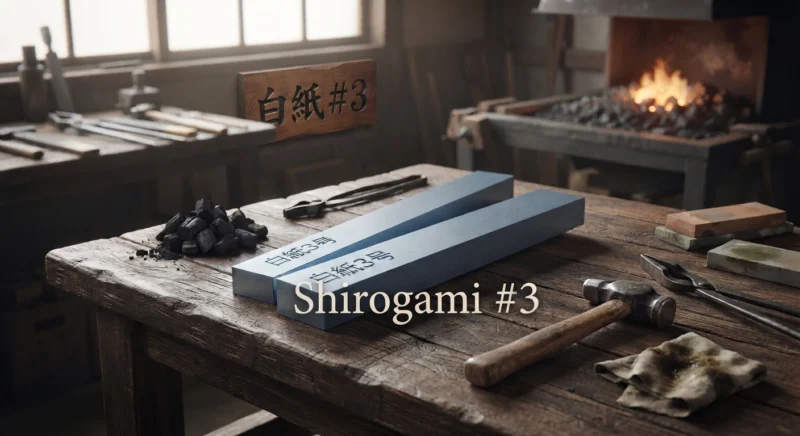
Shirogami #3
An Independent Guide
If you have ever wondered why some Japanese knives are made from an apparently simple steel containing little more than iron and carbon, Shirogami #3 is one of the most interesting answers.
Modern knife steels can contain chromium, vanadium, molybdenum, tungsten, cobalt and other alloying elements. Powder metallurgy steels can contain an entire chemistry designed around carbide formation, wear resistance and corrosion resistance.
White Paper Steel #3 takes almost the opposite approach.
It is a high-purity Japanese carbon steel designed around simplicity.
And that simplicity is exactly what makes it interesting.
It does not try to compete with modern powder steels in wear resistance. It does not try to become stainless. It does not attempt to hold an edge for days without maintenance.
Instead, it offers something that many experienced knife users value enormously:
a steel that responds immediately to sharpening and can produce a very fine, clean working edge.
At the same time, its relatively low carbon content within the White Steel family gives it a more forgiving character than White #1 and White #2.
That makes this lesser-known steel worth understanding.
What Is Shirogami #3?
Shirogami #3 is the third grade in the traditional Japanese White Paper Steel family, also known as White Steel #3 or White Paper Steel #3.
The Japanese name is commonly written as 白紙3号.
The “white” in White Steel does not describe the appearance of the finished blade. The name comes from the white paper historically associated with the steel when supplied by the manufacturer.
The White Steel family is known for very low levels of unwanted impurities and a relatively simple chemical composition.
Within that family, the grades are broadly differentiated by carbon content:
- White #1 has the highest carbon content.
- White #2 sits between #1 and #3.
- Shirogami #3 has the lowest carbon content of the three.
This difference might look small on a specification sheet, but carbon content has a significant influence on hardness potential, edge stability, toughness and sharpening behavior.
ModernC Cooking describes White #3 as the leanest of the three White Paper grades, with approximately 0.90% carbon, while other technical guides give a range of approximately 0.80–0.90%.
That lower carbon content is central to understanding this steel.
Shirogami #3 Chemical Composition
The chemistry is remarkably simple.
A commonly cited composition is:
| Element | Approximate content |
|---|---|
| Carbon (C) | 0.80–0.90% |
| Silicon (Si) | 0.10–0.20% |
| Manganese (Mn) | 0.20–0.30% |
| Phosphorus (P) | ≤0.025% |
| Sulfur (S) | ≤0.004% |
| Chromium (Cr) | No intentional addition specified |
| Molybdenum (Mo) | No intentional addition specified |
| Tungsten (W) | No intentional addition specified |
| Vanadium (V) | No intentional addition specified |
The particularly interesting part is what is not there.
There is no substantial chromium addition designed to make the steel stainless. There is no significant tungsten addition like you find in Aogami. There is no vanadium addition intended to create a large population of hard vanadium carbides.
Instead, the steel is intentionally kept simple.
That simplicity is one of its defining characteristics.
Why Does Carbon Matter So Much?
Carbon is one of the most important elements in conventional knife steel.
Increasing carbon generally increases the amount of carbon available to form cementite and, after appropriate heat treatment, increases the hardness that the steel can achieve.
But higher carbon isn’t automatically better.
A harder steel can potentially support a thinner, more stable cutting edge, but excessive hardness can also make a blade less forgiving when subjected to impacts, twisting or poor cutting technique.
This is where the White Steel grades become interesting.
White #1 contains more carbon than White #2.
White #2 contains more carbon than White #3.
Therefore, within the family, Shirogami #3 represents the lower-carbon end.
That doesn’t make it an inferior material.
It makes it a different tool.
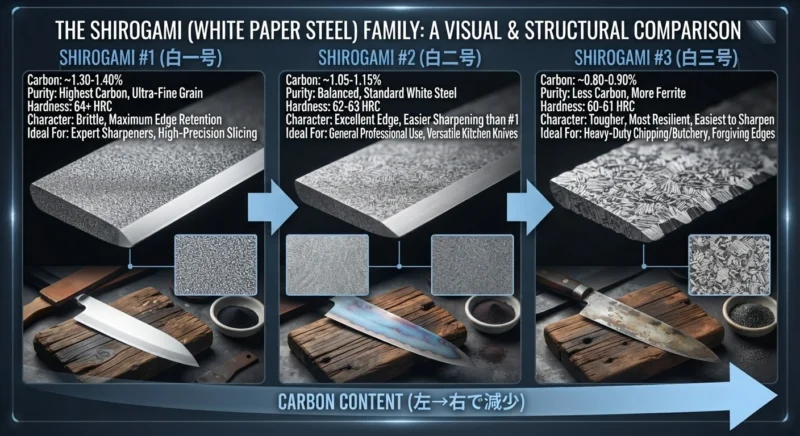
Shirogami #3 vs Shirogami #2
This is probably the comparison most people want to see.
White #2 is considerably more familiar among Japanese kitchen knives and is often selected when a maker wants a combination of high hardness, excellent sharpening response and a refined cutting edge.
White #3 moves the balance toward a somewhat softer and more forgiving steel.
| Characteristic | Shirogami #2 | Shirogami #3 |
|---|---|---|
| Carbon | 1.05–1.15% | 0.80–0.90% |
| Alloying | Very low | Very low |
| Potential hardness | Higher | Lower |
| Toughness | Good | Generally higher |
| Edge retention | Better | More modest |
| Sharpening | Very easy | Very easy |
| Corrosion resistance | Very low | Very low |
| Patina | Yes | Yes |
| Availability | Relatively common | Less common |
The difference is not simply “good steel versus bad steel.”
Think of the two as different tools.
If maximum edge retention is your priority, White #2 is generally the more attractive choice.
If you value easy sharpening, a forgiving working edge and lower hardness, White #3 becomes much more interesting.
Check Our Guide Shirogami #2 (White Steel #2)
Is Shirogami #3 Easy to Sharpen?
Yes.
This is one of the strongest reasons to consider it.
The absence of significant alloying additions means that you don’t have the large quantities of extremely hard alloy carbides found in many modern wear-resistant steels.
On a waterstone, simple carbon steels can feel dramatically different from highly alloyed stainless steels.
The stone removes steel readily.
The edge responds quickly.
And when the edge eventually becomes dull, restoring it generally does not require an enormous amount of work.
This is one reason traditional carbon steels remain popular among people who actually enjoy sharpening their knives.
The sharpening experience can become part of using the knife rather than simply being maintenance that you try to avoid.
Check Our Ultimate Guide to Caring for a Damascus Steel Knife
The “Shirogami Experience”
There is something particularly satisfying about sharpening a simple carbon steel.
You can feel the stone interacting with the blade.
You can raise a burr relatively quickly.
You can refine that burr through progressively finer stones.
And because the steel does not contain a huge volume of wear-resistant carbides, the sharpening process can feel extremely direct.
This is very different from choosing a steel solely because it can go the longest between sharpenings.
A modern powder steel might stay functional for much longer.
But when you finally sharpen it, the process can be considerably more demanding.
With White Steel, sharpening is part of the attraction.
Hardness: What Should You Expect?
This is an area where online descriptions often become misleading.
You will find different hardness numbers published for Shirogami #3, including values around 58–60 HRC, 60–62 HRC and low-60s ranges.
There is a good reason for the variation.
Steel composition is only one part of the equation.
Heat treatment determines a tremendous amount of the final performance.
The same nominal steel can behave very differently depending on:
- Austenitizing temperature
- Quenching method
- Quenching speed
- Tempering
- Blade thickness
- Geometry
- Forging history
- Grain refinement
- Manufacturer’s process
This is why you should never assume that every White #3 knife will perform identically.
A well-treated blade can be impressive.
A poorly treated blade can be disappointing regardless of how attractive the steel specification looks.
Check Our Guide What Is HRC? Understanding Rockwell Hardness
Toughness and Edge Stability
One of the main theoretical advantages of the lower carbon content is increased toughness compared with the higher-carbon White grades.
In practical terms, this can make Shirogami #3 more forgiving when the knife encounters situations where an extremely hard edge might be more vulnerable.
However, “tougher” does not mean indestructible.
A Japanese kitchen knife is still a precision cutting tool.
You should not twist the blade through hard food, chop bones with a thin kitchen knife, pry with the edge or use excessive lateral force.
Toughness is about how a material responds to stress.
It is not permission to abuse the knife.
Edge Retention
This is where you need to understand the trade-off.
Modern high-alloy steels often achieve excellent edge retention through hard carbides and alloying elements.
White #3 doesn’t work that way.
Its relatively simple chemistry means that it is not designed to compete with powder steels for extreme wear resistance.
Consequently, the edge will generally require sharpening sooner than a highly wear-resistant modern steel when both knives are used under comparable conditions.
But there is an important distinction:
shorter edge life does not mean poor cutting performance.
A White #3 knife can be extremely sharp.
It simply requires the owner to maintain that sharpness.
For somebody who enjoys frequent light sharpening, this can actually be an advantage.
Check Our Guide Edge Retention Explained
Why Would Anyone Choose Lower Edge Retention?
Because sharpening frequency is only one part of the ownership experience.
Imagine two knives.
Knife A stays reasonably sharp for a very long time but takes considerable effort to sharpen.
Knife B loses its finest edge sooner but can be restored in a few minutes on a waterstone.
Which one is better?
There isn’t a universal answer.
A professional cook working through enormous quantities of food may prefer longer edge retention.
A home cook who sharpens every weekend may happily choose the steel that is easier to maintain.
This is why steel comparisons should never be reduced to a single “best steel” ranking.
Shirogami #3 and Corrosion
There is one characteristic that should never be forgotten.
This is not stainless steel.
Because it lacks the chromium level required for stainless behavior, the blade can react with moisture, acids and other substances.
Freshly polished carbon steel can develop discoloration surprisingly quickly.
That isn’t necessarily damage.
A gray, blue, brown or even darker patina can develop naturally over time.
The appearance depends on:
- Food acidity
- Moisture
- Humidity
- How frequently the knife is cleaned
- Whether the blade is polished
- How the knife is stored
Patina is one of the visual signatures of traditional carbon-steel knives.
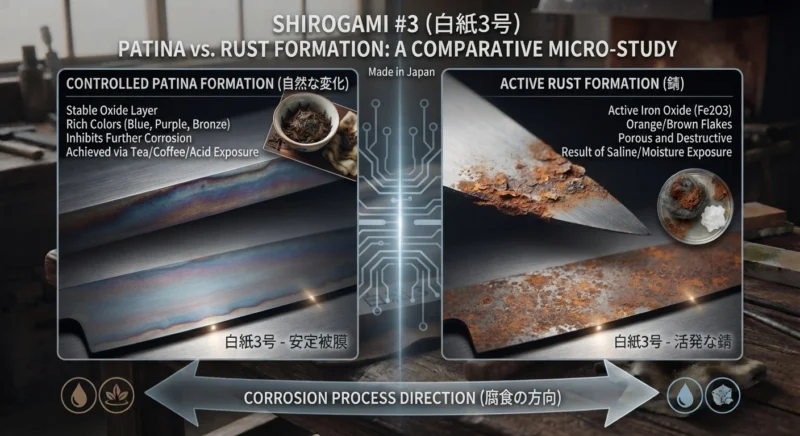
Patina vs Rust
These two should not be confused.
A stable patina is generally a thin surface oxidation layer that develops as the steel reacts with its environment.
Rust is active corrosion.
Rust can become rough, orange or flaky and can progressively damage the steel.
The easiest way to reduce the risk is simple:
Keep the knife clean and dry.
You don’t need complicated equipment.
Wash it by hand.
Dry it immediately.
Don’t leave it sitting in a wet sink.
Don’t put it in the dishwasher.
If the knife will be stored for an extended period, a thin layer of appropriate food-safe protective oil can provide additional protection.
How to Sharpen Shirogami #3
A basic waterstone progression works very well.
For routine maintenance, something around 1,000 grit can establish the edge.
A medium stone around 2,000–3,000 grit can refine it.
A 4,000–6,000 grit stone can produce a more polished edge if that suits your cutting style.
You don’t necessarily need an enormous progression.
More stones do not automatically mean a better edge.
The important things are:
- Maintain a consistent angle.
- Use controlled pressure.
- Raise a small burr.
- Refine the edge.
- Remove the burr carefully.
- Finish with light strokes.
Because White #3 responds quickly to stones, it is particularly suitable for learning these fundamentals.
What Makes a Good White Steel Edge?
Steel alone doesn’t create sharpness.
A knife’s final cutting performance depends on the interaction between:
Steel + heat treatment + geometry + sharpening + edge angle
This is extremely important.
A mediocre knife made from an excellent steel can perform worse than a beautifully constructed knife made from a simpler steel.
The maker’s heat treatment can influence hardness and microstructure.
The blade geometry determines how easily the edge passes through food.
The sharpening process determines the actual condition of the apex.
And the user’s technique determines how long that edge survives.
So when evaluating a White #3 knife, don’t obsess over the steel name alone.
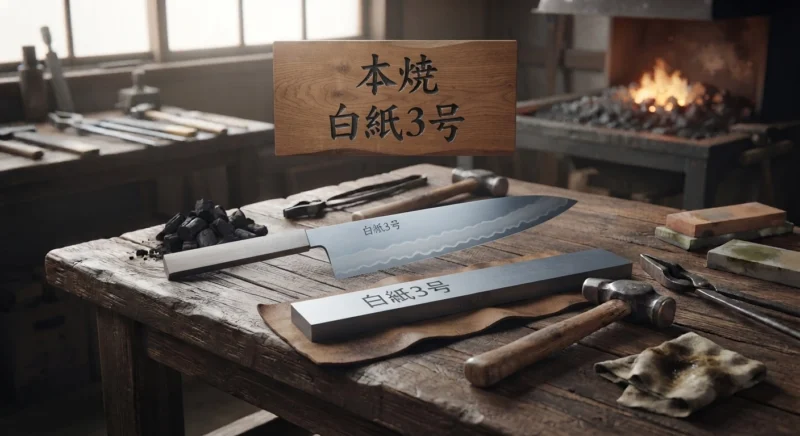
Honyaki and Shirogami #3
One particularly interesting application of White #3 is honyaki.
Honyaki knives are traditionally made from a single piece of carbon steel rather than using a softer iron jacket around a harder core.
The heat-treatment process can produce a visible hamon, the transition between hardened and softer regions.
White Steel #3 has a reputation for being suitable for certain honyaki approaches, particularly oil-quenched processes.
Sakai Ichimonji’s technical discussion of White Steel #3 specifically highlights its association with honyaki and the ability to produce attractive hamon patterns through appropriate heat treatment.
This is one reason the steel remains interesting even though it is not nearly as common as White #2.
Why Is Shirogami #3 Less Common?
This is one of the most interesting questions.
If the steel is easy to sharpen, reasonably tough and capable of producing a fine edge, why don’t we see it everywhere?
One reason is simply market preference.
Knife buyers often want maximum performance from a steel.
That usually means:
- Higher hardness
- Better edge retention
- More exotic alloying
- Stainless or semi-stainless behavior
- Strong marketing appeal
White #3 doesn’t check those boxes.
It is almost the opposite.
It says:
“I am simple. Sharpen me. Dry me. Use me.”
Sakai Ichimonji notes that White #3 has become less common in contemporary knife production and discusses the decline in the number of working blacksmiths as well as changing economics around this material.
That makes surviving White #3 knives particularly interesting to enthusiasts.
Is Shirogami #3 a Beginner Steel?
This requires some nuance.
If “beginner” means:
easy to sharpen
then yes, it can be a very approachable steel.
If “beginner” means:
requires almost no maintenance
then absolutely not.
A stainless knife can be a much easier first knife for somebody who doesn’t want to think about corrosion.
White #3 asks the owner to learn basic carbon-steel care.
But it can simultaneously teach one of the most useful knife skills:
how to sharpen properly.
Because the steel responds readily to stones, it can be an excellent material for someone who wants to understand sharpening rather than simply outsource it.
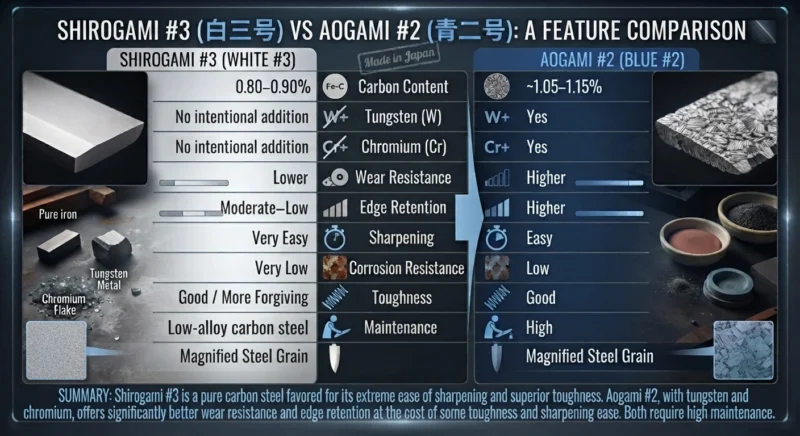
Shirogami #3 vs Aogami #2
This is a much more interesting comparison than simply asking which steel is “better.”
Aogami #2 contains additional alloying elements, including tungsten and chromium, which change its carbide structure and wear behavior.
White #3 is much simpler.
| Feature | White #3 | Aogami #2 |
|---|---|---|
| Carbon | 0.80–0.90% | ~1.05–1.15% |
| Tungsten | No intentional addition | Yes |
| Chromium | No intentional addition | Yes |
| Wear resistance | Lower | Higher |
| Edge retention | Moderate | Better |
| Sharpening | Very easy | Easy |
| Corrosion resistance | Very low | Still low |
| Toughness | Generally favorable | Good |
| Maintenance | High | High |
If you want a workhorse carbon knife that holds its edge longer, Aogami #2 is usually more attractive.
If your priority is straightforward sharpening and a simple traditional carbon-steel experience, White #3 has its own appeal.
Check Our Guide Aogami Steel N2
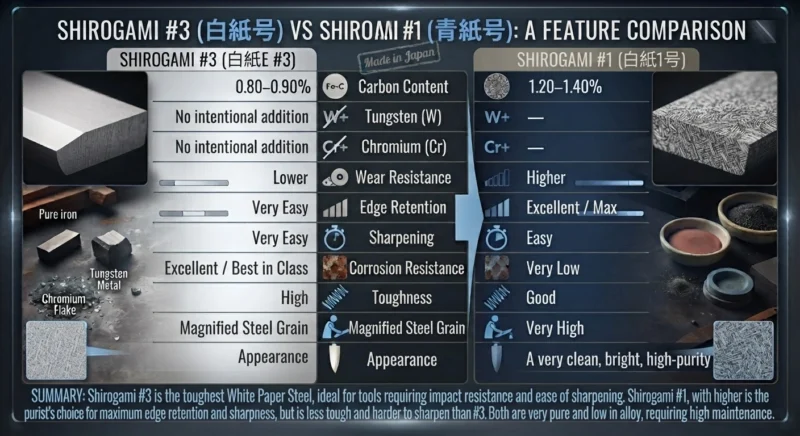
Shirogami #3 vs Shirogami #1
At the opposite end of the White Steel family is White #1.
White #1 contains significantly more carbon.
That gives it greater hardness potential but also changes the balance between hardness, toughness and edge stability.
A simplified way to think about the family is:
White #1 → maximum carbon within the family
White #2 → middle ground
White #3 → lower carbon and more forgiving character
This isn’t a ranking.
It’s a spectrum.
White #1 is attractive when maximum hardness and fine edge performance are priorities.
White #3 becomes interesting when you want a somewhat less demanding blade.
Check Our guide Shirogami #1 Steel
Is Shirogami #3 Good for Kitchen Knives?
Yes, provided that you understand what you are buying.
It can work particularly well in traditional Japanese knives where:
- Sharpening response matters
- High polish is desirable
- The user appreciates carbon steel
- Frequent maintenance is acceptable
- A very refined edge is valued
- Extreme wear resistance isn’t necessary
It can also be particularly interesting in traditional single-bevel designs.
For example, certain specialist Japanese knives benefit from a steel that can be maintained and refined easily.
What About Deba Knives?
A deba is designed for fish preparation and may encounter bones.
That makes toughness an important consideration.
A very hard, thin edge is not always the ideal answer for a knife that has to work around bone.
The lower-carbon character of White #3 can therefore make it interesting for applications where a little more forgiveness is desirable.
But you should still never assume that a White #3 deba is suitable for heavy bone chopping simply because it is tougher than White #1.
Blade thickness, geometry and heat treatment matter enormously.
What About Outdoor or Utility Knives?
The same characteristics can make White #3 attractive for certain traditional utility applications.
However, corrosion becomes a bigger issue outdoors.
Camping, fishing and hunting environments expose steel to:
- Water
- Humidity
- Salt
- Organic material
- Blood
- Acids
- Temperature changes
A stainless or semi-stainless steel may be much more practical in these environments.
White #3 makes more sense for someone who specifically wants a traditional carbon-steel tool and is willing to maintain it.
Check Our Guide Best Hunting Knife Features Explained
Does Shirogami #3 Get Very Sharp?
It certainly can.
But let’s be careful with the phrase “very sharp.”
There is no magical property in the steel that automatically produces a razor edge.
Sharpness comes from the geometry and condition of the apex.
A well-sharpened White #3 blade can support an exceptionally fine edge because the steel is well suited to conventional stone sharpening.
This is one of its biggest attractions.
The steel doesn’t fight the sharpening process.
Why Purity Matters
The White Steel concept is fascinating because its performance philosophy is almost minimalist.
Instead of adding more elements to achieve more wear resistance, the steel producer concentrates on controlling impurities and producing a predictable simple carbon steel.
Very low phosphorus and sulfur levels are particularly important.
These elements can be undesirable in steel when present above tightly controlled limits.
The result is a material designed to respond predictably to traditional forging and heat-treatment processes.
This is part of what makes Japanese White Steel historically important.
The Steel Is Only the Beginning
If you’re shopping for a knife made from Shirogami #3, don’t stop at the steel designation.
Ask:
Who made the knife?
How was it heat treated?
What is the blade geometry?
What is the edge angle?
Is it laminated or monosteel?
What is the intended use?
How will you maintain it?
Two knives made from the same nominal steel can feel completely different.
One might be thin and extremely responsive.
Another might be thick and robust.
One might be heat treated aggressively.
Another might be deliberately tempered softer.
The steel designation cannot tell you all of that.
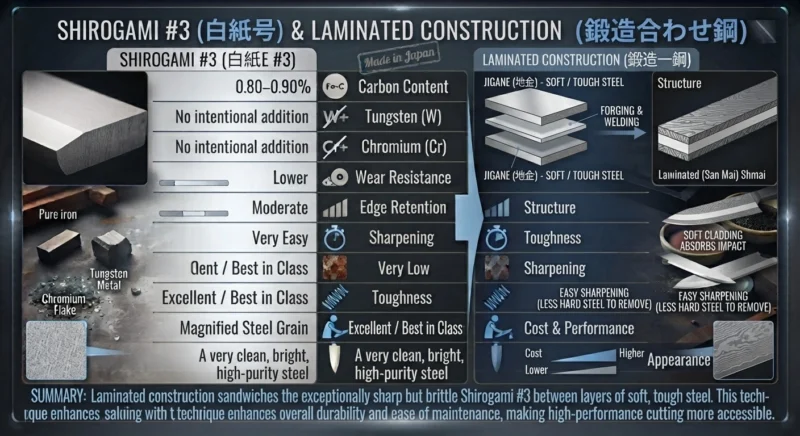
Shirogami #3 and Laminated Construction
Traditional Japanese blades frequently combine hard carbon steel with softer iron or steel.
This can produce constructions such as:
- Kasumi
- Warikomi
- San Mai
- Other laminated structures
The purpose can be structural, practical and aesthetic.
A hard cutting core provides the edge performance while softer material can make the blade easier to forge and finish.
This also means that when you see a beautiful Japanese knife with a dramatic contrast line, the visual appearance isn’t necessarily an indication of the steel’s hardness.
The construction and heat treatment are separate considerations.
Check Our Guide Laminated Steel Knife Blanks
Why the Steel Can Be Beautiful
White Steel has another characteristic that appeals to traditional knife enthusiasts:
it can be finished beautifully.
A highly polished carbon-steel blade can show a clean, almost mirror-like surface.
A forged and etched blade can show dramatic contrasts.
A honyaki blade can display a hamon.
A naturally patinated blade can develop an entirely individual appearance.
This is one of the places where traditional steel becomes more than a performance specification.
It becomes part of the knife’s identity.
Common Misconceptions
“White Steel means stainless.”
No.
The name refers to the traditional designation of the steel and its identifying paper, not stainless behavior.
“Shirogami #3 cannot get very hard.”
It can achieve useful knife hardness when properly heat treated, although its lower carbon content limits its hardness potential relative to the higher-carbon White grades.
“It has terrible edge retention.”
That depends on what you compare it with.
Against modern high-wear powder steels, its edge retention is modest.
Against ordinary low-alloy carbon steels, it can perform very well.
“It is impossible to maintain.”
No.
It requires more corrosion care than stainless steel, but the maintenance itself is straightforward.
“The steel determines everything.”
Definitely not.
Heat treatment and geometry can have enormous effects on performance.
How to Care for a White Steel #3 Knife
The basic routine is simple.
During use
Keep the blade reasonably clean.
If you’re cutting acidic ingredients such as citrus or tomatoes, don’t leave residue sitting on the steel.
After use
Wash by hand.
Dry immediately.
Don’t leave the knife in the sink.
Storage
Store the blade somewhere dry.
For long-term storage, use an appropriate food-safe protective oil.
Sharpening
Use waterstones or another sharpening system appropriate for traditional carbon steel.
Avoid
- Dishwasher cleaning
- Long periods underwater
- Cutting inappropriate hard materials
- Prying
- Twisting
- Cutting directly through bones unless the knife is specifically designed for that task
Who Should Buy Shirogami #3?
This steel makes the most sense for someone who says:
“I don’t mind sharpening my knife.”
It is particularly attractive to:
- Traditional Japanese knife enthusiasts
- Home cooks who enjoy sharpening
- Chefs who prefer fine edges
- Collectors of traditional Japanese steels
- Users interested in honyaki
- People who appreciate patina
- Knife enthusiasts who want to experience simple carbon steel
It is probably less suitable for someone who says:
“I want a knife that I can put in the sink and forget about.”
For that person, stainless steel is a much better choice.
Shirogami #3 Is Probably Not for You If…
- You don’t want to maintain carbon steel.
- You want maximum edge retention.
- You want a dishwasher-safe knife.
- You frequently cut very hard materials.
- You don’t want to sharpen your own knife.
Is Shirogami #3 Worth Buying?
Yes—but not because it is the “best” steel.
It is worth buying because it offers a different experience.
The modern knife world is full of steels competing for higher hardness, better wear resistance and longer edge retention.
White #3 goes in another direction.
It emphasizes simplicity.
It is easy to sharpen.
It can produce a fine edge.
It has a traditional Japanese history.
It develops patina.
And it rewards the owner who takes care of the blade.
That combination is difficult to reproduce with a modern stainless powder steel.
The Real Advantage: Maintenance Instead of Maximum Performance
One of the biggest misunderstandings in knife-steel discussions is that every steel should be judged by how long it remains sharp.
That’s useful, but incomplete.
A knife is a system.
If you sharpen every few days, a steel that takes three minutes to refresh may actually be more enjoyable than a steel that takes twenty minutes to restore after a very long edge-retention cycle.
This is where White #3 becomes interesting.
Its lower wear resistance is not necessarily a disadvantage for someone who enjoys maintaining knives.
It can be part of the experience.
Shirogami #3: The Simple Steel With a Different Philosophy
At first glance, White #3 looks almost boring.
There is no dramatic list of exotic alloying elements.
No vanadium percentage to advertise.
No powder-metallurgy technology.
No stainless-steel claim.
No huge carbide-volume specification.
But that is exactly the point.
It is a traditional steel based on controlled simplicity.
The result is a material that can be sharpened easily, can develop a beautiful patina, and can provide excellent cutting performance when properly forged, heat treated and sharpened.
It won’t give you the extreme wear resistance of modern powder steels.
It isn’t intended to.
| Steel | Carbon | Sharpening | Edge retention | Toughness | Corrosion |
|---|---|---|---|---|---|
| Shirogami #1 | ~1.3% | Excellent | High | Lower | Poor |
| Shirogami #2 | ~1.1% | Excellent | High | Good | Poor |
| Shirogami #3 | ~0.85% | Excellent | Moderate | Good | Poor |
| Aogami #2 | ~1.1% | Very good | Higher | Good | Poor |
Final Verdict
Shirogami #3 is one of the more interesting traditional Japanese carbon steels precisely because it doesn’t try to do everything.
Its approximately 0.80–0.90% carbon content places it below White #1 and White #2 in the White Steel family. Its low-alloy chemistry produces a steel that is relatively straightforward to sharpen and capable of taking a refined edge.
Its main limitations are equally clear.
It is reactive.
It does not compete with modern high-alloy steels for extreme edge retention.
And its final performance depends heavily on heat treatment and blade geometry.
But for someone who appreciates traditional Japanese knives, those limitations may actually be part of the attraction.
You sharpen it.
You dry it.
You watch the patina develop.
You learn how the edge behaves.
And over time, the knife becomes something that reflects the way you use and maintain it.
That is why White #3 remains worth discussing even in an age dominated by stainless powder steels.
It isn’t the steel for everyone.
But for the right knife user, it can be one of the most rewarding traditional carbon steels to experience.
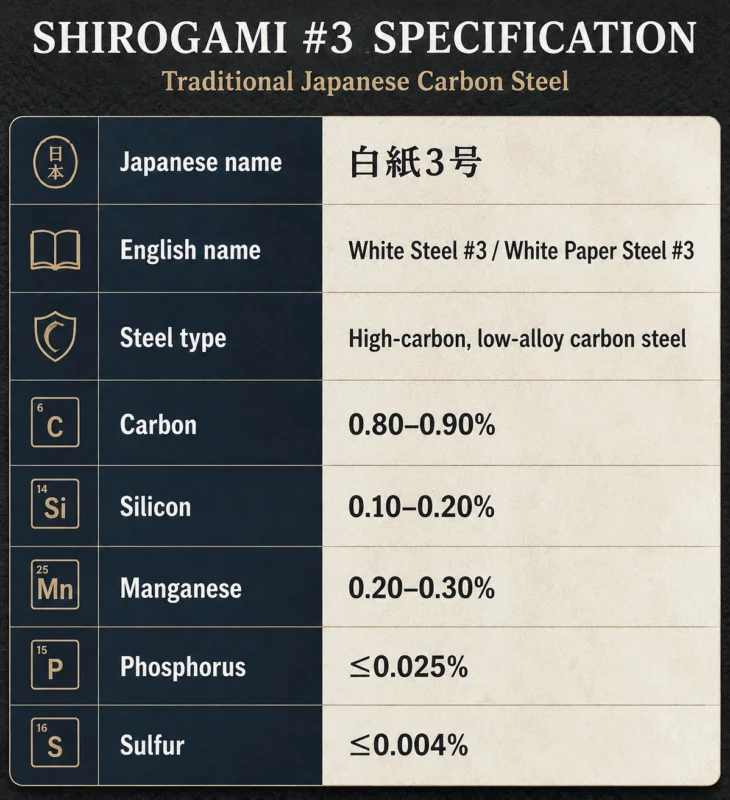
Quick Shirogami #3 Specification
| Property | Shirogami #3 |
|---|---|
| Japanese name | 白紙3号 |
| English name | White Steel #3 / White Paper Steel #3 |
| Steel type | High-carbon, low-alloy carbon steel |
| Carbon | 0.80–0.90% |
| Silicon | 0.10–0.20% |
| Manganese | 0.20–0.30% |
| Phosphorus | ≤0.025% |
| Sulfur | ≤0.004% |
| Chromium | No intentional addition specified |
| Molybdenum | No intentional addition specified |
| Tungsten | No intentional addition specified |
| Vanadium | No intentional addition specified |
| Stainless | No |
| Sharpening | Very easy |
| Edge retention | Moderate |
| Corrosion resistance | Very low |
| Patina | Yes |
| Main attraction | Fine edge + easy sharpening + traditional character |
This article is for independent informational purposes only and is not affiliated with, sponsored by, or endorsed by any steel manufacturer. All product names, trademarks, and registered trademarks are the property of their respective owners.
https://ww4.tiki.ne.jp/~hassy/kgkseibun/hamonokou.htm?utm_source