Different Heat Treatment Methods Explained
About steels

Different Heat Treatment Methods Explained: A Complete Guide for Knife Steels

Different Heat Treatment Methods Explained An Independent Guide Quick Answer Heat treatment is the process of heating and cooling steel under controlled conditions to achieve specific mechanical properties such as hardness, toughness, wear resistance, and edge retention. Common heat treatment methods include annealing, normalizing, hardening, quenching, tempering, and cryogenic treatment. The quality of heat treatment

Cryogenic Treatment Explained
About steels

Cryogenic Treatment Explained: How Deep Cryogenic Processing Improves Steel Performance (2026 Guide)

Cryogenic Treatment Explained An Independent Guide Quick Answer Cryogenic treatment is a deep-freezing process (usually -80°C to -196°C) used to improve steel performance by transforming retained austenite into martensite, increasing hardness, wear resistance, and edge stability. In simple terms:👉 It makes knife steel harder, more stable, and longer-lasting when done correctly. Introduction Cryogenic treatment (also

M390 Steel Review
About steels

M390 Steel Review: Pros, Cons, Edge Retention, Toughness & Real-World Performance

M390 Steel Review An Independent Guide Introduction When discussing premium knife steels, few names generate as much attention as M390. M390 has become one of the most respected stainless steels in the knife industry and is often considered a benchmark for modern high-performance blade materials. Over the past decade, M390 has appeared in countless premium

Premium VG10 steel stock showcase
About steels

VG10 Steel Review: Pros, Cons, Edge Retention, Toughness & Real-World Performance

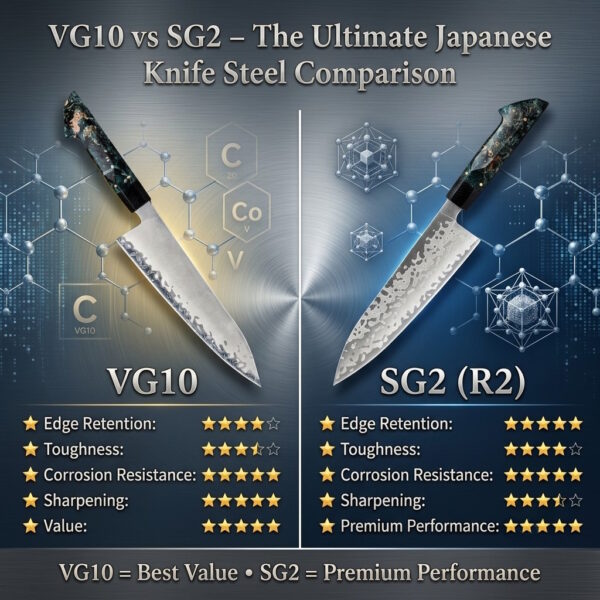
VG10 Steel Review An Independent Guide Introduction Among modern knife steels, few names are as respected as VG10. Originally developed in Japan, VG10 has become one of the most popular premium stainless steels used in kitchen knives, hunting knives, folding knives, and everyday carry blades. Knife enthusiasts often describe VG10 as the steel that bridges

AUS-8 Steel Review
About steels

AUS-8 Steel Review: Pros, Cons, Edge Retention, Toughness, and Real-World Performance

AUS-8 Steel Review An Independent Guide Introduction When discussing knife steels, names like D2, 1095, VG10, MagnaCut, and S35VN often dominate the conversation. However, one steel has quietly earned a reputation as one of the best value-for-money knife steels ever produced: AUS-8. Originally developed in Japan by Aichi Steel Corporation, AUS-8 has been used for

440C stainless steel knife blade close-up
About steels

440C Steel Review: Is 440C Still a Good Knife Steel in 2026?

440C Steel Review An Independent Guide 440C Steel Comparison Table Steel Corrosion Resistance Edge Retention Toughness Sharpening Ease Best Use 440C Excellent Good Good Easy Hunting, Fishing, Kitchen, EDC 1095 Low Good Excellent Very Easy Bushcraft, Survival, Outdoor D2 Medium Very Good Good Moderate Hunting, EDC VG10 Excellent Very Good Good Moderate Kitchen Knives AUS-8

1095 Steel Review
About steels

1095 Steel Review: Why This Classic Carbon Steel Remains a Favorite Among Knife Makers

1095 Steel Review An Independent Guide Introduction In a knife industry increasingly dominated by premium stainless steels and advanced powder metallurgy alloys, 1095 steel continues to maintain a loyal following among hunters, bushcrafters, survivalists, and custom knife makers. Despite being one of the oldest knife steels still widely used today, 1095 remains relevant because it

D2 Steel Review
About steels

D2 Steel Review: Is D2 Still One of the Best Knife Steels?

D2 Steel Review An Independent Guide Introduction When knife enthusiasts discuss the best steels for hunting knives, bushcraft knives, EDC knives, and custom blades, D2 steel is almost always part of the conversation. For decades, D2 has maintained a reputation as one of the most practical high-performance steels available, offering an excellent balance of edge

Carbon steel vs stainless steel knives
About steels

Carbon Steel vs Stainless Steel Knives: Which Is Better?

Carbon Steel vs Stainless Steel Knives: Complete Comparison Guide An Independent Guide Quick Answer: Carbon steel offers superior sharpness, toughness, and ease of sharpening, while stainless steel provides excellent corrosion resistance and lower maintenance. The best choice depends on whether cutting performance or rust resistance is your priority. When choosing a quality knife, one of

Blade Thickness for Different Uses
About knives

Best Blade Thickness for Different Uses: A Complete Knife Thickness Guide

Blade Thickness for Different Uses Introduction Quick Answer For most users, a blade thickness between 3 mm and 4 mm offers the best balance of cutting performance and durability. Thinner blades (1–3 mm) excel at slicing, kitchen work, and fishing tasks, while thicker blades (4.5–6 mm) are better suited for bushcraft, survival, and heavy-duty outdoor

Scroll to Top