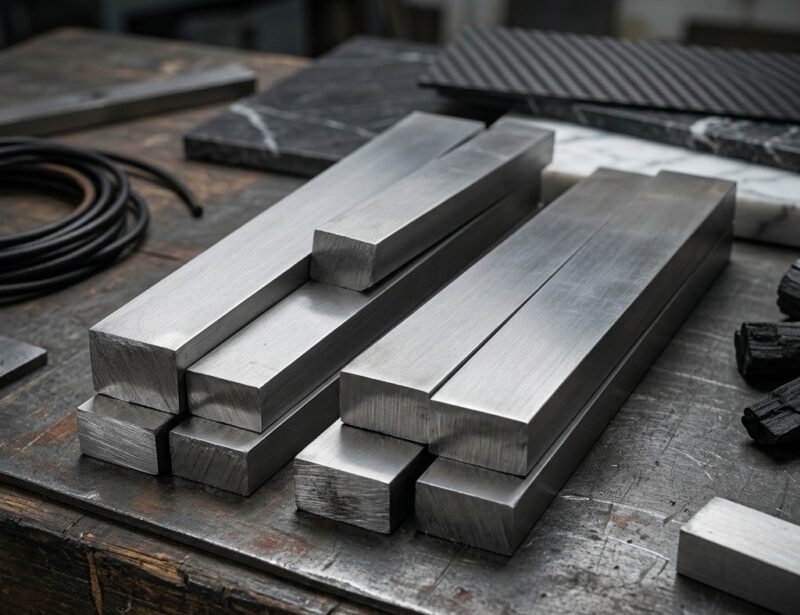
CPM 154 Steel Review
An Independent Guide
In the fast-evolving world of metallurgy, pocket knife enthusiasts and professional chefs are constantly chased by the allure of the “latest and greatest.” Super steels hit the market with massive hype, boasting off-the-chart edge retention and specialized chemical compositions.
Yet, amid the sea of new releases, certain classic formulations remain absolute favorites among custom knife makers and premium manufacturers alike. One such legendary contender is CPM 154 steel.
CPM 154 occupies a highly sought-after sweet spot in the knife community. It is celebrated not for breaking a single performance record, but for achieving a near-flawless, all-around harmony between toughness, corrosion resistance, edge retention, and ease of sharpening.
But in a market now dominated by newer options, how does this pioneer of powder metallurgy stack up? Is it still a premium choice, or has it been left in the dust?
In this definitive review, we will deep-dive into CPM 154’s chemical makeup, grade its real-world performance, contrast it against its legendary rivals, and help you decide if it’s the right steel for your next blade.
What Exactly is CPM 154 Steel?
To understand CPM 154, we first have to take a quick trip down memory lane to look at its conventional parent steel: 154 CM.
Originally engineered for high-stress aerospace applications—specifically jet engine turbine blades—154 CM became a breakout hit in the knife world during the 1970s thanks to legendary custom knifemakers. It was a massive upgrade over standard 440C stainless steel, offering significantly better hardness and wear resistance.
However, traditional 154 CM had an inherent limitation: it was produced using conventional ingot-casting methods. As the molten steel cooled slowly in large molds, alloying elements would pool together, creating large, unevenly distributed carbide clusters. In the real world, these microscopic irregularities meant the steel could be brittle in certain spots and notoriously frustrating to grind or polish.
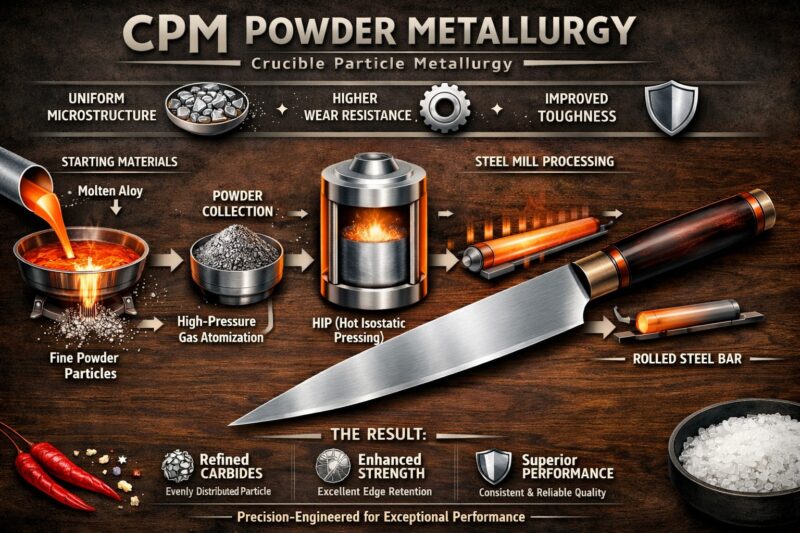
Enter 2006. Crucible Industries decided to apply their revolutionary Crucible Particle Metallurgy (CPM) process to the exact same chemical recipe.
The result was CPM 154.
Instead of pouring the molten steel directly into molds, the liquid metal is forced through a high-pressure gas nozzle that instantly atomizes the stream into a fine mist of tiny droplets. These droplets cool almost instantly into a perfectly uniform powder, locking the chemical elements in place. This powder is then hot isostatically pressed (HIP) under extreme heat and pressure to form a solid steel billet.
The Key Takeaway: CPM 154 is structurally superior to old-school 154 CM. By utilizing powder metallurgy, Crucible eliminated large carbide clusters, resulting in a razor-fine, incredibly homogeneous grain structure that drastically boosts the steel’s physical capabilities.
Chemical Composition: Breaking Down the Science
A steel’s performance is dictated by its recipe. Even though CPM 154 shares its elemental blueprint with conventional 154 CM, looking at the exact percentages reveals why this formula is so effective.
| Element | Percentage | Primary Role in Knife Performance |
| Carbon (C) | 1.05% | Boosts surface hardness, tensile strength, and wear resistance. |
| Chromium (Cr) | 14.00% | Provides high corrosion resistance (stainless threshold) and forms hard chromium carbides. |
| Molybdenum (Mo) | 4.00% | Increases “hot hardness”, improves deep-hardenability, and massively upgrades wear resistance. |
| Manganese (Mn) | 0.50% | Improves structural grain structure and adds to overall tensile strength. |
| Silicon (Si) | 0.80% | Acts as a deoxidizer during melting and enhances structural strength. |
How These Elements Work Together:
- The High Carbon Content (1.05%): Pushes the steel well out of budget territory and allows it to hit an optimal working hardness of 58 to 62 HRC on the Rockwell scale.
- The Molybdenum Factor (4.00%): This is the secret sauce. Compared to older steels like 440C (which lacks high molybdenum), this addition creates massive matrix strength and lets the steel hold an exceptionally keen edge even under abrasive stress.
- Chromium Balance (14.00%): While 14% is plenty to classify CPM 154 as a true stainless steel, it doesn’t overdo it. Keeping the chromium balanced prevents the formation of massive, brittle chromium-carbide bands, allowing the finer grain structure to take center stage.
Real-World Performance Metrics
To truly evaluate a knife steel, we have to look past the data sheets and observe how it handles everyday tasks, outdoor survival scenarios, and kitchen environments. We judge a steel across four pillars: Edge Retention, Toughness, Corrosion Resistance, and Sharpening Ease.
1. Edge Retention (Grade: B+)
CPM 154 offers fantastic edge retention that easily satisfies the vast majority of knife users. Thanks to the high volume of hard molybdenum and chromium carbides, it resists abrasive wear extremely well.
If you use your knife daily to break down cardboard boxes, slice zip-ties, or prep food, you can easily go months without needing a full resharpening session. While it won’t hold an edge quite as long as specialized, ultra-wear-resistant steels like CPM S110V or Maxamet, it doesn’t suffer from the aggressive micro-chipping that plagues those hyper-brittle alloys.
2. Toughness (Grade: A-)
This is where the powder metallurgy process pays massive dividends. Traditional 154 CM is somewhat prone to chipping if it impacts bone, hard wood, or accidental staple wires because of its uneven grain structure.
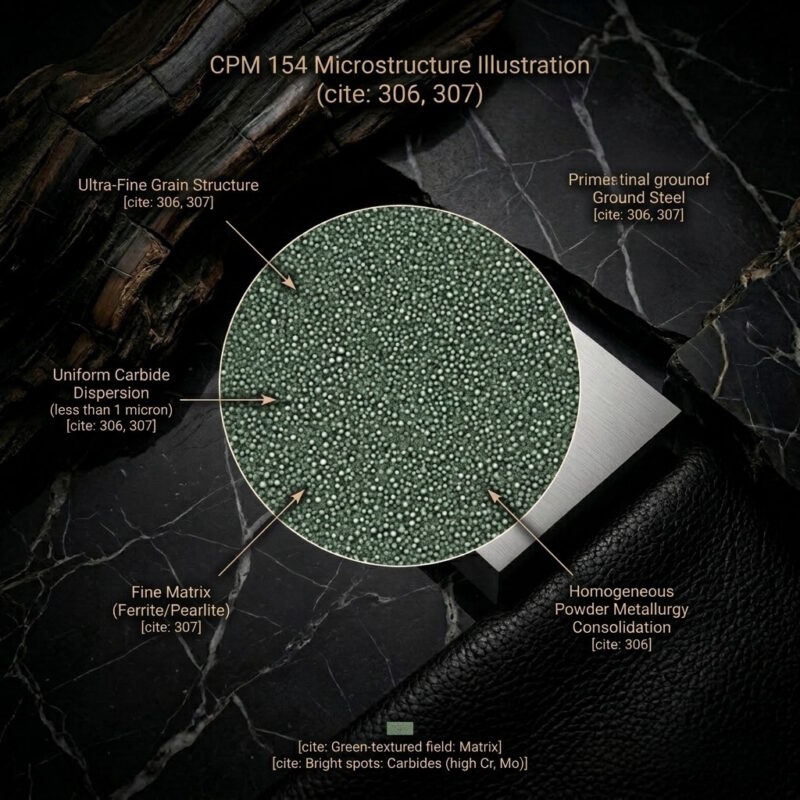
CPM 154, however, boasts nearly double the toughness of conventional 154 CM at the exact same hardness levels. The ultra-fine, uniform carbide distribution means stress is spread evenly across the blade. It deforms slightly under extreme impact rather than snapping or chipping out, making it surprisingly resilient for outdoor, hunting, and hard-use EDC folders.
3. Corrosion Resistance (Grade: B+)
With 14% Chromium, CPM 154 stands as a highly dependable stainless steel. It easily resists rust from pocket sweat, rainy weather, and acidic food juices encountered during kitchen prep.
It is worth noting, however, that because a portion of that 14% chromium is tied up forming carbides, it isn’t completely impervious to staining if left wet or dirty. A simple wipe-down after use is all it takes to keep a mirror-polished or satin-finished CPM 154 blade completely pristine.
4. Ease of Sharpening & Finishing (Grade: A)
For many knife owners, this is CPM 154’s crowning achievement. Many high-end super steels are an absolute nightmare to sharpen, requiring expensive diamond plates and hours of agonizing work.
Because CPM 154’s grain structure is so clean, it behaves beautifully on standard sharpening stones. It takes a spectacularly keen, scary-sharp edge with minimal effort and responds incredibly well to simple stropping.
Furthermore, custom knife makers absolutely adore CPM 154 because it is significantly easier to grind and can be buffed to a flawless, breathtaking mirror polish—something that is virtually impossible to achieve on steels like CPM S30V.
Head-to-Head: CPM 154 vs. The Competition
To fully appreciate where CPM 154 sits in the current knife landscape, let’s put it face-to-face against its most common rivals.
CPM 154 vs. 154 CM
- The Process: 154 CM is conventionally melted and cast; CPM 154 is a modern powdered metallurgy steel.
- Toughness: CPM 154 offers roughly twice the structural toughness, meaning it is vastly more resistant to chipping and breaking.
- User Experience: While they hold an edge similarly, CPM 154 is noticeably easier to sharpen, can take a finer edge, and finishes to a much more beautiful luster.
CPM 154 vs. CPM S30V / S35VN
- Edge Retention: CPM S30V and S35VN contain vanadium carbides, which are harder than the chromium/molybdenum carbides in CPM 154, giving them a slight edge in pure abrasion resistance.
- Sharpening & Crispness: CPM 154 is much easier to sharpen than S30V and tends to take a “crisper,” more laser-like edge. S30V can feel somewhat toothy and micro-chip more easily.
- Finish: CPM 154 wins handily if you prefer a bright satin or mirror finish, whereas S30V/S35VN typically look best with bead-blasted or stonewashed finishes.
- Check Our Guide S35VN Steel Review
CPM 154 vs. MagnaCut
- The Modern Titan: CPM MagnaCut is the newer darling of the knife world, specifically engineered to maximize toughness and corrosion resistance simultaneously.
- Performance: MagnaCut outperforms CPM 154 in raw stain resistance and holds an edge slightly longer.
- Value: Knives utilizing CPM 154 are often more accessible and affordable, offering a timeless, field-proven track record that comes without the “hype tax” associated with newer steels.Check Our Guide
Best Applications for CPM 154 Steel
Because it strikes such an exceptional balance across all performance metrics, CPM 154 is highly versatile. It excels particularly well in three distinct categories:
1. Everyday Carry (EDC) Pocket Knives
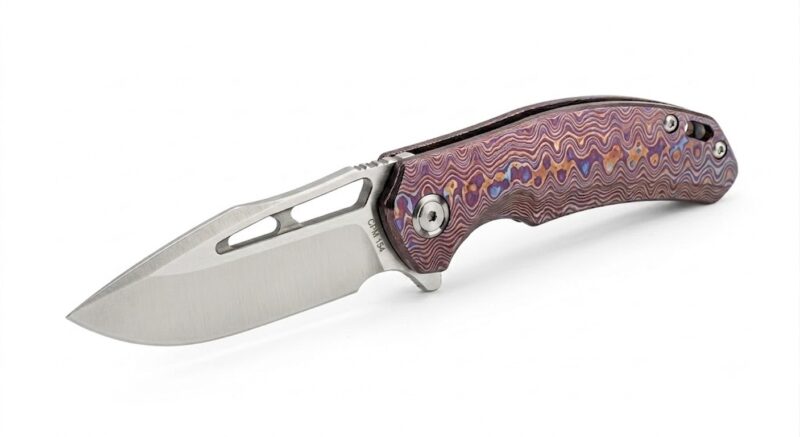
An EDC knife needs to be ready for anything—from slicing an apple to cutting heavy cordage or opening packages. CPM 154 is arguably one of the greatest EDC steels ever made because it doesn’t require specialized equipment to maintain and won’t fail you when pushed hard.
2. Custom and High-End Folders
Custom knifemakers repeatedly turn to CPM 154 because of its workability. It allows them to create breathtaking hand-rubbed satin or mirror-polished blades while ensuring the buyer receives a high-performance tool.
3. Premium Kitchen Cutlery
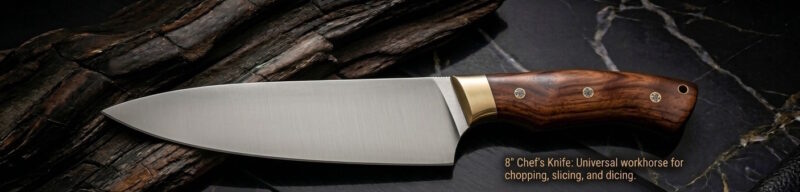
In the kitchen, edge stability and corrosion resistance are paramount. CPM 154’s fine grain structure allows it to be ground down to an incredibly thin, screamingly sharp geometry without becoming brittle, making it a fantastic choice for high-end chef knives and paring tools.
Pros and Cons of CPM 154 Steel
Every blade steel involves a set of engineering trade-offs. Here is a quick, unfiltered look at what makes CPM 154 brilliant, alongside where it falls short.
The Pros:
- Exceptional Balance: One of the most well-rounded user profiles on the market.
- Outstanding Toughness: Powder metallurgy makes it highly resistant to chipping and snapping.
- Dream to Sharpen: Gets incredibly sharp quickly without requiring advanced diamond abrasives.
- Stunning Aesthetics: Capable of taking a breathtaking mirror polish.
- Reliable Stainless Properties: Highly resistant to rust and pitting in normal daily conditions.
The Cons:
- Not a Hyper-Super Steel: Those looking for extreme, record-setting edge retention may prefer steels packed with heavy vanadium like CPM S90V.
- Cost: It is more expensive to produce and purchase than budget conventional steels like D2 or 14C28N.
- Heat Treat Dependent: To get the absolute most out of CPM 154, the heat treatment must be precise, preferably utilizing a cryogenic deep-freeze stage to maximize hardness.
Verdict: Is CPM 154 Steel Still Worth It?
While it may no longer be the newest exotic compound on the block, CPM 154 remains an absolute triumph of knife steel engineering.
It effortlessly bypasses the primary flaw of modern super steels—which are often incredibly difficult to sharpen—while providing vastly superior toughness and structural integrity compared to older, budget alternatives.
If you value a blade that takes a laser-like edge, shrugs off harsh environments, resists chipping under pressure, and can be easily brought back to a razor-sharp finish on a standard stone, a knife made of CPM 154 is an investment you will never regret. It is a true modern classic that continues to earn its place in the pockets and kitchens of serious users worldwide.
Is CPM 154 Good for Kitchen Knives?
One of the most common questions from knife buyers is whether CPM 154 performs well in kitchen environments. The answer is yes. CPM 154 has become one of the most respected stainless steels among custom kitchen knife makers because it offers a balance that many steels struggle to achieve.
Kitchen knives encounter moisture, acidic foods, proteins, and frequent washing. A steel that performs well outdoors does not always excel in food preparation, but CPM 154 adapts remarkably well to both environments.
Benefits of CPM 154 in kitchen knives include:
- Excellent corrosion resistance
- Fine grain structure for keen edges
- Good edge retention
- Easy sharpening
- High toughness
- Low maintenance requirements
Compared to many high-carbide “super steels,” CPM 154 offers a smoother sharpening experience while still delivering premium cutting performance.
Professional chefs often appreciate CPM 154 because it can achieve extremely sharp edges that remain stable during extended food preparation sessions. Home cooks benefit from the fact that the steel does not require the same maintenance as carbon steels such as 52100 or White Steel.
For handmade chef knives, bunka knives, gyutos, and utility knives, CPM 154 remains one of the best all-around stainless steel choices available today.
CPM 154 vs N690
N690 is one of the most popular European stainless steels used in both kitchen and outdoor knives.
CPM 154 Advantages
- Better edge retention
- Finer carbide structure
- Improved cutting feel
- Superior wear resistance
- Better premium appeal
N690 Advantages
- Lower cost
- Easier manufacturing
- Widely available
Comparison Table
| Property | CPM 154 | N690 |
|---|---|---|
| Corrosion Resistance | 8.5/10 | 9/10 |
| Edge Retention | 8.5/10 | 7.5/10 |
| Toughness | 8/10 | 8/10 |
| Sharpening Ease | 8.5/10 | 8/10 |
| Kitchen Performance | 9/10 | 8/10 |
While N690 remains an excellent value steel, CPM 154 generally offers a more refined cutting experience.
Check Our Guide N690 Steel Review
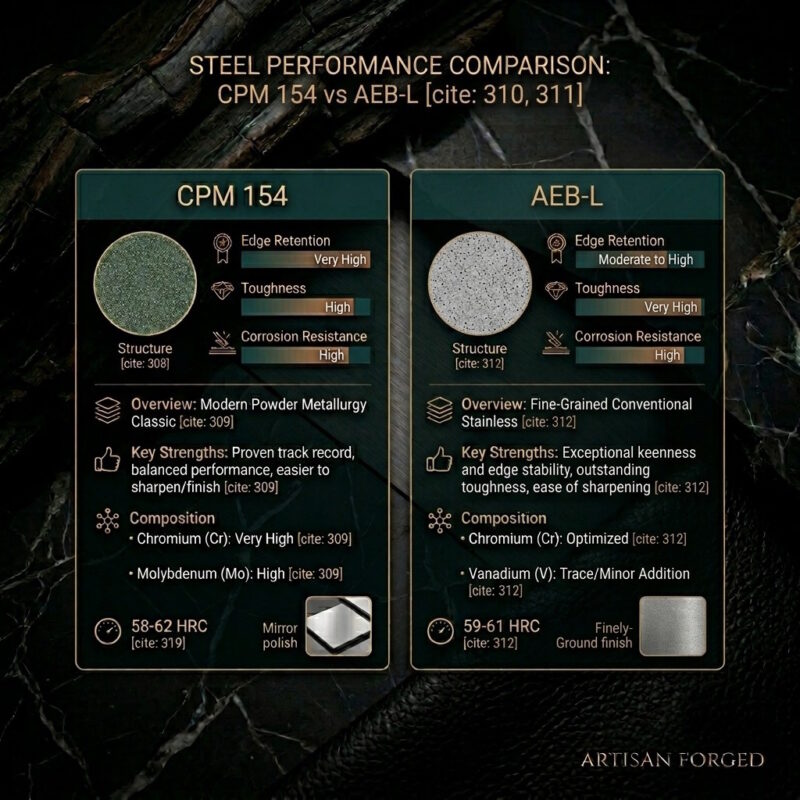
CPM 154 vs AEB-L
AEB-L is often called the “razor blade steel” because of its exceptionally fine grain structure.
AEB-L Advantages
- Outstanding toughness
- Extremely easy sharpening
- Superb fine-edge performance
CPM 154 Advantages
- Better edge retention
- Better wear resistance
- Higher hardness potential
Comparison Table
| Property | CPM 154 | AEB-L |
|---|---|---|
| Corrosion Resistance | 8.5/10 | 8.5/10 |
| Edge Retention | 8.5/10 | 7/10 |
| Toughness | 8/10 | 9/10 |
| Sharpening Ease | 8.5/10 | 10/10 |
| Wear Resistance | 8.5/10 | 6.5/10 |
For users who enjoy frequent sharpening and ultra-fine edges, AEB-L is difficult to beat. For those seeking longer edge life, CPM 154 is often the better choice.
Check Our Guide AEB-L Steel Review
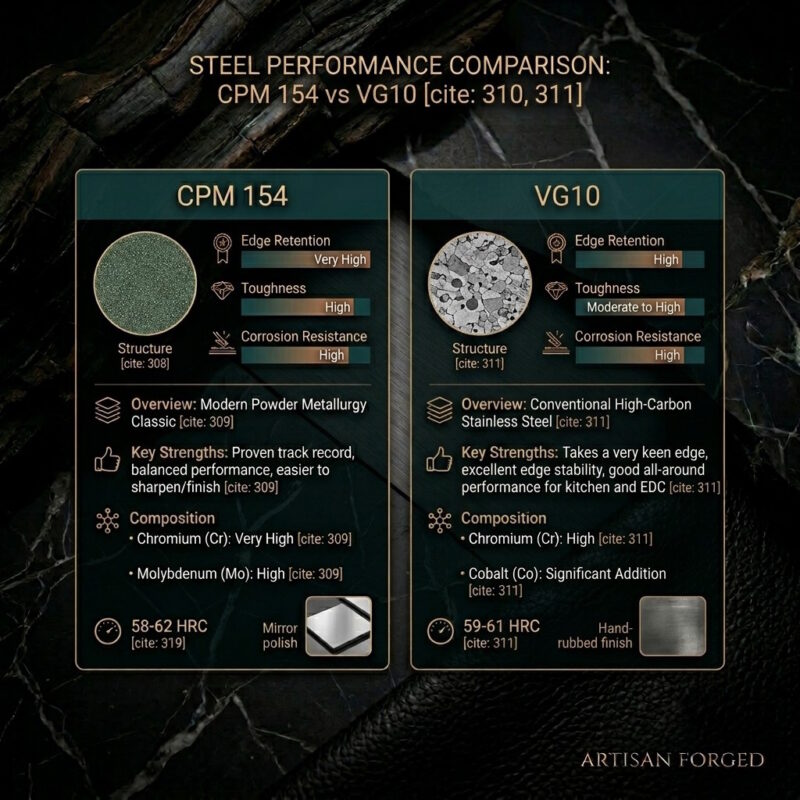
CPM 154 vs VG10
VG10 remains one of the most common premium Japanese knife steels.
VG10 Advantages
- Wide availability
- Proven performance
- Common in Japanese kitchen knives
CPM 154 Advantages
- Better toughness
- Better edge stability
- Easier deburring
- More predictable sharpening
Comparison Table
| Property | CPM 154 | VG10 |
|---|---|---|
| Corrosion Resistance | 8.5/10 | 9/10 |
| Edge Retention | 8.5/10 | 8/10 |
| Toughness | 8/10 | 6.5/10 |
| Sharpening Ease | 8.5/10 | 7/10 |
| Edge Stability | 9/10 | 7/10 |
Many custom makers prefer CPM 154 because it is less prone to micro-chipping than VG10.
Check Our Guide VG10 Steel Review
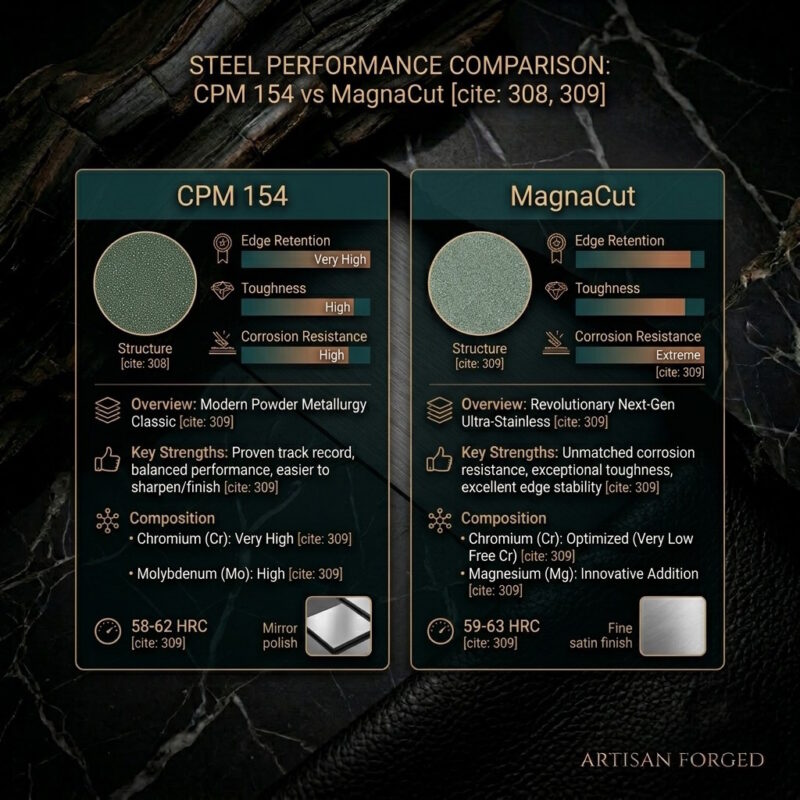
CPM 154 vs MagnaCut
MagnaCut has become one of the most talked-about knife steels in recent years.
MagnaCut Advantages
- Better corrosion resistance
- Better toughness
- Improved balance
CPM 154 Advantages
- Easier availability
- Lower cost
- Proven track record
Comparison Table
| Property | CPM 154 | MagnaCut |
|---|---|---|
| Corrosion Resistance | 8.5/10 | 10/10 |
| Edge Retention | 8.5/10 | 9/10 |
| Toughness | 8/10 | 9.5/10 |
| Sharpening Ease | 8.5/10 | 8/10 |
| Overall Balance | 8.5/10 | 9.5/10 |
MagnaCut may represent the next generation of stainless knife steel, but CPM 154 remains highly competitive.
Check Our Guide MagnaCut Steel Review
CPM 154 vs S35VN
S35VN was specifically designed as an upgrade to S30V and has become one of the most successful premium stainless steels.
CPM 154 Advantages
- Easier sharpening
- Lower manufacturing cost
- Excellent edge stability
S35VN Advantages
- Better wear resistance
- Longer edge retention
- Improved corrosion resistance
Comparison Table
| Property | CPM 154 | S35VN |
|---|---|---|
| Corrosion Resistance | 8.5/10 | 9/10 |
| Edge Retention | 8.5/10 | 9/10 |
| Toughness | 8/10 | 8.5/10 |
| Sharpening Ease | 8.5/10 | 7.5/10 |
| Value | 9/10 | 8/10 |
Common Myths About CPM 154
Myth #1: CPM 154 Is Just 154CM
Not exactly.
While both steels share similar chemistry, the CPM powder metallurgy process creates a much finer carbide structure, resulting in improved toughness and edge stability.
Myth #2: CPM 154 Is Outdated
False.
Although newer steels receive more marketing attention, CPM 154 remains one of the most respected stainless steels in the custom knife industry.
Myth #3: CPM 154 Cannot Compete With Modern Powder Steels
False.
CPM 154 still competes surprisingly well against many modern premium steels, especially in kitchen applications.
Myth #4: Higher Hardness Always Means Better Performance
False.
Blade geometry, heat treatment, and intended use matter more than hardness alone.
Real-World Performance
At Yashka Designs, we regularly evaluate premium knife steels used in custom kitchen and utility knives. While laboratory testing provides useful data, real-world performance often depends on blade geometry, heat treatment, and intended application.
CPM 154 consistently performs well because it avoids major weaknesses. It may not be the absolute best in every category, but it ranks highly across all important performance areas.
This balance explains why so many custom knife makers continue to rely on CPM 154 despite the arrival of newer steels.
CPM 154 Performance Ratings
| Category | Rating |
|---|---|
| Corrosion Resistance | 8.5/10 |
| Edge Retention | 8.5/10 |
| Toughness | 8/10 |
| Sharpening Ease | 8.5/10 |
| Edge Stability | 9/10 |
| Kitchen Performance | 9/10 |
| Outdoor Performance | 8.5/10 |
| Overall Balance | 9/10 |
Quick Questions and Answers
Is CPM 154 stainless steel?
Yes. CPM 154 offers excellent corrosion resistance and is considered a premium stainless knife steel.
Is CPM 154 better than 154CM?
Generally yes. The CPM manufacturing process produces a finer and more uniform microstructure.
Is CPM 154 good for kitchen knives?
Absolutely. CPM 154 is one of the most popular stainless steels among custom kitchen knife makers.
What hardness is CPM 154?
Most knives are heat treated between 59 and 62 HRC.
Is CPM 154 easy to sharpen?
Yes. Compared to many modern super steels, CPM 154 is relatively easy to sharpen and maintain.
CPM 154 vs MagnaCut?
MagnaCut offers superior overall performance, but CPM 154 remains a highly capable and often more affordable option.
CPM 154 vs S35VN?
S35VN offers slightly better wear resistance, while CPM 154 is generally easier to sharpen.
This article is for independent informational purposes only and is not affiliated with, sponsored by, or endorsed by any steel manufacturer. All product names, trademarks, and registered trademarks are the property of their respective owners.
CPM 154 Steel Review