X50CrMoV15 vs N690
An Independent Guide
When comparing knife steels, X50CrMoV15 and N690 can look surprisingly similar at first glance. Both are stainless martensitic steels, both are widely suitable for knife blades, both contain chromium, molybdenum, and vanadium, and both can produce excellent everyday knives when they are properly heat treated and ground.
But they are not simply two versions of the same steel.
The difference becomes much clearer when you look at their carbon content, alloy balance, achievable hardness, carbide structure, edge stability, sharpening behavior, corrosion resistance, and the type of knife geometry they suit best.
X50CrMoV15 is generally a lower-carbon, highly practical stainless cutlery steel. It is known for being forgiving, easy to maintain, relatively easy to sharpen, and well suited to kitchen knives where toughness, corrosion resistance, and simple maintenance matter more than maximum edge retention.
N690 moves the design considerably further toward higher hardness and wear resistance. Its higher carbon content, higher chromium content, molybdenum addition, and cobalt addition allow it to occupy a different performance range. It can hold a fine working edge longer than X50CrMoV15, while still retaining good stainless characteristics.
That does not automatically make N690 the better steel for every knife.
For a chef who values easy sharpening, toughness, and predictable everyday behavior, X50CrMoV15 can be the more sensible choice. For someone who wants longer edge life and is comfortable with a harder blade, N690 is usually the more capable option.
The important question is therefore not simply:
Which steel is better?
It is:
Which steel better matches the knife, the cutting work, and the person using it?
This article examines that question in detail.
X50CrMoV15 vs N690: The Short Answer
If you want the simplest possible conclusion, it is this:
N690 is generally the stronger choice for edge retention and higher-performance cutting, while X50CrMoV15 is generally the easier and more forgiving choice for everyday kitchen use.
N690 has substantially more carbon than X50CrMoV15. It also contains more chromium and molybdenum and approximately 1.5% cobalt. Standard technical data identifies N690 as 1.4528 / X105CrCoMo18-2, with approximately 1.08% carbon, 17.3% chromium, 1.1% molybdenum, 0.1% vanadium, and 1.5% cobalt.
X50CrMoV15, identified as material number 1.4116, contains approximately 0.45–0.55% carbon, 14–15% chromium, 0.50–0.80% molybdenum, and 0.10–0.20% vanadium.
That difference in chemistry matters.
The higher carbon and alloy content of N690 support a harder, more wear-resistant blade. X50CrMoV15 uses a more moderate alloy design that favors a useful balance of corrosion resistance, toughness, manufacturability, and sharpening convenience.
So, in broad terms:
- Edge retention: N690 wins
- Maximum achievable hardness: N690 wins
- Corrosion resistance: N690 generally wins
- Ease of sharpening: X50CrMoV15 generally wins
- Forgiving everyday behavior: X50CrMoV15 generally wins
- Wear resistance: N690 wins
- Fine-edge stability: N690 generally wins when properly heat treated
- Budget-friendly kitchen practicality: X50CrMoV15 is difficult to beat
- High-performance all-purpose knife: N690 has the advantage
But those conclusions need some qualification.
Steel chemistry establishes potential. It does not manufacture a good knife by itself.
What Is X50CrMoV15?
X50CrMoV15 is a European stainless martensitic steel identified by material number 1.4116.
The designation gives some useful information about its composition. It contains roughly 0.5% carbon and around 15% chromium, with molybdenum and vanadium additions. The actual permitted composition is a range rather than one single chemical recipe. Technical material data lists carbon at approximately 0.45–0.55%, chromium at 14–15%, molybdenum at 0.50–0.80%, and vanadium at 0.10–0.20%.
The steel was designed as a corrosion-resistant martensitic grade suitable for cutting applications. Material references specifically list cutlery and knives among its applications.
The important characteristic is its balance.
X50CrMoV15 does not try to achieve the extreme wear resistance of modern high-alloy premium steels. Instead, it gives the knife maker a material that can produce a useful combination of:
- corrosion resistance
- toughness
- adequate hardness
- reasonable edge retention
- easy sharpening
- practical manufacturing
- good everyday behavior
This makes it particularly logical for kitchen knives.
A kitchen knife is not used under laboratory conditions. It is exposed to water, food acids, salt, impact, twisting, cutting boards, repeated sharpening, and sometimes poor maintenance.
A steel that is slightly less impressive on an edge-retention test can therefore be more useful in an actual kitchen if it is easier to maintain and less demanding.
That is one of the main reasons X50CrMoV15 has remained relevant.
Check Our Guide X50CrMoV15 Steel Review: The German Best Standard for Kitchen Knives(DIN 1.4116)
What Is N690?
N690 is another stainless martensitic knife steel, but its chemistry is considerably more heavily alloyed.
Technical specifications identify it as 1.4528 / X105CrCoMo18-2. Typical published composition is approximately:
- Carbon: 1.08%
- Chromium: 17.3%
- Molybdenum: 1.1%
- Vanadium: 0.1%
- Cobalt: 1.5%
- Silicon: 0.4%
- Manganese: 0.4%
The most important difference compared with X50CrMoV15 is immediately visible.
N690 contains more than twice as much carbon.
That is a major metallurgical difference.
Carbon is not simply a number that makes a steel “better.” Its effect depends on the rest of the alloy and the heat-treatment process. But in a martensitic knife steel, higher carbon allows a substantially harder structure and contributes to the formation of carbides.
N690 also contains considerably more chromium and molybdenum than X50CrMoV15, while the cobalt addition is another important part of its formulation.
Technical references describe N690 as having high corrosion resistance and very high wear resistance, while also retaining good toughness and ductility for its class.
This gives N690 a different personality from X50CrMoV15.
It is still a practical stainless steel.
But it is designed to push performance further toward hardness and wear resistance.
Check Our Guide N690 Steel Review
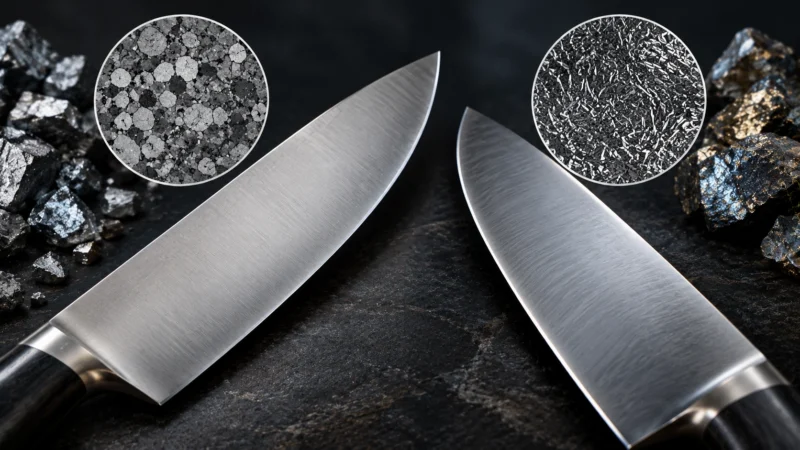
X50CrMoV15 vs N690: The Chemistry Difference
The easiest way to understand the two steels is not to memorize every alloying percentage. Instead, look at what the major elements are doing.
Carbon
This is probably the biggest difference.
X50CrMoV15 contains approximately 0.5% carbon.
N690 contains approximately 1.08% carbon.
That difference gives N690 considerably more potential for high hardness and carbide formation.
In a knife, that can translate into longer edge life and greater resistance to wear.
But higher carbon does not mean that a blade automatically holds its edge twice as long.
The final performance depends on:
- heat treatment
- hardness
- carbide formation
- carbide distribution
- blade geometry
- edge angle
- cutting material
- sharpening quality
- surface being cut
This is why simply comparing carbon percentages is not enough.
Still, carbon gives N690 a substantial advantage in potential edge retention.
Chromium
X50CrMoV15 contains approximately 14–15% chromium.
N690 contains approximately 17.3% chromium.
Chromium is central to stainless behavior because sufficient chromium in the steel’s matrix allows formation of a passive oxide layer that protects the surface.
But there is an important misconception here.
More total chromium does not automatically translate into a directly proportional increase in corrosion resistance.
Some chromium is tied up in carbides rather than remaining dissolved in the matrix. The actual corrosion behavior therefore depends on heat treatment and microstructure as well as nominal chemistry.
Even so, N690 has a strong stainless-steel chemistry and is generally capable of excellent corrosion resistance when properly processed.
X50CrMoV15 is also genuinely stainless and highly practical in kitchen environments.
Neither steel should be considered rust-proof.
Molybdenum
X50CrMoV15 contains approximately 0.50–0.80% molybdenum.
N690 contains approximately 1.1%.
Molybdenum contributes to corrosion resistance and influences the steel’s hardenability and carbide structure.
Again, it is not useful to think of molybdenum as a simple “corrosion score.”
It works as part of the entire alloy system.
The higher molybdenum level in N690 contributes to its more heavily alloyed character and supports its ability to combine hardness, wear resistance, and stainless performance.
Vanadium
Both steels contain vanadium, but in relatively small quantities.
X50CrMoV15 is specified around 0.10–0.20% vanadium, while N690 is typically around 0.10%.
This is worth mentioning because knife enthusiasts sometimes see “V” in a steel designation and assume that a steel must therefore have substantial vanadium carbide content.
That is not the case here.
Neither X50CrMoV15 nor N690 should be confused with modern high-vanadium powder metallurgy steels.
Their vanadium contribution is comparatively modest.
Cobalt
This is one of the most obvious chemical differences.
X50CrMoV15 does not have cobalt as a defining alloying element.
N690 contains approximately 1.5% cobalt.
Cobalt does not function like chromium or carbon in the simplistic sense of “more cobalt equals more edge retention.”
Its role is connected to the behavior of the steel during heat treatment and its overall alloy design.
This is one reason N690 should be understood as a deliberately engineered higher-performance stainless steel rather than simply “X50CrMoV15 with more carbon.”
Why Does N690 Usually Hold an Edge Longer?
This is one of the most important differences between the two steels.
A knife’s edge becomes dull primarily because material is removed from, deformed at, or damaged around the apex during cutting.
Wear resistance slows the loss of material.
N690 has a significant advantage in this area because its higher carbon content and more heavily alloyed structure allow it to develop more hard carbide phases than X50CrMoV15.
Combined with higher achievable hardness, this gives N690 better resistance to abrasive wear.
In practical terms, that means:
If two knives have similar geometry and are properly heat treated, an N690 blade will generally stay cutting effectively for longer than an X50CrMoV15 blade.
That does not mean the difference will always be dramatic.
Suppose one person uses a chef knife to cut soft vegetables, boneless meat, herbs, and fruit on a suitable cutting board.
Another person uses the knife to break down fibrous foods, cut cardboard, process hard ingredients, or work in a commercial kitchen for hours every day.
The difference between the steels will become much more noticeable in the second situation.
Edge retention is therefore partly about workload.
Is N690 Harder Than X50CrMoV15?
Generally, yes.
N690 is commonly used in the high-50s to low-60s HRC range, depending on heat treatment and application. Independent knife-steel references commonly report approximately 58–61 HRC, while technical information indicates that the actual hardness depends on the treatment used.
X50CrMoV15 is commonly encountered at lower knife hardness levels.
That difference has important consequences.
A harder blade can support a thinner and more stable edge without deforming as readily.
But hardness always involves trade-offs.
The goal is not to make every knife as hard as physically possible.
A knife that is too hard for its geometry and intended use can become more vulnerable to chipping or breakage.
A kitchen knife may benefit from a somewhat softer, tougher steel because kitchen cutting frequently involves accidental contact with hard cutting boards, bones, seeds, joints, or twisting forces.
This is where X50CrMoV15 has an advantage.
Check Our Guide What Is HRC? Understanding Rockwell Hardness in Kitchen Knives
Toughness: X50CrMoV15 vs N690
Toughness describes the ability of a material to resist cracking and catastrophic fracture when subjected to stress.
It is different from hardness.
A steel can be very hard and still have reasonable toughness, but increasing hardness often reduces the margin for abuse.
N690 is not an inherently fragile steel.
Technical descriptions classify its toughness and ductility as good.
However, X50CrMoV15’s lower-carbon design and common lower hardness make it particularly forgiving in kitchen applications.
This is important when choosing a chef knife.
Imagine that you accidentally twist the knife while cutting through a dense ingredient.
A more forgiving steel is more likely to deform or roll at the edge rather than chip.
The user can then restore the edge with sharpening or honing.
A harder, more wear-resistant steel can resist wear better, but the consequences of abuse can be different.
This is why “harder” should never be treated as synonymous with “better.”
Check Our Guide Wear Resistance vs Toughness: Understanding the Most Important Knife Steel Trade-Off
Corrosion Resistance: Which Is Better?
Both are stainless steels.
Both are very suitable for kitchen knives.
But N690 has a chemical advantage in nominal chromium and molybdenum content.
N690 contains approximately 17.3% chromium compared with approximately 14–15% for X50CrMoV15.
That gives N690 excellent potential corrosion resistance.
However, real-world corrosion resistance is more complicated.
A blade’s corrosion behavior depends on:
- alloy composition
- heat treatment
- surface finish
- chromium remaining in the matrix
- carbide formation
- exposure to salt
- exposure to acids
- humidity
- cleaning habits
- prolonged contact with food residue
A clean, properly finished X50CrMoV15 kitchen knife can perform extremely well against corrosion.
You do not need a premium steel simply because you live in a humid environment.
Likewise, an N690 knife should not be left wet and dirty overnight simply because it is stainless.
Stainless means high resistance to corrosion, not immunity.
Which Steel Is Easier to Sharpen?
This is one area where X50CrMoV15 has a very practical advantage.
N690 is harder and more wear resistant.
That means there is more material resisting abrasive removal when you sharpen it.
X50CrMoV15 is comparatively easy to bring back to a sharp edge.
For someone who sharpens knives at home with conventional water stones, ceramic systems, or other sharpening equipment, this can make a real difference.
You may notice that X50CrMoV15 responds quickly to a sharpening stone.
N690 generally requires more deliberate work.
That does not make N690 difficult to sharpen.
It simply means that you should not expect the same speed.
This produces an interesting trade-off:
X50CrMoV15 dulls sooner but is faster to sharpen.
N690 stays sharp longer but generally takes more effort when sharpening becomes necessary.
For some users, that makes the two steels feel much closer in overall convenience than edge-retention numbers suggest.
Check Our Guide All Kinds of Knife Sharpening Tools
Edge Retention Is Not the Same as Cutting Performance
This distinction deserves special attention.
A knife that stays sharp longer is not automatically a better cutting knife.
Geometry can have a huge influence on cutting performance.
Consider two knives:
Knife A uses N690 but has a thick blade and relatively thick edge.
Knife B uses X50CrMoV15 but has a thin, carefully ground edge.
Knife B may feel noticeably sharper and more efficient when slicing food.
This is why steel comparisons should never be separated completely from blade geometry.
The steel determines what the blade can potentially do.
The geometry determines how efficiently it actually cuts.
Heat treatment determines how effectively the steel’s potential is converted into usable performance.
The final knife is the combination.
Check Our Guide Edge Retention Explained: 10 Factors What Makes a Knife Stay Sharp Longer
X50CrMoV15 vs N690 for Kitchen Knives
This is probably the most relevant part of the comparison for many readers.
X50CrMoV15 for kitchen knives
X50CrMoV15 is an excellent choice when you want:
- easy maintenance
- good corrosion resistance
- straightforward sharpening
- forgiving behavior
- good toughness
- practical edge retention
- reliable everyday performance
It is particularly suitable for people who prefer to sharpen regularly rather than wait a long time between sharpening sessions.
A chef who uses a honing rod or ceramic honing tool regularly may find that a moderately hard X50CrMoV15 knife remains useful for a long time even though its theoretical edge retention is below that of N690.
It is also a good steel for people who do not want to treat their kitchen knife like a delicate piece of equipment.
N690 for kitchen knives
N690 becomes attractive when you want:
- longer edge retention
- higher hardness
- good corrosion resistance
- better wear resistance
- a finer, more stable edge
- a knife that requires less frequent sharpening
A well-made N690 chef knife can be an excellent everyday kitchen tool.
Its corrosion resistance makes it appropriate for food preparation, while its higher hardness gives it a performance advantage over X50CrMoV15 in edge retention.
But the blade should still be used intelligently.
N690 is not a license to cut bones, frozen food, glass, ceramic plates, or other inappropriate materials.
Which Is Better for a Chef Knife?
There is no universal answer.
For a traditional all-purpose Western chef knife, X50CrMoV15 makes a lot of sense.
The knife can be reasonably hard, tough, stainless, easy to sharpen, and forgiving.
For a thinner, more performance-oriented chef knife, N690 has greater potential.
The higher hardness allows the maker to pursue better edge stability and longer wear resistance.
But the geometry must match the steel.
A very thin N690 edge can perform beautifully when used correctly.
It can also be damaged if the user expects it to behave like a heavy-duty chopping tool.
The same principle applies to X50CrMoV15, although the steel gives the user a somewhat larger margin for abuse.
Which Steel Is Better for Outdoor Knives?
The answer becomes more favorable toward N690.
Outdoor knives often benefit from:
- higher wear resistance
- good corrosion resistance
- long edge life
- reasonable toughness
- resistance to moisture and environmental exposure
N690 offers a very attractive combination of these properties.
It is still not a dedicated extreme-toughness steel, so the blade’s geometry and intended use remain important.
X50CrMoV15 can certainly work outdoors, particularly when easy sharpening and toughness are priorities.
But if the goal is a general-purpose outdoor knife that should retain a working edge for a longer time, N690 is usually the stronger choice.
Which Is Better for Hunting Knives?
Again, N690 generally has the advantage if edge retention is the priority.
A hunting knife may perform repeated cutting through meat, connective tissue, hide, and other abrasive materials.
The higher wear resistance of N690 can be valuable.
However, a hunting knife must also be tough enough for its geometry and intended work.
Neither steel should be selected solely because it has a higher HRC number.
For a thin skinning knife, the edge geometry may be more important than the difference between these steels.
For a heavier hunting knife, toughness and blade thickness become increasingly important.
Check Our Guide Best Hunting Knives for Groomsmen Gifts
What About Boning?
This is where the comparison becomes more nuanced.
Boning knives often benefit from toughness and controlled flexibility.
If the knife will frequently encounter bone or require some lateral movement, X50CrMoV15 can be an attractive option.
N690 can also work extremely well when properly designed, but its higher hardness does not automatically make it ideal for abusive lateral loads.
A thin hard edge should not be twisted sideways.
This is not a weakness unique to N690.
It is simply a fundamental rule of knife use.
Does N690 Need Special Maintenance?
Not particularly.
That is one of its advantages.
Despite its higher performance level, N690 remains a stainless steel with strong corrosion resistance.
Normal kitchen care is sufficient:
- Wash the blade after use.
- Dry it thoroughly.
- Do not leave acidic or salty food sitting on the blade.
- Avoid unnecessary dishwasher exposure.
- Sharpen before the edge becomes severely damaged.
- Store the knife dry.
The same advice applies to X50CrMoV15.
In fact, proper maintenance often matters more than small differences in stainless chemistry.
A well-maintained X50CrMoV15 blade can remain attractive and functional for many years.
A neglected N690 blade can still develop staining or corrosion.
Does N690 Stay Sharp Twice as Long?
No responsible steel comparison should make such a simple promise.
The carbon content of N690 is more than twice that of X50CrMoV15, but edge retention does not scale directly with carbon percentage.
Real edge retention depends on several interacting factors.
For example:
- A very thin edge can cut efficiently but may deform more easily.
- A thick edge can survive abuse but require more force.
- A polished edge can behave differently from a coarse edge.
- Harder heat treatment can improve edge stability but reduce toughness.
- Cutting cardboard is much more abrasive than cutting soft vegetables.
- Cutting meat is different from cutting hardwood.
- A cutting board can affect edge deformation.
- Sharpening angle changes edge strength.
Therefore, the scientifically honest conclusion is simply that N690 has higher edge-retention potential than X50CrMoV15 under comparable conditions.
It does not mean every N690 knife will outperform every X50CrMoV15 knife.
Heat Treatment Changes Everything
One of the biggest mistakes in online steel comparisons is treating the chemical composition as the finished product.
It is not.
A steel composition is only the starting point.
The manufacturer or maker must transform that material through heat treatment.
The heat-treatment process affects:
- hardness
- retained austenite
- carbide formation
- grain structure
- toughness
- dimensional stability
- final cutting performance
N690 technical data includes hardening and tempering information, but the exact treatment used for a particular knife can differ according to blade thickness, manufacturing process, target hardness, and intended application.
The same principle applies to X50CrMoV15.
This is why two knives made from the same steel can perform noticeably differently.
If one knife has excellent heat treatment and the other has mediocre heat treatment, the steel name alone will not tell you which knife is better.
Check Our Guide Different Heat Treatment Methods Explained
Hardness Versus Toughness
It is useful to think about hardness and toughness as two different forms of resistance.
Hardness helps the edge resist deformation and wear.
Toughness helps the blade survive impact and stress without cracking.
Increasing hardness can improve edge stability.
Increasing hardness too far, however, can reduce the margin for abuse.
This is why the ideal hardness depends on the knife.
A delicate slicing knife can benefit from high hardness.
A heavy-duty camp knife may benefit from more toughness.
A chef knife sits somewhere in between.
X50CrMoV15 naturally fits the more forgiving end of that spectrum.
N690 allows the maker to move further toward hardness and wear resistance.
Neither philosophy is inherently wrong.
Which Steel Has Better Edge Stability?
N690 generally has the advantage when the comparison is between properly heat-treated blades of similar geometry.
Higher hardness allows the apex to resist deformation more effectively.
That matters when using a thin edge.
However, edge stability is not simply hardness.
A blade can have excellent hardness but poor edge stability if the geometry is inappropriate.
For example, a very thin edge subjected to heavy twisting forces can fail regardless of whether the steel is X50CrMoV15 or N690.
This is why edge stability should be understood as the interaction between:
steel + heat treatment + geometry + edge angle + use.
Which Steel Rolls Instead of Chips?
This is a difficult question because the answer depends on the exact hardness and geometry.
In general, the lower-hardness behavior commonly associated with X50CrMoV15 makes it more likely to deform or roll under certain forms of misuse rather than fracture suddenly.
That can be beneficial in a kitchen.
A rolled edge can often be restored quickly.
A chipped edge requires removing enough material to recreate the damaged apex.
N690, when hardened more aggressively, has less tolerance for certain types of lateral abuse.
That does not mean N690 automatically chips.
It means that the user should respect the edge.
If you use either steel appropriately, both can provide excellent service.
Which Steel Is Better for Beginners?
This is one of the easiest questions to answer.
X50CrMoV15 is usually the more beginner-friendly steel.
Why?
Because it is forgiving.
A beginner is likely to:
- use the wrong sharpening angle
- sharpen too aggressively
- occasionally twist the blade
- cut on an unsuitable board
- allow the knife to become dull
- use a honing rod incorrectly
- accidentally contact hard materials
X50CrMoV15 tolerates this kind of imperfect use relatively well.
N690 rewards better technique.
If you already understand sharpening and knife maintenance, the advantages of N690 become more meaningful.
Which Steel Is Better for Someone Who Hates Sharpening?
N690.
If sharpening is your least favorite part of knife ownership, the additional wear resistance is useful.
You may go longer between full sharpening sessions.
However, no steel eliminates maintenance.
Even a highly wear-resistant steel eventually becomes dull.
And once it does, N690 will generally require more effort to sharpen than X50CrMoV15.
So the choice is:
Sharpen more often and more easily: X50CrMoV15.
Sharpen less often but spend more time when you do: N690.
That is a very practical way to think about the difference.
Which Steel Is Better for Professional Kitchens?
This depends heavily on the kitchen.
In a busy professional kitchen, durability and maintenance convenience can be more important than theoretical edge retention.
X50CrMoV15 has an appealing combination of toughness, corrosion resistance, and easy sharpening.
A chef can restore its edge quickly.
N690 can be excellent when a knife is used heavily for slicing and the chef wants to reduce sharpening frequency.
But professional kitchens can be hard on knives.
Knives may be:
- washed frequently
- handled by multiple people
- used on large cutting boards
- exposed to acidic foods
- sharpened quickly rather than carefully
- subjected to occasional mistakes
For that environment, X50CrMoV15 remains extremely practical.
X50CrMoV15 vs N690 for Home Cooks
For the average home cook, the difference may be less dramatic than steel enthusiasts expect.
A home cook may use a chef knife for 20–40 minutes a day rather than several hours.
In that environment, either steel can stay useful for a long time.
The home cook may actually appreciate X50CrMoV15 because sharpening is simple.
N690 becomes more attractive if the user wants a knife that retains a crisp edge for longer periods and is willing to invest more effort into sharpening when necessary.
Does N690 Cut Better Than X50CrMoV15?
Not necessarily.
This is one of the most important points in the entire comparison.
Steel does not determine cutting performance by itself.
Imagine two knives:
- N690 with a thick edge
- X50CrMoV15 with a thin edge
The X50CrMoV15 knife may cut noticeably better.
The N690 blade may retain its edge longer.
Those are two different characteristics.
A well-designed knife made from X50CrMoV15 can be an outstanding cutter.
A poorly designed knife made from N690 can be disappointing.
Never buy a knife solely because the steel name sounds more advanced.
The Importance of Blade Geometry
Geometry includes:
- blade thickness
- primary grind
- secondary bevel
- edge angle
- behind-the-edge thickness
- blade height
- distal taper
For kitchen knives, the thickness immediately behind the edge is particularly important.
A thin blade generally passes through food with less resistance.
That can make a moderate steel feel extremely sharp.
N690 can support thin edges very well, but it still needs appropriate geometry.
X50CrMoV15 can also be ground thin, although the lower hardness means the designer must consider edge deformation more carefully.
This is another area where a skilled maker can make a bigger practical difference than simply changing steel.
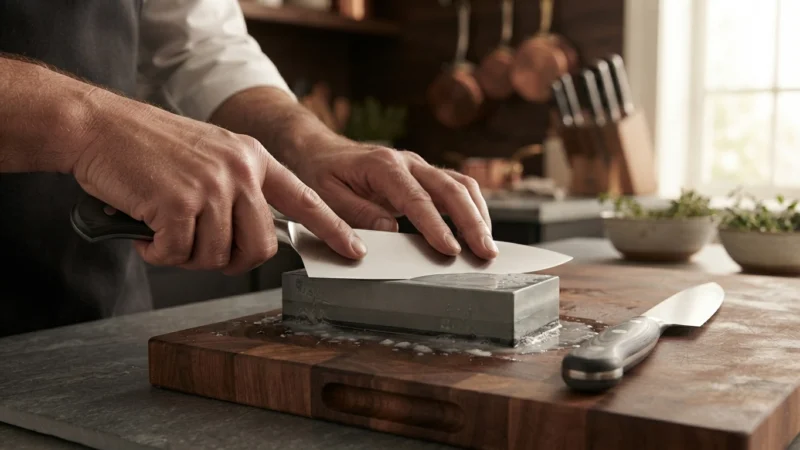
Sharpening X50CrMoV15
X50CrMoV15 is relatively friendly to conventional sharpening systems.
Water stones work well.
Ceramic abrasives work well.
Diamond abrasives also work, although they are not necessarily required for normal maintenance.
Because the steel is not extremely wear resistant, you can usually remove material at a reasonable rate.
For a beginner, this makes learning sharpening less frustrating.
You can see and feel the edge responding.
The important thing is not to sharpen excessively.
A common beginner mistake is removing too much metal because the knife “doesn’t feel sharp enough.”
Good sharpening is controlled sharpening.
Sharpening N690
N690 benefits from good sharpening technique.
A quality abrasive is important.
Diamond or high-quality ceramic abrasives can make the process more efficient, although conventional stones can also work.
The goal is to maintain a consistent angle and avoid unnecessary grinding.
Because N690 is more wear resistant, patience matters.
Do not keep changing the angle.
Do not press excessively hard.
Do not assume that a rougher stone will always sharpen faster.
A controlled progression is generally better.
Once properly sharpened, N690 can reward the effort with a long-lasting edge.
Which Steel Is More Forgiving of Poor Sharpening?
X50CrMoV15.
A beginner can generally correct mistakes relatively easily.
If the edge is slightly rolled, it can often be restored without removing a large amount of material.
N690 can also be sharpened successfully by beginners, but it rewards greater consistency.
The more expensive the knife and the harder the steel, the more worthwhile it becomes to learn proper sharpening technique.
X50CrMoV15 vs N690: Food and Acid Exposure
Kitchen knives encounter acidic foods every day.
Tomatoes, citrus, onions, vinegar-based sauces, fruit, and many other ingredients can attack steel surfaces.
Both X50CrMoV15 and N690 are well suited to this environment because they are stainless steels.
N690’s higher chromium content gives it strong corrosion resistance potential.
X50CrMoV15 also performs very well in normal kitchen conditions. Material references classify it as corrosion-resistant martensitic steel and specifically list cutlery among its applications.
The practical lesson is simple:
Do not choose between these steels based only on corrosion resistance.
Both are sufficiently stainless for ordinary kitchen use.
The more meaningful difference is what happens to the edge.
Is X50CrMoV15 a Cheap Steel?
It is better described as a practical and widely used steel rather than simply a cheap steel.
There is nothing inherently low quality about a well-made X50CrMoV15 blade.
In fact, the steel’s balanced properties are exactly why it has remained useful for cutlery.
A knife does not become high quality simply because its steel costs more.
A well-designed X50CrMoV15 knife with excellent heat treatment and geometry can outperform a poorly made knife using a much more expensive steel.
The steel is only one part of the system.
Is N690 a Premium Steel?
N690 sits in a more performance-oriented category than basic stainless cutlery steels.
It offers higher hardness and wear resistance while maintaining strong corrosion resistance.
But it should not be confused with every modern premium powder metallurgy steel.
There are steels with substantially more sophisticated alloy systems and different combinations of wear resistance, toughness, and corrosion resistance.
N690’s strength is balance.
It provides a significant step above traditional lower-carbon stainless cutlery steels without becoming an extreme, highly specialized material.
That makes it particularly versatile.
X50CrMoV15 vs N690: Which One Should You Buy?
Here is the practical decision.
Choose X50CrMoV15 if you:
- want easy sharpening
- prefer a forgiving knife
- value toughness
- use your knife primarily for kitchen work
- sharpen regularly
- do not need maximum edge retention
- want a reliable stainless steel
- prefer practical performance over steel prestige
Choose N690 if you:
- want longer edge retention
- prefer higher hardness
- want greater wear resistance
- sharpen less frequently
- are comfortable using better sharpening equipment
- want a stainless steel suitable for harder-working blades
- value edge stability
- are prepared to treat the edge with more care
X50CrMoV15 vs N690 for Different Knife Types
Chef knife
Best all-around choice: either.
X50CrMoV15 is excellent for a forgiving chef knife.
N690 is better if long edge retention is a priority.
Paring knife
Slight advantage: N690
A small blade benefits from excellent edge stability and long edge life.
Utility knife
Slight advantage: N690
Especially when the knife sees varied cutting work.
Hunting knife
Advantage: N690
Especially when edge retention and corrosion resistance matter.
Boning knife
Advantage: X50CrMoV15
Particularly where flexibility and forgiving behavior are important.
Heavy outdoor knife
Depends strongly on geometry
Neither steel should be selected without considering blade thickness and intended use.
Kitchen slicer
Advantage: N690
A thin, well-controlled edge can make excellent use of N690’s hardness and wear resistance.
The Biggest Misunderstanding About These Two Steels
The biggest mistake is to think:
N690 = better in every way.
It is not.
N690 improves several properties that matter to knife users, particularly hardness and wear resistance.
But those improvements come with trade-offs.
The steel is more demanding to sharpen.
The harder edge may be less forgiving of abusive use.
And the actual performance of an N690 knife depends heavily on its heat treatment and geometry.
Meanwhile, X50CrMoV15 gives up some edge retention in exchange for simplicity.
That is not a defect.
It is a design decision.
A steel that is easy to sharpen and difficult to damage can be more useful than a steel that holds an edge longer but demands more care.
What Matters More: Steel or Heat Treatment?
For the buyer, both matter.
If forced to choose between:
excellent heat treatment + good steel
and
poor heat treatment + fashionable steel
the first option is usually the better knife.
Heat treatment determines whether the steel’s potential is actually realized.
A blade can be advertised as N690, but if it is poorly treated, the user may not experience the expected combination of hardness, toughness, and edge retention.
Likewise, X50CrMoV15 can perform exceptionally well when correctly hardened and tempered.
This is why reputable makers often pay as much attention to heat treatment as to the steel designation itself.
Why Two N690 Knives Can Perform Differently
Suppose two knives are made from the same batch of N690.
One is hardened to a relatively moderate level.
The other is treated to a higher hardness.
Their edge behavior can differ.
Now add geometry.
One blade may be ground thin.
The other may be thick.
Now add sharpening.
One knife may have a clean, consistent 15-degree-per-side edge.
The other may have a thick, inconsistent bevel.
Now add use.
One user cuts vegetables on wood.
The other cuts cardboard and hard food on a hard surface.
The result?
The two knives may feel completely different.
Yet both are technically “N690.”
This illustrates why steel comparisons should be treated as comparisons of potential rather than guarantees.
Can X50CrMoV15 Be Made Very Sharp?
Absolutely.
Sharpness is not exclusive to high-end steel.
A properly sharpened X50CrMoV15 knife can take an extremely fine edge.
The difference is how long that edge remains in its optimal condition.
This distinction is essential.
You can sharpen almost any decent knife to impressive sharpness.
The question is how the apex behaves after repeated cutting.
N690’s advantage becomes more visible over time.
Can N690 Be Sharpened to a Very Fine Edge?
Yes.
Its hardness makes it capable of supporting a fine edge very effectively when the geometry and heat treatment are appropriate.
However, fine edges require appropriate use.
A thin, hard edge should not be twisted, chopped through bones, or used against inappropriate materials.
The sharper and thinner the apex, the more important correct technique becomes.
This is true for almost every hard knife steel.
Which Steel Is Better for Beginners Who Want to Learn Sharpening?
X50CrMoV15.
There is a practical educational advantage to starting with a moderately wear-resistant steel.
You can learn:
- angle control
- burr formation
- burr removal
- pressure control
- stone progression
- edge testing
without spending a very long time removing material.
Once those skills are developed, moving to harder steels such as N690 becomes much easier.
Does N690 Rust?
It can.
No stainless knife steel is completely immune to corrosion.
N690 has excellent corrosion resistance potential and a relatively high chromium content, but it should still be cleaned and dried after use.
Saltwater, acids, stagnant moisture, and contamination can eventually challenge stainless steels.
If corrosion resistance is the only criterion, both steels are already very good choices.
You should not buy N690 simply because you are afraid X50CrMoV15 will immediately rust.
That is not how these steels behave in normal kitchen use.
Does X50CrMoV15 Rust?
It can under sufficiently aggressive conditions, but it is designed as corrosion-resistant stainless steel.
Normal kitchen care is more than adequate for most applications.
Wash it.
Dry it.
Do not leave food residue on it.
Do not store it wet.
That is usually enough.
Final Verdict: X50CrMoV15 vs N690
X50CrMoV15 and N690 are both legitimate, useful knife steels, but they are optimized for somewhat different priorities.
X50CrMoV15 is the practical all-rounder.
Its lower carbon content and moderate alloying give it a useful combination of corrosion resistance, toughness, sharpening ease, and adequate edge retention. Technical references identify 1.4116/X50CrMoV15 as a corrosion-resistant martensitic steel suitable for cutlery and knives.
It is especially attractive for kitchen knives, professional environments, beginners, and users who prefer easy maintenance.
N690 is the performance-oriented option.
Its approximately 1.08% carbon, 17.3% chromium, 1.1% molybdenum, and 1.5% cobalt give it a substantially different alloy design. Technical data describes it as a corrosion-resistant martensitic steel with high wear resistance, while independent references commonly place knife hardness in approximately the upper-50s to low-60s HRC depending on treatment.
That chemistry allows N690 to hold a working edge longer and support higher hardness than X50CrMoV15.
But the advantage comes with a cost.
N690 generally takes more effort to sharpen and benefits more from careful edge maintenance and appropriate knife technique.
So the final choice is straightforward:
Choose X50CrMoV15 when you value:
- easy sharpening
- toughness
- forgiving behavior
- corrosion resistance
- simple maintenance
- dependable kitchen performance
- a practical everyday knife
Choose N690 when you value:
- longer edge retention
- higher hardness
- greater wear resistance
- fine-edge stability
- less frequent sharpening
- higher-performance cutting
And there is one final point worth remembering.
The best knife is not necessarily the one with the more advanced steel.
A well-designed X50CrMoV15 knife can be an outstanding kitchen tool.
A well-made N690 knife can be an excellent step up when longer edge retention is important.
The steel is only one part of the equation. Heat treatment, blade geometry, edge thickness, sharpening, and the way the knife is used all determine the final result.
If you understand that, the X50CrMoV15 vs N690 comparison becomes much easier.
N690 is generally the better steel when edge retention and wear resistance are the priority.
X50CrMoV15 is generally the better steel when simplicity, toughness, and easy sharpening are the priority.
Neither is universally better.
The right choice depends on what you expect the knife to do.
This article is for independent informational purposes only and is not affiliated with, sponsored by, or endorsed by any steel manufacturer. All product names, trademarks, and registered trademarks are the property of their respective owners.
https://www.appluslaboratories.com/materials-portal/datasheet/x50crmov15-1-4116/1470242034