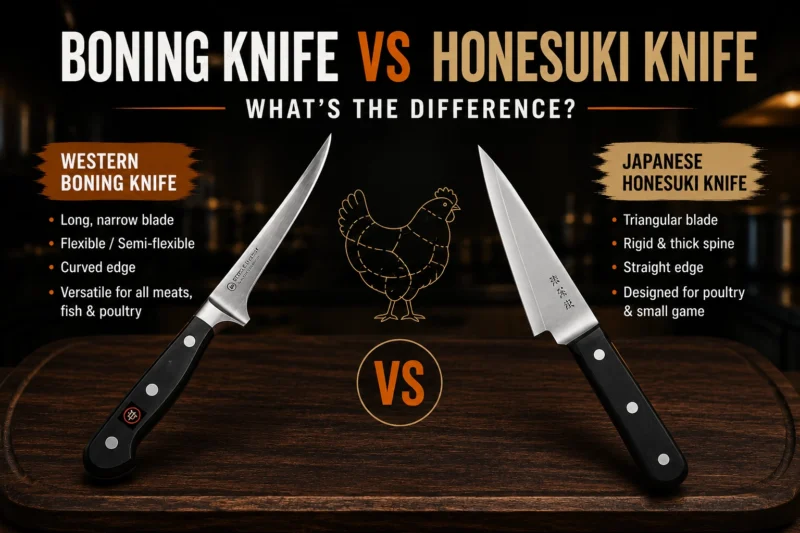
Boning Knife vs Honesuki Knife: The Complete Comparison Guide
Whether you’re breaking down whole chickens, trimming beef, filleting fish, or preparing pork, having the right knife can make the job faster, safer, and more enjoyable. One comparison that often confuses both home cooks and professional chefs is boning knife vs honesuki knife.
At first glance, these knives appear to serve the same purpose. Both are designed to work around bones, joints, and connective tissue. However, their designs, cutting techniques, and intended applications differ significantly.
A traditional Western boning knife emphasizes flexibility and maneuverability, making it excellent for separating meat from bones. The Japanese honesuki knife, on the other hand, prioritizes precision, stiffness, and controlled cuts, especially when processing poultry.
So, which one should you choose?
In this comprehensive guide, we’ll compare the boning knife vs honesuki knife in detail, covering their history, blade design, edge geometry, steel choices, cutting performance, sharpening characteristics, and ideal uses. By the end, you’ll know exactly which knife suits your cooking style and kitchen needs.
What Is a Boning Knife?
A boning knife is a specialized kitchen knife designed to remove meat from bones with minimal waste. It is commonly found in both professional butcher shops and home kitchens where meat is prepared regularly.
Unlike a chef’s knife, which performs multiple kitchen tasks, a boning knife is optimized for precision work around joints, cartilage, and bones.
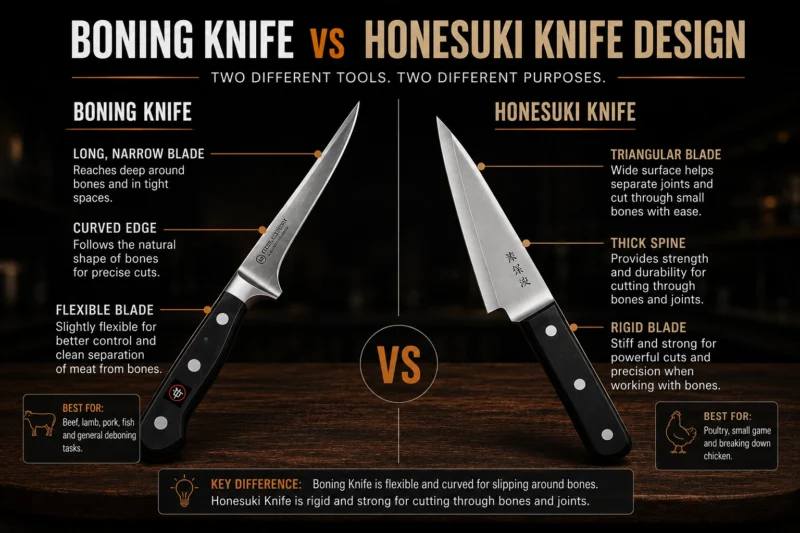
Typical characteristics include:
- Narrow blade
- Sharp pointed tip
- Blade length between 5–7 inches (125–180 mm)
- Available in stiff or flexible versions
- Usually double-beveled
- Excellent maneuverability
The narrow blade reduces resistance while allowing users to follow the natural contours of bones.
Western boning knives are commonly used for:
- Beef
- Pork
- Lamb
- Chicken
- Turkey
- Fish
Because flexibility varies between models, butchers often own several boning knives for different tasks.
Main Types of Boning Knives
Not all boning knives are the same. Manufacturers produce different blade stiffness levels depending on the intended application.
Flexible Boning Knife
A flexible boning knife bends slightly while cutting.
Advantages include:
- Easy to follow rib cages
- Excellent for fish
- Removes skin efficiently
- Produces less meat waste
Best for:
- Salmon
- Trout
- Snapper
- Small poultry
- Delicate trimming
Semi-Flexible Boning Knife
This design balances rigidity with maneuverability.
Ideal for:
- Home cooks
- Mixed meat preparation
- General-purpose boning
It is often considered the most versatile option.
Stiff Boning Knife
A stiff boning knife provides maximum control.
It excels at:
- Beef
- Pork
- Large game
- Thick connective tissue
- Heavy trimming
Professional butchers often prefer stiff blades because they transfer force more efficiently.
What Is a Honesuki Knife?
The honesuki knife is a traditional Japanese poultry knife developed specifically for breaking down chickens and other birds.
Unlike Western boning knives, a honesuki is not designed to flex around bones. Instead, it uses a rigid triangular blade that allows highly controlled cuts through joints and cartilage.
The name “Honesuki” roughly translates to “bone lover” or “bone cutter,” although the knife is intended to work around bones rather than chop through thick bone.
Today, many professional Japanese chefs rely on the honesuki for preparing:
- Chicken
- Duck
- Quail
- Rabbit
- Small game birds
Many cooks also use it for trimming meat and portioning fish.
History of the Honesuki Knife
The honesuki originated in Japan during the development of specialized kitchen knives tailored to individual culinary tasks.
Traditional Japanese cuisine values precision, efficiency, and minimal waste. Instead of designing one knife for multiple purposes, Japanese bladesmiths created dedicated knives for vegetables, fish, sushi, sashimi, poultry, and meat.
The honesuki became the preferred poultry knife because its:
- Thick spine
- Strong tip
- Triangular blade
- Excellent balance
allowed chefs to separate joints cleanly without damaging meat.
Unlike many Japanese knives that feature single-bevel edges, modern honesuki knives are often double-beveled, making them easier for Western users.
Boning Knife vs Honesuki Knife: Design Philosophy
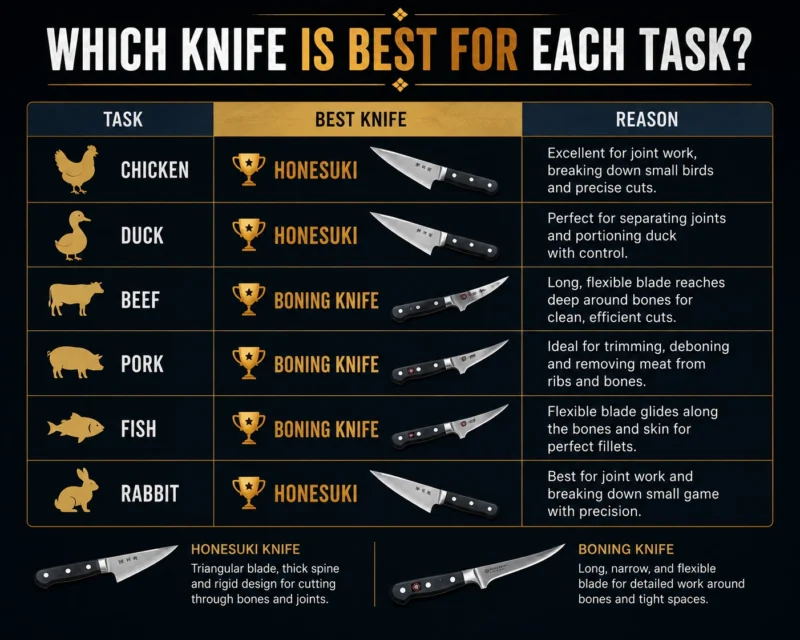
One of the biggest differences in the boning knife vs honesuki knife comparison is the philosophy behind each design.
Western Boning Knife Philosophy
Western kitchen knives evolved primarily for butchers processing large quantities of meat.
The goal is speed.
Boning knives are designed to:
- Follow curved bones
- Flex around ribs
- Separate meat efficiently
- Work with multiple animal species
Flexibility is considered an advantage.
Japanese Honesuki Philosophy
Japanese knives emphasize precision rather than flexibility.
Instead of bending around bones, the cook carefully uses the knife tip and heel to locate joints and separate them cleanly.
The honesuki encourages deliberate cutting rather than aggressive slicing.
As a result, it often wastes less meat while producing cleaner cuts.
Blade Shape Comparison
The blade profile is one of the easiest ways to distinguish these knives.
Boning Knife Blade
A Western boning knife typically features:
- Long narrow blade
- Curved edge
- Pointed tip
- Thin profile
The narrow shape reduces drag when cutting close to bones.
Its pointed tip allows precise trimming inside tight spaces.
Honesuki Blade
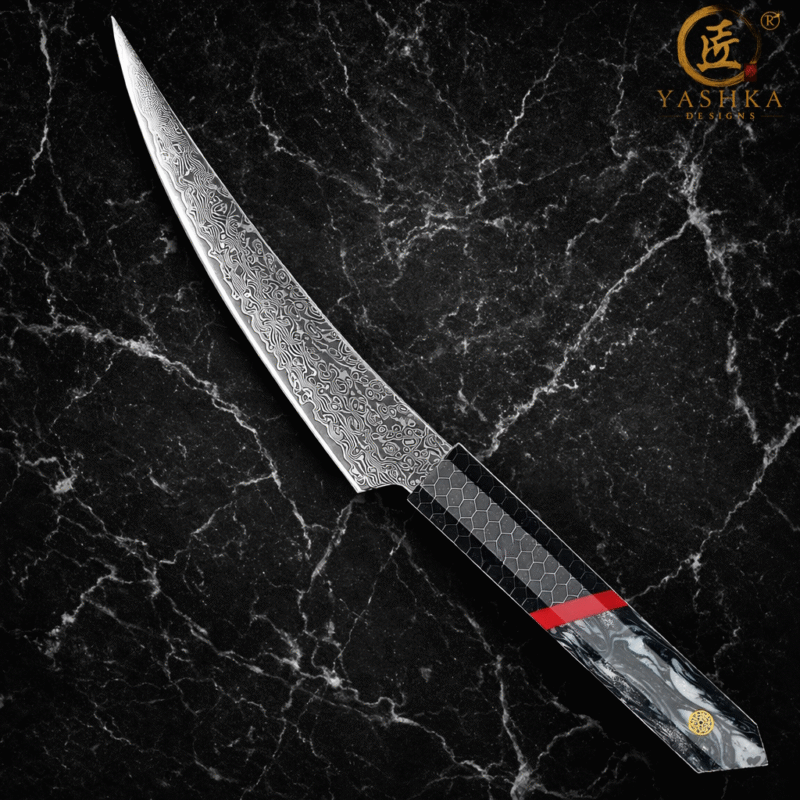
The honesuki has a distinctive triangular profile.
Features include:
- Tall heel
- Straight edge
- Aggressive pointed tip
- Thick spine
- Wide blade near handle
The blade provides greater stability while allowing powerful push cuts.
Blade Length
Boning Knife
Most boning knives measure:
- 5 inches
- 5.5 inches
- 6 inches
- 6.5 inches
- 7 inches
Longer blades improve reach around large cuts.
Honesuki Knife
Most honesuki knives measure:
- 145 mm
- 150 mm
- 160 mm
Their compact size offers outstanding control.
Blade Thickness
Blade thickness affects durability and cutting feel.
Boning Knife
Typical thickness:
1.5–2.5 mm
Thinner blades reduce friction.
Flexible models are usually thinner.
Honesuki Knife
Typical thickness:
3–4 mm near the spine
This added thickness increases rigidity.
Check Our Guide Best Blade Thickness for Different Uses
Blade Flexibility
Perhaps the largest difference in the boning knife vs honesuki knife debate is flexibility.
Boning Knife
Can be:
- Flexible
- Semi-flexible
- Stiff
The user selects the appropriate stiffness based on the meat.
Honesuki
Almost always rigid.
The knife should not bend during use.
Instead of flexibility, it relies on careful positioning and leverage.
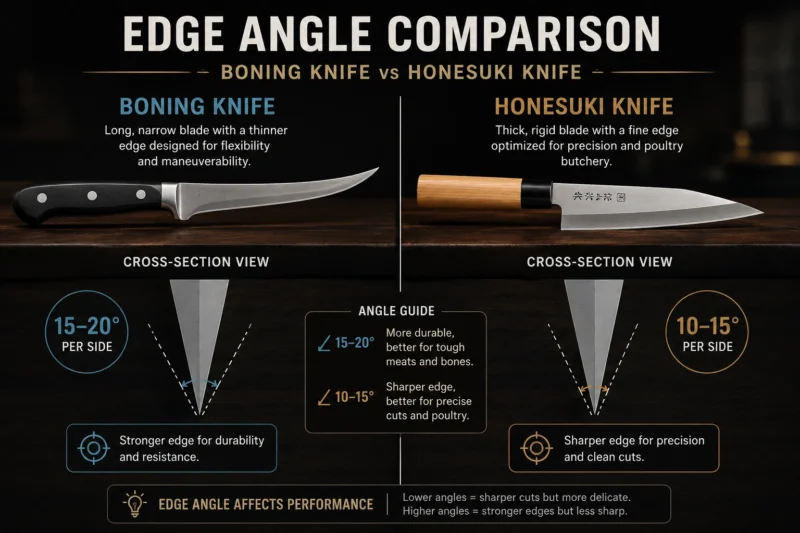
Edge Geometry
Edge geometry determines how a knife interacts with food.
Boning Knife
Western boning knives usually feature:
- Double bevel
- Symmetrical grind
- Edge angle around 15–20° per side
The geometry favors durability.
Honesuki Knife
Modern honesuki knives are commonly:
- Double bevel
- 70/30 asymmetrical grind or symmetrical grind
- Sharpened to approximately 10–15° per side
This thinner edge delivers exceptional precision.
Check Our Guide Blade Geometry Explained
Steel Types
Steel plays an important role in both performance and maintenance.
Common Boning Knife Steels
Many Western manufacturers prioritize toughness and corrosion resistance.
Popular choices include:
- X50CrMoV15
- 420HC
- 4116 stainless
- AUS-8
- 14C28N
- 440C
These steels are relatively easy to sharpen and resist staining.
Common Honesuki Steels
Japanese makers often use harder steels for better edge retention.
Popular examples include:
- VG10
- AUS-10
- White Steel #2
- Blue Steel #2
- SG2
- Ginsan
- SKD11
These steels generally achieve higher hardness, allowing thinner, longer-lasting edges.
Hardness Comparison
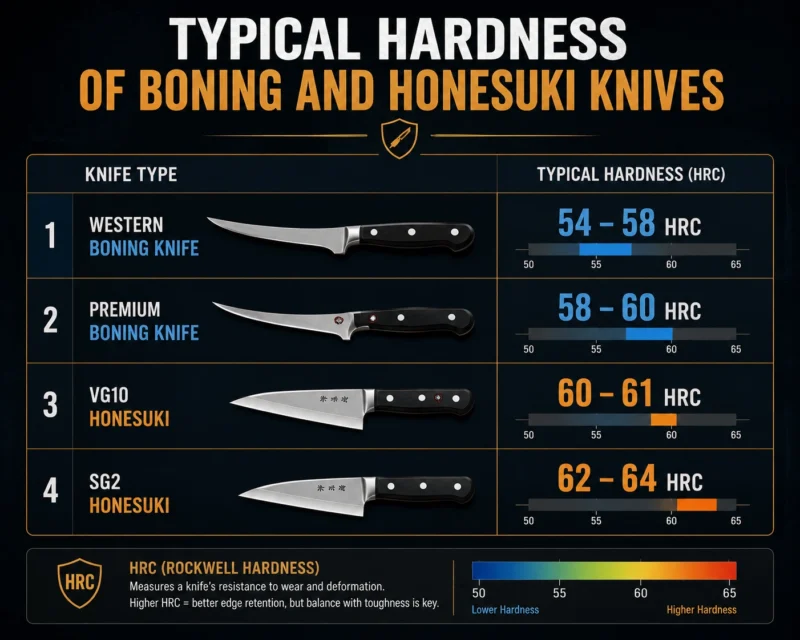
Typical hardness values:
| Knife | HRC |
|---|---|
| Western Boning Knife | 54–58 |
| Premium Boning Knife | 58–60 |
| VG10 Honesuki | 60–61 |
| SG2 Honesuki | 62–64 |
| White Steel Honesuki | 61–63 |
Higher hardness improves edge retention but may reduce resistance to chipping if the knife is misused.
Check Our Guide What Is HRC? Understanding Rockwell Hardness
Handle Design
Although blades receive most of the attention, handle design also affects comfort and control.
Western Boning Knife Handles
Common materials include:
- POM
- Fibrox
- Micarta
- G10
- Rosewood
- Pakka wood
These handles are typically contoured for a secure grip, even in wet conditions.
Honesuki Knife Handles
Traditional Japanese honesuki knives often feature Wa-style handles made from:
- Magnolia wood
- Walnut
- Oak
- Cherry
- Burnt chestnut
Many modern versions also use Western-style full-tang handles for cooks who prefer a familiar feel.
The octagonal or D-shaped Wa handle is lightweight, helping shift the balance slightly toward the blade for enhanced control during precise poultry work.
Weight and Balance
Weight distribution influences how a knife feels during extended use.
Boning Knife
Most boning knives are lightweight, allowing quick movements around bones. Flexible models feel especially nimble and are ideal for repetitive trimming tasks.
Honesuki Knife
A honesuki is generally heavier near the blade because of its thicker spine and taller heel. This forward balance provides additional stability when separating joints and working through tougher connective tissue.
Neither design is inherently better—the ideal choice depends on your cutting style and the foods you prepare most often.
Boning Knife vs Honesuki Knife: Feature Comparison
| Feature | Boning Knife | Honesuki Knife |
|---|---|---|
| Origin | Western | Japan |
| Primary Use | General meat boning | Poultry preparation |
| Blade Shape | Long and narrow | Triangular |
| Flexibility | Flexible to stiff | Rigid |
| Blade Length | 125–180 mm | 145–160 mm |
| Blade Thickness | Thin | Thick spine |
| Tip | Narrow and pointed | Strong reinforced tip |
| Edge Angle | 15–20° per side | 10–15° per side |
| Typical Hardness | 54–60 HRC | 60–64 HRC |
| Best For | Beef, pork, fish, poultry | Chicken, duck, small game |
| Sharpening | Easier | Requires more care with harder steels |
Which Knife Design Is Right for You?
When comparing a boning knife vs honesuki knife, the decision often comes down to how you work in the kitchen.
A boning knife is the more versatile option if you regularly process a variety of meats, trim silver skin, or fillet fish. Its narrow profile and, in many cases, flexible blade make it easy to follow curved bones and maximize meat yield.
A honesuki knife shines when poultry is your primary focus. Its rigid construction, strong tip, and triangular blade allow for exceptionally precise work around joints, making it a favorite among chefs who break down whole chickens with speed and accuracy.
Both knives are highly specialized tools, but they approach the same task from different traditions. Understanding these design differences is the first step toward choosing the knife that best fits your cooking style.
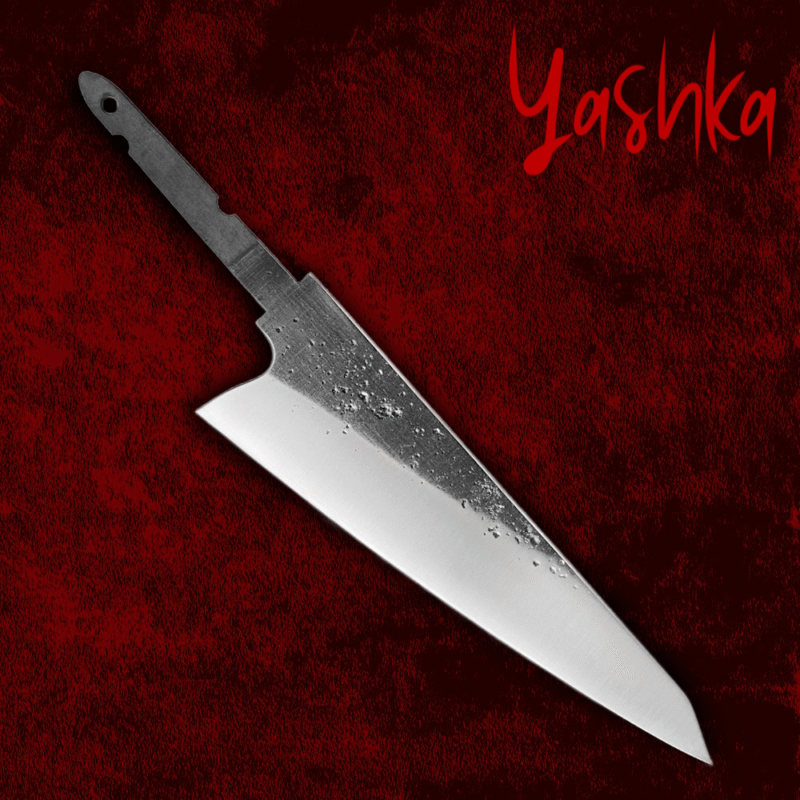
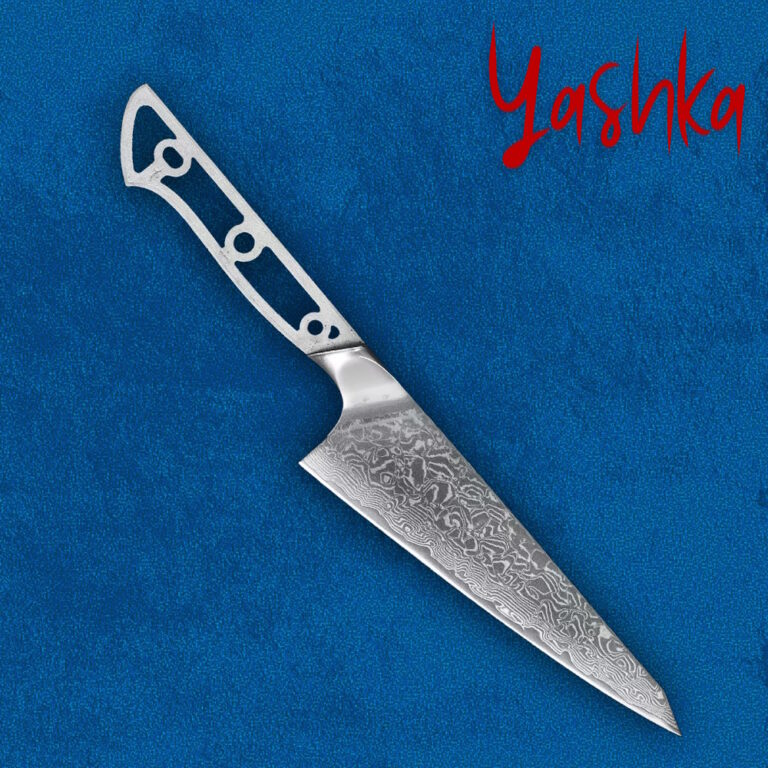
https://yashkadesigns.com/chef-knife-blank-honesuki-blade-shape-diy-japanese-boning-knives
Boning Knife vs Honesuki Knife Performance Comparison
Performance is where the differences between a boning knife vs honesuki knife become most noticeable.
A Western boning knife is designed for versatility. It adapts well to beef, pork, poultry, fish, and even wild game. Its narrow blade glides along bones, while flexible models hug curved surfaces to minimize waste.
The Japanese honesuki takes a different approach. Rather than flexing around bones, it uses a rigid blade and strong tip to locate joints and separate them cleanly. Skilled users often find it faster and more precise for poultry preparation.
Breaking Down Chicken
If you regularly purchase whole chickens, this is perhaps the most important comparison.
Boning Knife
A boning knife performs well when:
- Removing breasts
- Trimming fat
- Deboning thighs
- Separating wings
- Removing skin
Flexible models can closely follow the rib cage, helping preserve as much meat as possible.
Advantages
- Easy to maneuver
- Minimal waste
- Comfortable for beginners
Limitations
- Less stable when separating joints
- Flexible blades may twist under pressure
Honesuki Knife
The honesuki was specifically designed for this task.
Its reinforced tip easily locates joints without forcing the blade through bone.
Experienced chefs often process chickens significantly faster using a honesuki because the knife remains stable throughout every cut.
Advantages
- Outstanding joint separation
- Extremely precise
- Excellent control
- Minimal slipping
Winner
🏆 Honesuki Knife
Beef Preparation
Beef contains thicker muscles and stronger connective tissue than poultry.
Boning Knife
The long narrow blade excels at:
- Removing silver skin
- Separating muscles
- Trimming brisket
- Deboning roasts
- Cleaning tenderloin
A stiff boning knife is particularly effective for large cuts.
Honesuki Knife
The rigid blade works well for trimming smaller cuts but lacks the length required for larger roasts.
The triangular profile also creates more drag when working through thick muscles.
Winner
🏆 Boning Knife
Pork Preparation
Pork falls somewhere between poultry and beef.
A boning knife easily follows rib bones and removes excess fat.
The honesuki can separate joints efficiently but is less versatile for larger pork cuts.
Winner
🏆 Boning Knife
Fish Preparation
Fish requires precision and flexibility.
Flexible boning knives excel at:
- Skinning
- Removing rib bones
- Portioning
- Trimming
A honesuki can handle larger fish but lacks the flexibility needed for delicate filleting.
Winner
🏆 Boning Knife
Wild Game
Hunters often process:
- Venison
- Rabbit
- Duck
- Pheasant
- Goose
A stiff boning knife performs exceptionally well because it can handle tougher connective tissue.
The honesuki works beautifully for rabbits and birds but becomes less practical on larger animals.
Winner
🏆 Boning Knife
Precision
Precision isn’t simply about making thin cuts—it also involves control and confidence.
Boning Knife
Its narrow profile provides excellent maneuverability.
However, flexible blades may feel less stable during detailed work.
Honesuki Knife
The rigid construction offers exceptional feedback.
Every movement transfers directly to the cutting edge, allowing highly accurate cuts around joints and cartilage.
Winner
🏆 Honesuki Knife
Speed
Professional chefs value speed because it increases efficiency.
Boning Knife
Excellent for repetitive trimming across multiple types of meat.
Honesuki Knife
When processing poultry, the honesuki is often faster because fewer corrective cuts are needed.
For beef or pork, however, the boning knife generally maintains the advantage.
Overall Winner
Tie—each knife is fastest within its intended role.
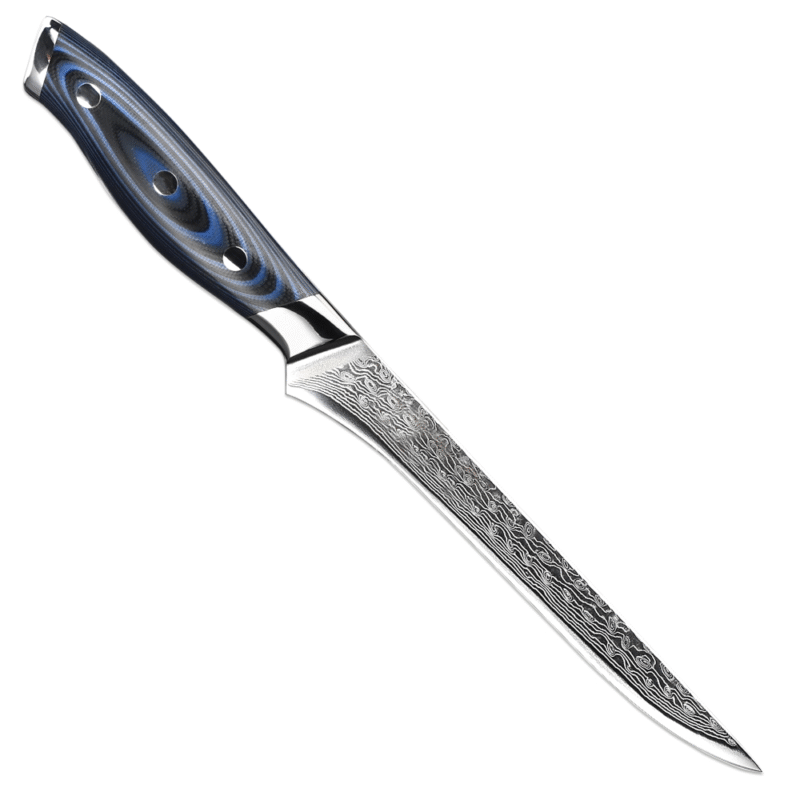
Edge Retention
Edge retention depends largely on the steel.
Western Boning Knife
Typical hardness:
54–58 HRC
Advantages:
- Tough
- Less prone to chipping
- Easy to maintain
Disadvantages:
- Requires more frequent sharpening
Honesuki Knife
Typical hardness:
60–64 HRC
Advantages:
- Longer-lasting edge
- Cleaner cuts
- Better slicing performance
Disadvantages:
- More brittle if misused
Winner
🏆 Honesuki Knife
Sharpening
Sharpening is another important consideration in the boning knife vs honesuki knife comparison.
Boning Knife
Most Western stainless steels sharpen quickly using standard water stones or ceramic systems.
Because they are softer, restoring the edge requires less time and skill.
Best Sharpening Angle
15–20° per side
Honesuki Knife
Harder Japanese steels take longer to sharpen but reward the effort with excellent edge retention.
Many enthusiasts sharpen a honesuki at approximately 10–15° per side to maximize cutting performance.
Winner
🏆 Boning Knife
For ease of maintenance.
Durability
Durability depends on proper use.
Boning Knife
More forgiving.
Can tolerate:
- Twisting
- Minor impacts
- Heavy trimming
Honesuki Knife
Very durable when used correctly.
However, extremely hard steels should not be used for chopping through thick bones or frozen foods, as this increases the risk of edge damage.
Winner
🏆 Boning Knife
Maintenance
Both knives benefit from the same basic care.
To maximize lifespan:
- Wash by hand immediately after use.
- Dry thoroughly before storing.
- Use a wooden or soft plastic cutting board.
- Store in a knife block, magnetic strip, or blade guard.
- Hone or sharpen as needed.
Carbon steel honesuki knives require additional attention. Dry them immediately after washing and apply a light coat of food-safe oil if they will be stored for an extended period.
Safety
Using the correct technique is just as important as using the correct knife.
A sharp knife is safer than a dull one because it requires less force and is less likely to slip.
The honesuki’s rigid blade offers excellent stability around joints, while a flexible boning knife provides greater control when following curved bones. Select the tool that matches the task instead of forcing one knife to do everything.
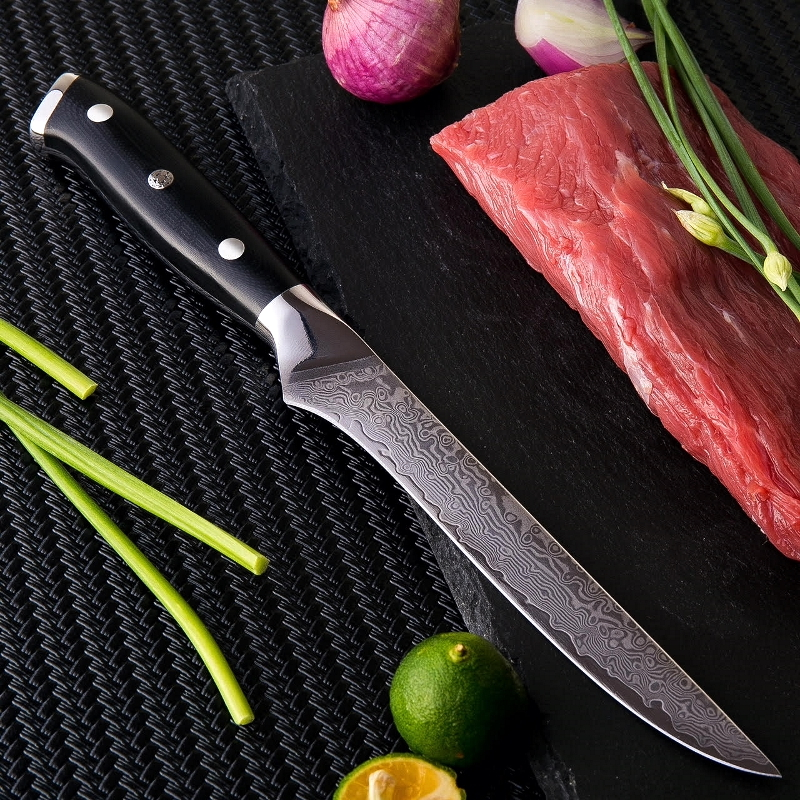
https://yashkadesigns.com/5-5-inch-boning-knife-chefs-kitchen-boning-knives-butcher-tool
Advantages and Disadvantages
Boning Knife
Pros
- Extremely versatile
- Available in flexible or stiff versions
- Excellent for beef, pork, poultry, and fish
- Easier to sharpen
- Usually more affordable
- Widely available
Cons
- Softer steels often lose their edge faster
- Less specialized for poultry
- Flexible blades can feel unstable to some users
Honesuki Knife
Pros
- Outstanding poultry knife
- Excellent edge retention
- Highly precise
- Strong reinforced tip
- Superb balance for detailed work
Cons
- Less versatile than a boning knife
- Harder steels require more careful sharpening
- Not ideal for filleting fish
- Premium models are often more expensive
Who Should Buy a Boning Knife?
A boning knife is an excellent choice if you:
- Prepare many different types of meat
- Trim brisket or pork shoulder
- Fillet fish
- Process wild game
- Prefer one versatile specialty knife
- Want easier maintenance
For many home cooks, a quality boning knife is the more practical option because it handles a wider range of kitchen tasks.
Who Should Buy a Honesuki Knife?
A honesuki is ideal if you:
- Frequently break down whole chickens
- Cook poultry several times each week
- Enjoy traditional Japanese knives
- Value precision over versatility
- Want longer edge retention
- Appreciate specialized kitchen tools
Professional chefs working with poultry often consider the honesuki indispensable.
Can You Use a Honesuki as a Boning Knife?
Yes—but with limitations.
A honesuki can debone pork chops, trim meat, and handle smaller cuts of beef. However, it is not as efficient for large roasts or delicate fish because its rigid, triangular blade does not flex around curved bones.
If poultry is your primary focus, a honesuki can serve as your main boning tool. If you prepare a broad range of meats, a traditional boning knife remains the more versatile choice.
Frequently Asked Questions
Is a honesuki the same as a boning knife?
No. Although both remove meat from bones, a honesuki is a Japanese poultry knife with a rigid triangular blade, while a Western boning knife is designed for a wider range of meats and is often available with flexible blades.
Which knife is better for chicken?
The honesuki is widely considered the better option because it was specifically designed for breaking down poultry.
Which knife is better for fish?
A flexible boning knife generally performs better because it follows the contours of fish bones and makes skinning easier.
Is a honesuki good for beef?
It can trim smaller cuts, but a boning knife is usually the better tool for large beef roasts and heavy connective tissue.
Which knife is easier to sharpen?
Most Western boning knives are easier to sharpen due to their tougher, lower-hardness stainless steels.
Can beginners use a honesuki?
Yes. While it has a unique shape, many beginners quickly appreciate its stability and precision for poultry preparation.
Do professional chefs use both?
Many do. A boning knife offers versatility across many proteins, while a honesuki excels when breaking down poultry. Owning both provides the greatest flexibility.
https://yashkadesigns.com/chef-boning-butcher-knife
Final Verdict: Boning Knife vs Honesuki Knife
The boning knife vs honesuki knife comparison isn’t about finding a single winner—it’s about matching the knife to the job.
Choose a boning knife if you want one versatile tool capable of trimming beef, pork, fish, poultry, and wild game. Its narrow profile, multiple stiffness options, and easy maintenance make it an excellent all-around choice for most kitchens.
Choose a honesuki knife if poultry preparation is a regular part of your cooking. Its rigid triangular blade, reinforced tip, and harder Japanese steel deliver exceptional precision and efficiency when separating joints and breaking down whole chickens.
For serious home cooks and professionals, owning both knives provides the best of both worlds. A boning knife handles the broad range of meat preparation tasks, while a honesuki offers unmatched control whenever poultry is on the menu.
Ultimately, the right choice depends on what you cook most often. If versatility matters most, invest in a quality boning knife. If precision poultry work is your priority, the honesuki is difficult to beat. Either way, selecting the appropriate knife will improve efficiency, reduce waste, and make meat preparation more enjoyable.
| Feature | Honesuki Knife | Boning Knife |
|---|---|---|
| Poultry | ⭐⭐⭐⭐⭐ | ⭐⭐⭐⭐☆ |
| Beef | ⭐⭐⭐☆☆ | ⭐⭐⭐⭐⭐ |
| Pork | ⭐⭐⭐☆☆ | ⭐⭐⭐⭐⭐ |
| Fish | ⭐⭐☆☆☆ | ⭐⭐⭐⭐⭐ |
| Precision | ⭐⭐⭐⭐⭐ | ⭐⭐⭐⭐☆ |
| Versatility | ⭐⭐⭐☆☆ | ⭐⭐⭐⭐⭐ |
| Edge Retention | ⭐⭐⭐⭐⭐ | ⭐⭐⭐⭐☆ |
| Ease of Sharpening | ⭐⭐⭐☆☆ | ⭐⭐⭐⭐⭐ |
FAQ: Boning Knife vs Honesuki Knife
What is the difference between a boning knife and a honesuki knife?
A boning knife is a Western-style knife designed for deboning a wide variety of meats, including beef, pork, poultry, and fish. It typically features a long, narrow blade and is available in flexible, semi-flexible, or stiff versions. A honesuki knife is a traditional Japanese poultry knife with a rigid, triangular blade designed for breaking down chickens and other small birds. While both knives remove meat from bones, a boning knife emphasizes versatility, whereas a honesuki prioritizes precision and control during poultry preparation.
Is a honesuki better than a boning knife?
A honesuki is better for breaking down poultry because its stiff, triangular blade provides excellent control when separating joints and trimming close to bones. However, a boning knife is more versatile and performs well on beef, pork, lamb, fish, and poultry. If you regularly prepare different types of meat, a boning knife is the better all-around choice. If you frequently process whole chickens, a honesuki is the superior specialist.
Can a honesuki cut through bones?
A honesuki can cut through soft cartilage and small poultry bones near joints, but it is not designed to chop through thick or hard bones. Instead, it excels at separating joints and working around bones with precision. For large beef or pork bones, a meat cleaver or butcher’s knife is the safer and more appropriate tool.
Which knife is best for deboning chicken?
A honesuki knife is widely considered the best knife for deboning chicken. Its rigid blade, reinforced tip, and excellent balance make it easy to locate joints and separate meat with minimal waste. A boning knife also works well, especially flexible models, but the honesuki was specifically designed for poultry preparation.
Is a boning knife good for fish?
Yes. A boning knife, particularly a flexible model, is an excellent choice for fish. The flexible blade follows the contours of fish bones, making it easier to remove skin, trim fillets, and minimize waste. While a honesuki can handle larger fish, it lacks the flexibility required for delicate filleting tasks.
Do professional chefs use honesuki knives?
Yes. Many professional chefs, especially those working in Japanese restaurants or kitchens that prepare whole poultry, rely on honesuki knives. Their rigid construction and precise cutting ability make them ideal for breaking down chickens quickly and efficiently. Many chefs also keep a Western boning knife for beef, pork, and fish, using each knife for the tasks it performs best.
Can a boning knife replace a chef’s knife?
Not completely. A boning knife is designed for specialized tasks such as removing meat from bones and trimming fat. While it can handle some slicing and precision work, it is not suitable for everyday kitchen tasks like chopping vegetables, mincing herbs, or slicing large fruits. A chef’s knife remains the most versatile all-purpose kitchen knife.
What steel is best for a honesuki knife?
The best steel depends on your priorities. VG10 offers an excellent balance of edge retention, corrosion resistance, and ease of maintenance, making it one of the most popular choices. White Steel #2 and Blue Steel #2 provide exceptional sharpness and are favored by traditional Japanese knife enthusiasts, although they require more maintenance. SG2 (R2) powder steel delivers outstanding edge retention and wear resistance for users seeking premium performance.
Should I buy a flexible or stiff boning knife?
Choose a flexible boning knife if you frequently fillet fish or remove meat from curved bones, as the blade easily follows contours. Choose a stiff boning knife if you mainly prepare beef, pork, or larger cuts of meat that require greater control and cutting power. A semi-flexible boning knife offers a good balance for home cooks who process a variety of meats.
Is a honesuki worth buying for home cooks?
Yes, if you regularly buy whole chickens or prepare poultry several times a month. A honesuki provides cleaner cuts, better control, and less waste than many general-purpose knives. However, if you only occasionally debone chicken and need one knife for multiple types of meat, a quality boning knife is usually the more practical investment.
How often should I sharpen a boning knife?
Sharpening frequency depends on the steel, how often the knife is used, and the cutting surface. Home cooks typically sharpen a boning knife every 3 to 6 months, while frequent users may sharpen every 4 to 8 weeks. Honing the edge regularly with a honing rod helps maintain sharpness and extends the time between full sharpening sessions.
What cutting board is best for boning and honesuki knives?
The best cutting boards are made from end-grain wood, edge-grain hardwood, or high-quality soft plastic. These materials are gentle on knife edges while providing good stability during meat preparation. Avoid cutting on glass, ceramic, marble, granite, or other hard surfaces, as they can quickly dull or chip the blade. A quality wooden cutting board is generally the best choice for preserving the performance of both boning and honesuki knives.