Knife Sharpening Tools
Introduction
A sharp knife is one of the most valuable tools in any kitchen. Whether you’re a professional chef, an enthusiastic home cook, a hunter, or an outdoor enthusiast, the quality of your knife depends not only on the steel it is made from but also on how well you maintain its edge. Even the finest knife will eventually become dull with regular use, making proper sharpening an essential skill.
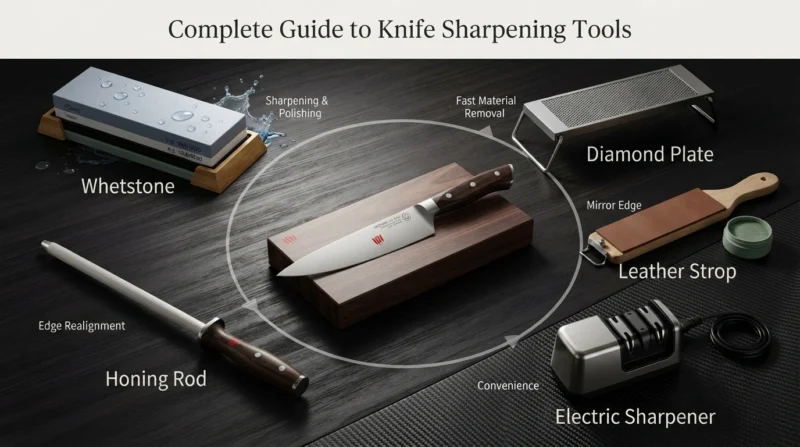
Today, there are countless knife sharpening tools available, ranging from traditional Japanese whetstones to modern electric sharpeners and precision-guided sharpening systems. Each type has its own strengths, ideal applications, and learning curve. Choosing the right sharpening tool can improve cutting performance, extend the life of your knife, and make food preparation both safer and more enjoyable.
This comprehensive guide explores every major type of knife sharpening tool, explaining how each works, its advantages and disadvantages, and which users will benefit most. Whether you own a simple stainless-steel kitchen knife or a premium Japanese blade made from VG10, SG2, or high-performance powder steel, understanding the sharpening process will help you keep your knives performing at their best for many years.
https://yashkadesigns.com/ceramic-sharpening-rod-360-mm
Why Knife Sharpening Matters
Many people continue using dull knives because they assume sharpening is complicated or unnecessary. In reality, maintaining a sharp edge is one of the easiest ways to improve both safety and cutting performance.
A sharp knife slices cleanly through food using minimal force. A dull knife, by contrast, crushes ingredients, tears delicate foods, and often requires excessive pressure. This additional force increases the likelihood of the blade slipping unexpectedly, making dull knives more dangerous than sharp ones.
Proper sharpening offers several important benefits:
- Cleaner, more precise cuts
- Improved cutting efficiency
- Better food presentation
- Less hand fatigue during extended use
- Increased safety
- Longer knife lifespan
- Reduced wear on the blade
Professional chefs often sharpen or hone their knives regularly because they understand that consistent maintenance is easier than restoring a severely worn edge.
Sharpening is also an investment in your knife. Premium kitchen knives are designed to last decades when cared for properly. Instead of replacing a dull knife every few years, learning how to sharpen it correctly allows you to enjoy peak performance for a lifetime.
Check Our Guide The Ultimate Guide to Caring for a Damascus Steel Knife
Honing vs. Sharpening: Understanding the Difference
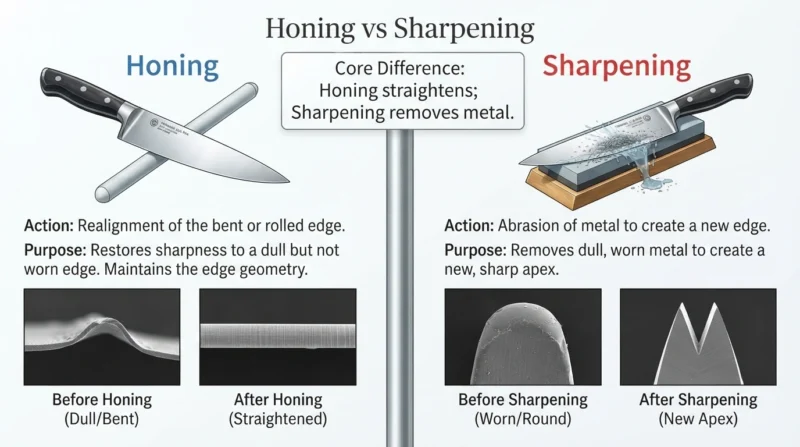
One of the most common misconceptions is that honing and sharpening are the same process. Although both improve cutting performance, they serve very different purposes.
What Is Honing?
Honing is the process of realigning the knife’s cutting edge rather than removing significant amounts of steel.
During normal cutting, the extremely thin edge bends microscopically to one side. Even though the knife has not actually become dull, this rolled edge reduces cutting efficiency.
A honing rod gently straightens the edge, restoring much of its original sharpness.
Common honing tools include:
- Traditional steel honing rods
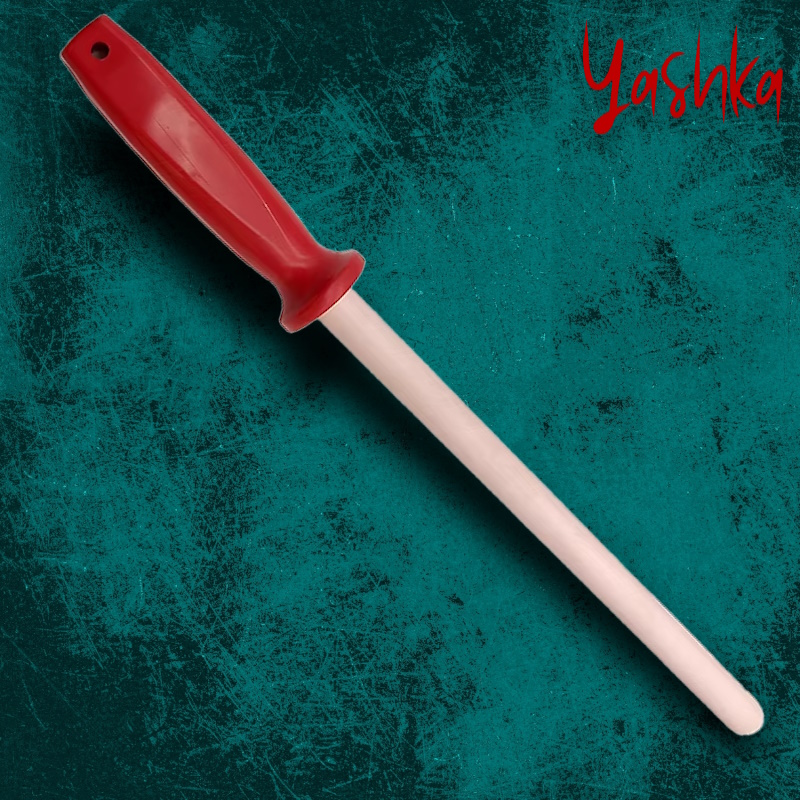
- Ceramic honing rods
- Diamond-coated honing rods
Ceramic rods remove a very small amount of steel while realigning the edge, making them more effective for harder knife steels.
Regular honing can significantly extend the time between full sharpening sessions.
What Is Sharpening?
Sharpening is the process of removing steel to create a completely new cutting edge.
As a knife is used repeatedly, the very apex of the edge gradually wears away. Instead of remaining thin and pointed, it becomes rounded under magnification.
Sharpening abrasives remove material from both sides of the blade until a fresh, sharp edge forms.
Unlike honing, sharpening permanently changes the blade geometry by removing metal.
Every sharpening session slightly shortens the knife over time, which is why proper maintenance and regular honing are recommended to minimize unnecessary steel removal.
How Knife Edges Become Dull
Understanding why knives lose their sharpness helps explain why different sharpening tools exist.
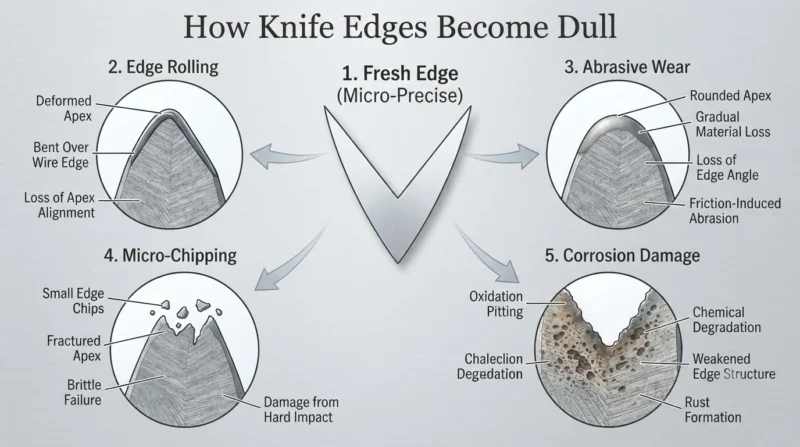
Contrary to popular belief, a knife usually doesn’t become dull because it simply “wears out.” Several microscopic processes contribute to edge degradation.
Edge Rolling
The most common form of dulling is edge rolling.
Rather than breaking completely, the extremely thin cutting edge bends sideways under cutting pressure. This is especially common in softer stainless steels.
Honing rods are specifically designed to correct this issue.
Check Our Guide Blade Geometry Explained
Abrasive Wear
Every time a knife cuts through food or contacts a cutting board, tiny particles of steel are gradually worn away.
Hard cutting boards, ceramic plates, and glass surfaces accelerate abrasive wear significantly.
Wood and high-quality plastic cutting boards are much gentler on knife edges.
Micro-Chipping
Harder steels often experience microscopic chips rather than simple edge rolling.
These tiny fractures are nearly invisible without magnification but noticeably reduce cutting performance.
Steels with very high hardness generally maintain sharpness longer but may be less forgiving during heavy use.
Corrosion
Although modern stainless steels resist rust, acids, salt, and moisture can slowly attack the cutting edge.
Even small amounts of corrosion weaken the apex of the edge, reducing sharpness over time.
Cleaning and drying knives immediately after use helps prevent this form of wear.
Improper Use
Many knives become dull prematurely because they are used for tasks they were never designed to perform.
Examples include:
- Cutting frozen food
- Chopping through bone
- Twisting the blade during cuts
- Using ceramic or glass cutting boards
- Opening cans or packages
Using the correct knife for each task dramatically extends edge life.
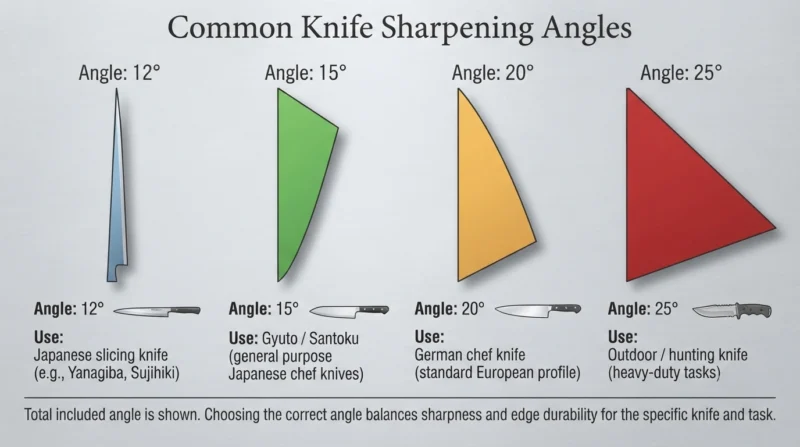
Understanding Knife Sharpening Angles
One of the most important aspects of knife sharpening is selecting the correct edge angle.
The sharpening angle determines how sharp, durable, and long-lasting the edge will be.
Lower angles produce exceptionally sharp cutting edges but sacrifice durability.
Larger angles create stronger edges capable of handling heavier work.
10°–12° Per Side
Ultra-thin edges are commonly found on specialty Japanese slicing knives.
Advantages:
- Outstanding slicing ability
- Extremely low cutting resistance
- Exceptional food release
Disadvantages:
- Less durable
- More susceptible to chipping
Best suited for:
- Sushi knives
- Yanagiba
- Fine vegetable knives
15° Per Side
Many premium Japanese chef knives use approximately a 15-degree edge.
Benefits include:
- Excellent sharpness
- High cutting precision
- Ideal balance between performance and durability
Suitable for steels such as:
- VG10
- SG2
- AUS-10
- Blue Paper Steel
- White Paper Steel
17°–20° Per Side
This range is considered the most versatile sharpening angle.
Advantages:
- Excellent edge strength
- Good cutting efficiency
- Suitable for everyday kitchen use
Common among:
- German chef knives
- Hybrid Japanese-Western designs
- General-purpose kitchen knives
20°–25° Per Side
Thicker edge angles prioritize durability over ultimate sharpness.
Ideal applications include:
- Hunting knives
- Survival knives
- Outdoor utility knives
- Heavy-duty work knives
These edges tolerate impact, twisting, and rough use better than thinner profiles.
Choosing the Right Angle for Your Knife
Different knife types perform best with different edge geometries.
| Knife Type | Recommended Angle |
|---|---|
| Japanese Chef Knife | 12°–15° |
| Gyuto | 15° |
| Santoku | 15° |
| Nakiri | 12°–15° |
| German Chef Knife | 18°–20° |
| Outdoor Knife | 20°–25° |
| Pocket Knife | 17°–20° |
| Hunting Knife | 20°–25° |
Maintaining a consistent sharpening angle is more important than achieving an exact number. Consistency produces a cleaner bevel and a sharper, longer-lasting edge.
Check Our Guide Carbon Steel vs Damascus Steel
Preparing for Sharpening
Before using any sharpening tool, inspect the knife carefully.
Check for:
- Chips along the edge
- Rolled sections
- Rust spots
- Bent tips
- Uneven bevels
Clean the blade thoroughly to remove grease, food residue, and dirt. A clean knife allows the abrasive surface to work more efficiently and prevents contamination of sharpening stones.
It’s also helpful to stabilize your sharpening setup. Whether you’re using a whetstone, diamond plate, or guided sharpening system, a non-slip base improves both safety and consistency.
Each sharpening stone has its own advantages, maintenance requirements, and ideal applications. Choosing the right one depends on your experience, the type of knives you own, and the steel you’re sharpening.
1. Water Stones (Whetstones)
Water stones, often called whetstones, are considered the gold standard for sharpening kitchen knives. They are widely used by professional chefs, knife enthusiasts, and manufacturers because they produce exceptionally sharp, refined edges while giving the user complete control over the sharpening process.
Unlike pull-through sharpeners or electric machines, a whetstone allows you to maintain the knife’s original geometry and remove only as much steel as necessary.
How Water Stones Work
A water stone consists of abrasive particles bonded together with a softer binder. As the knife moves across the stone with water acting as a lubricant, worn abrasive particles break away, exposing fresh cutting particles underneath.
This constant renewal allows water stones to cut efficiently while producing an extremely refined edge.
Water serves several purposes:
- Lubricates the surface
- Carries away metal particles (swarf)
- Prevents clogging
- Helps maintain a consistent cutting action
Most traditional water stones require soaking for 10–20 minutes before use, while splash-and-go stones need only a light spray of water.
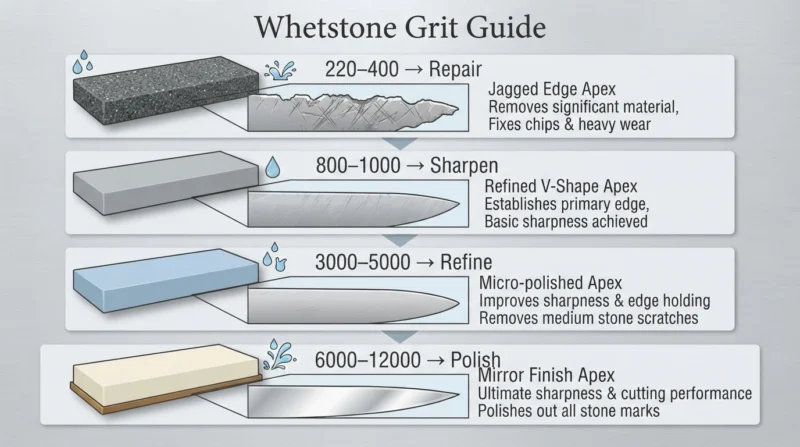
Common Water Stone Grits
Choosing the correct grit depends on the condition of your knife.
Coarse Stones (200–600 Grit)
Best for:
- Repairing chipped edges
- Removing damaged steel
- Reprofiling blade geometry
- Restoring severely dull knives
Coarse stones remove steel quickly and should only be used when necessary.
Medium Stones (800–1200 Grit)
This is the most commonly used sharpening range.
Ideal for:
- Routine maintenance
- Restoring dull kitchen knives
- General sharpening
A 1000-grit stone is often recommended as the first stone for beginners because it balances cutting speed with edge quality.
Fine Stones (2000–5000 Grit)
These stones refine the edge left by a medium stone.
Benefits include:
- Smoother cutting
- Better slicing performance
- Reduced cutting resistance
- Improved push-cutting ability
Many home cooks find that finishing around 3000 grit provides an excellent balance between sharpness and practicality.
Polishing Stones (6000–12000 Grit)
Ultra-fine stones polish the edge to an almost mirror finish.
Advantages include:
- Razor-like sharpness
- Exceptional precision
- Beautiful polished bevels
Professional sushi chefs often use stones in this range for knives designed to slice raw fish with minimal resistance.
Advantages of Water Stones
Water stones offer several benefits:
- Produce extremely sharp edges
- Preserve blade geometry
- Excellent tactile feedback
- Wide grit selection
- Suitable for almost every kitchen knife
- Preferred for Japanese knives
Many knife enthusiasts enjoy the sharpening process itself because water stones provide immediate feedback through sound and feel.
Disadvantages
Water stones also require maintenance.
Potential drawbacks include:
- Require practice
- Wear over time
- Must be flattened periodically
- Traditional stones require soaking
- Slower than electric sharpeners
Despite these disadvantages, many professionals believe the superior edge quality is well worth the extra effort.
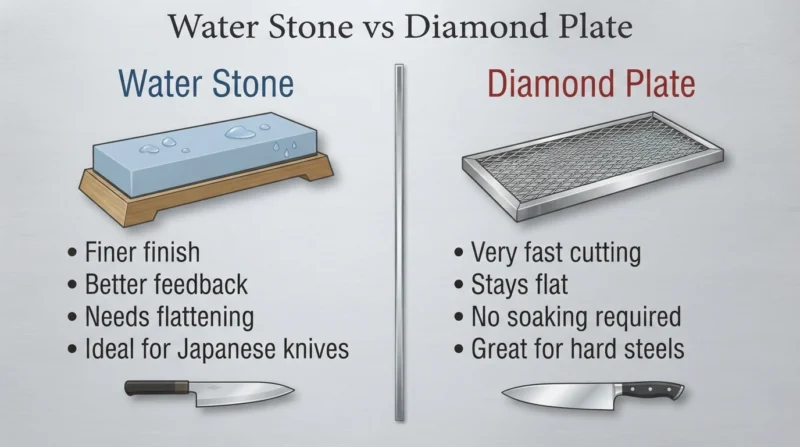
2. Diamond Sharpening Plates
Diamond plates are among the fastest sharpening tools available.
Instead of aluminum oxide or ceramic abrasives, they use industrial diamond particles bonded to a steel or metal plate.
Because diamond is one of the hardest known materials, these plates cut extremely hard knife steels with ease.
How Diamond Plates Work
The diamond particles scratch away steel efficiently while remaining exceptionally flat.
Unlike water stones, diamond plates do not wear unevenly under normal use.
This flatness makes them particularly useful for maintaining consistent bevel angles.
Advantages
Diamond sharpeners provide several important benefits:
- Extremely fast cutting speed
- Remain flat for years
- No soaking required
- Minimal maintenance
- Excellent for high-hardness steels
- Long service life
Best Knife Steels for Diamond Plates
Diamond abrasives excel when sharpening wear-resistant steels such as:
- M390
- CPM S90V
- CPM S110V
- Maxamet
- SG2 (R2)
- ZDP-189
- Elmax
- Vanadis steels
Traditional water stones often struggle with these steels because of their high carbide content.
Potential Drawbacks
Diamond plates are not perfect.
Possible disadvantages include:
- Higher initial cost
- Aggressive steel removal
- Less polishing ability
- Coarse plates leave deeper scratches
Many sharpeners combine diamond plates with finer water stones for the best overall results.
Check Our Guide What Is HRC? Understanding Rockwell Hardness
3. Oil Stones
Oil stones have been used for centuries and remain popular among woodworkers, machinists, and traditional knife sharpeners.
Unlike water stones, they use honing oil as a lubricant.
Types of Oil Stones
Arkansas Stones
Natural Arkansas stones are quarried from novaculite.
They are famous for producing refined, polished edges.
Available grades include:
- Soft Arkansas
- Hard Arkansas
- Hard Black Arkansas
- Hard Translucent Arkansas
Hard Black and Translucent stones produce exceptionally fine finishes.
India Stones
Manufactured from aluminum oxide.
Characteristics:
- Faster cutting
- Durable
- Excellent for general sharpening
Crystolon Stones
Made from silicon carbide.
Benefits include:
- Fast material removal
- Excellent for repairing damaged blades
- Good coarse sharpening option
Advantages
Oil stones offer:
- Long lifespan
- Durable construction
- Excellent edge control
- Traditional sharpening experience
- Consistent cutting performance
Disadvantages
Oil stones generally:
- Cut slower than water stones
- Require oil instead of water
- Can become messy
- Produce less aggressive polishing
Although less common today, many professionals still appreciate their reliability and longevity.
4. Ceramic Sharpening Stones
Ceramic stones combine many advantages of synthetic sharpening stones with exceptional durability.
Their abrasive particles remain stable for a long time, reducing wear.
Characteristics
Ceramic stones are:
- Extremely hard
- Wear slowly
- Stay flat longer
- Produce refined edges
Because they wear slowly, they require flattening less often than traditional water stones.
Advantages
Ceramic stones provide:
- Long service life
- Excellent edge refinement
- Minimal maintenance
- Consistent sharpening performance
Disadvantages
They also have limitations:
- More brittle
- Can crack if dropped
- Often cut slower than coarse water stones
Nevertheless, ceramic stones remain a favorite among many professional sharpeners.
5. Natural Sharpening Stones
Before synthetic abrasives existed, craftsmen relied entirely on natural stones.
Today, these stones remain highly valued by collectors and experienced sharpeners for their unique cutting characteristics.
No two natural stones are exactly alike.
Japanese Natural Stones
Japanese natural stones have earned legendary status.
They produce:
- Beautiful kasumi finishes
- Smooth sharpening feel
- Extremely refined cutting edges
High-quality natural stones are increasingly rare and often expensive.
Check Our Guide Japanese Gyuto Knife Guide
Belgian Coticule
Coticule stones contain natural garnet crystals.
Advantages include:
- Very fine polishing
- Excellent razor sharpening
- Smooth cutting action
Belgian Blue
Closely related to Coticule.
Characteristics:
- Slightly coarser
- More affordable
- Excellent finishing stone
Arkansas Natural Stone
Natural Arkansas remains one of the most respected finishing stones worldwide.
Many woodworkers continue using Arkansas stones for chisels, plane irons, and carving tools.
Flattening Stones
One often-overlooked sharpening accessory is the flattening stone.
Because water stones gradually develop uneven surfaces, they must occasionally be resurfaced.
A flattening stone restores a perfectly flat sharpening surface.
Without regular flattening:
- Sharpening angles become inconsistent
- Bevels become uneven
- Edge quality decreases
Many professionals flatten their stones every few sharpening sessions.
Choosing the Right Sharpening Stone
Every sharpening stone has strengths and weaknesses.
Water Stones
Best for:
- Professional chefs
- Japanese knives
- Maximum sharpness
- Fine polishing
Diamond Plates
Best for:
- High-carbide steels
- Fast sharpening
- Outdoor use
- Low maintenance
Oil Stones
Best for:
- Traditional sharpening
- Carbon steel tools
- Woodworking
- Long-term durability
Ceramic Stones
Best for:
- Fine finishing
- Edge refinement
- Consistent sharpening
Natural Stones
Best for:
- Collectors
- Enthusiasts
- Traditional craftsmanship
- Premium finishing
Which Stone Should Beginners Buy?
If you’re purchasing your first sharpening stone, a medium-grit synthetic water stone (around 1000 grit) is usually the best starting point. It provides an excellent balance between cutting speed, ease of use, and edge quality.
As your skills improve, you can expand your sharpening kit with:
- 400-grit stone for repairs
- 3000-grit stone for refinement
- 6000–8000-grit finishing stone
- Leather strop for final polishing
This progression is suitable for most kitchen knives, from affordable stainless-steel blades to premium Japanese chef knives.
Final Thoughts
Manual sharpening stones remain the preferred choice for anyone seeking maximum control and the highest-quality edge. While water stones continue to dominate professional kitchens, diamond plates offer unmatched performance on modern high-hardness steels, and traditional oil or natural stones still have a dedicated following among enthusiasts.
Learning to sharpen with stones takes practice, but the reward is a sharper knife, longer blade life, and a deeper understanding of how your tools perform.
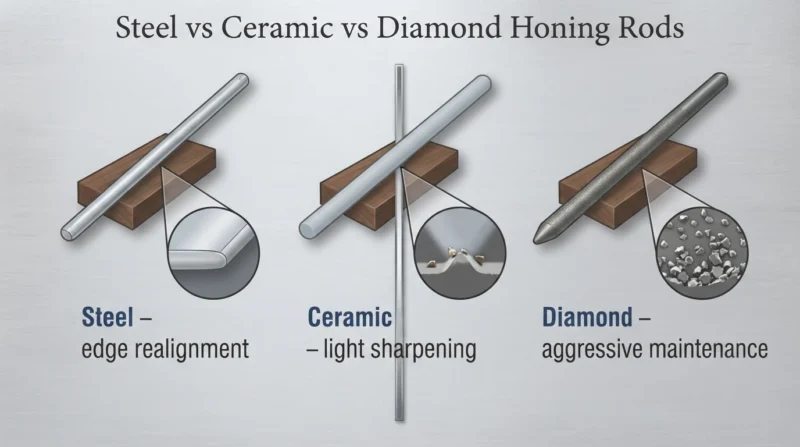
6. Honing Rods
A honing rod is one of the most misunderstood knife maintenance tools. Contrary to popular belief, most honing rods do not sharpen a knife. Instead, they realign the microscopic edge that bends during normal use.
Regular honing keeps a knife cutting efficiently and reduces how often full sharpening is required.
Types of Honing Rods
Steel Honing Rod
A traditional steel rod is commonly included with European knife sets.
Best for:
- German kitchen knives
- Softer stainless steels
- Everyday maintenance
Examples:
- X50CrMoV15
- 5Cr15MoV
- 3Cr13
Ceramic Honing Rod
Ceramic rods are harder than steel rods and remove a very small amount of metal while straightening the edge.
Advantages:
- Better for harder steels
- Produces a finer edge
- Excellent for regular maintenance
Recommended for:
- VG10
- AUS-10
- 14C28N
- 154CM
Diamond Honing Rod
Diamond rods are coated with industrial diamonds and can perform light sharpening as well as honing.
Best for:
- Outdoor knives
- Pocket knives
- Quick edge restoration
7. Leather Strops
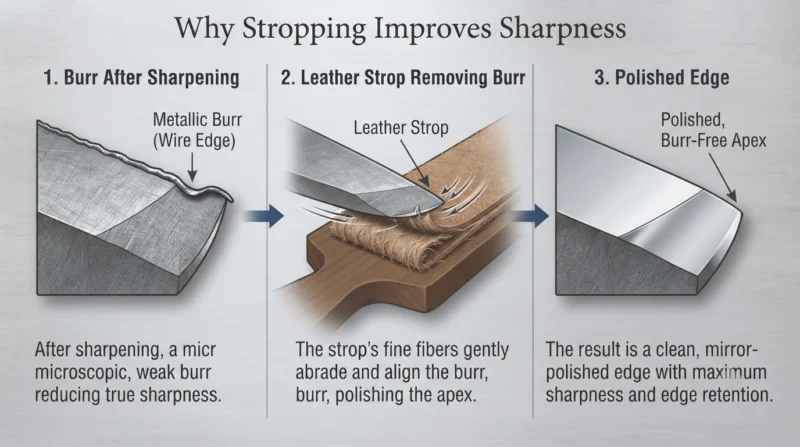
A leather strop is often the final step after sharpening.
Instead of removing large amounts of steel, a strop removes the tiny burr left behind by sharpening and polishes the cutting edge.
Benefits
- Produces razor-sharp edges
- Improves push-cutting performance
- Extends edge life
- Creates a polished bevel
Many users apply polishing compounds such as:
- Chromium oxide
- Diamond paste
- Aluminum oxide
A leather strop is especially useful after sharpening Japanese kitchen knives.
8. Guided Sharpening Systems
Guided sharpening systems help maintain a precise sharpening angle throughout the process.
The knife or sharpening stone is held in a guide, eliminating much of the guesswork.
Advantages
- Consistent sharpening angle
- Easy to learn
- Excellent repeatability
- Ideal for premium knives
These systems are popular with collectors who own expensive folding knives or custom blades.
Best Uses
- Pocket knives
- Hunting knives
- EDC knives
- Premium chef knives
9. Pull-Through Knife Sharpeners
Pull-through sharpeners are designed for speed and convenience.
The knife is pulled through preset abrasive slots that restore the edge quickly.
Advantages
- Very easy to use
- Fast sharpening
- Compact
- Affordable
Disadvantages
- Removes more steel
- Fixed sharpening angle
- Not suitable for premium Japanese knives
- Can shorten knife life with excessive use
Pull-through sharpeners work best for inexpensive kitchen knives rather than high-end cutlery.
10. Electric Knife Sharpeners
Electric sharpeners use rotating abrasive wheels to sharpen knives rapidly.
Some models include multiple stages for coarse grinding, sharpening, and polishing.
Advantages
- Very fast
- Minimal skill required
- Consistent results
- Suitable for large households
Disadvantages
- Higher cost
- Removes steel quickly
- Less control over the edge
- Not recommended for thin Japanese blades
Electric sharpeners are ideal for users who prioritize convenience over maximum edge refinement.
11. Belt Sharpeners
Professional knife makers often use belt grinders to create or restore edges.
Different abrasive belts allow coarse shaping, sharpening, and polishing.
Advantages
- Extremely fast
- Repairs damaged blades
- Creates convex edges
- Handles large amounts of steel removal
Disadvantages
- Requires experience
- Easy to overheat the blade
- Can permanently damage a knife if used incorrectly
For most home users, belt sharpeners are unnecessary unless repairing heavily damaged knives.
12. Bench Grinders
Bench grinders are designed primarily for tools, not kitchen knives.
Although they can sharpen knives, they require careful temperature control to avoid ruining the blade’s heat treatment.
They are generally recommended only for experienced users.
13. Pocket Sharpeners
Pocket sharpeners are compact tools designed for field use.
Most combine multiple sharpening surfaces such as:
- Carbide slot
- Ceramic slot
- Diamond plate
These are excellent companions for camping, hiking, hunting, and emergency kits.
Choosing the Right Sharpener for Different Knife Steels
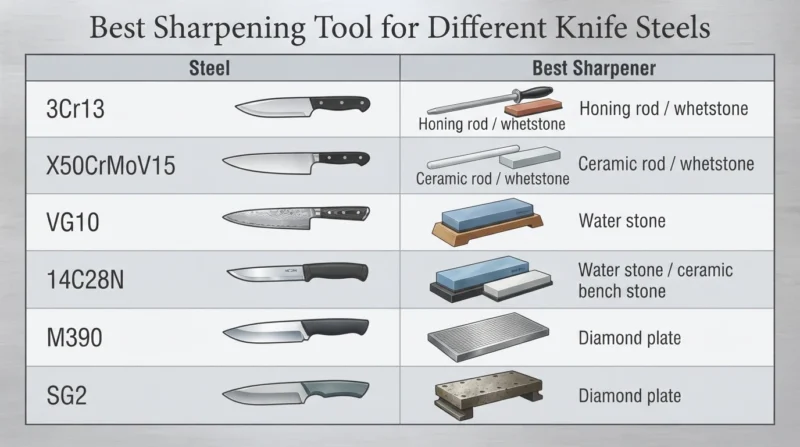
Not every sharpening tool works equally well with every steel.
Soft Stainless Steels
Examples:
- 3Cr13
- 5Cr15MoV
- X50CrMoV15
Recommended tools:
- Honing rod
- Medium-grit whetstone
- Pull-through sharpener
- Electric sharpener
Medium-Hard Stainless Steels
Examples:
- AUS-8
- AUS-10
- VG10
- 14C28N
- 154CM
Recommended tools:
- Water stones
- Ceramic stones
- Leather strop
- Guided sharpening systems
High-Wear Powder Steels
Examples:
- M390
- CPM S30V
- CPM S35VN
- CPM S90V
- SG2 (R2)
- ZDP-189
Recommended tools:
- Diamond plates
- Diamond compound strops
- Guided sharpening systems
These steels contain a high volume of hard carbides, making diamond abrasives the most efficient option.
Sharpening Frequency
How often you sharpen depends on how frequently you use your knives.
Home Cook
- Hone every 1–2 weeks
- Sharpen every 3–6 months
Professional Chef
- Hone daily
- Sharpen every few weeks or as needed
Outdoor Knife
Sharpen whenever cutting performance noticeably declines.
Common Sharpening Mistakes
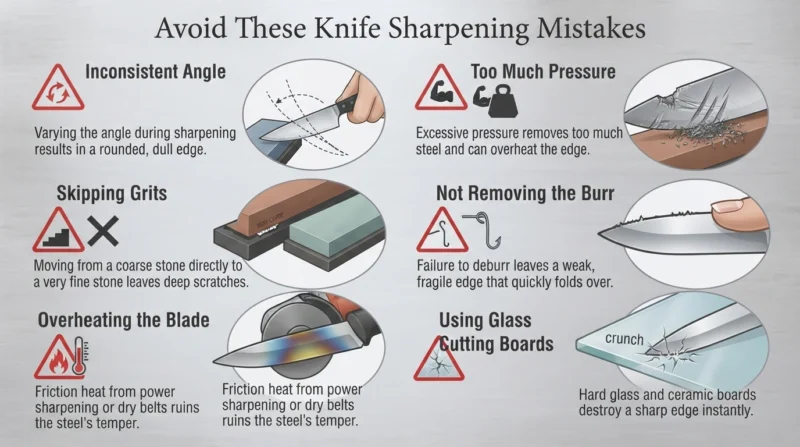
Avoiding these mistakes will improve both edge quality and knife longevity.
Inconsistent Angle
Changing the sharpening angle during each stroke creates an uneven bevel.
Maintain a consistent angle from heel to tip.
Too Much Pressure
Heavy pressure removes unnecessary steel and makes angle control more difficult.
Let the abrasive do the work.
Skipping Grits
Jumping directly from a coarse stone to a polishing stone leaves deep scratches and produces a weaker edge.
Progress gradually through finer grits.
Not Removing the Burr
The burr is a thin strip of metal created during sharpening.
If left in place, the edge quickly feels dull again.
A leather strop or fine finishing stone removes the burr effectively.
Overheating the Blade
Powered sharpeners and grinders can overheat the edge.
Excessive heat reduces hardness and permanently damages the heat treatment.
Always sharpen slowly and keep the blade cool.
Using the Wrong Cutting Board
Glass, marble, ceramic, and granite cutting boards dull knives rapidly.
Instead, choose:
- Hardwood
- Bamboo
- High-quality plastic
Knife Maintenance Tips
Proper maintenance reduces sharpening frequency.
Wash by Hand
Dishwashers expose knives to heat, detergent, and impacts that damage the edge.
Dry Immediately
Even stainless steel benefits from being dried after washing.
Store Safely
Use:
- Knife blocks
- Magnetic strips
- Blade guards
- Knife rolls
Avoid storing loose knives in a drawer.
Use the Right Knife
Don’t use a chef’s knife for:
- Opening cans
- Cutting frozen food
- Splitting bones
- Prying objects
Using the correct knife preserves the edge.
Frequently Asked Questions
What is the best knife sharpening tool?
For most users, a quality 1000-grit whetstone provides the best balance of performance, versatility, and value.
Are electric sharpeners safe?
Yes, when used correctly. However, they remove steel more aggressively than manual sharpening methods.
How often should I hone my knife?
Professional chefs often hone daily, while home cooks typically hone every one to two weeks.
Which sharpening tool is best for Japanese knives?
Water stones remain the preferred choice because they produce extremely refined edges while preserving blade geometry.
Can I sharpen every steel with the same stone?
Most traditional stainless steels respond well to water stones, but high-carbide powder steels sharpen much faster on diamond plates.
Is a leather strop necessary?
While not essential, stropping significantly improves edge refinement and helps remove the burr left after sharpening.
Can a dull knife be restored?
Yes. Even heavily worn knives can usually be restored with coarse sharpening stones or diamond plates unless the blade is severely damaged.
Do expensive knives stay sharp forever?
No. Premium steels retain their edges longer, but every knife eventually requires maintenance.
Is sharpening difficult?
Like any skill, sharpening becomes easier with practice. Many beginners achieve excellent results after only a few sessions using a medium-grit whetstone.
Final Thoughts
Keeping your knives sharp is one of the best ways to improve cutting performance, safety, and the overall cooking experience. There is no single sharpening tool that suits every knife or every user. Water stones provide exceptional control and edge quality, diamond plates excel with modern high-carbide steels, guided systems offer precision with minimal learning, and electric or pull-through sharpeners deliver convenience for those who value speed.
The best approach is to match the sharpening tool to your knife steel, your skill level, and how often you use your knives. With regular honing, proper sharpening techniques, and careful maintenance, even a modest kitchen knife can provide years of dependable performance, while premium blades can remain trusted companions for decades.
Investing time in learning how to sharpen your knives is one of the most valuable skills any cook, outdoors enthusiast, or knife collector can develop. A well-maintained edge not only performs better but also transforms everyday cutting into a smoother, safer, and more enjoyable experience.