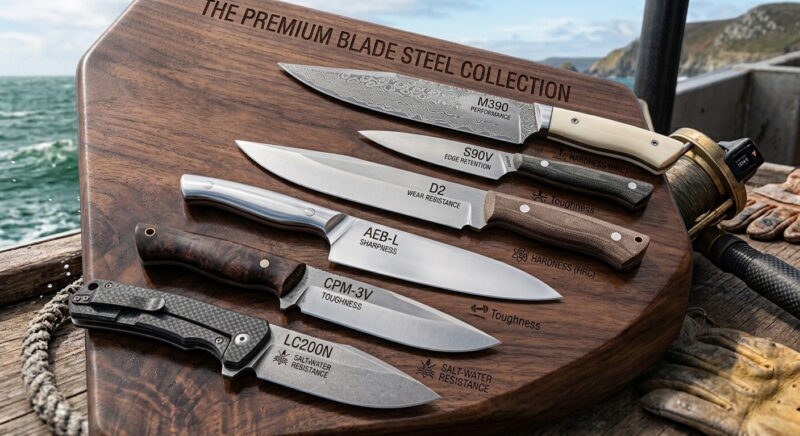
The Secret Code on the Blade
An Independent Guide
Walk into any knife shop or browse an online marketplace, and you’ll quickly notice mysterious markings engraved on knife blades.
You may see names such as:
To many buyers, these combinations of letters and numbers appear to be little more than model codes.
In reality, they reveal one of the most important aspects of any knife—the steel itself.
Behind every steel designation lies a carefully engineered chemical composition that determines how a knife performs in the real world. The balance of carbon, chromium, vanadium, molybdenum, nitrogen, and other alloying elements influences everything from edge retention and toughness to corrosion resistance and ease of sharpening.
Understanding these “secret codes” allows you to look beyond marketing claims and evaluate a knife based on its actual material properties.
Whether you’re buying a chef’s knife, a hunting knife, a bushcraft blade, or an everyday carry folder, learning the basics of steel chemistry helps you choose the right tool for your specific needs.
In this guide, you’ll discover:
- What knife steel names actually mean
- Why steel chemistry matters
- How alloying elements affect performance
- Why two steels with similar hardness can behave very differently
- How to read steel specifications like an experienced knife enthusiast
By the end of this article, those mysterious blade markings will no longer seem like secret codes—they’ll become valuable information that helps you make smarter buying decisions.
Why Steel Matters More Than Most People Realize
Many first-time knife buyers focus on the blade’s appearance.
They compare:
- Blade shape
- Handle material
- Blade finish
- Lock type
- Overall design
While these features certainly matter, none has as much influence on long-term performance as the steel itself.
The steel determines:
- How long the edge stays sharp
- How resistant the blade is to rust
- How difficult it is to sharpen
- How likely it is to chip
- How well it withstands heavy use
- How often maintenance is required
Imagine two knives that look nearly identical.
Both have:
- The same blade length
- Similar handle materials
- Comparable weight
- Identical blade shape
Yet after several months of use, one knife still slices paper cleanly while the other struggles to cut a tomato.
The difference often comes down to steel chemistry.
The Blade Is a Recipe
One of the easiest ways to understand knife steel is to compare it to cooking.
Think of steel as a carefully balanced recipe.
The primary ingredient is iron, but by itself, iron is too soft for a high-performance knife.
Metallurgists improve iron by adding carefully measured amounts of other elements.
Each ingredient contributes something different.
Just as adding more sugar changes the taste of a cake, adding more carbon or chromium changes how steel behaves.
Some elements increase hardness.
Others improve corrosion resistance.
Some increase toughness.
Others make sharpening more difficult while dramatically extending edge life.
The challenge is finding the right balance.
There is no perfect steel.
Every steel represents a compromise between competing characteristics.
What Do Knife Steel Names Mean?
One of the biggest misconceptions is that names like M390 or D2 indicate quality levels.
They do not.
Instead, they identify a specific steel composition and manufacturing standard.
Think of steel names as recipes.
Each designation represents a unique combination of alloying elements and processing methods.
For example:
- Some steels contain very high carbon.
- Others contain additional nitrogen.
- Some use powder metallurgy.
- Others rely on conventional production methods.
Although the names may seem confusing at first, they simply describe different engineering solutions.
Each was developed to solve particular performance requirements.
Check Our Guide Carbon Steel vs Damascus Steel
Steel Names vs Steel Chemistry
Two knives may have completely different steel names while sharing similar characteristics.
Conversely, two steels with similar names may perform quite differently.
Why?
Because performance depends on much more than the name engraved on the blade.
It depends on:
- Chemical composition
- Heat treatment
- Manufacturing process
- Carbide formation
- Blade geometry
- Edge thickness
- Intended application
The steel name is only the starting point.
Understanding the chemistry behind that name reveals much more about how the knife will perform.
Every Element Has a Job
Knife steel is a carefully engineered alloy.
Each alloying element contributes specific characteristics.
The overall performance depends on how these elements work together rather than on any single ingredient.
Some improve hardness.
Others increase corrosion resistance.
Some create extremely wear-resistant carbides.
Others refine grain structure or improve toughness.
Understanding these elements allows you to predict how an unfamiliar steel may behave before ever using the knife.
Carbon: The Foundation of Knife Steel
Carbon is the most important alloying element in nearly every knife steel.
Without enough carbon, a blade cannot become sufficiently hard to hold a sharp edge.
Increasing carbon generally allows steel to achieve:
- Higher hardness
- Better edge retention
- Greater wear resistance
However, excessive carbon also creates trade-offs.
Very high carbon levels can reduce toughness and make sharpening more difficult.
This is why steel designers carefully balance carbon with other alloying elements.
Carbon provides the foundation upon which all other improvements are built.
Chromium: More Than Rust Protection
Many people believe chromium simply makes steel stainless.
While corrosion resistance is one of its most important functions, chromium does much more.
It also contributes to:
- Wear resistance
- Hardenability
- Carbide formation
- High-temperature stability
When present in sufficient amounts, chromium forms a thin protective oxide layer on the surface of the blade.
This invisible layer dramatically slows rust formation.
However, chromium also participates in carbide formation.
This means not all chromium remains available to fight corrosion.
The balance between chromium used for carbides and chromium remaining in solution is one reason different stainless steels perform differently.
Why More Chromium Doesn’t Always Mean Better Steel
A common misconception is that higher chromium automatically produces a superior knife.
In reality, the answer is far more complicated.
High chromium often improves corrosion resistance.
However, it may also:
- Reduce toughness
- Change carbide structure
- Affect sharpening behavior
- Alter edge stability
A well-balanced steel frequently outperforms one that simply contains more chromium.
This illustrates an important principle of metallurgy:
Steel performance is determined by balance, not by maximizing a single element.
Wear Resistance Begins at the Microscopic Level
When a knife cuts cardboard, rope, wood, or food, the edge slowly wears away.
The rate of this wear depends largely on microscopic particles called carbides.
Carbides are extremely hard compounds formed when carbon combines with alloying elements such as:
- Vanadium
- Chromium
- Tungsten
- Molybdenum
These tiny particles resist abrasion far better than the surrounding steel.
As a result, blades containing carefully distributed hard carbides often maintain their cutting ability much longer.
Later in this guide, we’ll explore how carbide size, type, and distribution dramatically influence edge retention, sharpening, and toughness.
Steel Chemistry Is About Balance
It is tempting to assume that the steel containing the highest amount of every desirable element must be the best.
In practice, metallurgy doesn’t work that way.
Improving one characteristic usually requires sacrificing another.
For example:
- Increasing hardness may reduce toughness.
- Increasing wear resistance often makes sharpening slower.
- Maximizing corrosion resistance can reduce edge retention.
- Adding more carbides may increase brittleness.
The best knife steel is rarely the one with the highest numbers.
Instead, it is the steel whose chemistry matches the intended purpose of the knife.
A diving knife, for example, benefits from extraordinary corrosion resistance, while a woodworking knife may prioritize wear resistance and edge stability.
Understanding this balance is the key to decoding the “secret code” stamped on the blade.
Carbon (C): The Foundation of Every Great Blade
If knife steel were a building, carbon would be its foundation.
Carbon is the single most important alloying element because it determines whether steel can become hard enough to hold a sharp edge.
Without sufficient carbon, even the most expensive steel would struggle to perform as a knife.
Increasing carbon generally improves:
- Hardness
- Edge retention
- Wear resistance
- Ability to form carbides
However, more carbon is not always better.
Very high carbon content can also:
- Reduce toughness
- Increase brittleness
- Make sharpening more difficult
- Increase corrosion risk if chromium is insufficient
Typical Carbon Levels
| Carbon Content | General Characteristics |
|---|---|
| Below 0.50% | Soft, easy to sharpen, limited edge retention |
| 0.50–0.80% | Balanced performance |
| 0.80–1.20% | Excellent knife steels |
| Above 1.20% | Premium high-wear steels |
Carbon works together with nearly every other alloying element, making it the backbone of modern knife metallurgy.
Chromium (Cr): The Guardian Against Corrosion
Chromium is often associated with stainless steel, but its role is much broader.
When present in sufficient quantities, chromium forms a thin protective oxide layer that shields the blade from rust.
Benefits include:
- Corrosion resistance
- Improved hardenability
- Better wear resistance
- Carbide formation
- Increased durability
Many stainless knife steels contain approximately 13–20% chromium.
However, not all of that chromium remains available to protect against corrosion.
Some combines with carbon to form chromium carbides.
This is why two stainless steels with similar chromium content may exhibit different corrosion resistance.
More Chromium Isn’t Always Better
Extremely high chromium levels can sometimes reduce:
- Toughness
- Ease of sharpening
- Edge stability
Again, metallurgy is about balance rather than maximizing a single element.
Vanadium (V): The Edge Retention Specialist
Vanadium has become one of the most valuable alloying elements in premium knife steels.
Its primary contribution is the formation of vanadium carbides, among the hardest microscopic particles found in knife steel.
These carbides dramatically improve:
- Wear resistance
- Edge retention
- Edge stability
- Fine grain refinement
A blade with sufficient vanadium often remains sharp far longer during abrasive cutting.
Tasks such as:
- Cardboard
- Rope
- Leather
- Wood
benefit significantly from vanadium-rich steels.
Trade-Offs
Because vanadium carbides are extremely hard, they also make sharpening slower.
This explains why many premium wear-resistant steels require diamond sharpening stones.
Molybdenum (Mo): The Strength Enhancer
Molybdenum is frequently overlooked because it rarely receives as much attention as carbon or vanadium.
Nevertheless, it performs several important functions.
It contributes to:
- Strength
- Hardenability
- Wear resistance
- Corrosion resistance
- High-temperature stability
Molybdenum also supports heat treatment by helping steel achieve consistent hardness.
Although typically present in relatively small quantities, its influence is significant.
Tungsten (W): Stability Under Pressure
Tungsten increases:
- Hardness
- Wear resistance
- Edge stability
Like vanadium, tungsten forms extremely hard carbides.
These carbides help the cutting edge resist abrasion during prolonged use.
Tungsten also contributes to maintaining hardness during heat treatment.
Although modern knife steels often contain modest amounts of tungsten, its presence improves overall cutting performance.
Cobalt (Co): Supporting Heat Treatment
Unlike carbon or chromium, cobalt does not form carbides.
Instead, it improves how steel responds during heat treatment.
Benefits include:
- Higher achievable hardness
- Better heat-treatment consistency
- Improved wear resistance through enhanced carbide effectiveness
Steels containing cobalt often demonstrate excellent hardness while maintaining good structural stability.
Nitrogen (N): A Modern Alternative to Carbon
Nitrogen has become increasingly important in advanced stainless knife steels.
Rather than replacing carbon completely, nitrogen complements it.
Benefits include:
- Improved corrosion resistance
- Increased toughness
- Fine grain refinement
- Stable cutting edges
- Enhanced strength
One major advantage is that nitrogen allows chromium to remain in solution instead of forming excessive carbides.
This means more chromium remains available to fight corrosion.
For marine knives and kitchen knives, nitrogen can provide tremendous benefits.
Manganese (Mn): The Hidden Helper
Manganese rarely appears in advertisements, yet it plays several valuable supporting roles.
It contributes to:
- Improved hardenability
- Increased strength
- Better manufacturing consistency
- Enhanced toughness
Most knife steels contain relatively small amounts of manganese, but removing it entirely would noticeably reduce overall performance.
Silicon (Si): Improving Steel Quality
Silicon is another supporting alloying element.
Its primary functions include:
- Increasing strength
- Improving elasticity
- Assisting during steel production
- Enhancing stability
Although present in small percentages, silicon contributes to the clean, consistent structure expected from premium knife steels.
Nickel (Ni): Toughness and Corrosion Resistance
Nickel is less common in high-performance knife steels than chromium or vanadium, but it remains valuable in certain alloys.
Its benefits include:
- Increased toughness
- Better corrosion resistance
- Improved resistance to impact
- Enhanced ductility
Nickel is particularly useful in steels designed for harsh environments where both toughness and corrosion resistance are priorities.
How Alloying Elements Work Together
One of the biggest misconceptions among knife buyers is that a steel can be judged by a single element.
For example:
- “High carbon equals the best steel.”
- “More chromium always means better.”
- “Vanadium alone determines edge retention.”
In reality, no element works alone.
Knife steel performance depends on how alloying elements interact.
For example:
High carbon without sufficient chromium may produce excellent edge retention but poor corrosion resistance.
High chromium without enough carbon may resist rust but struggle to maintain a sharp edge.
Adding vanadium increases wear resistance, but excessive carbide formation can make sharpening more difficult.
This interaction explains why steel design is one of the most complex areas of modern metallurgy.
The Importance of Balance
The most successful knife steels are not those with the highest percentage of one particular element.
Instead, they achieve balance.
Designers carefully adjust alloying elements to create steels optimized for different purposes.
For example:
Kitchen Knives
Priority:
- Corrosion resistance
- Fine edge
- Easy maintenance
Outdoor Knives
Priority:
- Toughness
- Edge stability
- Wear resistance
Bushcraft Knives
Priority:
- Toughness
- Reliable sharpening
- Good edge retention
Everyday Carry
Priority:
- Balanced performance
- Corrosion resistance
- Long edge life
Each application demands a different chemical recipe.
This is why dozens of premium knife steels exist rather than a single “perfect” steel.
Chemistry Is Only the Beginning
Although chemistry provides the blueprint, it does not tell the whole story.
Two knives made from the same steel can perform differently because of:
- Heat treatment
- Blade geometry
- Edge angle
- Grinding quality
- Manufacturing precision
Steel chemistry creates the potential.
The knife maker determines how much of that potential becomes reality.
Reading Steel Like an Expert: Heat Treatment, Carbides, and Why Chemistry Alone Isn’t Enough
In Parts 1 and 2, we explored the chemistry behind knife steels and learned how alloying elements such as carbon, chromium, vanadium, nitrogen, and molybdenum influence blade performance.
However, knowing the chemical composition tells only part of the story.
Two knives made from the same steel can perform very differently.
How is that possible?
The answer lies in heat treatment, microstructure, carbide formation, and manufacturing quality.
Learning these concepts will help you evaluate a knife far more accurately than simply looking at the steel name stamped on the blade.
Heat Treatment: The Hidden Factor Behind Great Knives
If steel chemistry is the recipe, heat treatment is the cooking process.
Two chefs can use the exact same ingredients yet produce completely different meals.
Knife steels behave the same way.
Heat treatment determines how the alloy develops its final properties.
A carefully controlled process can transform a good steel into an outstanding blade, while poor heat treatment can prevent even a premium steel from reaching its full potential.
Heat treatment generally includes three main stages:
- Hardening
- Quenching
- Tempering
Each stage changes the internal structure of the steel.
The final result affects:
- Hardness
- Toughness
- Wear resistance
- Edge stability
- Ease of sharpening
This is why experienced knife enthusiasts often say:
The heat treatment is just as important as the steel itself.
Check Our Guide Different Heat Treatment Methods Explained
Hardness Is Only One Piece of the Puzzle
Many advertisements proudly display hardness values such as:
- 58 HRC
- 60 HRC
- 62 HRC
- 64 HRC
While hardness matters, it should never be viewed in isolation.
Higher hardness generally improves:
- Edge retention
- Wear resistance
- Fine edge capability
But it may also reduce:
- Toughness
- Resistance to chipping
- Ease of sharpening
For example, a blade hardened to 64 HRC may stay sharp longer than one at 60 HRC, but it could also be less forgiving during heavy-duty use.
The ideal hardness depends on the knife’s intended purpose rather than simply achieving the highest possible number.
Check Our Guide What Is HRC? Understanding Rockwell Hardness
Carbides: The Tiny Particles That Keep a Knife Sharp
One of the most important concepts in knife metallurgy is the carbide.
Carbides are microscopic compounds formed when carbon combines with elements such as:
- Vanadium
- Chromium
- Tungsten
- Molybdenum
Although invisible to the naked eye, they play a major role in cutting performance.
Think of carbides as extremely hard particles embedded throughout the steel.
As the blade cuts abrasive materials, these particles resist wear and help preserve the edge.
Different Carbides, Different Performance
Not all carbides are the same.
Each alloying element forms carbides with different characteristics.
Chromium Carbides
Provide:
- Good wear resistance
- Improved corrosion resistance
- Moderate hardness
Vanadium Carbides
Provide:
- Exceptional wear resistance
- Outstanding edge retention
- Excellent edge stability
These are among the hardest carbides found in knife steels.
Tungsten Carbides
Provide:
- High hardness
- Improved wear resistance
- Better high-temperature stability
Molybdenum Carbides
Provide:
- Additional wear resistance
- Improved strength
- Better heat-treatment response
The combination and distribution of these carbides largely determine how a knife behaves during real-world use.
Carbide Size Matters
Many people assume that more carbides automatically produce a better knife.
This is not always true.
Large carbides can:
- Reduce toughness
- Increase brittleness
- Make sharpening more difficult
Smaller, evenly distributed carbides generally produce:
- Smoother cutting
- Better edge stability
- Improved toughness
- More consistent sharpening
This is one reason modern premium steels often outperform older high-alloy steels with similar chemical compositions.
Powder Metallurgy: A Major Advancement in Knife Steel
Traditional steel production involves pouring molten steel into large ingots.
As the metal cools, carbides can cluster together, producing an uneven internal structure.
Powder metallurgy solves this problem.
Instead of cooling as one large mass, molten steel is transformed into tiny powder particles that solidify almost instantly.
These particles are then compressed under extreme pressure and heat into solid steel.
The result is a much finer and more uniform microstructure.
Benefits include:
- Smaller carbides
- Better carbide distribution
- Improved toughness
- Higher wear resistance
- Better edge stability
- More consistent performance
Many premium knife steels owe much of their reputation to this advanced manufacturing process.
Check Our Guide Powder Steels for Kitchen Knives
Why Two Knives Made from the Same Steel Can Perform Differently
This often surprises new knife buyers.
Imagine two knives made from the exact same steel.
One keeps its edge noticeably longer.
The other chips more easily.
How can that happen?
Several factors influence performance:
Heat Treatment
Small differences in temperature and tempering can significantly affect hardness and toughness.
Blade Geometry
A thinner blade slices more efficiently but may sacrifice durability.
A thicker blade is stronger but often cuts with more resistance.
Edge Angle
A narrow edge angle creates exceptional sharpness.
A wider edge angle increases durability.
Grind
The blade grind affects:
- Cutting efficiency
- Food release
- Strength
- Ease of sharpening
Manufacturing Precision
Even small differences in production quality can influence long-term performance.
This is why knowledgeable buyers evaluate the entire knife rather than focusing only on the steel.
Stainless vs. High-Carbon Steel
One of the most common questions from knife buyers is whether stainless or high-carbon steel is better.
The answer depends entirely on intended use.
Stainless Steel
Advantages:
- Excellent corrosion resistance
- Easier maintenance
- Ideal for kitchens
- Suitable for humid climates
Trade-offs:
- Some stainless steels sacrifice wear resistance for corrosion resistance.
High-Carbon Steel
Advantages:
- Excellent edge stability
- Easy sharpening
- Outstanding cutting feel
- Often preferred for woodworking and bushcraft
Trade-offs:
- Requires regular maintenance
- More susceptible to rust
- Can develop a natural patina
Neither category is universally superior.
Each serves different needs.
The Importance of Grain Structure
Another factor often overlooked is grain size.
A fine grain structure provides several advantages:
- Better toughness
- Sharper edges
- Improved edge stability
- Easier polishing
- More consistent sharpening
Large grain structures may reduce cutting precision and increase the likelihood of edge damage.
Modern metallurgy aims to create extremely fine grain structures while maintaining excellent hardness.
Reading Steel Like an Expert
After learning about chemistry and manufacturing, you can begin evaluating steels much more effectively.
Instead of asking:
“Is this steel good?”
Ask questions such as:
- Does it prioritize wear resistance or toughness?
- Is corrosion resistance important for my environment?
- Will I sharpen frequently or rarely?
- Will I cut food, wood, rope, or cardboard?
- Does the blade geometry suit the intended task?
These questions provide much better guidance than relying on steel names alone.
The Best Steel Depends on the Job
No steel dominates every category.
For example:
Kitchen Knives
Look for:
- Corrosion resistance
- Fine grain structure
- Easy maintenance
Bushcraft Knives
Look for:
- Toughness
- Easy sharpening
- Reliable edge stability
Everyday Carry
Look for:
- Balanced performance
- Good corrosion resistance
- Long edge life
Heavy Utility Work
Look for:
- Exceptional wear resistance
- High hardness
- Excellent edge retention
Choosing the right steel is about matching its strengths to the work you expect it to perform.
Choosing Knife Steel Like an Expert: Final Verdict, FAQ & Buying Guide
By now, you’ve learned that the letters and numbers etched onto a knife blade represent much more than a model designation. They reveal the blade’s metallurgical blueprint—a carefully balanced combination of alloying elements, manufacturing techniques, and heat treatment that ultimately determines how the knife performs.
Whether you’re purchasing your first quality knife or expanding an existing collection, understanding steel chemistry allows you to make informed decisions based on facts rather than marketing claims.
Let’s finish by bringing everything together.
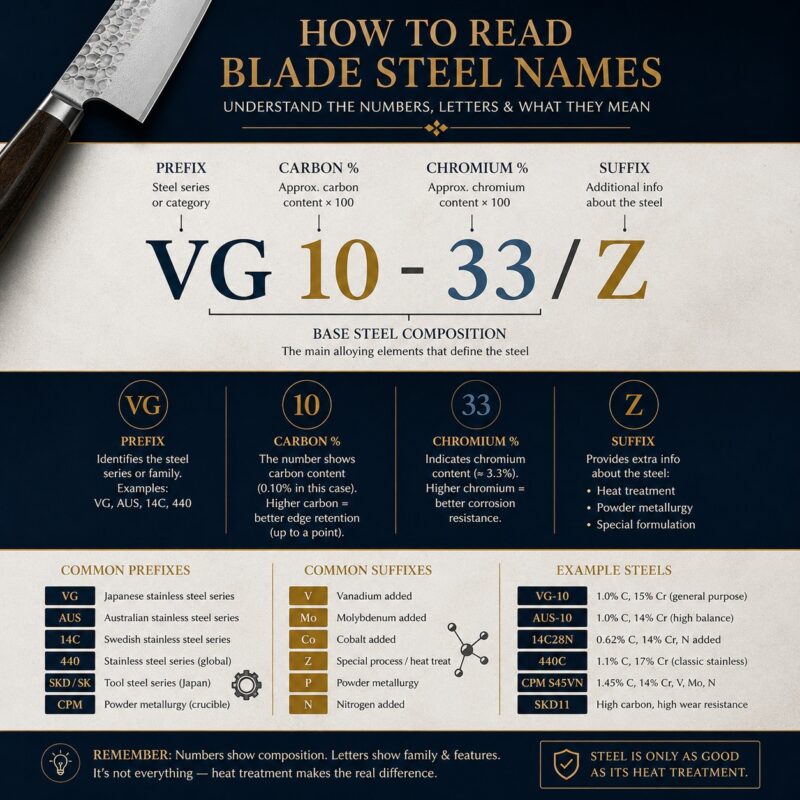
How to Read a Knife Steel Datasheet
When researching a knife steel, you’ll often encounter technical datasheets filled with numbers and chemical formulas.
At first glance they can seem overwhelming, but once you know what to look for, they become valuable buying tools.
Pay attention to these areas:
1. Chemical Composition
Look for percentages of:
- Carbon
- Chromium
- Vanadium
- Molybdenum
- Nitrogen
- Tungsten
- Cobalt
These elements provide the first clues about how the steel is likely to perform.
2. Recommended Hardness
Knife steels are commonly heat treated within a hardness range.
For example:
- 58–60 HRC
- 60–62 HRC
- 62–64 HRC
A recommended hardness range tells you how the steel is intended to balance:
- Edge retention
- Toughness
- Ease of sharpening
3. Corrosion Resistance
Not every stainless steel offers the same level of rust resistance.
If you’ll be using the knife for:
- Fishing
- Food preparation
- Coastal environments
- Camping in wet climates
choose a steel with excellent corrosion resistance.
4. Toughness
Toughness becomes especially important when the knife may experience:
- Twisting
- Batoning
- Light impact
- Outdoor work
A tough steel is generally less likely to chip or crack during demanding use.
5. Wear Resistance
Wear resistance determines how slowly the cutting edge loses material during use.
If your daily tasks involve:
- Cardboard
- Rope
- Leather
- Fibrous materials
high wear resistance can significantly reduce sharpening frequency.
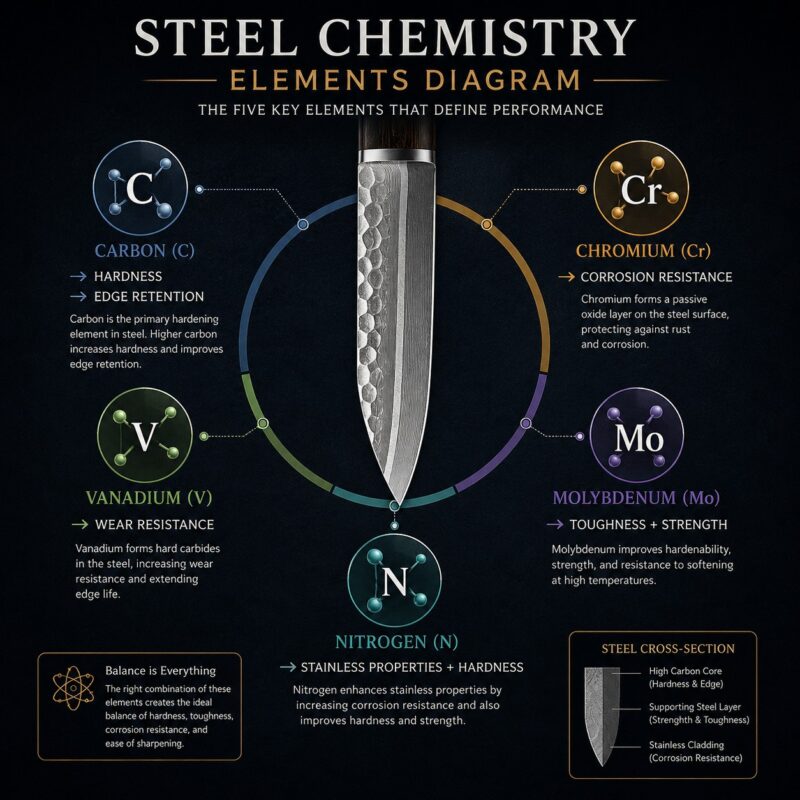
Choosing Steel Based on Your Needs
One of the biggest mistakes buyers make is searching for the “best” knife steel.
In reality, the better question is:
Which steel is best for my intended use?
Let’s look at some common scenarios.
For Home Cooking
Prioritize:
- Corrosion resistance
- Fine edge
- Easy maintenance
- Easy sharpening
Food preparation exposes blades to moisture, acids, and frequent washing.
A balanced stainless steel usually provides the best experience.
For Professional Kitchens
Professional chefs often benefit from steels that combine:
- Excellent edge retention
- Corrosion resistance
- Stable cutting edges
- Reliable sharpening intervals
A knife used throughout an entire workday benefits from both durability and ease of maintenance.
For Bushcraft and Camping
Outdoor users should focus on:
- Toughness
- Reliable sharpening
- Good edge stability
- Balanced wear resistance
Extreme hardness is often less valuable than durability in remote environments.
For Hunting
Field dressing and game processing require:
- Fine slicing ability
- Corrosion resistance
- Toughness
- Easy cleaning
Hunters often encounter moisture and organic materials, making corrosion resistance an important consideration.
For Everyday Carry (EDC)
Daily utility knives benefit from balanced performance.
Look for steels that provide:
- Good edge retention
- Corrosion resistance
- Easy maintenance
- Reliable toughness
A balanced steel generally proves more practical than one optimized for only a single characteristic.
Common Myths About Knife Steel
The internet contains countless misconceptions about knife steels.
Let’s examine some of the most common ones.
Myth 1: The Hardest Steel Is Always the Best
Not true.
Higher hardness usually improves edge retention but may reduce toughness.
The ideal hardness depends on how the knife will be used.
Myth 2: Stainless Steel Never Rusts
No steel is completely immune to corrosion.
Even highly corrosion-resistant stainless steels benefit from:
- Cleaning
- Drying
- Proper storage
Good maintenance always extends blade life.
Myth 3: High Carbon Automatically Means Better Edge Retention
Carbon contributes to hardness, but edge retention also depends on:
- Carbide formation
- Heat treatment
- Grain structure
- Blade geometry
Carbon alone does not determine cutting performance.
Myth 4: Steel Name Equals Knife Quality
The same steel can produce very different knives.
Performance depends on:
- Heat treatment
- Grinding
- Manufacturing precision
- Edge geometry
- Quality control
Steel is only one part of the equation.
Myth 5: Expensive Steel Is Always Worth It
Premium steels offer impressive performance, but they are not always necessary.
For many users, a well-made mid-range steel that is properly heat treated will outperform an expensive steel with poor manufacturing.
Buy the steel that matches your actual needs—not simply the one with the highest price tag.
Frequently Asked Questions
Why are there so many knife steels?
Different knives are designed for different jobs.
A steel optimized for kitchen use may not be ideal for bushcraft, while a steel designed for marine environments may prioritize corrosion resistance over maximum wear resistance.
What is the most important element in knife steel?
Carbon is generally considered the foundation because it enables the steel to harden.
However, knife performance results from the interaction of many alloying elements rather than any single ingredient.
Does more chromium always mean better corrosion resistance?
Not necessarily.
Some chromium forms hard carbides with carbon, leaving less chromium available to protect against rust.
The overall alloy design determines corrosion resistance.
Why are some premium steels difficult to sharpen?
Steels containing large amounts of hard carbides resist abrasion extremely well.
While this greatly improves edge retention, it also means sharpening stones remove material more slowly.
Can two knives made from the same steel perform differently?
Absolutely.
Heat treatment, blade geometry, edge angle, grinding, and manufacturing precision all influence real-world performance.
This is why evaluating the entire knife is more important than looking only at the steel name.
Final Verdict
The steel name engraved on a blade is much more than a collection of letters and numbers—it is a summary of years of metallurgical research and engineering.
Understanding knife steel chemistry allows you to look beyond advertising and evaluate a knife based on measurable performance characteristics.
When you recognize the role of alloying elements such as carbon, chromium, vanadium, molybdenum, nitrogen, and tungsten, the “secret code” on the blade becomes easy to interpret.
You begin to understand why one steel excels in edge retention, another in toughness, and another in corrosion resistance.
Most importantly, you realize there is no universally perfect knife steel.
Every steel represents a carefully balanced compromise between competing characteristics.
The best choice is always the one that fits your intended use, maintenance habits, and cutting environment.
Once you understand steel chemistry, choosing a knife becomes far less about marketing and far more about selecting the right tool for the job.
This article is for independent informational purposes only and is not affiliated with, sponsored by, or endorsed by any steel manufacturer. All product names, trademarks, and registered trademarks are the property of their respective owners.