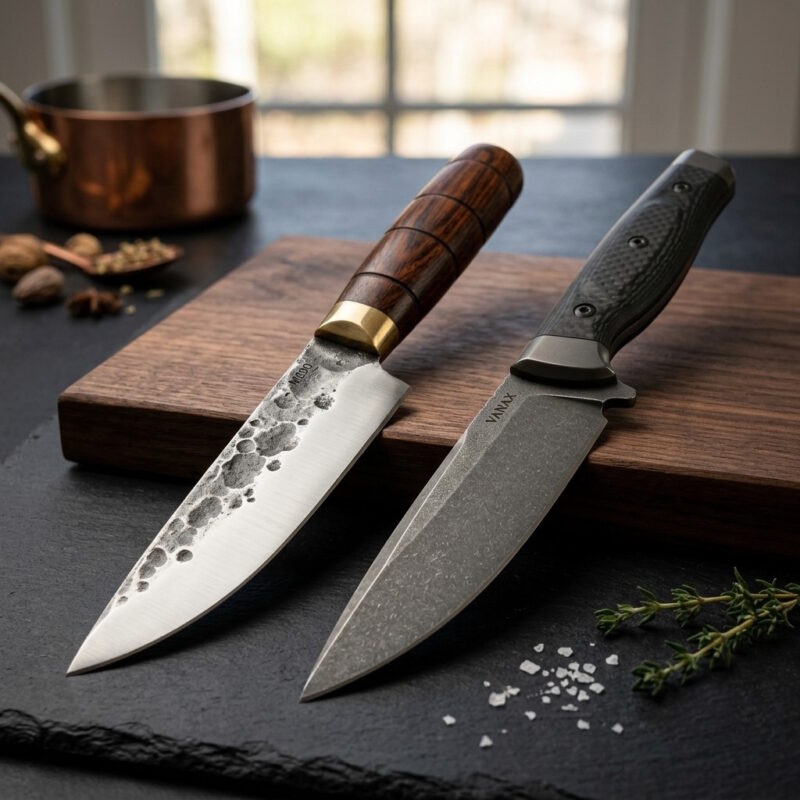
M390 vs Vanax Steel
An Independent Guide
Choosing between M390 and Vanax is not easy. Both belong to the premium class of powder metallurgy stainless steels and are widely respected for exceptional cutting performance. However, despite sharing a similar reputation, these steels were engineered with different priorities.
M390 has become famous for its incredible wear resistance and long-lasting edge retention. It is often selected when maximum cutting longevity is the primary goal.
Vanax approaches performance differently. Rather than focusing solely on wear resistance, it combines excellent edge retention with one of the highest levels of corrosion resistance available in a knife steel, making it particularly attractive for humid, marine, and food preparation environments.
Both steels command premium prices, yet they excel in different situations.
This guide compares every important characteristic, including:
- Chemical composition
- Powder metallurgy process
- Edge retention
- Toughness
- Corrosion resistance
- Sharpening difficulty
- Food preparation performance
- Outdoor and marine use
- Value for money
- Which steel is best for different users
If you’re deciding between these two premium steels, this comparison will help you understand where each one truly shines.
Quick Comparison
| Property | M390 | Vanax |
|---|---|---|
| Steel Type | Powder Metallurgy Stainless | Powder Metallurgy Stainless |
| Edge Retention | ★★★★★ | ★★★★☆ |
| Toughness | ★★★☆☆ | ★★★★☆ |
| Corrosion Resistance | ★★★★★ | ★★★★★+ |
| Ease of Sharpening | ★★☆☆☆ | ★★★☆☆ |
| Wear Resistance | ★★★★★ | ★★★★☆ |
| Fine Edge Stability | Excellent | Excellent |
| Food Preparation | Excellent | Outstanding |
| Marine Environment | Excellent | Exceptional |
What Is M390 Steel?
M390 is a high-alloy stainless powder metallurgy steel designed for exceptional wear resistance and edge retention. Its large amount of chromium and vanadium forms an abundance of extremely hard carbides throughout the steel.
These carbides dramatically slow edge wear during cutting, allowing knives made from M390 to remain sharp through prolonged use.
Typical composition includes approximately:
- Carbon: 1.9–2.2%
- Chromium: 20–21%
- Vanadium: 4%
- Molybdenum: 1%
- Tungsten: 0.6%
- Silicon and manganese in smaller amounts
The combination produces:
- Outstanding wear resistance
- Excellent corrosion resistance
- Very high hardness
- Long edge life
- Fine polished edges
Because of its extremely high carbide volume, M390 is more difficult to sharpen than many conventional stainless steels. Diamond or premium ceramic abrasives are usually recommended for efficient sharpening.
When properly heat treated, hardness generally falls between 60 and 62 HRC, although some makers may choose slightly different hardness levels depending on the intended use.
Check Our Guide M390 Steel Review
What Is Vanax Steel?
Vanax is also produced using powder metallurgy but follows a noticeably different metallurgical philosophy.
Instead of relying primarily on chromium carbides for wear resistance, Vanax uses a carefully balanced alloy containing nitrogen and vanadium to create very hard nitrides.
Nitrogen performs several important functions:
- Improves corrosion resistance
- Maintains high hardness
- Supports fine edge stability
- Reduces the need for excessive carbon
The result is an extremely clean microstructure with excellent resistance to rust while still providing premium cutting performance.
Typical composition includes approximately:
- Carbon: 0.36%
- Chromium: 18%
- Vanadium: 3.5%
- Molybdenum: 1.8%
- Nitrogen: 1.5%
Unlike traditional stainless steels, Vanax contains far less carbon than expected for a premium knife steel. The high nitrogen content compensates for this, allowing the steel to achieve impressive hardness while significantly improving corrosion resistance.
Knives are commonly hardened to 60–62 HRC, offering an excellent combination of edge retention, toughness, and stain resistance.
Check Our Guide Vanax Steel Review
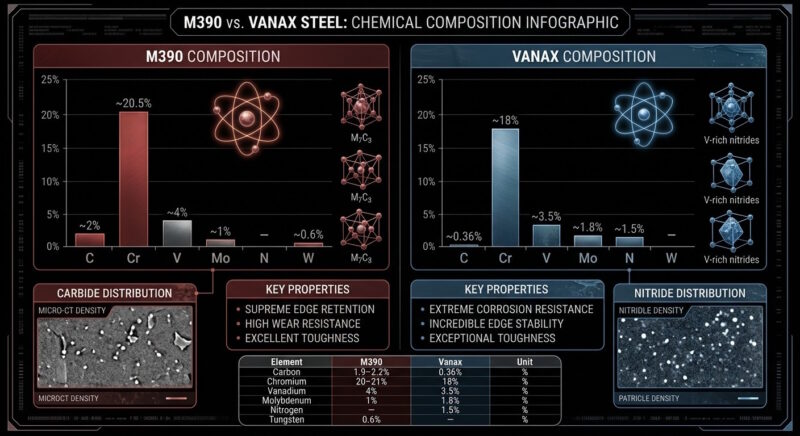
Chemical Composition Comparison
Although both steels belong to the premium stainless category, their alloy designs reveal very different engineering goals.
| Element | M390 | Vanax |
|---|---|---|
| Carbon | 1.9–2.2% | 0.36% |
| Chromium | 20–21% | 18% |
| Vanadium | 4% | 3.5% |
| Molybdenum | 1% | 1.8% |
| Nitrogen | — | 1.5% |
| Tungsten | 0.6% | — |
The biggest difference is immediately obvious:
M390 is carbon-rich.
Vanax is nitrogen-rich.
That single design choice influences nearly every aspect of their performance.
M390 develops a very high volume of chromium and vanadium carbides, which create extraordinary wear resistance but also increase sharpening difficulty.
Vanax forms hard vanadium nitrides instead of relying heavily on carbides. These nitrides provide impressive wear resistance while allowing the steel to remain cleaner and more corrosion resistant.
The reduced carbide volume also contributes to improved toughness and easier maintenance.
Powder Metallurgy Makes the Difference
Neither of these steels could achieve their impressive properties through conventional steelmaking.
Both are manufactured using powder metallurgy, a process in which molten steel is atomized into microscopic powder particles before being consolidated into solid billets.
This production method creates an extremely uniform distribution of carbides or nitrides throughout the steel.
Compared with conventionally cast steels, powder metallurgy provides several advantages:
- More uniform microstructure
- Smaller carbide particles
- Better toughness
- Improved grindability
- More consistent heat treatment
- Better overall cutting performance
Although both steels use powder metallurgy, the particles formed inside them differ significantly.
M390 develops an extremely dense population of hard carbides, maximizing wear resistance and edge life.
Vanax instead forms fine nitrogen-based nitrides, producing exceptional corrosion resistance without sacrificing premium cutting performance.
This difference in microstructure explains why these steels can feel surprisingly different during sharpening, heavy cutting, and long-term use—even when their hardness numbers are nearly identical.
Check Our Guide Powder Steels for Kitchen Knives
Edge Retention Comparison
Edge retention is often the first characteristic people consider when choosing a premium knife steel. Both M390 and Vanax perform at a very high level, but they achieve their cutting longevity through different metallurgical mechanisms.
M390 has long been recognized for its outstanding wear resistance. The steel contains a very high volume of extremely hard chromium and vanadium carbides that resist abrasion during cutting. As a result, the edge wears away very slowly, especially when slicing abrasive materials such as cardboard, rope, leather, or fibrous food.
Vanax also offers excellent edge retention, but it approaches the problem differently. Instead of relying primarily on carbide volume, it uses hard vanadium nitrides combined with a refined powder metallurgy microstructure. While its wear resistance is slightly lower than M390, many users report that Vanax maintains a remarkably consistent cutting feel over extended use.
In practical kitchen work, the difference is often much smaller than laboratory wear tests suggest. Both steels can complete many food preparation tasks before noticeable dulling occurs.
For users whose priority is maximum cutting longevity between sharpening sessions, M390 generally holds a slight advantage.
Edge Retention Rating
| Steel | Rating |
|---|---|
| M390 | ★★★★★ |
| Vanax | ★★★★☆ |
Winner: M390
Toughness Comparison
Toughness describes a steel’s ability to resist chipping, cracking, or breaking when subjected to impact or lateral stress.
Many people assume that harder steels are automatically more brittle, but modern powder metallurgy allows both steels to maintain impressive toughness despite their high hardness.
M390 performs well for a wear-resistant stainless steel, yet its extremely high carbide content naturally reduces toughness compared with steels designed specifically for impact resistance.
Vanax benefits from a cleaner microstructure and lower carbide volume. The presence of nitrogen-based nitrides allows it to maintain excellent cutting performance while improving resistance to edge chipping.
This difference becomes more noticeable during demanding tasks such as:
- Cutting dense vegetables
- Processing meat around joints
- Outdoor camp food preparation
- Occasional contact with harder materials
The advantage is not dramatic, but Vanax generally tolerates unexpected stress better than M390.
Users who occasionally twist the blade or encounter harder cutting media may appreciate the additional safety margin.
Toughness Rating
| Steel | Rating |
|---|---|
| M390 | ★★★☆☆ |
| Vanax | ★★★★☆ |
Winner: Vanax
Corrosion Resistance
Corrosion resistance is where these steels begin to separate significantly.
M390 is already considered one of the most corrosion-resistant premium knife steels available. Its chromium content of approximately 20% provides excellent protection against staining and rust when the knife receives ordinary care.
For most users, M390 performs exceptionally well in:
- Home kitchens
- Professional kitchens
- Outdoor cooking
- General everyday carry
- Moderate humidity
However, Vanax takes corrosion resistance to another level.
Its unique nitrogen-rich alloy design greatly reduces the formation of chromium carbides, leaving more chromium available to protect the steel against oxidation. Combined with nitrogen, this results in corrosion resistance that exceeds most conventional stainless knife steels.
Vanax performs exceptionally well in:
- Coastal environments
- Saltwater exposure
- Commercial kitchens
- Fishing
- Marine use
- Tropical climates
- High-humidity storage
For users who regularly work near saltwater or frequently prepare acidic foods, Vanax offers one of the best corrosion-resistant solutions currently available.
Corrosion Resistance Rating
| Steel | Rating |
|---|---|
| M390 | ★★★★★ |
| Vanax | ★★★★★+ |
Winner: Vanax
Sharpening Difficulty
Premium performance usually comes with more demanding sharpening, and both steels require quality sharpening equipment.
M390’s exceptional wear resistance also makes it one of the more difficult stainless steels to sharpen. The hard vanadium carbides resist abrasion from conventional sharpening stones.
Diamond plates or high-quality ceramic abrasives significantly reduce sharpening time and improve consistency.
Vanax remains a premium steel, but many sharpeners find it somewhat easier to sharpen than M390.
The cleaner microstructure allows fresh abrasive particles to engage the edge more efficiently, resulting in faster burr formation and simpler refinement.
Neither steel should be considered easy to sharpen compared with entry-level stainless steels, but Vanax generally requires less effort.
Sharpening Rating
| Steel | Rating |
|---|---|
| M390 | ★★☆☆☆ |
| Vanax | ★★★☆☆ |
Winner: Vanax
Microstructure Differences
The microscopic structure of a steel has a tremendous influence on how it behaves during cutting.
Although both steels are produced using powder metallurgy, their internal structures differ considerably.
M390 Microstructure
M390 contains:
- High chromium carbide content
- High vanadium carbide content
- Dense wear-resistant particles
- Extremely abrasion-resistant cutting edge
This structure maximizes edge retention but also increases sharpening difficulty and slightly reduces toughness.
Vanax Microstructure
Vanax contains:
- Fine vanadium nitrides
- Nitrogen-strengthened matrix
- Lower carbide volume
- Cleaner overall grain structure
Because nitrides occupy less volume than large carbide networks, the cutting edge experiences more uniform support. This contributes to better toughness while maintaining excellent wear resistance.
Many experienced sharpeners also describe Vanax as producing a smoother, more refined edge during polishing.

Real-World Cutting Performance
Laboratory testing is useful, but daily cutting performance is what matters most.
For cardboard, rope, heavy packaging, and other abrasive materials, M390 typically retains its aggressive slicing ability longer.
Users who sharpen infrequently often appreciate this characteristic because the knife continues cutting efficiently even after extended use.
Vanax excels in a different way.
Rather than maximizing wear resistance alone, it offers a balanced combination of:
- Excellent edge retention
- Outstanding corrosion resistance
- Very good toughness
- Consistent edge stability
Many users notice that Vanax continues to feel exceptionally smooth during food preparation even after prolonged use.
Its cutting performance is often described as predictable and refined rather than purely wear resistant.
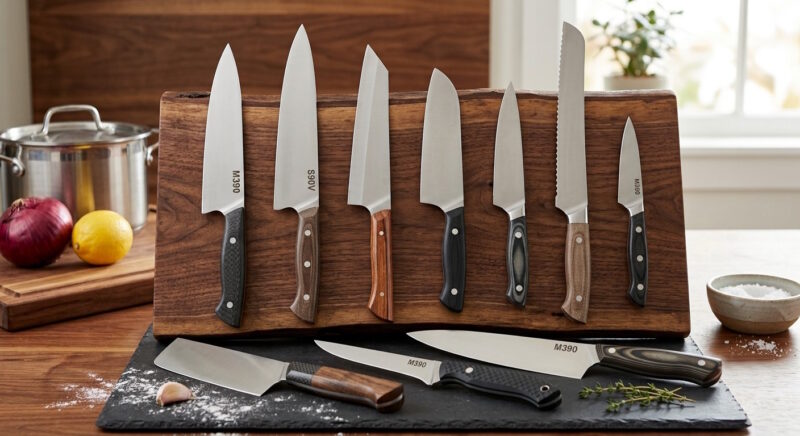
Kitchen Performance
Both steels perform exceptionally well in the kitchen, but their strengths differ slightly.
M390
Excellent for:
- Vegetables
- Herbs
- Boneless meat
- Fruits
- Long slicing sessions
Advantages include:
- Very long edge life
- High polish capability
- Excellent slicing efficiency
Vanax
Excellent for:
- Professional kitchens
- Seafood
- Citrus
- Tomatoes
- Onions
- Wet food preparation
Advantages include:
- Outstanding stain resistance
- Reduced risk of corrosion
- Excellent edge stability
- Easier maintenance in constantly wet environments
For cooks working daily around moisture, Vanax offers meaningful practical benefits.
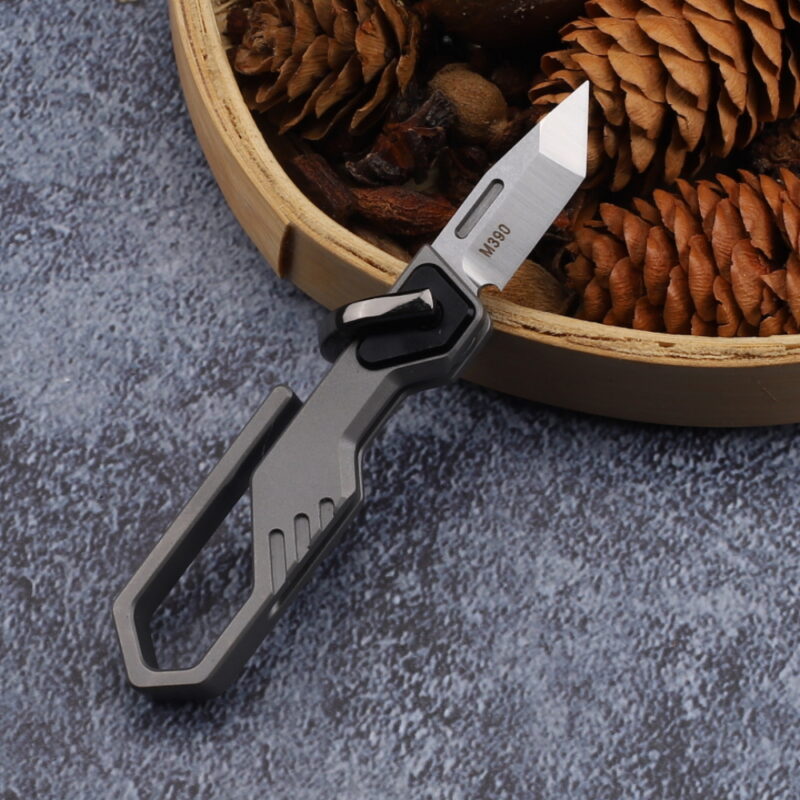
Outdoor and Marine Use
Outdoor environments expose knives to dirt, moisture, sweat, and sometimes saltwater.
M390 performs very well during camping, hiking, hunting, and general outdoor tasks. Its excellent edge retention reduces the need for field sharpening.
However, Vanax becomes particularly attractive whenever moisture is unavoidable.
Examples include:
- Kayaking
- Fishing
- Sailing
- Beach camping
- Coastal survival kits
- Humid jungle environments
Its extraordinary resistance to corrosion means users can spend less time worrying about rust and more time focusing on the task at hand.
For users living near the ocean or frequently working in wet environments, Vanax provides one of the most maintenance-friendly premium steels available.
Check Our Guide Best Hunting Knives for Groomsmen Gifts
Wear Resistance
Wear resistance is one of the defining characteristics of premium knife steels, and it determines how well a blade resists gradual edge loss from abrasion during cutting.
Materials such as cardboard, rope, dense vegetables, leather, and certain synthetic fibers slowly wear away the cutting edge. The more wear-resistant the steel, the longer the knife continues slicing efficiently before sharpening becomes necessary.
This is where M390 has built its outstanding reputation.
Its combination of high carbon, high chromium, and approximately 4% vanadium produces an extremely dense network of very hard carbides. These microscopic carbides act like tiny wear-resistant particles embedded throughout the edge, significantly slowing material loss.
Vanax also performs extremely well, but its design philosophy is different.
Rather than maximizing carbide volume, Vanax relies on vanadium nitrides combined with nitrogen strengthening. This creates excellent wear resistance while preserving better toughness and corrosion resistance.
In everyday kitchen use, many users may never notice a dramatic difference between the two steels.
However, during continuous cutting of abrasive materials, M390 generally maintains its sharpness for a longer period.
Wear Resistance Rating
| Steel | Rating |
|---|---|
| M390 | ★★★★★ |
| Vanax | ★★★★☆ |
Winner: M390
Edge Stability
Edge retention and edge stability are often confused, but they describe different characteristics.
- Edge retention measures how long the edge remains sharp.
- Edge stability describes how well a very thin edge resists rolling or micro-chipping during use.
A knife with excellent edge stability can support thinner edge geometry while maintaining reliable cutting performance.
M390 performs extremely well with thin edges, especially for slicing applications. Its high hardness allows very acute edge angles that cut effortlessly.
However, because of its higher carbide volume, extremely thin edges may become slightly more susceptible to micro-chipping if used improperly.
Vanax benefits from its cleaner microstructure and lower carbide volume.
Its fine nitrides provide outstanding support for thin edges while improving resistance to microscopic damage.
This characteristic is especially appreciated by users who sharpen at low edge angles for maximum slicing performance.
Edge Stability Rating
| Steel | Rating |
|---|---|
| M390 | ★★★★☆ |
| Vanax | ★★★★★ |
Winner: Vanax
Heat Treatment and Hardness
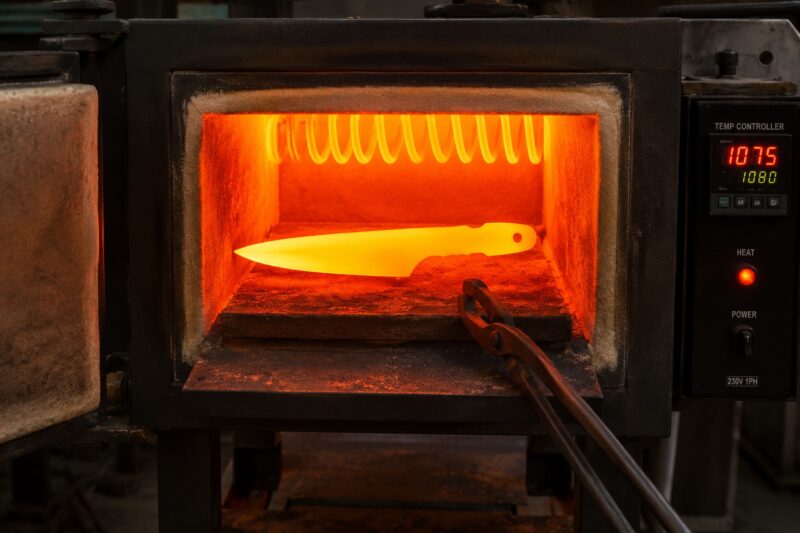
Neither steel reaches its full potential without proper heat treatment.
The heat treatment process controls:
- Final hardness
- Toughness
- Wear resistance
- Corrosion resistance
- Edge stability
Both steels are commonly hardened between 60 and 62 HRC, although some makers may choose slightly different targets depending on the knife’s intended purpose.
M390
At approximately 61–62 HRC, M390 achieves:
- Outstanding edge retention
- Maximum wear resistance
- Excellent slicing performance
Some users may choose slightly lower hardness for larger outdoor knives to improve impact resistance.
Vanax
Vanax also performs exceptionally well around 60–62 HRC.
At these hardness levels it provides:
- Excellent toughness
- Outstanding corrosion resistance
- Very stable cutting edges
- Strong overall balance
One important point is that hardness alone does not determine performance.
Two knives with identical HRC values may behave very differently because their internal microstructures are fundamentally different.
Check Our Guide Steel Heat Treatment Explained
Maintenance Requirements
Both steels belong to the stainless category, but neither is completely maintenance-free.
Proper care helps preserve edge quality and appearance for many years.
General maintenance recommendations include:
- Hand wash only
- Dry immediately after use
- Avoid prolonged exposure to moisture
- Store in a dry location
- Use cutting boards made from wood or soft plastic
- Avoid cutting glass, ceramic, or stone surfaces
Caring for M390
Although highly corrosion resistant, M390 still benefits from routine cleaning after cutting acidic foods.
Regular drying prevents cosmetic staining and helps preserve the blade’s finish.
Caring for Vanax
Vanax requires even less attention.
Its exceptional resistance to corrosion makes it one of the easiest premium steels to maintain in humid environments.
For fishermen, chefs, and outdoor enthusiasts, this reduced maintenance is often one of its greatest advantages.
Price and Value
Both steels occupy the premium end of the knife market.
The steel itself is expensive to manufacture because powder metallurgy involves sophisticated production methods and careful quality control.
In addition, both steels require:
- Precision heat treatment
- Careful grinding
- High-quality abrasives
- Longer manufacturing times
As a result, knives made from either steel generally cost more than those made from conventional stainless steels.
Is M390 Worth the Price?
For users seeking:
- Exceptional edge retention
- High wear resistance
- Long cutting sessions
- Premium slicing performance
M390 offers excellent long-term value.
Its ability to remain sharp reduces sharpening frequency, which many users appreciate.
Is Vanax Worth the Price?
Vanax justifies its premium cost differently.
Instead of focusing solely on edge retention, it delivers an outstanding balance of:
- Excellent corrosion resistance
- Very good edge retention
- Better toughness
- Easier maintenance
For users regularly exposed to moisture or saltwater, these advantages can easily outweigh the slight reduction in wear resistance.
Best Uses for M390
M390 performs particularly well for:
- Premium chef knives
- Precision slicing knives
- Everyday carry knives
- Folding knives
- Utility knives
- Fine cutting tools
- Dry outdoor environments
- Long cutting sessions
Its combination of hardness and wear resistance makes it ideal for users who value maximum cutting longevity.
Best Uses for Vanax
Vanax excels in situations involving frequent moisture or corrosive environments.
Ideal applications include:
- Professional kitchen knives
- Seafood preparation
- Fishing knives
- Marine knives
- Outdoor cooking
- Coastal environments
- Everyday carry in humid climates
- Food preparation requiring frequent washing
Its remarkable resistance to rust makes it particularly attractive for people who want premium performance with minimal maintenance.
Which Steel Should You Choose?
The answer depends entirely on your priorities.
Choose M390 if you value:
- Maximum edge retention
- Exceptional wear resistance
- Long intervals between sharpening
- Outstanding slicing performance
- Heavy daily cutting
Choose Vanax if you prioritize:
- Extreme corrosion resistance
- Better toughness
- Easier maintenance
- Frequent use around water or salt
- A more balanced overall performance
Neither steel is objectively superior in every category.
Instead, each represents a different philosophy of premium knife steel design.
M390 focuses on maximizing cutting longevity through wear resistance.
Vanax focuses on achieving exceptional balance by combining high edge retention with industry-leading corrosion resistance and improved toughness.
For many users, the choice comes down to environment rather than absolute performance. A knife used primarily in a dry workshop may benefit more from M390, while one that spends its life in a busy kitchen, on a fishing boat, or in a coastal climate may be better served by Vanax.
M390 vs Vanax: Final Verdict
After comparing composition, wear resistance, toughness, corrosion resistance, sharpening, and real-world use, one thing becomes clear:
Both M390 and Vanax are elite premium knife steels.
However, they excel in different areas.
When M390 Is the Better Choice
Choose M390 if your top priority is maximum edge retention.
This steel is ideal for users who:
- Cut cardboard, rope, or other abrasive materials frequently
- Want the longest possible time between sharpening sessions
- Prefer extremely high wear resistance
- Value premium slicing performance
- Use a knife primarily in dry or moderately humid environments
M390 strengths
- Outstanding edge retention
- Exceptional wear resistance
- Excellent corrosion resistance
- Very high hardness potential
- Superb slicing performance
When Vanax Is the Better Choice
Choose Vanax if you want the best balance of corrosion resistance, toughness, and premium cutting performance.
Vanax is especially attractive for:
- Professional kitchens
- Seafood preparation
- Fishing
- Marine environments
- Humid climates
- Users who dislike worrying about rust
Vanax strengths
- Industry-leading corrosion resistance
- Better toughness
- Excellent edge stability
- Easier maintenance
- Very good edge retention
Final Comparison Table
| Feature | M390 | Vanax |
|---|---|---|
| Edge Retention | ★★★★★ | ★★★★☆ |
| Wear Resistance | ★★★★★ | ★★★★☆ |
| Toughness | ★★★☆☆ | ★★★★☆ |
| Corrosion Resistance | ★★★★★ | ★★★★★+ |
| Sharpening Ease | ★★☆☆☆ | ★★★☆☆ |
| Kitchen Use | Excellent | Outstanding |
| Marine Use | Excellent | Exceptional |
| Overall Balance | Excellent | Excellent |
Frequently Asked Questions
Is Vanax better than M390?
Not universally. Vanax offers better corrosion resistance and toughness, while M390 generally provides superior wear resistance and longer edge retention.
Which steel stays sharp longer?
M390 typically holds an edge longer during abrasive cutting tasks because of its higher carbide volume and wear resistance.
Which steel is better for kitchen knives?
Both are excellent, but Vanax has a slight advantage for professional kitchens because of its exceptional corrosion resistance and ease of maintenance.
Which steel is better for fishing knives?
Vanax is generally the better choice for fishing and marine environments due to its extraordinary resistance to corrosion.
Is M390 difficult to sharpen?
Yes, M390 is noticeably harder to sharpen than many stainless steels. Diamond or high-quality ceramic abrasives are recommended.
Is Vanax worth the extra cost?
For users frequently exposed to moisture, saltwater, or humid conditions, many consider Vanax worth the premium because of its unique combination of corrosion resistance and cutting performance.
Overall Winner by Category
| Category | Winner |
|---|---|
| Edge Retention | 🏆 M390 |
| Wear Resistance | 🏆 M390 |
| Corrosion Resistance | 🏆 Vanax |
| Toughness | 🏆 Vanax |
| Sharpening Ease | 🏆 Vanax |
| Kitchen Performance | 🏆 Vanax |
| Marine Performance | 🏆 Vanax |
| Long Cutting Sessions | 🏆 M390 |
| Overall Balance | 🏆 Vanax |
The Bottom Line
If you want the longest-lasting edge, choose M390.
If you want the best combination of corrosion resistance, toughness, and premium everyday performance, choose Vanax.
For most kitchen users, fishermen, and people living in humid climates, Vanax is often the more practical choice.
For users focused on maximum cutting longevity and wear resistance, M390 remains one of the strongest premium stainless steels available.
This article is for independent informational purposes only and is not affiliated with, sponsored by, or endorsed by any steel manufacturer. All product names, trademarks, and registered trademarks are the property of their respective owners.