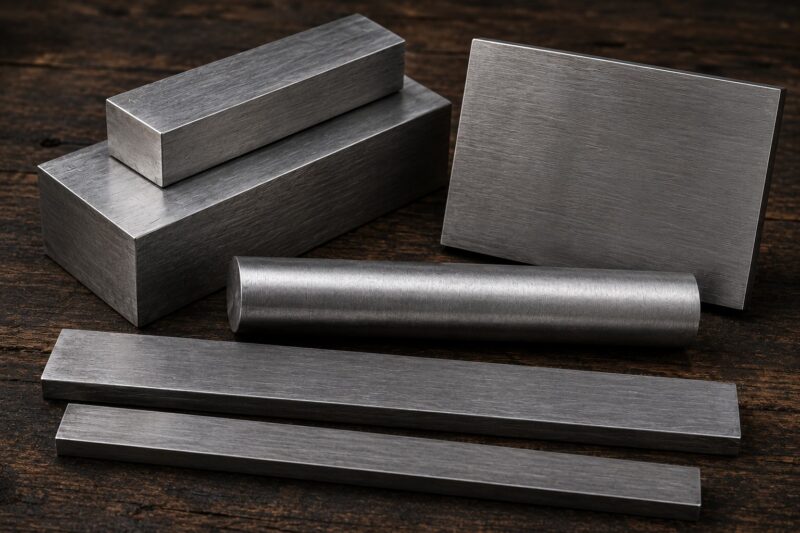
MagnaCut Steel Review
An Independent Guide
In the knife world, new steels appear regularly. Most generate excitement for a few months before fading into the background. However, every once in a while, a steel arrives that genuinely changes the industry.
CPM MagnaCut is one of those steels.
Since its introduction, MagnaCut has become one of the most discussed knife steels in the world. Knife makers, professional chefs, outdoor enthusiasts, collectors, and metallurgy experts have praised it as one of the most balanced blade steels ever created.
Unlike many modern steels that excel in one category while sacrificing another, MagnaCut was specifically engineered to provide an exceptional balance of:
- Edge retention
- Toughness
- Corrosion resistance
- Sharpenability
For many knife enthusiasts, it represents the closest thing yet to the “perfect knife steel.”
But does MagnaCut live up to the hype?
Is it truly better than M390, SG2, N690, 14C28N, or AEB-L?
Is it worth the premium price?
And is MagnaCut a good steel for kitchen knives?
In this complete guide, we’ll explore everything you need to know about MagnaCut steel.
What Is MagnaCut Steel?
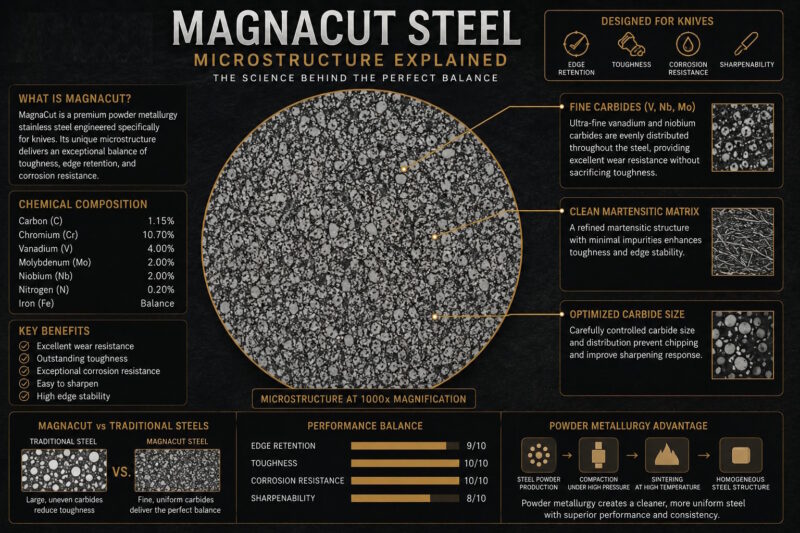
MagnaCut is a premium powder metallurgy stainless steel developed specifically for knives.
Unlike many steels adapted from industrial applications, MagnaCut was designed from the ground up as a knife steel.
The steel was created by metallurgist Larrin Thomas, who spent years studying knife metallurgy and analyzing the strengths and weaknesses of existing steels.
The goal was ambitious:
Create a steel that combines:
- High toughness
- High corrosion resistance
- Excellent edge retention
without the traditional trade-offs.
The result was MagnaCut.
Today it is produced by Crucible Industries using advanced CPM (Crucible Particle Metallurgy) technology.
Why Was MagnaCut Developed?
Traditional knife steels often force users to choose between desirable characteristics.
For example:
High Edge Retention
Steels such as:
- M390
- S90V
- S110V
offer excellent wear resistance but can be difficult to sharpen and may sacrifice toughness.
High Toughness
Steels such as:
- AEB-L
- 14C28N
- 52100
offer outstanding toughness but lower wear resistance.
High Corrosion Resistance
Steels such as:
- LC200N
- Vanax
offer superb corrosion resistance but may sacrifice other properties.
MagnaCut was engineered to break this pattern.
MagnaCut Steel Composition
Typical composition:
| Element | Percentage |
|---|---|
| Carbon | 1.15% |
| Chromium | 10.7% |
| Vanadium | 4.0% |
| Molybdenum | 2.0% |
| Niobium | 2.0% |
| Nitrogen | 0.2% |
| Iron | Balance |
At first glance, MagnaCut appears unusual.
Its chromium content is lower than many traditional stainless steels.
However, its carbide structure was carefully designed to maximize corrosion resistance while preserving toughness.
This is one of the reasons MagnaCut performs so differently from many competing steels.
What Makes MagnaCut Special?
The secret lies in its metallurgy.
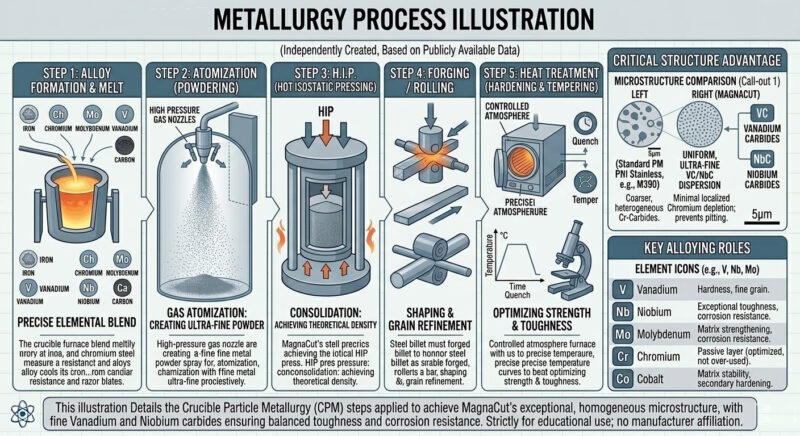
MagnaCut was designed to minimize large chromium carbides.
Benefits include:
- Better toughness
- Better corrosion resistance
- Improved edge stability
- Easier sharpening
Most steels sacrifice one property to gain another.
MagnaCut largely avoids this problem.
Powder Metallurgy Technology
MagnaCut is produced using powder metallurgy.
Powder metallurgy involves:
- Melting the alloy
- Atomizing molten steel into microscopic powder
- Compressing the powder under high pressure
- Forming a highly uniform steel structure
Benefits include:
- Fine grain structure
- Uniform carbide distribution
- Improved performance
- Better consistency
This process helps MagnaCut achieve its remarkable balance of properties.
Is MagnaCut Stainless?
Yes.
MagnaCut is a true stainless steel.
Its corrosion resistance is exceptional.
It performs extremely well against:
- Water
- Salt
- Kitchen acids
- Humidity
- Marine environments
Many experts compare its corrosion resistance to premium marine-grade steels.
Typical Hardness of MagnaCut
Most MagnaCut knives operate between:
60–64 HRC
Typical ranges:
| Knife Type | HRC |
|---|---|
| Chef Knife | 61–63 |
| Outdoor Knife | 60–62 |
| EDC Knife | 61–64 |
| Custom Knife | 62–64 |
Many makers choose around 62 HRC because it offers an excellent balance of performance.
Edge Retention
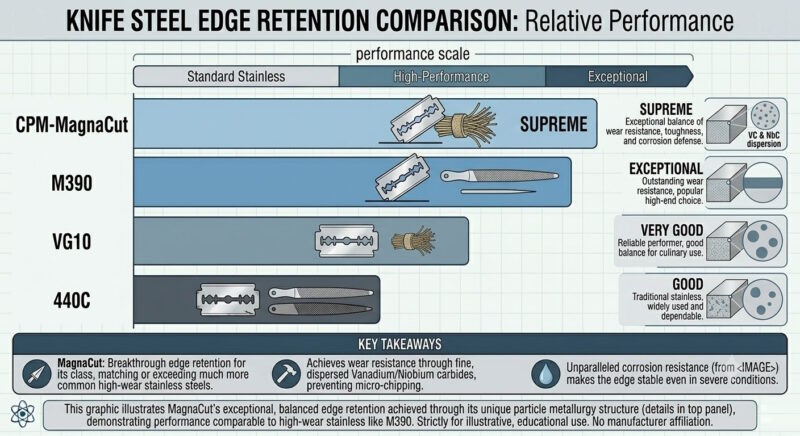
Edge retention is one of MagnaCut’s greatest strengths.
Advantages include:
- Long-lasting sharpness
- Excellent wear resistance
- Reduced sharpening frequency
Although it may not surpass extreme steels such as S110V or Maxamet in laboratory wear tests, MagnaCut performs exceptionally well in practical use.
Many users report edge retention comparable to premium powder steels.
Toughness
This is where MagnaCut truly stands apart.
Many steels with excellent wear resistance become brittle.
MagnaCut maintains impressive toughness despite its high hardness.
Benefits include:
- Reduced chipping
- Better durability
- More forgiving performance
This makes it suitable for:
- Kitchen knives
- Outdoor knives
- Hunting knives
- EDC blades
Corrosion Resistance
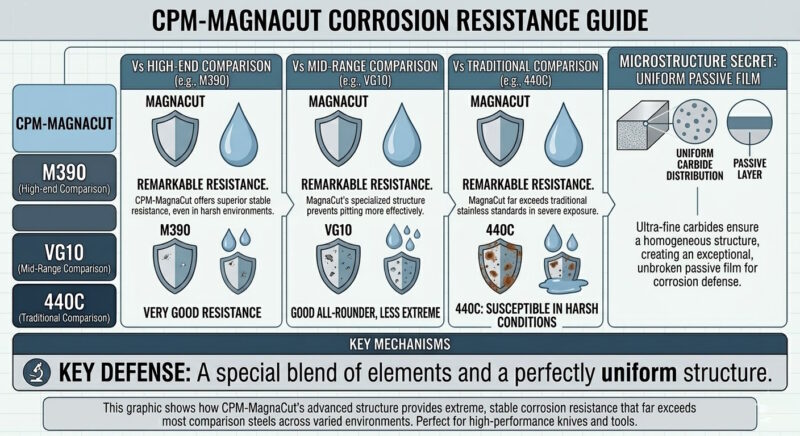
MagnaCut’s corrosion resistance is outstanding.
Compared to many popular knife steels:
| Steel | Corrosion Resistance |
|---|---|
| 52100 | Low |
| VG10 | High |
| N690 | Very High |
| MagnaCut | Exceptional |
| LC200N | Exceptional |
For kitchen use, MagnaCut performs extremely well.
Even acidic foods rarely cause issues.

MagnaCut for Kitchen Knives
Many chefs and custom knife makers now consider MagnaCut one of the best kitchen knife steels available.
Advantages include:
- Excellent corrosion resistance
- Outstanding edge retention
- Strong toughness
- Low maintenance
Professional kitchens are demanding environments.
MagnaCut handles them exceptionally well.
MagnaCut vs SG2 (R2)
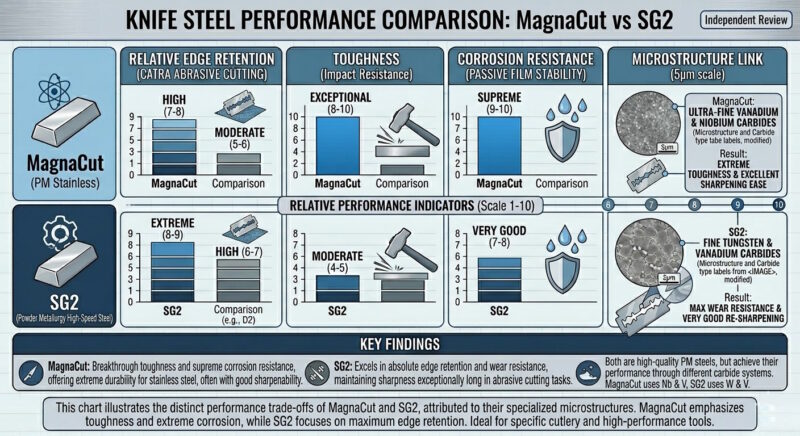
This comparison is increasingly common.
SG2 Advantages
- Extremely high wear resistance
- Established Japanese reputation
MagnaCut Advantages
- Better toughness
- Better corrosion resistance
- Less chipping
- Easier sharpening
Many knife makers now prefer MagnaCut for demanding kitchen use.
Check Our Guide Powder Steels for Kitchen Knives
MagnaCut vs M390
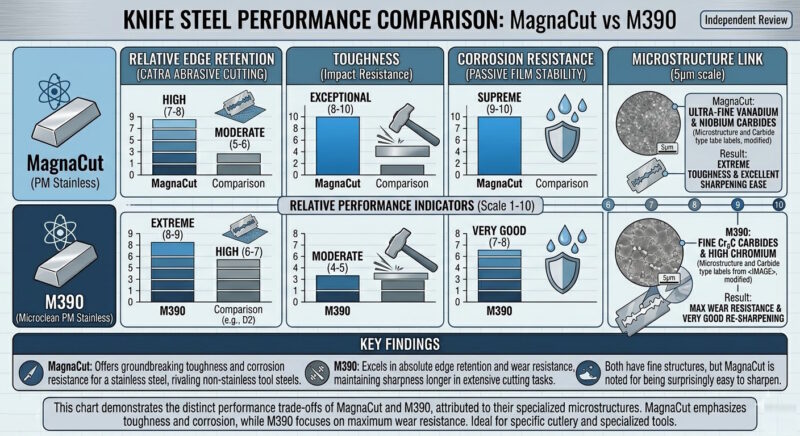
This is perhaps the most important comparison.
M390 Advantages
- Slightly greater wear resistance
MagnaCut Advantages
- Much better toughness
- Easier sharpening
- Better edge stability
For many users, MagnaCut offers a more balanced experience.
Check Our Guide M390 Steel Review
MagnaCut vs N690
N690 Advantages
- Lower cost
- Proven performance
MagnaCut Advantages
- Better edge retention
- Better toughness
- Better corrosion resistance
MagnaCut generally outperforms N690, although it comes at a higher price.
Check Our Guide N690 Steel Review
MagnaCut vs AEB-L
AEB-L Advantages
- Easier sharpening
- Lower cost
MagnaCut Advantages
- Better wear resistance
- Better corrosion resistance
- Longer edge retention
Both are excellent knife steels with different priorities.
Check Our Guide AEB-L Steel Review
MagnaCut vs 14C28N
14C28N Advantages
- Outstanding value
- Easy sharpening
MagnaCut Advantages
- Better edge retention
- Better corrosion resistance
- Greater overall performance
Check Our Guide 14C28N and Other Swedish Knife Steels Review
Why Custom Knife Makers Love MagnaCut
Custom makers appreciate MagnaCut because it allows them to create knives with:
- Thin geometry
- Excellent durability
- Premium performance
The steel works well across many knife categories.
Its versatility is one reason demand remains extremely high.
Common Myths About MagnaCut
Myth #1: MagnaCut Is Indestructible
False.
All steels can chip, crack, or wear if abused.
Myth #2: MagnaCut Never Needs Sharpening
False.
Every knife eventually dulls.
MagnaCut simply stays sharp longer.
Myth #3: MagnaCut Replaces Every Other Steel
False.
Steels like AEB-L, N690, 14C28N, and 52100 remain excellent choices.
Myth #4: MagnaCut Is Only Marketing Hype
False.
Independent testing consistently confirms its exceptional performance.
MagnaCut Performance Ratings
| Property | Rating |
|---|---|
| Corrosion Resistance | 10/10 |
| Toughness | 10/10 |
| Edge Retention | 9/10 |
| Sharpenability | 8/10 |
| Edge Stability | 10/10 |
| Kitchen Performance | 10/10 |
| Overall Balance | 10/10 |
Best Uses for MagnaCut
Excellent for:
- Chef knives
- Gyuto knives
- Santoku knives
- Bunka knives
- Hunting knives
- Bushcraft knives
- EDC knives
- Premium custom knives
Quick Questions and Answers
What is MagnaCut steel?
MagnaCut is a premium powder metallurgy stainless steel developed specifically for knives.
Is MagnaCut stainless?
Yes. MagnaCut offers exceptional corrosion resistance.
Is MagnaCut good for kitchen knives?
Absolutely. Many experts consider it one of the best kitchen knife steels available.
Is MagnaCut better than M390?
For most users, MagnaCut offers a better balance of toughness, corrosion resistance, and edge retention.
Is MagnaCut easy to sharpen?
It is easier to sharpen than many wear-resistant super steels, though not as easy as AEB-L or 14C28N.
What hardness is MagnaCut?
Most knives are heat treated between 60 and 64 HRC.
Final Verdict
MagnaCut has earned its reputation as one of the most important knife steels developed in decades.
Its combination of:
- Exceptional corrosion resistance
- Outstanding toughness
- Excellent edge retention
- Strong edge stability
- Practical sharpenability
makes it one of the most balanced steels ever created.
For cooks seeking a premium stainless steel that performs at the highest level without major compromises, MagnaCut is among the best choices available today.
Whether used in a handmade chef knife, a custom Bunka, a Gyuto, or a premium outdoor blade, MagnaCut consistently delivers the kind of performance that knife enthusiasts have been searching for for years.
FAQ
What is MagnaCut steel used for?
MagnaCut is used for premium kitchen knives, hunting knives, EDC knives, and custom blades.
Is MagnaCut better than M390?
Many users prefer MagnaCut because it offers better toughness and comparable edge retention.
Is MagnaCut stainless steel?
Yes. MagnaCut provides exceptional corrosion resistance.
Is MagnaCut good for chef knives?
Yes. It is considered one of the best modern steels for kitchen knives.
What HRC is MagnaCut?
Most MagnaCut knives are heat treated between 60 and 64 HRC.
Why is MagnaCut so popular?
Because it combines toughness, corrosion resistance, edge retention, and sharpenability better than most competing steels.
The History of MagnaCut Steel
One reason MagnaCut has attracted so much attention is that it was not created accidentally.
Many knife steels were originally developed for industrial applications and later adopted by knife makers.
Examples include:
- 52100 (bearing steel)
- D2 (tool steel)
- AEB-L (razor blade steel)
MagnaCut was different.
It was designed specifically for knives.
Metallurgist Larrin Thomas spent years studying the limitations of existing knife steels.
His research revealed that many popular steels suffered from unnecessary compromises.
Some had excellent edge retention but poor toughness.
Others offered great toughness but lacked corrosion resistance.
The goal became clear:
Create a steel optimized for knife performance rather than industrial requirements.
The result was MagnaCut.
Understanding MagnaCut’s Carbide Structure
To understand MagnaCut, we must first understand carbides.
Carbides are extremely hard particles inside steel.
They influence:
- Wear resistance
- Edge retention
- Toughness
- Sharpenability
Large carbides often increase wear resistance but reduce toughness.
This is why steels such as S110V can be difficult to sharpen and more prone to microchipping.
MagnaCut was engineered to minimize this problem.
Benefits include:
- Smaller carbides
- Better carbide distribution
- Improved toughness
- Improved sharpening response
This is one reason many users report that MagnaCut feels smoother during cutting.
MagnaCut and Kitchen Performance
Kitchen knives place unique demands on steel.
A kitchen knife must handle:
- Moisture
- Acids
- Frequent cleaning
- Thin edge geometry
- Long cutting sessions
MagnaCut performs exceptionally well in all of these areas.
Food Release
Many custom MagnaCut knives feature very thin grinds.
Combined with excellent edge stability, this often results in impressive food release.
Edge Stability
A highly stable edge allows:
- Cleaner cuts
- Reduced wedging
- Better slicing performance
Corrosion Resistance
Kitchen knives frequently contact:
- Tomatoes
- Lemons
- Onions
- Vinegar
MagnaCut handles these foods with ease.
MagnaCut for Professional Chefs
Professional chefs often prioritize:
- Edge retention
- Reliability
- Easy maintenance
MagnaCut excels in all three categories.
Benefits for professional kitchens include:
- Less sharpening downtime
- Excellent corrosion resistance
- Reduced risk of edge damage
For chefs working long shifts, these advantages can be significant.
MagnaCut for Home Cooks
Many home cooks sharpen knives only occasionally.
For these users, MagnaCut offers:
- Long-lasting sharpness
- Easy maintenance
- Excellent durability
A MagnaCut chef knife can remain effective for extended periods between sharpening sessions.
MagnaCut Corrosion Resistance Testing
Independent testing has demonstrated impressive corrosion resistance.
Compared with many premium steels, MagnaCut performs extremely well.
General Corrosion Ranking
| Steel | Corrosion Resistance |
|---|---|
| 52100 | Low |
| D2 | Low |
| VG10 | High |
| N690 | Very High |
| MagnaCut | Exceptional |
| LC200N | Exceptional |
This performance makes MagnaCut suitable for:
- Coastal environments
- Humid climates
- Professional kitchens
MagnaCut and Edge Geometry
Many knife enthusiasts focus entirely on steel.
However, geometry is equally important.
A thin MagnaCut blade often outperforms thicker knives made from more wear-resistant steels.
Benefits include:
- Reduced cutting resistance
- Better slicing
- Improved precision
This is one reason many custom makers prefer MagnaCut.
MagnaCut vs VG10
VG10 has long been one of the most popular Japanese knife steels.
VG10 Strengths
- Proven history
- Good edge retention
- Excellent corrosion resistance
MagnaCut Strengths
- Better toughness
- Better edge stability
- Easier sharpening
- Comparable corrosion resistance
Many makers view MagnaCut as a significant upgrade.
Check Our Guide VG10 Steel Review
MagnaCut vs 52100
This comparison highlights modern metallurgy versus traditional carbon steel.
52100 Advantages
- Easy sharpening
- Traditional cutting feel
- Excellent toughness
MagnaCut Advantages
- Stainless properties
- Better edge retention
- Lower maintenance
Both steels are outstanding.
The choice often depends on whether a user prefers carbon steel or stainless steel.
Check Our Guide 52100 Steel Review
MagnaCut vs S35VN
S35VN was once considered one of the most balanced premium knife steels.
S35VN Advantages
- Proven performance
- Strong edge retention
MagnaCut Advantages
- Better toughness
- Better corrosion resistance
- Better edge stability
Many modern makers now prefer MagnaCut.
MagnaCut vs S45VN
S45VN improved upon S35VN.
However, MagnaCut still offers advantages.
MagnaCut Benefits
- Higher toughness
- Better corrosion resistance
- More optimized carbide structure
This explains why many custom makers have transitioned toward MagnaCut.
Sharpening MagnaCut
A common misconception is that MagnaCut is difficult to sharpen.
In reality, many users find it surprisingly manageable.
Advantages include:
- Predictable burr formation
- Good stone feedback
- Fine edge refinement
Although it requires more effort than AEB-L or 14C28N, it is generally easier to sharpen than M390.
Heat Treatment and MagnaCut
Heat treatment remains critical.
Even the best steel can perform poorly if heat treated incorrectly.
Proper heat treatment influences:
- Hardness
- Toughness
- Corrosion resistance
- Edge retention
When evaluating MagnaCut knives, the maker is often as important as the steel itself.
Check out Guide Different Heat Treatment Methods Explained
Why Handmade MagnaCut Knives Cost More
Many buyers notice higher prices.
Several factors contribute:
Steel Cost
MagnaCut is expensive compared with traditional steels.
Tool Wear
Grinding MagnaCut consumes abrasives faster.
Heat Treatment Complexity
Proper heat treatment requires precision.
High Demand
Consumer demand remains extremely strong.
These factors contribute to premium pricing.
Check Our Guide How a Handmade Knife Is Made
Is MagnaCut Worth the Money?
This depends on your priorities.
If You Want
- Maximum performance
- Excellent corrosion resistance
- Outstanding toughness
- Long edge retention
then MagnaCut is often worth the premium.
If Budget Is the Priority
Steels such as:
- 14C28N
- N690
- AEB-L
may provide better value.
Who Should Buy MagnaCut?
Ideal users include:
Professional Chefs
Excellent edge life and low maintenance.
Home Cooks
Reliable and easy to own.
Knife Enthusiasts
One of the most advanced knife steels available.
Collectors
Historically important modern steel.
Who Might Not Need MagnaCut?
You may not need MagnaCut if:
- You enjoy sharpening frequently.
- You prefer traditional carbon steels.
- Budget is your primary concern.
In these cases, AEB-L, N690, or 52100 may be excellent alternatives.
MagnaCut Performance Summary
| Category | Rating |
|---|---|
| Corrosion Resistance | 10/10 |
| Toughness | 10/10 |
| Edge Retention | 9/10 |
| Sharpenability | 8/10 |
| Edge Stability | 10/10 |
| Kitchen Use | 10/10 |
| Outdoor Use | 10/10 |
| Overall Value | 9/10 |
Final Conclusion: Is MagnaCut the Best Knife Steel?
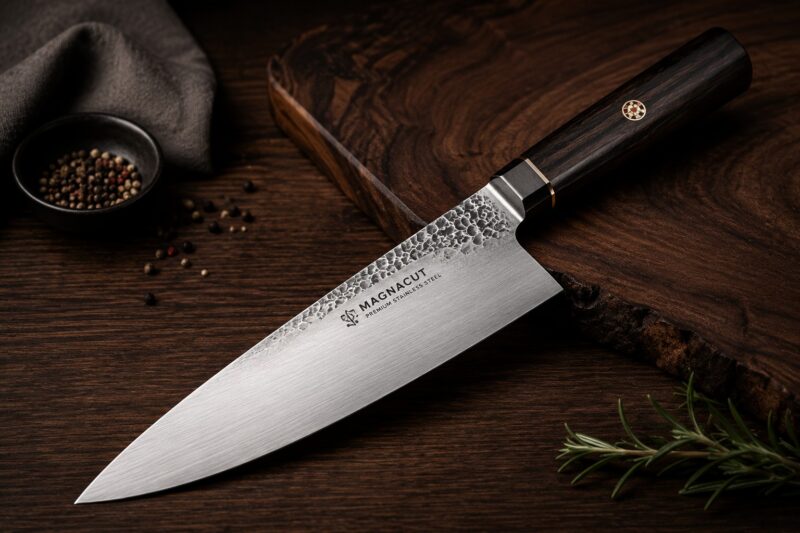
No steel is perfect.
Every steel involves compromises.
However, MagnaCut comes closer than most.
Its combination of:
- Outstanding toughness
- Exceptional corrosion resistance
- Excellent edge retention
- Practical sharpenability
makes it one of the most balanced knife steels ever developed.
For handmade kitchen knives, chef knives, Gyutos, Bunkas, hunting knives, and premium EDC blades, MagnaCut has established itself as one of the benchmark steels of the modern era.
For many knife enthusiasts, MagnaCut is not merely another steel.
It is the steel that changed what people thought was possible in knife metallurgy.
https://yashkadesigns.com/exclusive-chef-knives
MagnaCut Steel Review
This article is for independent informational purposes only and is not affiliated with, sponsored by, or endorsed by any steel manufacturer. All product names, trademarks, and registered trademarks are the property of their respective owners.