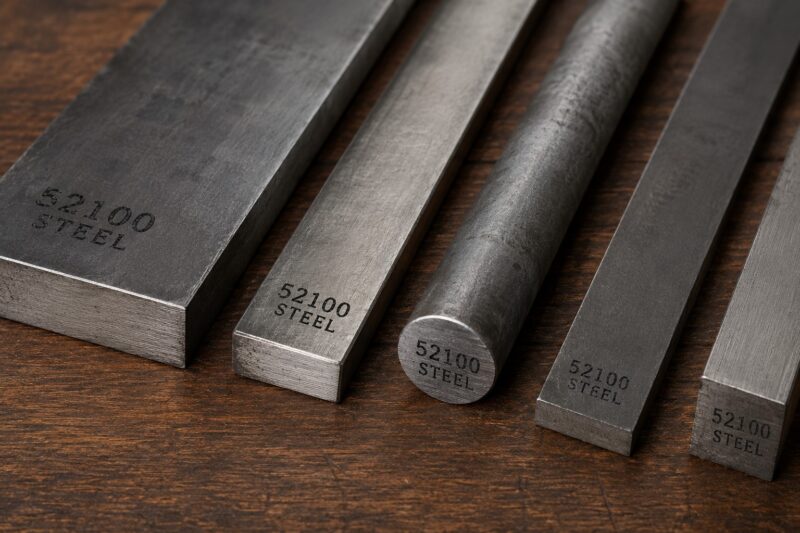
52100 Steel Review
An Independent Guide
52100 Steel Global Equivalents: ШХ15, GCr15, 100Cr6, and SUJ2
Depending on where your knife was manufactured, 52100 steel goes by different names around the world.
Don’t be confused by the markings on the blade—chemically, these are identical high-carbon bearing steels with the exact same performance, toughness, and edge retention:100Cr6 — The European (German) equivalent, widely used by high-end continental chefs and custom knife makers.
GCr15 — The Chinese designation, commonly found on modern, budget-friendly factory pocket knives that offer incredible value.
SUJ2 — The Japanese equivalent, legendary for its extreme hardness in traditional kitchen cutlery.
ШХ15 (ShKh15) — The post-Soviet equivalent, highly praised by Eastern European bladesmiths for rugged hunting knives.
Whether you buy a custom American hunter in 52100 or a German kitchen laser in 100Cr6, you are getting the exact same ‘King of Carbon’ performance.
When discussing legendary knife steels, names like VG10, MagnaCut, SG2, and M390 often dominate modern conversations. Yet among custom knife makers, bladesmiths, and serious knife enthusiasts, one steel continues to earn extraordinary respect despite being over a century old: 52100 steel.
Originally developed as a bearing steel, 52100 has become one of the most beloved materials for handmade knives. Its reputation is built not on marketing hype or exotic metallurgy but on something far more important—real-world cutting performance.
Many custom makers consider 52100 one of the finest knife steels ever produced because it offers an exceptional combination of toughness, edge stability, sharpenability, and cutting feel.
But is 52100 still relevant in the age of powder metallurgy super steels?
Can it compete with modern steels such as MagnaCut, M390, or SG2?
Is it a good choice for kitchen knives?
In this comprehensive guide, we’ll explore everything you need to know about 52100 steel, including its composition, properties, advantages, disadvantages, and how it compares to other popular knife steels.
What Is 52100 Steel?
52100 is a high-carbon chromium alloy steel originally developed for manufacturing ball bearings and roller bearings.
The name comes from the AISI steel classification system.
While it was never originally intended for knife making, bladesmiths quickly discovered that its characteristics were exceptionally well suited for cutting tools.
Today, 52100 is widely used for:
- Handmade chef knives
- Hunting knives
- Bushcraft knives
- Outdoor knives
- High-performance custom blades
Its popularity stems from its ability to take an incredibly fine edge while maintaining excellent toughness.
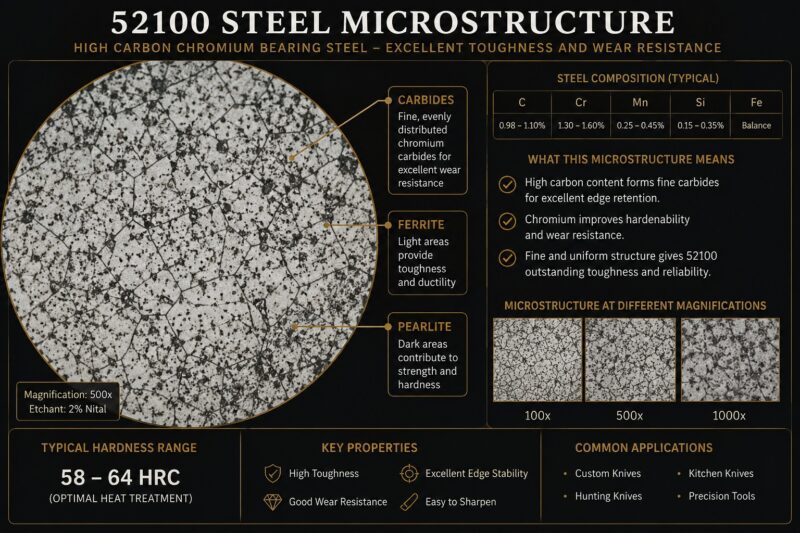
52100 Steel Composition
Typical composition:
| Element | Percentage |
|---|---|
| Carbon | 0.98–1.10% |
| Chromium | 1.30–1.60% |
| Manganese | 0.25–0.45% |
| Silicon | 0.15–0.35% |
| Iron | Balance |
Unlike modern stainless steels, 52100 contains relatively low chromium levels.
Although chromium improves wear resistance and hardenability, there is not enough chromium present to classify 52100 as stainless steel.
As a result:
52100 is a carbon steel.
Why Knife Makers Love 52100
Many experienced bladesmiths consider 52100 a “sweet spot” steel.
It offers an outstanding balance of:
- Toughness
- Edge retention
- Sharpenability
- Fine grain structure
Unlike some modern super steels that focus heavily on wear resistance, 52100 prioritizes cutting performance and edge stability.
This makes it particularly attractive for serious users who value how a knife cuts rather than simply how long it stays dull.
Fine Grain Structure
One of the most important characteristics of 52100 is its exceptionally fine grain structure.
Fine grain steel generally offers:
- Better edge stability
- Cleaner sharpening
- Improved toughness
- Superior cutting feel
Many knife makers describe properly heat-treated 52100 as having one of the finest grain structures available among traditional steels.
This allows extremely keen edges that are difficult to achieve with some high-carbide stainless steels.
Hardness of 52100
Most knives made from 52100 operate between:
58–64 HRC
Typical ranges:
| Knife Type | Typical HRC |
| Hunting Knife | 58–60 |
| Outdoor Knife | 59–61 |
| Kitchen Knife | 60–63 |
| Custom Performance Knife | 62–64 |
A well-heat-treated 52100 chef knife often falls around 61–63 HRC.
This range provides excellent edge retention while maintaining toughness.
Edge Retention
Edge retention is one of the main reasons users choose 52100.
While it may not match extreme wear-resistant steels such as:
- M390
- S90V
- Maxamet
it still performs exceptionally well in practical cutting tasks.
Many users find that 52100 maintains a working edge longer than expected because of its outstanding edge stability.
In kitchen use, a properly sharpened 52100 knife can remain highly effective through extensive food preparation.
Check Our Guide 14C28N and Other Swedish Steels Review
Toughness
Toughness is where 52100 truly shines.
Compared to many premium stainless steels, 52100 offers remarkable resistance to chipping and cracking.
Benefits include:
- Better durability
- More forgiving performance
- Greater edge stability
- Reduced microchipping
This toughness makes 52100 particularly popular among outdoor knife users and professional chefs.
Sharpening Performance
One of the biggest advantages of 52100 is how pleasant it is to sharpen.
Many enthusiasts describe it as:
- Responsive
- Predictable
- Easy to deburr
- Capable of taking extremely fine edges
Compared with powder metallurgy steels such as M390 or S90V, sharpening 52100 is significantly easier.
For many knife enthusiasts, this alone makes it preferable to modern super steels.
Corrosion Resistance
This is where 52100 shows its age.
Because it is not stainless steel, corrosion resistance is limited.
Users must:
- Wipe blades dry
- Avoid prolonged moisture exposure
- Store properly
- Occasionally apply protective oil
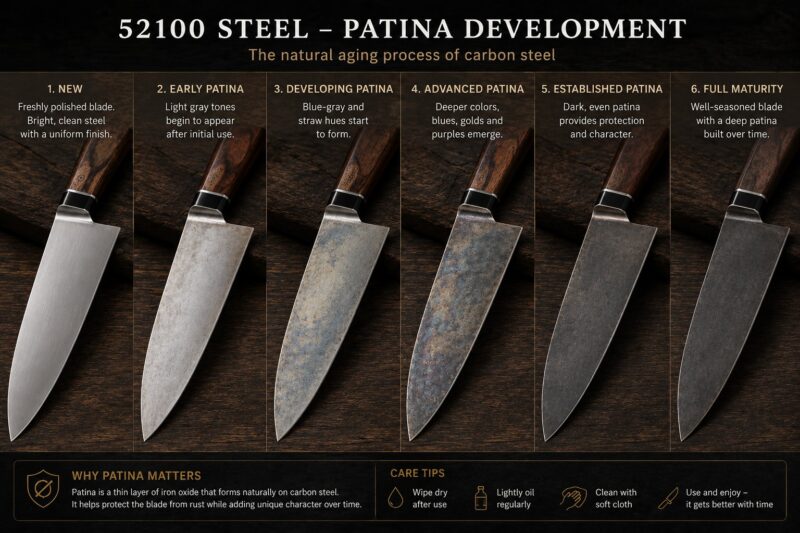
Over time, many 52100 knives develop a natural patina.
Many enthusiasts consider this patina attractive and part of the steel’s character.
52100 for Kitchen Knives
52100 has become increasingly popular among custom kitchen knife makers.
Why?
Because kitchen knives benefit enormously from:
- Fine edges
- Toughness
- Sharpening ease
- Cutting performance
A well-made 52100 chef knife often feels exceptionally smooth through food.
Many chefs appreciate the steel’s ability to maintain a highly refined edge.
Check Our Guide Powder Steels for Kitchen Knives
52100 vs 1095
Both are popular carbon steels.
52100 Advantages
- Better toughness
- Better edge retention
- Finer grain structure
- More sophisticated metallurgy
1095 Advantages
- Lower cost
- Simpler heat treatment
For most knife applications, 52100 is generally considered superior.
Check Our Guide 1095 Steel Review
52100 vs White Steel #2
This comparison is common among chef knife enthusiasts.
White Steel #2
Advantages:
- Extraordinary sharpness
- Traditional Japanese heritage
52100
Advantages:
- Better toughness
- Better wear resistance
- Easier maintenance
Both are outstanding knife steels.
Many makers view them as equals with different personalities.
52100 vs AEB-L
AEB-L is one of the most respected stainless knife steels.
AEB-L Advantages
- Stainless
- Excellent toughness
- Fine grain structure
52100 Advantages
- Slightly higher toughness
- Carbon steel cutting feel
- Exceptional sharpening response
This comparison often comes down to whether the user prefers carbon or stainless steel.
52100 vs MagnaCut
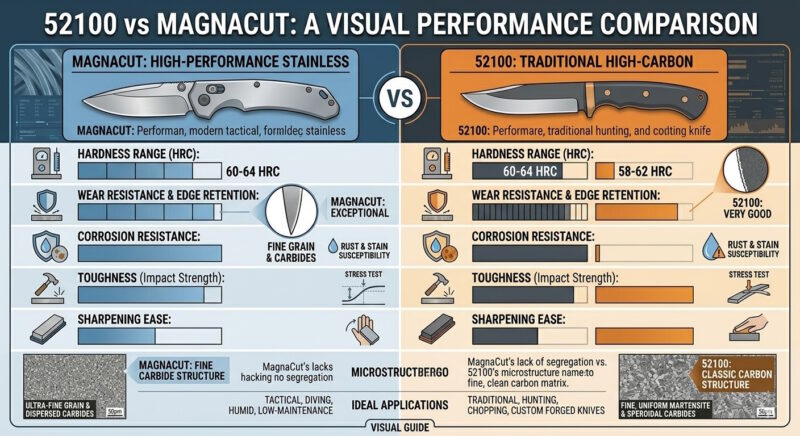
Modern versus classic.
MagnaCut Advantages
- Stainless
- Outstanding corrosion resistance
- Excellent toughness
- Modern powder metallurgy
52100 Advantages
- Easier sharpening
- Lower cost
- Traditional feel
- Exceptional edge refinement
MagnaCut wins on technology.
52100 wins many hearts through simplicity and cutting performance.
Common Myths About 52100
Myth #1: It Is Just Bearing Steel
Technically true, but misleading.
Many legendary knife steels originated from industrial applications.
What matters is performance.
Myth #2: Old Steel Means Inferior Steel
False.
Many experienced makers still choose 52100 despite access to modern super steels.
Myth #3: Carbon Steel Cannot Compete with Powder Steels
False.
Performance involves trade-offs.
52100 often excels in toughness and sharpening ease.
Myth #4: 52100 Rusts Instantly
False.
It requires care but is manageable with basic maintenance.
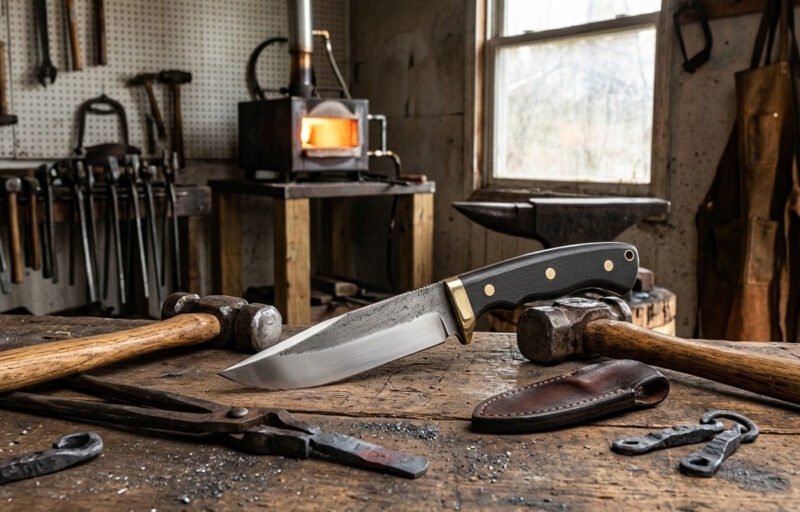
Best Uses for 52100
Excellent for:
- Chef knives
- Gyutos
- Hunting knives
- Bushcraft knives
- Outdoor knives
- Custom handmade knives
Less ideal for:
- Marine environments
- Extremely humid storage conditions
- Users unwilling to maintain carbon steel
Quick Questions and Answers
Is 52100 a good knife steel?
Yes. Many knife makers consider it one of the best traditional knife steels ever developed.
Is 52100 stainless?
No. It is a carbon steel and requires maintenance.
Does 52100 hold an edge well?
Yes. It offers excellent real-world edge retention.
Is 52100 easy to sharpen?
Yes. It is significantly easier to sharpen than many modern super steels.
Why do custom knife makers use 52100?
Because it combines toughness, edge stability, sharpenability, and excellent cutting performance.
Is 52100 good for kitchen knives?
Absolutely. Many custom chef knives use 52100 successfully.
Check Our Guide What Affects the Price of a Handmade Knife?
Final Verdict
More than a century after its development, 52100 remains one of the finest knife steels available.
While modern powder steels dominate marketing discussions, 52100 continues to earn loyalty through performance rather than hype.
Its combination of:
- Fine grain structure
- Excellent toughness
- Easy sharpening
- Strong edge retention
- Outstanding cutting feel
makes it one of the best choices for serious knife users.
For those willing to perform basic maintenance, a handmade 52100 knife can provide a level of cutting performance that rivals many far more expensive modern steels.
In the hands of a skilled knife maker, 52100 proves that sometimes the classics remain classics for a reason.
FAQ Schema
What is 52100 steel used for?
52100 is commonly used for bearings, chef knives, hunting knives, and high-performance custom blades.
Is 52100 steel good for kitchen knives?
Yes. It offers excellent toughness, sharpening ease, and cutting performance.
Does 52100 steel rust?
Yes. It is a carbon steel and requires proper care to prevent corrosion.
Is 52100 better than 1095?
Most knife enthusiasts consider 52100 superior in toughness, edge retention, and overall performance.
Is 52100 better than MagnaCut?
They excel in different areas. MagnaCut offers superior corrosion resistance, while 52100 provides easier sharpening and traditional carbon steel performance.
Why do custom knife makers love 52100?
Because it offers an exceptional balance of toughness, edge stability, edge retention, and sharpening characteristics.
52100 Steel Review
https://www.carpentertechnology.com
This article is for independent informational purposes only and is not affiliated with, sponsored by, or endorsed by any steel manufacturer. All product names, trademarks, and registered trademarks are the property of their respective owners.