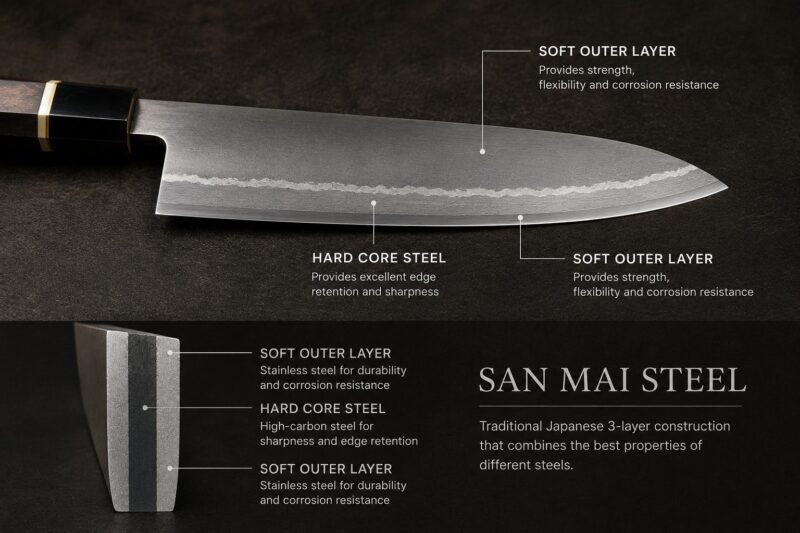
What Is San Mai Steel?
An Independent Guide
San Mai Steel
San Mai steel is one of the most admired blade constructions in the world of knives. Whether you’re a chef searching for a premium kitchen knife, a hunter looking for a durable field blade, or a knife enthusiast interested in traditional craftsmanship, you’ve probably encountered the term “San Mai.”
But what exactly is San Mai steel? Why is it so popular among custom knife makers and high-end knife brands? And how does it compare to Damascus steel, monosteel blades, and other knife constructions?
In this comprehensive guide, we’ll explore everything you need to know about San Mai steel, including its history, manufacturing process, advantages, disadvantages, maintenance requirements, and why many knife enthusiasts consider it one of the best blade constructions available.
Quick Answer:
San Mai steel is a traditional Japanese three-layer blade construction that combines a hard cutting core with softer outer layers. This design offers excellent edge retention, improved toughness, better durability, and often enhanced corrosion resistance compared to many monosteel blades.
What Does San Mai Mean?
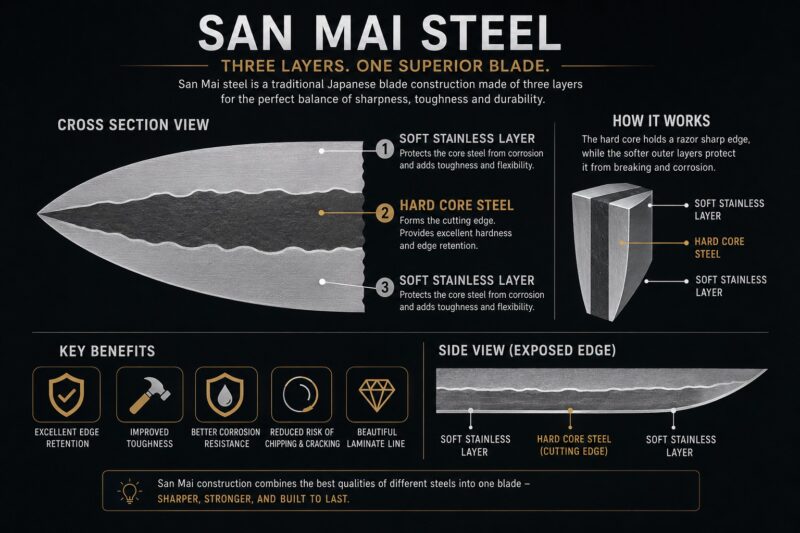
The term “San Mai” comes from Japanese.
“San” means three.
“Mai” means layers.
Therefore, San Mai literally translates to “three layers.”
In knife making, San Mai refers to a laminated blade construction consisting of:
- One hard core steel layer
- Two softer outer steel layers
The hard center core forms the cutting edge, while the softer outer layers protect the core and improve overall durability.
A typical San Mai blade structure looks like this:
Soft Steel
Hard Core Steel
Soft Steel
This simple but highly effective construction has been used for centuries in Japanese sword making and knife manufacturing.
The History of San Mai Steel
The concept behind San Mai construction dates back hundreds of years.
Traditional Japanese swordsmiths faced a difficult challenge:
A very hard blade could hold an excellent edge but might become brittle and chip.
A softer blade would be tougher but would not stay sharp for long.
To solve this problem, Japanese craftsmen combined different types of steel into a single blade.
The result was a laminated structure that offered:
- Excellent edge retention
- Increased toughness
- Reduced brittleness
- Better durability
This principle became a foundation of traditional Japanese blade making and remains widely used today.
Modern knife makers continue using San Mai construction because it successfully combines the best characteristics of multiple steels.
How San Mai Steel Is Made
Creating a San Mai blade requires skill, precision, and experience.
The process typically begins with three separate pieces of steel.
Step 1: Selecting the Core Steel
The center layer is usually a premium high-performance steel.
Popular choices include:
- VG10
- Aogami (Blue Steel)
- Shirogami (White Steel)
- SG2
- R2
- CPM steels
- High-carbon tool steels
This steel will eventually form the cutting edge.
Step 2: Selecting the Outer Layers
The outer cladding layers are usually softer and tougher steels.
These layers help:
- Protect the hard core
- Increase flexibility
- Reduce brittleness
- Improve corrosion resistance
Step 3: Forge Welding
The three layers are stacked together and heated to extremely high temperatures.
The steels are then forge welded into a single billet.
During this process, the layers permanently bond together.
Step 4: Blade Shaping
The billet is forged, ground, and shaped into the desired knife profile.
The edge is carefully ground until the hard core steel becomes exposed.
This exposed core becomes the cutting edge.
Step 5: Heat Treatment
The blade undergoes heat treatment to maximize hardness, toughness, and cutting performance.
Finally, the blade is polished and finished.
The result is a blade that combines multiple steel properties into one cutting tool.
Why Knife Makers Use San Mai Construction
San Mai construction offers several significant advantages over single-steel blades.
Superior Edge Retention
Because the cutting edge consists of hard premium steel, San Mai knives can maintain sharpness for a long time.
Many San Mai blades feature hardness levels between:
- 60 HRC
- 62 HRC
- 64 HRC
This allows the knife to hold a razor-sharp edge through extended use.
Improved Toughness
A blade made entirely from extremely hard steel may become brittle.
The softer outer layers act as shock absorbers.
This helps reduce:
- Chipping
- Cracking
- Catastrophic blade failure
The result is a more forgiving knife.
Easier Maintenance
Many San Mai knives use stainless cladding.
The outer layers protect much of the blade surface from corrosion.
This is especially useful when the core steel is highly reactive.
Beautiful Appearance
One of the most recognizable features of San Mai construction is the visible transition line between steels.
This line is often called the laminate line.
It creates a distinctive appearance that many knife enthusiasts find attractive.
San Mai vs Monosteel
Monosteel blades are made from a single type of steel.
San Mai blades use multiple layers.
Both approaches have advantages.
Monosteel Advantages
- Simpler construction
- Often lower cost
- Easier manufacturing
- Consistent steel properties
San Mai Advantages
- Better balance of hardness and toughness
- Improved edge retention
- Reduced brittleness
- Enhanced visual appeal
For many premium knives, San Mai provides the best compromise between performance and durability.
San Mai Construction Ratings
| Property | Rating |
|---|---|
| Edge Retention | ★★★★★ |
| Toughness | ★★★★☆ |
| Durability | ★★★★★ |
| Corrosion Resistance | ★★★★☆ |
| Ease of Maintenance | ★★★★☆ |
| Overall Value | ★★★★★ |
San Mai vs Damascus Steel
Many buyers confuse San Mai and Damascus steel.
Although both involve multiple layers, they are very different.
Damascus Steel
Damascus steel is typically made from many layers folded and forged together.
Its primary characteristic is the decorative surface pattern.
Modern Damascus may contain:
- 50 layers
- 100 layers
- 200+ layers
San Mai Steel
San Mai uses three primary layers:
- Soft outer layer
- Hard core
- Soft outer layer
Its focus is performance rather than decorative patterns.
However, many modern knives combine both technologies.
For example:
A knife may have:
- Damascus outer cladding
- San Mai core construction
This provides beauty and performance simultaneously.
Common Core Steels Used in San Mai Knives
VG10
VG10 is among the most popular San Mai core steels.
Advantages:
- Excellent edge retention
- Good corrosion resistance
- Easy maintenance
- Popular in kitchen knives
Blue Steel (Aogami)
Blue Steel is highly regarded among traditional Japanese craftsmen.
Advantages:
- Exceptional sharpness
- Excellent edge retention
- Fine grain structure
Disadvantages:
- Requires more maintenance
- Can develop patina
White Steel (Shirogami)
White Steel is known for its purity.
Advantages:
- Extremely sharp edge
- Easy sharpening
- Traditional Japanese performance
Disadvantages:
- Highly reactive
- Requires careful maintenance
SG2 / R2 Powder Steel
Modern premium San Mai knives often use SG2.
Advantages:
- Outstanding edge retention
- High wear resistance
- Excellent performance
Disadvantages:
- More expensive
- Harder to sharpen
Is San Mai Better Than Regular Steel?
There is no universal answer.
A high-quality monosteel knife can outperform a poorly made San Mai knife.
However, when properly manufactured, San Mai offers an impressive combination of:
- Sharpness
- Toughness
- Durability
- Corrosion resistance
- Edge retention
This balance explains why San Mai remains popular among professional chefs, hunters, collectors, and outdoor enthusiasts.
San Mai in Kitchen Knives
San Mai construction is particularly popular in premium Japanese kitchen knives.
Professional chefs and home cooks appreciate San Mai because it combines exceptional cutting performance with practical durability.
Kitchen knives experience constant use:
- Slicing vegetables
- Chopping herbs
- Preparing meat
- Cutting fish
- Precision food preparation
A very hard blade provides outstanding sharpness but can become brittle. A softer blade is tougher but loses its edge more quickly.
San Mai solves this problem by combining both characteristics.
Benefits for Kitchen Use
- Razor-sharp cutting edge
- Excellent edge retention
- Reduced risk of chipping
- Beautiful appearance
- Easier maintenance
This is why many premium Bunka, Gyuto, Santoku, and Petty knives feature San Mai construction.
San Mai in Hunting Knives
San Mai is also highly valued among hunters.
A hunting knife must perform tasks such as:
- Field dressing
- Skinning
- Quartering game
- Meat preparation
- General camp use
These jobs require both sharpness and durability.
The hard core steel delivers excellent cutting performance while the softer cladding provides additional toughness.
Why Hunters Like San Mai
- Superior edge retention
- Reduced brittleness
- Excellent slicing ability
- Long-term durability
Many custom hunting knife makers use San Mai construction specifically because it offers an excellent balance between performance and reliability.
San Mai in Bushcraft Knives
Bushcraft knives often face demanding tasks:
- Feather sticks
- Wood carving
- Fire preparation
- Camp chores
- Food preparation
Bushcraft enthusiasts typically value toughness above all else.
San Mai can be an excellent option because the softer outer layers help absorb impacts while the hard core maintains a sharp edge.
Benefits for Bushcraft
- Improved toughness
- Reliable edge retention
- Versatile performance
- Easier field maintenance
Although monosteel remains common in bushcraft knives, San Mai is increasingly popular among premium makers.
Corrosion Resistance of San Mai Steel
One common question is whether San Mai steel is rust resistant.
The answer depends on the steels used.
Stainless San Mai
Many modern San Mai knives use:
- VG10
- SG2
- AUS-10
- Other stainless steels
Combined with stainless cladding, these knives offer excellent corrosion resistance.
Carbon Steel San Mai
Traditional San Mai may use:
- Blue Steel
- White Steel
- High-carbon tool steels
These steels can develop:
- Patina
- Surface discoloration
- Rust if neglected
Proper maintenance is important.
Sharpening San Mai Steel
Many knife owners worry that San Mai blades are difficult to sharpen.
In reality, sharpening a San Mai knife is similar to sharpening any quality knife.
The exposed cutting edge consists of the core steel.
That is the portion being sharpened.
Recommended Sharpening Methods
- Japanese whetstones
- Diamond stones
- Professional sharpening systems
Typical Grit Progression
- 1000 grit for regular sharpening
- 3000 grit for refinement
- 5000–8000 grit for polishing
Premium San Mai knives can achieve exceptionally sharp edges.
Maintenance and Care
Proper maintenance helps maximize the lifespan of a San Mai knife.
Cleaning
Always:
- Hand wash only
- Use mild soap
- Rinse thoroughly
- Dry immediately
Avoid:
- Dishwashers
- Prolonged soaking
- Harsh chemicals
Storage
Store the knife:
- In a dry location
- In a sheath or knife block
- On a magnetic knife holder
Handle Care
Wooden handles benefit from occasional treatment with:
- Food-safe mineral oil
- Beeswax conditioner
Proper care preserves both appearance and durability.
Common Myths About San Mai Steel
There are many misconceptions surrounding San Mai construction.
Myth #1: San Mai Is the Same as Damascus
False.
Damascus refers to layered patterned steel.
San Mai refers specifically to three-layer construction.
Although some knives combine both techniques, they are not the same thing.
Myth #2: San Mai Is Only Decorative
False.
The primary purpose of San Mai is performance.
Its construction improves the balance between:
- Hardness
- Toughness
- Durability
The attractive appearance is simply an added benefit.
Myth #3: San Mai Is Fragile
False.
When properly made, San Mai can actually be tougher than many fully hardened monosteel blades.
The softer cladding provides additional support.
Myth #4: All San Mai Knives Are Expensive
Not necessarily.
While premium San Mai knives can be costly, many affordable options exist today thanks to modern manufacturing techniques.
How to Identify Genuine San Mai Steel
Because San Mai has become popular, some buyers wonder how to identify authentic construction.
Visible Lamination Line
The easiest clue is the visible transition line between steels.
This line often runs parallel to the cutting edge.
Manufacturer Specifications
Reputable makers clearly state:
- Core steel type
- Cladding material
- Construction method
Performance Characteristics
A genuine San Mai knife often displays:
- Outstanding edge retention
- Good toughness
- Distinctive appearance
Purchasing from trusted knife makers remains the best approach.
Is San Mai Worth the Price?
For many knife enthusiasts, the answer is yes.
San Mai offers a combination of qualities that are difficult to achieve with a single steel.
Benefits include:
- Premium cutting performance
- Long-lasting sharpness
- Improved durability
- Beautiful craftsmanship
- Traditional Japanese heritage
Although San Mai knives often cost more than basic monosteel knives, many users find the additional performance worthwhile.
| Steel | Edge Retention | Corrosion Resistance | Sharpening |
|---|---|---|---|
| VG10 | Very Good | Excellent | Easy |
| SG2 | Excellent | Excellent | Moderate |
| Blue Steel | Excellent | Low | Easy |
| White Steel | Excellent | Low | Very Easy |
Buying Guide: Choosing a San Mai Knife
If you’re considering a San Mai knife, focus on the following factors.
Core Steel
Popular options include:
- VG10
- SG2
- Blue Steel
- White Steel
- R2
Each offers different performance characteristics.
Intended Use
Choose the knife based on how it will be used.
Examples:
- Bunka for versatility
- Gyuto for general kitchen work
- Hunting knife for outdoor use
- Bushcraft knife for camping
Handle Material
Popular choices include:
- Stabilized wood
- Walnut
- Rosewood
- Micarta
- G10
Maker Reputation
The quality of heat treatment and craftsmanship often matters more than the steel itself.
Buy from reputable makers whenever possible.
Why San Mai Remains Popular Today
Despite countless advances in metallurgy, San Mai continues to thrive.
The reason is simple:
It works.
The combination of a hard cutting core and protective outer layers creates a blade that performs exceptionally well in real-world use.
Modern powder steels and advanced heat treatment have only improved the concept.
As a result, San Mai remains a favorite among:
- Professional chefs
- Home cooks
- Hunters
- Collectors
- Outdoor enthusiasts
Pros
✔ Excellent edge retention
✔ Improved toughness
✔ Beautiful appearance
✔ Traditional Japanese construction
✔ Premium cutting performance
Cons
✘ Usually more expensive
✘ Can be harder to manufacture
✘ Performance depends heavily on core steel
✘ Carbon-core versions require maintenance
Conclusion
San Mai steel represents one of the most successful blade constructions ever developed. By combining a hard cutting core with softer protective outer layers, San Mai offers an outstanding balance of sharpness, edge retention, toughness, and durability.
Whether found in a premium Japanese Bunka knife, a handcrafted hunting knife, or a high-end outdoor blade, San Mai construction continues to demonstrate why traditional Japanese knife-making techniques remain relevant today.
For anyone seeking exceptional cutting performance combined with long-term reliability, a quality San Mai knife is often an excellent investment.
Related Knife Steel Articles
1095 Steel Review
D2 Steel Review
440C Steel Review
Carbon Steel vs Stainless Steel
Best Blade Thickness for Different Uses
Best Hunting Knife Features Explained
FAQ
What does San Mai mean?
San Mai is Japanese for “three layers” and refers to a blade construction with a hard core steel sandwiched between two softer outer layers.
Is San Mai steel better than Damascus steel?
They serve different purposes. San Mai focuses on performance and durability, while Damascus is primarily known for its layered appearance.
Is San Mai steel good for kitchen knives?
Yes. Many premium Japanese kitchen knives use San Mai construction because it combines sharpness, edge retention, and durability.
Does San Mai steel rust?
It depends on the steels used. Stainless San Mai offers excellent corrosion resistance, while carbon steel San Mai requires more maintenance.
Is San Mai difficult to sharpen?
No. The exposed core steel is sharpened like any other quality knife blade.
Why is San Mai popular among hunters?
San Mai provides excellent edge retention while maintaining toughness, making it ideal for field dressing and game processing.
Can San Mai chip?
Like any hard blade, improper use can cause chipping. However, the softer cladding helps improve overall durability.
Is San Mai worth the extra cost?
Many knife enthusiasts believe so because of its balance of performance, durability, and craftsmanship.
How can I tell if a knife is genuine San Mai?
Look for a visible laminate line, manufacturer specifications, and purchase from reputable knife makers.
What is the most common San Mai core steel?
VG10 is one of the most widely used San Mai core steels in modern kitchen knives.
https://en.wikipedia.org/wiki/San_mai
This article is for independent informational purposes only and is not affiliated with, sponsored by, or endorsed by any steel manufacturer. All product names, trademarks, and registered trademarks are the property of their respective owners.