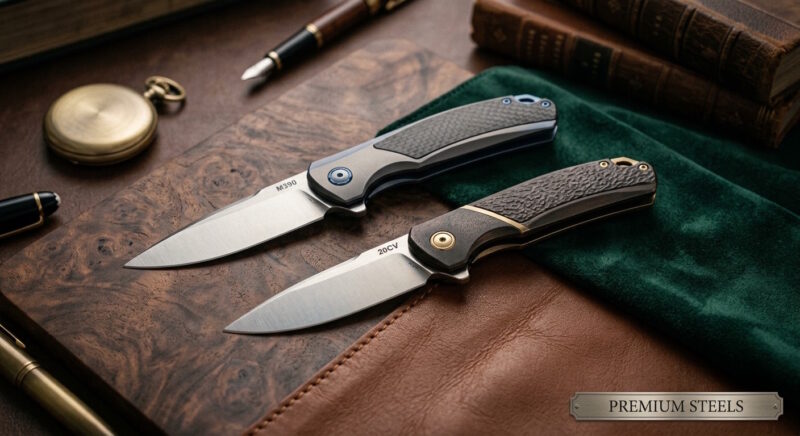
M390 vs 20CV Comparison: The Ultimate Guide for EDC, Hunting & Outdoor Knives
An Independent Guide
Premium knife steels have advanced significantly over the past two decades, giving knife enthusiasts access to blades that stay sharp longer, resist corrosion better, and perform reliably in demanding environments. Among these modern steels, M390 and 20CV are consistently ranked among the best stainless powder metallurgy steels available.
At first glance, these two steels appear almost identical. They share very similar chemical compositions, comparable hardness, outstanding corrosion resistance, and exceptional edge retention. Because of these similarities, many knife buyers wonder whether there is any meaningful difference between them.
The truth is that while M390 and 20CV belong to the same family of high-performance stainless steels, small differences in heat treatment, blade geometry, and manufacturing can influence real-world performance. Understanding these subtle distinctions helps buyers make informed decisions when selecting a premium folding knife, hunting knife, or outdoor blade.
This detailed M390 vs 20CV guide compares every important characteristic, including chemical composition, hardness, edge retention, wear resistance, toughness, corrosion resistance, sharpening, heat treatment, and practical performance. By the end of this article, you’ll understand why these steels are so highly regarded and whether one offers any real advantage over the other.
Quick Comparison Table
| Property | M390 | 20CV | Winner |
|---|---|---|---|
| Hardness | ⭐⭐⭐⭐⭐ | ⭐⭐⭐⭐⭐ | Tie |
| Edge Retention | ⭐⭐⭐⭐⭐ | ⭐⭐⭐⭐⭐ | Tie |
| Wear Resistance | ⭐⭐⭐⭐⭐ | ⭐⭐⭐⭐⭐ | Tie |
| Toughness | ⭐⭐⭐⭐☆ | ⭐⭐⭐⭐☆ | Tie |
| Corrosion Resistance | ⭐⭐⭐⭐⭐ | ⭐⭐⭐⭐⭐ | Tie |
| Sharpening | ⭐⭐⭐☆ | ⭐⭐⭐☆ | Tie |
| Everyday Carry | ⭐⭐⭐⭐⭐ | ⭐⭐⭐⭐⭐ | Tie |
| Hunting | ⭐⭐⭐⭐⭐ | ⭐⭐⭐⭐⭐ | Tie |
| Bushcraft | ⭐⭐⭐⭐☆ | ⭐⭐⭐⭐☆ | Tie |
| Kitchen Use | ⭐⭐⭐⭐⭐ | ⭐⭐⭐⭐⭐ | Tie |
Quick Summary
Choose either steel if you want:
- Excellent edge retention
- Outstanding corrosion resistance
- Premium stainless performance
- High wear resistance
- Reliable everyday carry performance
- Excellent slicing ability
For most users, the biggest differences between knives made from these steels come from heat treatment, blade geometry, grind, and overall knife design, rather than the steel itself.
Steel Overview
Few steel comparisons generate as much discussion as M390 vs 20CV, largely because these alloys are remarkably similar in composition and performance.
Both are premium stainless powder metallurgy steels designed to deliver:
- High hardness
- Excellent wear resistance
- Outstanding corrosion resistance
- Fine carbide distribution
- Excellent polishability
- Long edge retention
As a result, both steels are frequently found in:
- Premium folding knives
- Everyday carry (EDC) knives
- Hunting knives
- Outdoor knives
- High-end kitchen knives
- Custom knives
When properly heat treated, both steels deliver performance that exceeds the needs of most knife users.
What Is M390?
M390 is a premium stainless powder metallurgy steel originally developed for demanding industrial applications requiring excellent wear resistance and corrosion protection.
Its balanced alloy design quickly made it one of the world’s most respected knife steels.
Today, M390 is widely used for:
- Everyday carry knives
- Premium folders
- Hunting knives
- Outdoor knives
- Kitchen knives
- Collection-quality knives
Its reputation comes from several outstanding characteristics:
- Exceptional edge retention
- Excellent corrosion resistance
- High hardness
- Outstanding wear resistance
- Fine carbide structure
- Excellent edge stability
Because of this balance, M390 remains one of the benchmarks for premium stainless knife steels.
Check Our Guide M390 vs MagnaCut Comparison
What Is 20CV?
20CV is another premium stainless powder metallurgy steel that offers performance nearly identical to M390.
It was developed with similar performance goals:
- Excellent wear resistance
- Outstanding corrosion resistance
- High hardness
- Superior edge retention
- Fine carbide distribution
Today it is commonly found in:
- Premium folding knives
- High-end everyday carry knives
- Outdoor knives
- Hunting knives
- Utility knives
- Custom knives
Users often compare these steels because both consistently rank among the very best stainless options available.
Check Our Guide CPM 20CV Steel Review
Why Powder Metallurgy Matters
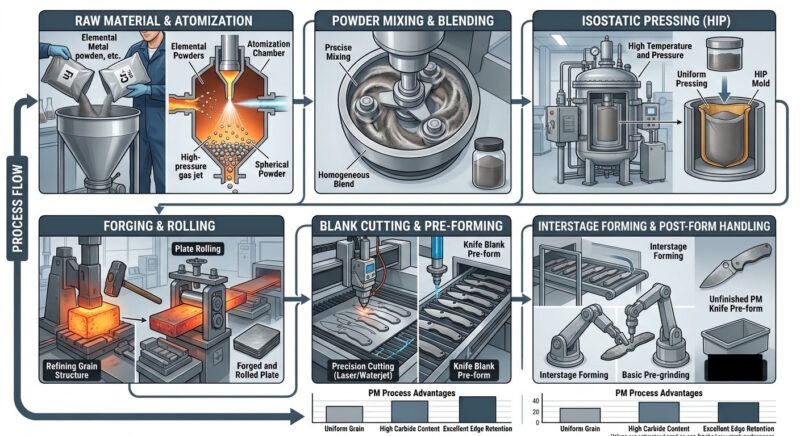
Traditional steel production can produce relatively large carbides that reduce toughness and edge stability.
Powder metallurgy solves this problem.
Instead of casting molten steel into large ingots, the molten alloy is atomized into microscopic powder particles before being compressed under high pressure and temperature.
The result is a much finer and more uniform microstructure.
Benefits include:
- Smaller carbides
- Improved toughness
- Better edge stability
- Higher wear resistance
- More consistent hardness
- Better corrosion resistance
- Improved machining and finishing
This advanced manufacturing process allows premium steels like M390 and 20CV to combine excellent wear resistance with impressive toughness.
Check Our Guide Powder Steels for Kitchen Knives
Chemical Composition
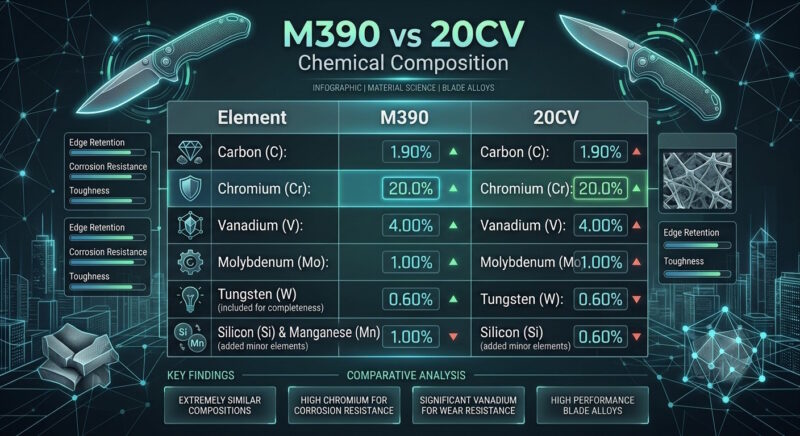
One reason the M390 vs 20CV comparison is so close is their nearly identical chemical composition.
| Element | M390 | 20CV |
|---|---|---|
| Carbon | 1.90% | 1.90% |
| Chromium | 20.0% | 20.0% |
| Vanadium | 4.0% | 4.0% |
| Molybdenum | 1.0% | 1.0% |
| Tungsten | 0.6% | — |
Their alloy chemistry explains why both steels perform so similarly in real-world use.
Understanding the Alloy Elements
Carbon
Carbon increases hardness while contributing to carbide formation.
Both steels contain approximately 1.90% carbon, allowing them to achieve:
- High hardness
- Excellent edge retention
- Outstanding wear resistance
Chromium
Chromium provides corrosion resistance and contributes to stainless performance.
With roughly 20% chromium, both steels offer excellent resistance to:
- Rust
- Staining
- Humidity
- Food acids
- Coastal environments
This makes them excellent choices for outdoor use and kitchen applications.
Vanadium
Vanadium creates extremely hard carbides that dramatically improve wear resistance.
Both steels contain approximately 4% vanadium, resulting in:
- Excellent abrasion resistance
- Long edge retention
- Improved cutting performance
Molybdenum
Each steel contains approximately 1% molybdenum, improving:
- Corrosion resistance
- Hardness
- Overall durability
- High-temperature stability
Tungsten
M390 contains a small amount of tungsten.
This contributes slightly to wear resistance and helps improve heat-treatment stability.
In practical knife use, this difference is generally too small to notice.
Hardness (HRC)
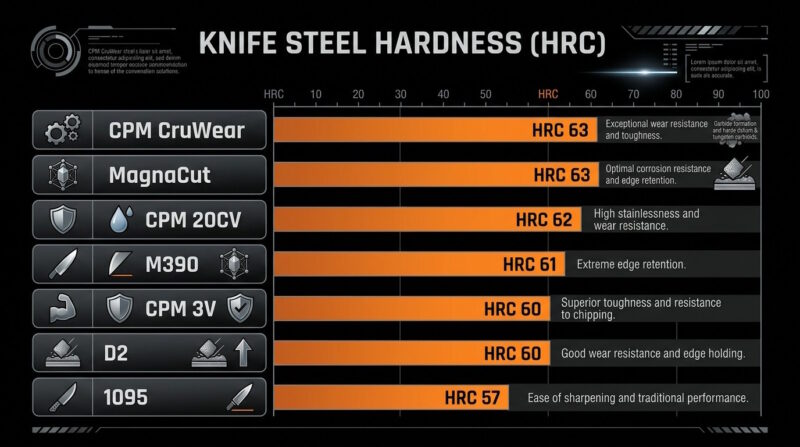
Hardness measures resistance to deformation and greatly influences edge retention.
Typical production hardness:
| Steel | Hardness |
|---|---|
| M390 | 60–62 HRC |
| 20CV | 60–62 HRC |
Premium heat treatments commonly achieve:
- M390: 63–64 HRC
- 20CV: 63–64 HRC
Because both steels can reach nearly identical hardness levels, real-world cutting performance is extremely similar.
Winner: Tie
Check Our Guide What Is HRC? Understanding Rockwell Hardness
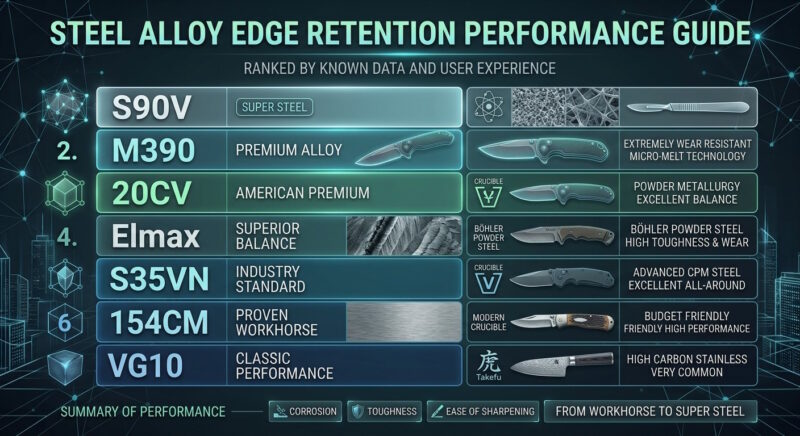
Edge Retention
Edge retention refers to how long a blade remains sharp during use.
This is one of the primary reasons users invest in premium knife steels.
M390
M390 has earned its reputation through:
- Excellent slicing performance
- Outstanding wear resistance
- Long sharpening intervals
- Stable cutting edge
It performs exceptionally well when cutting:
- Cardboard
- Rope
- Leather
- Plastic
- Packaging materials
20CV
20CV performs almost identically.
Users can expect:
- Excellent edge retention
- Outstanding cutting longevity
- High abrasion resistance
- Consistent slicing performance
In controlled testing, differences are typically very small and often impossible to notice during normal everyday use.
Winner: Tie
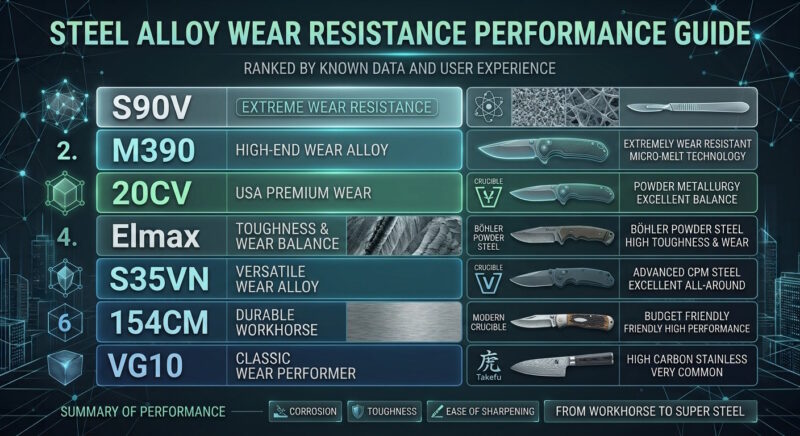
Wear Resistance
Wear resistance measures how well the cutting edge withstands abrasion.
This characteristic becomes especially important for users who frequently cut abrasive materials.
Examples include:
- Cardboard
- Rope
- Carpet
- Leather
- Synthetic fibers
M390
Thanks to its balanced carbide structure, M390 offers outstanding wear resistance while maintaining practical toughness.
20CV
20CV delivers virtually identical wear resistance.
Users can expect:
- Long cutting sessions
- Minimal edge wear
- Excellent slicing efficiency
- Outstanding durability
For most knife owners, there is no meaningful difference in wear resistance between these steels.
Winner: Tie
Toughness
Toughness measures resistance to chipping, cracking, and edge failure under stress.
M390
Although optimized primarily for wear resistance, M390 maintains respectable toughness.
Advantages include:
- Good edge stability
- Reliable performance
- Moderate resistance to chipping
- Suitable for everyday use
20CV
20CV performs almost identically.
Both steels contain similar carbide volumes, resulting in comparable toughness.
Neither steel is designed for extreme impact applications like heavy batoning, but both handle normal cutting tasks exceptionally well.
Winner: Tie
Corrosion Resistance
One of the greatest strengths of both steels is outstanding corrosion resistance.
M390
Its high chromium content provides excellent protection against:
- Rust
- Staining
- Food acids
- Humidity
- Coastal climates
Routine cleaning is generally all that’s required to keep the blade looking new.
20CV
20CV performs equally well.
It resists corrosion in virtually every environment encountered during everyday use, making it an excellent choice for:
- Everyday carry
- Outdoor activities
- Food preparation
- Wet climates
- Hunting trips
For practical purposes, both steels rank among the best stainless knife steels available.
Winner: Tie
Sharpening
Even the best knife steel eventually needs sharpening. The difficulty depends on hardness, wear resistance, carbide volume, and the sharpening equipment you use.
Because both steels have very similar alloy compositions, they also sharpen in very similar ways.
Sharpening M390
M390 is known for holding an edge for a long time while still allowing a very refined cutting edge.
Advantages
- Takes an extremely sharp edge
- Excellent edge refinement
- Long intervals between sharpening
- Works well with diamond and ceramic stones
- Consistent sharpening response
Challenges
- More difficult to sharpen than mid-range stainless steels
- Diamond abrasives greatly reduce sharpening time
- Requires patience to remove enough material
Fortunately, the excellent edge retention means sharpening sessions are relatively infrequent.
Sharpening 20CV
20CV offers almost identical sharpening characteristics.
Advantages
- Produces a razor-sharp edge
- Excellent polishability
- Maintains consistent edge geometry
- Long-lasting sharpness
Challenges
- Similar sharpening difficulty to M390
- Diamond stones provide the fastest results
- High wear resistance slows material removal
For most knife owners, the sharpening experience is virtually indistinguishable from M390.
Winner: Tie
Heat Treatment
Heat treatment is one of the most important factors affecting knife performance.
Two knives made from the same steel can perform differently if they receive different heat treatments.
When comparing M390 vs 20CV, heat treatment often has a greater influence than the steel itself.
Typical Hardness
Most production knives fall within:
60–62 HRC
Higher-end knives often reach:
63–64 HRC
At these hardness levels, both steels provide:
- Excellent edge retention
- High wear resistance
- Outstanding corrosion resistance
- Stable cutting performance
A well-executed heat treatment allows either steel to perform at an exceptionally high level.
Check Our Guide Steel Heat Treatment Explained
Real-World Performance
Laboratory testing is useful, but real-world cutting performance is what matters most to knife users.
Because the two steels are so similar, performance differences in everyday tasks are often too small to notice.
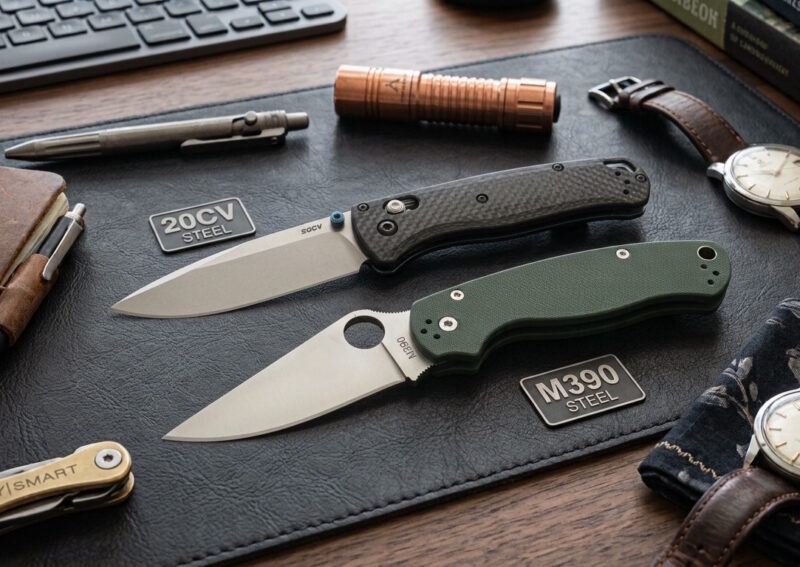
Everyday Carry (EDC)
Typical EDC tasks include:
- Opening packages
- Cutting cardboard
- Rope
- Plastic
- Zip ties
- Food preparation
- General utility work
M390 for EDC
M390 has become one of the most popular premium steels for everyday carry because it offers:
- Outstanding edge retention
- Excellent corrosion resistance
- Good toughness
- Reliable all-around performance
For users who carry one knife every day, M390 handles virtually every common cutting task with ease.
20CV for EDC
20CV performs just as well for everyday carry.
Its strengths include:
- Long-lasting sharpness
- Excellent slicing performance
- High wear resistance
- Outstanding stainless properties
In practical use, most owners would be unable to distinguish between M390 and 20CV without controlled testing.
Winner: Tie
Hunting
A quality hunting knife should provide:
- Reliable edge retention
- Corrosion resistance
- Sufficient toughness
- Easy cleaning after processing game
M390
M390 performs exceptionally well during:
- Skinning
- Meat processing
- Food preparation
- General field tasks
Its combination of toughness and wear resistance makes it an excellent hunting steel.
20CV
20CV performs almost identically.
Hunters can expect:
- Long-lasting sharpness
- Excellent corrosion resistance
- Reliable cutting performance
- Easy maintenance
Both steels are highly capable for field use.
Winner: Tie
Bushcraft & Outdoor Use
Bushcraft knives perform tasks such as:
- Feather sticking
- Carving
- Camp food preparation
- Light wood processing
- General camp chores
Neither M390 nor 20CV is designed specifically for heavy-impact bushcraft, but both perform well in moderate outdoor use.
M390
Advantages include:
- Stable edge
- Good corrosion resistance
- Reliable cutting performance
- Fine slicing ability
20CV
20CV offers virtually identical performance.
Its excellent wear resistance and corrosion resistance make it suitable for camping, hiking, and outdoor cooking.
For extreme impact tasks such as heavy batoning or chopping, tougher steels may be more appropriate.
Winner: Tie
Check Our Guide One Knife for Hunting and Bushcraft
Kitchen Use
Premium stainless steels also perform exceptionally well in kitchen knives.
Requirements include:
- Corrosion resistance
- Fine cutting ability
- Long edge life
- Easy cleaning
M390
M390 excels in food preparation.
Benefits include:
- Outstanding stain resistance
- Smooth slicing
- Excellent edge retention
- Long service life
20CV
20CV offers the same strengths.
Its combination of wear resistance and corrosion resistance makes it ideal for:
- Vegetables
- Meat
- Fish
- Fruit
- Professional kitchen work
Both steels remain sharp through extended food preparation.
Winner: Tie
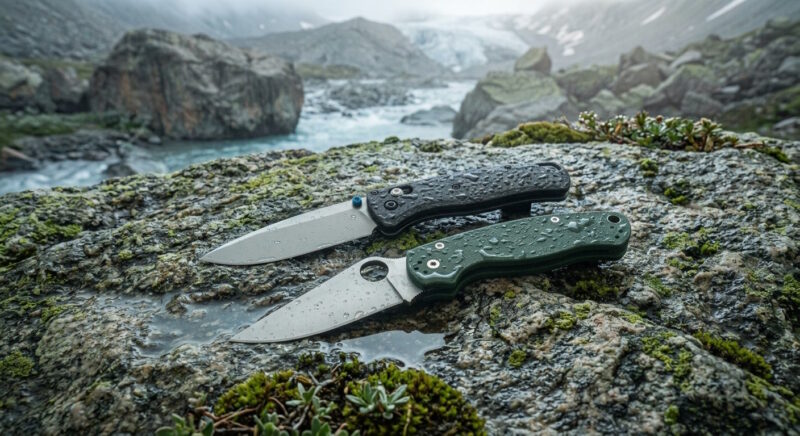
Wet & Humid Environments
High chromium content gives both steels excellent resistance to rust.
They perform well in:
- Coastal areas
- Humid climates
- Rain
- Snow
- Marine environments
- Food preparation
Routine cleaning and drying are generally sufficient to maintain their appearance.
Winner: Tie
Best Uses
Choose M390 For
- Everyday carry
- Hunting knives
- Outdoor knives
- Kitchen knives
- Utility work
- Premium folding knives
- Users seeking a balanced stainless steel
Choose 20CV For
- Everyday carry
- Hunting
- Utility cutting
- Premium folders
- Kitchen use
- Outdoor activities
- Long-term edge retention
Because performance is so similar, buyers should focus on knife design, ergonomics, heat treatment, and overall craftsmanship rather than the steel alone.
Pros & Cons
M390 Pros
- Excellent edge retention
- Outstanding corrosion resistance
- High wear resistance
- Good toughness
- Premium all-around performance
- Fine edge stability
M390 Cons
- More difficult to sharpen than mid-range steels
- Premium price
- Not intended for extreme impact applications
20CV Pros
- Excellent edge retention
- Outstanding corrosion resistance
- High wear resistance
- Excellent polishability
- Reliable all-around performance
- Long service life
20CV Cons
- Similar sharpening difficulty to M390
- Premium cost
- Moderate toughness compared to dedicated hard-use steels
Performance Scorecard
| Property | M390 | 20CV |
|---|---|---|
| Hardness | ⭐⭐⭐⭐⭐ | ⭐⭐⭐⭐⭐ |
| Edge Retention | ⭐⭐⭐⭐⭐ | ⭐⭐⭐⭐⭐ |
| Wear Resistance | ⭐⭐⭐⭐⭐ | ⭐⭐⭐⭐⭐ |
| Toughness | ⭐⭐⭐⭐☆ | ⭐⭐⭐⭐☆ |
| Corrosion Resistance | ⭐⭐⭐⭐⭐ | ⭐⭐⭐⭐⭐ |
| Sharpening | ⭐⭐⭐☆ | ⭐⭐⭐☆ |
| Everyday Carry | ⭐⭐⭐⭐⭐ | ⭐⭐⭐⭐⭐ |
| Hunting | ⭐⭐⭐⭐⭐ | ⭐⭐⭐⭐⭐ |
| Bushcraft | ⭐⭐⭐⭐☆ | ⭐⭐⭐⭐☆ |
| Kitchen | ⭐⭐⭐⭐⭐ | ⭐⭐⭐⭐⭐ |
Which Steel Should You Choose?
Unlike many knife steel comparisons where one steel clearly outperforms the other, M390 vs 20CV is different.
These steels are so similar that most users would never notice a meaningful performance difference during normal use.
Instead of focusing solely on the steel, it is often more important to evaluate:
- Heat treatment
- Blade geometry
- Edge angle
- Blade thickness
- Knife ergonomics
- Lock mechanism
- Overall build quality
A well-designed knife made from either steel will provide years of exceptional performance.
Choose M390 If…
M390 is an outstanding option if you:
- Want one of the best-balanced premium stainless steels
- Need excellent corrosion resistance
- Prefer long edge retention with practical sharpening
- Carry your knife every day
- Use your knife for a variety of cutting tasks
- Hunt, camp, or spend time outdoors
- Want a dependable all-purpose premium steel
Its balanced combination of wear resistance, toughness, and corrosion resistance makes it an excellent choice for users who own a single premium knife.
Choose 20CV If…
20CV is an equally excellent choice if you:
- Want premium edge retention
- Value excellent corrosion resistance
- Frequently cut abrasive materials
- Appreciate refined cutting performance
- Prefer premium stainless steels
- Use your knife for everyday carry or outdoor work
Because its performance is nearly identical to M390, choosing a knife with better ergonomics or craftsmanship often matters more than choosing between the two steels.
Best Steel by Application
Everyday Carry (EDC)
Both steels perform exceptionally well for:
- Opening packages
- Rope
- Plastic
- Cardboard
- Food
- Daily utility work
Winner
🤝 Tie
Both deliver premium cutting performance.
Hunting
Field dressing and processing game require:
- Excellent edge retention
- Corrosion resistance
- Reliable toughness
Winner
🤝 Tie
Both steels excel during hunting applications.
Bushcraft & Camping
Camp tasks include:
- Food preparation
- Feather sticking
- Carving
- General camp chores
Winner
🤝 Tie
For moderate outdoor use, both perform exceptionally well. For extreme impact tasks such as heavy batoning, a tougher steel would generally be a better choice.
Kitchen Use
Kitchen knives benefit from:
- Corrosion resistance
- Fine cutting ability
- Long-lasting sharpness
Winner
🤝 Tie
Both steels are excellent choices for premium kitchen knives.
Long-Term Value
Since both steels have very similar properties, long-term value depends more on the knife itself than the blade steel.
Consider factors such as:
- Comfortable handle design
- Blade shape
- Quality heat treatment
- Warranty
- Fit and finish
- Intended use
These elements often have a greater impact on user satisfaction than choosing between M390 and 20CV.
Frequently Asked Questions
1. Is M390 better than 20CV?
Not in any significant practical way.
Their performance is so similar that most users will not notice a difference during everyday use.
2. Which steel holds an edge longer?
Both offer outstanding edge retention.
With comparable heat treatment and edge geometry, cutting longevity is virtually identical.
3. Which steel is tougher?
Their toughness is extremely similar.
Neither steel has a meaningful advantage in normal use.
4. Which steel resists rust better?
Both provide excellent corrosion resistance thanks to their high chromium content.
Routine cleaning and drying are usually all that is needed.
5. Which steel is easier to sharpen?
Both require similar sharpening effort.
Diamond stones make sharpening much faster and easier.
6. Which steel is better for EDC?
Both are excellent.
Choose the knife with the design and features that best fit your needs.
7. Are these steels good for hunting?
Yes.
Both perform exceptionally well for skinning, field dressing, and general outdoor use.
8. Can these steels be used in the kitchen?
Absolutely.
Their excellent corrosion resistance and long edge life make them outstanding kitchen knife steels.
9. Why do some users report differences?
Small differences are usually caused by:
- Heat treatment
- Blade grind
- Edge angle
- Blade thickness
- Sharpening technique
These factors influence cutting performance more than the steel composition itself.
10. Which steel offers better value?
Both offer excellent value in the premium knife category.
Rather than choosing based solely on the steel, compare the overall quality of the knife.
11. Are M390 and 20CV interchangeable?
For most practical purposes, yes.
Their alloy compositions and performance characteristics are so close that many experienced users consider them interchangeable.
12. Which steel would most enthusiasts choose?
Many enthusiasts simply choose the knife they like best.
When comparing two well-made knives with proper heat treatment, either steel provides outstanding long-term performance.
Final Comparison Table
| Category | Winner |
|---|---|
| Hardness | 🤝 Tie |
| Edge Retention | 🤝 Tie |
| Wear Resistance | 🤝 Tie |
| Toughness | 🤝 Tie |
| Corrosion Resistance | 🤝 Tie |
| Sharpening | 🤝 Tie |
| Everyday Carry | 🤝 Tie |
| Hunting | 🤝 Tie |
| Bushcraft | 🤝 Tie |
| Kitchen Use | 🤝 Tie |
| Overall Performance | 🤝 Tie |
Final Verdict
The M390 vs 20CV comparison is one of the rare cases where there is no clear winner. Both steels share nearly identical chemical compositions and, when properly heat treated, deliver almost the same levels of hardness, wear resistance, edge retention, corrosion resistance, and overall cutting performance.
For everyday carry, hunting, outdoor activities, and kitchen use, both steels rank among the finest stainless knife steels available. They combine long-lasting sharpness, impressive resistance to rust, excellent edge stability, and dependable durability in a wide range of environments.
The small differences that some users notice are usually the result of heat treatment, blade geometry, edge thickness, sharpening quality, and overall knife construction, rather than the steel itself.
If you are deciding between two knives—one made from M390 and the other from 20CV—the better choice is usually the knife with the superior design, ergonomics, fit and finish, and intended purpose. In real-world cutting tasks, those factors will have a much greater influence on your experience than the slight differences between these two steels.
Ultimately, the M390 vs 20CV comparison ends in a draw. Both represent the highest level of modern powder metallurgy technology and remain excellent choices for anyone seeking a premium stainless knife steel that delivers exceptional performance for years of reliable service.
This article is for independent informational purposes only and is not affiliated with, sponsored by, or endorsed by any steel manufacturer. All product names, trademarks, and registered trademarks are the property of their respective owners.