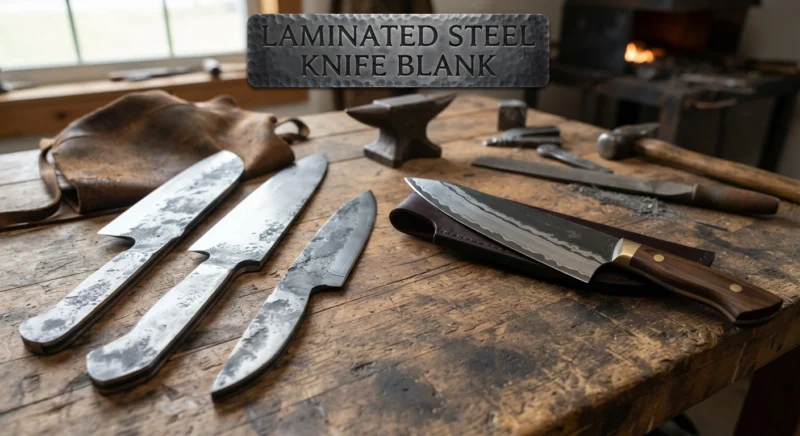
Laminated Steel Knife Blanks
An Independent Guide
Laminated Steel Knife Blanks have become increasingly popular among knife makers who want to combine the cutting performance of a hard core steel with the visual appeal and functional advantages of layered construction. Instead of making an entire blade from one homogeneous piece of steel, laminated construction combines different steels into a single blank, allowing each material to perform a different job.
The concept is especially familiar from Japanese San Mai construction, where a hard cutting core is surrounded by softer outer layers. The result can combine a high-performance cutting edge with a tougher blade body and, when stainless cladding is used, improved corrosion resistance.
For a knife maker, however, buying a laminated blank raises several questions. What exactly is laminated steel? How is it different from Damascus? Does the cladding actually improve toughness? Which core steels are available? Can stainless cladding be used with carbon steel? How should a laminated blank be ground and heat treated? And what should you look for when buying one?
This guide answers those questions and explains the advantages, disadvantages, construction methods, common steel combinations, and practical considerations involved in choosing laminated blanks for custom knives.
What Is Laminated Steel?
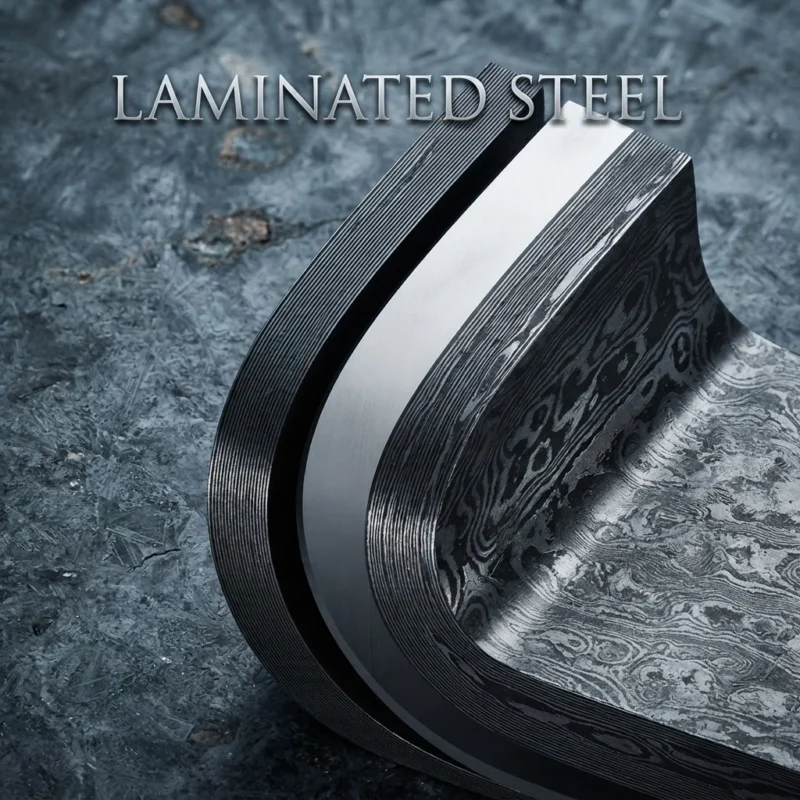
Laminated steel is a blade material made by bonding two or more different layers of metal together. Rather than using one homogeneous steel throughout the blade, the construction deliberately places different materials in different parts of the blade.
The reason is simple: different steels have different strengths.
One steel may be excellent for hardness and edge retention but relatively brittle. Another may be tougher and easier to work but unsuitable for producing a very hard cutting edge. A third material may provide excellent corrosion resistance.
Lamination allows a maker to combine these properties.
In a typical kitchen-knife application, a harder steel forms the cutting core while softer steel surrounds it. The hard material is exposed at the edge, where hardness and edge retention are most important. The softer material forms most of the visible blade surface.
This concept is not a modern invention. Historical bladesmiths used laminated constructions partly because producing consistent high-quality steel was difficult. Early iron-smelting methods produced materials with variable carbon content and impurities, so smiths learned to combine different materials strategically. Historical laminated blades have been found in several cultures, including China, Japan, Europe, and the Middle East.
Modern laminated steel is different in one important respect: today’s knife makers can start with commercially produced steels whose composition and properties are already known. This makes it possible to design a laminate deliberately rather than simply adapting to inconsistent raw material.
That is why laminated construction remains relevant even though modern monosteels are much more sophisticated than historical steels.
A Short History of Laminated Blade Construction
It is tempting to ask who “invented” laminated steel.
The answer is more complicated.
There was no single inventor who suddenly discovered the concept. Lamination developed gradually in different metalworking cultures as smiths learned how to work with the limitations of early iron and steel.
Ancient bladesmiths faced a fundamental problem. A very hard cutting edge could stay sharp, but high hardness generally came with increased brittleness. A softer material could absorb more impact but would not provide the same edge performance.
Combining different materials provided a solution.
Historical evidence shows that jacketed lamination techniques existed in ancient China. Metallurgical studies of ancient Chinese swords have identified layered and laminated structures, including constructions in which harder material was combined with softer material. Some techniques date back to the Han period and earlier traditions of forge-welding and repeated refinement.
The idea subsequently became highly developed in Japanese sword making.
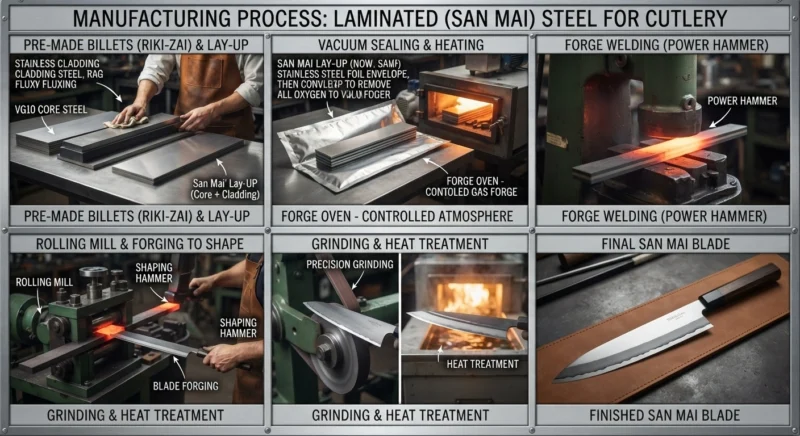
Japanese swordsmiths developed several sophisticated lamination structures, including Honsanmai, which uses a hard steel component and softer supporting steel. Japanese sword construction involved forge welding, folding, selective hardening, grinding, and polishing. Historical studies describe these processes and the different lamination methods used in Japanese blades.
The important point is that modern San Mai should not be described as a completely new invention. It is better understood as a modern continuation and refinement of a very old metallurgical idea.
The Japanese term San Mai means approximately “three layers” or “three flat pieces.” In knife construction, it normally describes a hard core sandwiched between two outer layers. The technique became especially associated with Japanese knives because it offers a practical way to combine a hard cutting edge with a more forgiving blade body.
Modern knife makers then adapted the concept to contemporary steels.
Instead of traditional iron and carbon steel, today’s blanks may combine steels such as VG10, AUS-10, 10Cr15CoMoV, 9Cr18MoV, 14C28N, D2, Shirogami, Aogami, or other steels with stainless or carbon-steel cladding.
The result is a fascinating combination of ancient blade architecture and modern metallurgy.
https://yashkadesigns.com/9-inch-chef-knife-blank-blade-diy
What Is a Laminated Knife Blank?
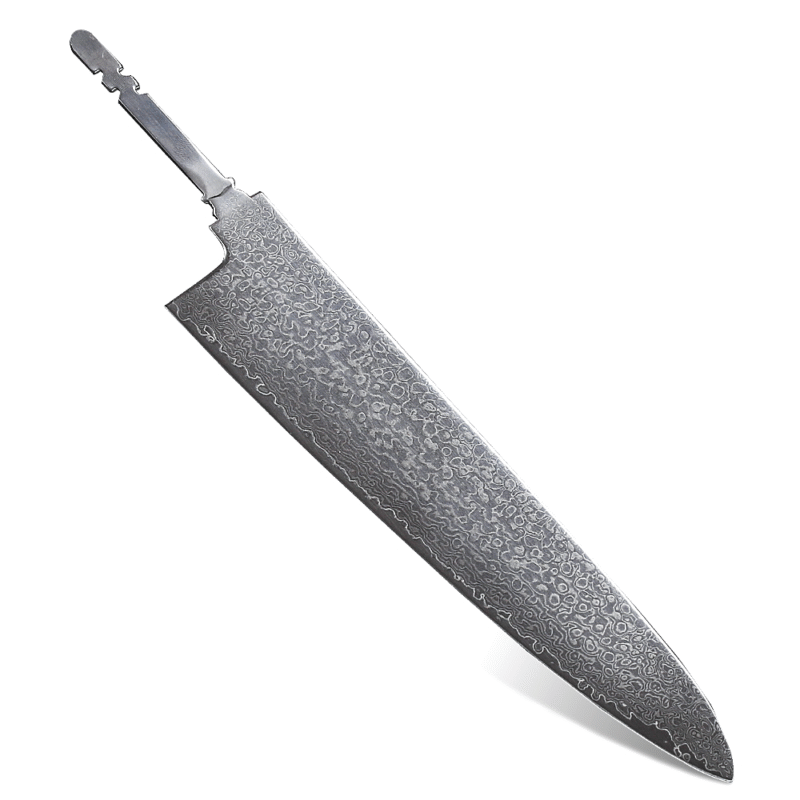
A laminated knife blank is a preformed piece of laminated steel intended to be ground, shaped, heat treated when necessary, finished, and fitted with a handle by a knife maker.
In simple terms, it is the starting material for a custom knife.
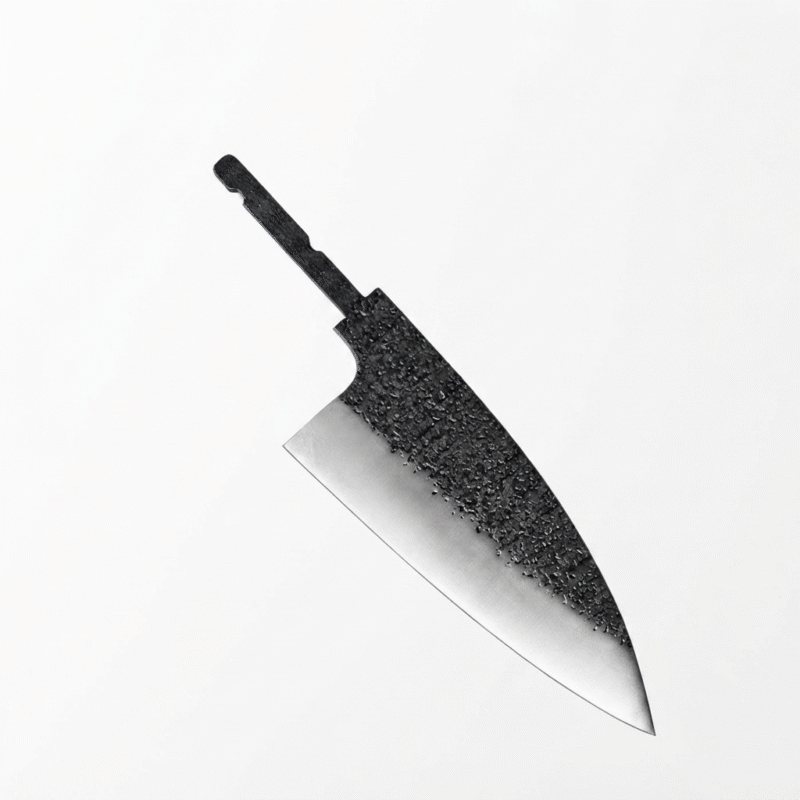
Unlike a finished knife, the blank usually does not have a completed handle and may have only a rough or partially finished profile. Depending on the manufacturer, it may be supplied as a forged blank, waterjet-cut profile, ground blank, or near-finished blade.
The important characteristic is that the material already contains multiple bonded layers.
A typical three-layer blank contains:
- One hard central core
- One outer layer on each side
- A bonded interface between the core and cladding
The core is usually selected for cutting performance.
The cladding is selected for properties such as toughness, corrosion resistance, appearance, workability, or cost.
When the maker grinds the blank toward the edge, the outer layers become progressively thinner and eventually expose the core.
This creates the characteristic visible lamination line.
For knife makers, this construction can save considerable work compared with creating a laminate from raw steel plates. The forge-welding, bonding, and initial preparation have already been completed.
The maker can concentrate on profiling, grinding, heat treatment, polishing, sharpening, and handle construction.
https://yashkadesigns.com/diy-kitchen-knives
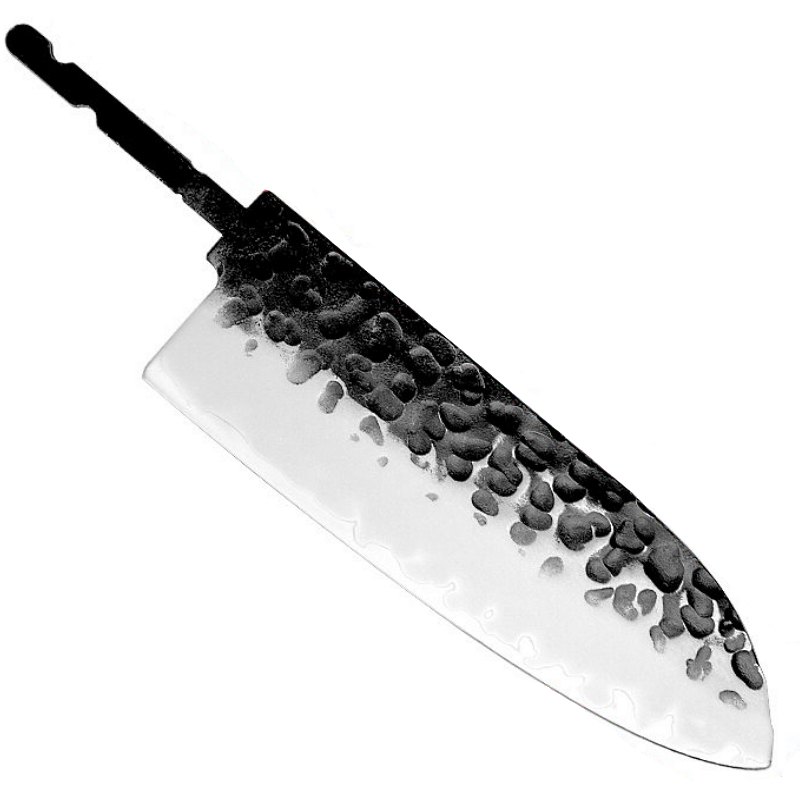
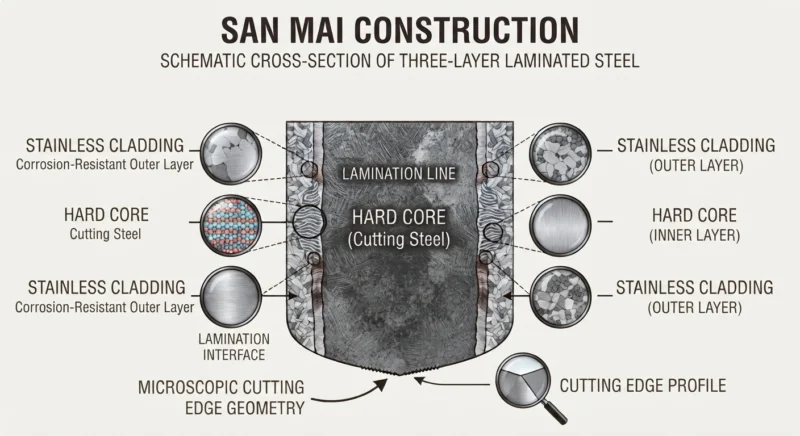
San Mai Construction
San Mai is probably the most recognizable form of laminated knife construction.
The basic arrangement is:
Cladding | Core | Cladding
The center layer is the cutting steel, while the two outside layers provide the blade’s supporting structure.
In a conventional double-bevel San Mai knife, grinding exposes the central core along the cutting edge. The cladding remains on the sides of the blade.
This arrangement is fundamentally different from pattern-welded Damascus.
San Mai describes how the blade is constructed.
Damascus or pattern welding generally describes a blade made by forge-welding different steels into a multi-layer pattern, often with repeated folding, stacking, twisting, or other manipulation.
A San Mai blade can have plain cladding.
A San Mai blade can also have patterned or Damascus-style cladding.
Therefore, “San Mai” and “Damascus” are not automatically synonyms.
A simple three-layer construction can be San Mai without being Damascus.
Likewise, a Damascus-clad blade can have a San Mai architecture if the patterned outer material surrounds a separate core.
Check Our Guide What Is San Mai Steel?
Core Steel and Cladding
The core is the most important functional component because it forms the actual cutting edge.
When selecting a blank, the knife maker should therefore pay close attention to the core steel.
A high-carbon or high-performance stainless steel can provide excellent hardness and edge retention.
Common core materials include:
- Shirogami
- Aogami
- VG10
- VG1
- AUS-10
- 10Cr15CoMoV
- 9Cr18MoV
- D2
- Other high-carbon or stainless knife steels
The cladding performs a different role.
It supports the core and makes up most of the blade surface. Depending on its chemistry, it can also dramatically affect corrosion resistance and appearance.
A stainless-clad carbon-steel core is particularly interesting because the knife can have a highly reactive cutting edge while the majority of the blade remains relatively corrosion resistant.
The exposed edge still requires care, but the large surface area of the blade is easier to maintain.
This is one reason laminated construction became so attractive for modern Japanese kitchen knives.
https://www.jstage.jst.go.jp/article/isijinternational1989/44/6/44_6_1040/_article/-char/en
https://yashkadesigns.com/chef-knife-billet-diy-custom-knives
Carbon Steel vs Stainless Cladding
The choice between carbon-steel and stainless cladding is one of the most important decisions when selecting a laminated blank.
Carbon-Steel Cladding
Carbon-steel cladding provides a traditional appearance and can create attractive contrast with the harder core.
It may develop a patina over time, especially when the knife is exposed to moisture and acidic foods.
For traditional carbon-steel enthusiasts, this can be desirable.
Carbon cladding can also be easier to forge with compatible carbon-steel cores because the materials have relatively similar thermal and metallurgical behavior.
However, the entire blade requires more maintenance.
Stainless Cladding
Stainless cladding provides significantly better corrosion resistance across the blade surface.
This can be especially useful when the core is a reactive carbon steel.
The result is a hybrid construction:
Reactive high-carbon edge + corrosion-resistant blade surface
This does not make the entire knife stainless.
The exposed core at the cutting edge remains reactive and can develop patina or rust if neglected.
Nevertheless, stainless cladding can substantially reduce maintenance requirements.
For kitchen knives, this is one of the most practical advantages of laminated construction.
Check Our Guide Carbon Steel vs Stainless Steel Knives: Which Is Better?
https://yashkadesigns.com/100mm-japanese-knife-blade-blank
Laminated Steel vs Monosteel
A monosteel blade is made from one homogeneous steel throughout its cross-section.
For example, a knife made entirely from 14C28N or M390 is a monosteel blade.
A laminated blade uses different materials in different areas.
Neither approach is automatically superior.
Advantages of Monosteel
A monosteel blade offers:
- Consistent composition throughout the blade
- Predictable heat treatment
- Simpler manufacturing
- No lamination interface
- No risk of delamination
- Straightforward grinding
- Consistent corrosion behavior
Modern monosteels can offer an excellent combination of hardness, toughness, corrosion resistance, and wear resistance.
Advantages of Laminated Construction
Lamination allows the manufacturer to optimize different parts of the blade independently.
The edge can use a very hard steel.
The blade body can use a tougher or more corrosion-resistant material.
The outer layer may also be softer and easier to grind.
This can be particularly valuable when using a very hard core steel that would otherwise make the entire blade expensive or difficult to manufacture.
In other words, laminated construction can be thought of as functional material engineering.
Instead of asking one steel to do everything, the maker gives different materials different jobs.
https://yashkadesigns.com/damascus-steel-santoku-knife-blade
Laminated Steel vs Damascus
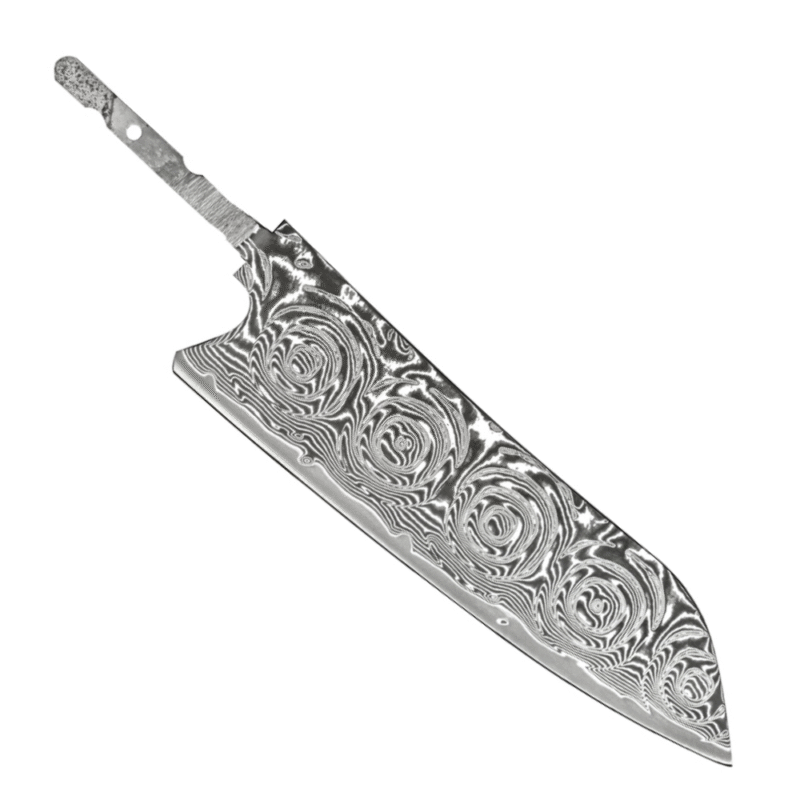
This is one of the most common sources of confusion.
Damascus can refer to several different things in the knife world, and terminology is sometimes used loosely.
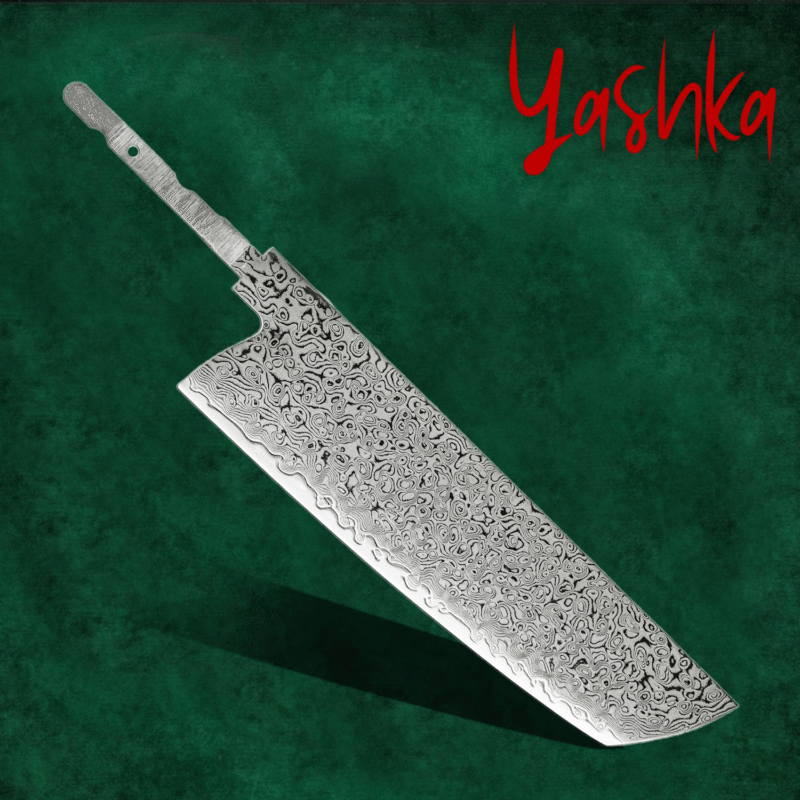
Modern pattern-welded Damascus is generally created by forge-welding different steels together and manipulating the resulting billet to produce a visible pattern.
The pattern is usually revealed through grinding and etching.
The primary visual characteristic is the pattern.
San Mai, by contrast, is primarily a structural arrangement.
The core is the important functional element, while the outer layers support it.
A simple comparison:
| Feature | Laminated / San Mai | Pattern-Welded Damascus |
|---|---|---|
| Main concept | Layered construction | Patterned layered material |
| Typical structure | Core + cladding | Multiple welded steels |
| Edge | Usually core steel | Can be Damascus or separate core |
| Pattern required? | No | Usually yes |
| Main purpose | Functional material combination | Pattern + material properties |
| Can be combined? | Yes | Yes |
A laminated blank does not automatically have a Damascus pattern.
This distinction is particularly important for knife makers buying blanks from suppliers.
https://yashkadesigns.com/chef-knife-blank-blade-240-mm-diy-custom-kitchen
Advantages of Laminated Steel Knife Blanks
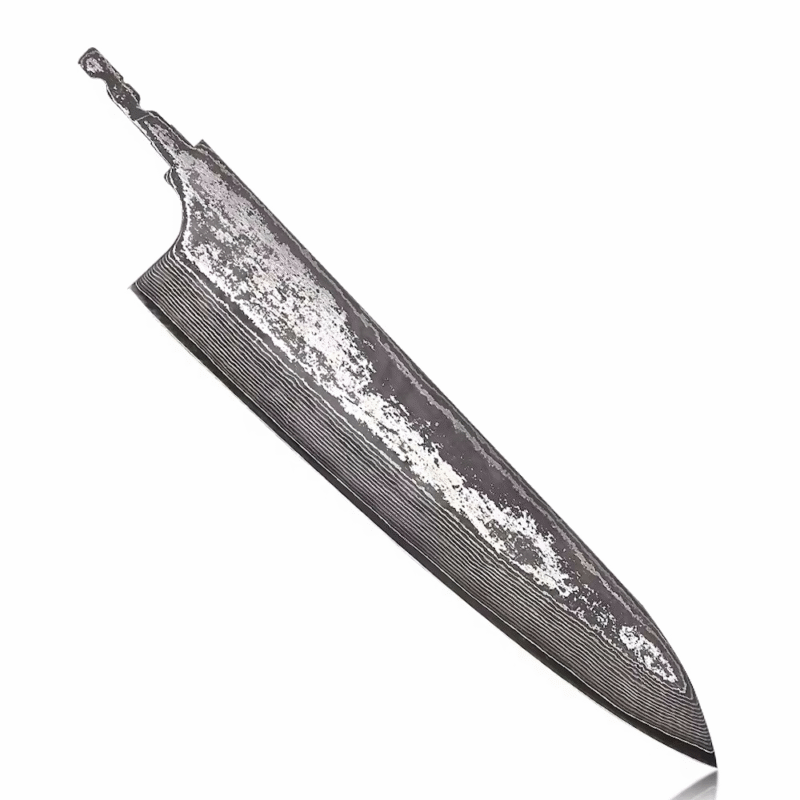
There are several reasons why Laminated Steel Knife Blanks are attractive to custom knife makers.
1. High-Performance Core
The most obvious advantage is that the cutting edge can be made from a steel selected specifically for edge performance.
A maker does not need to use the same material for the entire blade.
2. Tougher Blade Body
The outer layers can provide additional support around the hard core.
This does not mean cladding magically makes a brittle steel tough.
However, the composite structure can allow the blade body to use a more ductile material while concentrating the hard steel where it matters.
3. Improved Corrosion Resistance
Stainless cladding can protect much of the blade surface when paired with a carbon-steel core.
This is particularly useful in kitchen knives.
4. Visual Appeal
The lamination line creates an unmistakable handmade or Japanese-inspired appearance.
Different cladding finishes can create very different looks.
5. Material Efficiency
Only the cutting core needs to be made from the premium edge steel.
The outer layers can use less expensive material.
This can reduce the amount of expensive steel required.
6. Easier Grinding of the Blade Body
When softer cladding surrounds a hard core, much of the blade can be easier to grind than a monosteel blade made entirely from a highly wear-resistant steel.
The advantage depends heavily on the thickness and hardness of the cladding.
7. Design Flexibility
Knife makers can combine different steels to achieve a specific balance of properties.
This opens up many combinations that would not be practical with a single alloy.
https://yashkadesigns.com/santoku-knife-blank-blade-hammered-finish
Disadvantages of Laminated Steel Knife Blanks
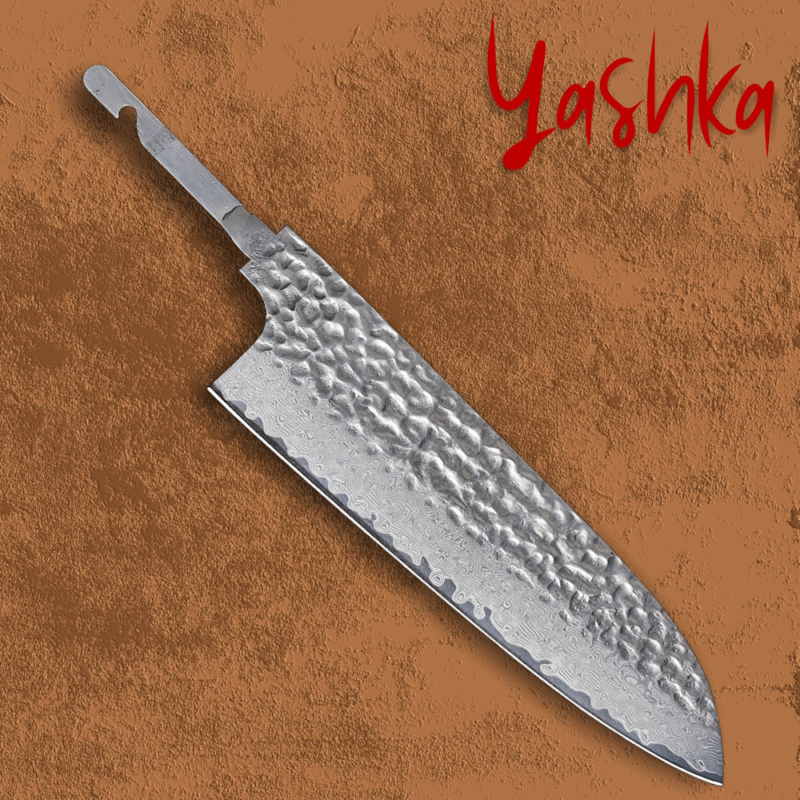
Lamination also introduces disadvantages.
1. Delamination Risk
The most obvious technical concern is the bond between the layers.
A properly manufactured blank should have a strong, continuous bond.
Poor bonding can result in voids or delamination.
This is why supplier quality is extremely important.
2. More Complex Manufacturing
Producing a good laminate is more difficult than producing a simple monosteel blank.
The layers must be compatible and properly bonded.
3. More Difficult Heat Treatment
If the core and cladding have significantly different metallurgical requirements, heat treatment becomes more complicated.
The manufacturer should provide appropriate heat-treatment recommendations.
4. Grinding Can Reveal Unexpected Geometry
The appearance of the lamination line depends on how the blade is ground.
Grinding too aggressively or changing the blade geometry can alter the visible relationship between core and cladding.
5. Cladding Can Affect Sharpening and Thinning
The cladding and core have different hardness and grinding characteristics.
A maker must understand where the core is located and how thick it is.
6. Exposed Carbon Core Can Still Rust
Stainless cladding does not eliminate corrosion completely.
If the core is carbon steel, the cutting edge remains reactive.
7. Quality Varies Greatly
Not every laminated blank is manufactured to the same standard.
A visually attractive laminate can still have poor bonding or inconsistent core thickness.
For this reason, experienced knife makers should evaluate the material rather than choosing solely on appearance.
Edge Performance
The edge performance of a laminated blank depends primarily on the core steel and the final geometry.
The cladding does not normally determine the cutting edge because it is ground away from the edge.
For example, if the core is a high-carbon steel hardened to approximately HRC 61–63, the resulting edge performance will primarily reflect that core’s properties.
Important variables include:
- Core steel
- Heat treatment
- Hardness
- Edge angle
- Edge thickness
- Grind geometry
- Sharpening quality
- Cutting board
- User technique
This is why two laminated blanks with completely different cladding can perform almost identically if they use the same core and geometry.
The visual laminate should therefore never be used as a substitute for knowing the core steel.
Toughness
Toughness is frequently cited as an advantage of laminated construction, but the subject requires some clarification.
The outer layers can provide structural support around a hard core, but the laminate does not automatically transform a brittle steel into a tough steel.
The core still determines much of the behavior at the edge.
If a hard core is very brittle, it can still chip.
The advantage of lamination is that the entire blade does not necessarily need to be made from that brittle material.
A softer cladding can contribute to the overall structural behavior of the blade.
This is particularly useful in kitchen knives, where the maker wants a hard edge without making the entire blade unnecessarily hard.
The final result depends on geometry and construction quality.
Check Our Guide Wear Resistance vs Toughness
Corrosion Resistance
Corrosion resistance is determined by the materials exposed to the environment.
A stainless-clad laminated blade can have excellent corrosion resistance across most of its surface.
However, if the core is carbon steel, the exposed edge remains reactive.
This creates an interesting maintenance profile.
The sides of the blade may require relatively little attention, while the edge needs regular drying and care.
For many users, this is an excellent compromise.
The knife can retain the sharpening and edge characteristics of traditional carbon steel while being easier to maintain than a fully carbon-steel blade.
https://yashkadesigns.com/petty-knife-diy-kit-cooking
Grinding and Finishing
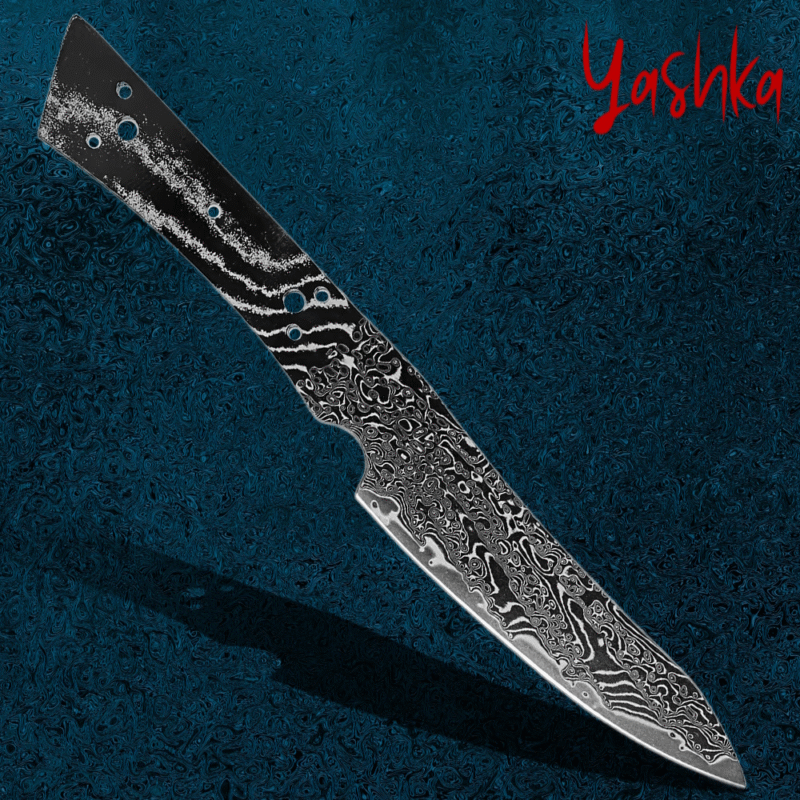
Grinding a laminated blank requires some understanding of how the layers are arranged.
The visible lamination line changes according to the blade’s geometry.
If the core is relatively thick, the line may remain visible high on the blade.
If the core is thin, it may appear only near the edge.
The maker should therefore decide on the desired appearance before aggressive grinding begins.
Initial Profiling
The blank can first be shaped to the desired profile.
This may involve:
- Cutting the tang
- Refining the spine
- Shaping the tip
- Establishing the heel
- Correcting the profile
Primary Grinding
The maker then establishes the blade geometry.
The amount of material removed should be controlled carefully.
Because the cladding and core may have different hardnesses, grinding behavior can change as the abrasive reaches different layers.
Finishing
Finishing options include:
- Satin finish
- Mirror polish
- Stone finish
- Bead-blasted appearance
- Hand-rubbed finish
- Etched finish
The choice depends on the type of cladding.
A plain stainless cladding may look excellent with a fine satin finish.
Reactive carbon cladding may develop an attractive patina.
Patterned cladding may require etching to reveal the design.
Heat Treatment
Heat treatment is one of the most important aspects of laminated knife making.
A laminated blank should never be treated simply according to its appearance.
The maker needs to know the core steel and follow an appropriate heat-treatment schedule.
The cladding material also matters.
Ideally, the materials have compatible thermal expansion and processing characteristics.
If the supplier provides a recommended heat-treatment process, follow it carefully.
If the blank has already been heat treated, it should not be reheated casually.
Poor heat treatment can cause:
- Warping
- Cracking
- Excessive hardness
- Insufficient hardness
- Internal stress
- Reduced toughness
- Lamination problems
The final performance of the knife depends heavily on this stage.
Check Our Guide Steel Heat Treatment Explained
A premium laminated blank can be ruined by inappropriate heat treatment.
https://yashkadesigns.com/diy-blades-and-handles
How to Choose a Laminated Knife Blank
When choosing a blank, do not begin with the pattern.
Start with the core steel.
Ask the supplier:
- What is the core steel?
- What is the cladding steel?
- How many layers are present?
- Is the core centered?
- Is the material already heat treated?
- What hardness is expected?
- What heat-treatment procedure is recommended?
- What is the finished blank thickness?
- How thick is the core?
- Is the material forge welded or manufactured by another bonding process?
- Has the laminate been tested for bonding quality?
- What are the intended applications?
If the supplier cannot answer basic questions about the material, caution is appropriate.
Core Steel
The core should match your intended knife.
For a kitchen knife, you may want excellent sharpening response and fine edge stability.
For a hunting or outdoor knife, toughness may be more important.
For a low-maintenance kitchen knife, a stainless core can be attractive.
Cladding
Choose carbon or stainless cladding depending on your maintenance and appearance requirements.
Thickness
Thickness should match the intended knife design.
A thin kitchen knife blank is very different from a thick outdoor knife blank.
Check Our Guide Best Blade Thickness for Different Uses
Core Position
The core should be centered and consistent.
An uneven core can produce asymmetrical cutting geometry and an unattractive lamination line.
Common Laminated Steel Combinations
There are many possible combinations.
Carbon Core + Carbon Cladding
This is a traditional arrangement.
Advantages include:
- Traditional appearance
- Compatible materials
- Easy patina development
- Excellent sharpening characteristics
The disadvantage is corrosion resistance.
The entire blade requires maintenance.
Carbon Core + Stainless Cladding
This is one of the most useful combinations for kitchen knives.
The core can provide excellent edge performance while stainless cladding reduces maintenance.
Examples may include carbon-steel cores combined with stainless steels such as SUS410 or similar stainless cladding materials, depending on the manufacturer’s design.
The exact compatibility and construction method are important.
Stainless Core + Stainless Cladding
This creates a relatively low-maintenance laminated blade.
The advantage is that both the core and cladding resist corrosion.
This construction is particularly attractive for users who want the appearance of lamination without the maintenance associated with carbon-steel edges.
High-Performance Core + Decorative Cladding
Some laminated blanks use a high-performance core surrounded by patterned or decorative steel.
The primary advantage is visual appearance combined with a high-performance edge.
However, makers should not assume that decorative cladding automatically improves cutting performance.
The core remains the key component.
Chinese Laminated Steels
Chinese manufacturers have become important suppliers of laminated knife materials and pre-made blanks.
A wide range of Chinese-produced laminated materials are now available, including San Mai-style blanks using stainless and high-carbon steels.
Commonly encountered core materials may include steels marketed under designations such as:
- 10Cr15CoMoV
- 9Cr18MoV
- 9Cr18
- 10Cr17
- D2
- Other Chinese stainless and carbon knife steels
Some suppliers also produce proprietary laminated combinations.
The quality of Chinese laminated steel varies considerably.
This is not unique to Chinese material; quality varies among manufacturers everywhere.
The important issue is to evaluate the actual steel specification, bonding quality, hardness, thickness, and manufacturing consistency.
Check Our Ultimate Guide to Chinese Knife Steels
Why Chinese Laminated Steel Is Popular
There are several reasons.
First, Chinese manufacturers can produce laminated material at competitive prices.
Second, there is a large domestic knife industry with experience in stainless and high-carbon blade materials.
Third, manufacturers can produce many combinations for different markets.
For knife makers, this can provide access to laminated blanks that would otherwise be expensive to produce individually.
However, product descriptions should be examined carefully.
A listing that simply says “Damascus San Mai steel” does not provide enough technical information.
The maker should know what the core actually is.
https://yashkadesigns.com/tea-knife-blank-blade-mini-knife
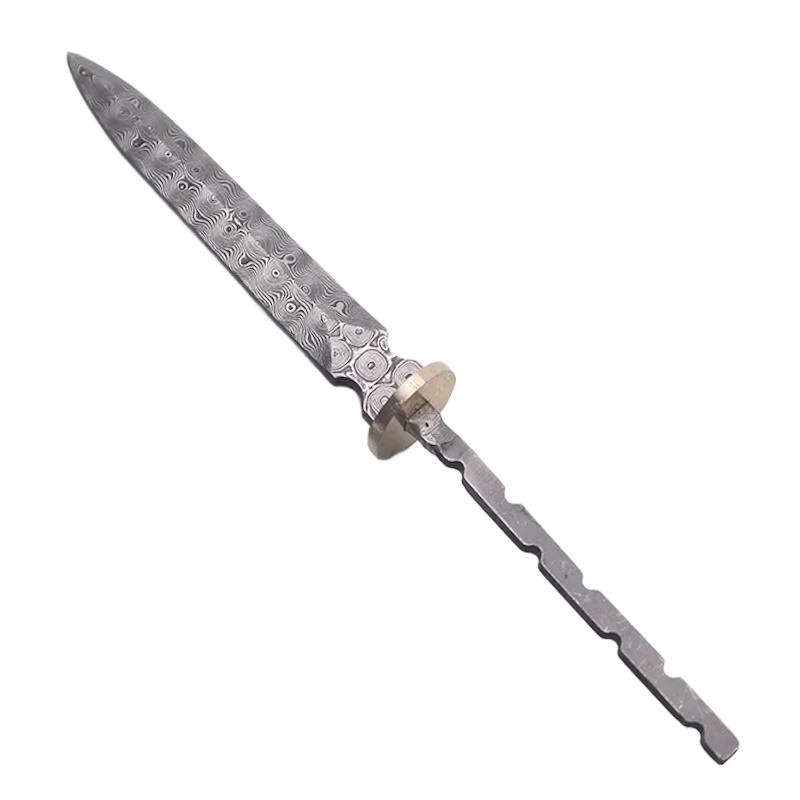
How to Evaluate a Chinese Laminated Blank
If you are considering Chinese laminated blanks for production knives, ask for technical information rather than relying on marketing terminology.
Look for:
- Exact core steel designation
- Cladding steel designation
- Number of layers
- Core thickness
- Blank thickness
- Hardness information
- Heat-treatment instructions
- Manufacturing method
- Dimensional tolerance
- Photographs of the actual material
- Evidence of consistent bonding
A supplier that can provide detailed specifications is generally preferable to one that only provides attractive photographs.
It can also be useful to purchase a small quantity for testing before committing to a large order.
Make several test knives.
Check grinding behavior.
Check the core position.
Perform your normal heat treatment.
Evaluate hardness.
Inspect the edge.
Look for signs of delamination.
This practical testing is much more useful than relying entirely on a product description.
Grinding a Laminated Blank Without Losing the Core
One concern among new knife makers is accidentally grinding through the core.
This can happen if the core is thin and the blade is aggressively thinned.
Before grinding, determine the approximate core thickness and position.
As the blade approaches the final geometry, monitor the lamination line carefully.
If the core becomes unexpectedly narrow or disappears from part of the edge, stop and reassess the geometry.
This is especially important for asymmetrical grinds.
A double-bevel knife usually exposes the core fairly evenly from both sides.
A single-bevel or strongly asymmetrical blade requires more careful planning.
Is Laminated Steel Better Than Monosteel?
There is no universal answer.
A laminated blade is not automatically better.
A modern premium monosteel can provide outstanding performance with fewer manufacturing complications.
The reason to choose lamination is the ability to combine properties.
Think of it this way:
Monosteel: one material optimized for the whole blade.
Laminated steel: different materials optimized for different areas.
For some applications, one excellent steel is enough.
For others, the composite approach offers meaningful advantages.
Pros and Cons of Laminated Steel
Pros
- High-performance core can provide excellent edge characteristics
- Softer cladding can support the hard core
- Stainless cladding can improve corrosion resistance
- Attractive lamination line
- Traditional Japanese-style appearance
- Can reduce the amount of expensive core steel required
- Offers material flexibility
- Can combine carbon-steel performance with easier maintenance
- Excellent option for custom knife making
- Wide range of possible steel combinations
Cons
- More complicated manufacturing
- Potential delamination if poorly manufactured
- More difficult heat-treatment considerations
- Carbon cores can still rust
- Core thickness can limit grinding options
- Different layers may grind differently
- Quality varies substantially between suppliers
- Laminated blanks can cost more than basic monosteel
- Appearance can sometimes hide poor technical quality
- The cladding does not automatically improve edge performance
The most important conclusion is that lamination is a design strategy, not a guarantee of quality.
A well-made monosteel blade can be better than a poorly manufactured laminate.
Frequently Asked Questions
What are laminated steel knife blanks?
Laminated steel knife blanks are pre-made blade materials consisting of two or more bonded layers of different steels. Usually, a harder steel forms the cutting core while softer or more corrosion-resistant material forms the cladding.
What does San Mai mean?
San Mai is a Japanese term meaning approximately “three layers.” In knife making, it generally describes a hard core sandwiched between two outer layers.
Is San Mai the same as Damascus?
No. San Mai describes a structural arrangement, while modern Damascus usually refers to pattern-welded layered steel. The two constructions can sometimes be combined.
Are laminated blanks stronger than monosteel?
Not automatically. Lamination allows different materials to perform different functions, but overall strength and toughness depend on the steels, bonding, heat treatment, geometry, and construction.
What is the core of a laminated knife?
The core is the central steel that becomes exposed at the cutting edge. It is normally selected for hardness, edge retention, toughness, sharpening characteristics, or a combination of these properties.
What is cladding?
Cladding is the outer material surrounding the core. It can provide support, corrosion resistance, easier grinding, and visual contrast.
Can a carbon-steel core have stainless cladding?
Yes. This is a common and useful laminated configuration, especially for kitchen knives.
Does stainless cladding make a carbon core stainless?
No. The exposed carbon-steel edge remains reactive and can develop patina or rust.
Can laminated steel rust?
Yes. Corrosion depends on the materials used. Stainless-clad laminated steel is more corrosion resistant than carbon-clad material, but a carbon-steel core can still rust at the exposed edge.
Is laminated steel good for kitchen knives?
Yes. Laminated construction is particularly well suited to kitchen knives because it can combine a hard cutting core with tougher or more corrosion-resistant cladding.
Is laminated steel good for hunting knives?
It can be, provided the core and construction are appropriate for the intended use. Toughness should be considered carefully for outdoor knives.
Can laminated knife blanks be heat treated?
Some are supplied annealed and require heat treatment. Others may already be heat treated. Always verify the supplier’s specifications before heating a blank.
How do I heat treat laminated steel?
Heat treatment should be based primarily on the core steel and the specific manufacturer’s recommendations. Different laminated combinations may require different procedures.
Can I forge laminated knife blanks?
That depends on the particular blank and materials. Some laminated materials are designed for stock removal rather than additional forging. Reheating can affect the bond and microstructure, so the supplier’s instructions should be followed.
How can I tell if a laminated blank is good quality?
Look for a consistent core, clean lamination lines, accurate dimensions, reliable hardness information, and clear steel specifications. The absence of visible gaps or defects is important, but visual inspection alone cannot prove bond quality.
Why is the core important?
The core forms the cutting edge, so its chemistry, hardness, heat treatment, and geometry have a major influence on the knife’s cutting performance.
Are laminated blanks difficult to grind?
They can be somewhat more demanding than simple monosteel, particularly when the core and cladding have very different hardness. However, properly manufactured blanks can be straightforward to work with.
Can laminated steel be polished?
Yes. Laminated blades can be finished using grinding, polishing, stone finishing, satin finishing, or etching, depending on the materials.
Can laminated steel be used for custom knives?
Absolutely. This is one of the major applications of laminated blanks. They allow makers to create custom blades without having to forge-weld the laminate themselves.
Are Chinese laminated knife blanks good?
Some are very good, while others may be inconsistent. The country of manufacture alone does not determine quality. Evaluate the actual steel specifications, bonding, hardness, dimensions, and supplier reliability.
What should I ask a supplier before buying?
Ask for the exact core steel, cladding steel, core thickness, total thickness, hardness, heat-treatment instructions, manufacturing process, and dimensional specifications.
Is a laminated knife blank worth the extra cost?
It can be, particularly when the construction provides a meaningful functional advantage such as a premium core combined with stainless cladding. If the laminate is purely decorative, the value depends more on the maker’s design priorities.
Final Thoughts
Laminated steel is one of the most interesting ways to approach modern knife making because it recognizes an important fact about metallurgy: no single material has to do everything.
A cutting edge needs hardness and edge stability.
The rest of the blade may benefit from toughness, ductility, corrosion resistance, easier grinding, or a particular appearance.
Lamination allows these requirements to be separated.
This principle has a remarkably long history. Ancient bladesmiths used layered constructions partly because steel production was difficult and inconsistent. Japanese swordsmiths developed sophisticated lamination methods over centuries, including San Mai-style constructions. Modern knife makers have taken the same basic concept and combined it with precisely manufactured modern alloys.
For today’s custom maker, Laminated Steel Knife Blanks offer a practical shortcut to this technology.
Instead of forge-welding multiple plates from scratch, the maker can purchase a prepared blank and concentrate on the parts of the process that define the finished knife: profile, geometry, grinding, heat treatment, finishing, sharpening, and handle construction.
But the word “laminated” should never be treated as a guarantee of superior performance.
The core steel still matters.
Heat treatment still matters.
Geometry still matters.
Bond quality matters.
And the skill of the knife maker remains critical.
The best laminated construction is one in which every layer has a clear purpose.
A high-performance core can provide the edge characteristics the knife needs. Tougher cladding can provide support. Stainless cladding can reduce corrosion. Decorative cladding can create a distinctive appearance.
For knife makers, this flexibility is the real advantage.
Whether you are making a Japanese-style chef knife, a custom hunting knife, a utility blade, or a one-of-a-kind handmade knife, understanding the relationship between the core and the cladding allows you to choose a blank based on engineering rather than appearance alone.
And that is ultimately what makes laminated steel so useful: it is not simply steel with layers—it is a deliberate way of putting the right material in the right place.
For anyone building custom knives, laminated blanks are therefore worth considering whenever the combination of edge performance, blade-body properties, corrosion resistance, and visual character is more important than the simplicity of a single alloy.
This article is for independent informational purposes only and is not affiliated with, sponsored by, or endorsed by any steel manufacturer. All product names, trademarks, and registered trademarks are the property of their respective owners.
https://pmc.ncbi.nlm.nih.gov/articles/PMC12608765/?utm_source