VG10 vs S30V: Which Knife Steel Is Better?
An Independent Guide
Choosing the right knife steel can make a significant difference in cutting performance, maintenance, durability, and long-term satisfaction. Among premium stainless steels, VG10 vs S30V is one of the most common comparisons because both materials offer excellent corrosion resistance, impressive hardness, and reliable cutting ability.
Although these steels belong to the same premium category, they were developed with different priorities. One emphasizes fine cutting performance and ease of sharpening, while the other focuses on maximizing wear resistance and edge life.
So, which one is the better choice?
The answer depends entirely on how you plan to use your knife.
In this comprehensive VG10 vs S30V comparison, we’ll examine every important characteristic, including:
- Chemical composition
- Hardness
- Edge retention
- Toughness
- Corrosion resistance
- Sharpening difficulty
- Wear resistance
- Food preparation performance
- Outdoor use
- Everyday carry applications
- Long-term value
By the end of this guide, you’ll understand which steel best suits your needs.
Understanding VG10 Steel
VG10 is a premium stainless knife steel widely appreciated for its excellent balance of sharpness, corrosion resistance, toughness, and ease of maintenance.
Unlike steels designed solely for maximum hardness, VG10 was engineered to deliver balanced everyday performance. It combines a fine carbide structure with good toughness, allowing the blade to take an extremely refined edge without becoming excessively brittle.
Typical properties include:
- High corrosion resistance
- Fine grain structure
- Excellent slicing ability
- Easy maintenance
- Good toughness
- Reliable edge retention
VG10 is especially popular among users who prepare food daily because it performs exceptionally well during long slicing sessions while remaining relatively easy to sharpen.
Check Our Guide VG10 Steel Review
Understanding S30V Steel
When discussing VG10 vs S30V, it’s important to understand why S30V became one of the most respected premium stainless steels.
S30V belongs to the category of powder metallurgy steels. Instead of traditional steel production, powdered particles are consolidated under controlled conditions, producing a much finer and more uniform carbide distribution.
This manufacturing process offers several advantages:
- Higher wear resistance
- Improved carbide distribution
- Better edge stability
- Excellent hardness
- Outstanding edge retention
- High corrosion resistance
Because of these characteristics, S30V has become a favorite for demanding cutting tasks where long-lasting sharpness is a priority.
Chemical Composition Comparison
Although both steels are stainless, their alloy compositions differ considerably.
VG10 Composition
Typical elements include:
- Carbon
- Chromium
- Vanadium
- Cobalt
- Molybdenum
- Manganese
This combination provides excellent hardness while maintaining fine grain size and corrosion resistance.
The cobalt content helps improve hardness after heat treatment, while chromium enhances stainless performance.
S30V Composition
S30V contains:
- Carbon
- Chromium
- Vanadium
- Molybdenum
The most notable feature is its significantly higher vanadium content.
Vanadium forms extremely hard carbides that dramatically improve:
- Wear resistance
- Edge retention
- Abrasion resistance
These carbides explain why S30V generally stays sharp longer than VG10 during abrasive cutting.
Hardness Comparison
Heat treatment has a major influence on performance, but typical hardness ranges are:
| Steel | Typical HRC |
|---|---|
| VG10 | 59–61 HRC |
| S30V | 59–61 HRC |
Interestingly, both steels often reach very similar hardness levels.
However, hardness alone does not determine cutting performance.
The carbide structure has an equally important role.
Although two knives may both measure 60 HRC, S30V usually maintains its edge longer because its vanadium carbides resist wear more effectively.
This illustrates why hardness numbers should never be the only factor when comparing VG10 vs S30V.
Edge Retention
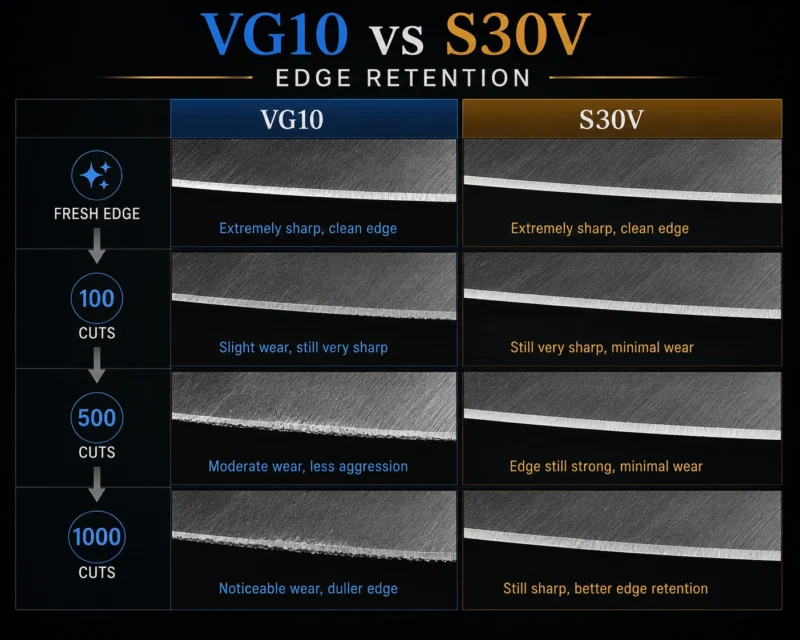
Edge retention is where differences become easier to notice.
VG10 provides very respectable cutting longevity.
It easily handles:
- Meal preparation
- Vegetables
- Fruit
- Fish
- Poultry
- Boneless meat
- Everyday utility work
However, S30V was designed specifically to resist abrasive wear.
Tasks involving:
- Cardboard
- Rope
- Synthetic materials
- Heavy daily cutting
often reveal S30V’s advantage.
For users who dislike frequent sharpening, S30V generally keeps a working edge noticeably longer.
That doesn’t mean VG10 performs poorly.
Instead, VG10 reaches an excellent compromise between edge life and ease of maintenance.
For most home cooks, the difference may not even be noticeable during everyday food preparation.
Initial Sharpness
Both steels are capable of becoming extremely sharp.
VG10 is especially known for taking a very refined, polished edge.
Its fine grain structure supports exceptionally clean slicing.
Many users appreciate how effortlessly VG10 glides through tomatoes, herbs, vegetables, and delicate proteins.
S30V can also achieve outstanding sharpness.
However, because of its harder carbide structure, some sharpeners find it slightly more difficult to polish to an ultra-fine edge.
In practical kitchen use, both steels deliver excellent cutting performance, and most users would be satisfied with either option.
VG10 vs S30V: Toughness, Corrosion Resistance, Wear Resistance, and Sharpening
When comparing VG10 vs S30V, many buyers focus first on edge retention. While keeping a sharp edge is important, it is only one part of overall knife performance. A truly great knife steel must also resist chipping, withstand corrosion, sharpen efficiently, and perform consistently over years of use.
This section of our VG10 vs S30V comparison explores the characteristics that determine how these steels behave in real-world applications.
VG10 vs S30V Toughness
Toughness refers to a steel’s ability to absorb impacts and resist chipping or cracking. It is especially important for knives used in demanding environments where accidental twisting or lateral forces may occur.
The comparison of VG10 vs S30V reveals two steels with respectable toughness, but they achieve it differently.
VG10 offers a balanced combination of hardness and toughness. Thanks to its relatively fine carbide structure, it is less likely to develop microchips during normal kitchen use. This makes VG10 an excellent option for users who prepare food every day and appreciate a forgiving cutting edge.
S30V also demonstrates good toughness, particularly for a premium wear-resistant stainless steel. Powder metallurgy creates a more uniform carbide distribution than conventional steel production, improving overall structural integrity.
However, because S30V contains a higher volume of extremely hard vanadium carbides, it can be slightly less forgiving under abusive conditions.
During normal cutting, both steels perform very well.
If your knife is used properly for slicing and food preparation, toughness differences between VG10 vs S30V are relatively small.
Which Steel Is More Resistant to Chipping?
One common question during a VG10 vs S30V comparison is whether one steel chips more easily.
The answer depends largely on heat treatment and intended use.
VG10 is often appreciated because its fine grain structure allows the edge to remain stable even when sharpened to very acute angles.
S30V can also support thin edges, but its high wear resistance sometimes means that small chips are more noticeable if the knife is abused.
Neither steel should be used for:
- Cutting bones
- Frozen food
- Prying
- Twisting the blade
- Striking hard surfaces
When used appropriately, both VG10 and S30V provide excellent durability.
VG10 vs S30V Corrosion Resistance
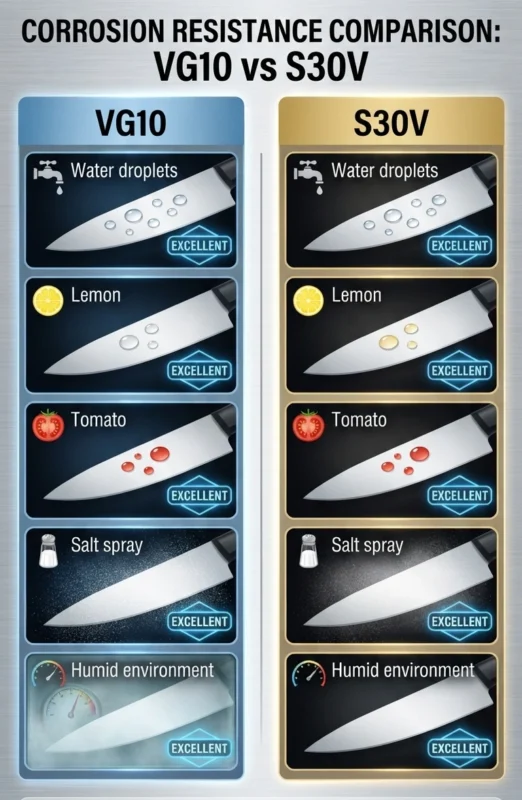
Corrosion resistance is one of the biggest strengths shared by both steels.
Because both contain high chromium levels, they belong to the premium stainless steel category and perform well in humid environments.
During the VG10 vs S30V comparison, both steels show excellent protection against:
- Kitchen moisture
- Food acids
- Fruit juice
- Vegetable acids
- Humid climates
- Everyday washing
VG10 has long been recognized for exceptional stain resistance, making it a favorite for kitchen knives that regularly contact acidic foods like tomatoes, citrus fruits, onions, and peppers.
S30V also performs extremely well and resists rust even after prolonged outdoor use when properly maintained.
For most users, corrosion resistance is nearly a tie in the VG10 vs S30V comparison.
Does Either Steel Rust?
Although both steels are classified as stainless, no knife steel is completely rust-proof.
Poor maintenance can eventually lead to staining or corrosion.
To maximize the lifespan of either steel:
- Wash after use.
- Dry thoroughly.
- Store in a dry location.
- Avoid prolonged exposure to saltwater.
- Do not leave the blade soaking in the sink.
Following these simple habits allows both VG10 and S30V to remain attractive for many years.
VG10 vs S30V Wear Resistance
Wear resistance measures how well a steel withstands abrasive cutting over time.
This is where the comparison between VG10 vs S30V becomes much clearer.
VG10 has good wear resistance that easily satisfies most home cooks and general knife users.
It handles repeated slicing of:
- Vegetables
- Meat
- Fish
- Herbs
- Fruits
- Cardboard
- Plastic packaging
without losing its cutting ability too quickly.
However, S30V was specifically designed to maximize wear resistance.
Its higher vanadium carbide content significantly improves resistance to abrasion.
When repeatedly cutting abrasive materials such as:
- Thick cardboard
- Rope
- Fiber
- Heavy packaging
S30V generally stays sharp noticeably longer.
For users who value extended cutting sessions without sharpening, VG10 vs S30V usually favors S30V.
Edge Stability
Another important factor in the VG10 vs S30V comparison is edge stability.
Edge stability refers to how well the very apex of the blade supports itself during cutting.
VG10 performs exceptionally well because of its fine grain structure.
It produces clean, controlled cuts and maintains excellent slicing performance throughout normal kitchen tasks.
S30V combines excellent edge stability with superior wear resistance, allowing it to maintain working sharpness even after extensive use.
Both steels are capable of producing razor-sharp edges when heat treated properly.
VG10 vs S30V Sharpening Difficulty
Sharpening is one of the biggest practical differences between these steels.
VG10 is widely regarded as relatively easy to sharpen compared to many premium stainless steels.
Most users can restore an excellent edge using standard whetstones or ceramic sharpening systems.
Its fine grain responds quickly to sharpening and polishing, allowing users to achieve razor-like sharpness without excessive effort.
This ease of maintenance is one reason why VG10 remains so popular.
Is S30V Harder to Sharpen?
Yes.
During the VG10 vs S30V comparison, S30V generally requires more time and patience.
Its extremely hard vanadium carbides resist abrasion not only during cutting but also during sharpening.
Many users prefer diamond stones or premium ceramic abrasives when working with S30V.
While sharpening takes longer, the reward is excellent edge retention that often reduces how frequently sharpening is needed.
This creates an interesting trade-off:
- VG10: Easier sharpening, more frequent maintenance.
- S30V: More difficult sharpening, less frequent maintenance.
Neither approach is inherently better—it depends entirely on user preference.
Burr Formation and Edge Refinement
One advantage often mentioned during VG10 vs S30V discussions is burr formation.
VG10 tends to develop a consistent burr that is easy to detect and remove during sharpening.
This makes it especially beginner-friendly.
S30V also sharpens to an impressive edge but often requires more attention to burr removal and polishing because of its higher wear resistance.
Experienced sharpeners usually achieve outstanding results with both steels.
Maintenance Requirements
One reason many buyers compare VG10 vs S30V is because both steels require relatively little maintenance compared with high-carbon steels.
Neither steel needs frequent oiling.
Routine care simply involves:
- Cleaning after use.
- Drying the blade.
- Proper storage.
- Occasional honing.
- Sharpening when necessary.
With proper maintenance, both steels can provide years of dependable cutting performance.
VG10 vs S30V: Performance Summary
After examining toughness, corrosion resistance, wear resistance, and sharpening, the overall picture becomes clearer.
VG10 offers:
- Excellent corrosion resistance
- Easy sharpening
- Fine cutting performance
- Good toughness
- Balanced everyday characteristics
S30V offers:
- Outstanding wear resistance
- Longer edge retention
- Excellent corrosion resistance
- High overall durability
- Superior performance during extended cutting tasks
The VG10 vs S30V comparison does not produce a universal winner. Instead, it highlights two premium stainless steels optimized for slightly different priorities.
VG10 vs S30V: Kitchen Performance, Outdoor Use, Everyday Carry, and Value
After comparing hardness, wear resistance, sharpening, and corrosion resistance, it’s time to see how VG10 vs S30V performs in real-world cutting tasks. Laboratory specifications are important, but what matters most is how these steels behave during everyday use.
Whether you’re preparing dinner, carrying an everyday folding knife, or using a fixed blade outdoors, understanding the strengths of VG10 vs S30V helps you choose the right steel for your needs.
VG10 vs S30V for Kitchen Knives
Kitchen performance is one of the biggest reasons people compare VG10 vs S30V.
Both steels are stainless, both can achieve razor-sharp edges, and both resist corrosion extremely well. However, their cutting characteristics feel slightly different during food preparation.
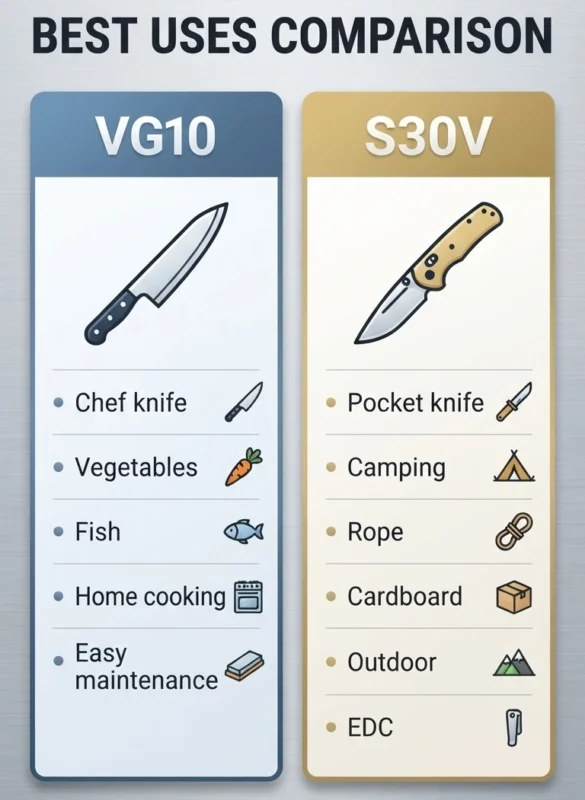
VG10 is widely appreciated for its exceptionally smooth slicing performance. Its fine grain structure allows the edge to glide effortlessly through vegetables, herbs, fruits, fish, and boneless meats.
Many cooks enjoy the refined cutting sensation that VG10 delivers, especially when making precise cuts that require excellent control.
Typical kitchen tasks include:
- Slicing onions
- Cutting tomatoes
- Chopping herbs
- Preparing fish
- Trimming poultry
- Slicing cooked meat
- Dicing vegetables
For these applications, VG10 vs S30V often comes down to personal preference rather than capability.
VG10 vs S30V for Professional Kitchens
Professional chefs often prioritize three qualities:
- Sharpness
- Corrosion resistance
- Easy maintenance
VG10 performs exceptionally well in busy kitchens because it is relatively easy to resharpen after long workdays.
A quick touch-up on a whetstone restores excellent cutting performance.
S30V also performs well in commercial kitchens but usually requires more effort during sharpening.
Its advantage is that sharpening sessions occur less frequently because the edge lasts longer.
For chefs preparing hundreds of meals each week, both steels provide excellent service, although many appreciate the easier maintenance offered by VG10.
Food Release and Cutting Feel
An often-overlooked aspect of the VG10 vs S30V comparison is cutting feel.
VG10 frequently develops an extremely polished edge that produces clean slices with minimal resistance.
Many users describe the cutting action as smooth and effortless.
S30V also cuts exceptionally well but often feels slightly more aggressive due to its wear-resistant carbide structure.
Neither characteristic is inherently better.
Some users prefer the silky cutting sensation of VG10, while others appreciate the long-lasting bite that S30V maintains after extensive use.
VG10 vs S30V for Outdoor Knives
Outdoor enthusiasts frequently compare VG10 vs S30V because both steels perform well in harsh environments.
Camping, hiking, hunting, fishing, and bushcraft all require dependable blades capable of handling varying conditions.
VG10 performs well for:
- Food preparation
- Camp cooking
- Light wood carving
- Rope cutting
- General campsite tasks
Its excellent corrosion resistance makes it suitable for humid environments and occasional exposure to moisture.
S30V excels during extended outdoor trips where sharpening equipment may not be available.
Its outstanding wear resistance allows the blade to remain effective through prolonged cutting sessions.
For users who spend multiple days outdoors, the longer edge life of S30V becomes a significant advantage.
Check Our Guide Knife Safety Tips for Outdoor Use
VG10 vs S30V for Everyday Carry Knives
Everyday carry knives encounter a wide variety of cutting tasks.
Typical EDC use includes:
- Opening packages
- Cutting cardboard
- Rope
- Plastic
- Tape
- Leather
- Food preparation
This is one area where VG10 vs S30V becomes particularly interesting.
VG10 provides excellent sharpness and quick maintenance.
If your knife sees moderate daily use, VG10 is more than capable.
However, users who open dozens of boxes each day often appreciate S30V’s superior wear resistance.
Repeated cardboard cutting slowly dulls almost every knife steel.
S30V simply takes longer before needing sharpening.
VG10 vs S30V for Hunting Knives
Hunters often need a knife that remains sharp throughout an entire field dressing session.
Both steels resist corrosion from moisture and organic materials.
VG10 offers:
- Excellent slicing
- Easy maintenance
- Fine cutting control
S30V offers:
- Longer working edge
- Superior abrasion resistance
- Excellent durability
For processing several animals without sharpening, S30V generally maintains its cutting ability longer.
For occasional hunting trips, both steels perform extremely well.
Check Our Guide Best Handmade Knives for BBQ Season
VG10 vs S30V for Utility Work
Utility knives perform many different cutting tasks throughout the day.
Examples include:
- Cardboard
- Packaging
- Plastic
- Rubber
- Twine
- Fabric
- Foam
- Leather
Because these materials are surprisingly abrasive, wear resistance becomes important.
This is where VG10 vs S30V generally favors S30V.
Its harder vanadium carbides resist abrasion exceptionally well, allowing the edge to remain effective through repeated utility work.
VG10 still performs admirably but typically requires sharpening sooner under heavy abrasive use.
Edge Retention During Daily Use
One of the most searched topics regarding VG10 vs S30V is edge retention during everyday cutting.
Real-world experience generally shows:
VG10 provides:
- Consistent cutting performance
- Easy maintenance
- Excellent slicing
S30V provides:
- Longer edge life
- Greater wear resistance
- Less frequent sharpening
For casual users preparing meals several times each week, either steel may remain sharp for extended periods.
For heavy daily users, S30V usually demonstrates its advantage.
Long-Term Durability
Durability involves more than edge retention.
A quality knife should continue performing well after years of sharpening.
Both VG10 and S30V have excellent reputations for long service life when properly maintained.
Routine sharpening removes only tiny amounts of steel.
Because both materials possess excellent corrosion resistance and structural stability, they can remain reliable cutting tools for decades.
The VG10 vs S30V comparison shows that both steels are long-term investments rather than disposable blade materials.
Ease of Ownership
Many buyers overlook an important factor during the VG10 vs S30V comparison:
How enjoyable is the knife to own?
VG10 offers:
- Easier sharpening
- Excellent corrosion resistance
- Outstanding kitchen performance
- Predictable maintenance
- Refined cutting feel
S30V offers:
- Longer edge retention
- Outstanding durability
- Less frequent sharpening
- Superior wear resistance
- Excellent all-around performance
Neither steel requires complicated care.
Both are suitable for users seeking premium stainless performance with minimal maintenance.
VG10 vs S30V Price and Value
Price often influences buying decisions.
VG10 knives are frequently available at a wider range of price points, making premium cutting performance accessible to more buyers.
S30V knives generally command higher prices because of the powder metallurgy manufacturing process and increased production costs.
Does this automatically make S30V the better value?
Not necessarily.
The value depends on how the knife will be used.
For someone who sharpens regularly and primarily prepares food, VG10 often delivers exceptional value.
For someone who demands maximum edge retention during heavy daily cutting, S30V may justify its higher cost.
When evaluating VG10 vs S30V, value should always be measured against intended use rather than price alone.
Who Should Choose VG10?
VG10 is an excellent choice for users who want:
- Outstanding kitchen performance
- Excellent corrosion resistance
- Easy sharpening
- Fine cutting precision
- Balanced overall performance
- Reliable everyday use
- Excellent value
Who Should Choose S30V?
S30V is ideal for users who prioritize:
- Maximum edge retention
- Superior wear resistance
- Extended cutting sessions
- Everyday carry knives
- Outdoor adventures
- Utility work
- Long intervals between sharpening
The VG10 vs S30V comparison demonstrates that both steels belong among the finest premium stainless knife steels available. Each excels in different situations, making the best choice dependent on your cutting habits rather than a simple specification sheet.
VG10 vs S30V: Final Verdict, FAQ, and Buying Guide
After exploring every important characteristic, the VG10 vs S30V comparison reaches its conclusion. Both steels are considered premium stainless knife steels, and each has earned a strong reputation for reliability, excellent cutting performance, and long service life.
The challenge is that there is no universal winner in the VG10 vs S30V debate. Instead, each steel excels in different situations and appeals to different types of users.
The best choice depends on how you plan to use your knife.
VG10 vs S30V Feature Comparison
| Feature | VG10 | S30V |
|---|---|---|
| Edge Retention | Very Good | Excellent |
| Toughness | Very Good | Very Good |
| Corrosion Resistance | Excellent | Excellent |
| Wear Resistance | Very Good | Excellent |
| Sharpening | Easy | Moderate |
| Fine Edge | Excellent | Excellent |
| Kitchen Performance | Excellent | Excellent |
| Outdoor Use | Very Good | Excellent |
| Everyday Carry | Very Good | Excellent |
| Maintenance | Easy | Moderate |
| Overall Balance | Excellent | Excellent |
The VG10 vs S30V comparison shows that neither steel has significant weaknesses. Both offer premium performance, but they prioritize different characteristics.
VG10 vs S30V for Beginners
If you’re purchasing your first premium knife, VG10 vs S30V often favors VG10.
Why?
VG10 offers:
- Easier sharpening
- Excellent corrosion resistance
- Outstanding slicing performance
- Lower maintenance effort
- Forgiving cutting characteristics
Even users with little sharpening experience can maintain VG10 successfully using quality whetstones.
Its balanced properties make it one of the easiest premium steels to own.
VG10 vs S30V for Experienced Users
Experienced knife enthusiasts often appreciate the advantages that S30V provides.
Its superior wear resistance allows longer cutting sessions before sharpening becomes necessary.
For users comfortable sharpening harder steels, S30V rewards the extra effort with impressive edge longevity.
This is one reason VG10 vs S30V remains such a popular comparison among serious knife users.
VG10 vs S30V for Everyday Carry
For EDC knives, both steels perform extremely well.
VG10 handles everyday tasks such as:
- Opening packages
- Cutting food
- Plastic
- Tape
- Light rope
- Household chores
S30V performs these same tasks while maintaining its edge longer during heavy daily use.
If your knife cuts cardboard for hours every week, VG10 vs S30V generally favors S30V.
For average daily carry, either steel performs exceptionally well.
VG10 vs S30V for Home Kitchens
Kitchen performance is one area where VG10 vs S30V becomes surprisingly close.
VG10 offers:
- Extremely fine edge
- Smooth slicing
- Easy sharpening
- Excellent corrosion resistance
S30V offers:
- Long edge life
- Outstanding wear resistance
- Excellent food preparation capability
Most home cooks would be satisfied with either steel.
Those who sharpen regularly may prefer VG10.
Those who want fewer sharpening sessions may appreciate S30V.
Check Our Guide Blade Geometry Explained
VG10 vs S30V for Outdoor Adventures
Outdoor enthusiasts often ask which steel performs better during camping, hiking, hunting, or fishing trips.
VG10 performs well in:
- Camp cooking
- Food preparation
- General campsite work
- Light carving
S30V adds another advantage:
Its edge typically lasts longer when sharpening equipment isn’t available.
For extended trips, the VG10 vs S30V comparison often leans toward S30V because of its excellent wear resistance.
Maintenance Tips
Regardless of whether you choose VG10 or S30V, proper care dramatically increases blade life.
To keep either steel performing at its best:
- Hand wash after use.
- Dry immediately.
- Store in a dry location.
- Avoid cutting bones.
- Do not cut frozen food.
- Use a wooden or plastic cutting board.
- Hone the edge periodically.
- Sharpen before the knife becomes completely dull.
Following these simple practices will allow either steel to deliver outstanding performance for many years.
Check Our Guide The Ultimate Guide to Caring for a Damascus Steel Knife
Common Myths About VG10 vs S30V
Myth 1: Harder Steel Always Means Better Steel
Not necessarily.
Hardness is only one factor.
The overall performance of VG10 vs S30V depends on heat treatment, carbide structure, geometry, and intended use.
Myth 2: S30V Never Needs Sharpening
False.
Although S30V keeps its edge longer than VG10, every knife eventually becomes dull.
Regular maintenance preserves cutting performance.
Myth 3: VG10 Is Only for Kitchen Knives
Incorrect.
VG10 performs well in folding knives, outdoor knives, utility knives, and many everyday cutting applications.
Its excellent corrosion resistance makes it extremely versatile.
Myth 4: S30V Is Too Difficult to Sharpen
Not really.
S30V requires more time than VG10, but modern diamond stones and quality sharpening systems make maintenance straightforward.
The trade-off is significantly longer edge retention.
Frequently Asked Questions
Which steel stays sharp longer?
In the VG10 vs S30V comparison, S30V generally offers longer edge retention because of its high wear resistance and vanadium carbides.
Which steel is easier to sharpen?
VG10 sharpens more quickly and is often recommended for users who sharpen their knives at home.
Which steel resists rust better?
Both steels provide excellent corrosion resistance.
With normal care, either steel performs exceptionally well in kitchens and outdoor environments.
Which steel is better for cooking?
VG10 is often favored for its refined cutting feel and easy maintenance.
However, S30V also performs extremely well in food preparation.
Which steel is better for outdoor use?
The VG10 vs S30V comparison usually favors S30V for long outdoor trips because of its excellent edge retention.
Which steel offers better value?
That depends on your priorities.
If easy sharpening is important, VG10 provides excellent value.
If maximum edge retention matters most, S30V may justify its typically higher cost.
| Feature | VG10 | S30V |
|---|---|---|
| Edge Retention | ⭐⭐⭐⭐ | ⭐⭐⭐⭐⭐ |
| Toughness | ⭐⭐⭐⭐ | ⭐⭐⭐⭐ |
| Corrosion | ⭐⭐⭐⭐⭐ | ⭐⭐⭐⭐⭐ |
| Sharpening | ⭐⭐⭐⭐⭐ | ⭐⭐⭐ |
| Wear Resistance | ⭐⭐⭐⭐ | ⭐⭐⭐⭐⭐ |
| Kitchen Use | ⭐⭐⭐⭐⭐ | ⭐⭐⭐⭐ |
| Outdoor Use | ⭐⭐⭐⭐ | ⭐⭐⭐⭐⭐ |
Final Verdict: VG10 vs S30V
After comparing every important characteristic, the conclusion is clear:
Choose VG10 if you value:
- Easy sharpening
- Excellent corrosion resistance
- Outstanding kitchen performance
- Fine cutting precision
- Balanced everyday performance
- Excellent overall value
Choose S30V if you prioritize:
- Superior edge retention
- Outstanding wear resistance
- Less frequent sharpening
- Heavy everyday use
- Outdoor adventures
- Utility and EDC applications
Ultimately, the VG10 vs S30V comparison is not about finding a universal winner. Both steels rank among the best premium stainless knife steels available and are capable of delivering years of reliable performance when properly heat treated and maintained.
For many users, VG10 vs S30V comes down to a simple choice: easier sharpening and refined slicing with VG10, or longer-lasting edge retention and exceptional wear resistance with S30V. Either way, you’re choosing a steel that offers excellent durability, corrosion resistance, and dependable cutting performance for a wide range of kitchen, outdoor, and everyday tasks.
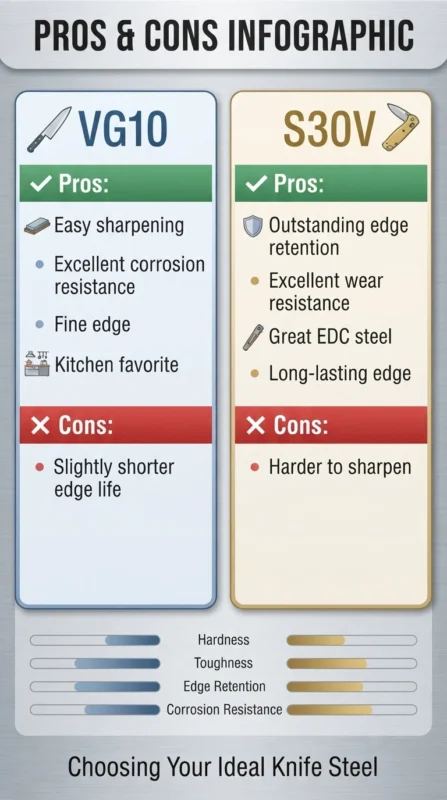
VG10 Pros and Cons
Pros
- Excellent corrosion resistance
- Takes a very fine, razor-sharp edge
- Easier to sharpen than S30V
- Fine grain structure provides smooth slicing performance
- Well-balanced hardness and toughness
- Ideal for kitchen knives and everyday use
- Requires relatively little maintenance
- Good value for the performance offered
- Performs well in humid and coastal environments
- Suitable for both beginners and experienced users
Cons
- Edge retention is lower than S30V
- Wear resistance is good but not exceptional
- Can chip if used on bones or frozen food
- Requires more frequent sharpening during heavy use
- Heat treatment quality greatly affects performance
S30V Pros and Cons
Pros
- Outstanding edge retention
- Excellent wear resistance
- Premium powder metallurgy steel
- Excellent corrosion resistance
- Holds a working edge through extended cutting sessions
- Great for EDC, outdoor, and utility knives
- Good toughness for a high wear-resistant stainless steel
- Long service life with proper maintenance
- Requires less frequent sharpening
Cons
- More difficult to sharpen than VG10
- Usually more expensive
- Requires quality sharpening stones (diamond stones work best)
- Can be slightly more prone to micro-chipping if abused
- Fine polishing takes more time because of hard vanadium carbides
Quick Comparison
| Feature | VG10 | S30V |
|---|---|---|
| Pros | Easy to sharpen, excellent corrosion resistance, fine edge, smooth slicing, balanced performance | Outstanding edge retention, superior wear resistance, excellent corrosion resistance, long-lasting edge |
| Cons | Shorter edge retention, more frequent sharpening | Harder to sharpen, higher price, may chip if misused |
Bottom Line
- Choose VG10 if you want a steel that is easy to maintain, takes an extremely sharp edge, and excels in kitchen and everyday cutting tasks.
- Choose S30V if your priority is maximum edge retention, excellent wear resistance, and fewer sharpening sessions, especially for EDC or outdoor use.
This article is for independent informational purposes only and is not affiliated with, sponsored by, or endorsed by any steel manufacturer. All product names, trademarks, and registered trademarks are the property of their respective owners.