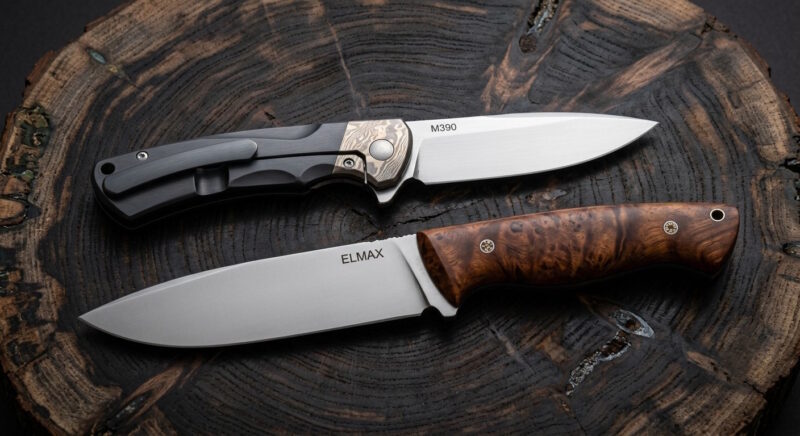
M390 vs Elmax Steel Comparison: The Ultimate Guide for EDC, Hunting, Bushcraft & Outdoor Knives
An Independent Guide
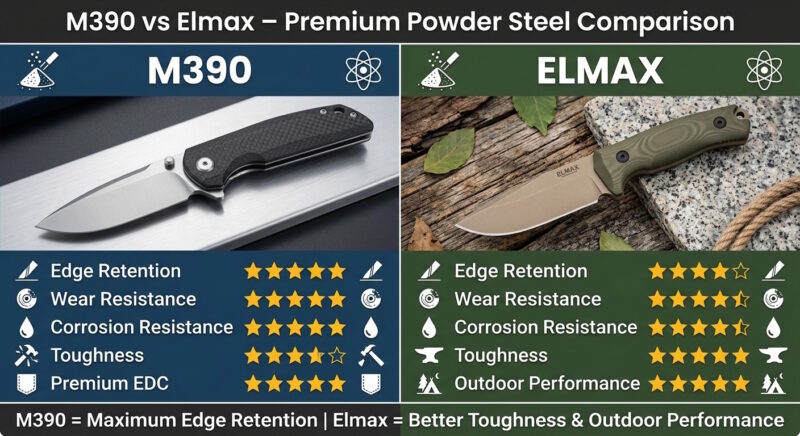
When choosing a premium knife, the blade steel plays a crucial role in determining its performance, durability, and longevity. Among today’s premium stainless knife steels, M390 and Elmax stand out as two of the most popular choices for everyday carry (EDC), hunting, bushcraft, outdoor adventures, and custom knives.
Both steels are manufactured using advanced powder metallurgy technology, both offer exceptional corrosion resistance, and both are capable of achieving excellent edge retention. Because of these similarities, knife enthusiasts often debate which steel delivers better overall performance.
Is M390’s legendary edge retention worth the higher sharpening effort? Does Elmax’s superior toughness make it the better choice for hard-use knives? Which steel is best for hunting, camping, food preparation, or everyday carry?
The answer depends on how you use your knife.
This comprehensive guide compares M390 and Elmax across every important category, including chemical composition, hardness, toughness, wear resistance, corrosion resistance, sharpening, and real-world performance. By the end of this article, you’ll understand the strengths and weaknesses of each steel and be able to choose the one that best fits your needs.
What Is M390?
M390 is a premium stainless powder metallurgy steel that has become one of the most respected knife steels in the world. Originally developed for industrial applications requiring exceptional wear resistance and corrosion protection, it quickly gained popularity among knife makers thanks to its outstanding combination of edge retention, hardness, and stainless performance. Today, M390 is widely used in premium folding knives, fixed blades, and custom knives, making it a benchmark for high-end stainless knife steels.
Its popularity comes from an outstanding combination of:
- Exceptional edge retention
- Excellent corrosion resistance
- High hardness
- Fine carbide structure
- Outstanding polish
- Premium cutting performance
Today, M390 is used by many leading knife manufacturers.
For many knife enthusiasts, M390 represents the benchmark for premium stainless EDC steel.
Check Our Guide M390 Steel Review
What Is Elmax?
Elmax is a high-performance stainless powder metallurgy steel that has earned an excellent reputation among knife enthusiasts, collectors, and custom knife makers. Designed to deliver a balanced combination of toughness, wear resistance, corrosion resistance, and edge retention, Elmax is widely used in premium folding knives, fixed blades, hunting knives, bushcraft knives, and high-end kitchen knives. Its fine-grained microstructure allows it to achieve impressive cutting performance while remaining easier to sharpen than many other premium stainless steels.
Unlike M390, which prioritizes maximum wear resistance, Elmax was engineered to achieve a more balanced combination of:
- High toughness
- Excellent wear resistance
- Very good corrosion resistance
- Good machinability
- Stable heat treatment
- Fine grain structure
Because of its balanced characteristics, Elmax has become extremely popular for:
- Fixed blades
- Hunting knives
- Outdoor knives
- Bushcraft knives
- Premium folding knives
- Kitchen knives
Many custom makers appreciate Elmax because it provides outstanding real-world cutting performance without becoming excessively brittle.
Check Our Guide ELMAX Steel Review
History of Both Steels
The Development of M390
During the early 2000s, Manufacturer developed M390 using third-generation powder metallurgy technology.
The goal was to create a steel that combined:
- High hardness
- Outstanding wear resistance
- Excellent corrosion resistance
- Superior polishability
Originally intended for plastic injection molds and industrial tooling, knife makers quickly recognized its potential.
Thanks to its high carbide volume and excellent stainless properties, M390 soon became one of the industry’s flagship premium knife steels.
Today, M390 is considered one of the gold standards for high-end folding knives.
The Development of Elmax
Manufacturer introduced Elmax with a different philosophy.
Instead of maximizing carbide content, engineers sought to create a steel with exceptional all-around performance.
Their objectives included:
- Better toughness
- High wear resistance
- Excellent corrosion resistance
- Easy heat treatment
- Reliable edge stability
The result was a steel that performs consistently across a wide variety of cutting tasks while remaining more forgiving under impact than many wear-focused stainless steels.
Powder Metallurgy: Why It Matters
One reason both steels outperform traditional stainless alloys is their manufacturing process.
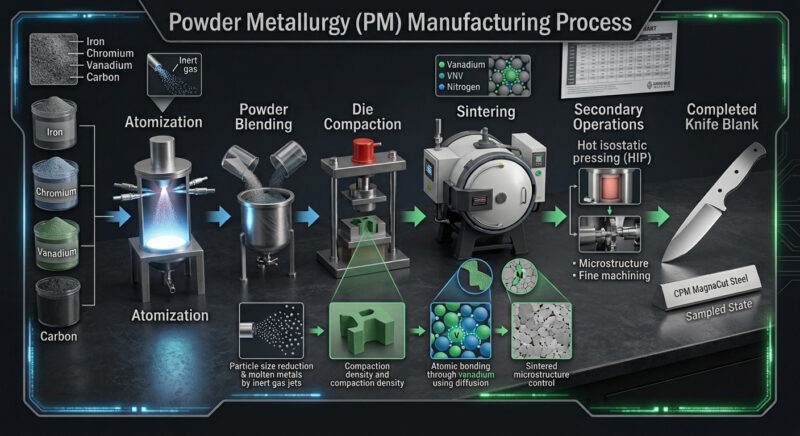
Instead of casting molten steel into large ingots, powder metallurgy atomizes the molten steel into microscopic particles. These particles are then compressed under extreme pressure and heat to create a uniform billet with a very fine microstructure.
Benefits of powder metallurgy include:
- Smaller carbides
- Improved toughness
- Better wear resistance
- More consistent heat treatment
- Enhanced edge stability
- Cleaner microstructure
Compared to conventionally produced steels such as 440C or AUS-8, powder metallurgy steels offer a noticeable improvement in cutting performance and durability.
Check Our Guide Powder Steels for Kitchen Knives
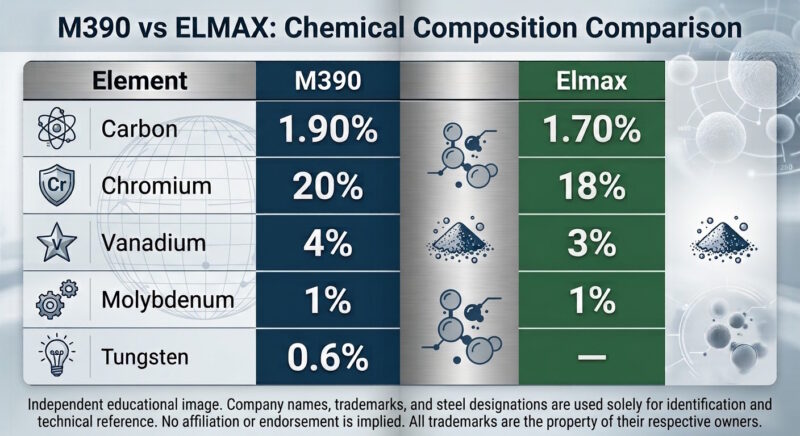
Chemical Composition Comparison
| Element | M390 | Elmax |
|---|---|---|
| Carbon | 1.90% | 1.70% |
| Chromium | 20.0% | 18.0% |
| Vanadium | 4.0% | 3.0% |
| Molybdenum | 1.0% | 1.0% |
| Tungsten | 0.6% | — |
| Silicon | 0.7% | 0.8% |
| Manganese | 0.3% | 0.3% |
Although the two steels appear similar, their subtle compositional differences significantly influence their performance.
M390 contains more carbon, chromium, and vanadium, giving it exceptional wear resistance and edge retention. Elmax, with a slightly lower carbide volume, sacrifices a small amount of wear resistance in exchange for greater toughness and easier sharpening.
Understanding the Alloy Elements
Carbon
Carbon is one of the most important elements in knife steel. It contributes to hardness, edge retention, and carbide formation.
M390
With approximately 1.90% carbon, M390 develops a very high volume of hard carbides. This contributes directly to its outstanding wear resistance and ability to hold a sharp edge for an extended period.
Elmax
Elmax contains approximately 1.70% carbon, still a very high level. While slightly lower than M390, it provides an excellent balance between hardness and toughness.
Chromium
Chromium is responsible for corrosion resistance and stainless performance.
M390
At around 20% chromium, M390 offers excellent protection against rust and staining. It performs exceptionally well in humid environments and requires minimal maintenance.
Elmax
Elmax contains about 18% chromium, also providing excellent corrosion resistance. While slightly lower than M390 on paper, the real-world difference is small for most users.
Vanadium
Vanadium forms extremely hard carbides that improve wear resistance and edge retention.
M390
Approximately 4% vanadium gives M390 exceptional cutting longevity, particularly during abrasive tasks such as cutting cardboard, rope, or synthetic materials.
Elmax
With approximately 3% vanadium, Elmax still delivers excellent edge retention while maintaining better toughness.
Molybdenum
Both steels contain about 1% molybdenum, improving:
- Corrosion resistance
- High-temperature stability
- Hardness
- Overall toughness
Tungsten
One unique aspect of M390 is the addition of tungsten.
Although present in a relatively small amount, tungsten contributes to wear resistance and helps stabilize the steel during heat treatment.
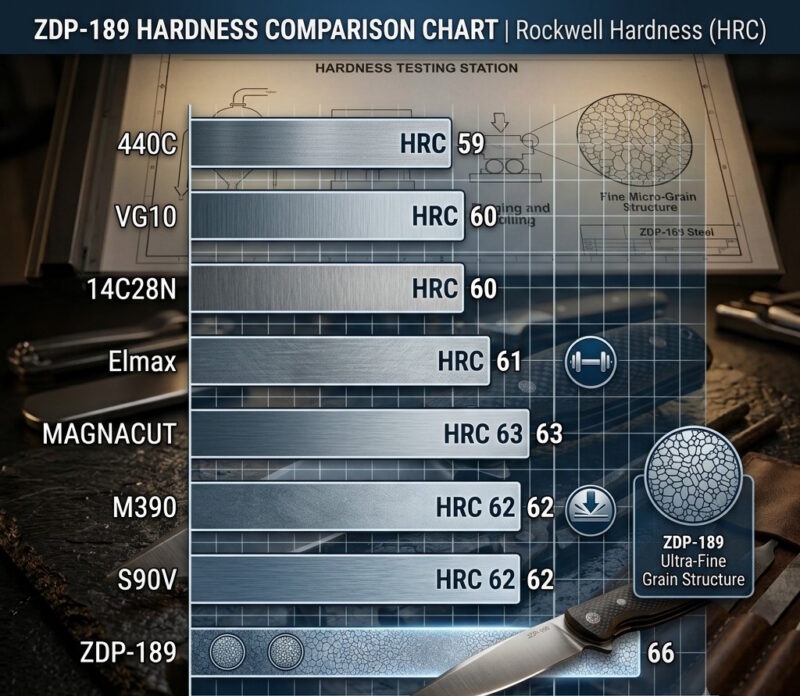
Hardness (HRC)
The hardness of a knife directly affects edge retention, cutting performance, and durability.
Typical production hardness:
| Steel | Typical HRC |
|---|---|
| M390 | 60–62 HRC |
| Elmax | 60–62 HRC |
Some custom makers push these steels even further.
Well-executed custom heat treatments may achieve:
- M390: 63–64 HRC
- Elmax: 62–63 HRC
Higher hardness generally improves edge retention, although excessive hardness can reduce toughness if not balanced with proper heat treatment.
Check Our Guide What Is HRC? Understanding Rockwell Hardness
Edge Retention
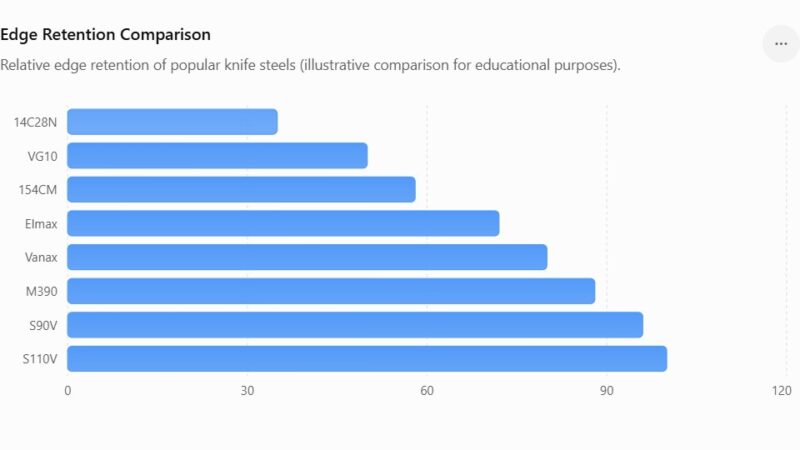
Edge retention measures how long a blade remains sharp during use before requiring resharpening.
This is one of M390’s strongest characteristics.
M390
Thanks to its high carbide content, M390 excels during prolonged cutting sessions.
Advantages include:
- Extremely long-lasting edge
- Excellent slicing performance
- Outstanding abrasion resistance
- Ideal for frequent cutting tasks
Users who regularly cut cardboard, rope, leather, or other abrasive materials often appreciate how infrequently M390 needs sharpening.
Elmax
Elmax also offers excellent edge retention.
Its lower carbide volume means it may require sharpening slightly sooner than M390 during extended abrasive cutting, but the difference is smaller than many people expect.
In everyday use, Elmax remains impressively sharp for a long time and provides very consistent cutting performance.
Winner: M390 (slight advantage)
Wear Resistance
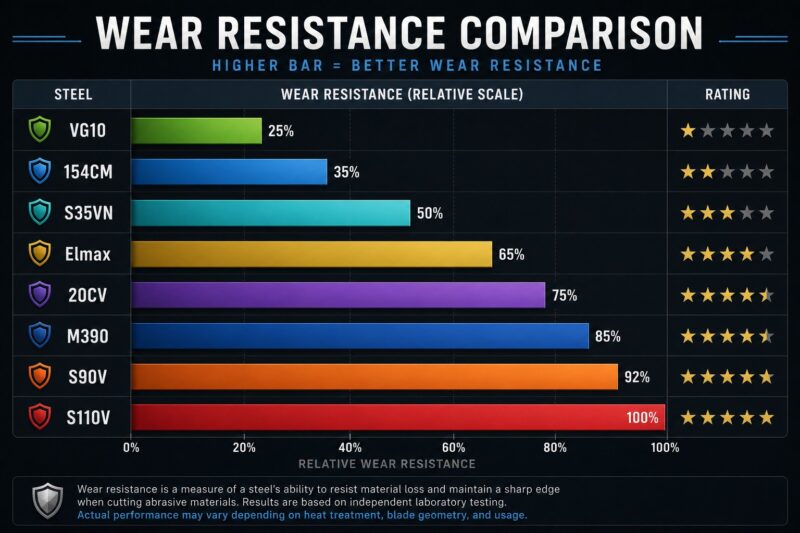
Wear resistance refers to the blade’s ability to resist abrasion from repeated cutting.
Common abrasive materials include:
- Cardboard
- Rope
- Plastic
- Leather
- Carpet
- Wood
M390
M390 is widely regarded as one of the highest wear-resistant stainless knife steels available.
Its dense network of vanadium and chromium carbides enables it to maintain cutting performance over extended use, even in demanding environments.
This makes M390 a favorite among users who prioritize maximum edge life.
Elmax
Elmax also performs extremely well but takes a more balanced approach.
Its wear resistance is excellent—far superior to many traditional stainless steels—but slightly below M390 due to its lower carbide volume.
For most everyday cutting tasks, however, the practical difference is relatively small.
Toughness
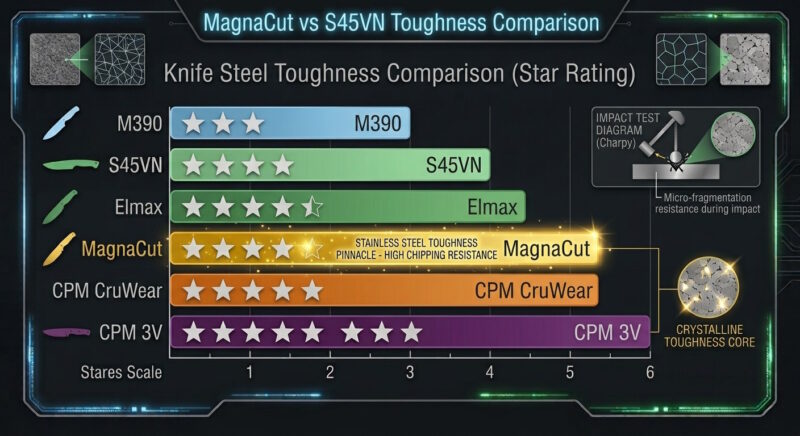
Toughness measures a steel’s ability to resist chipping, cracking, or breaking under impact or lateral stress.
This is one area where Elmax gains an advantage.
M390
M390 offers respectable toughness, especially considering its exceptional hardness and wear resistance.
However, its high carbide content means it is somewhat less forgiving under heavy impacts or twisting forces.
Proper edge geometry and heat treatment are especially important for maximizing M390’s toughness.
Elmax
Elmax was specifically engineered to provide greater toughness without sacrificing premium cutting performance.
Advantages include:
- Better resistance to chipping
- Improved impact strength
- More forgiving edge under hard use
- Excellent stability during demanding outdoor tasks
For bushcraft, hunting, and heavier cutting applications, Elmax’s additional toughness can be a meaningful advantage.
Winner: Elmax
Corrosion Resistance
Both steels belong to the premium stainless category and perform exceptionally well in humid or wet environments.
M390
With approximately 20% chromium, M390 offers outstanding resistance to rust, staining, and corrosion.
It performs exceptionally well for:
- Everyday carry
- Food preparation
- Humid climates
- Coastal environments
- Outdoor use
With normal care, corrosion is rarely a concern.
Elmax
Elmax also delivers excellent corrosion resistance thanks to its high chromium content and clean powder metallurgy structure.
Although M390 has a slight advantage in laboratory corrosion testing, most users will never notice a significant difference in everyday conditions.
Whether used in the kitchen, on a hunting trip, or as an EDC knife, Elmax resists rust extremely well when properly maintained.
Winner: M390 (slight advantage)
Performance Summary So Far
Both M390 and Elmax rank among the finest premium stainless knife steels available today, but they are optimized for slightly different priorities.
M390 stands out for its exceptional edge retention, wear resistance, and corrosion resistance, making it a favorite for everyday carry knives and users who want maximum cutting longevity with minimal maintenance.
Elmax, on the other hand, offers a more balanced performance profile. While giving up a small amount of wear resistance, it rewards users with greater toughness, easier sharpening, and outstanding reliability for hunting, bushcraft, and outdoor applications.
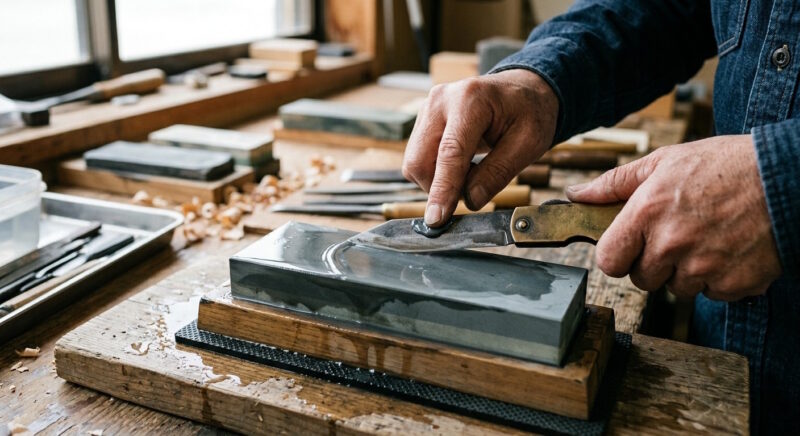
Sharpening: Which Steel Is Easier to Maintain?
No matter how long a knife stays sharp, every blade eventually needs maintenance. While M390 and Elmax are both premium powder metallurgy steels, they differ noticeably when it comes to sharpening.
M390’s outstanding wear resistance means it takes more time to sharpen, whereas Elmax offers a friendlier sharpening experience without sacrificing excellent cutting performance.
For many users, this difference becomes more important over years of ownership than laboratory wear tests.
Sharpening M390
M390 is famous for its exceptional edge retention, but that performance comes with a trade-off.
The steel contains a high volume of extremely hard vanadium and chromium carbides, which resist abrasion during cutting—and during sharpening.
Advantages
- Holds an edge for an exceptionally long time
- Produces a highly refined cutting edge
- Excellent polish
- Outstanding slicing performance
Challenges
- Requires more sharpening time
- Diamond or CBN stones are strongly recommended
- Harder for beginners to sharpen
Fortunately, because M390 stays sharp so long, sharpening sessions are relatively infrequent.
Sharpening Elmax
Elmax offers one of the best sharpening experiences among premium stainless steels.
Its lower carbide volume allows abrasives to remove steel more efficiently while still maintaining excellent edge retention.
Advantages
- Faster sharpening
- Easier burr formation
- Excellent edge refinement
- Responsive on quality water stones
- Less effort required than M390
For users who sharpen their own knives regularly, Elmax is noticeably more forgiving.
Sharpening Verdict
| Category | Winner |
|---|---|
| Beginner Friendly | Elmax |
| Sharpening Speed | Elmax |
| Edge Refinement | Tie |
| Long-Term Edge Holding | M390 |
If you prefer minimal sharpening, M390 is difficult to beat.
If you enjoy maintaining your knives yourself, Elmax offers a more pleasant experience.
Heat Treatment
Heat treatment has a tremendous impact on knife performance.
Two knives made from identical steel may perform very differently depending on how the manufacturer hardens and tempers the blade.
Always buy from reputable knife makers with proven heat-treatment protocols.
Check Our Guide Steel Heat Treatment Explained
M390 Heat Treatment
Typical production hardness:
60–62 HRC
Custom makers often reach:
63–64 HRC
Well-executed heat treatment provides:
- Outstanding wear resistance
- Excellent edge stability
- High hardness
- Very good corrosion resistance
Premium manufacturers such as Benchmade, LionSteel, Reate, and WE Knife are known for producing excellent M390 blades.
Elmax Heat Treatment
Typical production hardness:
60–62 HRC
Custom makers commonly harden Elmax to:
61–63 HRC
Proper heat treatment emphasizes:
- Excellent toughness
- High edge stability
- Consistent grain structure
- Reliable cutting performance
Because Elmax is slightly more forgiving than M390, manufacturers often achieve excellent results across a wide range of blade styles.
Real-World Performance
Laboratory tests tell only part of the story.
Most buyers care about how a knife performs during everyday use.
Let’s compare both steels across common applications.
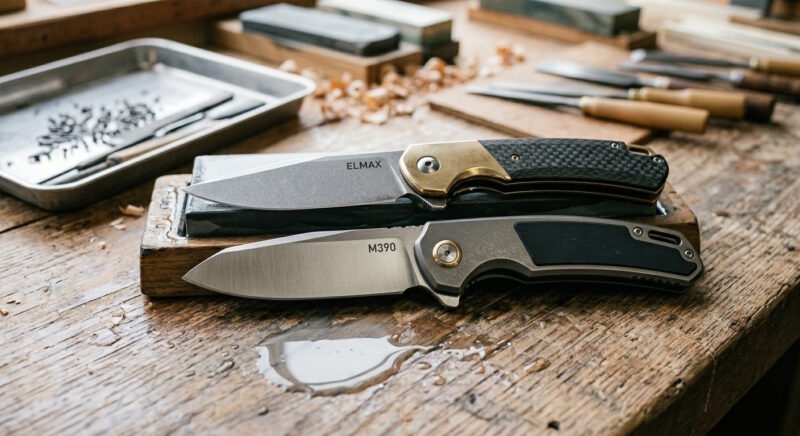
Everyday Carry (EDC)
EDC knives typically cut:
- Cardboard
- Rope
- Plastic
- Packaging
- Tape
- Food
- Leather
M390
M390 excels in everyday carry because of its incredible edge retention.
Advantages include:
- Rarely needs sharpening
- Outstanding slicing ability
- Excellent corrosion resistance
- Premium edge stability
Users who open dozens of packages every day often appreciate M390’s ability to stay sharp for weeks or even months.
Elmax
Elmax performs equally well for most EDC users.
Advantages include:
- Excellent cutting performance
- Better toughness
- Easier maintenance
- Comfortable sharpening
Unless you frequently cut abrasive materials, you may never notice a significant difference in edge retention.
Winner: M390 (slight)
Hunting
Field dressing game demands:
- Long-lasting sharpness
- Toughness
- Corrosion resistance
- Easy cleanup
M390
Excellent for:
- Skinning
- Caping
- Meat processing
- Fine slicing
The edge lasts remarkably long throughout processing.
Elmax
Elmax shines because of its increased toughness.
Advantages include:
- Better resistance to accidental edge damage
- Excellent stain resistance
- Reliable performance in cold weather
- Outstanding balance
Many custom hunting knives are made from Elmax for precisely these reasons.
Winner: Elmax (slight)
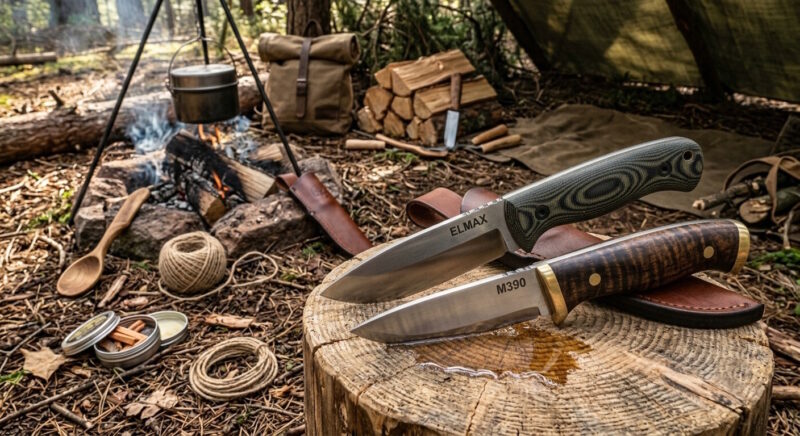
Bushcraft & Survival
Bushcraft places heavy stress on a knife.
Tasks include:
- Feather sticks
- Carving
- Fire preparation
- Food processing
- Camp chores
M390
Although capable, M390 is optimized more for slicing than repeated impact.
Its higher carbide volume means users should avoid abusive batoning or prying.
Elmax
Elmax performs exceptionally well in demanding outdoor conditions.
Advantages:
- Better impact resistance
- Higher toughness
- Stable edge during carving
- Lower risk of chipping
Winner: Elmax
Check Our Guide Best Hunting Knife Features Explained
Kitchen Use
Both steels are excellent choices for premium kitchen knives.
M390
Benefits:
- Extremely long-lasting edge
- Excellent corrosion resistance
- Minimal maintenance
- Outstanding slicing
Perfect for:
- Professional chefs
- Serious home cooks
- High-volume food preparation
Elmax
Benefits:
- Easier sharpening
- Excellent stain resistance
- Fine cutting feel
- Outstanding balance
Many custom chef knives use Elmax because of its combination of toughness and ease of maintenance.
Winner: Tie
Corrosive Environments
If you live near the ocean or work in humid conditions, corrosion resistance becomes increasingly important.
M390
Advantages:
- Outstanding stainless properties
- Excellent rust resistance
- Performs well around food and moisture
Elmax
Also offers exceptional corrosion resistance.
While slightly behind M390 in laboratory testing, the difference is minimal in real-world use.
Most owners will never experience corrosion issues if they clean and dry the knife after use.
Winner: M390 (slight)
Side-by-Side Comparison Table
| Property | M390 | Elmax | Winner |
|---|---|---|---|
| Hardness | ⭐⭐⭐⭐⭐ | ⭐⭐⭐⭐☆ | M390 |
| Edge Retention | ⭐⭐⭐⭐⭐ | ⭐⭐⭐⭐☆ | M390 |
| Wear Resistance | ⭐⭐⭐⭐⭐ | ⭐⭐⭐⭐☆ | M390 |
| Toughness | ⭐⭐⭐☆ | ⭐⭐⭐⭐⭐ | Elmax |
| Corrosion Resistance | ⭐⭐⭐⭐⭐ | ⭐⭐⭐⭐☆ | M390 |
| Sharpening Ease | ⭐⭐⭐☆ | ⭐⭐⭐⭐⭐ | Elmax |
| EDC | ⭐⭐⭐⭐⭐ | ⭐⭐⭐⭐☆ | M390 |
| Hunting | ⭐⭐⭐⭐☆ | ⭐⭐⭐⭐⭐ | Elmax |
| Bushcraft | ⭐⭐⭐☆ | ⭐⭐⭐⭐⭐ | Elmax |
| Kitchen | ⭐⭐⭐⭐⭐ | ⭐⭐⭐⭐⭐ | Tie |
Advantages of M390
Pros
- Outstanding edge retention
- Exceptional wear resistance
- Excellent corrosion resistance
- Premium slicing performance
- High hardness potential
- Ideal for EDC
- Holds a polished edge extremely well
Advantages of Elmax
Pros
- Excellent toughness
- Easier sharpening
- Outstanding all-around performance
- Excellent corrosion resistance
- Reliable heat treatment
- Great for outdoor use
- Better resistance to chipping
Disadvantages of M390
Cons
- More difficult to sharpen
- Less forgiving under heavy impacts
- Premium price
- Not ideal for abusive tasks
Disadvantages of Elmax
Cons
- Slightly lower edge retention
- Slightly lower wear resistance
- Fewer production knives compared to M390
- Often overlooked despite excellent performance
Which Steel Should You Choose?
Choose M390 if:
- You want maximum edge retention.
- You primarily carry an EDC folding knife.
- You dislike frequent sharpening.
- You cut abrasive materials regularly.
- Corrosion resistance is important.
Choose Elmax if:
- You hunt regularly.
- You enjoy bushcraft and camping.
- You prefer easier sharpening.
- You value toughness over maximum wear resistance.
- You want a well-balanced all-purpose steel.
Frequently Asked Questions
Is M390 better than Elmax?
Not universally. M390 offers better edge retention, wear resistance, and corrosion resistance, while Elmax provides greater toughness and is easier to sharpen.
Which steel stays sharp longer?
M390 generally maintains a sharp edge longer during abrasive cutting thanks to its higher carbide content.
Which steel is tougher?
Elmax is tougher and more resistant to chipping during heavy-duty use.
Which steel is easier to sharpen?
Elmax sharpens faster and is more forgiving for most users.
Which steel is better for EDC?
M390 has a slight advantage for everyday carry because of its exceptional edge retention.
Which steel is better for hunting?
Elmax is often preferred for hunting due to its toughness, excellent corrosion resistance, and dependable field performance.
M390 vs Elmax – At a Glance
| Category | Winner |
|---|---|
| Hardness | 🏆 M390 |
| Edge Retention | 🏆 M390 |
| Wear Resistance | 🏆 M390 |
| Toughness | 🏆 Elmax |
| Sharpening | 🏆 Elmax |
| Hunting | 🏆 Elmax |
| Bushcraft | 🏆 Elmax |
| EDC | 🏆 M390 |
| Kitchen | 🤝 Tie |
Final Verdict: M390 vs Elmax
M390 and Elmax are both exceptional premium stainless knife steels, but they are designed with different priorities in mind.
M390 is the ideal choice for users who prioritize maximum edge retention, superior wear resistance, and excellent corrosion resistance. It excels in everyday carry folders, premium production knives, and situations where long intervals between sharpening are highly valued. If your cutting tasks frequently involve abrasive materials such as cardboard, rope, or synthetic fibers, M390 is one of the best stainless steels available.
Elmax, on the other hand, offers a more balanced performance profile. While it gives up a small amount of wear resistance compared to M390, it rewards users with greater toughness, easier sharpening, and improved resistance to chipping during demanding outdoor tasks. These qualities make it an excellent choice for hunting knives, bushcraft blades, survival knives, and versatile fixed blades.
For most EDC enthusiasts, M390 remains the preferred option because of its outstanding cutting longevity.
For hunters, campers, and outdoor users, Elmax is often the more practical choice thanks to its excellent toughness and easier maintenance.
Ultimately, neither steel is objectively better in every situation. Both represent the highest tier of powder metallurgy stainless steels, and either will deliver years of exceptional performance when paired with quality heat treatment and thoughtful knife design.
This article is for independent informational purposes only and is not affiliated with, sponsored by, or endorsed by any steel manufacturer. All product names, trademarks, and registered trademarks are the property of their respective owners.