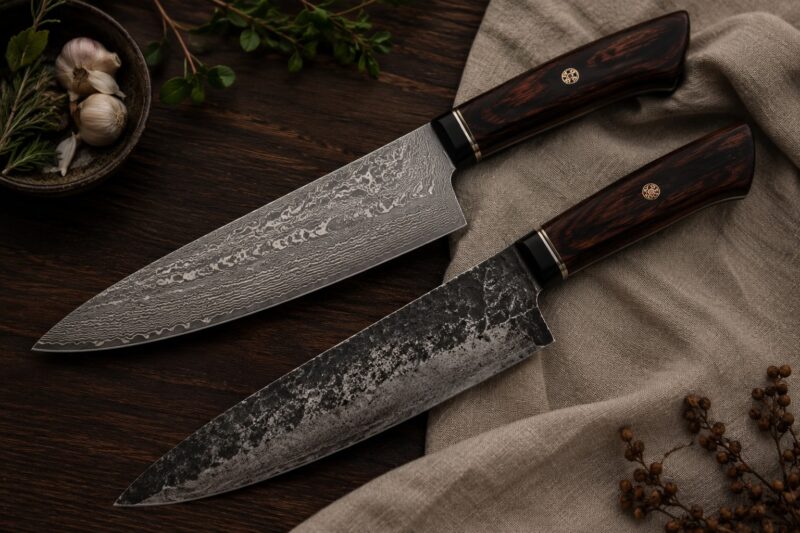
Carbon Steel vs Damascus Steel
An Independent Guide
When shopping for a handmade knife, one of the most common questions buyers ask is:
“Should I choose carbon steel or Damascus steel?”
The answer isn’t as straightforward as many online articles make it seem.
In fact, one of the biggest misconceptions in the knife industry is that carbon steel and Damascus steel are direct competitors. They are not.
Carbon steel is a steel category. Damascus steel is a construction method or blade style. A Damascus knife may actually contain carbon steel, stainless steel, or a combination of both.
This misunderstanding has led to countless myths, marketing claims, and buyer confusion.
In this complete guide, we’ll break down the real differences between carbon steel and Damascus steel, compare their performance, maintenance, durability, sharpening characteristics, appearance, and long-term value, and help you decide which type of knife is right for your kitchen, collection, or everyday use.
Whether you’re a professional chef, outdoor enthusiast, collector, or simply searching for a beautiful handmade knife from Yashka Designs, understanding these differences can save you money and help you make a better purchase.
Understanding Carbon Steel
Carbon steel is one of the oldest and most respected blade materials in history.
At its core, carbon steel is simply steel containing a relatively high percentage of carbon and little chromium compared to stainless steel.
Popular carbon steels include:
- 1095
- 52100
- O1
- White Steel (Shirogami)
- Blue Steel (Aogami)
- W2
- 80CrV2
For centuries, blacksmiths used carbon steel because it offers an excellent balance of:
- Hardness
- Toughness
- Sharpenability
- Cutting performance
Many traditional Japanese knives, custom chef knives, hunting knives, and artisan blades are still made from carbon steel today.
Why Knife Makers Love Carbon Steel
Carbon steel is often described as a “pure cutting steel.”
Because it contains fewer alloying elements than many modern steels, it can take an exceptionally fine edge.
Many knife makers prefer carbon steel because:
- It sharpens easily.
- It develops an incredibly keen edge.
- It provides excellent feedback during sharpening.
- It performs exceptionally well in slicing applications.
For knife enthusiasts, few experiences compare to using a properly sharpened carbon steel blade.
Understanding Damascus Steel
Damascus steel is often misunderstood.
Many buyers assume Damascus is a special steel formula. Historically, true Damascus steel referred to ancient crucible steel produced in the Middle East.
Modern Damascus knives are different.
Today’s Damascus knives are usually made by forging together multiple layers of different steels.
The blade is folded, forged, welded, and etched to reveal beautiful patterns.
Common Damascus patterns include:
- Raindrop
- Twist
- Ladder
- Feather
- Random pattern
- Rose pattern
The result is a blade with distinctive flowing lines that resemble water, wood grain, or waves.
What Makes Damascus Special?
The primary appeal of Damascus steel is visual.
Every Damascus blade develops a unique pattern.
No two blades are exactly alike.
This uniqueness has made Damascus one of the most popular materials for:
- Premium chef knives
- Luxury gifts
- Collector knives
- Custom artisan blades
A Damascus knife often combines performance and artistry in a single piece.
Carbon Steel vs Damascus Steel: The Biggest Myth
The biggest myth is that Damascus automatically performs better than carbon steel.
This is simply not true.
Performance depends on the steel used inside the Damascus construction.
For example:
A Damascus blade with a VG10 core performs mostly like VG10.
A Damascus blade with a 1095 core performs mostly like 1095.
A Damascus blade with a White Steel core performs mostly like White Steel.
The visible pattern itself does not make the knife sharper.
The pattern does not improve edge retention.
The pattern does not automatically increase toughness.
The core steel determines most cutting characteristics.
This is perhaps the most important thing knife buyers should understand.
Appearance Comparison
If appearance is your top priority, Damascus steel usually wins.
Carbon Steel Appearance
Carbon steel offers a more traditional look.
Characteristics include:
- Clean steel surface
- Satin finish
- Stonewashed finish
- Forge scale finish
- Natural patina development
Many enthusiasts appreciate the understated beauty of carbon steel.
Over time, carbon steel develops a unique patina that reflects its history of use.
Damascus Appearance
Damascus is visually dramatic.
Characteristics include:
- Flowing layered patterns
- High contrast etching
- Luxury appearance
- Artisan craftsmanship
A Damascus knife often becomes a conversation piece.
For gifts, Damascus usually creates a stronger first impression.
Appearance Winner
If beauty alone is the goal:
Damascus Steel Wins.
If traditional craftsmanship and character matter more:
Carbon Steel Wins.
The choice depends entirely on personal preference.
Sharpness Comparison
Sharpness is where things become interesting.
Many buyers assume Damascus is automatically sharper because it is more expensive.
This is false.
Sharpness depends on:
- Core steel
- Heat treatment
- Blade geometry
- Sharpening quality
Carbon Steel Sharpness
Carbon steel excels here.
Benefits include:
- Extremely fine edge
- Razor-like sharpening potential
- Excellent edge refinement
Many professional chefs consider high-carbon steels among the sharpest blade materials available.
Damascus Sharpness
Damascus sharpness depends on the core steel.
If the core is excellent, the knife can be extremely sharp.
If the core steel is mediocre, the knife may not outperform a basic carbon steel blade.
Sharpness Winner
In pure cutting performance:
Carbon Steel usually wins.
Especially when comparing premium carbon steels to decorative Damascus constructions.
Edge Retention Comparison
Edge retention refers to how long a knife stays sharp.
Carbon Steel Edge Retention
Carbon steels generally provide:
- Excellent initial sharpness
- Good edge stability
- Easy touch-up sharpening
However, some simple carbon steels may lose their razor edge sooner than advanced alloy steels.
Damascus Edge Retention
Again, edge retention depends on the core steel.
A Damascus blade with VG10 may outperform a basic 1095 blade.
A Damascus blade with White Steel may perform similarly to other high-carbon knives.
Edge Retention Winner
No universal winner exists.
The core steel matters more than the Damascus pattern.
This is why buyers should always ask:
“What steel is the core made from?”
Rather than focusing solely on the Damascus label.
Maintenance Comparison
Maintenance is one area where buyers often notice major differences.
Carbon Steel Maintenance
Carbon steel requires:
- Immediate drying after washing
- Protection from long-term moisture
- Occasional oiling during storage
Patina formation is normal.
Rust formation is preventable with basic care.
Damascus Maintenance
Maintenance depends on steel composition.
Carbon Damascus requires similar care to carbon steel.
Stainless Damascus requires less maintenance.
Many buyers mistakenly assume Damascus means stainless.
This is not always true.
Always verify the steel composition before purchasing.
The Ultimate Guide to Caring for a Damascus Steel Knife
Durability Comparison
Durability includes toughness, resistance to chipping, and long-term reliability.
Carbon Steel Durability
Carbon steel is known for:
- Excellent toughness
- High reliability
- Predictable performance
This makes it popular among outdoorsmen and professional users.
Damascus Durability
Durability depends heavily on:
- Construction quality
- Forge welding quality
- Core steel selection
A well-made Damascus knife can be extremely durable.
A poorly made Damascus knife can experience issues.
Quality craftsmanship matters enormously.
Rust Resistance Comparison
One of the biggest factors influencing a knife purchase is corrosion resistance.
Many buyers assume Damascus steel is automatically rust-proof, while carbon steel rusts instantly. Neither statement is accurate.
Carbon Steel Rust Resistance
Carbon steel contains relatively little chromium, which means it is more reactive to moisture, oxygen, and acidic foods.
This does not mean carbon steel is a poor material. It simply means it requires basic care.
With proper maintenance:
- Wash after use
- Dry immediately
- Avoid prolonged moisture exposure
- Apply light oil for long-term storage
A carbon steel knife can easily last decades.
In fact, many carbon steel knives made over 50 years ago remain in daily use today.
Damascus Steel Rust Resistance
The answer depends entirely on the steels used in the Damascus construction.
Carbon Damascus
If the Damascus layers are made from carbon steels:
- Patina will develop
- Rust can form if neglected
- Maintenance is similar to carbon steel
Stainless Damascus
If the Damascus layers contain stainless steels:
- Corrosion resistance is much higher
- Maintenance requirements are reduced
- Patina formation is minimal
This is why buyers should never assume Damascus equals stainless.
Rust Resistance Winner
For pure corrosion resistance:
- Stainless Damascus
- Stainless Steel
- Carbon Damascus
- Carbon Steel
However, many knife enthusiasts willingly accept the extra care required by carbon steel because of its exceptional cutting performance.
Sharpening Comparison
Sharpening is where carbon steel truly shines.
Professional sharpeners often prefer carbon steel because it provides outstanding feedback and predictable results.
Carbon Steel Sharpening
Advantages include:
- Fast burr formation
- Excellent stone feedback
- Easier angle control
- Faster sharpening sessions
Even beginners often find carbon steel easier to sharpen than highly alloyed steels.
A properly heat-treated carbon steel knife can achieve a razor edge with relatively little effort.
Damascus Sharpening
Again, the core steel determines performance.
A Damascus knife with:
- VG10 core
- SG2 core
- White Steel core
- Blue Steel core
will sharpen according to the properties of that core.
The Damascus layers themselves contribute very little to sharpening behavior.
Sharpening Winner
For most users:
Carbon Steel Wins
Especially for those who enjoy maintaining their own knives.
How to Keep a Damascus Kitchen Knife Sharp
Carbon Steel vs Damascus for Professional Chefs
Professional kitchens demand performance.
A knife may be used for:
- 8 to 12 hours per day
- Hundreds of cuts
- Constant food preparation
Under these conditions, performance matters more than appearance.
Why Many Chefs Choose Carbon Steel
Professional chefs often value:
- Sharpness
- Ease of maintenance
- Fast touch-up sharpening
- Predictable cutting performance
Carbon steel delivers all of these characteristics.
Many traditional Japanese sushi chefs still use high-carbon steel knives because they provide extraordinary cutting precision.
Why Some Chefs Choose Damascus
Damascus remains popular among chefs because it combines:
- Strong performance
- Beautiful appearance
- Professional presentation
In open kitchens where customers can see the chef working, a Damascus knife can enhance the overall dining experience.
Best Choice for Professionals
For pure performance:
Carbon Steel
For performance plus aesthetics:
Damascus
Carbon Steel vs Damascus for Collectors
Collectors often evaluate knives differently than working chefs.
Performance matters, but so do:
- Rarity
- Visual appeal
- Craftsmanship
- Storytelling
Carbon Steel Collectibility
Collectors appreciate:
- Traditional forging techniques
- Historical authenticity
- Patina development
- Handmade craftsmanship
A carbon steel knife develops personality over time.
No two blades age exactly alike.
Damascus Collectibility
Damascus often dominates collector markets because:
- Every pattern is unique
- Visual impact is immediate
- Craftsmanship is highly visible
- Display value is exceptional
A premium Damascus knife frequently becomes the centerpiece of a collection.
Collector Winner
For visual appeal:
Damascus
For traditional authenticity:
Carbon Steel
Carbon Steel vs Damascus for Gift Buyers
Many customers purchasing from artisan knife makers are buying gifts.
Common occasions include:
- Birthdays
- Father’s Day
- Christmas
- Retirement gifts
- Anniversary gifts
- Wedding gifts
Carbon Steel as a Gift
Carbon steel appeals to recipients who:
- Understand knives
- Appreciate craftsmanship
- Enjoy traditional tools
However, some gift recipients may not understand maintenance requirements.
Damascus as a Gift
Damascus often creates a stronger first impression because:
- The pattern is visually striking
- It looks expensive
- It appears luxurious
- It photographs beautifully
For gift purchases, Damascus frequently wins.
Gift Winner
Damascus Steel
Performance Comparison Table
| Category | Carbon Steel | Damascus Steel |
|---|---|---|
| Sharpness | ⭐⭐⭐⭐⭐ | ⭐⭐⭐⭐ |
| Sharpening Ease | ⭐⭐⭐⭐⭐ | ⭐⭐⭐ |
| Rust Resistance | ⭐⭐ | ⭐⭐⭐ |
| Aesthetics | ⭐⭐⭐ | ⭐⭐⭐⭐⭐ |
| Collectibility | ⭐⭐⭐⭐ | ⭐⭐⭐⭐⭐ |
| Traditional Craftsmanship | ⭐⭐⭐⭐⭐ | ⭐⭐⭐⭐ |
| Gift Appeal | ⭐⭐⭐ | ⭐⭐⭐⭐⭐ |
| Value for Money | ⭐⭐⭐⭐⭐ | ⭐⭐⭐⭐ |
Value for Money Analysis
One question buyers frequently ask is:
“Is Damascus worth the extra money?”
The answer depends on what you value.
If Performance Is Your Priority
Carbon steel often provides better value.
You are paying for:
- Cutting ability
- Sharpening performance
- Functional excellence
Rather than decorative appearance.
If Beauty Is Your Priority
Damascus often justifies its higher price.
You are paying for:
- Additional forging work
- Pattern creation
- Visual uniqueness
- Artistic craftsmanship
Both can be excellent values when purchased from a reputable maker.
Common Buyer Mistakes
Mistake #1: Assuming Damascus Is a Steel Type
Damascus is usually a blade construction method.
Always ask about the core steel.
Mistake #2: Assuming Damascus Is Better
Damascus is not automatically superior.
A high-quality carbon steel knife may outperform many Damascus knives.
Mistake #3: Ignoring Heat Treatment
Heat treatment often matters more than steel type.
A properly heat-treated blade can outperform a poorly treated premium steel.
Mistake #4: Buying Based Only on Appearance
Beautiful knives should still perform well.
Always evaluate both aesthetics and functionality.
Which One Should You Choose?
Choose Carbon Steel if you want:
✓ Maximum sharpness
✓ Easy sharpening
✓ Traditional craftsmanship
✓ Professional cutting performance
✓ Excellent value
✓ A knife that develops character through use
Choose Damascus Steel if you want:
✓ Unique patterns
✓ Luxury appearance
✓ Premium gift value
✓ Collectible craftsmanship
✓ Performance combined with artistry
✓ A visually striking centerpiece knife
Why Handmade Knives Matter More Than Steel Alone
One of the biggest lessons experienced knife buyers learn is this:
The maker matters as much as the steel.
A skilled artisan can transform ordinary steel into an exceptional knife through:
- Proper heat treatment
- Precise grinding
- Excellent geometry
- Attention to detail
Conversely, even premium steel can perform poorly if craftsmanship is lacking.
When purchasing a handmade knife from an experienced maker, you’re investing not only in steel but also in knowledge, skill, and craftsmanship.
This is particularly true for custom and handmade knives where every step of the process directly affects performance.

Final Verdict
The debate between carbon steel and Damascus steel often starts with the wrong question.
It should not be:
“Which is better?”
It should be:
“Which is better for my needs?”
Carbon steel remains the champion of pure cutting performance.
It offers:
- Incredible sharpness
- Easy sharpening
- Traditional craftsmanship
- Outstanding value
Damascus steel remains the champion of visual artistry.
It offers:
- Unique patterns
- Luxury aesthetics
- Exceptional gift appeal
- Collectible value
For many knife enthusiasts, the perfect collection includes both.
A carbon steel knife for everyday performance.
A Damascus knife for beauty, pride of ownership, and special occasions.
At Yashka Designs, understanding these differences helps buyers choose a knife that fits not only their cutting tasks but also their appreciation for craftsmanship, artistry, and the timeless tradition of handmade blades.
Quick Q&A
Is Damascus steel stronger than carbon steel?
Not necessarily. Strength depends primarily on the core steel and heat treatment.
Is Damascus steel sharper than carbon steel?
Usually no. Carbon steel often achieves a finer edge.
Does Damascus steel rust?
Some Damascus knives can rust if they contain carbon steel layers.
Why is Damascus steel more expensive?
The layered forging process requires additional labor and craftsmanship.
Which steel do professional chefs prefer?
Many professional chefs prefer carbon steel for its cutting performance.
Which steel is best for gifts?
Damascus steel is usually the most popular gift option because of its appearance.
Which steel lasts longer?
Both can last a lifetime when properly maintained.
Is carbon steel worth the extra maintenance?
Most enthusiasts believe the performance benefits easily justify the additional care.
FAQ
What is the difference between carbon steel and Damascus steel?
Carbon steel is a steel category focused on performance, while Damascus steel is typically a layered blade construction known for its distinctive patterns.
Which is better, carbon steel or Damascus steel?
Neither is universally better. Carbon steel excels in sharpness and sharpening ease, while Damascus steel excels in aesthetics and collectibility.
Is Damascus steel just for looks?
No. High-quality Damascus knives can perform exceptionally well, but the core steel determines most cutting performance.
Do carbon steel knives stay sharp longer?
Carbon steel often maintains a very keen edge and is easier to resharpen, though edge retention depends on the specific steel and heat treatment.
Are Damascus knives worth the money?
For buyers who appreciate craftsmanship, unique patterns, and artisan workmanship, Damascus knives can provide excellent value.
Carbon Steel vs Damascus Steel
https://yashkadesigns.com/utilitypetty-knives
https://yashkadesigns.ecrater.com/c/2444216/santoku-knives
This article is for independent informational purposes only and is not affiliated with, sponsored by, or endorsed by any steel manufacturer. All product names, trademarks, and registered trademarks are the property of their respective owners.