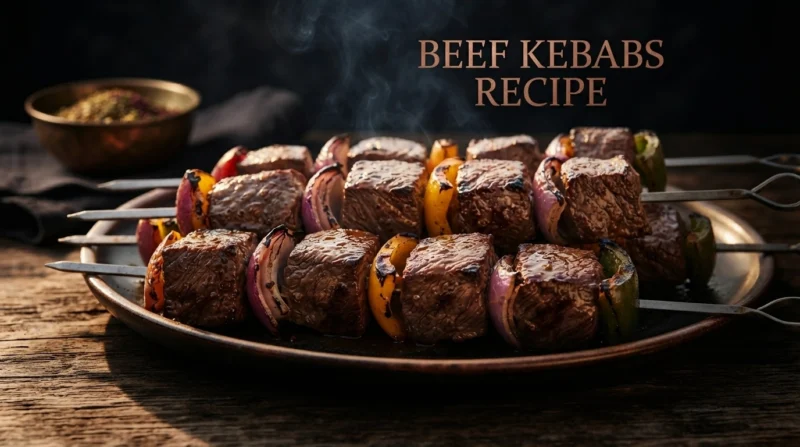
Classic Beef Kebabs
Few grilled dishes are as satisfying as classic beef kebabs. Small pieces of well-seasoned beef, threaded onto skewers with colorful vegetables, exposed to high heat, and cooked until beautifully browned on the outside while remaining juicy inside—that combination is difficult to beat.
The good news is that excellent beef kebabs do not require complicated ingredients or advanced culinary skills. What matters most is understanding a few basic principles: choosing the right beef, cutting it correctly, seasoning it without overwhelming the meat, preparing the vegetables so everything cooks properly, and controlling the heat.
This recipe is designed for home cooks, including complete beginners. You will learn not only how to make beef kebabs, but also why each step matters, how to recognize when the meat is ready, what commonly goes wrong, and how to fix it.
The recipe uses a simple Mediterranean-style combination of beef, onion, bell pepper, garlic, olive oil, lemon, and herbs. The marinade adds flavor without hiding the natural taste of the beef.
What Makes a Great Beef Kebab?
Before we start cooking, it helps to understand what we are trying to achieve.
A good beef kebab should have several things happening at the same time:
- The beef should be browned and slightly charred on the outside.
- The center should remain juicy and tender.
- The vegetables should be cooked but not completely collapsed.
- The seasoning should complement the beef rather than dominate it.
- The pieces should be cut into relatively uniform sizes so they finish cooking together.
- The outside should develop grilled flavor without becoming burnt.
- The meat should remain moist after resting.
The biggest mistake beginners make is thinking that kebabs are simply chunks of meat placed on skewers and grilled.
They are not.
Kebabs are a small cooking system. Every component affects the others.
If the beef pieces are too small, they dry out before they brown properly. If they are too large, the outside may burn before the center is cooked. If the vegetables are cut too thick, the meat can be ready while the vegetables are still hard. If the heat is too low, the meat may steam instead of developing a good crust.
Once you understand these relationships, making excellent kebabs becomes much easier.
Classic Beef Kebabs Recipe at a Glance
Prep time: 30 minutes
Marinating time: 1–4 hours
Cook time: approximately 8–12 minutes
Resting time: 5 minutes
Total active cooking time: about 45 minutes
Servings: 4
Ingredients
For the beef
- 2 lb (900 g) beef sirloin, top sirloin, or another tender grilling cut
- 3 tablespoons olive oil
- 2 tablespoons fresh lemon juice
- 3 garlic cloves, finely minced
- 1 teaspoon paprika
- 1 teaspoon dried oregano
- 1 teaspoon kosher salt
- ½ teaspoon freshly ground black pepper
- ½ teaspoon ground cumin
- ¼ teaspoon red pepper flakes, optional
For the vegetables
- 1 large red bell pepper
- 1 large yellow or green bell pepper
- 1 large red or yellow onion
- 1–2 tablespoons olive oil
- A small pinch of salt
- Fresh parsley, optional, for serving
For the skewers
- Metal skewers, or wooden/bamboo skewers
If using wooden skewers, soak them in water for at least 30 minutes before grilling.
Check Our Guide Best Steak and Beef Recipes: 15 Easy & Delicious Beef Recipes
Choosing the Right Beef for Kebabs
The beef you choose has a major effect on the final result.
For kebabs, you want meat that is:
- Tender enough to cook quickly.
- Flavorful enough to stand up to grilling.
- Capable of staying juicy when cut into relatively small pieces.
Sirloin
Sirloin is one of the easiest choices for home kebabs.
It has good beef flavor, moderate fat, and enough tenderness for quick grilling. It is also widely available and usually less expensive than premium steaks.
For beginners, sirloin is an excellent balance between quality and price.
Top Sirloin
Top sirloin is particularly useful because it is relatively lean but still tender enough for grilling.
Trim away any large pieces of tough connective tissue before cutting the beef.
Ribeye
Ribeye produces exceptionally flavorful kebabs because of its marbling.
The downside is that it can be relatively expensive, and the additional fat can cause flare-ups on a very hot grill.
If you use ribeye, trim away extremely large pieces of exterior fat but leave the internal marbling.
Tenderloin
Tenderloin will give you very tender kebabs, but it is usually unnecessary.
Tenderloin is expensive and relatively lean. Because kebabs are cooked quickly over high heat, a less expensive tender cut can produce an equally satisfying result.
What about tougher beef?
Some cuts that are excellent for slow cooking are not ideal for classic quick-cooked kebabs.
Chuck, brisket, and other cuts containing substantial connective tissue generally benefit from long, slow cooking.
Simply cutting them into cubes and grilling them quickly will not magically make them tender.
For classic beef kebabs, choose a tender grilling cut.
How to Cut the Beef for Kebabs
This is one of the most important steps.
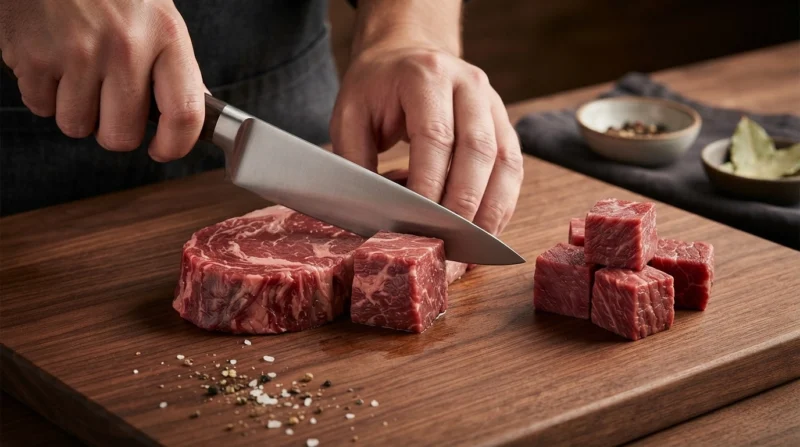
Cut the beef into pieces approximately 1½ inches (3.5–4 cm) across.
Try to keep the pieces reasonably uniform.
They do not need to be mathematically identical. They simply need to be similar enough that they cook at approximately the same rate.
Why size matters
Imagine putting a tiny cube and a large cube of beef on the same skewer.
The small cube may already be well done by the time the large cube reaches the same internal temperature.
That creates a frustrating situation where some pieces are juicy while others are dry.
Uniformity solves much of this problem.
Trim first, cut second
Place the beef on a clean cutting board.
Look for:
- large pieces of surface fat
- tough connective tissue
- silverskin
- very thin edges that may burn quickly
Remove tough connective tissue with a sharp knife.
A sharp knife is especially helpful here because it allows you to make clean cuts without repeatedly sawing through the meat.
Cut the beef into strips first if that makes the grain easier to identify.
Then cut across those strips to create cubes.
Check Our Ultimate American BBQ Meat Guide: How to Cut Chicken, Steak & Ribs + 8 Easy BBQ Recipes
Why Cutting Against the Grain Matters
Muscle fibers run through meat in a particular direction, commonly called the grain.
When possible, cut across those fibers rather than parallel to them.
Why?
Because a bite taken across shorter muscle fibers is easier to chew than one containing long, intact fibers.
This is particularly useful for grilled beef.
You do not need to obsess over this with every cube, but when the grain is obvious, take advantage of it.
The Marinade
A good beef kebab marinade does not need twenty ingredients.
In fact, keeping it relatively simple often produces a better result.
This marinade combines:
- olive oil
- lemon juice
- garlic
- paprika
- oregano
- cumin
- black pepper
- salt
Each ingredient has a job.
Olive oil
Olive oil helps distribute the seasonings over the meat and contributes richness.
It also helps herbs and spices adhere to the beef.
Lemon juice
Lemon adds acidity and brightness.
However, more lemon juice is not necessarily better.
A very acidic marinade left on meat for a very long time can affect the texture of the outer surface.
For this reason, a few tablespoons are enough.
Garlic
Garlic gives the kebabs a savory aromatic character.
Fresh garlic is preferable here because it provides a much more pronounced aroma than garlic powder.
Paprika
Paprika contributes mild sweetness, color, and a warm grilled flavor.
Oregano
Oregano gives the marinade a Mediterranean character.
Cumin
Cumin should be used carefully.
A small amount adds warmth and depth.
Too much can dominate the entire dish.
Black pepper
Freshly ground black pepper adds a sharper, more aromatic pepper flavor than pre-ground pepper.
Salt
Salt is essential.
It does much more than simply make food taste salty.
Salt helps season the meat itself and enhances its natural flavor.
How to Marinate the Beef
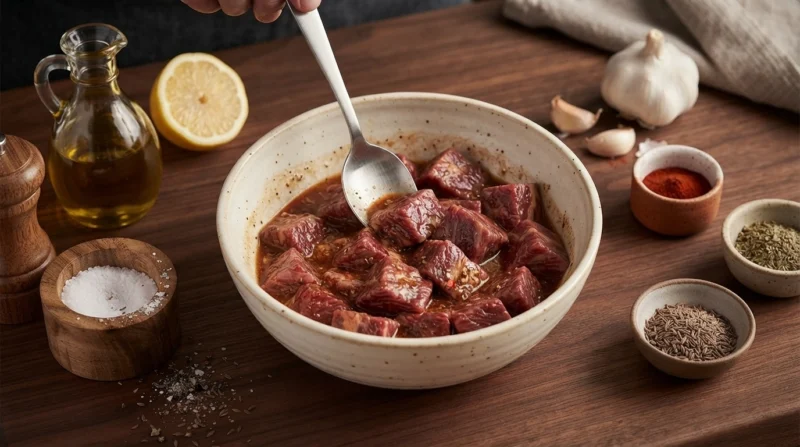
Place the beef cubes in a large bowl.
Add:
- olive oil
- lemon juice
- garlic
- paprika
- oregano
- salt
- black pepper
- cumin
- red pepper flakes, if using
Mix thoroughly.
Every piece should be lightly coated.
Cover the bowl and refrigerate.
For this recipe, 1–4 hours is a good range.
You do not need to marinate the beef overnight.
In fact, a very long acidic marinade is not automatically better.
The goal is to add flavor while preserving the natural texture of the beef.
Do Not Marinate at Room Temperature
Keep raw beef refrigerated while it marinates.
Do not leave the bowl sitting on the kitchen counter for several hours.
Cold storage is important for food safety.
Take the beef out of the refrigerator only when you are ready to prepare the skewers and begin grilling.
Preparing the Vegetables
Classic kebabs are not only about the meat.
The vegetables provide sweetness, freshness, color, and textural contrast.
For this recipe we use:
- bell peppers
- onion
You can also add other vegetables, but remember that different vegetables cook at different speeds.
Bell peppers
Remove the stem and seeds.
Cut the peppers into pieces roughly similar in size to the beef.
Avoid cutting them into extremely thin pieces because they can become soft or charred before the beef is ready.
Onion
Peel the onion.
Cut it into chunks or sections large enough to remain on the skewer.
If the onion pieces are too small, their layers can separate and fall through the grill.
Should Meat and Vegetables Be on the Same Skewer?
This is an important question.
There are two good approaches.
Method 1: Alternate meat and vegetables
You can thread beef, onion, pepper, beef, onion, pepper, and so on.
This looks beautiful and is convenient for serving.
However, the vegetables and beef do not necessarily cook at exactly the same rate.
Method 2: Separate meat and vegetables
You can place beef on one set of skewers and vegetables on another.
This is often the better cooking method.
Why?
Because you can remove each component when it is ready.
If the beef reaches the desired doneness before the peppers are sufficiently tender, you can take the beef off the grill and continue cooking the vegetables.
For beginners, separate skewers can make the cooking process easier.
If presentation is your priority, alternating them is perfectly fine.
Preparing Wooden Skewers
If using bamboo or wooden skewers, soak them in water for at least 30 minutes.
This reduces the chance of the exposed wood burning over the grill.
Ideally, the entire skewer should fit in the soaking container.
If the skewers are too long, rotate them during soaking.
Metal skewers do not require soaking and are reusable.
They also conduct heat into the center of the meat, which can slightly change cooking speed.
Preparing the Grill
A hot grill is essential.
You want the cooking surface hot enough to brown the beef quickly.
A low-temperature grill can produce gray, slowly cooked meat rather than the browned exterior associated with good kebabs.
Preheat your grill thoroughly before cooking.
If using a charcoal grill, wait until the coals are hot and covered with a light gray ash.
If using a gas grill, preheat it with the lid closed.
Clean the grates before cooking and lightly oil them if necessary.
Direct Heat Is the Main Cooking Method
Classic beef kebabs are generally cooked over direct heat.
That means the skewers are positioned directly above the heat source.
The objective is relatively quick cooking and strong surface browning.
However, you should always have a cooler area available if possible.
This gives you somewhere to move the kebabs if flames become excessive.
Why High Heat Works
When beef hits a hot grill, several things happen.
The surface moisture begins evaporating.
The temperature of the outer surface rises.
Eventually, browning reactions create the complex flavors associated with grilled meat.
This is one reason kebabs should not be cooked over weak heat.
You want the surface to brown before the inside becomes overcooked.
The Problem With Flames
One of the biggest mistakes in grilling kebabs is confusing flames with high heat.
Flames are not the goal.
If fat or marinade drips onto the heat source, flames may suddenly rise.
A brief flare-up is not necessarily a disaster.
But prolonged direct flame can burn the outside of the beef before the center is cooked.
If flames become aggressive, move the skewers to a cooler part of the grill.
Wait for the flames to settle, then return the kebabs to the hot zone.
Preparing the Beef for Grilling
Remove the marinated beef from the refrigerator.
Do not rinse it.
You want the marinade and seasoning on the surface.
However, the pieces should not be dripping excessively.
Too much liquid on the surface can interfere with browning.
If necessary, let excess marinade drip back into the bowl.
Do not press the meat dry so aggressively that you remove all the seasoning.
You simply want the beef coated rather than dripping.
Threading the Beef Onto the Skewers
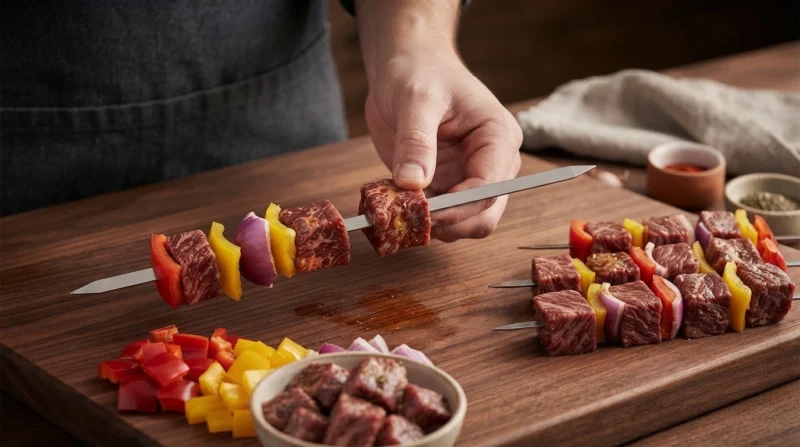
Thread each piece through the center.
Do not pack the pieces extremely tightly together.
Leave a small amount of space between them.
Why?
Heat needs to reach the sides of the meat.
If the cubes are compressed tightly against one another, the surfaces touching each other will not brown properly.
A little spacing improves airflow and surface contact with the heat.
How Many Pieces per Skewer?
This depends on the size of your skewers.
For a standard serving, approximately 5–7 beef cubes per skewer is reasonable.
Do not make the skewers so full that they become difficult to rotate.
Leave some bare skewer at each end so you can safely handle them.
The First Side Goes Down First
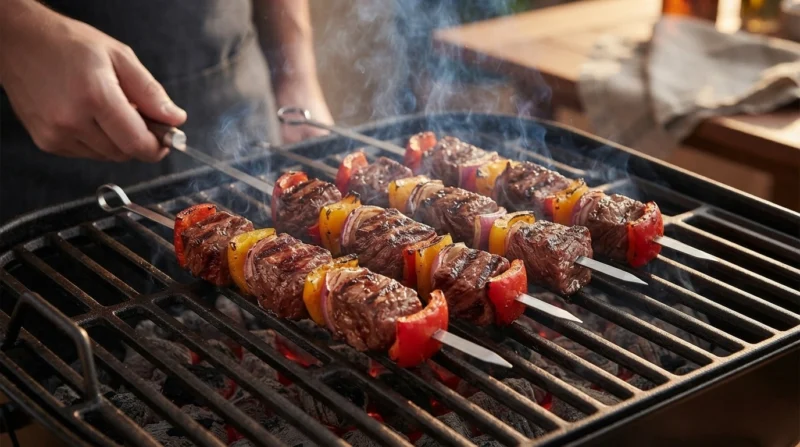
Place the skewers on the hot grill.
You should hear an immediate sizzling sound.
That sound is useful.
It tells you the surface is hot enough for active cooking.
Do not immediately start moving the kebabs around.
Let the first side develop color.
Depending on the heat and size of the beef cubes, this may take approximately 2–3 minutes.
Then turn the skewers.
How Often Should You Turn Beef Kebabs?
You do not need to spin them continuously.
A good approach is to rotate them every couple of minutes so that several sides receive direct heat.
For cubes approximately 1½ inches in size, you may rotate the skewers three or four times during cooking.
The exact timing depends on:
- grill temperature
- beef size
- beef cut
- weather
- grill design
- desired doneness
Use visual cues rather than blindly following a timer.
What Should the Beef Look Like?
As the beef cooks, look for:
- a browned exterior
- visible grill marks
- slightly darker edges
- a cooked surface rather than raw-looking meat
- juices beginning to appear on the surface
Do not wait for every cube to become completely dark brown.
A beautifully grilled kebab has variation.
Some edges may be deeply browned while other surfaces remain golden brown.
That contrast is part of the appeal.
How to Check Doneness
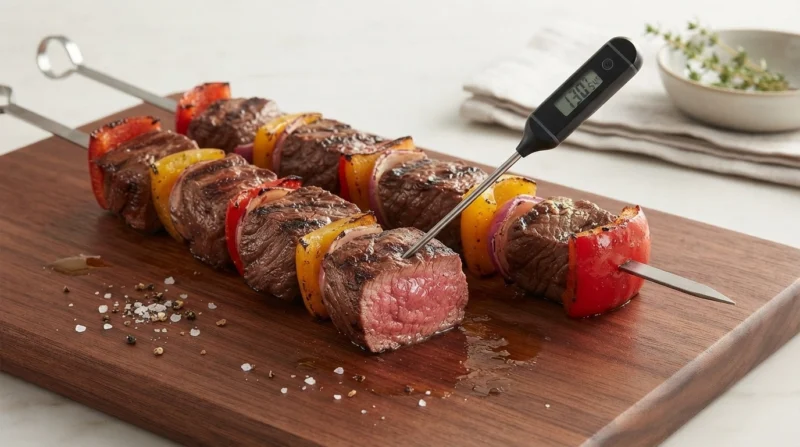
A thermometer is the most reliable method.
Insert an instant-read thermometer into the thickest part of a beef cube.
Avoid touching the skewer because the metal can interfere with the reading.
For food safety, use the temperature appropriate to your beef and local food-safety guidance.
For many home cooks, medium or medium-rare beef is desirable when the beef cut is suitable and handled properly.
However, the safest target should take priority over personal preference, especially for vulnerable diners.
Do not rely exclusively on cutting every piece open to check it.
Every time you cut into the meat, juices can escape.
A thermometer is much more useful.
Why Resting the Beef Matters
When the kebabs come off the grill, do not immediately start eating them.
Give the beef approximately 5 minutes to rest.
During cooking, the interior of the meat becomes very hot.
Resting allows the temperature to stabilize and gives the juices time to redistribute.
You do not need to cover the kebabs tightly with foil.
Heavy covering can trap steam and soften the beautifully browned exterior.
A loose rest is enough.
Preparing the Vegetables
If the vegetables are cooked on separate skewers, place them on the grill at approximately the same time as the beef or slightly earlier, depending on their size.
Turn them regularly.
You want:
- softened centers
- browned edges
- some char
- enough structure that they still hold together
Do not cook them until they completely collapse.
Good grilled vegetables retain some texture.
The Importance of Knife Technique
This recipe contains a surprisingly large amount of knife work.
You will be cutting:
- beef
- peppers
- onion
- garlic
- parsley, if using
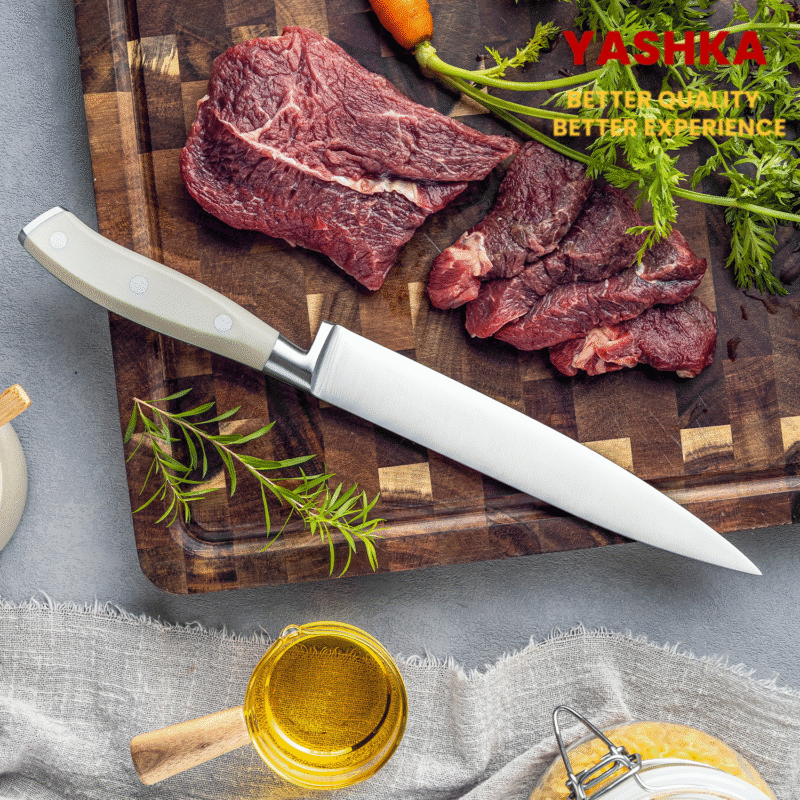
A sharp kitchen knife makes this process easier and safer.
A dull knife often requires more force.
More force means less control.
When preparing the beef, keep your non-cutting hand in a claw position, with the fingertips curled inward.
Keep the knife blade against your knuckles rather than extending your fingertips toward the blade.
Move slowly when necessary.
Speed is not the goal.
Control is.
How to Safely Cut the Beef
Place the beef on a stable cutting board.
If the board moves, place a damp kitchen towel underneath it.
Cut away from your fingers.
Do not attempt to hold a slippery piece of meat in an awkward position while making a fast cut.
If the beef is very soft, briefly chilling it can make cutting easier.
The goal is clean, deliberate cuts.
https://yashkadesigns.com/luxury-slicing-knife
Why a Sharp Knife Helps With Kebabs
A sharp knife creates cleaner cuts.
That means:
- more uniform cubes
- less crushing of the meat
- easier trimming
- better control
- less physical effort
It also makes vegetable preparation more consistent.
Uniform cutting is not just about appearance.
It directly affects cooking.
Common Mistake: Cutting the Beef Too Small
This is probably the most common kebab mistake.
Small pieces seem convenient because they cook quickly.
But they cook too quickly.
The outside can become dry before the meat develops enough browning.
Pieces around 1½ inches are a useful starting point.
If you are using a very hot grill, slightly larger pieces can sometimes work better.
Common Mistake: Cutting the Beef Too Large
Very large cubes create the opposite problem.
The outside can become heavily charred while the center remains undercooked.
The solution is not simply lowering the heat.
Start with appropriately sized pieces.
Common Mistake: Overcrowding the Skewer
Packing the meat tightly together prevents proper browning.
Think of each beef cube as an individual piece that needs exposure to heat.
Leave a small gap between pieces.
Common Mistake: Overcrowding the Grill
Do not cover every square inch of the grill with food.
Crowding reduces your ability to control cooking.
It also makes turning the skewers more difficult.
Leave enough space to move the kebabs when necessary.
Common Mistake: Using Too Much Marinade
More marinade does not necessarily mean more flavor.
If the beef is dripping wet, it may struggle to brown properly.
A marinade should coat the meat.
It should not form a thick liquid layer around every piece.
Common Mistake: Marinating for Too Long
Many people assume that leaving beef in marinade overnight automatically makes it better.
Not necessarily.
This recipe contains lemon juice, so a moderate marinating period is sufficient.
The objective is balanced flavor, not prolonged exposure to acid.
Common Mistake: Constantly Moving the Beef
Some beginners turn the kebabs every few seconds because they are worried about burning them.
That makes browning more difficult.
Give the meat enough time to develop color.
Turn it deliberately.
Common Mistake: Pressing the Beef
Do not press the kebabs against the grill with a spatula.
You are not cooking a burger.
Pressing the beef does not improve browning.
It can squeeze out flavorful juices.
Let the grill do the work.
Common Mistake: Cooking Over Flames
If flames are licking continuously around the beef, move the kebabs.
A little char is delicious.
Burning is not.
Common Mistake: Trusting the Timer Completely
A recipe may say eight minutes.
Your grill may take six.
Another grill may take twelve.
The timer is a guide.
The appearance and internal temperature of the meat are more important.
Troubleshooting Dry Beef Kebabs
If your kebabs came out dry, consider these possibilities.
The beef was too lean
Very lean meat can dry more quickly.
The cubes were too small
Small pieces have little protection against overcooking.
The grill was too hot
Extreme heat can overcook the surface rapidly.
The kebabs stayed on too long
This is the most common cause.
You cut the beef repeatedly
Every cut releases some juice.
Use a thermometer instead.
Troubleshooting Tough Beef Kebabs
If the beef is tough rather than simply dry, consider the cut.
A naturally tough cut may not become tender through quick grilling.
Also check how you cut it.
If the muscle fibers are long and you cut parallel to them, the finished bite may feel tougher.
Troubleshooting Pale Beef Kebabs
If the beef tastes good but looks pale, your grill may not have been hot enough.
Other possibilities include:
- too much surface moisture
- overcrowded grill
- too much marinade
- insufficient preheating
Preheat thoroughly and allow the surface to brown before turning.
Troubleshooting Burnt Outside and Raw Center
This usually means the heat is too aggressive for the size of the beef.
Try:
- Slightly larger pieces.
- A two-zone grill setup.
- Moving the kebabs away from direct flames.
- Lowering the cooking temperature slightly.
- Turning the kebabs more frequently.
Do not simply continue cooking the burnt exterior.
Once a surface is severely burned, additional cooking will not repair it.
Can Beef Kebabs Be Made on a Gas Grill?
Absolutely.
A gas grill is excellent for kebabs.
Preheat thoroughly and use direct heat.
If your grill has multiple burners, create a hot zone and a cooler zone.
The hot zone is for browning.
The cooler zone is your safety net when the exterior is becoming too dark.
Can Beef Kebabs Be Made on Charcoal?
Yes—and charcoal can provide wonderful flavor.
Build a hot charcoal fire and allow the coals to become properly heated before cooking.
Avoid cooking directly over large uncontrolled flames.
You want strong radiant heat from the hot coals.
If possible, create a two-zone fire with hotter and cooler areas.
Can Beef Kebabs Be Made in the Oven?
Yes, although you will lose some of the flavor associated with outdoor grilling.
Set the oven to a high temperature.
Place the skewers on a rack positioned over a baking tray so hot air can circulate around them.
Turn them during cooking.
You can also finish them briefly under the broiler to increase browning.
Watch carefully because the broiler can burn the exterior very quickly.
Can Beef Kebabs Be Made in an Air Fryer?
Yes.
Air frying works well for small batches.
Leave enough space around the skewers for air circulation.
Cook at a high temperature and turn them partway through.
Because air fryers vary considerably, check the internal temperature rather than relying solely on the stated cooking time.
Can You Make Beef Kebabs Ahead of Time?
You can prepare much of the recipe in advance.
For example:
Earlier in the day
- Cut the beef.
- Prepare the marinade.
- Marinate the beef in the refrigerator.
- Cut the vegetables.
- Soak wooden skewers if necessary.
Just before cooking
- Thread the skewers.
- Preheat the grill.
- Remove excess marinade.
- Begin grilling.
This makes kebabs an excellent choice for entertaining.
What to Serve With Beef Kebabs
Classic beef kebabs are extremely versatile.
They can be served with:
- warm flatbread
- pita
- rice
- grilled vegetables
- salad
- cucumber and tomato salad
- roasted potatoes
- hummus
- yogurt sauce
- garlic sauce
- tzatziki
- fresh herbs
- lemon wedges
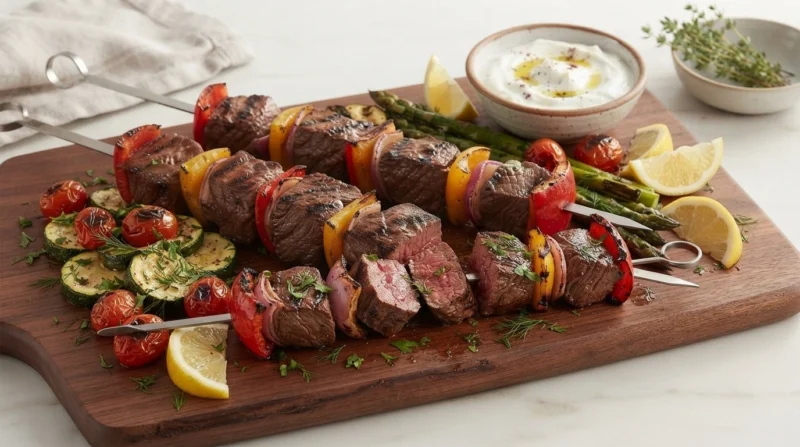
A simple meal can consist of beef kebabs, grilled vegetables, warm bread, and a fresh salad.
You do not need ten side dishes.
A Simple Garlic Yogurt Sauce
One of the easiest sauces to serve with beef kebabs is garlic yogurt.
Combine:
- 1 cup plain Greek yogurt
- 1 small garlic clove, finely grated
- 1 tablespoon lemon juice
- 1 tablespoon olive oil
- a pinch of salt
- chopped parsley or mint
Mix well.
Taste.
If it seems too thick, add a small splash of water.
If it needs more brightness, add a little lemon.
This sauce works particularly well because the cool acidity contrasts with the hot grilled beef.
A Simple Fresh Salad
For an easy side dish, combine:
- chopped tomatoes
- cucumber
- red onion
- parsley
- olive oil
- lemon juice
- salt
Keep the dressing light.
The beef already provides richness, so a fresh salad should bring acidity and freshness.
Warm Bread and Kebabs
Warm pita or flatbread is another classic pairing.
You can place the beef directly inside the bread with:
- grilled peppers
- onion
- salad
- yogurt sauce
- herbs
Alternatively, serve everything separately and let everyone assemble their own meal.
How to Serve Kebabs at the Table
Transfer the cooked kebabs to a serving platter.
Add:
- lemon wedges
- fresh parsley
- grilled vegetables
- sauce
You can serve the beef directly on the skewers.
For children or for easier eating, remove the meat from the skewers before serving.
Be careful with metal skewers because they remain extremely hot after cooking.
How to Remove Meat From a Skewer
Place the skewer over a plate.
Use a fork to gently slide the meat off the skewer.
Do not grab a hot metal skewer with bare hands.
Wooden skewers may also remain hot enough to burn you.
Give them time to cool.
How to Store Leftover Beef Kebabs
If you have leftovers, remove the beef and vegetables from the skewers once they are cool enough to handle.
Store them in a covered container in the refrigerator.
Use them within the appropriate food-safety storage period.
Leftover beef is excellent in:
- salads
- wraps
- sandwiches
- rice bowls
- pita
- pasta
- grain bowls
How to Reheat Leftover Beef
The main challenge is avoiding overcooking.
Reheat gently.
A microwave can work, but short intervals are preferable to one long heating cycle.
A covered skillet over moderate heat can also work.
Add a tiny amount of water or broth if necessary to prevent the meat from becoming excessively dry.
Do not repeatedly reheat the same leftovers.
Can You Freeze Beef Kebabs?
Yes, although the texture is usually best when the beef is eaten fresh.
If freezing leftovers, cool them promptly and store them in an airtight freezer-safe container.
When possible, freeze the cooked beef separately from fresh vegetables or sauces.
Thaw safely in the refrigerator before reheating.
Variations on Classic Beef Kebabs
Once you understand the basic technique, you can change the flavor profile without changing the cooking method.
Herb-Forward Kebabs
Add more fresh parsley and oregano to the marinade.
You can also add a little chopped rosemary.
Use rosemary carefully because its flavor is strong.
Spicy Beef Kebabs
Increase the red pepper flakes.
Alternatively, add a small amount of cayenne or another chili seasoning.
Start conservatively.
You can always increase the heat next time.
Smoky Beef Kebabs
Use smoked paprika instead of some or all of the regular paprika.
Charcoal grilling will increase the smoky character further.
Lemon-Herb Kebabs
Increase the lemon zest rather than dramatically increasing the lemon juice.
Fresh lemon zest provides intense citrus aroma without adding as much acidity.
Adding Mushrooms
Mushrooms are a popular kebab ingredient.
Choose larger mushrooms or cut larger mushrooms into substantial pieces.
Very small mushrooms can shrink considerably during cooking.
Because mushrooms release water, give them enough space on the grill.
Adding Cherry Tomatoes
Cherry tomatoes can be delicious on skewers.
However, they cook differently from beef.
They become soft and can split.
If you use them, consider cooking them on separate vegetable skewers.
Adding Zucchini
Zucchini works well when cut into thick rounds or substantial chunks.
Thin slices can become soft too quickly.
As with other vegetables, uniformity matters.
What Makes These Kebabs “Classic”?
There are countless kebab traditions around the world.
The word kebab covers many different preparations, from minced meat to large pieces of meat cooked over open fire.
This recipe is a classic home-style beef skewer preparation rather than an attempt to represent one specific regional tradition.
The combination of beef, peppers, onions, olive oil, lemon, garlic, and herbs produces the familiar grilled-kebab profile many home cooks associate with beef skewers.
The important thing is to understand that there is no single universal kebab recipe.
Regional cuisines use different cuts, marinades, spices, vegetables, and cooking methods.
Why Simple Seasoning Works So Well
Beef already has a strong flavor.
A complicated marinade can actually make the final dish less balanced.
The purpose of this marinade is to support the beef.
Garlic adds aroma.
Lemon adds brightness.
Paprika adds warmth.
Oregano adds herbal character.
Cumin adds depth.
Olive oil adds richness.
Salt brings everything together.
Nothing needs to dominate.
A Beginner’s Cooking Timeline
If this is your first time making beef kebabs, use the following sequence.
3–4 hours before dinner
Cut the beef.
Prepare the marinade.
Combine the beef and marinade.
Refrigerate.
About 45 minutes before cooking
Prepare the vegetables.
Cut the peppers and onion.
Prepare the skewers.
About 30 minutes before cooking
Soak wooden skewers if using them.
About 20–25 minutes before cooking
Begin preheating the grill.
About 15 minutes before cooking
Thread the beef and vegetables onto skewers.
Cooking time
Place the skewers over direct heat.
Cook and rotate them until browned and the beef reaches your desired safe internal temperature.
After cooking
Rest the beef for approximately 5 minutes.
Serve immediately.
The Most Important Lessons for Beginners
If you remember only a few things from this recipe, remember these:
1. Use a suitable cut
Start with sirloin or another tender grilling cut.
2. Cut evenly
Uniform pieces cook more evenly.
3. Do not make the cubes tiny
Approximately 1½ inches is a useful starting point.
4. Preheat the grill
A cold grill makes good browning difficult.
5. Do not overcrowd the skewers
Leave small spaces between the pieces.
6. Control the flames
Char is good.
Burning is not.
7. Use a thermometer
It is the most reliable way to judge doneness.
8. Let the beef rest
Five minutes can make a noticeable difference.
Frequently Asked Questions
What is the best beef for kebabs?
Sirloin and top sirloin are excellent choices. Ribeye can produce especially rich kebabs because of its marbling, while tenderloin is very tender but usually unnecessary from a cost perspective.
How big should beef cubes be for kebabs?
Approximately 1½ inches (3.5–4 cm) is a good starting point. The most important thing is that the pieces are reasonably uniform.
How long should beef kebabs marinate?
For this recipe, 1–4 hours is sufficient. Because the marinade contains lemon juice, there is no need to leave the beef in it overnight.
Should I put vegetables and beef on the same skewer?
You can, but separate skewers make temperature and cooking control easier because beef and vegetables cook at different rates.
Should wooden skewers be soaked?
Yes. Soak them in water for at least 30 minutes before grilling.
How do I stop kebabs from sticking to the grill?
Preheat the grill properly and keep the cooking grates clean. Lightly oiling the grates can also help.
Why are my kebabs dry?
The most likely causes are overcooking, cubes that are too small, very lean beef, or excessive grill temperature.
Why are my kebabs tough?
The beef may have been overcooked, cut incorrectly relative to the grain, or made from a cut that is better suited to slow cooking.
Can I make beef kebabs without a grill?
Yes. A hot oven, broiler, or air fryer can produce good results, although an outdoor grill provides the most characteristic grilled flavor.
Can I prepare kebabs the night before?
You can prepare the vegetables and cut the beef ahead of time. For this lemon-based marinade, however, it is preferable not to marinate the beef excessively long.
Should I remove the beef from the marinade before grilling?
Allow excess marinade to drip off. The beef should be coated but not dripping heavily.
Do I need to oil the beef?
The marinade already contains olive oil, so additional oil is generally unnecessary.
How do I know when the beef is done?
Use an instant-read thermometer inserted into the thickest part of a beef cube. Visual appearance alone is less reliable.
Should I press the kebabs while grilling?
No. Pressing the meat can force out juices without improving the cooking process.
Final Tips for Perfect Classic Beef Kebabs
Making good beef kebabs is less about a secret ingredient and more about controlling a handful of variables.
Start with good beef.
Cut it into consistent pieces.
Use enough seasoning to complement the meat.
Marinate for a reasonable amount of time.
Prepare the vegetables separately when convenient.
Preheat the grill thoroughly.
Keep the skewers spaced properly.
Watch the flames.
Turn the kebabs deliberately rather than constantly.
Most importantly, do not cook by the clock alone.
The grill, the size of the meat, and the desired doneness all influence cooking time.
Use your eyes, your thermometer, and your experience together.
When the beef has developed a deeply browned exterior and reached the appropriate internal temperature, remove it from the grill.
Then give it a few minutes to rest.
Serve the kebabs with warm bread, fresh salad, grilled vegetables, or a cool garlic-yogurt sauce.
The result should be juicy beef with smoky grilled edges, sweet roasted peppers and onions, fresh acidity from lemon, and enough herbs and spices to make every bite interesting without overwhelming the meat.
And once you have mastered this basic recipe, the technique becomes a foundation for countless variations.
You can change the beef cut, herbs, spices, vegetables, sauces, and serving style while keeping the same essential method.
That is what makes classic beef kebabs such a useful recipe to learn: they are simple enough for a beginner, but the more attention you give to the details—knife work, cutting size, heat control, browning, and doneness—the better they become.