How to Cut and Chop Pork
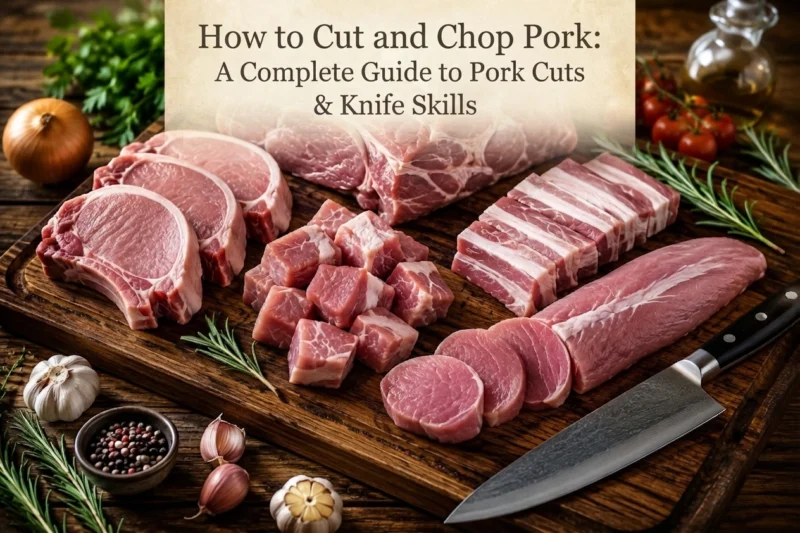
Pork is one of the most versatile meats in the kitchen. A single animal provides a wide range of cuts, from tenderloin and pork chops to pork shoulder, belly, ribs, and leg. Each cut has a different structure, amount of fat, and connective tissue—and that means each one benefits from a different preparation and cutting technique.
Learning how to cut pork correctly is not only about making attractive pieces. The direction of your cuts can affect tenderness, cooking time, texture, and even how evenly the meat cooks.
A sharp, appropriate knife makes the job considerably easier. A chef’s knife is excellent for many everyday pork preparations, while a boning knife is better for trimming around bones and separating meat. A slicing knife becomes useful when working with large cooked pieces or creating thin, even slices.
This guide explains the major pork cuts, how to prepare them, how to cut pork chops, how to slice pork tenderloin, how to prepare pork belly, how to cut pork for stir-fry, and how to prepare pork for tacos and carnitas. It also explains which knife works best for each task.
What You Will Learn in This Pork Cutting Guide
This guide covers:
- The major cuts of pork
- How pork shoulder differs from pork loin
- How to prepare pork chops
- How to cut pork tenderloin
- How to trim and cut pork belly
- How to cut pork for stir-fry
- How to prepare pork for tacos
- How to cut pork for carnitas
- How to trim pork ribs
- How to portion larger pork cuts
- How to cut pork against the grain
- Which knife to use for different pork-cutting tasks
- How to improve cutting consistency
- Common pork-cutting mistakes
- Safe and efficient knife techniques
Whether you’re a beginner learning basic meat preparation or an experienced home cook looking to improve your knife skills, these techniques can help you get more from every pork cut.
Please check Our Guide The Ultimate Guide to Vegetable Preparation
Understanding the Major Pork Cuts
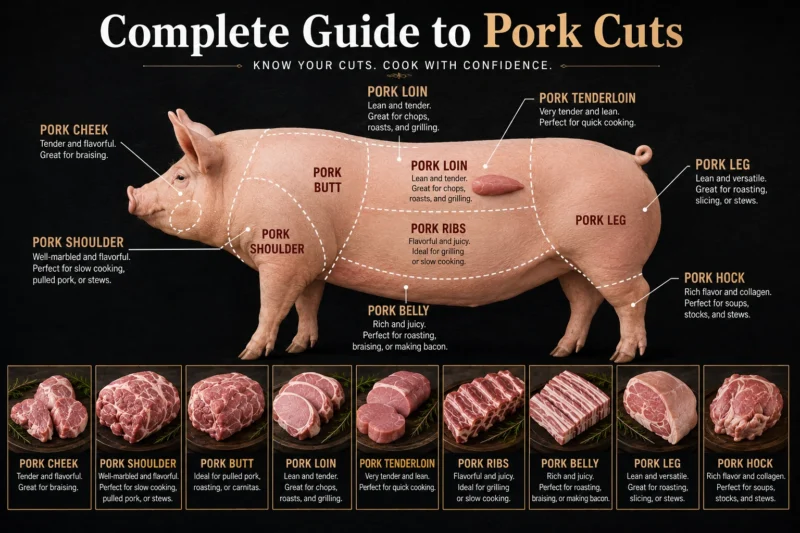
Before learning how to cut pork, it helps to understand where the different cuts come from.
The terminology can vary somewhat between countries and butchers, but the major sections are generally similar.
The most useful pork cuts for home cooks include:
- Pork shoulder
- Pork butt
- Pork loin
- Pork tenderloin
- Pork chops
- Pork belly
- Pork ribs
- Pork leg
- Pork hock
- Pork cheeks
Each behaves differently when cooked and therefore requires different preparation.
1. Pork Shoulder
Pork shoulder comes from the front portion of the pig.
It contains substantial connective tissue and fat, which makes it particularly suitable for long, slow cooking.
Pork shoulder is commonly used for:
- Pulled pork
- Carnitas
- Tacos
- Braised pork
- Stews
- Slow-roasted pork
When working with pork shoulder, the goal is usually not to create perfectly thin slices immediately.
Instead, the shoulder is often divided into large chunks before cooking.
How to Cut Pork Shoulder
Place the pork shoulder on a stable cutting board.
Use a sharp chef’s knife or boning knife to remove excessive surface fat.
Do not automatically remove every piece of fat. Much of the internal fat and connective tissue contributes to flavor and moisture during slow cooking.
Follow the natural seams of the muscle when possible.
Large muscles can often be separated along these seams with relatively little cutting.
For carnitas or stew, cut the meat into approximately 1½–2 inch chunks.
Try to keep the pieces reasonably uniform.
Uniform pieces cook at similar rates.
2. Pork Butt
Despite its name, pork butt comes from the upper shoulder region rather than the rear of the pig.
It is one of the most useful cuts for slow cooking.
Pork butt is commonly used for:
- Pulled pork
- Carnitas
- Barbecue
- Braised pork
- Large roasts
It contains enough fat and connective tissue to remain moist during long cooking.
How to Prepare Pork Butt
Start by placing the meat fat-side up.
Trim any thick, hard exterior fat that will not render effectively.
Leave a reasonable layer of softer fat.
Then examine the natural muscle structure.
If making pulled pork, you can generally leave the roast relatively large.
If preparing carnitas or another dish requiring individual pieces, divide the pork into large cubes.
A sharp chef’s knife is usually sufficient.
A boning knife can be particularly useful around irregular areas.
3. Pork Loin
Pork loin is very different from pork shoulder.
It is relatively lean and comes from the back of the animal.
Pork loin can be prepared as:
- Roasts
- Pork chops
- Medallions
- Thin slices
- Stuffed roasts
Because pork loin is leaner, overcooking can make it dry.
Cutting it correctly is therefore particularly important.
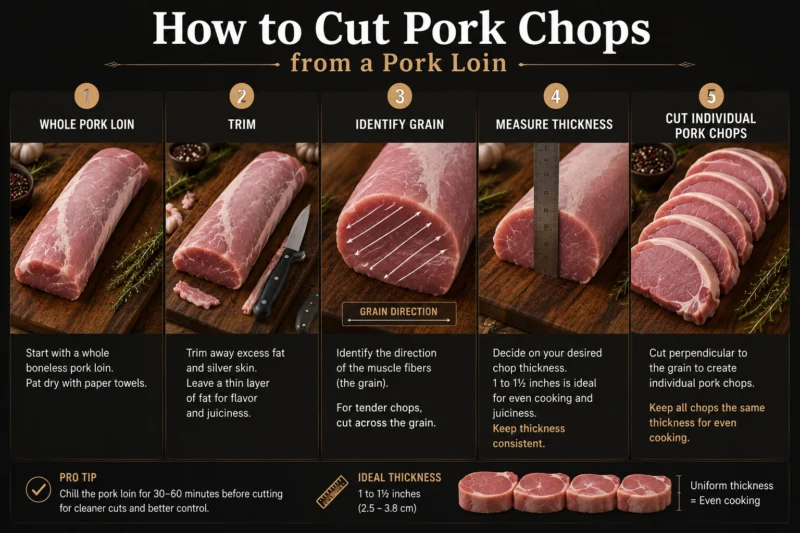
How to Cut Pork Loin into Chops
If you have a whole boneless pork loin, you can turn it into individual pork chops.
First, chill the loin thoroughly.
Cold meat is easier to cut cleanly.
Place the loin horizontally on the cutting board.
Identify the direction of the muscle fibers.
For traditional pork chops, make crosswise cuts through the loin.
Choose the desired thickness.
For many home-cooking applications, chops around 1–1½ inches thick are practical.
Try to keep every chop approximately the same thickness.
This is more important than making every piece look perfectly identical.
Uniform thickness means more predictable cooking.
4. Pork Tenderloin
Pork tenderloin is one of the leanest and most tender pork cuts.
It is long, narrow, and relatively easy to prepare.
It can be:
- Roasted whole
- Cut into medallions
- Sliced for stir-fry
- Cut into strips
- Used in sandwiches
- Marinated and grilled
Because the tenderloin is relatively small, a sharp chef’s knife or slicing knife works very well.
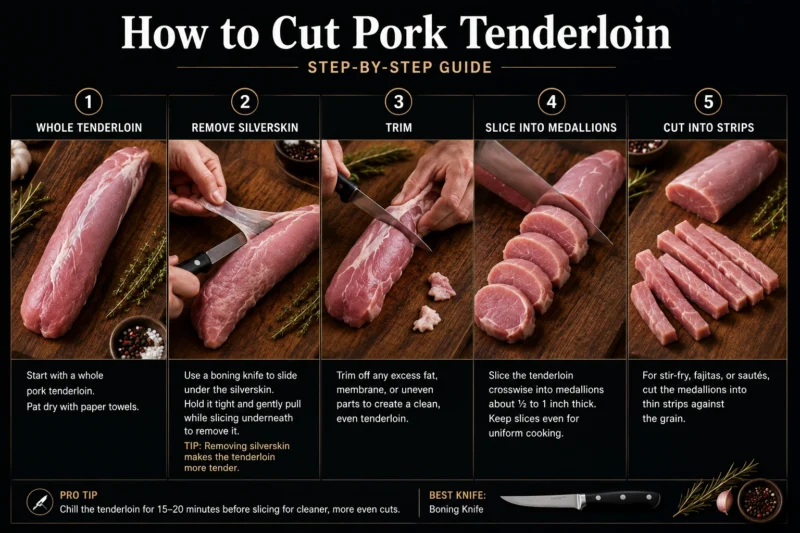
How to Trim Pork Tenderloin
One of the most important steps is removing the silverskin.
Silverskin is a tough, shiny membrane found on the outside of some muscles.
Unlike fat, it does not become tender during cooking.
To remove it:
- Place the tenderloin on the cutting board.
- Locate the shiny membrane.
- Slide the tip of a sharp knife underneath one end.
- Lift the membrane slightly.
- Keep the blade angled upward.
- Pull the membrane away while making shallow cuts.
Avoid removing large amounts of meat along with the silverskin.
A narrow boning knife is excellent for this task because its blade can make controlled, precise cuts.
How to Slice Pork Tenderloin into Medallions
After trimming the tenderloin, decide how thick you want the medallions.
For quick pan cooking, slices around ½–1 inch thick are practical.
Hold the knife comfortably and use a smooth forward-and-back motion rather than pressing straight down.
Make each slice approximately the same thickness.
If the tenderloin is very soft, place it in the refrigerator or freezer briefly before slicing.
Slightly chilled meat is easier to cut into precise pieces.
Pork Tenderloin for Stir-Fry
Tenderloin can also be cut into thin strips.
First cut the tenderloin into manageable sections.
Then slice each section into thin pieces.
Finally, cut those pieces into strips.
For stir-fry, the pieces should be relatively thin so they cook quickly over high heat.
Try to cut across the muscle fibers rather than creating extremely long strips following the grain.
This produces a more pleasant texture when eating.
5. Pork Chops
Pork chops are among the most familiar pork cuts.
They can come from different sections of the loin and may be:
- Boneless
- Bone-in
- Thick-cut
- Thin-cut
- Center-cut
- Rib chops
The bone can add flavor and provides a useful visual reference when portioning.
How to Cut Bone-In Pork Chops
If you’re cutting chops from a larger bone-in loin, use a suitable meat or butcher’s knife rather than forcing a thin chef’s knife through hard bone.
The safest approach is to identify the natural spaces between bones and cut through the softer tissue.
Do not attempt to force a fine kitchen knife through large bones.
For home cooks, it is often better to have the butcher portion bone-in chops if specialized equipment is required.
Your chef’s knife can then be used for trimming and preparation.
How Thick Should Pork Chops Be?
There is no single correct thickness.
Thin chops cook quickly and are convenient for weeknight meals.
Thick chops are more forgiving and provide a larger margin between a browned exterior and the desired interior temperature.
Thick-cut chops are particularly good for:
- Grilling
- Pan-searing
- Stuffing
- Oven roasting
Thin chops work well for:
- Quick frying
- Breaded pork
- Stir-fry
- Sandwiches
6. Pork Belly
Pork belly is a rich, fatty cut taken from the underside of the pig.
It is used in many cuisines around the world.
Popular preparations include:
- Crispy pork belly
- Braised pork belly
- Bacon
- Asian-style pork belly
- Pork belly tacos
- Roasted pork belly
Because pork belly contains substantial layers of fat, the cutting technique is different from working with lean tenderloin.
How to Trim Pork Belly
Place the pork belly skin-side down.
Use a sharp knife to remove uneven pieces of meat or excessive hard fat.
If the skin is still attached, decide whether your recipe requires it.
For crispy pork belly, the skin is often intentionally retained.
For tacos, stir-fry, or certain braised preparations, the skin may be removed depending on the recipe.
A flexible boning knife is particularly useful for separating skin from meat.
Work slowly.
The goal is to remove the skin while preserving as much meat as possible.
How to Cut Pork Belly into Cubes
For braising or slow cooking, pork belly can be cut into large cubes.
Start by cutting the belly into strips.
Then turn the strips and make crosswise cuts.
Try to keep the cubes approximately the same size.
Because pork belly contains significant fat, uniform pieces help the fat render more consistently.
How to Slice Pork Belly Thinly
For thin pork belly slices, a long, sharp slicing knife works very well.
The meat should be very cold.
Partially freezing the pork belly can make thin slicing significantly easier.
Use long, smooth strokes.
Avoid aggressive chopping.
The goal is to create clean slices without crushing the fat layers.
Thin pork belly is excellent for:
- Hot pot
- Stir-fry
- Korean-style barbecue
- Japanese-style dishes
- Asian noodle dishes
7. Pork Ribs
Pork ribs contain bones, connective tissue, and meat.
They are generally purchased already portioned, but trimming may still be necessary.
Common types include:
- Baby back ribs
- Spare ribs
- St. Louis-style ribs
How to Trim Pork Ribs
Place the ribs meat-side down.
Look for the membrane covering the bone side.
Use the tip of a knife to lift one corner.
Once you have a section to grip, pull the membrane away.
A paper towel can help provide additional grip.
Remove any excessively loose pieces of fat or meat.
For St. Louis-style ribs, the rack is trimmed into a more rectangular shape.
The removed pieces can be saved for stock or other cooking applications.
8. Pork Leg
Pork leg is a large, relatively lean cut.
It can be prepared as:
- Roast pork
- Ham
- Thin slices
- Cubes
- Escalopes
- Stir-fry strips
Because it is relatively lean, careful cooking is important.
When slicing pork leg, pay attention to the direction of the muscle fibers.
For tender slices, cutting across the grain is usually preferable.
9. Pork Hock
Pork hock contains significant connective tissue and is generally used for slow cooking.
It is excellent in:
- Soups
- Beans
- Braises
- Stocks
- Slow-cooked dishes
A chef’s knife is not normally used to cut through the bone.
Instead, use your knife for trimming and separating accessible meat.
For major bone cutting, use appropriate butcher equipment or ask a butcher to portion the cut.
10. Pork Cheeks
Pork cheeks are small but flavorful.
They contain connective tissue and benefit from long, slow cooking.
Before cooking, trim excess connective tissue and surface fat.
A small boning knife is ideal because the area is relatively small and irregular.
How to Cut Pork Against the Grain
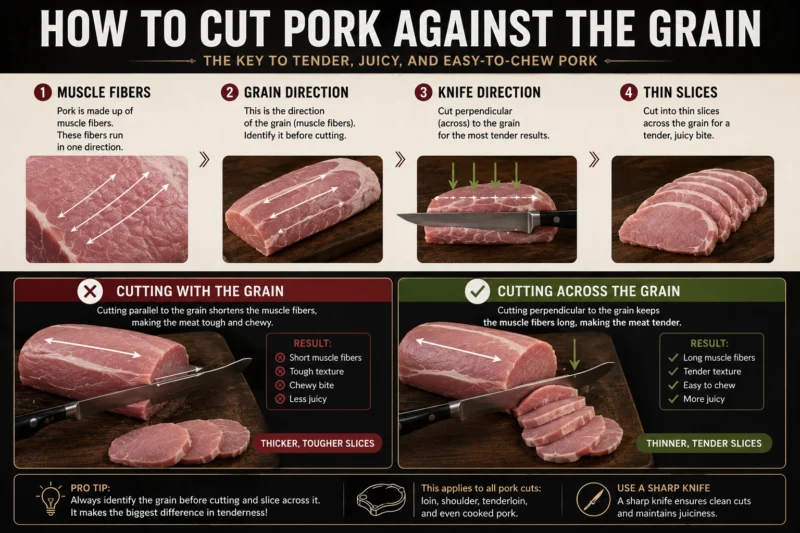
Understanding the grain is one of the most important pork-cutting skills.
The grain refers to the direction in which the muscle fibers run.
Imagine the fibers as a bundle of parallel threads.
If you cut along the threads, you create long muscle fibers.
If you cut across them, you shorten those fibers.
Shorter fibers generally feel more tender when chewing.
This is especially important for cuts such as:
- Pork shoulder
- Pork leg
- Flank-style pork preparations
- Certain roasted pork cuts
Please check Our Guide The Ultimate American BBQ Meat Guide
How to Identify the Grain
Look closely at the surface of the meat.
You should be able to see faint lines running in one direction.
Those lines indicate the general direction of the muscle fibers.
Make your final slicing cuts perpendicular to those lines.
If the grain changes direction within a large roast, adjust your cutting direction accordingly.
This is one reason separating a large roast into its individual muscles can be useful.
Pork Cutting for Stir-Fry
Stir-fry requires thin, evenly sized pieces.
The goal is rapid, consistent cooking.
Good pork cuts for stir-fry include:
- Tenderloin
- Pork loin
- Boneless shoulder
- Pork belly
Step 1: Chill the Pork
Place the pork in the refrigerator until very cold.
For extremely thin slices, you can briefly place it in the freezer.
Do not freeze it solid.
You want the surface firm enough to slice cleanly.
Step 2: Trim
Remove excessive fat, silverskin, and unwanted connective tissue.
Don’t necessarily remove all fat.
A small amount can contribute flavor.
Step 3: Identify the Grain
Look for the direction of the fibers.
For many stir-fry preparations, cut across the grain.
Step 4: Slice
Use a sharp chef’s knife.
Create thin, consistent slices.
Step 5: Cut into Strips
If the recipe calls for strips, stack or arrange the slices and cut them into narrow pieces.
Avoid making them excessively thick.
Thin pieces cook quickly over high heat.
Pork for Tacos
Pork is excellent for tacos because different cuts can produce completely different results.
Some of the best choices include:
- Pork shoulder
- Pork butt
- Pork loin
- Pork belly
For carnitas, pork shoulder is usually the most suitable.
How to Cut Pork for Tacos
If you are preparing diced pork for tacos, cut the meat into relatively small, uniform pieces.
Remove large pieces of hard fat.
Leave enough fat for flavor.
For quick-cooking tacos, leaner cuts can be sliced into thin strips.
For slow-cooked tacos, larger chunks are preferable.
This distinction is important.
Small pieces + high heat = fast cooking.
Large pieces + low heat = slow cooking.
How to Cut Pork for Carnitas
Carnitas traditionally uses pork shoulder.
Start with a large boneless shoulder.
Trim only excessive surface fat.
Cut the meat into large chunks.
Approximately 2-inch pieces work well for many preparations.
The pieces will shrink as they cook, so don’t cut them too small.
After slow cooking, the pork can be shredded or broken into smaller pieces.
For crispy carnitas, the cooked pork can then be browned before serving.
Pork Cutting for Sandwiches
Cooked pork can be sliced into:
- Thin slices
- Thick slices
- Shredded pieces
A long slicing knife is excellent for creating thin, uniform slices from a roast.
Let the cooked meat rest before slicing.
Resting helps the meat retain its juices and makes clean slicing easier.
Pork Cutting for Salads
Cooked pork can be sliced into thin strips or small pieces for salads.
Good choices include:
- Pork tenderloin
- Roast pork
- Grilled pork loin
Thin slices work particularly well with leafy salads.
For grain bowls, slightly larger cubes are appropriate.
Pork Cutting for Sandwiches
Thinly sliced roast pork can make excellent sandwiches.
Use a long slicing knife and smooth strokes.
Try to avoid sawing aggressively because this can tear the meat.
For pulled pork, a knife is usually unnecessary after cooking—the meat should separate easily with forks or suitable utensils.
https://yashkadesigns.com/damascus-chef-knife
Choosing the Best Knife for Pork
Different pork-cutting tasks require different knives.
There isn’t one perfect knife for everything.
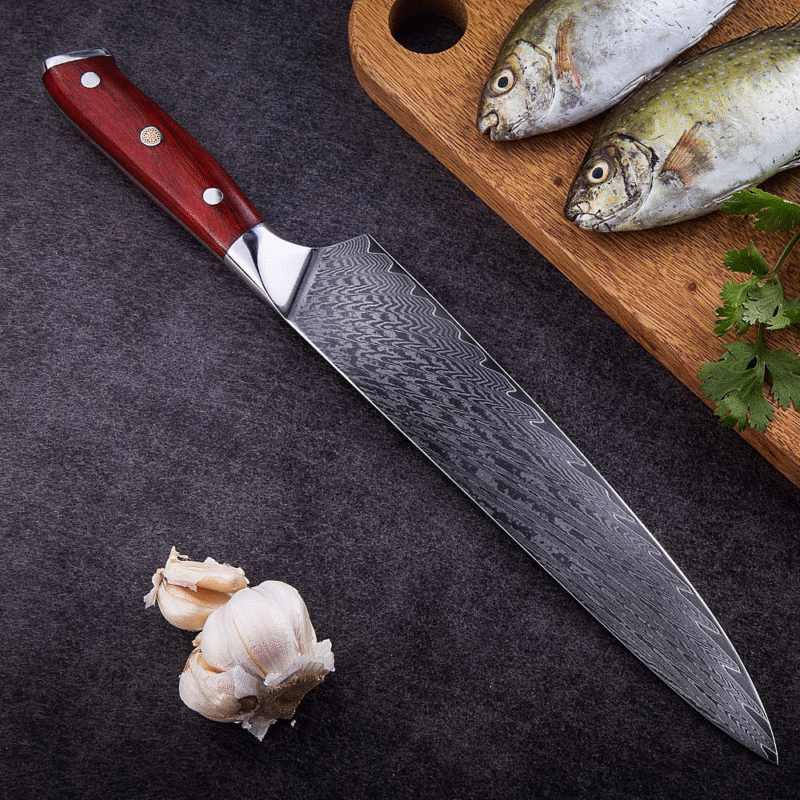
Chef’s Knife
A chef’s knife is the most versatile option.
It works well for:
- Pork loin
- Tenderloin
- Pork shoulder
- Pork belly
- Trimming
- Cutting cubes
- Cutting strips
For most home cooks, this is the primary knife to reach for.
Check Our Guide Best Knives for Steak: Slicing, Cutting & Serving
Looking for a luxury boning knife? Please visit this page:
https://yashkadesigns.com/chef-kitchen-knife-butcher-boning-bbq
Boning Knife
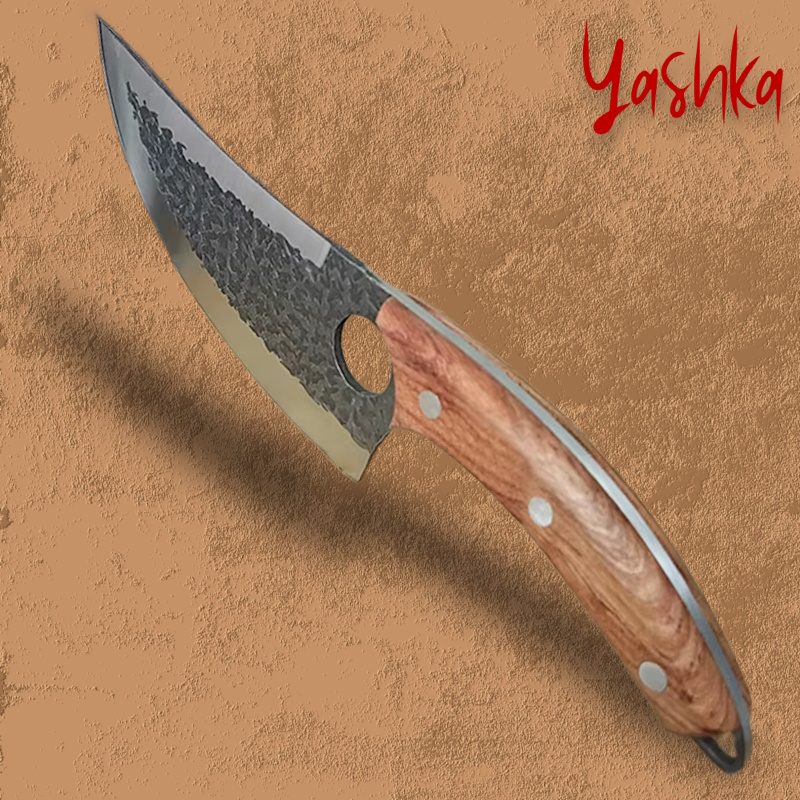
A boning knife has a narrower blade and is designed for working around bones and connective tissue.
It is particularly useful for:
- Trimming pork shoulder
- Removing silverskin
- Separating meat from bone
- Trimming pork belly
- Working around ribs
- Detailed preparation
A flexible boning knife is especially useful when precision is important.
https://yashkadesigns.com/damascus-chef-knife-2
Slicing Knife
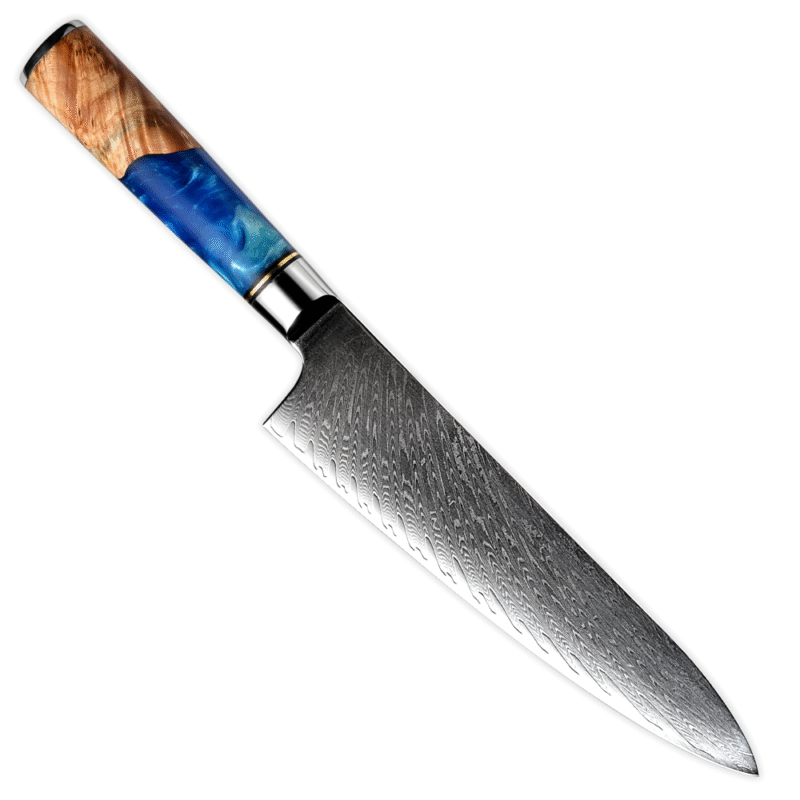
A slicing knife has a long, relatively narrow blade.
It is ideal for:
- Roast pork
- Cooked pork loin
- Pork tenderloin
- Large pork roasts
- Thin pork belly
The long blade allows you to make long strokes and create clean slices.
https://yashkadesigns.com/cleaver-knife-aus10-damascus-stainless-steel
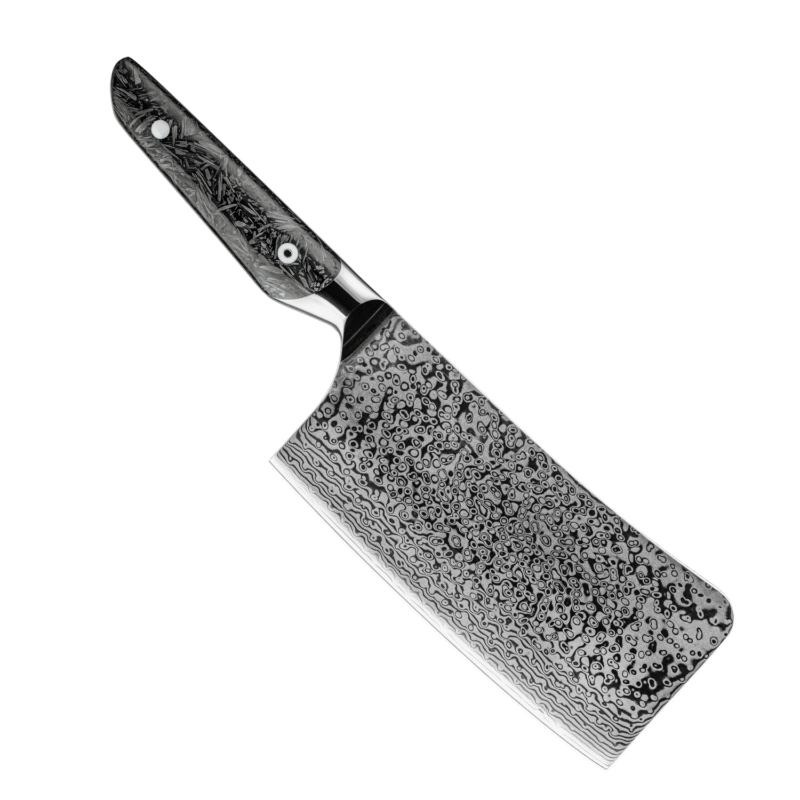
Cleaver
A meat cleaver can be useful for certain pork preparations.
However, a cleaver should be used appropriately.
A heavy cleaver designed for chopping through appropriate bones is different from a thin vegetable cleaver.
Do not use a thin kitchen knife or delicate chef’s knife to chop through hard bones.
That can damage the blade and create an unsafe situation.
https://yashkadesigns.com/petty-knife-damascus-blade
Utility Knife
A smaller utility knife can be useful for:
- Small trimming tasks
- Removing small pieces of connective tissue
- Working with small pork cuts
However, for most major pork preparation, a chef’s knife or boning knife will be more useful.
Best Knife for Each Pork-Cutting Task
| Pork task | Recommended knife |
|---|---|
| Cutting pork loin | Chef’s knife |
| Cutting pork chops | Chef’s knife / butcher knife |
| Trimming tenderloin | Boning knife |
| Removing silverskin | Boning knife |
| Cutting pork belly | Chef’s knife / slicing knife |
| Thin pork belly slices | Slicing knife |
| Pork stir-fry | Chef’s knife |
| Pork tacos | Chef’s knife |
| Carnitas chunks | Chef’s knife |
| Trimming ribs | Boning knife |
| Slicing cooked pork | Slicing knife |
| Working around bones | Boning knife |
| Large bone cutting | Appropriate butcher equipment |
Why Knife Sharpness Matters
A sharp knife is generally safer and easier to control than a dull one.
A dull knife requires more pressure.
More pressure makes it harder to control the blade.
When cutting pork, especially fatty or slippery pieces, this becomes particularly important.
A sharp knife allows you to make:
- Cleaner slices
- More consistent pieces
- More precise trimming
- Less crushing
- More controlled cuts
Check Our Guide The Ultimate Guide to Caring for a Damascus Steel Knife
How to Hold Pork While Cutting
Keep your non-cutting hand away from the blade.
Use a stable grip on the meat.
For smaller pieces, use your fingertips in a controlled position rather than placing your entire hand flat over the meat.
The cutting board should not move.
If necessary, place a damp towel underneath the board to improve stability.
The Claw Grip
The claw grip is useful when cutting pork into strips or cubes.
Curl your fingers slightly so the fingertips are protected.
The knife blade should travel alongside the knuckles rather than toward the fingertips.
This technique is particularly useful when cutting:
- Pork stir-fry
- Pork belly
- Pork loin
- Vegetables alongside pork
- Taco ingredients
How to Make Even Pork Cubes
Uniformity matters more than absolute size.
Start by creating a flat surface.
Cut the pork into strips.
Turn the strips.
Cut across them to create cubes.
If you’re making stew or carnitas, try to keep the pieces approximately the same size.
This allows them to cook more evenly.
How to Cut Pork Thinly
Thin slicing becomes easier when the meat is cold.
Use a sharp knife.
Keep the blade at a consistent angle.
Use long strokes rather than pressing straight downward.
If the meat becomes soft and difficult to control, return it to the refrigerator for a few minutes.
How to Cut Pork for Korean-Style Cooking
Thinly sliced pork is common in many Korean dishes.
Pork belly and shoulder are particularly useful.
For very thin slices, partially freeze the meat first.
Then use a sharp slicing knife or chef’s knife.
Create thin, consistent slices.
These can be marinated and cooked quickly.
How to Cut Pork for Ramen
Pork for ramen can be prepared in several ways.
For sliced roasted pork, cook the pork first and then slice it thinly.
A long slicing knife works particularly well.
For diced pork toppings, use a chef’s knife.
The size depends on the recipe.
Thin slices provide a more traditional presentation, while smaller pieces can be easier to eat.
Check Our Guide Authentic Japanese Ramen Recipe
How to Cut Pork for Fried Rice
For fried rice, pork should generally be cut into small, uniform pieces.
Pork loin, tenderloin, and leftover roast pork can all work.
Cut the meat into thin slices first.
Then cut those slices into small strips or cubes.
Keep the pieces small enough to mix evenly with the rice.
How to Cut Pork for Dumplings
Ground pork is normally used for dumplings, but finely chopped pork can also be used in some preparations.
If chopping pork by hand, first chill the meat thoroughly.
Cut it into small pieces.
Then chop repeatedly with a sharp knife.
A cleaver can make this process faster.
The goal is a fine, consistent texture.
How to Cut Pork for Pizza
Cooked pork can be sliced or diced for pizza.
Good options include:
- Pulled pork
- Pork sausage
- Thin pork belly
- Roast pork
- Bacon
Use a chef’s knife to create small pieces.
Avoid overly large pieces because they can release excess fat during baking.
How to Prepare Pork for Grilling
For grilling, cut pork into portions that are thick enough to remain juicy.
Good choices include:
- Pork chops
- Pork tenderloin
- Pork loin
- Pork shoulder steaks
Try to keep portions similar in thickness.
This allows them to cook more consistently.
Pork Shoulder Steaks
Pork shoulder doesn’t have to be cooked only as a large roast.
It can also be cut into steaks.
Take the shoulder and identify the muscle structure.
Cut thick slices across the shoulder.
These can be marinated and grilled or pan-cooked.
Because shoulder contains more connective tissue than loin, it benefits from appropriate cooking methods.
How to Portion Pork Tenderloin
A whole tenderloin can be divided into several portions.
For medallions, simply slice crosswise.
For stir-fry, cut lengthwise into strips and then into smaller pieces.
For roasting, leave the tenderloin whole.
One cut can therefore become several completely different dishes.
Common Pork Cutting Mistakes
Mistake 1: Using a Dull Knife
A dull blade makes clean cutting difficult.
Keep your knife properly sharpened.
Mistake 2: Cutting Meat Too Warm
Warm meat becomes soft and difficult to control.
Chill it before precision slicing.
Mistake 3: Ignoring the Grain
Cutting in the wrong direction can produce unnecessarily chewy slices.
Mistake 4: Making Pieces Uneven
Large differences in size mean different cooking times.
Mistake 5: Removing Too Much Fat
Fat contributes flavor and moisture.
Trim according to the recipe rather than removing everything.
Mistake 6: Using a Fine Knife on Bone
Don’t force a chef’s knife through hard bone.
Use appropriate equipment.
Mistake 7: Cutting Cooked Pork Immediately
Resting the meat before slicing generally produces better results.
How to Improve Your Pork Knife Skills
The best way to improve is to practice consistency.
Choose one cut of pork and practice making:
- Even slices
- Uniform strips
- Consistent cubes
Don’t focus on speed.
Focus on control.
Speed comes naturally with experience.
A Simple Pork Cutting Workflow
For most pork preparations, this workflow works well:
1. Prepare the Workspace
Use a stable cutting board.
Have a sharp knife ready.
Keep a clean plate nearby for prepared meat.
2. Chill the Pork
Especially for thin slicing.
3. Trim
Remove silverskin, excessive hard fat, and unwanted connective tissue.
4. Identify the Grain
Look at the muscle fibers.
5. Choose the Cut
Decide whether you need:
- Chops
- Cubes
- Strips
- Medallions
- Thin slices
- Large chunks
6. Cut Consistently
Make pieces as uniform as practical.
7. Clean Your Workspace
Wash and sanitize surfaces and utensils appropriately after handling raw pork.
Pork Cutting and Food Safety
Knife skills are important, but food safety is equally important when working with raw pork.
Use a clean cutting board and knife.
Keep raw pork separate from ready-to-eat foods.
Wash your hands after handling raw meat.
Clean surfaces and utensils after preparation.
Keep pork properly refrigerated before cooking.
Cook pork according to the requirements of the specific cut and preparation, using a reliable food thermometer rather than relying only on appearance.
Frequently Asked Questions About Cutting Pork
What is the best knife for cutting pork?
For most everyday pork preparation, a sharp chef’s knife is the most versatile option. A boning knife is better for trimming and working around bones, while a slicing knife is ideal for thin slices of cooked pork.
What knife should I use to cut pork chops?
A sharp chef’s knife can be used for boneless pork loin. For bone-in chops, specialized butcher equipment may be appropriate depending on the cut.
How do you cut pork tenderloin?
Trim the silverskin first, then slice the tenderloin crosswise into medallions or lengthwise into strips for stir-fry.
Should pork be cut with or against the grain?
For sliced cooked pork, cutting across the grain generally produces shorter muscle fibers and a more tender eating texture.
How do you cut pork for stir-fry?
Chill the pork, trim it, identify the grain, and cut it into thin, uniform slices or strips.
What pork is best for carnitas?
Pork shoulder or pork butt is an excellent choice because its fat and connective tissue work well with slow cooking.
How do you cut pork belly?
For cubes, cut the belly into strips and then crosswise into pieces. For thin slices, chill the belly and use a sharp slicing knife.
What knife is best for trimming pork tenderloin?
A narrow boning knife is particularly useful for removing silverskin and trimming the tenderloin.
Should you remove all the fat from pork?
No. The appropriate amount depends on the cut and recipe. Some fat contributes significantly to flavor and moisture.
Final Thoughts: Mastering Pork Cutting and Knife Skills
Learning how to cut and chop pork gives you much more flexibility in the kitchen.
Instead of buying every pork preparation pre-portioned, you can start with larger cuts and create exactly what you need.
A pork loin can become thick pork chops or thin stir-fry strips. Pork tenderloin can become medallions, strips, or a whole roasted centerpiece. Pork shoulder can become large chunks for carnitas, pulled pork, tacos, or stew. Pork belly can be transformed into cubes, thin slices, or roasted portions.
The most important principles are simple:
Use the right knife. Keep it sharp. Chill meat when precision slicing is needed. Understand the grain. Keep pieces consistent. Don’t force a knife through hard bone.
For most kitchen tasks, a good chef’s knife will handle the majority of the work. A boning knife becomes valuable when trimming silverskin and working around bones, while a long slicing knife is the best choice when you want clean, thin slices from a cooked pork roast or tenderloin.
Once these basic techniques become familiar, pork becomes much easier to work with—and you can buy larger cuts, prepare them yourself, and create everything from quick stir-fries and tacos to slow-cooked carnitas and elegant roast pork.