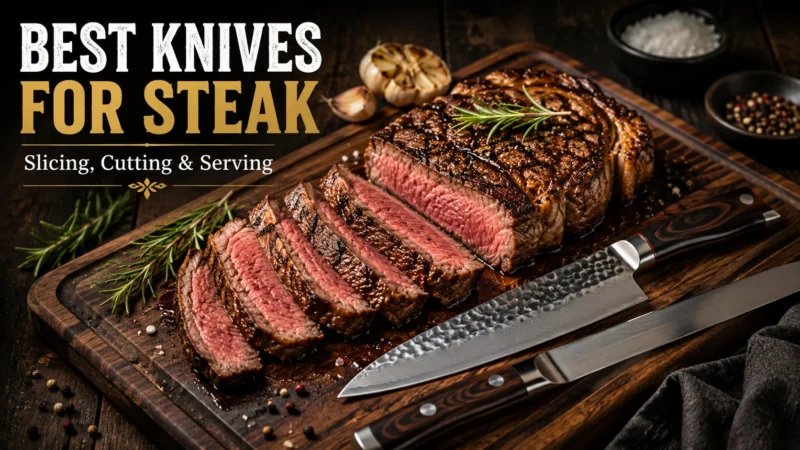
Best Knives for Steak
A great steak deserves more than a good cooking technique. The knife you use to slice, cut, carve, and serve steak can make a surprisingly noticeable difference to the final experience.
A dull or poorly designed knife can tear meat, crush a delicate crust, and make clean slicing difficult. A sharp, well-balanced knife allows you to make controlled cuts and present steak beautifully.
But what is the best knife for steak?
The answer depends on what you are doing.
A knife used to prepare a raw steak is not necessarily the same knife you want at the dinner table. A chef knife can be excellent for trimming and preparing steak, while a long slicing knife is better for carving a large roast or brisket. A straight-edge steak knife can provide clean cuts at the table, while a serrated steak knife can be practical when durability and low maintenance are priorities.
This guide explains the best knives for steak, including chef knives, slicing knives, carving knives, boning knives, and steak knives. You’ll also learn how to choose between serrated and straight-edge steak knives, how to cut steak against the grain, what blade length and steel characteristics matter, and how to care for your steak knives.
Quick Answer: What Is the Best Knife for Steak?
For most home cooks, there isn’t one single “best steak knife.”
Instead, the ideal knife depends on the task.
| Task | Best Knife |
|---|---|
| Preparing raw steak | Chef knife |
| Trimming steak | Boning knife |
| Slicing cooked steak | Slicing/carving knife |
| Cutting a large roast | Long slicing knife |
| Eating steak at the table | Steak knife |
| Cutting delicate steak cleanly | Straight-edge steak knife |
| Low-maintenance table use | Serrated steak knife |
| Preparing vegetables for steak | Chef knife |
| Carving brisket | Long slicing knife |
If you’re building a steak-focused knife collection, a practical combination is:
Chef knife + slicing knife + steak knives.
For more specialized meat preparation, add a boning knife.
Why the Right Steak Knife Matters
Steak contains muscle fibers, connective tissue, fat, and a cooked exterior crust. Cutting it correctly requires a blade that can move through the meat without excessive tearing.
A good steak knife should:
- Cut efficiently
- Feel comfortable in the hand
- Provide good control
- Maintain a useful edge
- Match the type of steak being served
- Be easy to maintain
- Work naturally with the user’s preferred cutting motion
Recent steak-knife testing also emphasizes sharpness, comfort, balance, and how cleanly the blade moves through different types of meat.
The important point is that sharpness and geometry matter more than simply buying the most expensive knife.
The Different Types of Knives for Steak
There are several knives that can legitimately be described as “steak knives,” but they serve different purposes.
https://yashkadesigns.com/damascus-kitchen-knives
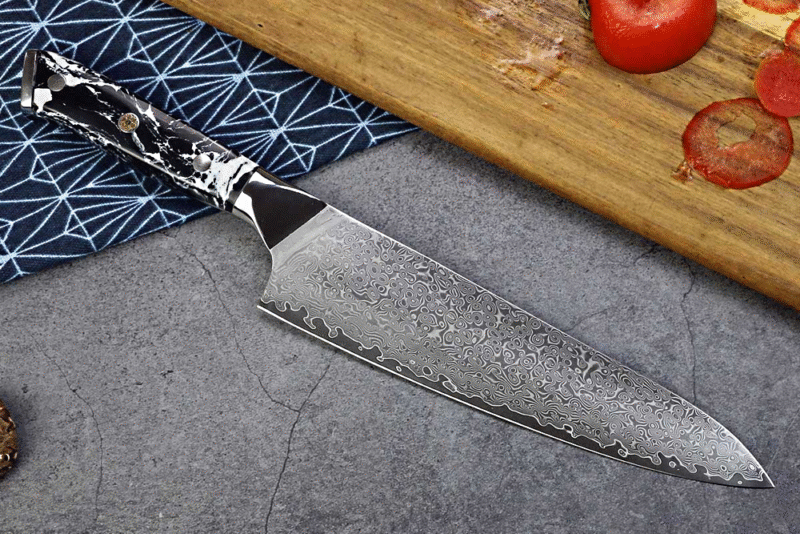
1. Chef Knife
The chef knife is the primary preparation knife in most kitchens.
An 8-inch chef knife can handle:
- Steak trimming
- Cutting raw meat
- Slicing vegetables
- Chopping herbs
- Preparing garlic
- Cutting butter
- Portioning ingredients
For someone who cooks steak at home, a good chef knife is often more useful than a specialized steak knife.
https://yashkadesigns.com/luxury-slicing-knife
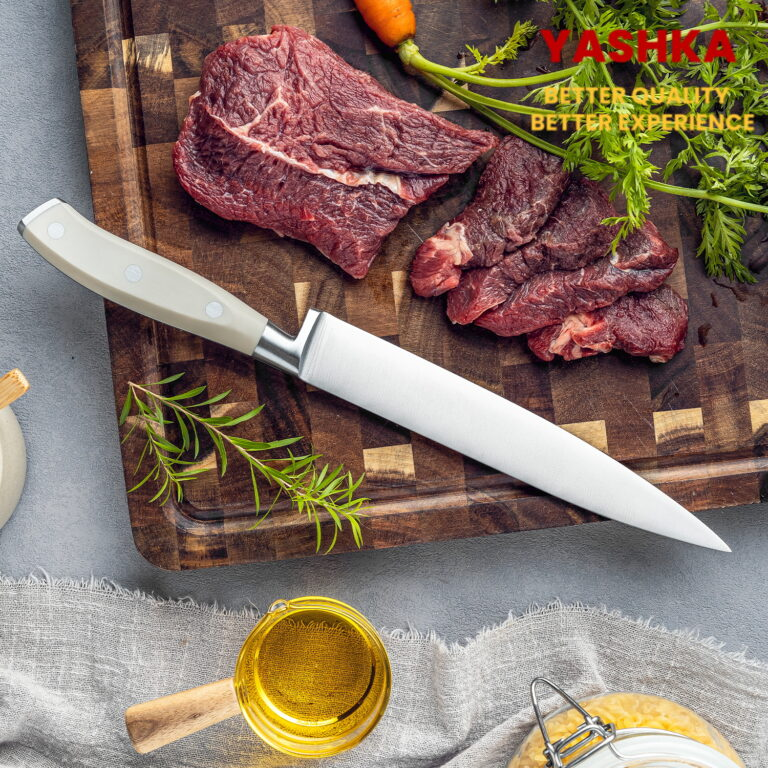
2. Slicing Knife
A slicing knife has a long, relatively narrow blade.
It is designed for making long, smooth cuts through cooked meat.
A slicing knife is particularly useful for:
- Ribeye roasts
- Strip loin
- Prime rib
- Roast beef
- Brisket
- Large steaks
- Tenderloin
The longer blade allows you to make longer strokes instead of repeatedly sawing through the meat.
https://yashkadesigns.com/chef-kitchen-knives
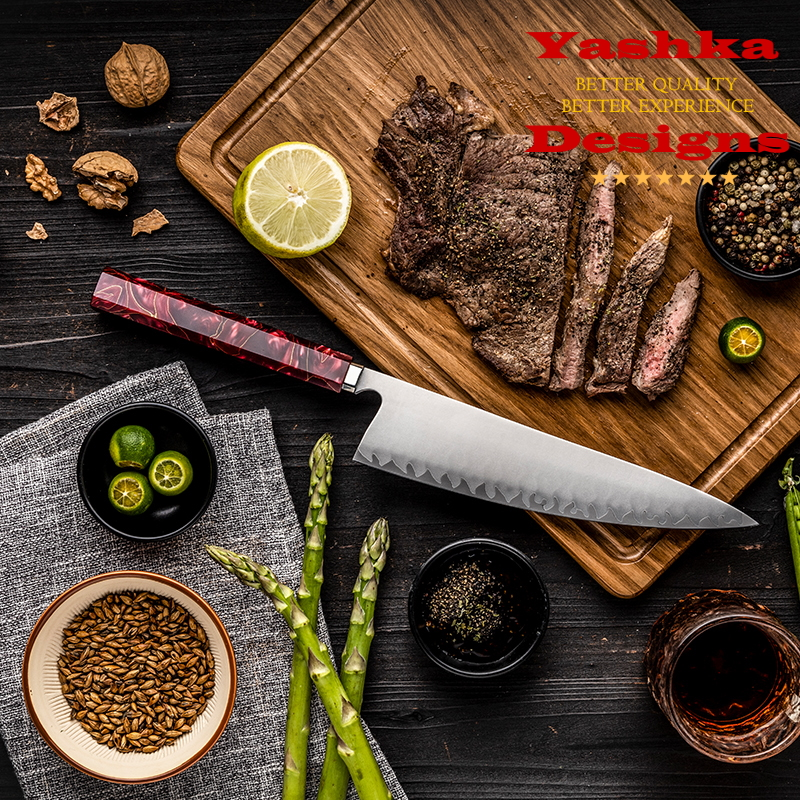
3. Carving Knife
A carving knife is similar to a slicing knife but may have a somewhat different blade profile and rigidity depending on the design.
It is useful for large cuts of cooked meat.
If you frequently prepare large roasts, a carving knife can be an excellent addition to your kitchen.
https://yashkadesigns.com/professional-meat-cleaver-bbq-kitchen
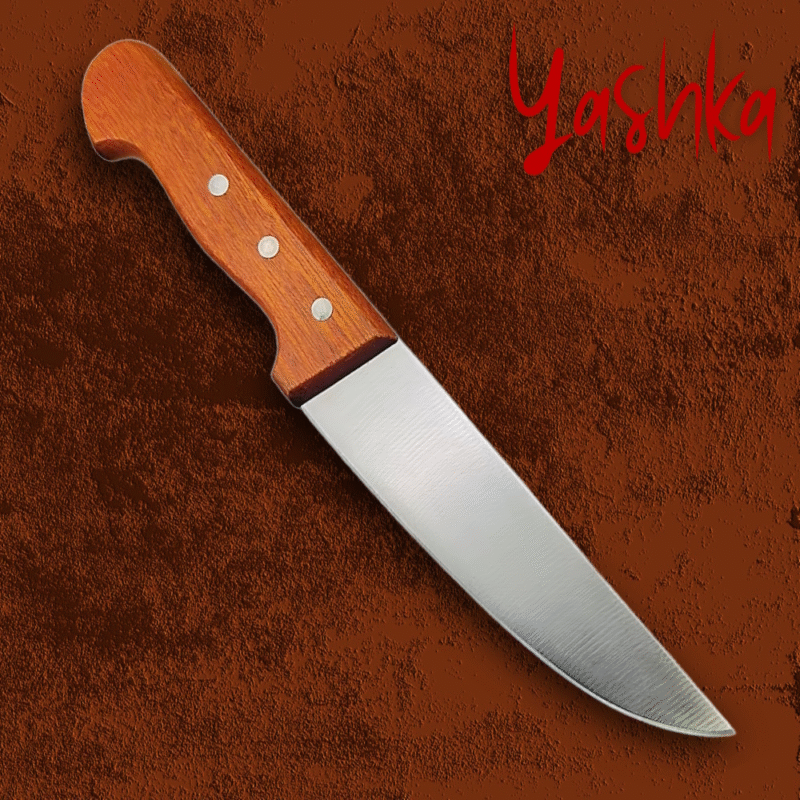
4. Boning Knife
A boning knife is designed primarily for separating meat from bones and trimming.
It is useful for:
- Bone-in ribeye
- T-bone
- Porterhouse
- Whole cuts of beef
- Removing excess fat
- Trimming connective tissue
For everyday steak preparation, a chef knife may be enough.
For serious meat preparation, however, a boning knife gives you much more control.
Check Our Guide Boning Knife vs Honesuki Knife
https://yashkadesigns.com/95-mm-blade-steak-knife

5. Steak Knife
The steak knife is the knife most people associate with steak.
Unlike a chef knife or slicing knife, it is designed primarily for cutting individual portions at the table.
Steak knives generally fall into two broad categories:
- Straight-edge
- Serrated
Both have advantages.
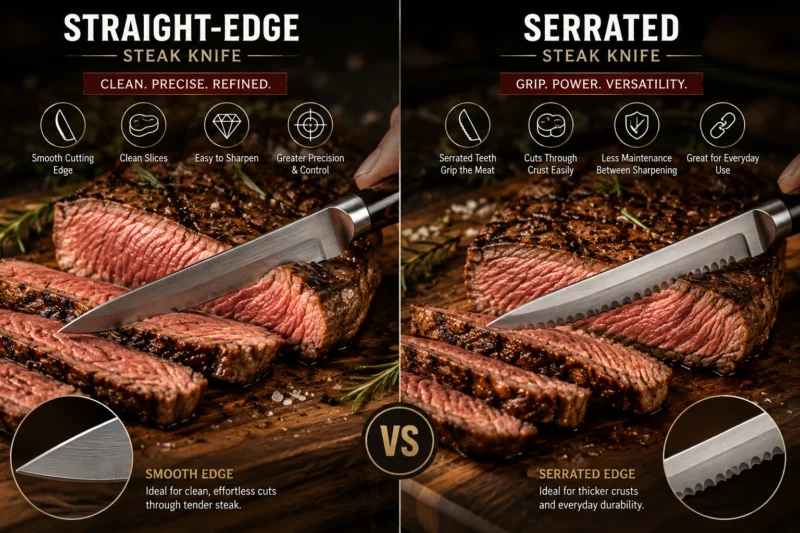
Straight-Edge vs Serrated Steak Knives
This is one of the most common questions when choosing the best steak knife.
Straight-Edge Steak Knives
A straight-edge steak knife has a smooth cutting edge.
Its advantages include:
- Clean slicing
- Precise cuts
- Easy sharpening
- Excellent control
- Attractive presentation
- Ability to resharpen the entire edge
A quality straight-edge knife can glide through a properly cooked steak rather than aggressively tearing it.
Straight-edge Japanese steak knives are often particularly attractive to enthusiasts who value precision and resharpenability.
Serrated Steak Knives
Serrated steak knives have teeth along the cutting edge.
Their primary advantage is that the teeth can grab the surface of food and continue cutting even when the knife isn’t extremely sharp.
Serrated steak knives are popular for:
- Casual dining
- Restaurants
- Large households
- Low-maintenance use
- Tougher crusts
However, sharpening serrations is more specialized than sharpening a straight edge.
Which Is Better: Serrated or Straight-Edge?
There isn’t one universal answer.
Choose straight-edge if you want:
- Maximum precision
- Clean cuts
- Easy sharpening
- A premium knife experience
- A refined appearance
Choose serrated if you want:
- Easy everyday use
- Less frequent sharpening
- Good performance on crusty surfaces
- A practical restaurant-style knife
For someone who appreciates high-quality knives and wants to maintain them properly, I generally favor a straight-edge steak knife.
Best Blade Length for Steak
Steak knives typically have relatively short blades because they are intended for individual portions.
For a slicing knife, however, blade length becomes much more important.
8–9 Inch Blade
A versatile choice for:
- Steaks
- Small roasts
- Tenderloin
- Roast beef
10–12 Inch Blade
Better for:
- Prime rib
- Brisket
- Large roasts
- Long cuts of meat
A longer blade can produce cleaner, longer strokes.
Why Blade Geometry Matters
Two knives can have the same blade length and steel but perform very differently.
Geometry determines how the blade interacts with the food.
Important characteristics include:
- Edge angle
- Blade thickness
- Grind
- Distal taper
- Blade height
- Spine thickness
- Edge geometry
For slicing steak, a relatively thin, refined edge can reduce resistance.
For heavy trimming, a more robust geometry may be preferable.
The Best Steel for Steak Knives
There is no single “best steel” for steak knives.
Different steels emphasize different characteristics.
The most important properties include:
- Edge retention
- Toughness
- Corrosion resistance
- Ease of sharpening
- Wear resistance
VG10 for Steak Knives
VG10 is a popular Japanese stainless steel.
It offers a useful combination of:
- Edge retention
- Corrosion resistance
- Hardness
- Sharpenability
VG10 can be an excellent choice for premium kitchen and steak knives.
Check Our Guide VG10 Steel Review
AUS-8
AUS-8 is another practical stainless steel.
It is generally easier to sharpen than many harder premium steels.
It can be a good choice for cooks who prefer simple maintenance.
Check Our Guide VG10 vs AUS-8 Steel: Which Knife Steel Is Better?
14C28N
14C28N is known for a useful balance of:
- Toughness
- Corrosion resistance
- Edge performance
- Sharpenability
It is particularly interesting for people who want a practical everyday knife rather than an ultra-hard blade.
D2
D2 is known for strong wear resistance and good edge retention.
However, it can be more demanding to sharpen than simpler steels.
For steak knives, D2 can make sense when long edge life is a priority.
Check Our Guide D2 Steel Review: Is D2 Still One of the Best Knife Steels?
S35VN
S35VN is a premium powder metallurgy steel designed to combine edge retention with toughness.
It can be an excellent option for high-performance custom steak knives.
M390
M390 is a premium powder steel known for exceptional wear resistance and corrosion resistance.
It can hold an edge for a long time.
However, high wear resistance can also mean more work when it eventually needs sharpening.
MagnaCut
MagnaCut is a modern powder metallurgy steel designed around an unusually balanced combination of toughness, corrosion resistance, and edge performance.
For premium custom steak knives, it is an interesting option when you want a balance rather than optimizing for only one characteristic.
Does Harder Steel Always Mean a Better Steak Knife?
No.
Hardness is only one factor.
A knife with very high hardness may have excellent edge retention but can be less forgiving if abused.
For a steak knife, the ideal balance depends on how the knife will be used.
A knife used exclusively at the dinner table can prioritize a fine edge and precision.
A knife used for heavy preparation may benefit from greater toughness.
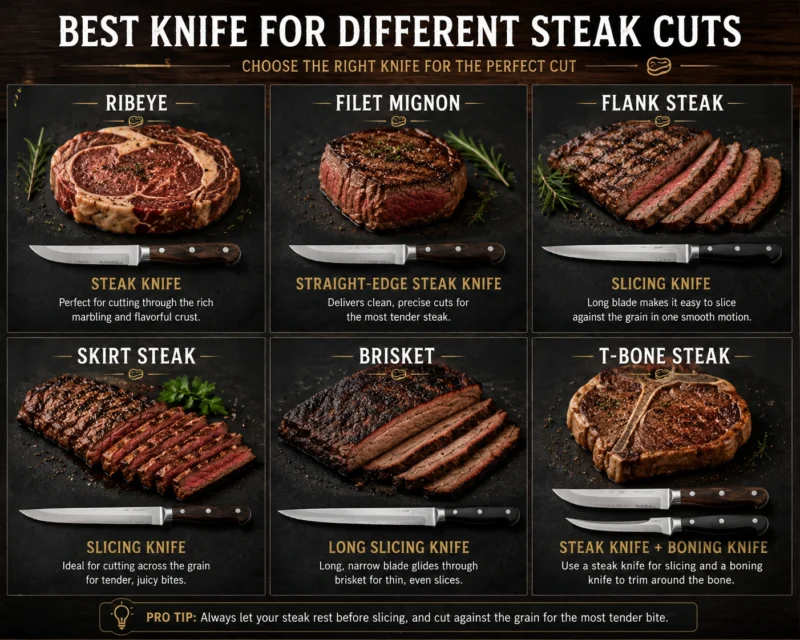
Best Knife for Cutting Ribeye
Ribeye has substantial marbling and can have a thick crust after grilling or searing.
For preparing raw ribeye:
Chef knife
For trimming:
Boning knife
For slicing a large ribeye roast:
Long slicing knife
For eating:
Straight-edge or serrated steak knife
A sharp straight edge is particularly enjoyable with a properly cooked ribeye because it allows controlled cuts through both crust and interior.
Check Our guide The Ultimate American BBQ Meat Guide
Best Knife for New York Strip
New York strip has a relatively consistent structure and is usually easy to portion.
A quality steak knife is sufficient for eating.
If preparing a large strip loin before cooking, use a chef knife or slicing knife depending on the task.
Best Knife for Filet Mignon
Filet mignon is tender and delicate.
A sharp straight-edge steak knife is ideal because it can cut the meat without excessive sawing.
A dull serrated knife may still work, but a refined straight edge can provide a more elegant cutting experience.
Best Knife for T-Bone and Porterhouse
T-bone and Porterhouse steaks contain bone and multiple sections of meat.
For preparation:
Boning knife + chef knife
For serving:
Sharp steak knife
The bone makes aggressive cutting unnecessary.
Instead, work around it carefully.
Best Knife for Flank Steak
Flank steak is one of the most important cuts when discussing slicing technique.
The grain is usually relatively visible.
After cooking, identify the direction of the muscle fibers and slice across the grain.
A long slicing knife or sharp chef knife can work very well.
Best Knife for Skirt Steak
Skirt steak has long, prominent muscle fibers.
Cutting against the grain is especially important.
A sharp slicing knife can make this easier.
For dinner-table use, a sharp steak knife is ideal.
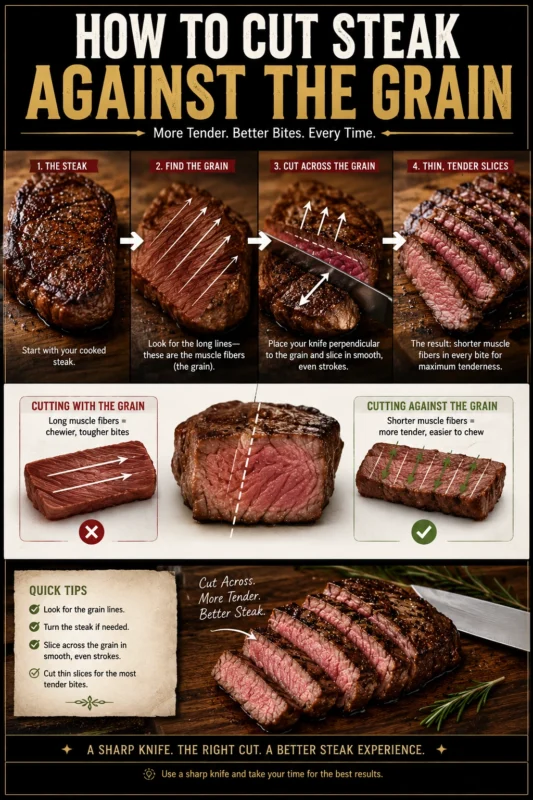
How to Cut Steak Against the Grain
One of the most important steak-cutting skills has nothing to do with the knife’s brand.
It is understanding the grain.
The grain is the direction in which the muscle fibers run.
When you cut with the grain, you leave longer muscle fibers in each bite.
When you cut against the grain, you shorten those fibers.
This generally produces a more tender eating experience.
Step 1: Find the Grain
Look at the surface of the steak.
You may see lines running in one direction.
Those lines indicate the general direction of the muscle fibers.
Step 2: Position the Steak
Place the steak on a stable cutting board.
Identify the direction of the fibers.
Turn the steak so that your knife will cross those fibers rather than follow them.
Step 3: Use a Long, Smooth Motion
Instead of hacking downward repeatedly, use controlled slicing strokes.
Let the sharp edge do the work.
Step 4: Choose the Right Thickness
Thin slices are often ideal for:
- Flank steak
- Skirt steak
- Hanger steak
- Large roasts
For tender steaks such as filet mignon, thicker slices can be appropriate.
Should You Slice Steak Before or After Cooking?
For most steaks, cook first and slice afterward.
This helps retain juices and preserves the structure of the steak.
There are exceptions.
For dishes such as stir-fries or certain marinades, beef may be sliced before cooking.
Should You Rest Steak Before Slicing?
Yes.
Allowing steak to rest before slicing can improve the eating experience.
The USDA recommends that whole cuts of beef reach at least 145°F (63°C) as measured with a food thermometer and recommends a minimum three-minute rest for safety and quality.
Cooking preference and food-safety requirements are not identical concepts, so use a thermometer when appropriate rather than relying solely on appearance.
How Sharp Should a Steak Knife Be?
A steak knife should be genuinely sharp.
A sharp knife requires less force.
That gives you:
- Better control
- Cleaner cuts
- Less tearing
- Greater comfort
- Better presentation
A dull knife often encourages people to use a sawing motion with excessive pressure.
How to Sharpen a Straight-Edge Steak Knife
Straight-edge steak knives can generally be sharpened using the same basic principles as other straight-edge knives.
Options include:
- Whetstone
- Guided sharpening system
- Professional sharpening
A honing rod can help maintain alignment on suitable blades, but honing is not a substitute for sharpening when the edge has actually become dull.
Can Serrated Steak Knives Be Sharpened?
Yes, but serrated knives require a different approach.
Each serration is shaped differently depending on the manufacturer.
A narrow sharpening rod designed for serrations can be used.
Professional sharpening may be preferable for expensive serrated knives.
How to Store Steak Knives
Don’t simply throw quality steak knives into a drawer.
Contact with other utensils can damage edges.
Better options include:
- Knife block
- Knife tray
- Individual blade guards
- Magnetic storage where appropriate
For premium knives, keeping the edges separated is particularly important.
Should Steak Knives Go in the Dishwasher?
For high-quality knives, hand washing is generally the better choice unless the manufacturer specifically states otherwise.
Repeated dishwasher exposure can subject knives to:
- Heat
- Detergents
- Moisture
- Mechanical contact
Even knives labeled dishwasher-safe may benefit from hand washing if long-term appearance and edge condition are priorities.
Food Network’s recent steak-knife testing similarly recommends following manufacturer instructions and generally favors hand washing and immediate drying for longevity.
How to Wash a Steak Knife
Use:
- Warm water
- Mild dish soap
- Soft sponge or cloth
Wash carefully.
Rinse.
Dry immediately.
Never leave a quality knife sitting wet in a sink.
Straight-Edge Steak Knives for Premium Dining
If you’re building a premium table setting, straight-edge steak knives have several advantages.
They provide:
- Clean visual lines
- Precise cutting
- Sharpenability
- A refined appearance
- A more traditional premium-knife experience
They can also match the style of premium kitchen knives used during preparation.
Japanese Steak Knives
Japanese-inspired steak knives are becoming increasingly popular among knife enthusiasts.
Typical characteristics may include:
- Thin blades
- Fine edges
- Lightweight construction
- Premium steels
- Refined handles
- Minimalist design
The emphasis is generally on precision and clean cutting.
This makes Japanese-style steak knives particularly appealing to people who already appreciate Japanese chef knives.
Damascus Steak Knives
Damascus-style steak knives are popular because of their distinctive blade patterns.
The visual appeal can make them excellent choices for:
- Gifts
- Weddings
- Special occasions
- Premium dinner settings
- Knife collections
However, Damascus patterning should not automatically be interpreted as a performance guarantee.
The actual performance depends on the underlying steel, heat treatment, geometry, and edge.
What Makes a Good Steak Knife Handle?
Handle comfort matters because cutting steak involves repeated hand movements.
Look for:
- Comfortable contours
- Secure grip
- Good balance
- Appropriate weight
- Smooth finishing
- Durable materials
Popular handle materials include:
- Wood
- Stabilized wood
- Micarta
- G10
- Pakkawood
- Synthetic composites
For premium steak knives, the handle can also contribute significantly to the overall appearance of a table setting.
Full Tang vs Hidden Tang Steak Knives
Both constructions can work well.
Full Tang
The tang extends through the handle.
Advantages can include:
- Strong construction
- Traditional appearance
- Good balance
- Robustness
Hidden Tang
The tang is enclosed within the handle.
Advantages can include:
- Elegant appearance
- Traditional Japanese-style aesthetics
- Lightweight construction
- Greater freedom in handle design
The construction should be evaluated as part of the entire knife rather than treated as the only measure of quality.
How Much Should You Spend on Steak Knives?
There is no magic price.
A useful approach is to think about how often you eat steak.
Occasional steak dinners
A good-quality affordable set is sufficient.
Frequent steak cooking
Invest in better steel and construction.
Serious knife enthusiast
Premium straight-edge steak knives can make sense.
Gift or luxury dining
Consider premium materials, custom handles, or Damascus construction.
The goal isn’t simply to spend more.
The goal is to buy a knife whose performance and construction match your needs.
One Steak Knife or a Set?
For a couple, four steak knives may be unnecessary.
For a family or someone who regularly entertains guests, a four- or six-piece set is more practical.
When buying a set, consider whether all knives are identical.
Matching knives create a more cohesive table setting.
What to Look for in a Steak Knife Set
Before buying, check:
Blade
- Steel type
- Straight or serrated edge
- Blade thickness
- Blade length
- Grind
Handle
- Material
- Comfort
- Balance
- Construction
Maintenance
- Sharpenability
- Corrosion resistance
- Washing requirements
Design
- Matching set
- Finish
- Handle style
- Overall appearance
The Best Knife for Steak Preparation vs Serving
This distinction is important.
Many articles about “best steak knives” focus exclusively on table knives.
But if you’re cooking steak regularly, your preparation knife may be even more important.
A practical steak knife system looks like this:
Preparation
Chef knife
↓
Trimming
Boning knife
↓
Carving
Slicing knife
↓
Serving
Steak knife
This gives you the right tool for every stage.
Best Knife Combination for a Home Steak Cook
If you only want three knives, I’d choose:
1. 8-Inch Chef Knife
For general preparation.
2. 10–12-Inch Slicing Knife
For large steaks, roasts, and brisket.
3. Four Steak Knives
For serving.
If you frequently purchase whole cuts or bone-in beef, add a boning knife.
Check Our Guide Best Handmade Knives for BBQ Season
Best Knife for Steak and Vegetables
A chef knife is the obvious choice.
When preparing a steak dinner, you may also need to cut:
- Potatoes
- Onions
- Garlic
- Mushrooms
- Asparagus
- Peppers
- Herbs
A chef knife handles all of these tasks.
This is another reason why investing in one excellent chef knife can be more useful than buying a large collection of specialized knives.
Steak Knife Maintenance Checklist
To keep your knives performing well:
Wash by hand when appropriate.
Dry immediately.
Avoid cutting on glass or stone surfaces.
Don’t use steak knives to pry or twist.
Sharpen straight edges when needed.
Use appropriate serration sharpening for serrated blades.
Store knives safely.
Keep blades away from other metal utensils.
Common Steak Knife Mistakes
Using a dull knife
This is perhaps the biggest mistake.
A dull blade requires more force and often tears meat.
Cutting steak immediately
Give the steak time to rest before slicing.
Cutting with the grain
Especially problematic with flank and skirt steak.
Using a tiny blade for a large roast
A longer slicing knife will generally make the job easier.
Using a serrated knife for everything
Serrations are useful, but they aren’t necessarily ideal when you want precise, clean cuts.
Washing premium knives carelessly
Repeated dishwasher use and poor storage can shorten the useful life of a knife.
Best Steak Knife: Final Recommendations
The best steak knife depends on your priorities.
Best for precision
Straight-edge steak knife
Best for low maintenance
Serrated steak knife
Best for steak preparation
Chef knife
Best for carving
Long slicing knife
Best for trimming
Boning knife
Best for premium dining
High-quality straight-edge steak knife
Best all-around setup
Chef knife + slicing knife + steak knife set
Frequently Asked Questions
What is the best knife for cutting steak?
For eating steak, a sharp steak knife is the most appropriate choice. For preparing or slicing a large steak or roast, a chef knife or long slicing knife may be better.
Are serrated steak knives better?
Not necessarily. Serrated knives are practical and low-maintenance, while straight-edge knives generally provide greater precision and are easier to resharpen.
Should a steak knife be serrated?
It doesn’t have to be. A high-quality straight-edge steak knife can cut steak extremely cleanly when properly sharpened.
What size steak knife is best?
Most steak knives are relatively compact. For carving large cuts, choose a longer slicing knife rather than a standard table steak knife.
What knife should I use to cut ribeye?
Use a chef knife for raw ribeye preparation, a slicing knife for large cooked ribeye roasts, and a steak knife for serving individual portions.
What knife should I use for brisket?
A long slicing knife is ideal for cooked brisket. Because brisket grain can vary, a sharp, long blade gives you better control over thin slices.
Should I cut steak with or against the grain?
For cuts where the grain is clearly identifiable, cutting across the grain shortens the muscle fibers and generally produces a more tender bite.
Are Japanese steak knives good?
Yes. Japanese-style steak knives can be excellent for people who prioritize thin edges, precision, premium steels, and refined craftsmanship.
Are Damascus steak knives better?
Not automatically. Damascus describes a construction or visual pattern depending on the product. Performance depends on the actual steels, heat treatment, geometry, and edge.
How do I keep a steak knife sharp?
Use an appropriate sharpening method for the blade type. Straight edges can be sharpened on stones or guided systems; serrated edges require specialized sharpening.
Final Thoughts: Choosing the Best Knife for Steak
The best steak knife isn’t necessarily the most expensive knife or the knife with the most impressive-looking blade.
It’s the knife that matches the way you prepare and eat steak.
For most home cooks, the ideal setup begins with a sharp chef knife for preparation and a quality steak knife for serving. If you regularly cook large cuts of beef, adding a long slicing knife can make a substantial difference.
When choosing steak knives, pay particular attention to edge type, blade geometry, steel, handle comfort, balance, and maintenance requirements.
A straight-edge knife is an excellent choice when precision and resharpenability are priorities. A serrated knife is practical when you want a more forgiving, low-maintenance option.
Most importantly, remember that the knife is only part of the equation.
Start with a quality steak, cook it appropriately, allow it to rest, identify the grain, and use a sharp blade with controlled strokes. A good knife then becomes what it should be: a tool that makes excellent food easier to prepare and more enjoyable to eat.
https://ask.fsis.usda.gov/article/What-is-a-safe-internal-temperature-for-cooking-meat-and-poultry