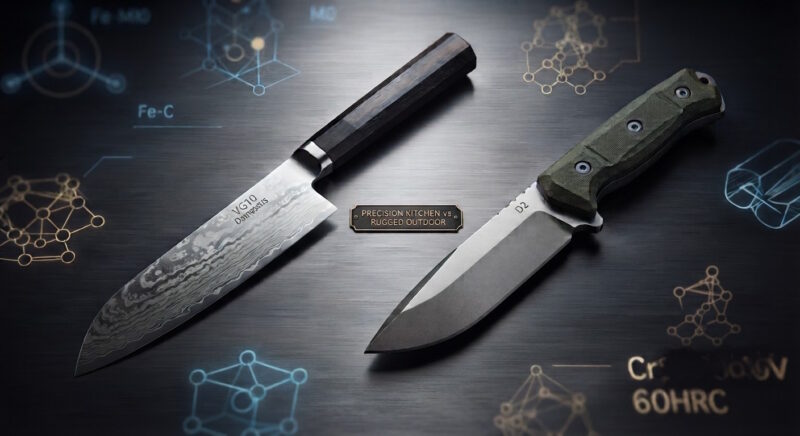
VG10 vs D2 Steel
An Independent Guide
Introduction: VG10 or D2 — Which Knife Steel Is Better?
Choosing the right knife steel can be confusing. Two popular blade materials often compared by knife enthusiasts are VG10 and D2 steel. Both have earned a strong reputation, but they represent two different approaches to knife performance.
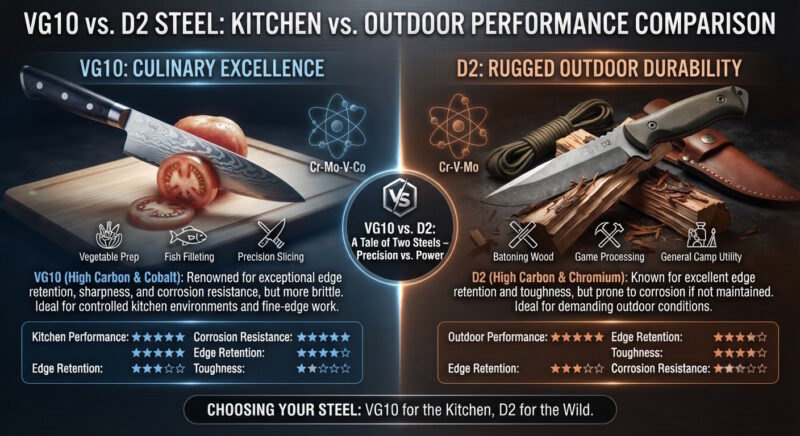
VG10 is widely recognized as a premium stainless steel designed for kitchen knives, offering excellent corrosion resistance, balanced hardness, and easy maintenance. D2, on the other hand, is a semi-stainless high-carbon tool steel known for outstanding wear resistance, toughness, and long-lasting edge retention.
At first glance, both steels appear similar because they can achieve comparable hardness levels and excellent cutting performance. However, their internal chemistry creates major differences in everyday use.
VG10 focuses on:
- Stainless performance
- Easy sharpening
- Clean cutting ability
- Kitchen applications
- Low maintenance
D2 focuses on:
- High wear resistance
- Strong edge retention
- Outdoor and EDC applications
- Tough working performance
- Aggressive cutting ability
So which one is better?
The answer depends on how the knife will be used. A chef who works in a wet kitchen environment may prefer VG10, while an outdoorsman who needs a durable working blade may choose D2.
This detailed comparison explains the differences between VG10 and D2 steel, including:
- Chemical composition
- Hardness
- Edge retention
- Corrosion resistance
- Toughness
- Sharpening difficulty
- Kitchen performance
- Outdoor performance
- Maintenance requirements
VG10 Steel Overview
VG10 is a stainless Japanese blade steel developed for high-performance kitchen knives. It became popular because it offers a very balanced combination of sharpness, durability, corrosion resistance, and ease of maintenance.
Unlike many extremely hard steels that are difficult to sharpen, VG10 provides a practical balance between performance and usability.
A properly heat-treated VG10 blade usually reaches around:
Hardness: 59–61 HRC
This hardness range allows the steel to maintain a fine edge while still being relatively easy to sharpen.
VG10 is especially popular among:
- Chef knives
- Santoku knives
- Gyuto knives
- Slicing knives
- Everyday kitchen blades
The main advantage of VG10 is balance. It does not specialize in only one area. Instead, it provides strong overall performance.
Check Our Guide VG10 Steel Review
VG10 Chemical Composition
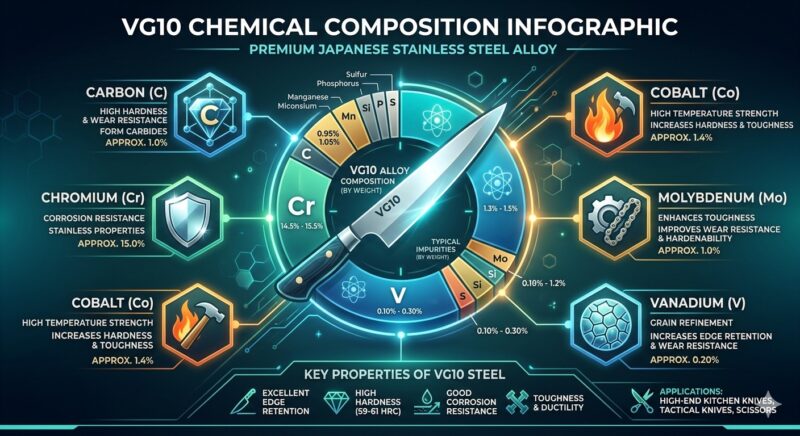
The performance of any knife steel comes from its alloy elements. VG10 contains a carefully balanced mixture of carbon, chromium, cobalt, molybdenum, and vanadium.
Typical composition:
| Element | Approximate Amount | Function |
|---|---|---|
| Carbon | ~1.0% | Increases hardness and edge retention |
| Chromium | ~15% | Improves corrosion resistance |
| Cobalt | ~1.5% | Enhances strength and hardness response |
| Molybdenum | ~1.2% | Improves toughness and wear resistance |
| Vanadium | ~0.2% | Helps refine carbide structure |
The relatively high chromium content gives VG10 excellent stainless properties.
Carbon increases hardness, while vanadium and molybdenum contribute to better edge stability.
The result is a steel that can take a very sharp edge and maintain it during normal kitchen tasks.
VG10 Performance Characteristics
Edge Retention
VG10 offers very good edge retention compared with traditional stainless kitchen steels.
It performs better than many common steels because of:
- Higher carbon content
- Strong carbide formation
- Good heat treatment response
However, compared with modern high-wear steels, VG10 will lose its edge faster during extremely abrasive cutting.
For example:
Excellent performance:
- Vegetables
- Meat preparation
- Fish processing
- General kitchen work
Less ideal:
- Cutting cardboard for hours
- Heavy outdoor tasks
- Abrasive materials
VG10 is designed for precision cutting rather than extreme wear resistance.
Corrosion Resistance
One of VG10’s strongest advantages is corrosion resistance.
With approximately 15% chromium, VG10 creates a protective chromium oxide layer that helps prevent rust.
This makes it excellent for:
- Professional kitchens
- Humid environments
- Food preparation
- Users who prefer low maintenance knives
A VG10 knife can usually handle:
- Water exposure
- Acidic foods
- Daily kitchen humidity
However, no steel is completely rust-proof. Proper care is still recommended:
- Dry the blade after washing
- Avoid leaving food residue on the edge
- Store in a dry place
D2 Steel Overview
D2 is a high-carbon tool steel originally developed for industrial cutting applications. It became popular in knives because of its excellent wear resistance and ability to maintain a sharp edge for a long time.
Unlike VG10, D2 is not a fully stainless steel.
It contains a high amount of carbon and chromium, but much of the chromium is locked inside carbide structures. This means less chromium remains available for corrosion protection.
Typical D2 hardness:
Hardness: 58–62 HRC
Depending on heat treatment, D2 can become extremely wear resistant.
D2 is popular for:
- Folding knives
- Outdoor knives
- Hunting knives
- Utility blades
- Heavy-duty cutting tools
Check Our Guide D2 Steel Review
D2 Chemical Composition
Typical D2 composition:
| Element | Approximate Amount | Function |
|---|---|---|
| Carbon | 1.5% | Provides hardness and wear resistance |
| Chromium | 12% | Improves corrosion resistance |
| Molybdenum | 1% | Improves strength |
| Vanadium | 1% | Creates hard carbides |
| Manganese | 0.4% | Improves toughness |
The higher carbon and vanadium content create a large amount of hard carbides.
These carbides are responsible for D2’s impressive edge retention.
However, the same carbide structure can make sharpening more demanding.
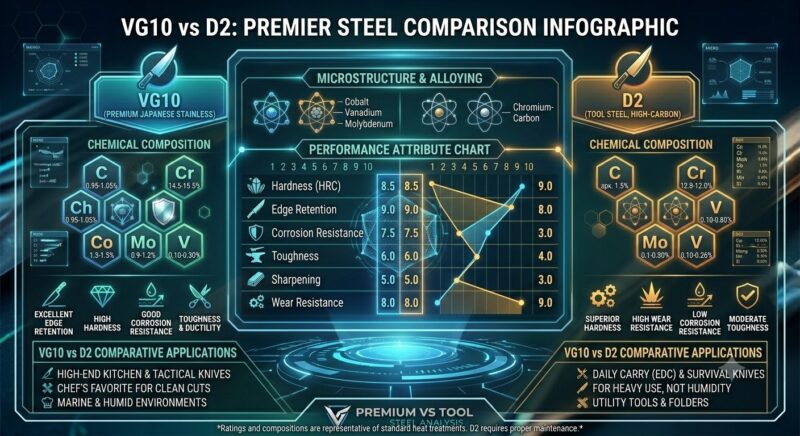
Edge Retention Comparison: VG10 vs D2
Edge retention is one of the most important factors when choosing a knife steel. It describes how long a blade can continue cutting effectively before it becomes noticeably dull.
The ability of a steel to hold an edge depends on several factors:
- Carbon content
- Carbide structure
- Heat treatment
- Blade geometry
- Cutting material
- Edge angle
VG10 and D2 both provide good edge retention, but they achieve it differently.
VG10 Edge Retention Performance
VG10 provides excellent edge retention for a stainless kitchen steel.
Its advantages come from:
- Balanced carbon content
- Fine carbide structure
- Good hardness potential
- Stable edge geometry
A VG10 kitchen knife can maintain a sharp edge through many food preparation tasks:
- Slicing vegetables
- Cutting meat
- Preparing fish
- General cooking
The fine carbide structure allows VG10 to produce a very refined edge. This means it can feel extremely sharp, especially when sharpened properly.
However, VG10 is not designed for maximum wear resistance. When cutting abrasive materials, the edge will degrade faster compared with D2.
D2 Edge Retention Performance
D2 generally has better edge retention than VG10, especially during heavy cutting.
The reason is the large amount of hard carbides created by:
- High carbon content
- High chromium content
- Vanadium additions
These carbides resist abrasion, allowing the edge to remain functional longer.
D2 performs especially well when cutting:
- Cardboard
- Rope
- Wood
- Packaging materials
- Outdoor materials
For users who frequently perform demanding cutting tasks, D2 can offer noticeably longer working time between sharpening.
Edge Retention Winner: D2
Advantage: D2
D2 usually keeps a working edge longer because of its higher wear resistance.
However, VG10 may feel sharper during precision cutting because it can take a very fine polished edge.
A useful comparison:
| Category | Winner |
|---|---|
| Long working edge retention | D2 |
| Fine slicing sharpness | VG10 |
| Kitchen cutting | VG10 |
| Heavy-duty cutting | D2 |
Wear Resistance Comparison
Wear resistance determines how well steel resists material removal during cutting.
A steel with high wear resistance loses less metal during use and maintains its edge longer.
D2 has a significant advantage in this category.
Why D2 Has Higher Wear Resistance
D2 contains a large volume of hard chromium carbides.
These carbides are extremely resistant to abrasion.
During cutting, the softer steel matrix wears away slowly while the carbides help maintain the cutting structure.
This makes D2 excellent for:
- Utility knives
- Outdoor blades
- Work knives
- EDC knives
VG10 Wear Resistance
VG10 has good wear resistance but uses a different design philosophy.
Instead of maximizing carbide volume, VG10 focuses on balance:
- Stainless performance
- Fine edge quality
- Easy maintenance
- Sharpening simplicity
The smaller carbide structure allows VG10 to achieve excellent slicing ability.
This is one reason many professional cooks prefer it.
A chef usually values:
- Clean cuts
- Easy sharpening
- Predictable performance
rather than maximum abrasion resistance.
Wear Resistance Winner: D2
Advantage: D2
D2 is better when the knife is used for long cutting sessions involving abrasive materials.
VG10 is better when precision and control are more important.
Toughness Comparison: VG10 vs D2
Toughness describes how well a steel resists:
- Chipping
- Cracking
- Breaking
- Impact damage
This is especially important for outdoor and survival knives.
VG10 Toughness
VG10 has moderate toughness.
Its fine grain structure helps it resist small chips when properly heat-treated.
VG10 performs well for:
- Kitchen knives
- Slicing tasks
- Controlled cutting
However, it is not intended for extreme impact tasks.
Using a VG10 knife for:
- Chopping frozen food
- Twisting cuts
- Hard impacts
can damage the edge.
D2 Toughness
D2 has excellent wear resistance but only moderate toughness.
The large carbide structure that gives D2 long edge retention can also make it more vulnerable to:
- Edge chipping
- Impact damage
- Hard twisting forces
D2 works very well when cutting straight through materials.
It is less suitable for:
- Batoning wood
- Heavy chopping
- Extreme impact use
Toughness Winner: VG10
Advantage: VG10
VG10 generally offers better toughness and a more forgiving cutting edge.
For kitchen applications, this is a major advantage.
Sharpening Comparison: VG10 vs D2
Sharpening is often overlooked when choosing knife steel.
A knife that holds an edge for a long time is not always better if sharpening becomes extremely difficult.
Sharpening VG10
VG10 is considered a relatively easy steel to sharpen.
Benefits:
- Responds well to sharpening stones
- Develops a fine edge quickly
- Easy for beginners and professionals
- Works well with traditional sharpening methods
VG10 can achieve:
- Razor sharp edges
- Polished finishes
- Excellent slicing performance
For kitchen users who maintain knives regularly, VG10 is very convenient.
Sharpening D2
D2 is more challenging to sharpen.
Reasons:
- High wear resistance
- Hard carbides
- Higher abrasion resistance
A dull D2 blade usually requires:
- More sharpening time
- Quality abrasive stones
- Better technique
However, once sharpened correctly, it can maintain the edge much longer.
Sharpening Winner: VG10
Advantage: VG10
VG10 is easier to maintain and more beginner-friendly.
D2 rewards users who want longer edge life but are willing to spend more time sharpening.
Corrosion Resistance Comparison
Corrosion resistance is another major difference between these steels.
VG10 Corrosion Resistance
VG10 is a true stainless steel.
Its chromium content provides excellent resistance against:
- Rust
- Moisture
- Food acids
This makes it ideal for:
- Kitchens
- Coastal environments
- Daily carry where low maintenance is important
D2 Corrosion Resistance
D2 is often called semi-stainless.
Although it contains a high chromium percentage, much of that chromium forms carbides.
As a result, D2 has less free chromium available for corrosion protection.
D2 can develop:
- Patina
- Surface oxidation
- Small rust spots if neglected
Maintenance recommendations:
- Wipe dry after use
- Apply protective oil when storing
- Avoid prolonged moisture exposure
Corrosion Resistance Winner: VG10
Advantage: VG10
VG10 clearly performs better in humid and wet environments.
VG10 vs D2 Performance Summary Table
| Performance Category | Winner |
|---|---|
| Edge retention | D2 |
| Wear resistance | D2 |
| Toughness | VG10 |
| Corrosion resistance | VG10 |
| Sharpening ease | VG10 |
| Fine edge quality | VG10 |
| Heavy cutting | D2 |
| Kitchen performance | VG10 |
| Outdoor utility | D2 |
Which Steel Has Better Heat Treatment Potential?
Heat treatment plays a huge role in knife performance.
A well-treated steel can outperform a poorly treated premium steel.
Both VG10 and D2 can achieve excellent performance when properly processed.
VG10 Heat Treatment
VG10 benefits from:
- Fine grain structure
- Stable hardness
- Reliable edge performance
Typical working hardness:
59–61 HRC
This range provides an excellent balance between sharpness and durability.
D2 Heat Treatment
D2 responds strongly to heat treatment.
Proper processing can produce:
- High hardness
- Excellent wear resistance
- Long-lasting edges
Typical working hardness:
58–62 HRC
The quality of heat treatment is especially important because improper processing can increase brittleness.
Check Our Guide Different Heat Treatment Methods Explained
Final Thoughts
VG10 and D2 are both excellent knife steels, but they are optimized for different priorities.
Choose VG10 if you want:
✓ Stainless performance
✓ Easy sharpening
✓ Fine slicing ability
✓ Kitchen reliability
✓ Low maintenance
Choose D2 if you want:
✓ Maximum wear resistance
✓ Longer edge retention
✓ Hard-working performance
✓ Outdoor capability
VG10 vs D2 for Kitchen Knives
Kitchen knives have very different requirements compared with outdoor or utility blades.
A chef usually needs:
- Extremely sharp cutting ability
- Smooth slicing performance
- Corrosion resistance
- Easy maintenance
- Simple sharpening
For this type of work, VG10 and D2 behave very differently.
VG10 Kitchen Knife Performance
VG10 is one of the most popular choices for high-performance kitchen knives because it provides an excellent balance between sharpness, durability, and maintenance.
A VG10 kitchen knife performs especially well for:
- Vegetables
- Meat
- Fish
- Fruits
- Herbs
- Precision slicing
The steel can be sharpened to a very fine edge, allowing clean cuts with minimal resistance.
This is especially important when preparing delicate ingredients.
For example:
When slicing tomatoes, onions, or herbs, a properly sharpened VG10 blade can create very thin, precise cuts without crushing the food.
Advantages of VG10 in the Kitchen
1. Excellent Sharpness
VG10 can achieve a very refined edge.
This makes it suitable for:
- Chef knives
- Gyuto knives
- Santoku knives
- Slicing knives
The blade feels smooth and controlled during cutting.
2. High Corrosion Resistance
Kitchen environments expose knives to:
- Water
- Salt
- Acidic foods
- Steam
VG10 handles these conditions very well.
A cook does not need to constantly worry about:
- Rust spots
- Patina development
- Immediate drying after every small task
3. Easy Maintenance
Many professional and home cooks appreciate VG10 because it is practical.
Routine maintenance usually requires:
- Washing after use
- Drying the blade
- Occasional sharpening
D2 Kitchen Knife Performance
D2 can work well as a kitchen knife, but it is not naturally optimized for this environment.
Its strengths are different.
D2 provides:
- Strong edge retention
- High wear resistance
- Durable cutting performance
However, kitchen use creates some challenges.
Limitations of D2 in the Kitchen
1. Lower Corrosion Resistance
Daily exposure to:
- Water
- Citrus
- Tomatoes
- Vinegar
- Salty foods
requires more attention.
A D2 kitchen knife should be:
- Cleaned quickly
- Dried immediately
- Properly stored
2. Sharpening Requires More Effort
Professional cooks often sharpen knives regularly.
VG10 responds quickly to sharpening stones.
D2 usually requires more time because of its harder carbide structure.
3. Less Ideal for Fine Slicing
D2 can become very sharp, but VG10 generally provides a smoother slicing experience.
For tasks requiring precision, VG10 has an advantage.
Kitchen Knife Winner: VG10
For most kitchen applications:
VG10 is the better choice.
Reasons:
✓ Better corrosion resistance
✓ Easier sharpening
✓ Cleaner slicing performance
✓ Lower maintenance
D2 can still be a good kitchen steel for users who prioritize long edge life and do not mind extra maintenance.
VG10 vs D2 for Outdoor and Hunting Knives
Outdoor knives have completely different priorities.
Important characteristics include:
- Edge retention
- Wear resistance
- Durability
- Resistance to abuse
- Field maintenance
Here D2 becomes much more competitive.
VG10 Outdoor Performance
VG10 works well for:
- Camping knives
- Small outdoor blades
- General utility knives
Advantages:
- Stainless performance
- Easy sharpening
- Reliable cutting ability
A camper who spends time near water may appreciate VG10 because it requires less maintenance.
However, VG10 is not the best choice for extreme outdoor tasks.
Examples:
- Heavy chopping
- Cutting abrasive materials
- Hard utility work
Other steels may provide better performance.
D2 Outdoor Performance
D2 is extremely popular for outdoor knives because of its wear resistance.
It performs well for:
- Hunting knives
- Bushcraft knives
- EDC knives
- Utility blades
Advantages:
Long-Lasting Edge
When cutting:
- Rope
- Wood
- Cardboard
- Synthetic materials
D2 can maintain a working edge for a long time.
Check Our Guide Best Hunting Knife Features Explained
Excellent Abrasion Resistance
Outdoor materials are often more abrasive than food.
D2’s carbide structure provides a significant advantage.
Strong Working Performance
A properly made D2 blade is a reliable tool for demanding jobs.
Outdoor Knife Winner: D2
For outdoor and utility applications:
D2 usually has the advantage.
Reasons:
✓ Better wear resistance
✓ Longer edge life
✓ Excellent working performance
However, users in wet environments may still prefer stainless steels.
VG10 vs D2 Blade Geometry Considerations
Steel is only one part of knife performance.
Blade design can completely change the result.
Important factors include:
- Blade thickness
- Edge angle
- Grind type
- Blade shape
- Heat treatment
Thin Blade vs Thick Blade
A thin VG10 blade can outperform a thicker D2 blade in slicing tasks.
Why?
Because cutting efficiency depends heavily on geometry.
A thin edge:
- Separates material easier
- Requires less force
- Feels sharper
A thicker D2 blade may perform better for:
- Hard cutting
- Outdoor tasks
- Utility work
Check Our Guide Best Blade Thickness for Different Uses
Edge Angle Comparison
Typical angles:
VG10 Kitchen Knife
Approximately:
12–15 degrees per side
Advantages:
- Maximum sharpness
- Excellent slicing
D2 Utility Knife
Approximately:
15–20 degrees per side
Advantages:
- Stronger edge
- Better durability
Real-World Cutting Comparison
Cutting Vegetables
Winner: VG10
Why:
- Cleaner cuts
- Better slicing feel
- Easier maintenance
Cutting Meat
Winner: VG10
Advantages:
- Fine edge
- Smooth performance
Cutting Rope
Winner: D2
Advantages:
- Higher wear resistance
- Longer edge life
Cutting Cardboard
Winner: D2
Advantages:
- Better abrasion resistance
Outdoor Camping Tasks
Winner: D2
Advantages:
- Long working edge
- Strong utility performance
Humid Environment
Winner: VG10
Advantages:
- Better corrosion protection
VG10 Steel Pros and Cons
Advantages
✓ Excellent corrosion resistance
✓ Easy sharpening
✓ Fine edge capability
✓ Great kitchen performance
✓ Balanced hardness
✓ Low maintenance
✓ Good toughness
Disadvantages
✗ Lower wear resistance than D2
✗ Edge does not last as long during abrasive cutting
✗ Not designed for extreme outdoor abuse
D2 Steel Pros and Cons
Advantages
✓ Excellent edge retention
✓ Very high wear resistance
✓ Strong working performance
✓ Good hardness potential
✓ Excellent for outdoor and utility knives
Disadvantages
✗ Lower corrosion resistance
✗ More difficult sharpening
✗ Can be more prone to edge chipping
✗ Requires more maintenance
VG10 vs D2: Who Should Choose Which Steel?
Choose VG10 If You Are:
- A home cook
- A professional chef
- Looking for a low-maintenance knife
- Cutting food daily
- Interested in easy sharpening
- Living in a humid environment
Choose D2 If You Are:
- An outdoor enthusiast
- A hunter
- Looking for long edge retention
- Using a knife for utility work
- Cutting abrasive materials
- Comfortable with additional maintenance
Quick Decision Table
| User Type | Recommended Steel |
|---|---|
| Chef | VG10 |
| Home kitchen user | VG10 |
| Beginner knife owner | VG10 |
| Hunter | D2 |
| Camper | D2 |
| EDC user | D2 |
| Wet environment user | VG10 |
| Heavy utility user | D2 |
VG10 vs D2: Final Verdict — Which Steel Is Better?
After comparing VG10 and D2 in every important category, it becomes clear that there is no universal winner.
Both steels are excellent, but they were created with different goals.
VG10 focuses on:
- Stainless performance
- Precision cutting
- Easy maintenance
- Fine edge quality
D2 focuses on:
- Wear resistance
- Long-lasting edge retention
- Hard-working performance
- Utility applications
The better steel depends on the knife’s purpose.
A chef preparing food every day will usually benefit more from VG10.
A person using a knife outdoors, for hunting, or heavy cutting will often appreciate D2.
Complete VG10 vs D2 Steel Comparison Chart
| Feature | VG10 | D2 |
|---|---|---|
| Steel Type | Stainless steel | Semi-stainless tool steel |
| Carbon Content | Medium-high | High |
| Chromium Content | Higher available chromium | High but more carbide-bound |
| Hardness Range | 59–61 HRC | 58–62 HRC |
| Edge Retention | Very good | Excellent |
| Wear Resistance | Good | Excellent |
| Corrosion Resistance | Excellent | Moderate |
| Toughness | Good | Moderate |
| Sharpening Difficulty | Easy | More difficult |
| Fine Edge Ability | Excellent | Very good |
| Maintenance | Low | Higher |
| Kitchen Use | Excellent | Good |
| Outdoor Use | Good | Excellent |
| Beginner Friendly | Excellent | Moderate |
Performance Rating Comparison
VG10 Performance Ratings
| Category | Rating |
|---|---|
| Edge Retention | ⭐⭐⭐⭐☆ |
| Sharpness | ⭐⭐⭐⭐⭐ |
| Corrosion Resistance | ⭐⭐⭐⭐⭐ |
| Toughness | ⭐⭐⭐⭐☆ |
| Sharpening Ease | ⭐⭐⭐⭐⭐ |
| Kitchen Performance | ⭐⭐⭐⭐⭐ |
| Outdoor Performance | ⭐⭐⭐☆☆ |
D2 Performance Ratings
| Category | Rating |
|---|---|
| Edge Retention | ⭐⭐⭐⭐⭐ |
| Sharpness | ⭐⭐⭐⭐☆ |
| Corrosion Resistance | ⭐⭐⭐☆☆ |
| Toughness | ⭐⭐⭐☆☆ |
| Sharpening Ease | ⭐⭐⭐☆☆ |
| Kitchen Performance | ⭐⭐⭐☆☆ |
| Outdoor Performance | ⭐⭐⭐⭐⭐ |
VG10 vs D2: The Role of Heat Treatment
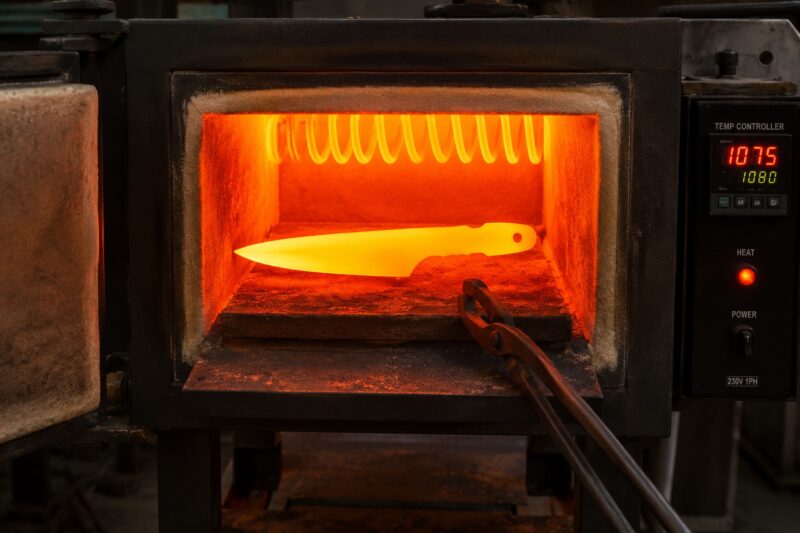
One important point many knife buyers overlook is that steel quality alone does not determine performance.
Heat treatment can dramatically change how a blade behaves.
A properly heat-treated VG10 blade can outperform a poorly processed premium steel.
A properly heat-treated D2 blade can provide outstanding:
- Edge stability
- Wear resistance
- Working durability
When comparing knives, always consider:
- Steel type
- Heat treatment quality
- Blade geometry
- Manufacturing precision
The same steel can perform differently depending on how the blade was produced.
Check Our Guide Steel Heat Treatment Explained
Does VG10 Stay Sharper Than D2?
Usually, no.
D2 generally holds an edge longer because it has:
- Higher carbon content
- More carbide volume
- Better abrasion resistance
However, VG10 may feel sharper because it can achieve:
- A finer edge
- Better polishing ability
- Smoother slicing performance
For example:
A VG10 chef knife may feel sharper when slicing vegetables.
A D2 utility knife may remain functional longer when cutting cardboard.
Is D2 Harder Than VG10?
The hardness ranges overlap.
VG10 commonly performs around:
59–61 HRC
D2 commonly performs around:
58–62 HRC
The final hardness depends on:
- Heat treatment
- Blade design
- Manufacturer process
Hardness alone does not determine overall performance.
A harder blade is not always better because excessive hardness can reduce toughness.
Is VG10 Better Than D2 for Kitchen Knives?
For most kitchen applications:
Yes, VG10 is usually the better choice.
Reasons:
- Better corrosion resistance
- Easier sharpening
- Cleaner cutting performance
- Lower maintenance
Kitchen knives are exposed to:
- Water
- Food acids
- Frequent washing
VG10 handles these conditions better.
Is D2 Better Than VG10 for Outdoor Knives?
For many outdoor applications:
Yes, D2 has the advantage.
Reasons:
- Longer edge retention
- Higher wear resistance
- Better performance on abrasive materials
D2 is especially suitable for:
- Hunting knives
- EDC knives
- Utility blades
- Work knives
Which Steel Is Easier to Sharpen?
Winner:
VG10
VG10 is easier because:
- The carbide structure is finer
- Sharpening stones work faster
- It responds well to traditional methods
D2 requires:
- More patience
- Better sharpening equipment
- More experience
Which Steel Requires Less Maintenance?
Winner:
VG10
VG10 is more forgiving.
It tolerates:
- Moisture
- Kitchen humidity
- Frequent washing
D2 requires more attention.
Recommended D2 care:
- Dry after use
- Avoid long exposure to moisture
- Use protective oil during storage
Frequently Asked Questions (FAQ)
Is VG10 a good knife steel?
Yes. VG10 is considered one of the best balanced stainless steels for kitchen knives. It provides excellent sharpness, corrosion resistance, and easy maintenance.
Is D2 a good knife steel?
Yes. D2 is an excellent high-wear steel known for strong edge retention and durability. It is especially popular for outdoor and utility knives.
Which steel has better edge retention, VG10 or D2?
D2 generally has better edge retention because of its higher wear resistance and carbide structure.
Which steel is more corrosion resistant, VG10 or D2?
VG10 has better corrosion resistance because it has more available chromium for stainless protection.
Which steel is sharper, VG10 or D2?
Both can become extremely sharp. VG10 usually achieves a finer polished edge, while D2 maintains a working edge longer.
Which steel is better for beginners?
VG10 is usually better for beginners because it is easier to sharpen and requires less maintenance.
Can D2 rust?
Yes. D2 is not fully stainless. Without proper care, it can develop oxidation or surface rust.
Can VG10 rust?
VG10 has excellent rust resistance, but no steel is completely immune. Proper care is still recommended.
Which steel is better for a chef knife?
VG10 is generally the better choice for chef knives because of its balance between sharpness, corrosion resistance, and maintenance.
Which steel is better for an EDC knife?
D2 is often preferred for EDC because of its excellent edge retention and working durability.