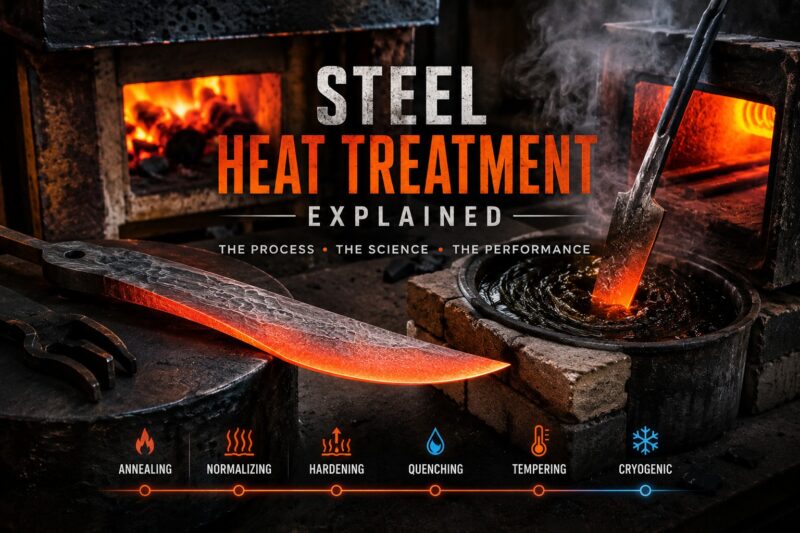
Steel Heat Treatment Explained
An Independent Guide
Quick Answer
Steel heat treatment is a controlled process of heating and cooling steel to alter its internal structure and improve properties such as hardness, toughness, wear resistance, edge retention, and durability. In knife making, proper heat treatment is often just as important as the steel itself because it determines how the blade performs in real-world use.
Introduction
When most people buy a knife, they focus on the name of the steel.
They compare MagnaCut, M390, N690, S35VN, D2, 1095, and countless other steel grades, assuming the steel alone determines quality.
However, experienced bladesmiths and metallurgists know that the steel composition is only half of the equation.
The other half is heat treatment.
A premium steel that receives poor heat treatment may perform worse than a simpler steel that has been expertly heat treated. In fact, many knife makers would argue that heat treatment is the single most important factor affecting blade performance.
Heat treatment controls the internal structure of steel. By carefully managing temperatures and cooling rates, manufacturers can dramatically change a blade’s hardness, toughness, wear resistance, and edge retention.
Understanding heat treatment helps explain why some knives stay sharp longer, resist chipping better, and perform more reliably in demanding situations.
This guide explains how heat treatment works, the different methods used in knife manufacturing, and why proper heat treatment is critical to producing a high-performance blade.
What Is Heat Treatment?
Heat treatment is a metallurgical process used to modify the physical and mechanical properties of steel through controlled heating and cooling cycles.
The process does not change the chemical composition of the steel itself. Instead, it changes how the atoms are arranged within the steel’s microstructure.
By altering the microstructure, manufacturers can influence:
- Hardness
- Toughness
- Wear resistance
- Edge retention
- Corrosion resistance
- Strength
- Dimensional stability
Different heat treatment methods produce different balances of these properties.
For example, a chef’s knife may be optimized for maximum hardness and edge retention, while a survival knife may prioritize toughness and resistance to impact.
Heat treatment allows knife makers to customize steel performance for specific applications.
Why Heat Treatment Matters More Than Many People Realize
Many knife enthusiasts become obsessed with steel names.
While steel chemistry is certainly important, the reality is that two knives made from the exact same steel can perform dramatically differently.
Imagine two manufacturers producing knives from M390 steel.
The first manufacturer uses:
- Precision temperature control
- Vacuum heat treatment
- Cryogenic processing
- Multiple tempering cycles
- Rigorous quality control
The second manufacturer uses:
- Inaccurate temperature control
- Inconsistent quenching
- Minimal quality testing
Although both knives are technically made from M390, their performance may differ significantly.
The first blade may exhibit:
- Superior edge retention
- Better toughness
- Improved wear resistance
- Greater reliability
The second blade may suffer from:
- Premature dulling
- Edge chipping
- Reduced toughness
- Inconsistent performance
This is why reputable knife makers often publish their target hardness values and heat treatment protocols.
The History of Steel Heat Treatment
Heat treatment is not a modern invention.
Blacksmiths have been experimenting with heating and cooling steel for thousands of years.
Ancient civilizations discovered that heating metal and cooling it rapidly could produce harder tools and weapons.
Early examples include:
- Ancient Egyptian tools
- Roman weapons
- Viking swords
- Japanese katana blades
Although these craftsmen did not understand metallurgy at the atomic level, they observed that certain heating and cooling methods improved performance.
The Japanese sword-making tradition became particularly famous for developing differential heat treatment techniques that produced blades with hard cutting edges and flexible spines.
Today, modern metallurgy has transformed heat treatment from an art into a precise science, using computer-controlled furnaces and sophisticated testing equipment.
Understanding Steel Microstructure
To understand heat treatment, it helps to understand what happens inside steel.
Steel is not simply a uniform block of metal. Instead, it contains microscopic structures that change depending on temperature and cooling speed.
These structures determine the steel’s final properties.
Ferrite
Ferrite is one of the softest structures found in steel.
Characteristics include:
- Low hardness
- High ductility
- Excellent machinability
Ferrite is useful during manufacturing but generally unsuitable for knife edges.
Pearlite
Pearlite consists of alternating layers of ferrite and iron carbide.
Characteristics include:
- Moderate hardness
- Improved strength
- Better wear resistance
Pearlite was commonly used in traditional tools before advanced heat treatment techniques became widespread.
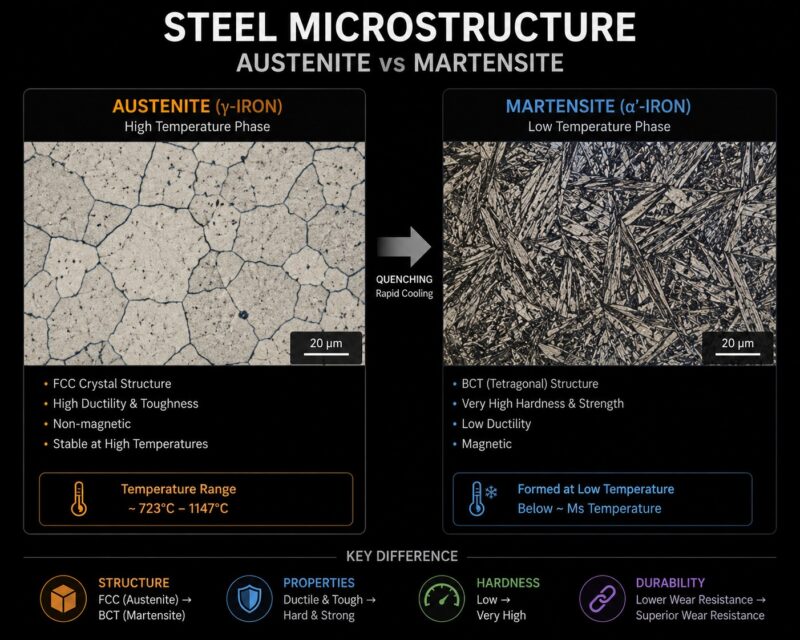
Austenite
Austenite forms when steel is heated above its critical transformation temperature.
Characteristics include:
- High-temperature phase
- Dissolves carbon into solution
- Necessary for hardening
Austenite serves as the foundation for creating martensite during quenching.
Martensite
Martensite is the structure responsible for knife performance.
It forms when austenite is cooled rapidly during quenching.
Characteristics include:
- Very high hardness
- Excellent wear resistance
- Strong edge retention
However, untreated martensite can also be brittle, which is why tempering is necessary.
Carbides
Carbides are hard particles formed by alloying elements such as:
- Vanadium
- Chromium
- Tungsten
- Molybdenum
- Niobium
Carbides play a major role in:
- Edge retention
- Wear resistance
- Cutting longevity
Modern powder metallurgy steels often contain highly refined carbide structures that contribute to their exceptional performance.
The Main Stages of Heat Treatment
Most knife steels undergo several heat treatment stages before becoming finished blades.
Each stage serves a specific purpose.
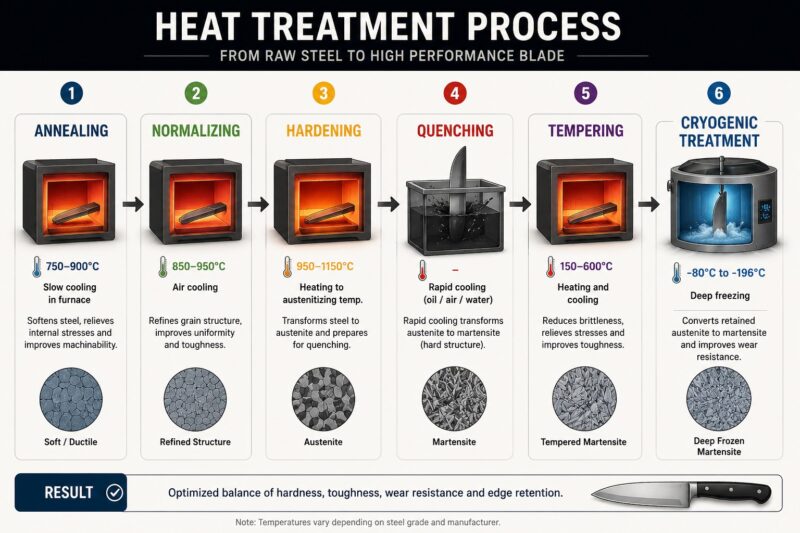
Annealing
Annealing is usually one of the first heat treatment processes applied to steel.
Purpose of Annealing
The goal of annealing is to soften the steel and reduce internal stresses.
This makes the material easier to machine, drill, grind, and shape.
How Annealing Works
Steel is heated to a specific temperature and then cooled very slowly, often inside the furnace itself.
The slow cooling process allows the microstructure to become softer and more uniform.
Benefits of Annealing
- Easier machining
- Improved workability
- Reduced internal stress
- Better dimensional stability
- Lower risk of cracking during manufacturing
Without annealing, many high-alloy steels would be extremely difficult to process.
Normalizing
Normalizing is often performed before hardening.
Purpose of Normalizing
The goal is to create a more uniform grain structure throughout the steel.
A fine grain structure generally improves toughness and consistency.
How Normalizing Works
Steel is heated above its critical temperature and then allowed to cool naturally in air.
The cooling rate is faster than annealing but slower than quenching.
Benefits of Normalizing
- Refined grain structure
- Improved toughness
- Better consistency
- Reduced stress concentrations
- Enhanced reliability
Many custom knife makers perform multiple normalizing cycles before hardening a blade.
Hardening
Hardening is one of the most important stages in knife heat treatment.
This is where the steel develops the potential for high hardness and edge retention.
Purpose of Hardening
The goal is to transform the steel into a structure capable of forming martensite during quenching.
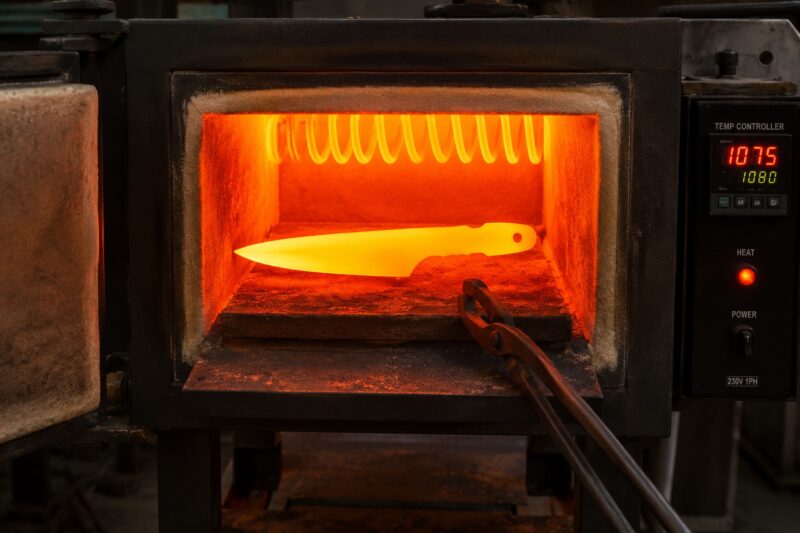
Austenitizing
Hardening begins by heating the steel into the austenitic temperature range.
Different steels require different temperatures.
Typical examples include:
- 1095: approximately 1475°F (800°C)
- N690: approximately 1950°F (1065°C)
- M390: approximately 2100°F (1150°C)
- MagnaCut: approximately 2050°F–2150°F (1120°C–1175°C)
During this stage, carbon and alloying elements dissolve into the austenite.
This prepares the steel for transformation during quenching.
Importance of Temperature Control
Precision is critical.
If the steel is heated too little:
- Incomplete transformation occurs.
If heated too much:
- Grain growth may occur.
- Toughness can decrease.
Modern manufacturers use digitally controlled furnaces to maintain precise temperatures.
Quenching
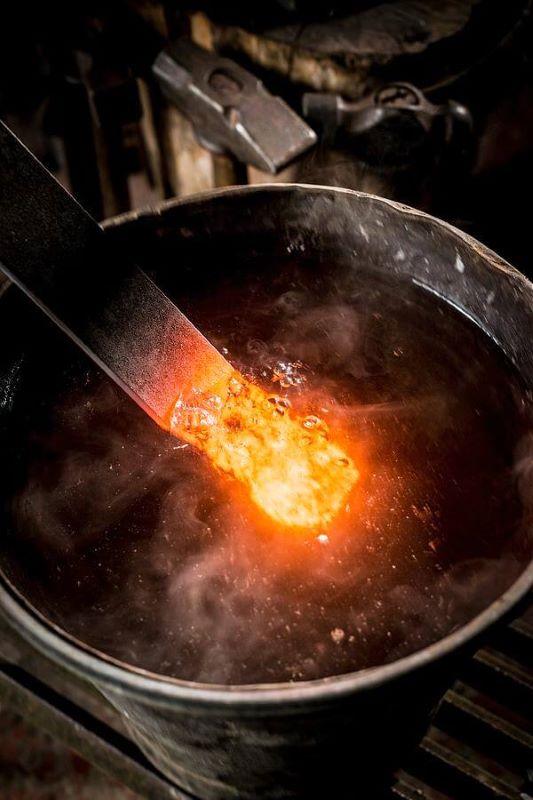
Quenching is the process of rapidly cooling steel after hardening.
This is the stage where martensite forms.
Why Quenching Matters
Without rapid cooling, the steel cannot develop the hardness required for a quality knife edge.
The cooling rate determines the final microstructure.
A successful quench creates a high percentage of martensite while minimizing distortion and cracking.
Common Quenching Methods
Water Quenching
Water removes heat extremely quickly.
Advantages:
- Maximum hardness potential
Disadvantages:
- High stress
- Increased cracking risk
- Greater distortion
Water quenching is primarily used with simple carbon steels.
Oil Quenching
Oil quenching is common among knife makers.
Advantages:
- Lower stress than water
- Reduced cracking risk
- More predictable results
Commonly used for:
- 1095
- O1
- Tool steels
Air Quenching
Many modern stainless steels are air-hardening.
Advantages:
- Less distortion
- Excellent dimensional stability
- Lower stress levels
Common examples include N690, AEB-L, MagnaCut, and M390.
Tempering
After quenching, steel becomes extremely hard. However, this hardness comes at a cost.
Freshly quenched martensite contains significant internal stresses and can be quite brittle. A blade in this condition may chip, crack, or even break during use.
This is why tempering is one of the most important steps in the entire heat treatment process.
Purpose of Tempering
Tempering reduces brittleness while maintaining most of the hardness gained during quenching.
The goal is to create a balance between:
- Hardness
- Toughness
- Edge retention
- Durability
Without tempering, even the finest knife steel would be impractical for real-world use.
How Tempering Works
The steel is reheated to a lower temperature than the hardening temperature.
Typical tempering temperatures range between:
- 300°F–1100°F (150°C–600°C)
depending on the steel and desired properties.
During tempering:
- Internal stresses are reduced
- Toughness increases
- Hardness decreases slightly
- Structural stability improves
The result is a blade that can withstand real-world cutting tasks without becoming excessively fragile.
Double and Triple Tempering
Many premium knife makers perform multiple tempering cycles.
Benefits include:
- Greater dimensional stability
- Improved toughness
- More complete stress relief
- Better long-term performance
High-end custom makers often use double or triple tempering to maximize steel performance.
Cryogenic Treatment
Cryogenic treatment is often considered an advanced stage of heat treatment.
While not every knife receives cryogenic processing, many premium manufacturers incorporate it into their heat treatment protocols.
What Is Cryogenic Treatment?
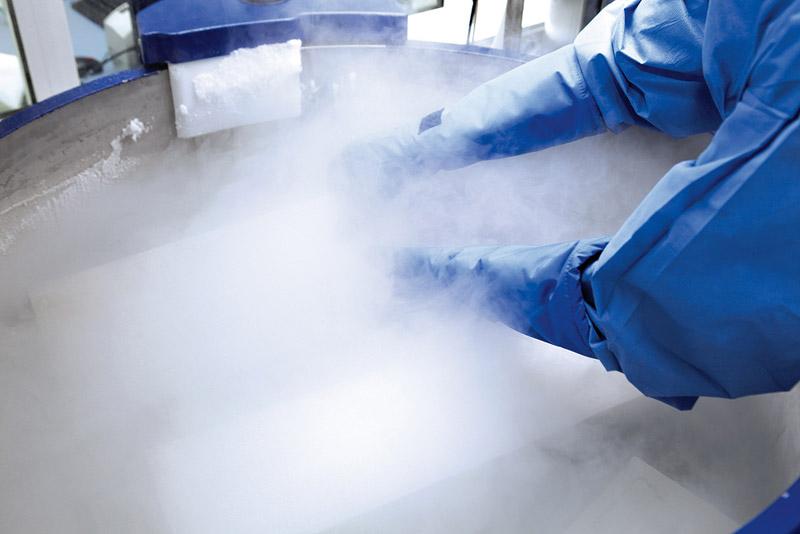
Cryogenic treatment involves cooling steel to extremely low temperatures after quenching.
Common temperature ranges include:
- -120°F (-85°C)
- -300°F (-184°C)
- -320°F (-196°C)
Liquid nitrogen is often used to achieve these temperatures.
Check Our Guide Cryogenic Treatment Explained
Why Cryogenic Treatment Is Used
After quenching, some austenite may remain untransformed.
This retained austenite is softer than martensite and can reduce performance.
Cryogenic treatment converts additional retained austenite into martensite.
Benefits may include:
- Increased hardness
- Improved wear resistance
- Better edge retention
- Enhanced dimensional stability
Steels That Benefit Most
Cryogenic treatment is particularly beneficial for:
- M390
- MagnaCut
- S30V
- S35VN
- Elmax
- CPM 154
Many custom knife makers consider cryogenic treatment an essential step when working with premium stainless steels.
Check Our Guide M390 Steel Review
Vacuum Heat Treatment
Modern knife manufacturing often relies on vacuum heat treatment.
What Is Vacuum Heat Treatment?
Vacuum heat treatment takes place inside a sealed chamber where oxygen is removed.
This prevents oxidation and scaling during heating.
Benefits
- Cleaner steel surfaces
- Better temperature control
- Reduced decarburization
- Improved consistency
- Higher-quality finished blades
Vacuum furnaces are commonly used by manufacturers producing premium stainless steel knives.
Salt Bath Heat Treatment
Although less common today, salt bath heat treatment remains an important method in metallurgy.
How It Works
Steel is immersed in molten salt heated to precise temperatures.
The salt surrounds the steel evenly and transfers heat efficiently.
Advantages
- Uniform heating
- Reduced distortion
- Excellent temperature control
- Consistent results
Some custom makers and industrial facilities still use salt bath systems for specialized applications.
Differential Heat Treatment
Differential heat treatment creates different hardness levels within the same blade.
How It Works
The edge is allowed to cool faster than the spine.
As a result:
- The edge becomes very hard
- The spine remains tougher and more flexible
Benefits
This creates a blade that combines:
- Excellent cutting ability
- Improved shock resistance
- Greater durability
Traditional Japanese swords are the most famous example of differential hardening.
The Hamon Line
Differential heat treatment often produces a visible line known as a hamon.
Collectors highly value authentic hamon patterns because they reflect traditional craftsmanship.
Austempering
Austempering is a specialized heat treatment process used to create bainite instead of martensite.
What Is Bainite?
Bainite is a microstructure that combines many of the advantages of martensite and pearlite.
Characteristics include:
- High toughness
- Good wear resistance
- Excellent strength
Advantages of Austempering
- Reduced distortion
- Improved toughness
- Lower internal stress
- Enhanced fatigue resistance
Although uncommon in knife manufacturing, austempering is widely used in industrial components that require exceptional durability.
Marquenching
Marquenching is another specialized heat treatment technique.
Purpose
The goal is to reduce stress and distortion during cooling.
Process
Instead of cooling directly to room temperature, steel is cooled to an intermediate temperature and held briefly before continuing the cooling process.
Benefits
- Reduced cracking risk
- Improved dimensional accuracy
- Less warping
- Greater consistency
Marquenching is especially useful for precision components and complex blade geometries.
Heat Treatment Temperatures for Popular Knife Steels
Different steels require different heat treatment schedules.
Below are typical hardness ranges achieved through proper heat treatment.
1095 Carbon Steel
Typical hardness:
58–62 HRC
Strengths:
- Excellent toughness
- Easy sharpening
- Affordable
N690 Stainless Steel
Typical hardness:
58–61 HRC
Strengths:
- Excellent corrosion resistance
- Balanced performance
- Easy maintenance
D2 Tool Steel
Typical hardness:
59–62 HRC
Strengths:
- Strong wear resistance
- Good edge retention
- Popular value option
Check Our Guide D2 Steel Review
CPM MagnaCut
Typical hardness:
60–64 HRC
Strengths:
- Outstanding corrosion resistance
- Exceptional toughness
- Premium edge retention
M390
Typical hardness:
60–62 HRC
Strengths:
- Excellent wear resistance
- Superior edge retention
- Premium stainless performance
CPM S35VN
Typical hardness:
59–62 HRC
Strengths:
- Balanced toughness
- Good corrosion resistance
- Reliable all-around performance
How Heat Treatment Affects Knife Performance
The effects of heat treatment become obvious during real-world use.
Hardness
Hardness determines how well the edge resists deformation.
Benefits of higher hardness include:
- Better edge retention
- Increased wear resistance
- Longer cutting life
However, excessive hardness can reduce toughness.
Toughness
Toughness determines how well a blade resists:
- Chipping
- Cracking
- Breaking
Proper heat treatment helps maximize toughness without sacrificing too much hardness.
Edge Retention
Many knife users focus on edge retention.
Heat treatment directly affects:
- Carbide formation
- Martensite quality
- Overall wear resistance
This explains why two knives made from the same steel can exhibit very different edge retention.
Corrosion Resistance
While alloy composition primarily determines corrosion resistance, heat treatment can influence:
- Carbide distribution
- Chromium availability
- Microstructural stability
Proper heat treatment helps premium stainless steels reach their full corrosion-resistant potential.
How Manufacturers Test Heat Treatment Quality
Professional manufacturers do not simply heat and cool steel.
They verify results through testing.
Rockwell Hardness Testing
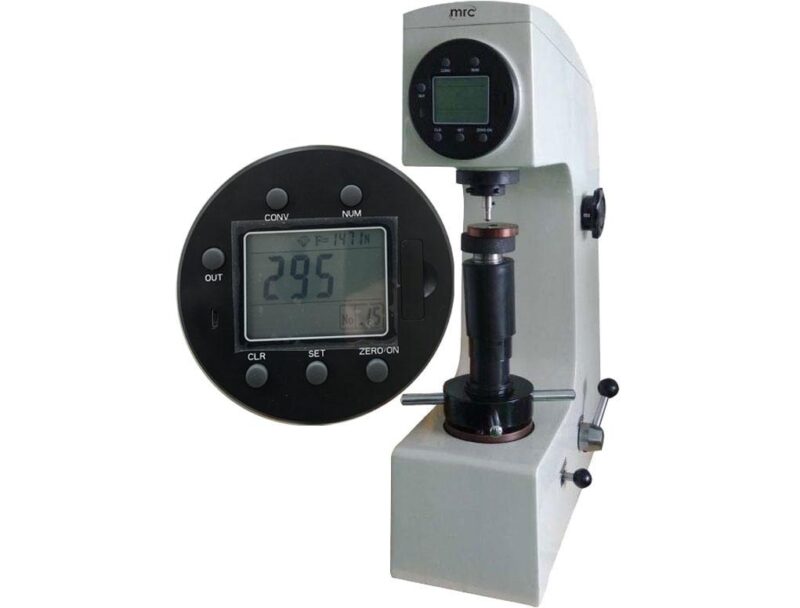
The most common method is Rockwell hardness testing.
The Rockwell C scale (HRC) measures resistance to indentation.
Typical knife hardness:
- Soft outdoor knives: 56–58 HRC
- General EDC knives: 58–61 HRC
- Premium stainless steels: 60–64 HRC
Metallurgical Analysis
Microscopes allow manufacturers to inspect:
- Grain structure
- Carbide distribution
- Martensite formation
This helps confirm that heat treatment goals were achieved.
Performance Testing
Many companies also conduct:
- Edge retention tests
- Impact tests
- Corrosion tests
- Flex testing
These evaluations ensure consistent quality across production batches.
Common Heat Treatment Mistakes
Even premium steel can perform poorly if heat treatment is not executed correctly.
Common mistakes include:
Overheating
Excessive temperatures may cause:
- Grain growth
- Reduced toughness
- Lower overall performance
Underheating
Insufficient temperatures may result in:
- Incomplete hardening
- Lower hardness
- Poor edge retention
Improper Quenching
Incorrect cooling rates may cause:
- Warping
- Cracking
- Soft spots
Insufficient Tempering
Poor tempering can leave steel:
- Brittle
- Stress-prone
- Vulnerable to chipping
Common Heat Treatment Myths
Myth #1: Harder Is Always Better
False.
The hardest blade is not necessarily the best blade.
Excessive hardness often reduces toughness.
Myth #2: Steel Type Is More Important Than Heat Treatment
False.
Heat treatment can dramatically influence performance.
Many experts consider steel composition and heat treatment equally important.
Myth #3: Cryogenic Treatment Is Magic
False.
Cryogenic processing can improve performance, but it cannot compensate for poor heat treatment fundamentals.
Myth #4: All Manufacturers Heat Treat the Same Way
False.
Heat treatment protocols vary significantly between manufacturers.
This is one reason why knives made from identical steels often perform differently.
Choosing a Knife Based on Heat Treatment
When evaluating a knife, consider more than just steel type.
Look for manufacturers known for:
- Consistent hardness
- Proven heat treatment protocols
- Quality control
- Real-world testing
A well-heat-treated N690 knife may outperform a poorly treated super steel in actual use.
For many buyers, manufacturer reputation is just as important as steel selection.
The Future of Heat Treatment
Heat treatment technology continues to evolve.
Modern advancements include:
- Computer-controlled furnaces
- Vacuum heat treatment systems
- Precision cryogenic processing
- Advanced metallurgical testing
- Optimized powder metallurgy protocols
These technologies allow manufacturers to extract greater performance from both traditional and modern steels.
As knife steels continue to evolve, heat treatment will remain one of the most important factors influencing blade performance.
Final Verdict
Steel heat treatment is the process that transforms raw steel into a high-performance cutting tool.
While steel composition provides the foundation, heat treatment determines how effectively that potential is realized.
Processes such as annealing, normalizing, hardening, quenching, tempering, and cryogenic treatment allow knife makers to fine-tune hardness, toughness, wear resistance, and edge retention.
Understanding heat treatment helps explain why some knives outperform others, even when they use similar steels.
For knife enthusiasts, collectors, hunters, outdoor users, and professional chefs, recognizing the importance of heat treatment is essential when evaluating blade quality.
In the end, steel matters—but heat treatment is what unlocks its true performance.
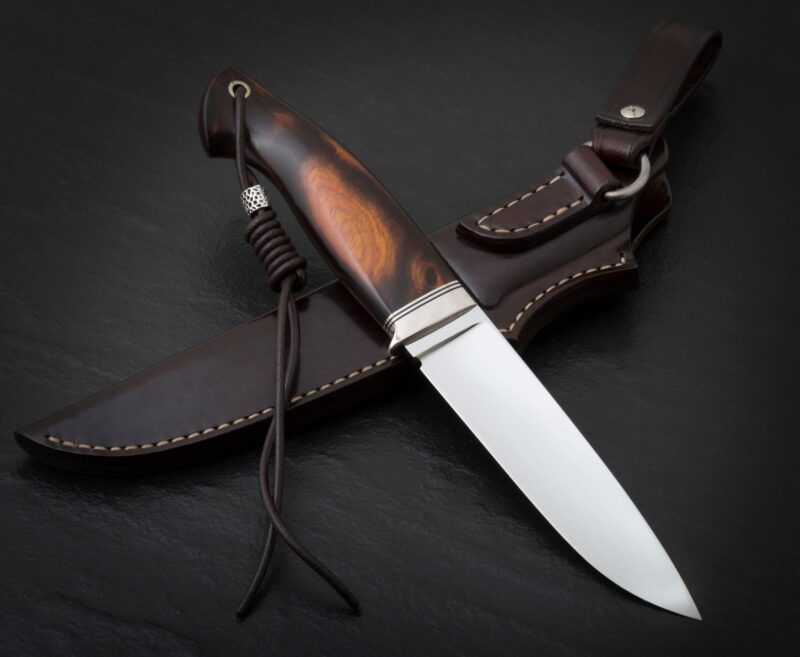
Steel heat treatment explained
Frequently Asked Questions
What is steel heat treatment?
Steel heat treatment is a controlled heating and cooling process used to improve hardness, toughness, wear resistance, and overall performance.
Why is heat treatment important for knives?
Heat treatment determines how well a knife holds an edge, resists chipping, and withstands real-world use.
What is quenching?
Quenching is the rapid cooling of heated steel to create hard martensite.
Why is tempering necessary?
Tempering reduces brittleness and internal stresses while preserving useful hardness.
Does cryogenic treatment improve knife performance?
Yes. Cryogenic treatment can improve wear resistance, hardness, edge retention, and dimensional stability.
Is heat treatment more important than steel type?
Both are important, but excellent heat treatment can significantly improve steel performance and often determines how a knife performs in real-world use.
Steel heat treatment explained
https://yashkadesigns.com/hunting-knives
https://yashkadesigns.ecrater.com/c/2444223/blade-handles
This article is for independent informational purposes only and is not affiliated with, sponsored by, or endorsed by any steel manufacturer. All product names, trademarks, and registered trademarks are the property of their respective owners.