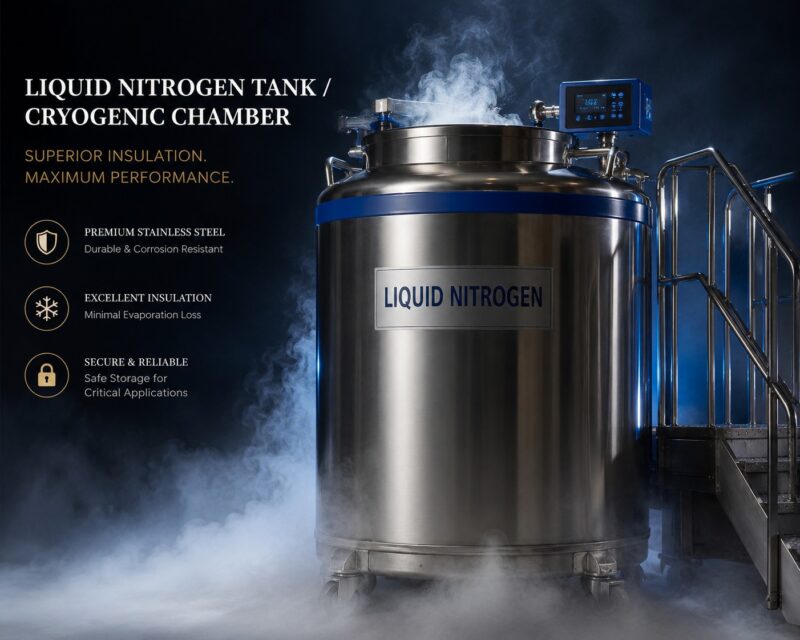
Cryogenic Treatment Explained
An Independent Guide
Quick Answer
Cryogenic treatment is a deep-freezing process (usually -80°C to -196°C) used to improve steel performance by transforming retained austenite into martensite, increasing hardness, wear resistance, and edge stability.
In simple terms:
👉 It makes knife steel harder, more stable, and longer-lasting when done correctly.
Introduction
Cryogenic treatment (also called deep cryogenic processing) has become an important topic in metallurgy, especially in the knife industry, tool manufacturing, and high-performance engineering.
It is often associated with premium knife steels such as M390, S30V, S35VN, and CPM MagnaCut, where manufacturers aim to improve:
- Edge retention
- Wear resistance
- Dimensional stability
- Overall durability
But despite its popularity, cryogenic treatment is still widely misunderstood. Some believe it is a “miracle upgrade,” while others think it has no real effect.
The truth is more balanced:
👉 Cryogenic treatment is a real metallurgical process with measurable benefits, but its effectiveness depends heavily on steel type and heat treatment quality.
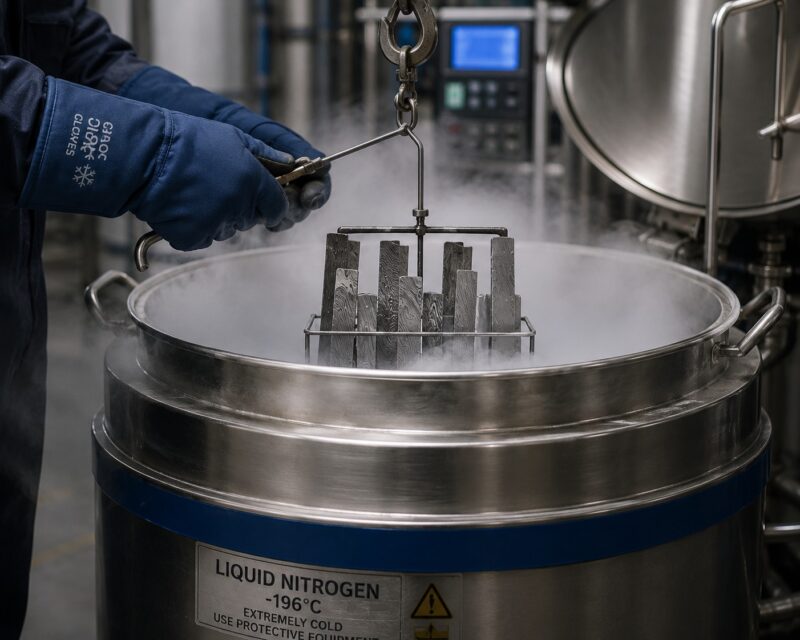
What Is Cryogenic Treatment?
Cryogenic treatment is a post-heat-treatment process where steel is cooled to extremely low temperatures, typically:
- -80°C (mild cryogenic treatment)
- -196°C (liquid nitrogen deep cryogenic treatment)
This process is performed after traditional heat treatment and quenching.
The goal is to improve the internal structure of steel by reducing unstable phases and increasing carbide formation.
Why Cryogenic Treatment Is Used
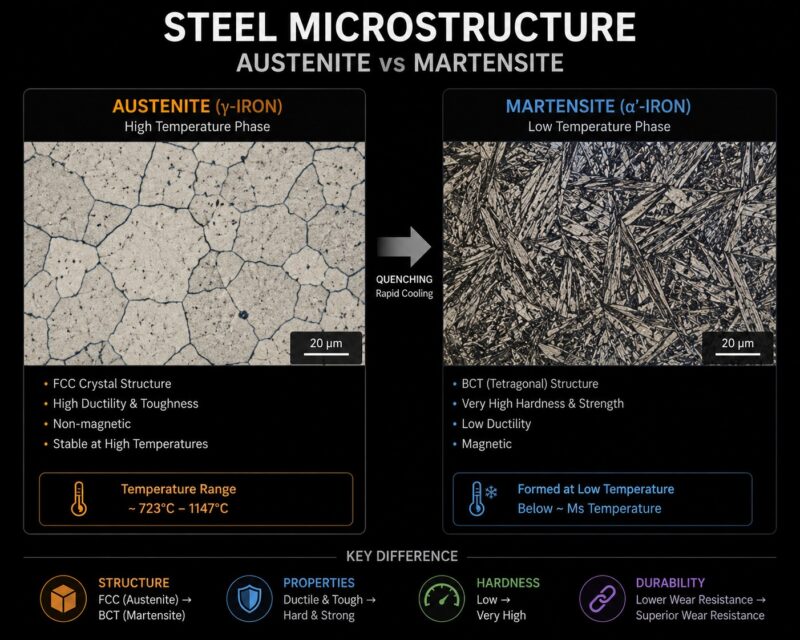
During normal heat treatment, not all austenite converts into martensite. The remaining portion is called:
👉 Retained austenite
This unstable phase can negatively affect performance by:
- Reducing hardness
- Lowering wear resistance
- Making edge retention inconsistent
- Causing dimensional instability
Cryogenic treatment helps reduce this problem.
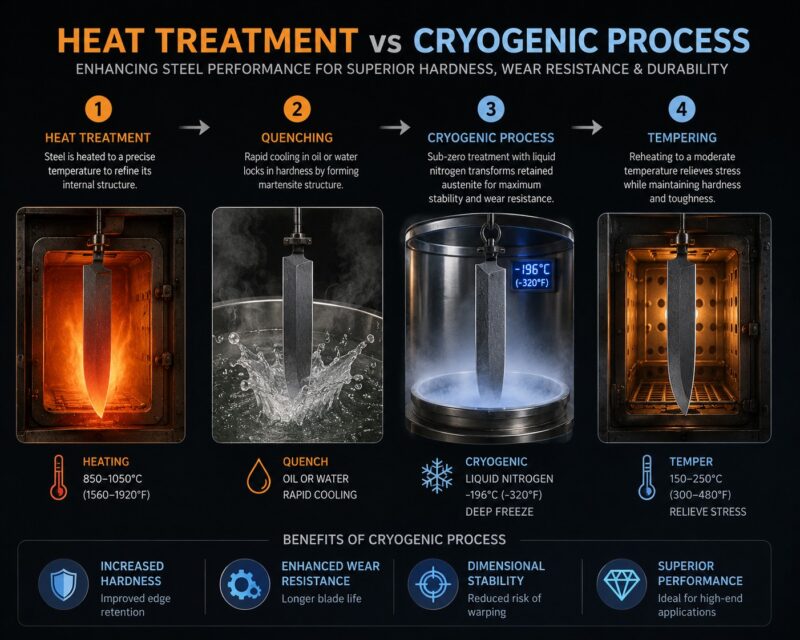
How Cryogenic Treatment Works (Step-by-Step)
1. Heat Treatment
Steel is heated to high temperature and then quenched.
2. Cooling to Room Temperature
The steel is partially hardened, but retains some austenite.
3. Cryogenic Cooling
Steel is slowly cooled to -80°C to -196°C.
4. Phase Transformation
Retained austenite transforms into martensite.
5. Tempering
Steel is reheated slightly to relieve stress and stabilize structure.
Metallurgical Changes Explained Simply
Cryogenic treatment causes three main improvements:
1. More Martensite Formation
Martensite is the hard, strong phase responsible for:
- Hardness
- Edge retention
- Wear resistance
More martensite = better cutting performance.
2. Reduction of Retained Austenite
Less austenite means:
- More stable edge geometry
- Better consistency
- Less deformation under stress
3. Fine Carbide Precipitation
Cryogenic treatment can encourage formation of fine carbides, which:
- Improve wear resistance
- Enhance edge longevity
- Increase cutting efficiency
Cryogenic Treatment in Knife Steels
Not all steels benefit equally.
🔥 Best candidates:
⚠️ Limited benefit:
- Very low alloy steels
- Some simple carbon steels
- Poorly heat-treated steels
Cryogenic Treatment in Knives
In knife manufacturing, cryogenic treatment is used to improve:
- Edge retention
- Hardness consistency
- Resistance to rolling or deformation
- Long-term cutting stability
Many premium knife brands include cryogenic treatment as part of their production process.
Real-World Performance Benefits
🔪 Edge Retention
Cryogenically treated steels usually show:
- 5–20% improvement in wear resistance (depending on steel)
- Longer-lasting sharp edges
- More consistent cutting performance
🧱 Toughness
Toughness may slightly improve or remain similar, depending on steel type and tempering process.
⚙️ Hardness (HRC)
Cryogenic treatment can increase hardness by:
- ~1–3 HRC in some steels
This may sound small, but in metallurgy it is significant.
🌧 Corrosion Resistance
Cryogenic treatment does not significantly improve corrosion resistance, but it can indirectly help by stabilizing structure.
🔧 Edge Stability
One of the biggest benefits is improved:
- Edge stability
- Reduced micro-chipping
- Better long-term sharpness retention
Advantages of Cryogenic Treatment
✔ Improved Wear Resistance
Longer-lasting cutting performance.
✔ Increased Hardness
More martensite = harder steel.
✔ Better Dimensional Stability
Less movement in the steel structure.
✔ More Consistent Performance
Especially in high-end powder steels.
✔ Improved Edge Retention
One of the most noticeable real-world benefits.
Disadvantages of Cryogenic Treatment
❌ Not Always Necessary
Some steels already perform well without it.
❌ Cost Increases Production
Adds extra manufacturing steps.
❌ Small Gains in Some Steels
Low-alloy steels may show minimal improvement.
❌ Requires Precise Control
Poor cryogenic treatment can damage steel properties.
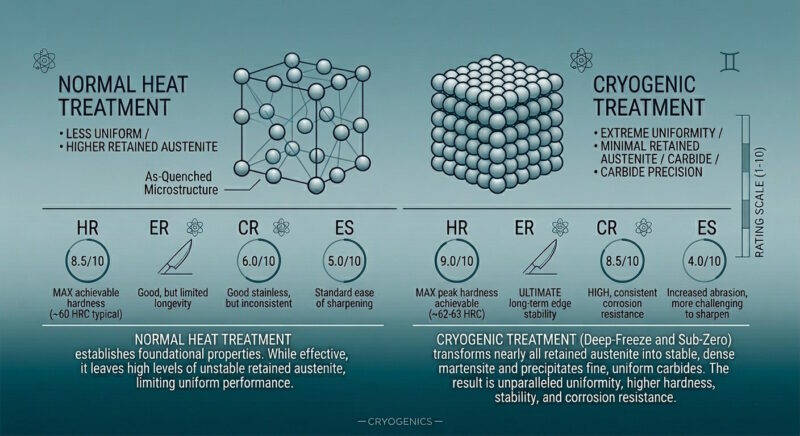
Cryogenic Treatment vs Normal Heat Treatment
| Property | Normal Heat Treatment | Cryogenic Treatment |
|---|---|---|
| Hardness | Good | Higher |
| Edge Retention | Good | Better |
| Wear Resistance | Moderate | Improved |
| Stability | Moderate | High |
| Cost | Lower | Higher |
Common Myths About Cryogenic Treatment
❌ Myth 1: Cryo makes steel “super steel”
False. It improves performance, but does not transform steel into a different category.
❌ Myth 2: All knives are cryogenically treated
False. Many budget and mid-range knives skip this step.
❌ Myth 3: Cryo replaces heat treatment
False. Cryogenic treatment is only a supplement, not a replacement.
❌ Myth 4: It only works for expensive steels
False. Even tool steels like D2 can benefit.
Which Knife Steels Benefit Most?
🥇 High Benefit
- CPM steels (M390, S35VN, S30V)
- Tool steels (D2)
- High-performance stainless steels
🥈 Medium Benefit
- VG10
- Elmax
- N690 (moderate improvement depending on maker)
🥉 Low Benefit
- Simple carbon steels
- Low alloy steels
Cryogenic Treatment in Industry
Outside knives, cryogenic treatment is used in:
- Aerospace components
- Automotive gears
- Industrial cutting tools
- Medical instruments
- Firearms components
This proves it is not a marketing concept, but a real engineering process.
Is Cryogenic Treatment Worth It?
Yes — but with context.
It is worth it when:
- You want maximum performance from premium steel
- You use high-end knives
- You need better edge retention
It is less important when:
- You use budget knives
- You don’t sharpen frequently
- You prioritize cost over performance
Final Verdict
Cryogenic treatment is a real and scientifically proven metallurgical process that enhances steel performance by improving hardness, wear resistance, and structural stability.
However, it is not a miracle upgrade.
Its value depends entirely on the steel type, heat treatment quality, and intended use of the knife.
For premium knife steels like M390, S35VN, and similar CPM steels, cryogenic treatment is a meaningful performance booster. For simpler steels, its effect is more limited.
In modern knife manufacturing, it remains an important tool for optimizing high-performance blades, especially in the premium segment.
FAQ – Cryogenic Treatment Explained
What is cryogenic treatment in steel?
Cryogenic treatment is a deep-freezing process that improves steel by converting retained austenite into martensite.
Does cryogenic treatment make steel stronger?
Yes, it increases hardness, wear resistance, and edge stability, but improvements vary by steel type.
Is cryogenic treatment necessary for knives?
Not always. It is more beneficial for high-end steels than for basic stainless or carbon steels.
Does cryogenic treatment improve edge retention?
Yes, typically it improves edge retention by increasing wear resistance and stability.
What temperature is used in cryogenic treatment?
Usually between -80°C and -196°C (liquid nitrogen temperatures).
Which steels benefit most from cryogenic treatment?
High-performance steels like M390, S35VN, D2, and other CPM steels benefit the most.
Check Our Guide Carbon Steel vs Stainless Steel Knives
This article is for independent informational purposes only and is not affiliated with, sponsored by, or endorsed by any steel manufacturer. All product names, trademarks, and registered trademarks are the property of their respective owners.