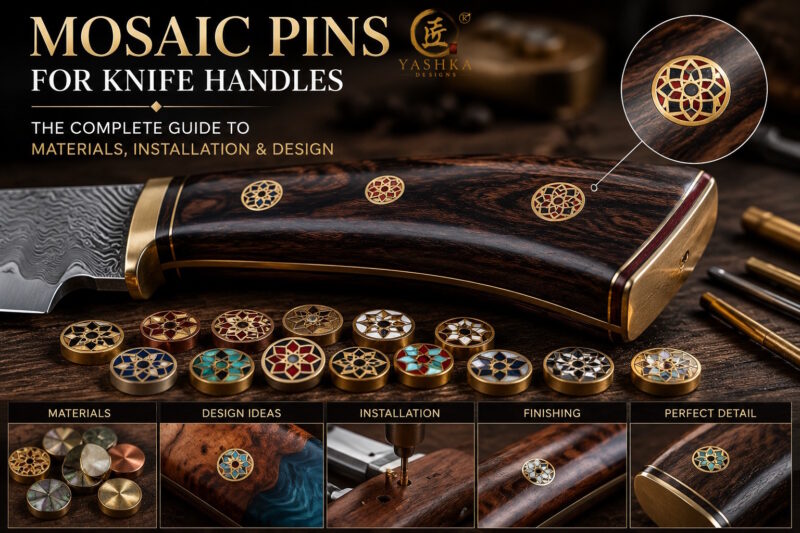
Mosaic Pins for Knife Handles
Introduction
Mosaic pins have become one of the most popular decorative elements in custom knife making. Whether you’re building a premium hunting knife, a handcrafted chef knife, or restoring an existing blade, mosaic pins can transform an ordinary handle into a unique piece of craftsmanship.
Originally developed by custom knife makers seeking a way to add visual interest to handle scales, mosaic pins have evolved into an art form of their own. Today, they are available in hundreds of patterns, materials, colors, and sizes, allowing makers to create truly one-of-a-kind knives.
This guide covers everything you need to know about mosaic pins, including materials, construction, sizing, installation, maintenance, and design considerations.
What Are Mosaic Pins For Knife Handles?
A mosaic pin is a decorative tubular fastener used to secure knife handle scales while simultaneously adding a visual accent.
Unlike standard brass or stainless-steel pins, mosaic pins contain multiple tubes, rods, and colored materials arranged in intricate patterns. When cut and polished, the cross-section reveals a decorative design resembling a mosaic.
Mosaic pins serve two purposes:
- Structural support
- Decorative enhancement
They are commonly used on:
- Hunting knives
- Bushcraft knives
- Chef knives
- Kitchen knives
- Utility knives
- Collector knives
- Handmade custom knives
Why Use Mosaic Pins For Knife Handles?
Many knife makers choose mosaic pins because they instantly elevate the appearance of a knife.
Benefits include:
- Premium appearance
- Custom craftsmanship
- Unique design possibilities
- Improved resale value
- Personalization opportunities
A well-designed mosaic pin often becomes a focal point of the handle.
Common Materials Used in Mosaic Pins for Knife Handles
Brass
Brass remains one of the most popular materials.
Advantages:
- Easy to polish
- Attractive golden color
- Corrosion resistant
- Traditional appearance
Brass pairs beautifully with wood handles and hunting knives.
Stainless Steel
Stainless steel offers a modern appearance.
Benefits:
- Excellent corrosion resistance
- Durable
- Bright finish
- Low maintenance
Often used in kitchen knives.
Copper
Copper provides warm color tones.
Advantages:
- Unique appearance
- Rich patina over time
- Excellent contrast against dark woods
Many makers use copper mosaic pins in rustic knife designs.
Nickel Silver
Nickel silver combines durability with elegance.
Benefits:
- Bright finish
- Corrosion resistance
- Premium appearance
Often found on high-end custom knives.
Colored Components
Modern mosaic pins frequently include colored materials.
Popular options include:
- Colored epoxy
- Resin
- Acrylic inserts
- Fiber spacers
These materials allow virtually unlimited design possibilities.
Popular Mosaic Pin Patterns
Star Pattern
One of the most recognizable designs.
Features:
- Symmetrical layout
- Traditional appearance
- Excellent visual impact
Honeycomb Pattern
A geometric design that complements modern knives.
Flower Pattern
Popular for kitchen knives and artistic builds.
Spiral Pattern
Creates dynamic movement within the handle.
Custom Patterns
Many makers design their own patterns for exclusive projects.
Choosing the Right Mosaic Pin Size
Common diameters include:
- 4 mm
- 6 mm
- 8 mm
- 10 mm
For kitchen knives:
6 mm and 8 mm are most common.
For large hunting knives:
8 mm and 10 mm often provide better visual balance.
Mosaic Pins for Kitchen Knives
Kitchen knives benefit from elegant handle details without excessive decoration.
Popular combinations include:
- Walnut + brass mosaic pins
- Ebony + nickel silver pins
- Stabilized maple burl + stainless mosaic pins
Japanese-inspired handles often use smaller mosaic pins to maintain a refined appearance.
Check Our Guide Kiritsuke vs Gyuto
Mosaic Pins for Hunting Knives
Hunting knives frequently feature larger and more visible mosaic pins.
Popular materials:
- Stabilized burl wood
- Desert ironwood
- Micarta
- G10
Mosaic pins provide visual character while maintaining structural integrity.
Check Our Guide Best Hunting Knives for Groomsmen Gifts
How Mosaic Pins For Knife Handles Are Installed
Step 1: Drill Handle Holes
Ensure the hole diameter matches the pin diameter precisely.
Step 2: Dry Fit Components
Test fit:
- Tang
- Handle scales
- Mosaic pins
Verify alignment before gluing.
Step 3: Apply Epoxy
Use a high-quality two-part epoxy.
Apply epoxy to:
- Tang
- Handle scales
- Pin holes
Step 4: Insert Pins
Press mosaic pins through the handle assembly.
Remove excess adhesive.
Step 5: Clamp and Cure
Allow the epoxy to cure fully according to manufacturer recommendations.
Step 6: Shape and Finish
Once cured:
- Grind flush
- Sand progressively
- Polish the handle
The mosaic pattern will become visible during finishing.
Finishing Mosaic Pins For Knife Handles
Proper finishing dramatically improves appearance.
Recommended process:
- 220 grit sanding
- 400 grit sanding
- 600 grit sanding
- 1000 grit sanding
- Polishing compound
The result is a bright, detailed pattern with maximum visual depth.
Common Mistakes
Oversized Holes
Loose holes reduce strength and visual quality.
Poor Epoxy Coverage
Can create gaps around the pin.
Excessive Heat During Grinding
May damage resin components.
Uneven Sanding
Can distort the pattern.
Design Tips
For premium knife builds:
- Match pin metals with bolsters
- Coordinate colors with handle materials
- Use one central mosaic pin as a focal point
- Avoid excessive decoration
Often, less is more.
Are Mosaic Pins For Knife Handles Structural?
Yes.
When properly installed with epoxy, mosaic pins contribute significantly to handle strength.
However, they should not replace proper handle construction techniques.
Final Thoughts
Mosaic pins are one of the most effective ways to add character and craftsmanship to a custom knife. Whether you’re building a high-end kitchen knife, a rugged hunting knife, or a collector piece, mosaic pins provide a unique combination of beauty and functionality.
From traditional brass patterns to modern stainless-steel designs, the possibilities are nearly endless. By choosing quality materials, proper sizing, and careful installation techniques, you can create knife handles that stand out while maintaining the durability required for everyday use.
For knife makers and enthusiasts alike, mosaic pins remain one of the defining details that separate an ordinary knife from a truly exceptional custom build.
FAQ Schema
Mosaic Pins for Knife Handles
Q: What are mosaic pins used for in knife handles?
A: Mosaic pins secure handle scales while providing decorative patterns that enhance the appearance of custom knives.
Q: Are mosaic pins strong enough for hunting knives?
A: Yes. When installed correctly with quality epoxy, mosaic pins provide both structural support and decorative value.
Q: What size mosaic pin is best for kitchen knives?
A: Most kitchen knives use 6 mm or 8 mm mosaic pins, depending on handle size and design.
Q: Can mosaic pins be used with stabilized wood?
A: Absolutely. Stabilized wood and mosaic pins are one of the most popular combinations in custom knife making.
Q: Are brass or stainless-steel mosaic pins better?
A: Brass offers a traditional warm appearance, while stainless steel provides a modern look and excellent corrosion resistance.
Q: How are mosaic pins installed?
A: Mosaic pins are typically installed through drilled handle scales using two-part epoxy and then sanded flush during finishing.
Q: Can mosaic pins be polished?
A: Yes. Proper polishing reveals the full pattern and enhances the visual appeal of the finished knife handle.
Q: Do mosaic pins increase the value of a custom knife?
A: High-quality mosaic pins often increase the perceived craftsmanship and value of handmade knives.
Mosaic Pins for Knife Handles
https://yashkadesigns.com/diy-blades-and-handles
Mosaic Pins for Knife Handles
https://yashkadesigns.ecrater.com/c/2444223/blade-handles
Mosaic Pins for Knife Handles