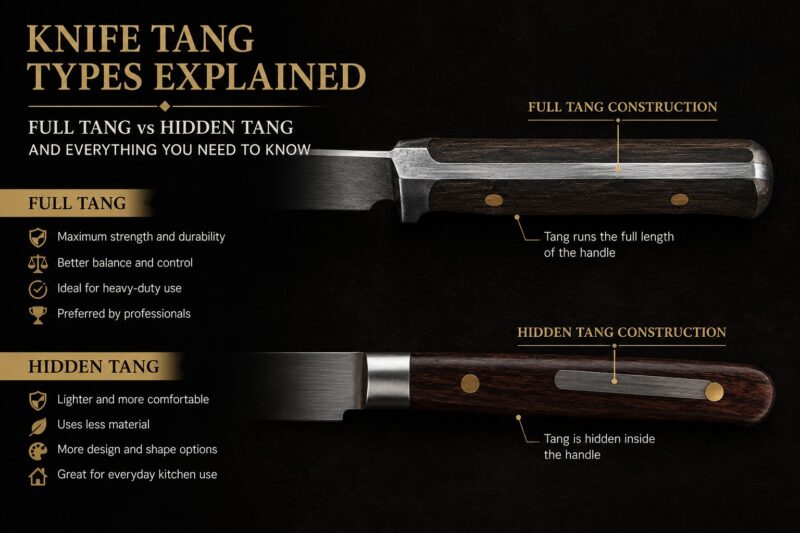
Knife Tang Types Explained
Introduction
When shopping for a quality knife, most people focus on the blade steel, edge retention, or handle material. However, one of the most important yet often overlooked parts of a knife is the tang.
The tang is the portion of the blade that extends into the handle. While it may not be visible from the outside, the tang plays a critical role in determining a knife’s strength, durability, balance, and overall performance.
Whether you are choosing a chef knife, hunting knife, bushcraft knife, or custom handmade knife, understanding knife tang construction can help you make a more informed decision.
In this guide, we’ll explore the different types of knife tangs, compare full tang vs hidden tang designs, and explain which tang type is best for various applications.
What Is a Knife Tang?
A knife tang is the section of steel that extends from the blade into the handle. It serves as the structural connection between the blade and the handle scales or handle material.
The tang acts as the backbone of the knife. A well-designed tang improves durability and ensures that the knife can withstand years of heavy use.
Tang design affects:
- Strength
- Balance
- Weight
- Durability
- Safety
- Overall knife performance
The larger the tang, the stronger the connection between the blade and handle generally becomes.
Why Is the Tang Important?
The tang absorbs and distributes force when the knife is used.
When cutting, chopping, carving, batoning, or processing food, significant stress is placed on the blade. The tang helps transfer that force throughout the entire knife structure.
A poorly constructed tang can lead to:
- Handle loosening
- Cracking
- Blade instability
- Reduced durability
- Potential safety hazards
This is why professional chefs, hunters, outdoor enthusiasts, and custom knife makers pay close attention to tang construction.
Full Tang Knives
What Is a Full Tang?
A full tang knife features a blade that extends through the entire length and width of the handle.
The steel can usually be seen running along the spine and bottom edge of the handle.
Handle scales are attached directly to both sides of the tang using pins, rivets, mosaic pins, bolts, or epoxy.
Characteristics of Full Tang Knives
- Maximum strength
- Excellent durability
- Superior balance
- Visible steel throughout handle
- Easy maintenance
- Popular in custom knives
Advantages of Full Tang Knives
Exceptional Strength
Full tang knives are considered the strongest knife construction available.
Because the steel extends throughout the handle, force is distributed evenly across the knife.
This makes full tang knives ideal for:
- Bushcraft
- Hunting
- Survival
- Heavy-duty outdoor tasks
Improved Durability
A properly made full tang knife can last for decades.
Many heirloom-quality knives use full tang construction because there are fewer weak points compared to partial tang designs.
Better Balance
The extra steel in the handle often creates excellent weight distribution.
Balanced knives improve comfort and control during prolonged use.
Easier Handle Replacement
For custom knife makers, replacing scales on a full tang knife is often simpler than rebuilding a hidden tang handle.
Disadvantages of Full Tang Knives
Increased Weight
Because more steel is used, full tang knives tend to be heavier.
Some users appreciate the additional weight, while others prefer lighter knives for extended use.
Less Traditional Appearance
Certain traditional Japanese and Scandinavian knife designs favor hidden tang construction for aesthetic reasons.
Hidden Tang Knives
What Is a Hidden Tang?
A hidden tang knife has a tang that extends into the handle but is not visible from the outside.
The handle material completely surrounds the tang.
This design has been used for centuries in traditional knife making.
Advantages of Hidden Tang Knives
Reduced Weight
Less steel means a lighter knife.
This can reduce hand fatigue during long periods of use.
Traditional Appearance
Many classic knife styles utilize hidden tang construction.
Examples include:
- Japanese kitchen knives
- Puukko knives
- Traditional hunting knives
Elegant Design
Hidden tang knives often feature seamless transitions between blade and handle.
This creates a clean and sophisticated appearance.
Disadvantages of Hidden Tang Knives
Potentially Less Durable
A poorly made hidden tang can become a weak point.
However, modern manufacturing techniques have significantly improved hidden tang reliability.
More Difficult Handle Replacement
Repairing or replacing a hidden tang handle often requires specialized tools and experience.
Types of Knife Tangs
Full Tang
The strongest and most common design for outdoor and survival knives.
Best for:
- Hunting knives
- Bushcraft knives
- Tactical knives
- Heavy-duty utility knives
Hidden Tang
A traditional design commonly found in Japanese and Scandinavian knives.
Best for:
- Chef knives
- Traditional hunting knives
- Lightweight outdoor knives
Partial Tang
A partial tang extends only partway into the handle.
These knives are usually less expensive but generally weaker than full tang models.
Best for:
- Light kitchen tasks
- Budget knives
Rat Tail Tang
A narrow tang extending through the handle.
Common on decorative or inexpensive knives.
Not recommended for heavy-duty use.
Encapsulated Tang
The tang is completely enclosed within synthetic handle material.
Often found in modern production knives.
Provides excellent weather resistance.
Skeletonized Tang
A full tang with strategically removed material.
This reduces weight while maintaining much of the knife’s strength.
Popular among:
- Survival knives
- Backpacking knives
- Modern custom knives
Full Tang vs Hidden Tang: Which Is Better?
The answer depends on intended use.
Choose a Full Tang Knife If:
- Maximum durability is required
- You perform heavy outdoor work
- You need a survival knife
- You prefer rugged construction
Choose a Hidden Tang Knife If:
- Weight reduction matters
- You prefer traditional craftsmanship
- You use the knife primarily for food preparation
- You appreciate classic aesthetics
Neither design is universally superior.
Both can perform exceptionally well when properly designed and manufactured.
Full Tang Knives for Hunting
Hunters often prefer full tang construction because field dressing and game processing can place significant stress on the knife.
Benefits include:
- Increased reliability
- Better control
- Improved strength
- Long-term durability
Many professional hunters consider a full tang knife the safest option in remote environments.
Check Our Guide Best Hunting Knife Features Explained
Hidden Tang Knives in Japanese Kitchen Cutlery
Many traditional Japanese chef knives feature hidden tang construction.
The famous Wa handle design pairs naturally with a hidden tang.
Benefits include:
- Lightweight feel
- Enhanced maneuverability
- Reduced fatigue
- Excellent balance for precision cutting
This explains why hidden tang construction remains popular among professional chefs worldwide.
How Knife Makers Attach Handles
Full tang knives typically use:
- Mosaic pins
- Brass pins
- Stainless pins
- Corby bolts
- Epoxy adhesives
Hidden tang knives often use:
- Epoxy
- Compression fitting
- Mechanical peening
- Threaded assemblies
The quality of handle attachment is just as important as tang design itself.
Common Myths About Knife Tangs
Myth 1: Full Tang Always Means Better
Not necessarily.
A high-quality hidden tang knife can outperform a poorly made full tang knife.
Craftsmanship matters more than tang type alone.
Myth 2: Hidden Tang Knives Are Weak
Modern hidden tang construction can be extremely strong.
Many premium Japanese and Scandinavian knives use hidden tang designs successfully.
Myth 3: Tang Type Is the Only Important Factor
Blade steel, heat treatment, handle material, and overall design all contribute to knife performance.
Tang design is important, but it should be evaluated as part of the complete knife.
Choosing the Right Tang for Your Needs
Consider:
Kitchen Use
A hidden tang or lightweight full tang often works best.
Hunting
Full tang construction provides excellent reliability.
Bushcraft
Most experts recommend full tang knives.
Everyday Carry
Either design can work well depending on intended use.
Custom Knives
Both tang styles offer unique benefits and aesthetic possibilities.
Conclusion
The tang is one of the most important structural components of any knife. Whether you choose a full tang or hidden tang design, understanding how the tang affects strength, balance, durability, and performance can help you select the right knife for your needs.
Full tang knives offer unmatched strength and ruggedness, making them ideal for survival, hunting, and outdoor applications. Hidden tang knives provide lighter weight, elegant aesthetics, and exceptional control, particularly in kitchen and traditional knife designs.
Ultimately, the best knife tang is the one that matches your intended use, personal preferences, and quality expectations. By understanding the different types of knife tangs, you’ll be better equipped to choose a knife that delivers years of reliable service.
Frequently Asked Questions
What is a knife tang?
A knife tang is the portion of the blade that extends into the handle. It serves as the structural backbone of the knife, providing strength, balance, and durability.
What is a full tang knife?
A full tang knife features a blade that extends through the entire length and width of the handle. This design offers maximum strength and is commonly found in hunting, survival, and bushcraft knives.
Are full tang knives stronger than hidden tang knives?
In general, full tang knives are considered stronger because the steel extends throughout the handle. However, a well-made hidden tang knife can also provide excellent durability and performance.
What is a hidden tang knife?
A hidden tang knife has a tang that extends into the handle but remains completely enclosed by the handle material. This design is popular in traditional Japanese kitchen knives and classic hunting knives.
Which tang type is best for a hunting knife?
Most hunters prefer full tang knives because they offer superior strength, reliability, and durability during demanding outdoor tasks.
Why do many Japanese knives use hidden tang construction?
Hidden tang construction allows Japanese knives to remain lightweight and well-balanced, improving precision and reducing fatigue during extended food preparation.
What is a skeletonized tang?
A skeletonized tang is a full tang with portions of steel removed to reduce weight while maintaining most of the knife’s structural strength.
Does tang type affect knife balance?
Yes. The size and design of the tang influence the knife’s weight distribution, which directly affects balance, handling, and overall comfort.
Can a hidden tang knife be used for heavy-duty tasks?
A high-quality hidden tang knife can handle many demanding tasks. However, for extreme use such as batoning or survival situations, a full tang knife is generally preferred.
What should I choose: full tang or hidden tang?
Choose a full tang knife if you prioritize strength and durability. Choose a hidden tang knife if you prefer lighter weight, traditional aesthetics, and excellent maneuverability. The best choice depends on your intended use.Для SEO это хороший FAQ, потому что включает популярные запросы:
• what is a knife tang
• full tang knife
• hidden tang knife
• full tang vs hidden tang
• skeletonized tang
• best tang for hunting knife
Knife Tang Types Explained
https://yashkadesigns.com/diy-blades-and-handles
Knife Tang Types Explained
https://yashkadesigns.ecrater.com/c/2444223/blade-handles
Knife Tang Types Explained