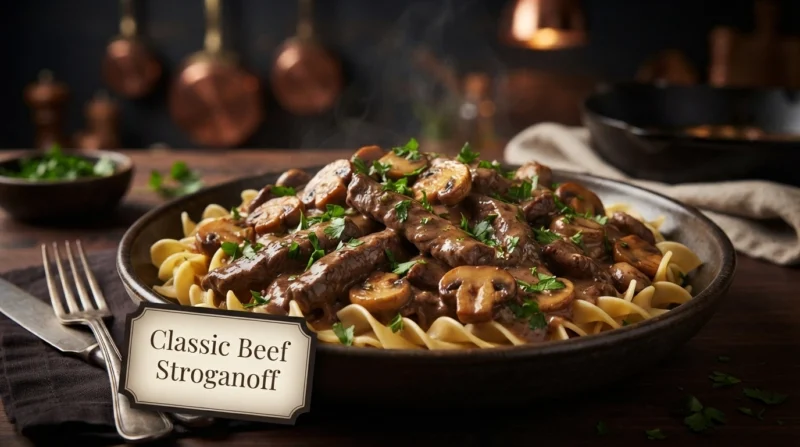
Beef Stroganoff Recipe
Introduction
Classic Beef Stroganoff is one of those dishes that looks much more complicated than it really is.
Tender strips of beef are quickly browned, mushrooms are cooked until deeply savory, onions become sweet and soft, and everything comes together in a rich sauce finished with sour cream. Traditionally served over egg noodles, Beef Stroganoff is comforting, satisfying, and substantial enough for a family dinner while still feeling special enough for guests.
But there is an important difference between a good Beef Stroganoff and a disappointing one.
The beef should be tender, not tough. The mushrooms should be deeply browned, not pale and watery. The sauce should be creamy and savory, not heavy or greasy. And the sour cream should contribute its characteristic tang without splitting into unpleasant curds.
The good news is that all of these results are achievable with a few straightforward techniques.
This recipe explains not only what to do, but why you are doing it, so even a complete beginner can understand what is happening in the pan.
The central idea is simple:
Cook the beef quickly over high heat, build flavor in the same pan, create a concentrated sauce, and combine everything at the end without overcooking the meat.
What Is Classic Beef Stroganoff?
Beef Stroganoff is a dish built around beef cooked with onions and mushrooms in a creamy, savory sauce. It is commonly served with egg noodles, although rice, potatoes, or other starches can also work.
The dish has a long culinary history associated with Russian cuisine and later became popular internationally, developing many regional variations.
There is no single universally accepted modern version. Some recipes use mustard, some use stock, some use wine, some use paprika, and some use different cuts of beef.
For this recipe, the goal is a classic, balanced home-style Beef Stroganoff:
- tender beef
- browned mushrooms
- onions
- garlic
- beef stock
- a small amount of Dijon mustard
- sour cream
- fresh herbs
- egg noodles
The mustard is not there to make the dish taste strongly of mustard. A small amount simply gives the sauce additional depth and helps balance the richness.
Check Our Guide Best Steak and Beef Recipes: 15 Easy & Delicious Beef Recipes
Why This Beef Stroganoff Works
There are several techniques that make a major difference.
1. The beef is cut thinly
Thin strips cook quickly, which helps prevent the meat from becoming tough.
2. The beef is browned separately
If you put all the beef into a crowded pan with the mushrooms and onions, the temperature drops and the meat begins to release liquid.
Instead of browning, it starts to steam.
A quick, high-heat sear gives the beef much better flavor.
3. Mushrooms are cooked until properly browned
Mushrooms contain a large amount of water. They need enough heat and enough space in the pan for that moisture to evaporate.
Only then can the mushrooms begin to brown.
4. The sauce is built from the browned bits
After the beef and mushrooms have been cooked, the bottom of the pan contains concentrated browned material.
Adding stock and scraping the pan releases those flavorful bits into the sauce.
5. Sour cream is added at the end
Sour cream provides the characteristic creamy tang of Stroganoff, but excessive heat can cause it to separate.
Adding it after reducing the sauce and lowering the heat gives you a smoother result.
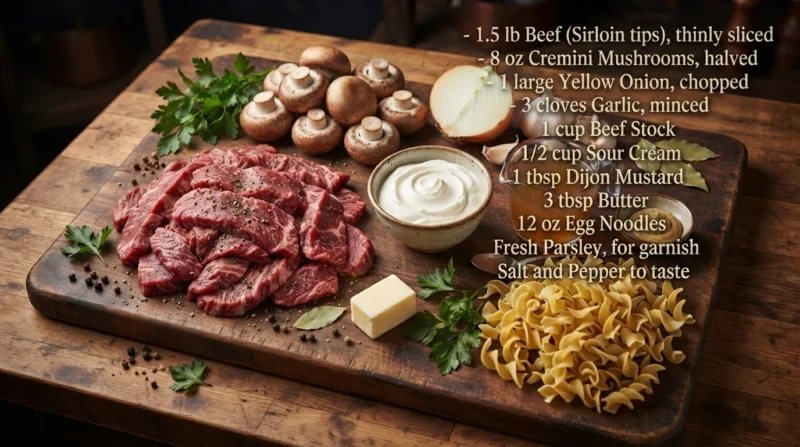
Ingredients
For the Beef
- 1½ lb (680 g) beef steak, preferably sirloin, ribeye, tenderloin, or strip steak
- 1 teaspoon kosher salt
- ½ teaspoon freshly ground black pepper
- 1–2 tablespoons neutral cooking oil
For the Stroganoff
- 1 tablespoon butter
- 8 oz (225 g) mushrooms, sliced
- 1 medium yellow onion, thinly sliced
- 2 cloves garlic, finely chopped
- 1 tablespoon all-purpose flour
- 1½ cups (360 ml) beef stock
- 1 tablespoon Dijon mustard
- ½ teaspoon Worcestershire sauce, optional
- ½ cup (120 ml) sour cream
- ½ teaspoon salt, or to taste
- ¼ teaspoon freshly ground black pepper
- 1 tablespoon chopped fresh parsley
For Serving
- 12 oz (340 g) egg noodles
- Salt for the pasta water
- Fresh parsley for garnish
Choosing the Right Beef
You do not need an expensive piece of beef to make excellent Stroganoff.
The most important factors are tenderness, thickness, and how you cut the meat.
Good choices include:
Sirloin
Sirloin is one of the best choices for this recipe because it provides a good balance between tenderness, beef flavor, and price.
Ribeye
Ribeye gives the dish excellent flavor because of its marbling.
It is richer than sirloin, so it is particularly good when you want a luxurious Stroganoff.
New York Strip
Strip steak is another excellent option.
It has strong beef flavor and enough tenderness for quick cooking.
Tenderloin
Tenderloin produces exceptionally tender Stroganoff, although using such an expensive cut is not necessary.
Flat Iron
Flat iron can also work very well when properly sliced across the grain.
Avoiding Tough Beef
The biggest mistake beginners make with Beef Stroganoff is assuming that because the pieces are small, they can be cooked for a long time.
The opposite is usually true.
If you use a tender steak and slice it thinly, you generally want to cook it quickly.
Thin strips can go from juicy to dry surprisingly fast.
If you want a traditional slow-cooked beef dish, that requires a different approach and a different type of beef.
Stroganoff made with tender steak is fundamentally a quick-cooking dish.
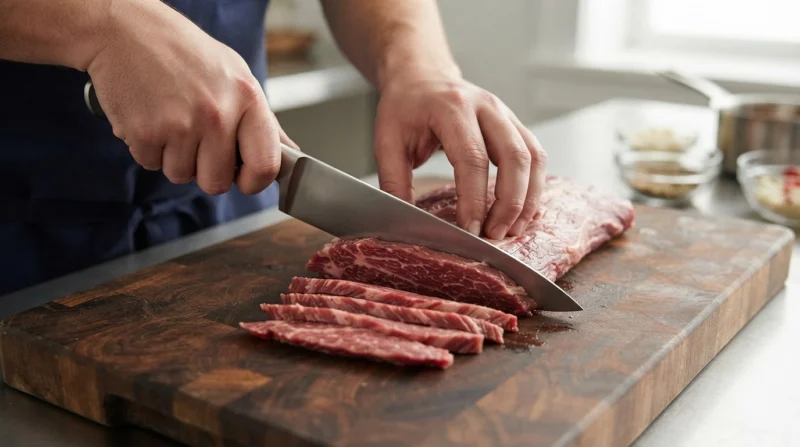
How to Cut the Beef Correctly
This step is extremely important.
Look carefully at the surface of the steak and identify the direction in which the muscle fibers run.
Those fibers are commonly called the grain.
Your knife should cut across the grain, rather than parallel to it.
Why?
Imagine the muscle fibers as many tiny pieces of string.
If you cut parallel to those strings, each piece contains long strands that your teeth must break apart.
If you cut across them, the strands become much shorter.
Shorter fibers feel more tender when you chew.
Aim for thin strips
Cut the beef into strips approximately:
¼ inch (6 mm) thick
and roughly 2–3 inches long.
The exact dimensions are not critical.
What matters most is that the strips are:
- relatively thin
- reasonably uniform
- cut across the grain
Uniform pieces also cook more evenly.
Check Our Ultimate American BBQ Meat Guide: How to Cut Chicken, Steak & Ribs + 8 Easy BBQ Recipes
Should You Bring the Beef to Room Temperature?
You do not need to leave the beef sitting out for a long time.
Instead, take it from the refrigerator while you prepare the other ingredients.
Pat the surface very dry with paper towels.
This matters because surface moisture interferes with browning.
A wet piece of beef has to lose that moisture before its surface can become hot enough to brown effectively.
Dry meat gives you a much better chance of developing a flavorful crust.
Prepare Everything Before Cooking
Beef Stroganoff moves relatively quickly once you begin.
That means it is worth preparing everything beforehand.
Slice the beef.
Slice the mushrooms.
Slice the onion.
Chop the garlic.
Measure the stock.
Measure the mustard.
Have the sour cream ready.
Bring the flour and seasonings near the stove.
This is often called mise en place, a French culinary term meaning that your ingredients are prepared and organized before cooking.
You do not need professional restaurant equipment to use the technique.
For this recipe, it simply prevents you from discovering halfway through cooking that you still need to chop the garlic.
Preparing the Egg Noodles
Bring a large pot of water to a boil.
Salt the water generously.
Add the egg noodles and cook according to the package directions.
Try to finish them slightly before the Stroganoff sauce is ready.
The noodles should be tender but still have enough structure to hold the sauce.
Reserve approximately ½ cup of pasta water before draining.
You may not need it, but it is useful if the sauce becomes thicker than you want.
Drain the noodles and set them aside.
Do not rinse them unless you have a specific reason to do so.
The surface starch helps the sauce cling to the noodles.
Step 1: Season the Beef
Place the sliced beef in a bowl.
Add the salt and black pepper.
Toss well so that the seasoning is distributed evenly.
Do not heavily season the beef at this stage.
The sauce will also contain salt from the stock, mustard, butter, and other ingredients.
It is much easier to add salt later than to correct an overly salty sauce.
Step 2: Heat the Pan Properly
Use a large, heavy skillet.
Cast iron works particularly well.
Stainless steel is also excellent.
The important thing is that the pan is large enough that the beef can be spread out rather than piled on top of itself.
Place the pan over medium-high to high heat.
Allow it to become properly hot before adding the oil.
Add the oil and swirl it around the pan.
You want the oil to become hot but not produce excessive smoke.
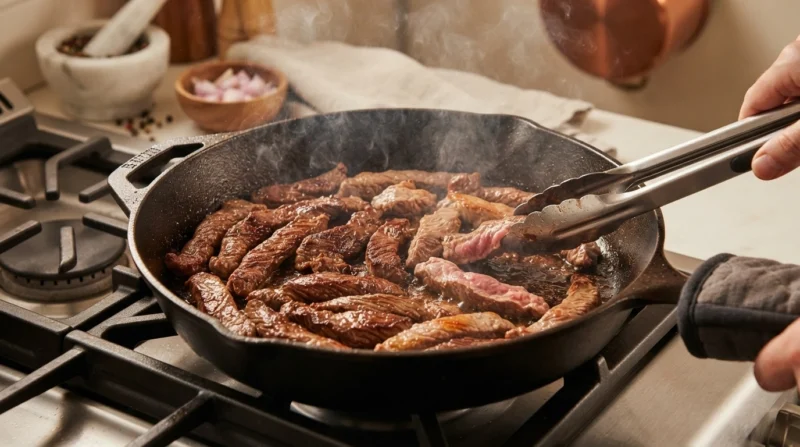
Step 3: Sear the Beef
Add the beef in a single layer.
Do not overcrowd the pan.
If necessary, cook the beef in two batches.
This is one of the most important steps in the recipe.
When too much meat is added at once, the pan loses heat and the beef releases water.
The temperature then remains too low for proper browning.
Instead of developing a flavorful brown surface, the meat steams.
A little space between the pieces allows moisture to escape.
How Long Should the Beef Cook?
Because the strips are thin, they need very little time.
Sear them for approximately:
60–90 seconds on the first side
then turn and cook briefly on the other side.
You are not trying to completely cook the beef at this point.
You are trying to brown the outside quickly.
The center can remain underdone because the beef will briefly return to the sauce later.
Remove the beef from the pan and place it on a plate.
Do not clean the pan.
Those browned bits are valuable.
Beginner Mistake: Cooking the Beef Until Fully Done
This is a common problem.
A beginner may think:
“The beef isn’t cooked yet, so I should keep frying it.”
That can result in tough meat.
Remember that the beef will be reheated later.
If you cook it completely during the initial sear and then cook it again in the sauce, it can become overdone.
The initial cooking is primarily about browning and flavor development.
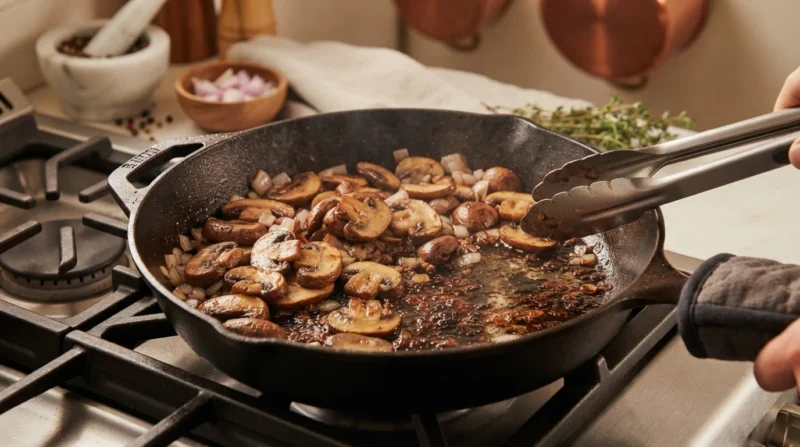
Step 4: Cook the Mushrooms
Reduce the heat to medium-high.
Add the butter.
Once it melts, add the mushrooms.
Spread them across the pan as much as possible.
Do not immediately stir them every few seconds.
Let them make contact with the hot pan.
Initially, the mushrooms will release water.
This is normal.
Keep cooking until most of that moisture has evaporated.
Only then will the mushrooms begin to develop a deeper brown color.
Depending on your pan and mushrooms, this can take approximately 5–8 minutes.
What Properly Cooked Mushrooms Look Like
Raw mushrooms are pale, firm, and full of moisture.
Properly cooked mushrooms should be:
- noticeably smaller
- browned around the edges
- tender
- savory
- fragrant
If they are still pale and sitting in a pool of liquid, they need more time.
Do not rush this stage.
Mushroom browning contributes a huge amount of flavor to the final sauce.
Step 5: Add the Onion
Once the mushrooms have browned, add the sliced onion.
Cook for approximately 4–5 minutes.
Stir occasionally.
The onion should become soft and translucent with lightly browned edges.
You do not need to caramelize it deeply.
The goal is to soften it and develop some sweetness.
Step 6: Add the Garlic
Add the chopped garlic.
Cook for approximately 30 seconds.
Garlic burns easily, especially in a hot pan.
You want it fragrant, but not dark brown.
If garlic becomes heavily browned or burned, it can taste bitter.
Thirty seconds is often enough.
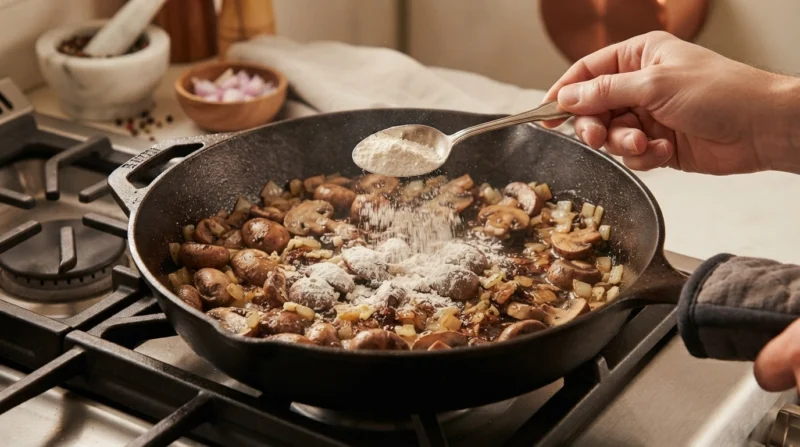
Step 7: Add the Flour
Sprinkle the flour over the mushrooms and onions.
Stir continuously for about 30–60 seconds.
The flour helps thicken the sauce.
Cooking it briefly also removes the raw flour taste.
Do not worry if the mixture looks slightly dry.
The stock will transform it into a sauce.
Step 8: Deglaze the Pan
Slowly pour in the beef stock while stirring.
As you pour, scrape the bottom of the pan with a wooden spoon or spatula.
You should see the browned material from the bottom dissolve into the liquid.
This process is called deglazing.
It is one of the easiest ways to add flavor to a pan sauce.
Those browned bits are not burnt food that needs to be thrown away.
The properly browned ones are concentrated flavor.
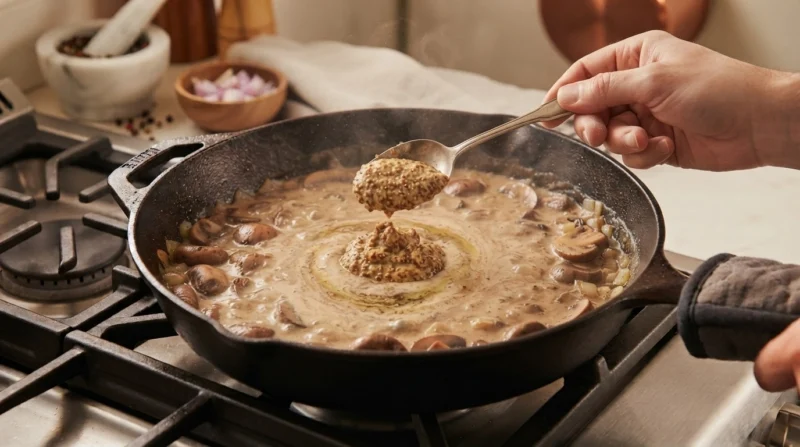
Step 9: Add Mustard
Add the Dijon mustard.
Stir until completely incorporated.
The sauce should begin to smell deeper and more savory.
The mustard should not dominate the dish.
It should simply add acidity, spice, and complexity.
If you strongly taste mustard as the main flavor, you have probably used more than necessary.
Step 10: Reduce the Sauce
Bring the sauce to a gentle simmer.
Cook for approximately 3–5 minutes.
The sauce should begin to thicken.
You are looking for a consistency that coats the back of a spoon.
It should not be as thick as gravy.
It needs to remain fluid enough to coat the beef and noodles.
How to Know When the Sauce Is Ready
Dip a spoon into the sauce.
Lift it.
The sauce should coat the spoon rather than immediately running off like thin stock.
Run a finger across the back of the spoon.
If the line remains visible for a moment, the sauce has thickened sufficiently.
This is more useful than relying only on a timer because different pans and heat levels produce different evaporation rates.
Step 11: Lower the Heat Before Adding Sour Cream
This is another important technique.
Turn the heat to low.
Allow the sauce to stop boiling vigorously.
Then add the sour cream.
Stir continuously until the sauce becomes smooth and creamy.
Do not let the sauce boil aggressively after adding the sour cream.
High heat can cause dairy products to separate.
A gentle temperature gives you a smoother sauce.
Why Does Sour Cream Sometimes Split?
Sour cream is an emulsion containing dairy proteins and fat.
Very high heat can cause the proteins to tighten and separate.
The result can be a sauce that looks grainy or oily.
You can reduce the risk by:
- lowering the heat
- avoiding a hard boil
- adding sour cream near the end
- stirring it thoroughly
If your sour cream is very cold, you can also temper it by mixing a spoonful of the warm sauce into the sour cream before adding the mixture back to the pan.
This gently raises its temperature.
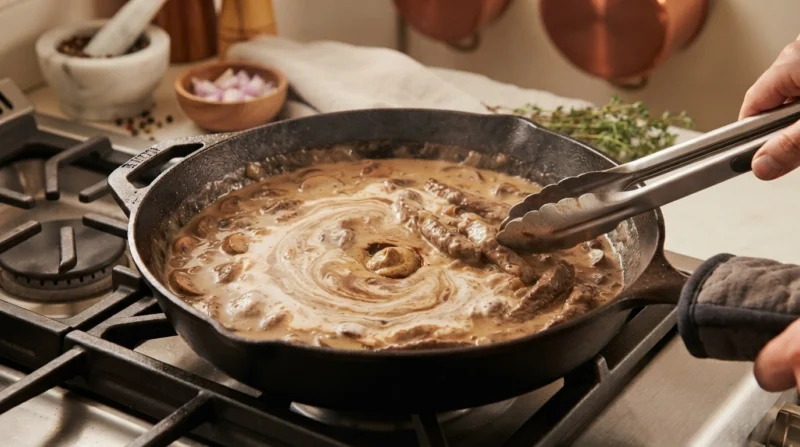
Step 12: Return the Beef to the Pan
Now add the seared beef and any juices that collected on the plate.
Stir gently.
Allow the beef to warm through for approximately 1–2 minutes.
Do not simmer it aggressively for a long time.
The meat is already cooked from the initial sear.
The final stage is about bringing the beef and sauce together.
Taste the Sauce
Before serving, taste the Stroganoff.
Ask yourself:
- Does it need more salt?
- Is the beef flavor strong enough?
- Does it need more black pepper?
- Is the sauce too thick?
- Is the sour cream balanced?
- Does it have enough acidity?
If the sauce is too thick, add a small splash of beef stock or reserved pasta water.
If it tastes flat, a small amount of salt can make a surprising difference.
If it is too rich, a tiny additional amount of mustard or another acidic element can help balance it.
Make adjustments gradually.
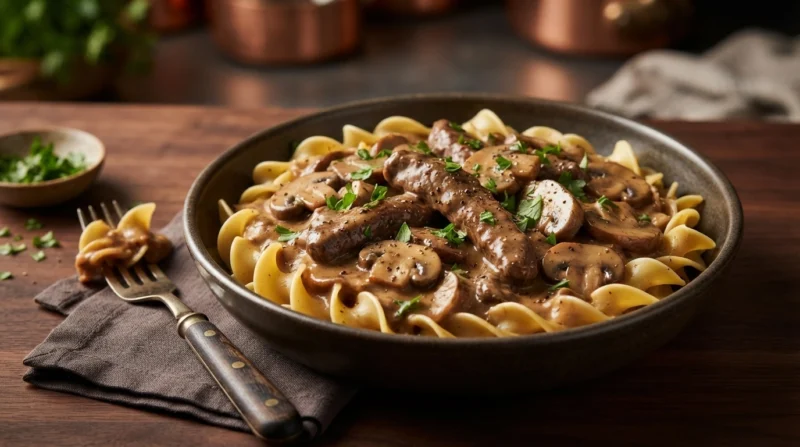
Step 13: Combine With the Noodles
Add the cooked egg noodles to the pan or spoon the Stroganoff over the noodles.
If the sauce seems slightly too thick, add a little reserved pasta water.
The starch in the pasta water can help loosen the sauce while still allowing it to cling to the noodles.
Toss gently.
You want every noodle lightly coated in sauce.
The Perfect Beef Stroganoff Texture
When you take the first bite, several things should happen at once.
The beef should be tender.
The mushrooms should have a savory, concentrated flavor.
The noodles should be soft but not mushy.
The sauce should be creamy without feeling excessively heavy.
The sour cream should provide a subtle tang.
The mustard should be noticeable as complexity rather than as an obvious mustard flavor.
The overall result should taste rich but balanced.
Common Beef Stroganoff Mistakes
Mistake 1: Overcrowding the Beef
This is probably the most common technical mistake.
Too much meat in the pan causes steaming instead of browning.
Solution
Cook the beef in batches.
It takes a little longer, but the flavor is much better.
Mistake 2: Starting With Wet Beef
If the steak surface is covered with moisture, browning becomes more difficult.
Solution
Pat the beef thoroughly dry before seasoning.
Mistake 3: Cutting With the Grain
This can make otherwise good beef seem surprisingly tough.
Solution
Identify the direction of the muscle fibers and cut perpendicular to them.
Mistake 4: Cooking the Beef Too Long
Thin strips of tender steak do not need prolonged cooking.
Solution
Sear quickly, remove the beef, and return it to the sauce only at the end.
Mistake 5: Under-Browning the Mushrooms
Pale mushrooms can make the dish taste watery.
Solution
Give them time to release their moisture and then brown.
Mistake 6: Burning the Garlic
Garlic becomes bitter when burned.
Solution
Add it after the onions and mushrooms have cooked and give it only a short time in the pan.
Mistake 7: Adding Flour Without Cooking It
Raw flour can leave an unpleasant taste.
Solution
Cook the flour with the mushrooms and onions for about 30–60 seconds before adding the stock.
Mistake 8: Boiling the Sour Cream
This can cause the sauce to become grainy.
Solution
Lower the heat before adding sour cream.
Mistake 9: Making the Sauce Too Thick
A very thick sauce can feel heavy and pasty.
Solution
Loosen it with a little stock or pasta water.
Remember that the sauce will also cling to the noodles.
Mistake 10: Making the Sauce Too Thin
A watery Stroganoff does not cling properly to the beef or noodles.
Solution
Allow the stock to reduce before adding the sour cream.
What If Your Sauce Splits?
Do not panic.
Remove the pan from the heat immediately.
Whisk gently.
Add a small spoonful of warm stock or water.
If necessary, add another small amount of sour cream and stir gently.
The goal is to bring the sauce back together without increasing the heat dramatically.
Prevention is easier than repair, however.
Keep the sauce below a vigorous boil once the sour cream is added.
Can You Use Different Mushrooms?
Absolutely.
White button mushrooms work perfectly well.
Cremini mushrooms provide slightly deeper flavor.
Portobello mushrooms can also work, although their larger size and stronger flavor can change the character of the dish.
A mixture of mushrooms can be especially good.
Whatever mushrooms you use, slice them fairly evenly so they cook at approximately the same rate.
Can You Add Wine?
Yes.
A small amount of dry white wine can add acidity and complexity.
If using wine, add it after the mushrooms and onions have cooked and before adding the stock.
Allow the wine to simmer for a minute or two so some of the alcohol evaporates and the liquid becomes more concentrated.
However, wine is not required for an excellent Stroganoff.
The classic character of the dish comes from the combination of beef, mushrooms, onions, stock, mustard, and sour cream.
Can You Use Heavy Cream Instead of Sour Cream?
You can, but the result will be different.
Sour cream provides acidity as well as creaminess.
Heavy cream provides richness but much less tang.
If you replace all of the sour cream with heavy cream, the dish may taste richer but less characteristic of traditional Stroganoff.
For the most recognizable flavor, sour cream is the better choice.
Can You Use Greek Yogurt?
Greek yogurt can work as a substitute, particularly if you want a lighter variation.
However, it also needs careful handling because high heat can cause yogurt to separate.
Use full-fat Greek yogurt when possible and add it after reducing the heat.
The flavor will be somewhat different from traditional sour cream.
Can You Make Stroganoff Without Flour?
Yes.
Flour is convenient, but it is not absolutely essential.
You can reduce the stock further or use another thickening method.
However, a small amount of flour makes it easy to create the classic creamy consistency without requiring a long reduction.
For a straightforward beginner recipe, flour is practical.
Cast Iron vs. Stainless Steel
Both can produce excellent results.
Cast Iron
Cast iron holds heat extremely well.
That makes it excellent for browning beef and mushrooms.
It is particularly useful if you are cooking larger quantities.
Stainless Steel
Stainless steel also works very well.
It gives excellent browning and makes it easy to build a pan sauce from the browned bits.
Nonstick
Nonstick pans can work, but they generally do not develop the same degree of fond—the browned material left on the pan—that makes a pan sauce particularly flavorful.
For Stroganoff, cast iron or stainless steel is my preference.
Knife Technique for Preparing Beef Stroganoff
Because this is a recipe centered around sliced beef, your knife matters.
A sharp chef’s knife makes it easier to create thin, even strips.
A dull knife tends to crush and tear the meat rather than slicing cleanly.
Place the beef on a stable cutting board.
Keep your non-knife hand in a safe claw position with the fingertips curled inward.
Use controlled slicing motions.
Do not force the blade through the meat.
A sharp kitchen knife should do the work.
Should You Freeze the Beef Before Slicing?
If your steak is difficult to slice thinly, place it in the freezer for approximately 20–30 minutes.
You do not want to freeze it solid.
You simply want the exterior to become firmer.
Slightly firm meat is easier to cut into thin, uniform strips.
This is especially useful for beginners.
How to Make Stroganoff for Guests
If you are cooking for a larger group, do not simply multiply everything and put it into one small pan.
The browning stage depends on adequate surface area.
Cook the beef in several batches.
Cook the mushrooms in batches if necessary.
You can then combine everything in a larger pan when building the sauce.
This preserves the quality of the browning.
Can Beef Stroganoff Be Made Ahead?
Yes, but the beef is best when cooked close to serving time.
You can prepare several components ahead:
- slice the beef
- slice the mushrooms
- slice the onions
- chop the garlic
- measure the stock
- cook the noodles
For the best texture, build the sauce and finish the beef shortly before serving.
How to Store Leftover Stroganoff
Allow leftovers to cool reasonably quickly and refrigerate them in a covered container.
They are generally best consumed within 3–4 days when properly refrigerated.
The sauce may become thicker in the refrigerator.
That is normal.
How to Reheat Stroganoff
Gentle reheating is important.
Place the Stroganoff in a skillet over low to medium-low heat.
Add a small splash of stock or water.
Stir occasionally.
Avoid bringing the sauce to a hard boil.
The beef can become tougher and the sour cream sauce can separate if reheated aggressively.
For this reason, leftovers often benefit from slow, gentle reheating rather than very high heat.
Can You Freeze Beef Stroganoff?
You can freeze it, but the texture of the sour cream sauce may change after thawing.
Dairy-based sauces sometimes separate or become slightly grainy when frozen and reheated.
If you know in advance that you want to freeze the dish, consider preparing the beef and mushroom sauce without the sour cream.
Cool and freeze the base.
When reheating, add the sour cream near the end.
This generally gives a better final texture.
What to Serve With Beef Stroganoff
Egg noodles are the classic choice, but they are not your only option.
Egg Noodles
Probably the most familiar pairing.
Their shape and texture are excellent for holding the creamy sauce.
Mashed Potatoes
A richer option.
The creamy sauce and mashed potatoes create an especially comforting combination.
Rice
Plain white rice or buttered rice can work well when you want a simple alternative.
Roasted Potatoes
Crisp potatoes provide an appealing contrast to the soft beef and creamy sauce.
Green Vegetables
Green beans, broccoli, asparagus, or a simple green salad can provide freshness and balance.
Because Stroganoff is rich, a crisp vegetable side is often a good idea.
How to Balance a Rich Stroganoff
If the finished dish tastes too heavy, do not immediately add more salt.
Think about balance.
You already have:
- beef
- butter
- sour cream
- stock
- mushrooms
A little acidity can make the dish feel lighter.
The sour cream already provides some acidity, and Dijon mustard adds another layer.
A simple green salad with a lightly acidic dressing is also an excellent accompaniment.
A Beginner’s Timeline
Here is a practical sequence for the whole meal.
Before cooking
10 minutes
- Slice beef
- Slice mushrooms
- Slice onion
- Chop garlic
- Measure ingredients
- Start pasta water
Cook noodles
8–10 minutes
Cook and drain the egg noodles.
Sear beef
3–5 minutes
Brown beef in one or two batches.
Cook mushrooms and onions
8–10 minutes
Brown mushrooms, then soften onions and garlic.
Build sauce
5–8 minutes
Add flour, stock, mustard, and reduce.
Finish
2–3 minutes
Add sour cream and return beef to pan.
Serve
Total active cooking time is approximately 30–40 minutes, depending on your preparation speed.
How to Tell If Your Beef Is Tender
You should not need to cut every piece open to check.
Instead, look at the cooking time and thickness.
Thin strips of a naturally tender steak should cook very quickly.
If the beef is thin, browned on the outside, and only briefly returned to the sauce, it should remain tender.
If it has been simmering for 15–20 minutes, that is a warning sign.
You are moving away from the quick-seared steak method and toward a tougher result.
Why Stroganoff Doesn’t Need a Marinade
Some people assume beef must be marinated before making Stroganoff.
It does not.
For a tender steak, a marinade is unnecessary.
The important factors are:
- Choose an appropriate cut.
- Slice it correctly.
- Pat it dry.
- Season it.
- Sear it quickly.
- Avoid overcooking.
The sauce provides plenty of flavor.
Marinating can actually complicate the browning process if the beef surface becomes wet.
Should You Salt the Beef Early?
You can season shortly before cooking.
For a simple weeknight Stroganoff, salting immediately before searing works well.
The more important point is that the meat should be dry on the outside.
If you season the beef far ahead of time, salt can draw moisture toward the surface.
That is not necessarily bad—dry-brining can be useful—but if you are doing a quick preparation, seasoning immediately before cooking is simpler.
The Role of Each Ingredient
Understanding ingredients helps you adjust the recipe confidently.
Beef
Provides the central savory flavor and protein.
Mushrooms
Add umami and earthy depth.
Onion
Adds sweetness and aromatic flavor.
Garlic
Adds a sharper aromatic note.
Butter
Provides richness and helps carry flavor.
Flour
Thickens the sauce.
Beef Stock
Creates the liquid foundation of the sauce and adds beef flavor.
Dijon Mustard
Adds acidity, mild heat, and complexity.
Sour Cream
Creates the characteristic creamy and tangy Stroganoff finish.
Parsley
Adds freshness and visual contrast.
Egg Noodles
Provide a neutral, comforting base that carries the sauce.
Making the Sauce More Mushroom-Forward
If you love mushrooms, increase the quantity.
Instead of 8 ounces, you can use 12 ounces or even a pound.
The important thing is to give them enough room in the pan.
More mushrooms mean more moisture.
That means you may need additional cooking time before they brown.
Do not compensate by turning the heat extremely high.
Simply allow the mushrooms to cook until their moisture has evaporated and browning begins.
Making a More Peppery Stroganoff
Freshly ground black pepper works particularly well here.
You can add a little more black pepper near the end of cooking.
Avoid relying exclusively on pre-ground pepper if possible.
Freshly ground pepper has a more pronounced aroma and sharper flavor.
Making It More Savory
If the sauce tastes flat even though you have added enough salt, the problem may be lack of depth rather than lack of salt.
Try:
- better browning of the mushrooms
- better browning of the beef
- properly deglazing the pan
- a small amount of Worcestershire sauce
- slightly more Dijon mustard
Make changes one at a time.
What If the Sauce Is Too Salty?
Do not simply add a huge amount of sour cream.
Instead, dilute carefully with unsalted stock or a little water.
If you have not yet combined the sauce with the noodles, adding more unsalted noodles can also help distribute the salt.
The best prevention is tasting before adding additional salt.
Remember that beef stock can vary considerably in saltiness.
What If the Sauce Is Too Sour?
Too much sour cream or mustard can make the sauce overly acidic.
First, add a small amount of unsalted stock or cream.
Then taste again.
Do not try to fix acidity by adding large amounts of sugar.
The goal is balance, not sweetness.
What If the Sauce Is Too Rich?
Add a small amount of stock and check the seasoning.
Serve with a fresh vegetable or salad.
A little acidity can also help.
What If the Sauce Is Too Thin?
Continue simmering the sauce before adding the sour cream, allowing some liquid to evaporate.
If you have already added sour cream, keep the heat low and allow the sauce to thicken gently rather than boiling it aggressively.
What If the Beef Is Tough?
If the beef is already tough, there is no magic last-minute technique that can completely reverse overcooking.
However, serving it with plenty of sauce can make the texture more pleasant.
For your next batch:
- choose a more tender cut
- cut across the grain
- slice thinner
- sear faster
- avoid overcrowding
- return the beef to the sauce only at the end
Those changes make a much bigger difference than simply cooking the meat for less time without addressing the slicing and searing technique.
Classic Beef Stroganoff Recipe Card
Ingredients
Beef
- 1½ lb (680 g) sirloin, ribeye, strip steak, tenderloin, or another tender beef steak
- 1 teaspoon kosher salt
- ½ teaspoon freshly ground black pepper
- 1–2 tablespoons neutral cooking oil
Sauce
- 1 tablespoon butter
- 8 oz (225 g) mushrooms, sliced
- 1 medium yellow onion, thinly sliced
- 2 cloves garlic, finely chopped
- 1 tablespoon all-purpose flour
- 1½ cups (360 ml) beef stock
- 1 tablespoon Dijon mustard
- ½ teaspoon Worcestershire sauce, optional
- ½ cup (120 ml) sour cream
- Salt and black pepper to taste
- 1 tablespoon chopped fresh parsley
To Serve
- 12 oz (340 g) egg noodles
- Salt for cooking the noodles
- Fresh parsley
Instructions
1. Prepare the beef
Pat the steak dry.
Slice it thinly across the grain into approximately ¼-inch strips.
Season with salt and black pepper.
2. Cook the noodles
Bring a large pot of salted water to a boil.
Cook the egg noodles according to the package directions.
Reserve about ½ cup of pasta water, then drain.
3. Sear the beef
Heat a large skillet over medium-high to high heat.
Add the oil.
When hot, add the beef in a single layer.
Cook for approximately 60–90 seconds on the first side and briefly on the second side.
Remove the beef from the pan.
4. Brown the mushrooms
Reduce the heat slightly.
Add the butter and mushrooms.
Cook until the mushrooms release their moisture and become well browned, approximately 5–8 minutes.
5. Cook the onion and garlic
Add the onion.
Cook for 4–5 minutes until softened.
Add the garlic and cook for about 30 seconds.
6. Add the flour
Sprinkle the flour over the mushrooms and onions.
Stir for 30–60 seconds.
7. Add the stock
Slowly pour in the beef stock while stirring and scraping the browned bits from the bottom of the pan.
Add the Dijon mustard and Worcestershire sauce if using.
8. Reduce
Bring to a gentle simmer.
Cook for approximately 3–5 minutes, until the sauce thickens enough to coat a spoon.
9. Add sour cream
Reduce the heat to low.
Add the sour cream and stir until smooth.
Do not allow the sauce to boil vigorously.
10. Return the beef
Add the seared beef and any accumulated juices.
Warm gently for approximately 1–2 minutes.
11. Finish
Taste and adjust salt and pepper.
If necessary, loosen the sauce with a little reserved pasta water or stock.
12. Serve
Serve immediately over egg noodles.
Garnish with fresh parsley.
Recipe Notes
Best beef
Sirloin is an excellent combination of tenderness, flavor, and value.
Best pan
A large cast-iron or stainless-steel skillet works particularly well.
Most important technique
Do not overcrowd the pan when searing the beef.
Most important knife technique
Slice the beef thinly across the grain.
Most important sauce technique
Do not boil the sour cream.
Best serving temperature
Serve Stroganoff immediately after finishing the sauce.
Frequently Asked Questions
What is the best cut of beef for Beef Stroganoff?
Sirloin is one of the best all-around choices. Ribeye, New York strip, tenderloin, and flat iron can also work very well when sliced thinly across the grain.
Why is my Stroganoff beef tough?
The most common reasons are overcooking, cutting with the grain, using a less suitable cut, or overcrowding the pan during searing.
Can I use ground beef?
Yes, but it produces a different dish. Ground beef Stroganoff can be delicious, but it does not have the same texture as classic sliced-beef Stroganoff.
Can I use chicken instead of beef?
Yes. Chicken Stroganoff is a useful variation, although the flavor profile is different.
Can I make Beef Stroganoff without mushrooms?
Yes, but mushrooms contribute an important savory flavor. If you dislike them, the dish can still be made without them.
Can I use heavy cream?
Yes, but sour cream provides the characteristic tang associated with Stroganoff.
Can I use Greek yogurt?
Yes, preferably full-fat Greek yogurt. Add it over low heat to reduce the chance of separation.
Can I use a different pasta?
Yes. Egg noodles are traditional, but other broad noodles can work.
Can I serve Stroganoff with rice?
Absolutely. Rice is a practical alternative to egg noodles.
How long does Beef Stroganoff last in the refrigerator?
Properly refrigerated leftovers are generally best consumed within 3–4 days.
Can I freeze Stroganoff?
You can, but the sour cream sauce may change texture. For better results, freeze the beef and mushroom sauce before adding sour cream, then add the sour cream while reheating.
Final Tips for Perfect Beef Stroganoff
If you remember only a few things from this recipe, remember these:
Use tender beef.
Cut it thinly across the grain.
Dry the surface before searing.
Use a hot pan.
Do not overcrowd the beef.
Brown the mushrooms properly.
Do not burn the garlic.
Scrape the browned bits from the pan when adding stock.
Reduce the sauce before adding sour cream.
Never boil the sour cream aggressively.
Return the beef to the pan only at the end.
Serve immediately.
These techniques are more important than any single ingredient.
A great Beef Stroganoff is not about complicated cooking. It is about controlling heat, moisture, timing, and texture.
Final Thoughts
Classic Beef Stroganoff is an excellent example of how simple ingredients can become a deeply satisfying meal when each ingredient is treated correctly.
The beef does not need a complicated marinade.
The mushrooms do not need elaborate seasoning.
The sauce does not need dozens of ingredients.
Instead, the flavor comes from a sequence of small but important decisions:
dry beef → hot pan → quick browning → properly browned mushrooms → deglazing → concentrated sauce → gentle sour cream finish → tender beef added at the end.
Once you understand that sequence, Stroganoff becomes much easier to cook well.
And perhaps more importantly, the same principles apply to many other dishes.
Learning how to avoid overcrowding a pan will improve your steaks and vegetables.
Learning how to cut meat across the grain will improve many beef dishes.
Learning how to deglaze a pan will improve sauces.
Learning how to control the temperature of dairy will improve creamy sauces.
That is why Beef Stroganoff is such a useful recipe for beginners: it is comforting food, but it also teaches real cooking technique.
Serve it over warm egg noodles, finish it with fresh parsley, and bring it to the table while the sauce is still creamy and hot.
The result should be tender, savory, rich, slightly tangy, and deeply comforting—the kind of classic dinner that earns its place in a regular home-cooking rotation.