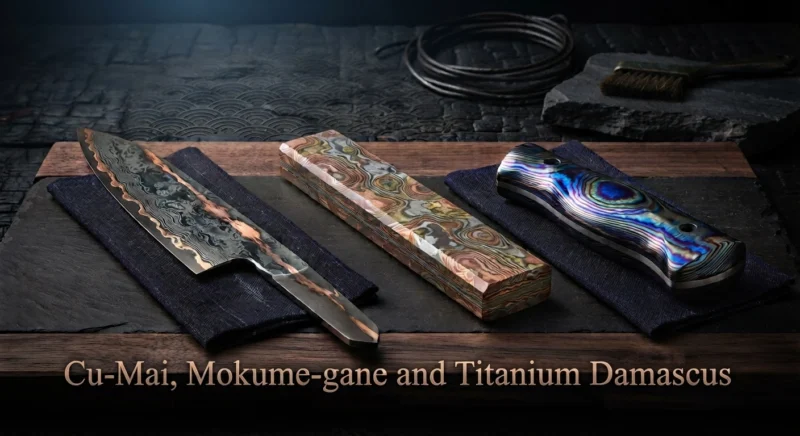
Cu-Mai, Mokume-gane and Titanium Damascus
An Independent Guide
Exotic knife materials can be confusing because several very different technologies are often grouped together under familiar words such as Damascus, layered metal, or pattern-welded. A knife with flowing copper lines, a handle with a wood-grain metal pattern, and a titanium handle covered in blue and purple waves may all look “Damascus-like,” but they are not made in the same way and they do not perform the same job.
Three materials are especially interesting:
- Cu-Mai, a steel-and-copper layered material used primarily for visually distinctive blades.
- Mokume-gane, a traditional Japanese layered-metal technique that creates wood-grain patterns from contrasting non-ferrous metals.
- Titanium Damascus, commonly called Timascus, a patterned titanium laminate used mostly for premium knife handles, bolsters, clips, and other components.
Understanding the difference matters if you are buying, designing, making, or simply evaluating an unusual knife.
The most important point is this:
These materials are not interchangeable versions of “Damascus.”
Cu-Mai can be part of a functional cutting blade because it incorporates blade steel. Mokume-gane is primarily a decorative and structural metalworking material rather than a blade steel. Timascus is a titanium-based decorative and structural material that is particularly popular for high-end knife hardware and handles.
The visual effect is only the beginning. The real differences involve metallurgy, bonding, hardness, corrosion behavior, weight, machining, finishing, maintenance, and the role each material plays in a finished knife.
This guide explains how each material is made, why its patterns look different, what it can and cannot do, and how to judge an exotic knife material without being distracted by appearance alone.
https://yashkadesigns.com/cu-mai-paring-knife-blank-blade
What Are Cu-Mai, Mokume-gane and Titanium Damascus?
Before looking at each material individually, it helps to establish a simple framework.
Cu-Mai
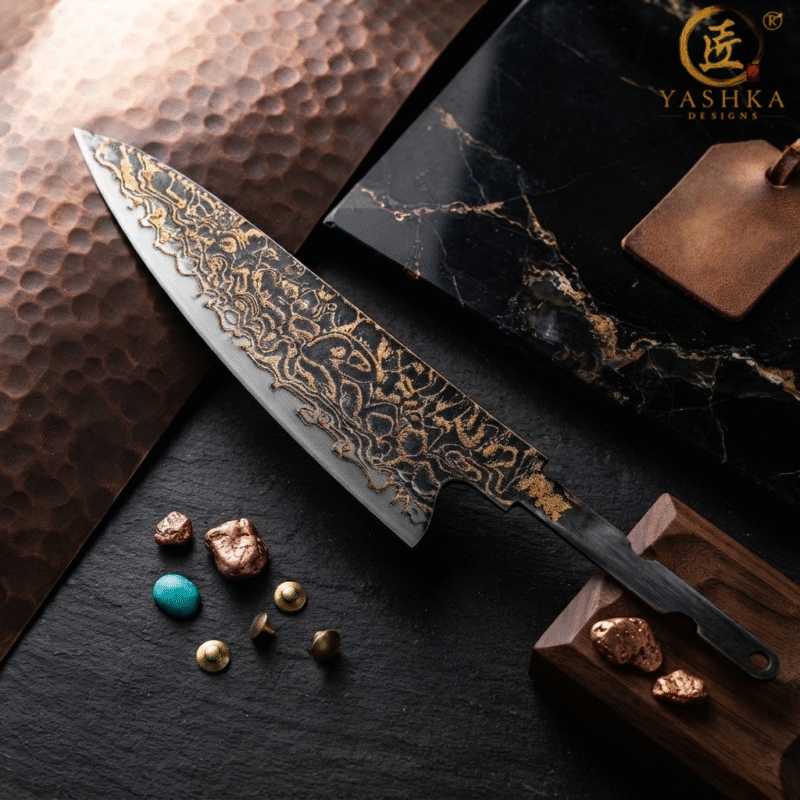
Cu-Mai is a layered knife material in which copper is incorporated into a steel-based billet. The exact construction can vary considerably between makers.
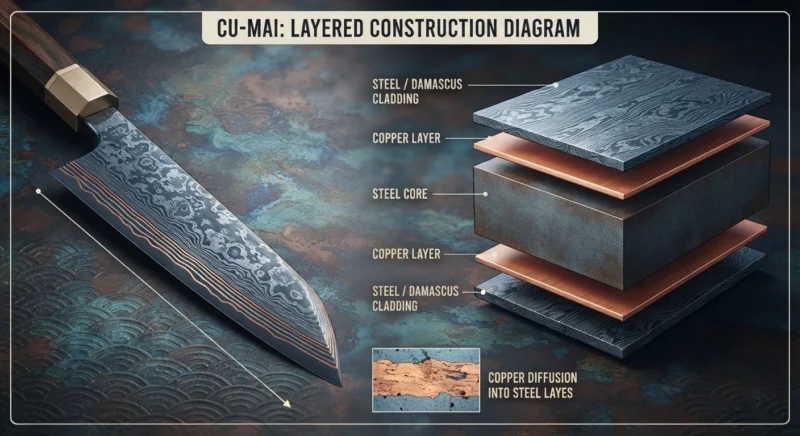
Some constructions use copper layers between pattern-welded steels. Others use a hard steel core surrounded by copper and patterned steel cladding. The terminology is not completely standardized, so the actual construction should always be checked rather than assuming that every product called Cu-Mai has identical metallurgy.
The copper creates warm reddish, orange, or bronze-colored lines when the finished blade is polished and etched.
The cutting edge must ultimately come from suitable hardened steel rather than copper.
Copper is far too soft to function as the primary cutting edge material of a serious knife.
Cu-Mai therefore combines a functional blade-steel system with a highly decorative copper component.
What Is Mokume-gane?
Mokume-gane is a Japanese metalworking technique whose name is commonly translated as something like “wood-grain metal.”
Instead of relying on multiple grades of steel, mokume-gane traditionally combines different colored non-ferrous metals and alloys.
Common materials include:
- copper
- silver
- gold
- shakudō
- shibuichi
- brass
- nickel silver
- other compatible alloys
The layers are bonded together and then manipulated through carving, cutting, forging, twisting, rolling, or related techniques.
When the patterned billet is worked and its surface is exposed, the different metals appear as flowing lines resembling wood grain.
The Japanese origins of mokume-gane are generally associated with sword fittings during the Edo period. The Japan Mokumegane Research Institute describes the technique as a layered-metal craft developed around the beginning of the Edo period and associated with Shoami Denbei.
Mokume-gane is therefore better understood as a metalworking method and material family, not as a particular steel grade.
https://yashkadesigns.com/8-inch-chef-knife-billet-timascus-steel
What Is Titanium Damascus?
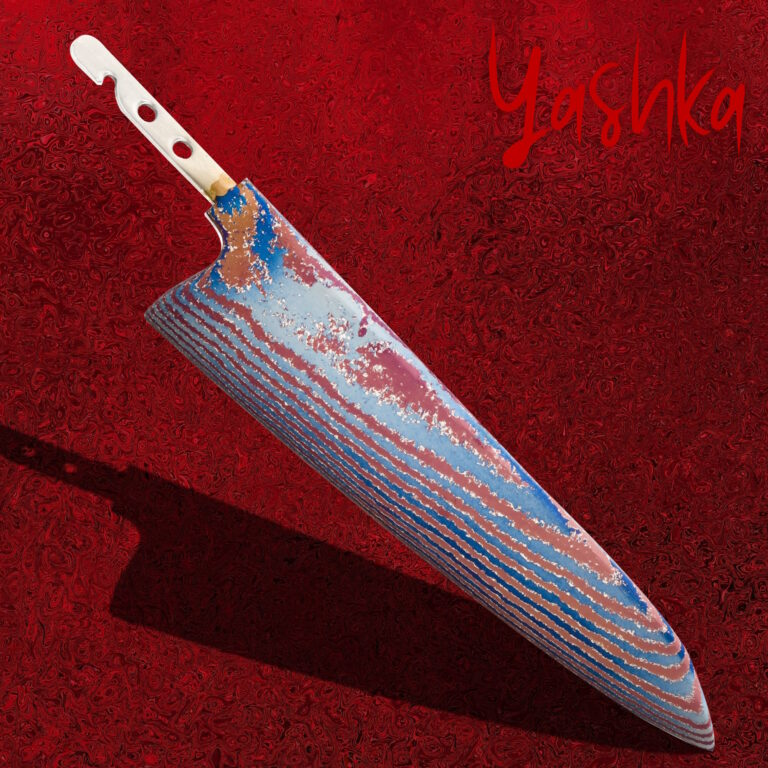
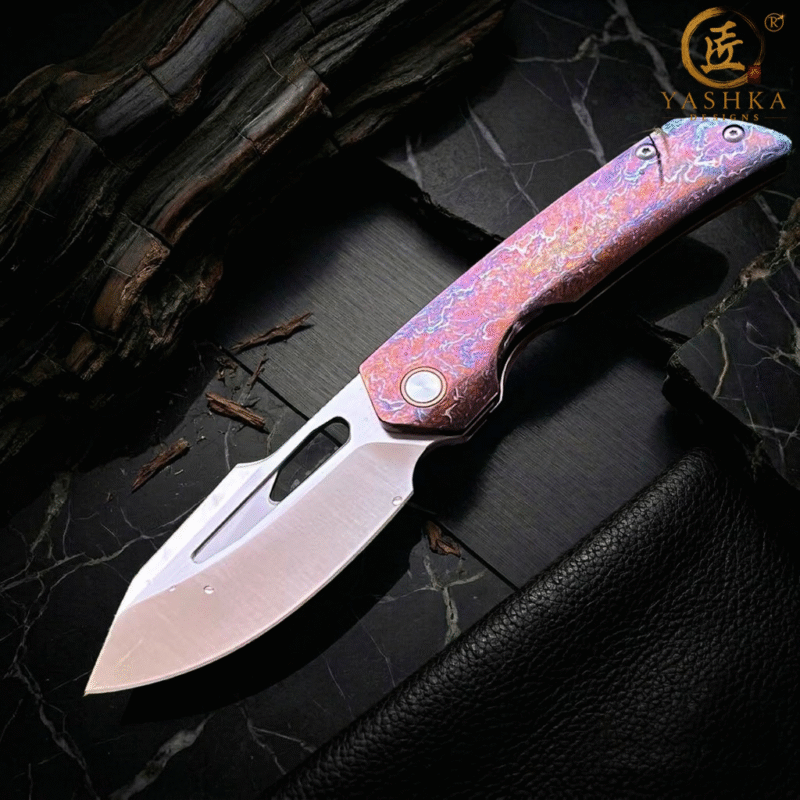
Titanium Damascus is commonly known as Timascus in the knife world.
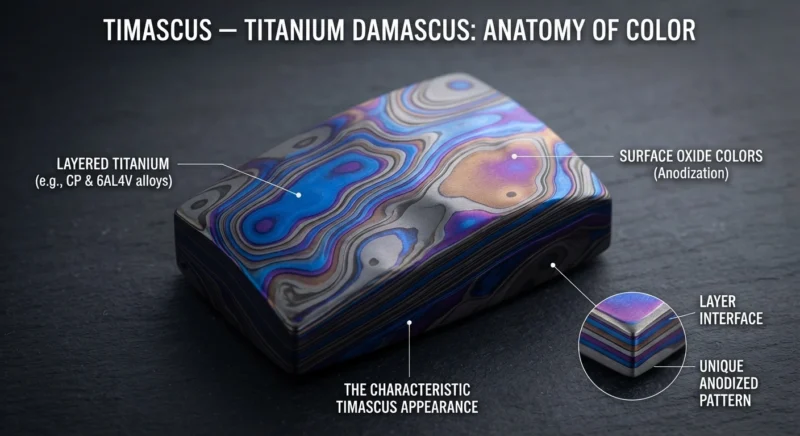
Rather than layering steel, Timascus combines different titanium alloys into a patterned laminate.
The resulting billet can be twisted, carved, cut, forged, machined, and otherwise manipulated to distort the layers.
The final pattern is then revealed through surface finishing and, very importantly, titanium coloring.
Timascus is particularly popular for:
- folding knife scales
- fixed-blade handles
- bolsters
- pocket clips
- backspacers
- pivot collars
- guards
- inlays
- decorative hardware
- jewelry and other premium metalwork
Unlike Cu-Mai, Timascus is normally not a blade material for a conventional cutting knife.
It is primarily a premium titanium component material.
The Biggest Difference: What Part of the Knife Does the Material Make?
This is the easiest way to understand the three materials.
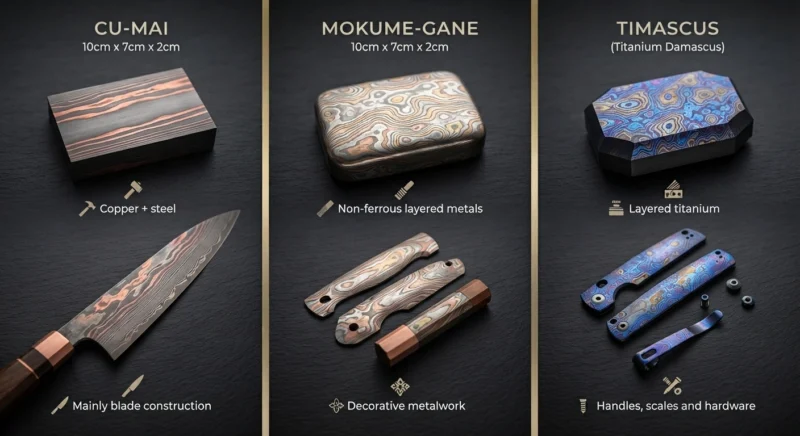
| Material | Main material family | Typical knife application | Main visual feature |
|---|---|---|---|
| Cu-Mai | Steel + copper laminate | Blade | Copper lines combined with steel pattern |
| Mokume-gane | Non-ferrous layered metals | Handle, bolster, guard, fittings | Wood-grain metal pattern |
| Titanium Damascus / Timascus | Layered titanium alloys | Handle, clip, bolster, hardware | Flowing multicolor titanium pattern |
This distinction is more important than the word “Damascus.”
A Cu-Mai blade can contain actual blade steel capable of being heat treated for cutting performance.
A mokume-gane handle can be exceptionally beautiful while having nothing to do with blade metallurgy.
A Timascus scale can be strong, light, corrosion resistant, and highly decorative without being appropriate for the cutting edge.
Cu-Mai: Copper in a Steel-Based Blade
Why Is Cu-Mai Called Cu-Mai?
The name combines Cu, the chemical symbol for copper, with mai, a term associated with layered construction in Japanese knife terminology.
The concept is relatively straightforward:
steel + copper + steel = a visually distinctive layered blade material.
In reality, the manufacturing process is considerably more complicated.
Copper behaves very differently from steel at forging temperatures. Copper has a melting point of approximately 1085°C, substantially below the temperatures commonly associated with conventional steel forge welding. This creates a narrow processing window when copper is incorporated into a steel billet.
That difference is one of the reasons Cu-Mai is considerably more demanding than ordinary pattern-welded steel.
What Does Cu-Mai Look Like?
The most recognizable feature is the warm color of copper.
Depending on the construction and finishing process, a Cu-Mai blade may show:
- pinkish copper
- orange copper
- reddish copper
- bronze-like tones
- dark etched steel
- bright nickel-bearing steel
- flowing Damascus patterns
The copper can appear as relatively straight lines, waves, irregular ribbons, or elements integrated into a more complex pattern-welded design.
The final appearance depends on:
- copper thickness
- layer arrangement
- steel selection
- billet manipulation
- forging
- grinding
- polishing
- etching
- finishing
Two Cu-Mai billets made from similar materials can therefore look dramatically different.
How Cu-Mai Is Constructed
There is no single universal Cu-Mai recipe.
A maker may use:
- carbon steel core
- pattern-welded steel
- copper sheet
- nickel-bearing steel
- stainless or corrosion-resistant steels in some specialized constructions
- combinations of these materials
One important construction is a hard steel core surrounded by decorative copper-containing layers.
Another uses copper layers within a pattern-welded steel billet.
The key principle is that the cutting portion must ultimately be supported by an appropriate blade steel.
Copper provides visual contrast, not edge hardness.
Why Copper Creates a Technical Challenge
Copper and steel differ significantly in their physical and metallurgical behavior.
Copper has:
- a much lower melting point
- high thermal conductivity
- different thermal expansion behavior
- different mechanical properties
- very different hardness
The joining of dissimilar metals is therefore inherently more complicated than joining identical or closely related steels. Technical literature on copper-to-steel joining specifically identifies differences in melting points, thermal expansion, thermal conductivity, and metallurgical behavior as important challenges.
This is why Cu-Mai requires careful control of:
- temperature
- cleanliness
- pressure
- layer thickness
- billet geometry
- forging conditions
A poor bond can produce delamination or other structural defects.
https://yashkadesigns.com/cu-mai-japanese-knife-black-blank-blade
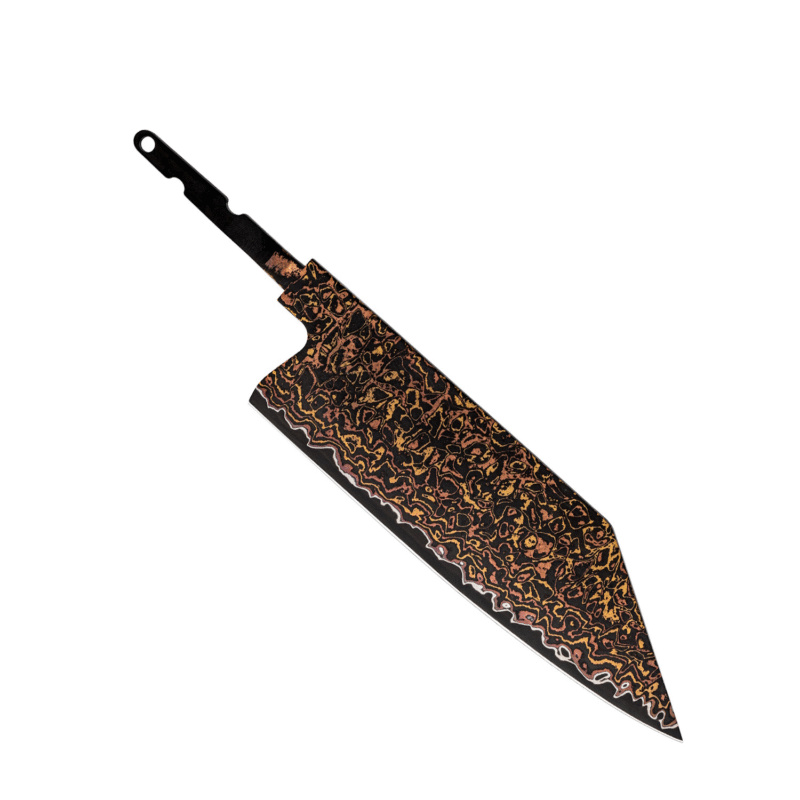
Does Cu-Mai Actually Have Copper Inside It?
It can, and that is one of the most important things to verify when buying a Cu-Mai knife.
A genuine copper-layered construction uses actual copper within the billet.
This is fundamentally different from:
- copper-colored coating
- copper-colored PVD
- paint
- printed pattern
- surface decoration
A properly made Cu-Mai blade exposes copper as part of the layered construction.
However, the exact internal architecture varies.
For a serious purchase, asking the maker:
“What is the layer construction?”
is much more useful than asking simply:
“Is this real Damascus?”
Is Cu-Mai the Same as Damascus Steel?
Not exactly.
Traditional modern pattern-welded Damascus generally uses two or more steels or alloys that are welded together and manipulated to create a visible pattern.
Cu-Mai adds copper to that concept.
Therefore, “copper Damascus” is often used as a descriptive marketing term, but it does not define one standardized steel composition.
Some Cu-Mai constructions are essentially copper-enhanced pattern-welded blades.
Others are layered constructions with a hard core and copper-bearing cladding.
The actual blade performance therefore depends much more on the steel forming the cutting edge and its heat treatment than on the presence of copper.
Does Copper Make a Knife Better?
Not automatically.
Copper can make a knife:
- visually distinctive
- more difficult to manufacture
- more expensive
- more unusual
- more collectible
But copper itself does not automatically improve:
- edge retention
- hardness
- toughness
- corrosion resistance
- cutting ability
The performance comes primarily from the blade steel, geometry, heat treatment, and construction.
This distinction is important because exotic appearance and cutting performance are two different questions.
https://yashkadesigns.com/8-inch-chef-knife-blank-blade-cu-mai-steel
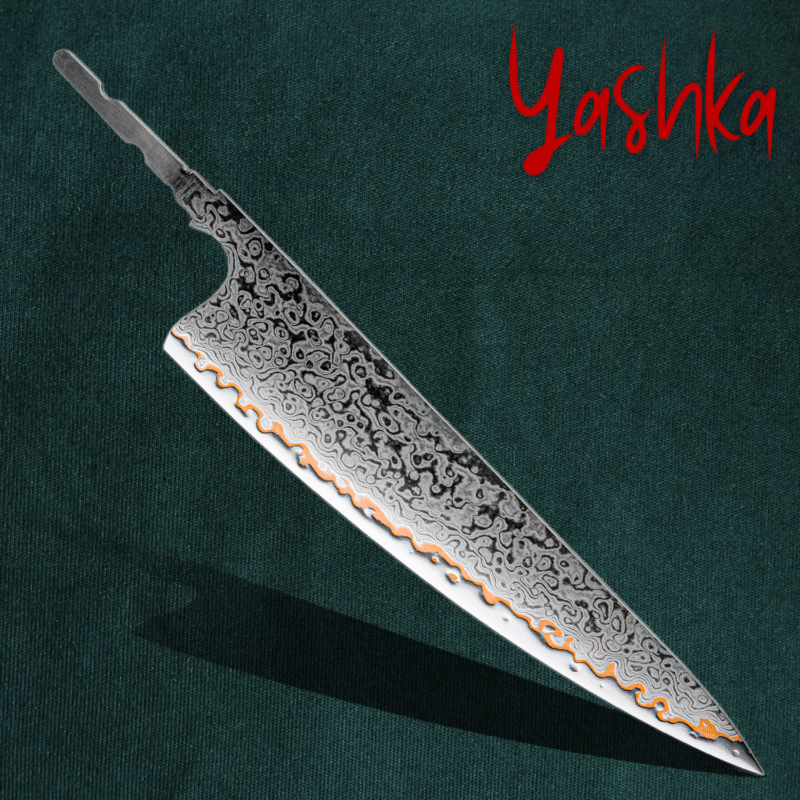
Does Cu-Mai Affect Edge Performance?
The answer depends heavily on construction.
If copper is located only in decorative layers away from the cutting edge, its direct influence on cutting performance can be relatively small.
If the edge itself incorporates soft copper, however, the situation is very different.
Copper is not capable of providing the hardness and wear resistance expected from a knife edge.
This is why Cu-Mai constructions intended for functional knives generally use an appropriate steel core or cutting zone.
Blade Magazine has also documented Cu-Mai constructions using a steel core or carbon Damascus core so that the copper remains a decorative component rather than the cutting edge itself.
Cu-Mai and Corrosion
One of the biggest misconceptions is that a copper-containing Damascus blade is automatically stainless.
It is not.
If the blade contains carbon steel, that steel can still oxidize and develop patina.
The presence of copper does not magically convert a carbon-steel blade into stainless steel.
Therefore, maintenance depends on the actual steels used.
A Cu-Mai knife made with carbon steel may require:
- drying after use
- avoiding prolonged moisture
- wiping after acidic foods
- appropriate storage
- occasional protective oil for long-term storage
A construction using corrosion-resistant steel may have different requirements.
Always evaluate the actual steel rather than the decorative copper.
Why Does Cu-Mai Change Appearance Over Time?
Copper itself develops surface changes when exposed to air, moisture, acids, salts, and handling.
Carbon steel can also patinate.
As a result, an older Cu-Mai knife may look different from the day it was finished.
This is not necessarily a defect.
For many owners, patina becomes part of the personality of the knife.
However, it means that a Cu-Mai blade should not necessarily be treated like a completely inert decorative object.
How Is Cu-Mai Pattern Revealed?
The finishing stage is critical.
A typical process can involve:
- grinding
- progressive polishing
- surface preparation
- controlled etching
- neutralization
- cleaning
- final polishing
- protective finishing
The steel and copper respond differently to the finishing process.
An etchant can darken or texture the steel while leaving copper visually brighter.
This produces the characteristic copper-on-steel contrast.
Over-etching can damage the appearance, while under-etching may produce a weak pattern.
What Makes a Good Cu-Mai Blade?
Look for:
1. A clearly defined steel cutting core
The edge should come from a suitable blade steel.
2. Clean layer transitions
The copper should appear continuous rather than randomly interrupted.
3. No visible delamination
Layer separation is a serious structural warning sign.
4. Consistent grinding
The pattern should remain coherent along the blade.
5. Appropriate heat treatment
The cutting steel needs a proper heat-treatment process.
6. Honest material description
The maker should be able to explain the basic layer construction.
Mokume-gane: Wood Grain Made from Metal
Mokume-gane is perhaps the most misunderstood of the three materials because it looks similar to some forms of Damascus while being fundamentally different.
The term refers to a Japanese layered-metal technique in which contrasting metals are bonded and then manipulated to create wood-grain-like patterns.
The Japan Mokumegane Research Institute describes the process as involving layered metals followed by carving and forging to develop the characteristic pattern.
The Historical Background of Mokume-gane
Mokume-gane developed in Japan during the Edo period.
It is strongly associated with decorative sword fittings and other metalwork rather than with modern kitchen knife blades.
The technique allowed artisans to create complex visual effects from combinations of metals with different colors.
Traditional examples can incorporate:
- copper
- gold
- silver
- shakudō
- shibuichi
Historical examples demonstrate that sophisticated patterns could be created by stacking many individual layers and manipulating the resulting billet. Research into historical mokume-gane sword fittings has identified complex stacks involving copper, gold, silver, and shakudō.
What Is Shakudō?
Shakudō is a traditional copper-based alloy associated with Japanese metalwork.
It typically contains copper with a small amount of gold.
One of its most distinctive features is its ability to develop a deep dark or purple-black patina.
Traditional sources describe shakudō as a copper-gold alloy whose gold content can vary and whose surface can be chemically colored to produce its characteristic dark appearance.
In mokume-gane, shakudō can create dramatic contrast against brighter metals.
What Is Shibuichi?
Shibuichi is another traditional Japanese alloy associated with mokume-gane.
It is primarily copper and silver.
The exact composition can vary, which means its color and working characteristics can vary as well.
Shibuichi can provide subtle gray, blue-gray, or silver-like tones rather than the strong black-versus-copper contrast associated with some shakudō combinations.
It is particularly useful when the goal is a softer, more sophisticated pattern rather than maximum color contrast.
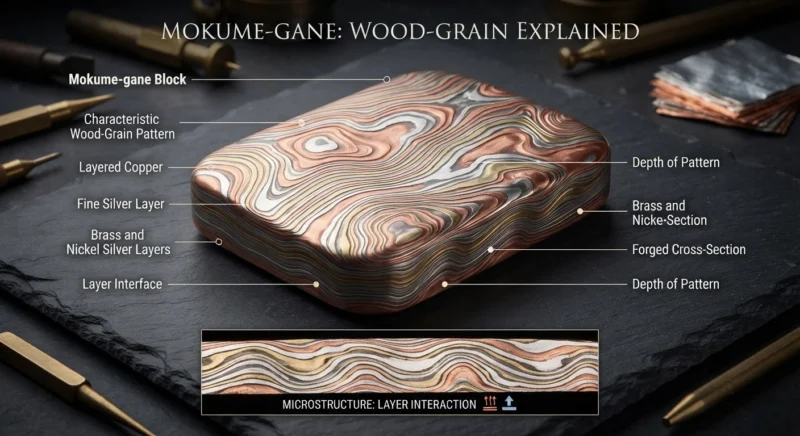
How Is Mokume-gane Made?
The basic concept is simple:
stack → bond → deform → expose → finish
The actual process is much more demanding.
First, compatible metal sheets are prepared.
The surfaces need to be extremely clean and free of contamination.
The layers are then stacked in a deliberate sequence.
Heat and pressure are used to create a bonded billet.
Once bonded, the billet can be manipulated to distort the layers.
Finally, selected portions of the billet are exposed through carving, cutting, grinding, forging, or other techniques.
The resulting surface reveals the different metals.
Diffusion Bonding in Mokume-gane
A key concept is diffusion bonding.
At the microscopic level, atoms from neighboring metal surfaces interact across the interface when the surfaces are clean, close together, heated appropriately, and subjected to pressure.
Mokume-gane references emphasize three important conditions for successful bonding:
- clean surfaces
- close contact
- pressure at elevated temperature
Depending on the metal combination and process, bonding may involve solid-state diffusion, eutectic behavior, or related mechanisms.
This is one reason mokume-gane should not simply be described as “glued metal.”
The objective is to create a metallurgical bond between the layers.
Why Are the Surfaces So Important?
Oxides and contaminants can prevent proper bonding.
Imagine stacking ten beautiful sheets of metal together.
If the interfaces contain contamination, the billet may contain weak planes.
That means surface preparation is not cosmetic.
It is part of the metallurgy.
Traditional mokume-gane practice can involve carefully flattening and cleaning the individual sheets before stacking. Historical and modern technical descriptions repeatedly emphasize surface preparation and control of the bonding conditions.
How Mokume-gane Patterns Are Created
This is where the technique becomes especially interesting.
The original billet contains flat layers.
The pattern appears only after those layers are deliberately distorted.
Several techniques are possible.
Carving
Sections of the surface are cut into the billet.
When the billet is subsequently flattened or otherwise manipulated, the carved regions create waves and irregular shapes.
Twisting
The billet can be twisted around its longitudinal axis.
The originally straight layers become spirals.
When the twisted billet is flattened and polished, the result can resemble flowing wood grain.
Cutting
Cross-cuts can expose the layers in rings or irregular shapes.
Forging
Hammering can stretch and distort the layers.
Combination techniques
Advanced patterns may combine carving, twisting, drilling, forging, and repeated flattening.
The Japan Mokumegane Research Institute documents historical examples in which layer sequences were manipulated through twisting and then flattened to create complex surface patterns.
Why Every Mokume-gane Piece Looks Different
Mokume-gane is unusually individual.
Even if two billets begin with:
- the same metals
- the same layer count
- the same layer thickness
their final appearance can differ because of:
- billet deformation
- carving depth
- twisting
- cutting position
- grinding depth
- polishing
- patination
The pattern is therefore not simply printed onto the surface.
The surface is exposing a manipulated three-dimensional layered structure.
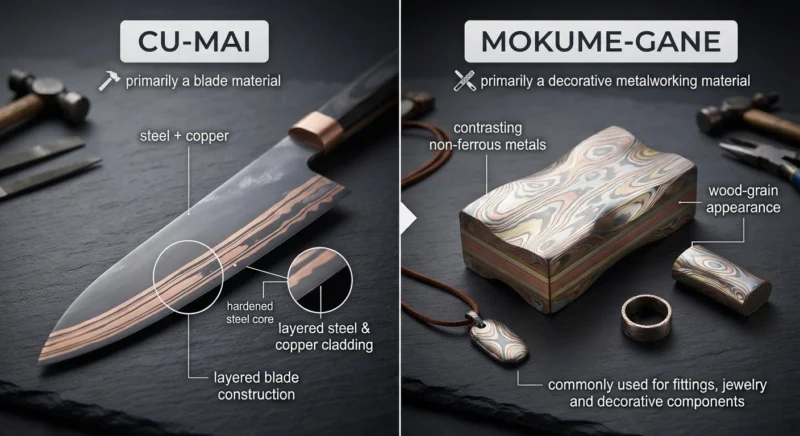
Mokume-gane Is Not Damascus Steel
This distinction is essential.
Mokume-gane may look like Damascus.
It may have:
- flowing lines
- waves
- swirls
- contrasting layers
- complex patterns
But traditional mokume-gane does not mean pattern-welded steel.
Its material palette is fundamentally different.
Mokume-gane often uses non-ferrous metals such as copper, silver, gold, shakudō, and shibuichi.
Therefore:
Mokume-gane is a layered-metal technique, not a type of Damascus blade steel.
Can Mokume-gane Be Used for a Knife Blade?
Technically, specialized layered-metal constructions can be incorporated into knife components, but traditional mokume-gane is generally not the material you want for the cutting edge.
The problem is simple:
Most of the traditional mokume-gane metals are relatively soft compared with hardened blade steels.
Copper, silver, and gold are not appropriate substitutes for a hardened cutting steel.
Mokume-gane therefore makes much more sense for:
- handles
- bolsters
- guards
- decorative fittings
- pins
- collars
- inlays
- saya hardware
- presentation elements
A knife can combine a high-performance steel blade with a mokume-gane handle or bolster.
That gives you the best of both worlds:
steel for cutting + mokume-gane for visual artistry.
Why Mokume-gane Works So Well on Knife Handles
Handles are an ideal application because the material does not need to provide cutting-edge hardness.
Instead, the handle material can be judged for:
- appearance
- durability
- corrosion behavior
- comfort
- weight
- grip
- dimensional stability
- craftsmanship
Mokume-gane can be particularly striking when used in small areas.
A full mokume handle can become visually overwhelming.
A mokume bolster or spacer can provide a sophisticated accent while allowing the rest of the handle to remain relatively simple.
Patina Is Part of the Design
One of the most fascinating aspects of traditional mokume-gane is that the final appearance can depend heavily on patination.
Copper alloys can develop strong colors through controlled chemical treatment.
Shakudō, for example, can develop very dark colors.
Copper can become darker or develop characteristic surface changes.
Shibuichi can develop more subtle grayish or bluish tones.
The Japan Mokumegane Research Institute describes traditional coloring processes in which chemical treatment produces thin surface films responsible for the final appearance.
This means that mokume-gane is partly a metallurgical artwork and partly a surface-coloring art.
Does Mokume-gane Stay the Same Forever?
Not necessarily.
Some colors are created by surface patination.
That means:
- polishing can alter them
- abrasion can remove them
- aggressive cleaning can affect them
- chemicals can change them
- wear can expose different underlying metal
A mokume-gane handle can therefore change subtly with use.
For collectors, this can be part of the attraction.
For someone wanting a completely maintenance-free surface, it may be less attractive.
https://yashkadesigns.com/m390-titanium-folding-knife
Titanium Damascus: Timascus
Timascus represents a very different approach to patterned metal.
Instead of using copper and steel or traditional Japanese non-ferrous alloys, Timascus uses titanium alloys.
The result can be:
- extremely colorful
- lightweight
- corrosion resistant
- non-magnetic
- highly machinable with the right equipment
- visually complex
But it is important to understand that Timascus is not titanium blade steel.
It is primarily a material for premium knife components.
Why Titanium Is Attractive for Knives
Titanium has several properties that make it valuable in knife construction.
Compared with steel, titanium is significantly lighter.
Titanium is also highly corrosion resistant and has an excellent strength-to-weight ratio.
This makes it particularly attractive for folding knife handles and hardware where reducing weight is valuable.
Timascus preserves many of the underlying advantages of titanium while adding the aesthetic complexity of layered construction.
What Makes Timascus Different from Ordinary Titanium?
A normal titanium handle scale may be a single alloy.
It can be:
- bead blasted
- stonewashed
- anodized
- machined
- polished
Timascus begins with a layered structure.
Different titanium alloys are joined into a billet.
The billet is then manipulated to create the pattern.
Once the surface is machined and finished, the different layers become visible.
The result is a material that combines:
titanium properties + layered pattern + controlled surface coloring.
How Timascus Is Bonded
Titanium laminate production is technically demanding.
Diffusion bonding is an important technology for joining titanium alloys and other titanium-based structures. Scientific literature describes diffusion bonding as a method capable of producing high-quality joints in titanium systems, with atomic diffusion, void closure, and microstructural evolution all playing important roles.
Knife-grade Timascus production generally requires:
- carefully prepared titanium surfaces
- controlled stacking
- pressure
- elevated temperature
- controlled atmosphere
- careful deformation
Titanium reacts readily with oxygen at elevated temperatures, so atmosphere control is particularly important.
Why Is Timascus Usually Made from More Than One Titanium Alloy?
Because the visual contrast depends on differences between the materials.
If every layer were identical, there would be little reason to create a layered structure.
Different titanium alloys can respond differently during:
- machining
- etching
- polishing
- heat coloring
- anodizing
That difference allows the individual layers to remain visually distinguishable.
How Does Timascus Get Its Amazing Colors?
This is one of the most important technical points.
Timascus is not normally painted.
The color comes from the titanium surface.
When titanium is oxidized, an extremely thin oxide layer forms on the surface.
The thickness of this layer affects how light interacts with it.
The result is optical interference.
Depending on the oxide thickness, the surface can appear:
- gold
- bronze
- purple
- blue
- cyan
- green
- pink
- other transitional colors
Anodizing allows the maker to control oxide growth electrically.
Heat coloring controls it through temperature and exposure.
The resulting color is therefore a physical surface phenomenon rather than conventional pigment.
Why Do Different Timascus Layers Show Different Colors?
The layers are not necessarily identical titanium alloys.
They can respond differently to the same finishing conditions.
As a result, one region may appear purple while another appears blue or gold.
The exact color depends on:
- alloy composition
- surface preparation
- voltage
- electrolyte
- temperature
- oxide thickness
- lighting
- viewing angle
This is why Timascus can look almost three-dimensional.
Is Timascus Color Permanent?
No.
This is an important practical consideration.
The color comes from a thin oxide layer.
The underlying titanium may remain perfectly intact while the visible color changes due to:
- scratching
- abrasion
- polishing
- aggressive cleaning
- wear
A pocket clip is especially likely to show wear because it repeatedly contacts clothing and other surfaces.
A protected bolster may retain its finish much longer.
Therefore, Timascus is both a material and a surface finish.
Can Timascus Be Used for a Knife Blade?
For conventional cutting applications, Timascus is generally not used as a substitute for hardened blade steel.
Titanium alloys do not provide the same edge-retention behavior as modern hardened knife steels.
They are not designed around the same carbide structures and heat-treatment mechanisms that give premium blade steels their cutting performance.
This is why Timascus is overwhelmingly associated with:
- scales
- bolsters
- clips
- spacers
- collars
- guards
- decorative hardware
rather than the actual cutting edge.
Why Timascus Is So Popular in Folding Knives
Folding knives provide many opportunities for decorative titanium.
A single premium folder can contain Timascus in:
- front scale
- rear scale
- pocket clip
- backspacer
- pivot collar
- thumb stud
- hardware
- decorative inlays
This creates a coordinated visual design.
Because titanium is relatively light, adding patterned titanium can produce a luxurious appearance without necessarily making the knife extremely heavy.
Check Our Guide Best Hunting Knife Features Explained
Cu-Mai vs Mokume-gane vs Timascus
Now the fundamental differences become easier to see.
Cu-Mai
The primary question is:
What steel is doing the cutting?
Cu-Mai can be part of a functional blade construction.
Its signature feature is copper integrated into steel.
The copper creates visual contrast.
Mokume-gane
The primary question is:
Which metals are layered, and how was the pattern developed?
Traditional mokume-gane is primarily a decorative layered-metal system.
It is ideal for handles and fittings.
Its strongest characteristic is the organic wood-grain appearance.
Timascus
The primary question is:
Which titanium alloys are laminated, and how were they patterned and colored?
Timascus is a titanium-based patterned material.
It combines low weight, corrosion resistance, and dramatic surface color.
Its strongest applications are premium knife components rather than cutting edges.
Visual Differences
Although appearance is subjective, there are useful general differences.
Cu-Mai
Usually shows:
- warm copper
- dark steel
- silver steel
- flowing lines
- Damascus-style patterns
It often looks like copper veins inside a steel blade.
Mokume-gane
Usually shows:
- copper
- silver
- gold
- dark copper alloys
- gray alloys
- organic wood-grain lines
It often looks like metalized wood grain.
Timascus
Usually shows:
- blue
- purple
- gold
- bronze
- green
- pink
- metallic transitions
It often looks like iridescent flowing titanium.
Strength and Hardness Are Not the Same Thing
One of the biggest mistakes when evaluating exotic materials is assuming that the most expensive-looking material must be the hardest.
That is not how metallurgy works.
A material can be:
- hard but brittle
- tough but relatively soft
- strong but difficult to sharpen
- lightweight but not suitable for edges
- corrosion resistant but poor at edge retention
Therefore, the intended application matters.
A Timascus handle can be an excellent material even though Timascus is not a suitable cutting edge.
A mokume-gane bolster can be extremely desirable even though copper itself is too soft to function as a knife edge.
A Cu-Mai blade can perform very well when the cutting edge is based on properly heat-treated blade steel.
Corrosion Comparison
The three materials behave differently.
Cu-Mai
Corrosion depends heavily on the steels used.
Carbon steel components can develop patina or rust.
Copper also changes surface appearance.
Maintenance can therefore be relatively demanding.
Mokume-gane
Copper and copper alloys can oxidize and develop patina.
Silver can tarnish.
Gold is highly resistant to ordinary corrosion.
The exact behavior depends on the metals in the billet.
Timascus
Titanium is highly corrosion resistant.
The major concern is generally surface finish rather than conventional rust.
The oxide-based colors can change with abrasion.
Weight Comparison
Titanium has a major advantage here.
Its density is around 4.5 g/cm³, substantially lower than steel.
Copper is around 8.9 g/cm³.
Silver is around 10.5 g/cm³.
Steel is generally around 7.7–8.0 g/cm³ depending on alloy.
Therefore, a large decorative titanium component can provide substantial visual impact without adding as much mass as an equivalent volume of copper or silver.
This is one reason Timascus works particularly well for folding knife scales and hardware.
Why Exotic Materials Cost More
The price of an exotic knife material is not determined simply by the raw metal.
You are paying for:
- material cost
- specialized processing
- billet production
- failed billets
- machining time
- grinding
- finishing
- pattern development
- polishing
- anodizing
- labor
- material waste
- craftsmanship
This is especially important with Timascus and complex mokume-gane.
A small piece of finished material may represent a much larger original billet.
Patterning and machining can remove substantial amounts of material.
Material Waste Matters
Imagine a titanium billet with an elaborate pattern.
The maker must cut that billet into a scale shape.
Much of the original material may become scrap.
The same applies to mokume-gane and Cu-Mai.
A complex pattern may be beautiful in the middle of a billet but unsuitable for the final component.
The maker must therefore:
- understand the billet
- predict pattern movement
- orient the material
- cut the component
- grind away material
- preserve the desired pattern
This is part of the reason high-quality exotic materials are expensive.
Pattern Orientation Matters
A beautiful billet can produce a disappointing knife if it is cut poorly.
The pattern may run:
- lengthwise
- diagonally
- vertically
- in waves
- concentrically
The orientation determines how the finished component looks.
This is especially important with:
- Timascus scales
- mokume bolsters
- Cu-Mai blades
A maker who understands the billet can deliberately place the most interesting portion of the pattern where it will be visible.
Why Two Identical Knives May Not Look Identical
Exotic layered materials naturally produce variation.
Even if two knife handles come from the same billet, their pattern may differ because they are cut from different locations.
The left scale and right scale may also show slightly different pattern geometry.
This is not necessarily a manufacturing flaw.
In many cases, it is part of the appeal.
Cu-Mai, Mokume-gane and Timascus: What Is Actually “Damascus”?
The word Damascus is used in several different ways in the knife industry.
Historically, Damascus steel can refer to crucible steel traditions.
Modern knife makers often use “Damascus” to refer to pattern-welded steel.
But marketing language sometimes extends the term to materials that merely have a layered or patterned appearance.
This creates confusion.
A useful classification is:
Pattern-welded steel
Multiple steels/alloys welded together and manipulated to create a pattern.
Cu-Mai
Steel-based layered construction incorporating copper.
Mokume-gane
Layered non-ferrous metals manipulated to create a wood-grain pattern.
Timascus
Layered titanium alloys manipulated to create a Damascus-like pattern.
They can all be visually related without being metallurgically equivalent.
Check Our Guide What Is Damascus Steel? History, Benefits, and Why It Remains Popular Today
Is “Titanium Damascus” Actually Damascus?
Technically, it is better understood as a Damascus-style titanium laminate rather than Damascus steel.
The term “Titanium Damascus” is widely used because consumers immediately understand the visual idea.
But titanium and steel are very different materials.
Timascus does not become steel simply because its layers form a Damascus-like pattern.
This distinction matters when evaluating:
- hardness
- edge retention
- weight
- corrosion
- applications
- machining
- heat treatment
Is Mokume-gane a Type of Damascus?
No, not in the conventional knife-steel sense.
Mokume-gane has a layered structure and can produce patterns that resemble Damascus.
But traditional mokume-gane is based on combinations of non-ferrous metals and alloys.
The Japan Mokumegane Research Institute describes it specifically as a technique involving different-colored metals layered and manipulated to create wood-grain patterns.
Calling every patterned laminate “Damascus” therefore removes an important technical distinction.
Is Cu-Mai Better Than Regular Damascus?
There is no universal answer.
It depends on what you want.
Cu-Mai can offer:
- unusual appearance
- copper contrast
- artistic value
- collector appeal
Traditional pattern-welded steel can offer:
- more conventional blade construction
- wider choice of steel combinations
- simpler finishing
- potentially easier maintenance depending on steel choice
Neither is automatically better.
For a practical working knife, the most important factors remain:
- edge geometry
- steel
- heat treatment
- blade thickness
- grind
- intended use
The copper pattern is secondary to those factors.
Is Timascus Better Than Ordinary Titanium?
Again, it depends on the objective.
For a simple working folding knife, plain titanium may be more practical.
It can be:
- lighter
- easier to manufacture
- less expensive
- easier to refinish
Timascus adds:
- pattern
- color
- rarity
- craftsmanship
- visual complexity
Therefore, Timascus is primarily a premium aesthetic upgrade rather than a universal performance upgrade.
Is Mokume-gane Better Than Plain Metal?
Not necessarily.
A plain copper bolster can be:
- attractive
- durable
- relatively inexpensive
- easy to repair
A mokume-gane bolster adds visual complexity and craftsmanship.
Its value is therefore largely connected to:
- artistic quality
- material selection
- pattern
- rarity
- craftsmanship
The exotic material should be appreciated for what it actually adds.
What Should You Look for in a Cu-Mai Knife?
If you are buying a Cu-Mai blade, ask these questions:
What is the cutting steel?
This is the most important question.
Is there a steel core?
If the construction is clad, the core determines much of the cutting performance.
What is the copper thickness?
Very thick copper layers can behave differently from extremely thin decorative layers.
How is the billet constructed?
Ask whether it is:
- steel/copper laminate
- copper between pattern-welded layers
- Cu-Mai cladding over a core
- another construction
How was it heat treated?
A beautiful Damascus pattern cannot compensate for poor heat treatment.
What Should You Look for in Mokume-gane?
Ask:
Which metals are used?
Copper and silver behave differently from copper and shakudō.
Is the material traditional or modern?
The term can cover many constructions.
How was the pattern produced?
Carving, twisting, rolling, and other processes produce different results.
Is the surface patinated?
If so, understand that patination may change over time.
What is the material used for?
A bolster, handle, spacer, or decorative inlay has different requirements.
What Should You Look for in Timascus?
Ask:
Which titanium alloys are used?
“Titanium Damascus” alone does not tell you the exact alloy combination.
How was it patterned?
Twisting, carving, and other processes produce different visual effects.
Is the color anodized or heat colored?
This can affect maintenance and appearance.
Is the pattern actually through the material?
A genuine layered billet has internal structure corresponding to the visible pattern.
How thick is the finished material?
A decorative surface treatment is not the same thing as a thick patterned laminate.
How to Tell Real Layered Material from Surface Decoration
This is an important buying skill.
A knife can have a decorative pattern without being made from a layered material.
Possible surface effects include:
- laser engraving
- acid etching
- PVD coatings
- paint
- electroplating
- anodizing
- printed patterns
None of these automatically means the underlying material is layered.
With genuine laminated material, the pattern generally continues into the material rather than existing only as a superficial graphic.
However, determining this visually is not always possible.
The safest approach is to obtain a clear material description from the maker.
Why Etching Can Be Misleading
Etching can create dramatic contrast.
Two steels that look nearly identical after polishing can look completely different after etching.
This is why photographs of Damascus can exaggerate the impression of complexity.
The same applies to Cu-Mai.
Copper may appear dramatically brighter after the surrounding steel has been darkened.
Therefore, when evaluating a knife, distinguish:
pattern geometry
from
surface contrast.
The underlying geometry is created by the layered material.
The contrast is enhanced by finishing.
Why Timascus Looks More Colorful Than Mokume-gane
Mokume-gane usually relies on the natural colors and patination of different metals.
Timascus can use controlled titanium oxide interference.
That allows much more dramatic colors.
A Timascus surface can transition through:
- gold
- purple
- blue
- cyan
- green
with very small changes in surface condition.
This gives Timascus a visual language that is very different from the warmer, more earthy appearance of traditional mokume-gane.
Why Cu-Mai Has a Warmer Appearance
Copper has a naturally warm reddish-orange color.
When placed beside dark carbon steel or bright nickel-bearing steel, the contrast becomes immediately visible.
This gives Cu-Mai a particularly distinctive palette:
black + silver + copper.
That combination is visually different from both:
silver + copper + gold
in mokume-gane,
and
blue + purple + gold
in Timascus.
Maintenance Guide
Cu-Mai
For carbon-steel Cu-Mai:
- keep the blade dry
- wipe after acidic foods
- avoid prolonged moisture
- use appropriate protective oil for storage
- accept that patina may develop
Do not assume that copper means stainless.
Mokume-gane
Maintenance depends on the metals.
For copper-rich material:
- avoid harsh chemicals
- avoid aggressive polishing
- expect patina
- handle with clean hands when practical
For silver-containing material:
- expect tarnish
- use suitable silver-safe cleaning methods
For patinated material:
- do not aggressively polish unless you intend to change the appearance.
Timascus
For Timascus:
- wipe away fingerprints
- avoid abrasive polishing
- avoid aggressive chemicals
- protect anodized surfaces from scratching
- understand that clips may develop wear
The titanium itself is highly corrosion resistant.
The vulnerable element is often the colored surface finish.
Check Our Guide How to Keep a Damascus Kitchen Knife Sharp
Can You Sharpen a Cu-Mai Knife Normally?
Yes, provided the cutting edge is made from conventional blade steel.
The sharpening process should be based on the edge steel and geometry.
However, avoid treating every part of the visible blade pattern as though it contributes equally to the edge.
If the cutting edge contains multiple materials, the situation becomes more complicated.
For this reason, a properly designed steel-core Cu-Mai construction is easier to understand from a sharpening perspective.
Can You Sharpen a Timascus Knife?
If Timascus is used for the handle, there is nothing to sharpen there.
The actual blade should be a separate blade steel.
This is another reason Timascus is best understood as a knife component material, not a blade steel.
A premium Timascus folding knife may combine:
- high-performance blade steel
- titanium frame
- Timascus scale
- Timascus clip
- premium hardware
The cutting performance and decorative material are therefore separate design decisions.
Can You Sharpen a Mokume-gane Knife?
Again, this depends on where the mokume-gane is used.
If it is a handle or bolster, obviously not.
If a specialized laminated decorative material were somehow incorporated near the edge, sharpening would need to account for the actual cutting material.
Traditional mokume-gane should not be treated as a substitute for hardened blade steel.
Exotic Materials and Knife Performance
A knife has many interacting components.
The blade is influenced by:
- steel composition
- heat treatment
- hardness
- toughness
- edge geometry
- grind
- blade thickness
- sharpening angle
The handle is influenced by:
- material strength
- grip
- weight
- ergonomics
- corrosion
- dimensional stability
A decorative material may have almost no influence on the cutting performance.
This is why a knife should be evaluated component by component.
The Importance of Heat Treatment
Heat treatment is particularly important for Cu-Mai.
A beautiful blade can still perform poorly if the cutting steel has been:
- overheated
- under-hardened
- improperly tempered
- poorly controlled during quenching
The decorative pattern tells you almost nothing about these properties.
A perfectly beautiful Damascus or Cu-Mai pattern does not prove that the blade has been heat treated correctly.
When performance matters, ask about the cutting steel and heat treatment.
Check Our Guide Steel Heat Treatment Explained
The Importance of Machining in Timascus
Timascus requires different skills from Cu-Mai.
The billet itself must be properly bonded.
Then the maker has to machine the titanium without destroying the pattern.
Titanium can present machining challenges because of its low thermal conductivity and heat concentration at the cutting interface.
The final appearance is strongly influenced by:
- tool selection
- cutting speed
- feed
- cooling
- surface preparation
- polishing
Poor machining can make an expensive Timascus billet look ordinary.
Excellent machining can make the same material look spectacular.
Why Pattern Placement Matters More Than Pattern Complexity
A highly complicated pattern is not automatically better.
For a knife scale, the best pattern may be one that:
- follows the shape of the handle
- creates visual movement
- frames the pivot
- complements the blade
- avoids awkward interruptions
A simple flowing pattern can look more sophisticated than an extremely busy pattern.
The same principle applies to Cu-Mai blades.
The pattern should complement the blade geometry rather than compete with it.
Matching the Material to the Knife
A useful design approach is:
Cu-Mai
Best suited to:
- collector blades
- art knives
- custom hunting knives
- premium kitchen knives
- visually distinctive fixed blades
Mokume-gane
Best suited to:
- bolsters
- guards
- handle accents
- spacers
- pins
- decorative fittings
Timascus
Best suited to:
- folding knife scales
- premium fixed-blade handles
- clips
- backspacers
- pivot collars
- decorative hardware
Cu-Mai for Kitchen Knives
Cu-Mai can be particularly attractive on a kitchen knife because the blade provides a large canvas for the layered pattern.
However, kitchen use creates special considerations.
Food acids can affect carbon steel and copper.
Tomatoes, citrus, onions, vinegar, and other acidic foods can accelerate patina.
Therefore, a Cu-Mai kitchen knife should be maintained carefully.
The owner should understand that visual changes are part of the material’s behavior.
Cu-Mai for Hunting Knives
A Cu-Mai hunting knife can make sense as a premium or collector-oriented design.
But the same rules apply:
- cutting steel matters
- heat treatment matters
- edge geometry matters
- corrosion resistance matters
For a hard-use hunting knife, a simple high-performance blade steel may be more practical.
For a custom or presentation hunting knife, Cu-Mai can provide significant aesthetic value.
Mokume-gane for Kitchen Knives
Mokume-gane is particularly attractive as a bolster or handle accent.
Copper-and-silver patterns can create a warm contrast against:
- dark wood
- stabilized wood
- black synthetic materials
- natural horn
- micarta
- modern composites
The important consideration is that the mokume component should not be treated as a cutting steel.
Its job is primarily structural decoration and design.
Timascus for Folding Knives
This is arguably the most natural application.
Titanium already has a long history in folding-knife construction.
Timascus simply takes the titanium concept into the luxury and collector category.
A Timascus scale can create:
- strong visual identity
- low weight
- corrosion resistance
- high material value
- unique patterning
A Timascus pocket clip can provide a small but highly visible accent.
Why Collectors Value These Materials
Collectors often appreciate materials for reasons beyond raw performance.
Three factors are particularly important:
Rarity
A complex billet may be produced in limited quantities.
Craftsmanship
The material requires specialized processes.
Individuality
The final pattern can be unique.
This is particularly important because a collector knife can be evaluated as both a tool and an object of craftsmanship.
Exotic Does Not Mean Better
This deserves repeating.
A knife made from:
- ordinary stainless steel
- simple titanium
- stabilized wood
can be an excellent knife.
A knife made from:
- Cu-Mai
- mokume-gane
- Timascus
can also be excellent.
But the exotic material does not automatically make the knife better at cutting.
In many cases, it makes the knife more unusual and more expensive, rather than fundamentally better as a cutting tool.
That distinction helps buyers make more rational comparisons.
The Three Materials at a Glance
| Feature | Cu-Mai | Mokume-gane | Timascus |
|---|---|---|---|
| Main metals | Steel + copper | Copper, silver, gold, alloys | Titanium alloys |
| Usually used for blade? | Yes, depending on construction | Generally no | Generally no |
| Cutting edge material | Hardened steel | Not traditional mokume | Separate blade steel |
| Main visual effect | Copper + steel pattern | Wood-grain pattern | Multicolor titanium |
| Corrosion behavior | Depends on steel | Depends on metals | Excellent titanium resistance |
| Weight | Moderate to high | Varies | Low |
| Pattern creation | Layering + pattern welding/manipulation | Carving, twisting, forging | Layering + deformation |
| Color source | Metal contrast + etching | Metal colors + patina | Titanium oxide interference |
| Typical use | Blades | Handles and fittings | Handles and hardware |
| Main appeal | Copper Damascus appearance | Traditional Japanese metal artistry | Modern high-end titanium appearance |
Which Material Is the Most Practical?
There is no single answer because practicality depends on the part of the knife.
For a blade, Cu-Mai can be practical if it uses an appropriate hardened steel construction.
For a traditional decorative handle, mokume-gane can be practical and exceptionally attractive.
For a lightweight premium folding knife, Timascus can be particularly well suited.
The correct question is not:
“Which material is best?”
It is:
“Which material is best suited to this particular part of the knife?”
Which Material Requires the Most Specialized Craftsmanship?
All three can require significant expertise, but in different ways.
Cu-Mai demands control of dissimilar steel/copper behavior and careful billet construction.
Mokume-gane demands precision in:
- material compatibility
- bonding
- layer preparation
- pattern manipulation
- finishing
- patination
Timascus demands:
- titanium billet preparation
- controlled bonding
- pattern manipulation
- machining
- polishing
- anodizing or heat coloring
The skill sets overlap, but they are not identical.
Why Material Compatibility Matters
Whenever two different metals are combined, their properties must be considered.
Important factors include:
- melting temperature
- thermal expansion
- hardness
- ductility
- oxidation
- diffusion behavior
- forging behavior
- chemical compatibility
This is particularly important in mokume-gane and Cu-Mai.
Even materials that look beautiful together may be difficult to bond reliably.
Mokume-gane references specifically emphasize that different metal combinations have different working and bonding characteristics.
What Does a Failed Billet Look Like?
A failed layered billet may show:
- delamination
- cracks
- voids
- gaps
- irregular layer thickness
- pattern distortion
- inclusions
Some defects are visible immediately.
Others can appear only after grinding or machining.
This is one reason experienced makers can command significantly higher prices for exotic materials.
They are not merely selling raw metal.
They are selling a successful billet.
Why the Billet Is the Heart of the Material
The final knife may be small.
The original billet can be much larger.
The billet determines:
- layer count
- pattern
- material distribution
- bond quality
- orientation
- future cutting possibilities
A poor billet cannot be turned into a premium component simply by polishing it.
A high-quality billet gives the maker many possibilities.
The Role of Surface Finishing
The material is only half the story.
Finishing determines how much of the material structure becomes visible.
For Cu-Mai:
grinding + polishing + etching
can dramatically increase contrast.
For mokume-gane:
polishing + selective patination
can transform the visual result.
For Timascus:
machining + polishing + anodizing or heat coloring
can completely change the appearance.
This is why the same material can look radically different in the hands of different makers.
Why Photography Can Misrepresent Exotic Materials
Photographs can exaggerate:
- contrast
- color
- gloss
- pattern depth
Lighting also changes how metallic surfaces appear.
Timascus is especially sensitive to lighting because interference colors change visually with viewing angle.
Copper can appear more orange or pink depending on the light.
Mokume-gane can look dramatically different before and after patination.
Therefore, when evaluating a knife online, photographs should be treated as an interpretation of the material rather than a perfect representation.
How to Compare Exotic Knife Materials Rationally
Use five questions.
1. What is the material?
Identify the actual metals.
2. What is the material doing?
Blade, handle, bolster, clip, spacer, or decoration?
3. What provides the cutting edge?
This is critical for blade evaluation.
4. How is the pattern created?
Layering, welding, carving, twisting, machining, coloring?
5. What will happen with use?
Consider:
- patina
- scratches
- corrosion
- color changes
- sharpening
- maintenance
These five questions eliminate most of the confusion surrounding exotic knife materials.
Common Myths About Cu-Mai
Myth 1: Copper makes a knife sharper
No.
Sharpness depends primarily on edge geometry and finishing.
Myth 2: Cu-Mai is automatically stainless
No.
The steel composition determines corrosion behavior.
Myth 3: More copper means a better knife
No.
Copper is primarily decorative in these constructions.
Myth 4: Every Cu-Mai blade is made the same way
No.
The term covers multiple constructions.
Myth 5: The pattern proves blade quality
No.
Pattern quality and heat-treatment quality are separate issues.
Common Myths About Mokume-gane
Myth 1: Mokume-gane is Damascus steel
No.
It is a layered non-ferrous metalworking technique.
Myth 2: Every mokume-gane piece uses gold
No.
Copper, silver, shakudō, shibuichi, and other alloys can be used.
Myth 3: The pattern is printed
Traditional mokume-gane patterns are produced by manipulating the layered billet.
Myth 4: The pattern never changes
Patinated surfaces can change with wear and handling.
Common Myths About Timascus
Myth 1: Timascus is titanium blade steel
No.
It is primarily a patterned titanium laminate used for knife components.
Myth 2: The colors are paint
No.
The characteristic colors come from titanium oxide and optical interference.
Myth 3: Timascus is indestructible
No.
Titanium is corrosion resistant, but the colored surface can scratch and wear.
Myth 4: More colors mean better material
Not necessarily.
Pattern quality, machining, symmetry, and finishing matter more than simply having many colors.
What Makes an Exotic Knife Material Truly Premium?
The answer is not simply rarity.
A premium material should have:
- sound construction
- clean bonding
- controlled pattern
- excellent finishing
- appropriate application
- consistent geometry
- thoughtful design
A badly made exotic material can be less impressive than a beautifully finished ordinary material.
The best knife designs use exotic materials deliberately rather than simply adding as much decoration as possible.
Design Philosophy: Let the Material Support the Knife
A common mistake in luxury knife design is to make every component visually complicated.
Imagine:
- busy Damascus blade
- multicolor Timascus handle
- patterned mokume spacer
- ornate engraving
- bright hardware
Every individual component may be beautiful.
Together, they can become visually chaotic.
A sophisticated knife often works better when one material is the star.
For example:
Cu-Mai blade + simple dark handle
or
plain blade + Timascus handle
or
plain blade + mokume bolster + restrained handle
This allows the exotic material to remain visually important.
Cu-Mai + Traditional Handle Materials
Cu-Mai can pair especially well with:
- dark walnut
- ebony
- stabilized wood
- black micarta
- dark horn
- natural brown materials
The copper creates a warm bridge between the blade and handle.
The best combinations usually repeat one visual element rather than introducing several competing colors.
Mokume-gane + Japanese Knife Design
Mokume-gane naturally fits Japanese-inspired knife design because of its historical relationship with Japanese metalwork.
A mokume bolster can work particularly well with:
- Wa handles
- simple wooden handles
- dark lacquered surfaces
- understated blade finishes
The traditional material can provide visual richness without turning the knife into a purely decorative object.
Timascus + Modern Folding Knives
Timascus naturally fits modern mechanical knife design.
It works especially well with:
- titanium frames
- premium blade steels
- ceramic bearings
- precision-machined hardware
- sculpted scales
The contrast between modern machining and organic layered patterning is part of the appeal.
Exotic Materials and Collectability
Collectability depends on many factors.
Material alone is not enough.
Collectors may consider:
- maker reputation
- craftsmanship
- rarity
- historical importance
- pattern quality
- material provenance
- originality
- condition
- design
- documentation
A common material used exceptionally well can be more desirable than an exotic material used poorly.
The Future of Exotic Knife Materials
Modern knife making continues to expand beyond traditional Damascus.
Makers are experimenting with:
- new titanium alloy combinations
- hybrid laminates
- stainless layered systems
- copper-bearing constructions
- precious-metal laminates
- modern composites
- ceramic-metal combinations
- additive manufacturing
- advanced diffusion bonding
The trend is moving toward materials that combine engineering performance with artistic individuality.
That makes these materials particularly interesting for custom knives.
Final Comparison
Cu-Mai, mokume-gane, and Timascus all demonstrate the same fundamental idea:
layering can transform ordinary materials into something visually and technically unusual.
But they achieve that goal in completely different ways.
Cu-Mai
Cu-Mai brings copper into a steel-based knife construction.
Its defining characteristic is the combination of warm copper with patterned or layered steel.
It can be used in functional blades when the cutting edge is based on appropriate blade steel.
Its main challenge is controlling the very different behavior of copper and steel during fabrication.
Mokume-gane
Mokume-gane is a traditional Japanese layered-metal technique.
Its beauty comes from manipulating contrasting metals into wood-grain-like patterns.
It is particularly suited to:
- handles
- bolsters
- guards
- fittings
- decorative knife components
Its identity comes from the combination of metallurgy, pattern manipulation, and traditional surface coloring.
Titanium Damascus / Timascus
Timascus is a modern titanium-based patterned laminate.
It combines different titanium alloys and uses controlled surface oxidation to create its characteristic colors.
It is especially suited to:
- folding knife scales
- bolsters
- clips
- backspacers
- pivot collars
- premium hardware
Its greatest strengths are its low weight, corrosion resistance, distinctive appearance, and ability to produce colors unavailable from ordinary steel.
The Most Important Lesson
When you see an exotic knife material, do not start with the question:
“How beautiful is this?”
Start with:
“What exactly is this material, and what job is it doing?”
A copper pattern on a blade does not tell you what steel is at the edge.
A wood-grain metal handle does not mean the blade is made from mokume-gane.
A rainbow-colored titanium scale does not mean the blade is made from titanium.
The appearance tells only part of the story.
The real story is in the metallurgy.
For Cu-Mai, investigate the blade steel and layer construction.
For mokume-gane, investigate the metals, bonding method, patterning technique, and patination.
For Timascus, investigate the titanium alloys, billet construction, pattern, machining, and coloring process.
Once those distinctions are clear, exotic knife materials become much easier to understand.
They are not simply different versions of Damascus.
They represent three different approaches to combining materials, metallurgy, craftsmanship, and design.
And that is exactly what makes them so interesting.
FAQ: Cu-Mai, Mokume-gane and Titanium Damascus
Is Cu-Mai real Damascus?
Cu-Mai is generally a copper-containing layered or pattern-welded steel construction. The exact architecture varies, so it is more accurate to describe the specific construction rather than treating Cu-Mai as one standardized steel grade.
Is Cu-Mai good for kitchen knives?
It can be, provided the cutting edge uses an appropriate knife steel and the blade is properly heat treated. Copper itself should not be considered the edge material.
Does Cu-Mai rust?
The answer depends on the steels used. Carbon-steel Cu-Mai can develop patina or rust and requires appropriate care.
Is mokume-gane a steel?
Traditional mokume-gane is not a steel. It is a layered-metal technique using combinations of non-ferrous metals and alloys.
Can mokume-gane be used for knife handles?
Yes. Handles, bolsters, guards, spacers, and decorative fittings are among its most appropriate knife applications.
Does mokume-gane contain gold?
It can, but it does not have to. Copper, silver, shakudō, shibuichi, brass, and other metals can be used.
What does mokume-gane mean?
The term is commonly translated as “wood-grain metal,” reflecting the appearance produced by its layered and manipulated structure.
What is Timascus?
Timascus is a patterned titanium laminate made by joining different titanium alloys and manipulating the resulting billet to create a visible layered pattern.
Is Timascus the same as titanium Damascus?
The terms are commonly used interchangeably in the knife industry, although exact compositions and production methods can vary.
Can Timascus be used for blades?
It is primarily used for handles, scales, bolsters, clips, spacers, and other components rather than conventional cutting edges.
Why is Timascus colorful?
Its colors are produced by thin titanium oxide layers. Optical interference creates the visible colors.
Does Timascus fade?
The titanium itself remains corrosion resistant, but the colored surface can be altered by scratching, abrasion, polishing, or wear.
Which is heavier: titanium or copper?
Copper is substantially denser than titanium. Titanium therefore provides a major weight advantage in applications such as knife handles.
Which material is most traditional?
Mokume-gane has the strongest traditional Japanese metalworking heritage of the three.
Which material is most associated with blades?
Cu-Mai is the one most directly associated with blade construction because it incorporates steel suitable for cutting.
Which material is most associated with modern custom folders?
Timascus is particularly common in high-end folding-knife scales and hardware.
Are exotic knife materials worth the extra cost?
That depends on what you value. They can provide unusual appearance, craftsmanship, rarity, and collector appeal, but those qualities should not automatically be confused with better cutting performance.
Conclusion
Cu-Mai, mokume-gane, and Titanium Damascus demonstrate three very different ways of turning layered metals into extraordinary knife materials.
Cu-Mai brings copper into the world of steel blades.
Mokume-gane transforms contrasting non-ferrous metals into wood-grain patterns.
Timascus turns titanium into a lightweight, multicolored patterned material for modern custom knives.
The common theme is layering, but the metallurgy, manufacturing process, appearance, and practical role are completely different.
For knife buyers, the most useful approach is to separate material beauty from material function.
The blade still needs the right steel.
The edge still needs proper geometry and heat treatment.
The handle still needs to be comfortable and durable.
And exotic materials should be judged according to the job they are actually performing.
That is what makes Cu-Mai, mokume-gane, and Timascus so fascinating: they show that knife making is not only about finding a stronger or harder material. It is also about understanding how different metals can be combined, manipulated, finished, and turned into something that is both functional and visually unique.