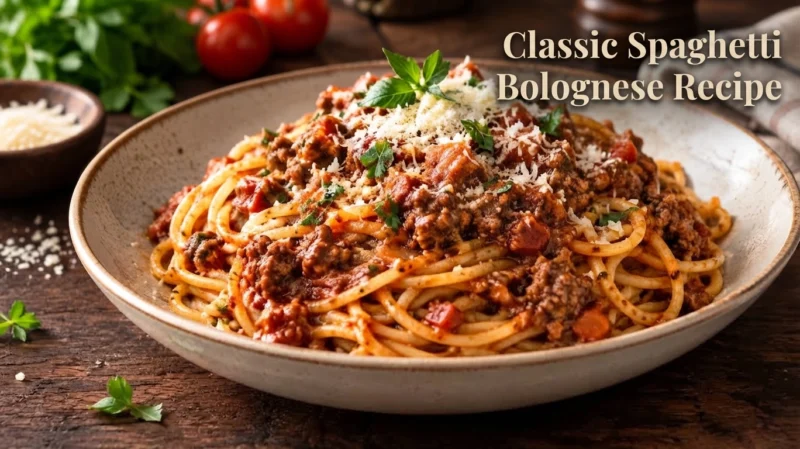
Spaghetti Bolognese
Spaghetti Bolognese is one of those dishes that seems simple until you try to make a truly good version. Ground meat, tomatoes, onions, pasta, and a little seasoning are all familiar ingredients, yet the difference between an ordinary bowl of pasta and a deeply flavorful Bolognese comes from how those ingredients are treated.
The most important lesson is that Bolognese sauce is not simply ground beef cooked in tomato sauce. A good sauce is built in layers. The vegetables need time to soften. The meat needs to brown properly. The tomato needs time to lose its raw taste. The liquid needs to reduce. Finally, the sauce needs enough gentle cooking time for everything to come together.
This classic spaghetti Bolognese recipe is designed for home cooks, including complete beginners. You do not need expensive ingredients, specialized equipment, or advanced cooking skills. You simply need to understand what each stage is doing and avoid rushing the important parts.
The finished sauce should be rich and savory, with tender meat, a rounded tomato flavor, subtle sweetness from the vegetables, and enough acidity to keep the dish from feeling heavy. The sauce should cling to the spaghetti rather than sit like a watery soup underneath it.
And there is one more important point: the pasta and sauce should become one dish. Instead of putting plain spaghetti on a plate and pouring sauce over it, we will finish the pasta in the sauce so the two components properly combine.
What Is Spaghetti Bolognese?
Spaghetti Bolognese is a popular Italian-inspired pasta dish made with a slow-cooked meat and tomato sauce served with spaghetti.
The sauce is commonly associated with Bologna, in northern Italy, although the familiar combination of spaghetti with a tomato-heavy meat sauce is much more common outside Italy than in traditional Bolognese cooking.
Traditional ragù alla Bolognese is generally more restrained with tomatoes and is commonly served with wider pasta shapes such as tagliatelle. The dish most English-speaking cooks call “spaghetti Bolognese” is a widely loved interpretation rather than a strict reproduction of the traditional ragù served in Bologna.
For a home recipe, however, the goal is not to win an argument about authenticity. The goal is to make a delicious, balanced, deeply flavored bowl of spaghetti with meat sauce.
That means using sound cooking techniques:
- build flavor with onion, carrot, and celery
- brown the meat instead of steaming it
- cook tomato paste properly
- allow the sauce to simmer gently
- reduce excess water
- season gradually
- cook spaghetti separately
- finish the pasta with the sauce
These simple steps make a remarkable difference.
Why This Classic Spaghetti Bolognese Recipe Works
There are several reasons this recipe produces a richer sauce than simply combining ground beef and canned tomatoes.
1. The vegetables create the flavor base
Onion, carrot, and celery are cooked slowly before the meat and tomatoes are added.
They do not need to taste strongly of individual vegetables when the sauce is finished. Their purpose is to create a savory, aromatic foundation.
2. The meat is properly browned
This is one of the most important steps.
If you add too much meat to a crowded pan, it releases water and begins to boil or steam. The meat may still cook, but it will not develop the same deep roasted flavor.
Proper browning gives the sauce much more character.
3. Tomato paste is cooked before the liquid is added
Tomato paste tastes very different after being cooked for a few minutes.
Its raw, sharp flavor becomes deeper and more savory, and the paste helps give the sauce body.
4. The sauce is simmered rather than aggressively boiled
A gentle simmer allows the flavors to develop without unnecessarily drying or scorching the sauce.
5. Pasta water helps finish the dish
Starchy pasta water can loosen the sauce while helping it cling to the spaghetti.
This is particularly useful when finishing the pasta directly in the pan.
Ingredients for Classic Spaghetti Bolognese
This recipe serves approximately 4 to 6 people.
For the Bolognese sauce
- 2 tablespoons olive oil
- 1 medium yellow onion, finely diced
- 1 medium carrot, finely diced
- 1 celery stalk, finely diced
- 3 garlic cloves, finely minced
- 1 pound (450 g) ground beef
- 2 tablespoons tomato paste
- 1 can (28 ounces / 800 g) crushed tomatoes
- 1 cup (240 ml) beef stock or chicken stock
- 1/2 cup (120 ml) dry red wine, optional
- 1 teaspoon dried oregano
- 1 teaspoon dried basil
- 1/2 teaspoon dried thyme
- 1 bay leaf
- 1/2 teaspoon black pepper
- salt, to taste
- 1/2 teaspoon sugar, optional
- 2 tablespoons butter, optional
- 2–3 tablespoons finely grated Parmesan, optional
For the pasta
- 12 ounces (340 g) spaghetti
- salt for the pasta water
For serving
- freshly grated Parmesan
- chopped fresh parsley or basil, optional
- extra black pepper
- extra-virgin olive oil, optional
Choosing the Ground Meat
Ground beef is the simplest choice for this recipe.
I recommend beef with enough fat to remain flavorful during the long cooking process. Very lean beef can work, but the sauce may be less rich.
An approximately 80–90% lean ground beef is a good practical range for home cooking.
You can also make Bolognese with a combination of beef and pork. Pork contributes additional fat and savory flavor, while beef gives the sauce its familiar character.
For a straightforward classic version, however, ground beef alone works very well.
Choosing the Tomatoes
Canned crushed tomatoes are convenient because they already have the texture we want.
Whole peeled tomatoes can also be used. If you use them, crush them with your hands or a spoon before or during cooking.
Avoid using a heavily seasoned pasta sauce as your primary tomato ingredient. It makes it much harder to control the flavor and salt level.
The sauce should taste like your Bolognese, not like a jarred sauce with meat added to it.
Do You Need Red Wine?
No.
Red wine is optional.
It can contribute acidity, aroma, and additional depth, but a good Bolognese does not depend on it.
If you have an open bottle of dry red wine, use a modest amount. If you do not have wine, simply replace it with additional stock.
Do not use a sweet wine.
Equipment
You do not need special equipment.
You will need:
- a large heavy-bottomed skillet, Dutch oven, or saucepan
- wooden spoon or sturdy spatula
- chef’s knife
- cutting board
- large pot for spaghetti
- colander
- ladle or measuring cup for pasta water
- grater for Parmesan
A wide pan is particularly useful because it gives the meat enough surface area to brown.
Before You Start: Prepare Everything
Bolognese is much easier to cook when the ingredients are prepared before the pan gets hot.
Dice the onion, carrot, and celery.
Mince the garlic.
Measure the tomato paste.
Open the tomatoes.
Measure the stock.
Have the herbs ready.
If you are using wine, have it beside the stove.
This is called mise en place, a French culinary term meaning that your ingredients are prepared and organized before cooking.
You do not need to become a professional chef to use the idea. It simply prevents you from trying to chop garlic while your onions are burning.
Step 1: Dice the Vegetables
Dice the onion, carrot, and celery into small pieces.
Try to keep the pieces approximately the same size.
They do not need to be perfectly identical. The important thing is that they are small enough to soften during cooking.
If the carrot pieces are very large, they may remain noticeably firm while the onion has already disappeared into the sauce.
For a smooth, integrated sauce, aim for pieces roughly 1/8 to 1/4 inch (3–6 mm).
Beginner tip
Do not worry about making the vegetables microscopic.
They will soften considerably during cooking.
The goal is simply to prevent large chunks.
Step 2: Heat the Pan
Place a large heavy skillet or Dutch oven over medium heat.
Add the olive oil.
Give the oil a little time to warm.
You do not want the pan smoking.
A simple test is to add a small piece of onion. It should begin to sizzle gently.
If the onion immediately darkens or the oil smokes heavily, the pan is too hot.
Step 3: Cook the Onion, Carrot, and Celery
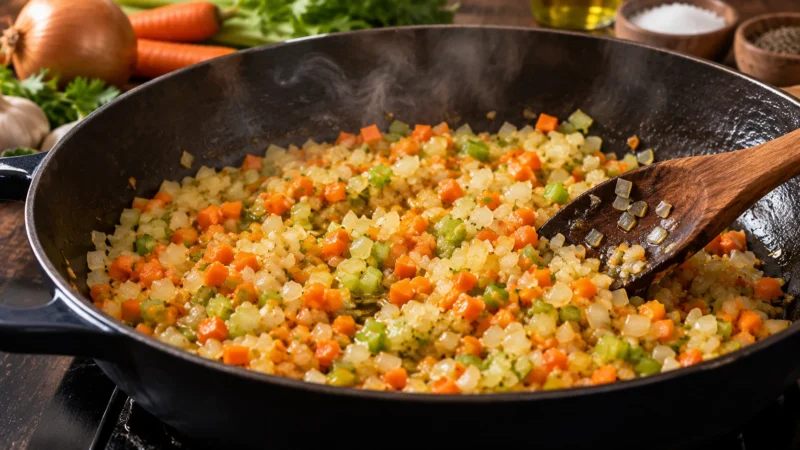
Add the diced onion, carrot, and celery.
Add a small pinch of salt.
Cook for approximately 7–10 minutes, stirring regularly.
You are not trying to brown the vegetables aggressively.
Instead, you want them to become soft and fragrant.
The onion should become translucent.
The carrot should begin to soften.
The celery should lose its raw, crunchy character.
This vegetable mixture is sometimes called a soffritto in Italian cooking. It is a foundational mixture used to build flavor.
What should it smell like?
At first, the vegetables will smell raw and sharp.
After several minutes, the aroma becomes sweeter, warmer, and more savory.
That change is your cue that the vegetables are ready for the next stage.
Step 4: Add the Garlic
Add the minced garlic.
Cook for approximately 30–60 seconds.
Garlic cooks quickly.
Do not walk away from the pan.
If garlic turns dark brown or black, it can become bitter.
You want it fragrant, not burned.
Step 5: Add the Ground Beef
Increase the heat to medium-high.
Add the ground beef.
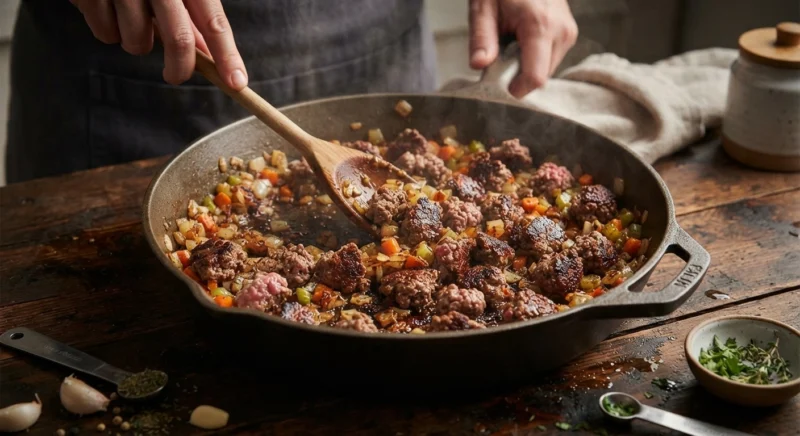
Use your spoon or spatula to break the meat into smaller pieces.
But do not immediately stir constantly.
Let some of the meat sit against the hot pan.
This is how browning develops.
Step 6: Brown the Meat Properly
Cook the beef for approximately 7–10 minutes, breaking it into smaller pieces as it cooks.
This is one of the most important stages of the entire recipe.
You want the meat to lose its raw pink color and develop some brown areas.
The biggest beginner mistake
Do not add all the tomatoes as soon as the meat turns gray.
Gray cooked meat is not the same thing as browned meat.
Browning creates additional flavor.
What if liquid appears?
Some liquid is normal.
If the pan becomes very wet, simply continue cooking until much of that liquid evaporates.
You want the meat to begin frying in the pan rather than simmering in a pool of water.
Do you need to brown every tiny piece?
No.
You do not need every piece to be dark brown.
Aim for a mixture of cooked meat with plenty of golden-brown areas.
Step 7: Season the Meat
Add:
- black pepper
- oregano
- basil
- thyme
Add a modest amount of salt.
Remember that the tomatoes, stock, pasta water, and Parmesan may also contain salt.
It is much easier to add salt later than to rescue an oversalted sauce.
Stir well.
Step 8: Cook the Tomato Paste
Add the tomato paste.
Stir it into the meat.
Cook for approximately 2–3 minutes.
This step is easy to skip, but it is worth doing.
The tomato paste should darken slightly and become more fragrant.
You may notice that it begins to stick lightly to the bottom of the pan.
That is fine as long as it is not burning.
The flavor should become richer and less raw.
Step 9: Deglaze With Red Wine
If using wine, pour it into the pan.
Immediately scrape the bottom with a wooden spoon.
The liquid will loosen browned bits stuck to the pan.
These browned bits contain concentrated flavor.
Allow the wine to simmer for 2–3 minutes.
You are not trying to preserve all of the alcohol. You are allowing the wine to reduce and integrate into the sauce.
If you are not using wine, simply move directly to the next step.
Step 10: Add the Tomatoes
Add the crushed tomatoes.
Stir thoroughly.
Then add the stock.
Add the bay leaf.
Stir again.
The sauce will initially look relatively loose.
That is normal.
Do not panic and add flour.
Bolognese does not need flour to become thick.
Time and evaporation will do the work.
Step 11: Bring the Sauce to a Gentle Simmer
Bring the sauce to a gentle simmer.
You should see occasional small bubbles.
You do not want the sauce violently boiling.
Once it reaches a simmer, reduce the heat to low or medium-low.
Partially cover the pan.
Leave a small opening so steam can escape.
Step 12: Simmer the Bolognese
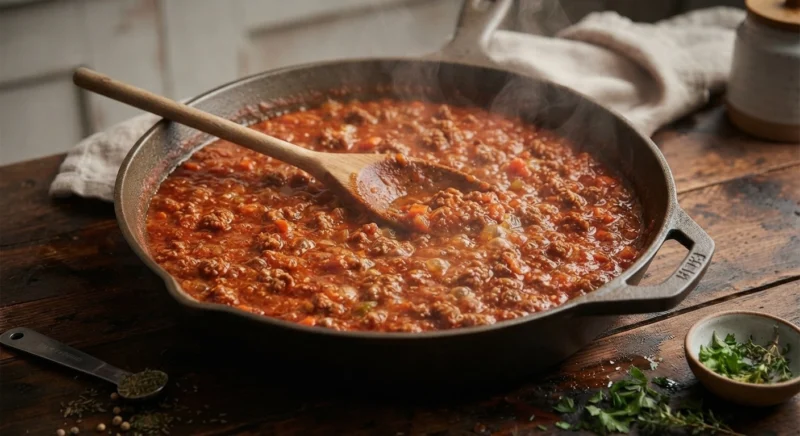
Allow the sauce to simmer for at least 45 minutes.
For a deeper flavor, you can simmer it for 60–90 minutes.
Stir every 10–15 minutes.
If the sauce becomes too thick before the flavor has developed, add a small amount of water or stock.
If it remains very watery near the end, remove the lid and allow additional moisture to evaporate.
Why does longer cooking help?
During simmering, the ingredients gradually become more integrated.
The meat becomes more tender.
The tomato flavor becomes deeper.
The vegetables soften further.
The sauce loses its watery character.
The result becomes much more cohesive.
What a Proper Simmer Looks Like
This is important for beginners.
A simmer is not the same as a full boil.
A boil has large, frequent bubbles breaking across the entire surface.
A gentle simmer has smaller bubbles appearing regularly but less aggressively.
If the sauce is splattering everywhere and rapidly shrinking, your heat is probably too high.
Turn it down.
You want patience, not violence.
Step 13: Taste the Sauce
After at least 45 minutes, taste the sauce.
Do not simply ask, “Does it taste good?”
Ask several specific questions.
Is it salty enough?
If not, add a small amount of salt.
Is it too acidic?
If the tomato flavor tastes sharply sour, additional cooking may help.
A very small amount of sugar can also balance the acidity.
Do not automatically add sugar.
Good tomatoes do not necessarily require it.
Is it too thick?
Add a little stock or water.
Is it too thin?
Continue simmering uncovered.
Does it taste flat?
It may need salt, more reduction, or a little Parmesan.
Sometimes “flat” simply means under-seasoned.
Step 14: Finish the Sauce
Remove the bay leaf.
Taste again.
If desired, stir in a small amount of butter.
Butter is not mandatory, but it can add richness and round the sauce.
You can also add a little finely grated Parmesan.
Stir well.
The final sauce should be thick enough to coat a spoon but still moist enough to combine easily with pasta.
Step 15: Cook the Spaghetti
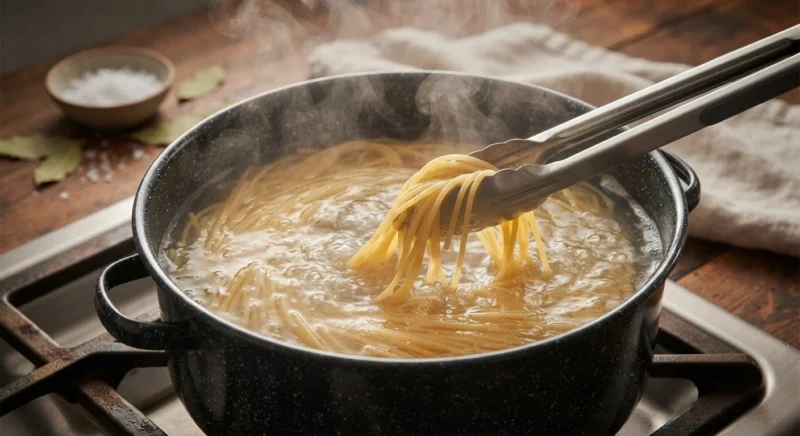
Bring a large pot of water to a vigorous boil.
Add a generous amount of salt.
The water should taste noticeably seasoned.
Add the spaghetti.
Stir immediately to prevent the strands from sticking together.
Cook according to the package directions, but begin tasting the pasta about 1–2 minutes before the suggested cooking time.
You want the spaghetti al dente.
Al dente means the pasta is cooked through but still has a slight firmness when bitten.
It should not be hard or crunchy.
Why You Should Not Overcook the Pasta
The pasta will continue cooking briefly when you combine it with the hot sauce.
If you boil the spaghetti until it is completely soft before combining it with the sauce, it can become mushy.
The goal is for the pasta to retain enough structure to hold the sauce.
Step 16: Save Pasta Water
Before draining the spaghetti, scoop out at least 1 cup of pasta cooking water.
This is an important habit.
Pasta water contains starch released from the pasta.
A little of this water can help loosen the sauce and help it coat the spaghetti.
Do not throw all the water away before you remember to save some.
That is one of the most common beginner mistakes.
Step 17: Drain the Spaghetti
Drain the spaghetti.
Do not rinse it.
Rinsing removes surface starch that helps the sauce cling to the pasta.
Immediately move the spaghetti to the pan with the Bolognese.
Step 18: Combine the Pasta and Sauce
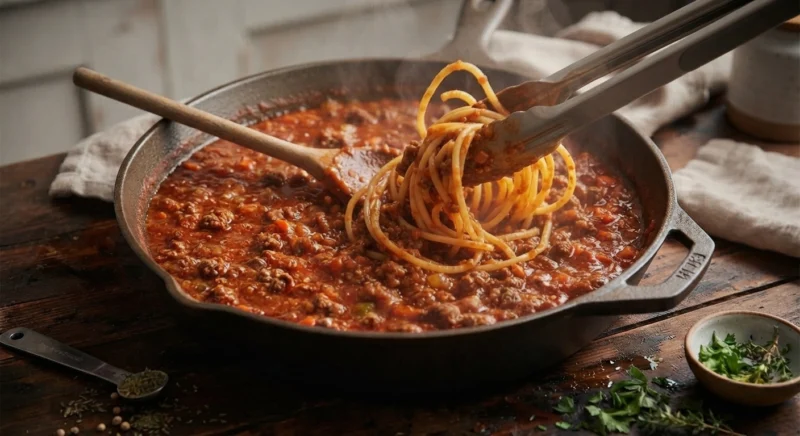
Add the cooked spaghetti directly to the Bolognese sauce.
Use tongs to toss everything together.
Add a small splash of reserved pasta water if the sauce looks too thick.
Continue tossing for approximately 1–2 minutes.
This is where the dish comes together.
The sauce should coat the spaghetti rather than simply sit underneath it.
What are you looking for?
Pick up a small amount of spaghetti with the tongs.
The strands should be coated with sauce.
There should not be a large pool of watery liquid at the bottom of the pan.
If the sauce seems too thick, add another splash of pasta water.
If it seems too loose, continue tossing over low heat for another minute.
The Best Way to Tell if the Sauce Is Ready
Forget trying to judge Bolognese entirely by a clock.
Look at the sauce.
A finished Bolognese should:
- look glossy
- cling to the meat
- coat pasta
- contain very little free water
- smell deeply savory
- have balanced tomato acidity
- taste seasoned but not salty
When you drag a spoon through the sauce, it should briefly leave a path rather than immediately filling with liquid.
That is a useful visual test.
Common Mistakes When Making Spaghetti Bolognese
Mistake 1: Not Browning the Meat
If the meat is simply cooked until gray, the sauce can taste flat.
Solution: Let the meat spend enough time against the hot pan to develop brown areas.
Mistake 2: Crowding the Pan
A very full pan creates steam.
Solution: Use a large pan or brown the meat in batches if necessary.
Mistake 3: Cooking at Too High a Temperature
Aggressive boiling can reduce the sauce too quickly and create a burnt layer on the bottom.
Solution: Use a gentle simmer.
Mistake 4: Adding Too Much Liquid
A sauce that starts too watery can take a long time to reduce.
Solution: Start with a moderate amount of stock and adjust later.
Mistake 5: Adding Sugar Automatically
Tomato sauce does not always need sugar.
Solution: Taste first.
If the sauce is pleasantly sweet and balanced, leave it alone.
Mistake 6: Using Too Much Garlic
Garlic can easily dominate the dish.
Solution: Use enough to contribute aroma without making the sauce taste primarily of garlic.
Mistake 7: Skipping the Tomato Paste
Tomato paste contributes depth and body.
Solution: Cook it with the meat for a few minutes before adding the liquid.
Mistake 8: Rinsing the Pasta
This removes useful surface starch.
Solution: Drain and immediately combine with the sauce.
Mistake 9: Serving Plain Pasta With Sauce Poured Over It
This creates separate components rather than one finished dish.
Solution: Toss the pasta directly in the sauce before serving.
How to Make Bolognese Less Acidic
Sometimes tomato sauce tastes sharper than expected.
First, cook it longer.
Reduction and simmering can soften the flavor considerably.
If it remains noticeably acidic, try one of these:
Add a small amount of butter
Butter rounds the sauce and reduces the perception of sharpness.
Add a tiny amount of sugar
Use very little.
You are balancing the tomatoes, not turning the sauce sweet.
Add more meat or stock
If the tomato flavor is extremely concentrated, a little additional stock can rebalance it.
Check the salt
Under-seasoned tomato sauce can sometimes taste more acidic than it actually is.
How to Make Bolognese Thicker
If your sauce is watery, do not immediately add flour.
Instead:
- Remove the lid.
- Continue simmering.
- Stir occasionally.
- Allow excess water to evaporate.
If you are in a hurry, use a slightly wider pan.
A larger surface area allows more evaporation.
Remember that the sauce will also become thicker when combined with pasta.
Do not reduce it until it looks like tomato paste.
How to Fix Bolognese That Is Too Thick
This is easy to fix.
Add a small amount of:
- pasta water
- stock
- water
Stir and reassess.
Add liquid gradually.
It is much easier to add another tablespoon than to correct a sauce that suddenly becomes watery.
How to Make Extra-Rich Bolognese
If you want a particularly rich version, consider using:
- a beef and pork mixture
- a small amount of butter
- longer simmering
- Parmesan at the end
- a splash of dry red wine
The key is restraint.
Adding more ingredients does not automatically create a better sauce.
Depth comes primarily from proper cooking.
Can You Make Bolognese Ahead?
Yes.
In fact, Bolognese is one of those dishes that often tastes even better after resting.
You can make the sauce a day ahead, cool it safely, refrigerate it, and reheat it gently the next day.
The flavors have additional time to come together.
Keep the pasta separate.
Cook fresh spaghetti when you are ready to serve.
How to Store Leftover Bolognese
Allow the sauce to cool appropriately and transfer it to a covered container.
Refrigerate promptly.
Use refrigerated leftovers within a few days.
For longer storage, freeze the sauce.
Label the container with the date.
Can You Freeze Bolognese?
Yes.
Bolognese freezes very well.
For best results, freeze the sauce separately from the pasta.
Allow the sauce to cool, place it in a freezer-safe container, and leave a little room for expansion.
When ready to use it, thaw it safely in the refrigerator and reheat thoroughly.
You can also reheat portions gently from frozen, adding a little water or stock if necessary.
Freshly cooked spaghetti will provide a much better texture than frozen and reheated pasta.
How to Reheat Bolognese
Place the sauce in a saucepan over medium-low heat.
Add a small splash of water or stock.
Stir occasionally.
Heat until the sauce is thoroughly hot.
If it becomes too thick, add another splash of liquid.
Do not blast the sauce over high heat.
Gentle reheating preserves the texture better.
What Pasta Is Best With Bolognese?
Spaghetti is the familiar choice for this recipe.
However, thicker or wider pasta shapes can hold a meat sauce particularly well.
Examples include:
- tagliatelle
- pappardelle
- fettuccine
- rigatoni
For this article, we are specifically making spaghetti Bolognese, so spaghetti remains the main recommendation.
If you enjoy experimenting, however, try the same sauce with a wider pasta shape.
You may notice that the sauce feels even more integrated with the pasta.
Why Pasta Shape Matters
Pasta is not just a vehicle for sauce.
Its shape determines how sauce is carried to your mouth.
Long strands such as spaghetti are excellent with smooth or moderately thick sauces.
Tube-shaped pasta can capture meat and sauce inside and around the surface.
Wider ribbons provide a substantial surface for rich meat sauces.
This is one reason traditional ragù preparations are often paired with wider pasta.
How Much Sauce Should You Use?
Do not drown the spaghetti.
You want enough sauce to coat the pasta generously.
A useful approach is to start with a moderate amount of sauce and add more if needed.
You can always add more.
Removing excess sauce from a finished bowl is much more difficult.
Parmesan: When and How Much?
Freshly grated Parmesan is excellent with Bolognese.
Add it at the table or stir a modest amount into the finished sauce.
Freshly grated cheese melts more naturally than many pre-grated products.
You do not need a huge amount.
The cheese should support the sauce rather than overwhelm it.
Fresh Herbs: Necessary or Optional?
Fresh parsley or basil can be added at the end.
They provide freshness and visual contrast.
But they are not necessary.
A properly cooked Bolognese should have enough flavor without relying on a large quantity of fresh herbs.
Use them as a finishing touch.
Should You Add Oregano and Basil?
For this home-style version, yes, in modest quantities.
However, dried herbs should not dominate the dish.
The primary flavors should still come from:
- browned meat
- cooked vegetables
- tomato
- reduction
- seasoning
Herbs should sit in the background.
How to Make Bolognese More Meaty
If you prefer a meatier sauce, reduce the tomato slightly and increase the ground beef.
You can also use beef and pork together.
The important thing is to maintain enough liquid for the meat to become tender during simmering.
How to Make It More Tomato-Forward
Use a little more crushed tomato and reduce the amount of stock.
You can also increase the tomato paste slightly.
However, remember that a classic-style meat sauce should still taste rich and savory rather than simply like tomato sauce with beef mixed in.
How to Make a Vegetable-Rich Bolognese
You can increase the amount of onion, carrot, and celery.
Finely diced mushrooms can also be added.
Cook mushrooms before adding the tomato so that they have a chance to lose their moisture and develop flavor.
This produces a sauce with more depth rather than watery vegetables.
Can You Add Milk?
Yes.
Milk is traditionally associated with many versions of Bolognese-style ragù and can soften the acidity of the tomato while contributing richness.
For this particular recipe, it is optional.
If you want to experiment, add a small amount during the simmering stage and allow it to integrate into the sauce.
Do not add a large amount.
The finished sauce should still have a clear savory character.
Can You Make It Without Wine?
Absolutely.
Simply omit the wine and add a little more stock.
The result will still be delicious.
Do not use wine just because a recipe says you have to.
Good cooking is about understanding what an ingredient contributes and knowing how to replace it when necessary.
Can You Make Spaghetti Bolognese Without Beef?
Yes.
Ground turkey, chicken, pork, or plant-based ground meat can all be used.
However, each produces a somewhat different sauce.
Turkey and chicken are leaner and may require additional fat.
Pork is naturally rich.
Plant-based meat alternatives vary significantly in composition and may need different cooking times.
For the classic version described here, beef remains the simplest choice.
A Beginner’s Guide to Knife Technique
This recipe includes several vegetables that need to be diced.
Your knife should be sharp.
A dull knife requires more pressure and can be harder to control.
Place the cutting board on a stable surface.
If it slides, place a damp kitchen towel underneath it.
When cutting onions, carrots, and celery, keep your fingertips curled slightly inward so that your knuckles face the blade.
Move the knife with controlled strokes.
Do not rush.
The goal is not to look fast.
The goal is to be accurate and safe.
A properly maintained kitchen knife makes this preparation much easier.
A sharp chef’s knife makes quick work of the onion, garlic, celery, and carrot preparation.
How to Dice an Onion Safely
Cut the onion in half through the root.
Remove the outer skin.
Place the flat side down.
Make several controlled horizontal or vertical cuts as appropriate for your knife technique.
Then make crosswise cuts.
Finally, cut across the onion to create small dice.
Keep the knife tip controlled and your supporting hand away from the blade.
How to Dice a Carrot
Peel the carrot if desired.
Cut it into manageable lengths.
Cut each length into strips.
Then cut across the strips into small pieces.
The goal is consistent pieces that cook at approximately the same rate.
How to Dice Celery
Trim the ends.
Cut the stalk into thin strips if necessary, then cross-cut into small pieces.
Celery can have strong fibers, so a sharp knife is particularly useful.
Sensory Checks During Cooking
Good cooking is not only about timers.
Your senses tell you what is happening.
When the vegetables are ready
They smell sweet and savory rather than raw.
When the meat is browned
You see golden-brown areas and smell roasted meat.
When the tomato paste is ready
It becomes darker and more fragrant.
When the sauce is reducing
The bubbles become thicker and the sauce moves more slowly.
When the Bolognese is finished
It looks rich and cohesive rather than watery.
Learning these signals is more valuable than memorizing exact cooking times.
Troubleshooting Spaghetti Bolognese
The sauce tastes watery
Continue simmering uncovered.
The sauce is too thick
Add a small amount of stock or pasta water.
The sauce tastes too sour
Cook it longer, then taste again.
If necessary, add a tiny amount of sugar or butter.
The sauce tastes bland
Check salt first.
Then consider whether the sauce needs additional reduction.
The meat tastes dry
The meat may have been too lean or cooked too aggressively.
Next time, use moderately fatty beef and maintain a gentle simmer.
The pasta is mushy
It was probably overcooked before being combined with the sauce.
Next time, begin testing it earlier.
The pasta and sauce feel separate
You probably served the pasta and sauce separately.
Finish the spaghetti directly in the Bolognese with a little pasta water.
The sauce is greasy
Some fat is normal.
If there is excessive fat, carefully spoon off a portion.
Next time, use moderately fatty meat rather than extremely fatty meat.
How to Serve Spaghetti Bolognese
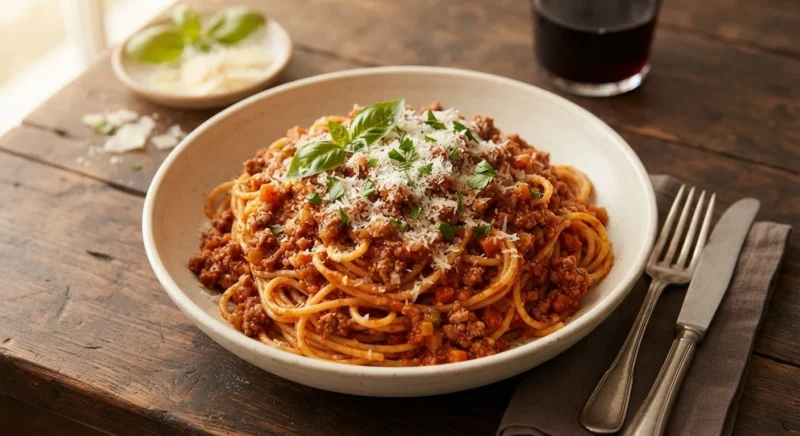
Use warm bowls or plates if possible.
Add the sauced spaghetti.
Twist or lift it neatly with tongs.
Top with freshly grated Parmesan.
Add freshly ground black pepper.
A small amount of fresh parsley or basil can be added for color and freshness.
Serve immediately.
Pasta waits for nobody.
As it cools, the sauce becomes thicker and the texture changes.
What to Serve With Spaghetti Bolognese
Because Bolognese is already a substantial meal, side dishes should be simple.
Good options include:
Green salad
A crisp salad with a slightly acidic dressing helps balance the richness of the meat sauce.
Garlic bread
A small portion works well, particularly for soaking up the remaining sauce.
Roasted vegetables
Simple roasted vegetables can add color and texture without competing with the pasta.
Crusty bread
A good loaf of bread can be enough.
Avoid serving too many heavy sides.
The pasta should remain the star.
A Simple Dinner Workflow
If you want to make this meal without feeling rushed, use this order.
First
Prepare and dice all vegetables.
Second
Start the Bolognese.
Third
Allow the sauce to simmer.
Fourth
Prepare the salad or side dish.
Fifth
Bring the pasta water to a boil.
Sixth
Cook the spaghetti.
Seventh
Finish the pasta directly in the sauce.
Eighth
Serve immediately.
This workflow means that the sauce is already developed when the pasta is ready.
Why the Sauce Should Be Ready Before the Pasta
This is a useful rule for many pasta dishes.
The sauce can wait for a few minutes.
Pasta cannot wait as well.
If you cook the spaghetti too early, it begins to cool and become sticky.
If the sauce is ready first, you can cook the pasta at the last moment and combine everything while it is hot.
That produces a better final texture.
Can You Make the Sauce in a Slow Cooker?
Yes, although browning the meat and vegetables first is still recommended.
The slow cooker can be useful when you want to develop the sauce over several hours.
Brown the meat and vegetables in a skillet first.
Transfer them to the slow cooker.
Add the remaining ingredients.
Cook according to your slow cooker’s instructions.
Then adjust the consistency at the end if necessary.
The slow cooker should be viewed as a convenience rather than a replacement for browning.
Can You Make It in the Oven?
Yes.
A covered Dutch oven can be used for slow cooking.
After browning the meat and adding the tomatoes and stock, transfer the pot to a moderate oven.
Cook gently until the sauce is rich and tender.
Stir occasionally and check the liquid level.
This method can provide very even heat.
Can You Make It in an Instant Pot or Pressure Cooker?
Yes, although pressure cooking produces a somewhat different result.
The same flavor-building principles still apply:
- brown the meat
- cook the vegetables
- cook the tomato paste
- add the liquid
- pressure cook
- reduce afterward if necessary
Do not skip the browning stage simply because the pressure cooker is faster.
Why Browning Matters More Than Fancy Ingredients
You can buy expensive tomatoes, premium olive oil, and imported cheese.
But if the meat is steamed instead of browned, the sauce can still taste mediocre.
Technique often matters more than price.
Good heat control, proper browning, adequate reduction, and correct seasoning will take ordinary supermarket ingredients surprisingly far.
The Difference Between a Good and Great Bolognese
A good Bolognese contains the correct ingredients.
A great Bolognese handles those ingredients correctly.
The vegetables are soft.
The meat is browned.
The tomato paste is cooked.
The sauce has reduced.
The seasoning is balanced.
The pasta is properly cooked.
The sauce clings to the pasta.
Nothing is excessively sweet, salty, acidic, or watery.
That balance is what makes the dish memorable.
Classic Spaghetti Bolognese Recipe Card
Classic Spaghetti Bolognese
Prep Time: 20 minutes
Cook Time: 60–90 minutes
Pasta Cooking Time: 8–12 minutes
Total Time: Approximately 1 hour 30 minutes
Servings: 4–6
Yield: 4–6 portions
Category: Main Course
Cuisine: Italian-inspired
Difficulty: Moderate
Ingredients
For the sauce
- 2 tablespoons olive oil
- 1 medium yellow onion, finely diced
- 1 medium carrot, finely diced
- 1 celery stalk, finely diced
- 3 garlic cloves, minced
- 1 pound (450 g) ground beef
- 2 tablespoons tomato paste
- 28 ounces (800 g) crushed tomatoes
- 1 cup (240 ml) beef or chicken stock
- 1/2 cup (120 ml) dry red wine, optional
- 1 teaspoon dried oregano
- 1 teaspoon dried basil
- 1/2 teaspoon dried thyme
- 1 bay leaf
- 1/2 teaspoon black pepper
- salt to taste
- 1/2 teaspoon sugar, optional
- 2 tablespoons butter, optional
- 2–3 tablespoons finely grated Parmesan, optional
For the pasta
- 12 ounces (340 g) spaghetti
- salt for pasta water
For serving
- freshly grated Parmesan
- fresh parsley or basil, optional
- freshly ground black pepper
Instructions
- Dice the onion, carrot, and celery into small pieces. Mince the garlic.
- Heat olive oil in a large heavy pan over medium heat.
- Add onion, carrot, and celery with a small pinch of salt. Cook 7–10 minutes until softened.
- Add garlic and cook for 30–60 seconds.
- Increase heat to medium-high and add ground beef.
- Brown the beef thoroughly, breaking it into small pieces. Cook approximately 7–10 minutes.
- Add oregano, basil, thyme, and black pepper.
- Stir in tomato paste and cook for 2–3 minutes.
- Add red wine if using and scrape the bottom of the pan. Simmer for 2–3 minutes.
- Add crushed tomatoes, stock, and bay leaf.
- Bring to a gentle simmer.
- Reduce heat, partially cover, and simmer for at least 45 minutes. For deeper flavor, cook 60–90 minutes.
- Stir periodically and add a little stock or water if the sauce becomes too thick.
- Remove the bay leaf.
- Taste and adjust salt, acidity, and consistency.
- Stir in butter and Parmesan if desired.
- Bring a large pot of salted water to a boil.
- Cook spaghetti until al dente.
- Reserve at least 1 cup of pasta water before draining.
- Drain the spaghetti without rinsing.
- Add spaghetti directly to the Bolognese sauce.
- Toss over low heat for 1–2 minutes.
- Add a splash of pasta water if needed to loosen the sauce.
- Serve immediately with freshly grated Parmesan and black pepper.
Final Tips for Perfect Spaghetti Bolognese
If you remember only a few things from this recipe, remember these:
Brown the meat.
Do not rush this stage.
Cook the vegetables properly.
They should become soft and sweet rather than remain crunchy.
Cook the tomato paste.
A few extra minutes can make a noticeable difference.
Simmer the sauce.
Bolognese benefits from time.
Taste as you go.
Cooking time is a guide, but your senses tell you when the sauce is actually ready.
Do not rinse the spaghetti.
The starch helps the sauce cling.
Save pasta water.
It is one of the simplest tools for fixing pasta texture.
Finish the spaghetti in the sauce.
This is how the pasta becomes part of the dish instead of simply carrying sauce.
And finally, do not be afraid of simplicity.
A great bowl of spaghetti Bolognese does not require dozens of ingredients. It requires patience, proper heat, good seasoning, and attention to the small changes happening in the pan.
Once you understand those principles, this recipe becomes much easier—and you can apply the same techniques to countless other meat sauces and pasta dishes.