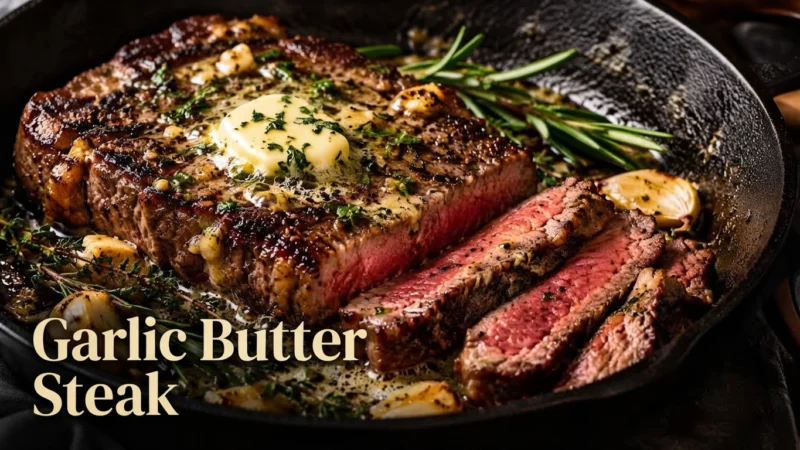
Garlic Butter Steak Recipe
Few steak recipes are as satisfying as a perfectly seared steak finished with garlic butter. The combination is simple, but when the steak is cooked properly and the butter is infused with garlic and fresh herbs, the result is rich, savory, aromatic, and deeply flavorful.
This Garlic Butter Steak recipe shows you how to cook a steak with a deeply browned crust and a tender, juicy center, then finish it with a quick garlic-herb butter sauce right in the skillet. You do not need a complicated marinade or a long ingredient list. A good steak, a hot pan, butter, garlic, herbs, salt, and pepper are enough to create an impressive meal.
The technique works particularly well with ribeye, New York strip, sirloin, and other steaks that are suitable for high-heat cooking. You can prepare the entire dish on the stovetop using a heavy skillet, making it an excellent option when you want a restaurant-style steak at home without using a grill.
The most important part is understanding the sequence: dry the steak, season it properly, build a strong sear, control the heat, add the butter at the right moment, baste continuously, and use internal temperature rather than guesswork to determine doneness.
Why This Garlic Butter Steak Recipe Works
A great steak does not need complicated preparation. In fact, adding too many ingredients can hide the natural flavor of the beef.
This recipe focuses on a few techniques that make a major difference.
A dry surface creates a better crust
Moisture on the outside of a steak has to evaporate before the surface can brown effectively. If the steak goes into the pan wet, much of the initial heat is spent evaporating water instead of creating the intense browning you want.
Patting the steak thoroughly dry with paper towels helps the surface brown faster and more evenly.
High heat creates the sear
The characteristic brown crust on a steak comes from intense surface browning. A properly heated skillet gives the steak enough energy to develop a flavorful crust before the interior becomes overcooked.
Butter is added after the initial sear
Butter tastes fantastic with steak, but it is not the ideal fat for starting a steak over very high heat because its milk solids can burn.
Instead, the steak is initially seared with a high-heat cooking oil. Butter is added later, once the steak already has a crust and the heat can be moderated.
Garlic and herbs flavor the butter
As the butter melts, garlic and fresh herbs release their aromas into the fat. Basting the steak with this infused butter coats the crust with additional flavor.
Internal temperature provides consistency
Thickness, pan temperature, starting temperature, and cooking time can all vary. An instant-read thermometer removes much of the guesswork.
If you want a steak that is consistently medium-rare, measuring the internal temperature is much more reliable than relying only on minutes per side.
What Is Garlic Butter Steak?
Garlic butter steak is a steak that is seared in a hot skillet and finished with butter infused with garlic and often fresh herbs such as thyme or rosemary.
It is not a particular cut of beef. The term describes the cooking method and finishing technique.
You can make garlic butter steak using several different cuts, including:
- Ribeye
- New York strip
- Sirloin
- Top sirloin
- Filet mignon
- Flat iron steak
- Strip steak
- Other tender steaks suitable for pan searing
The best choice depends on what you value most.
Ribeye provides substantial marbling and a rich beefy flavor. New York strip offers a balance of tenderness and flavor. Sirloin is generally leaner and more affordable. Filet mignon is exceptionally tender but has a milder flavor because it contains less intramuscular fat.
The same garlic butter technique can be adapted to all of them.
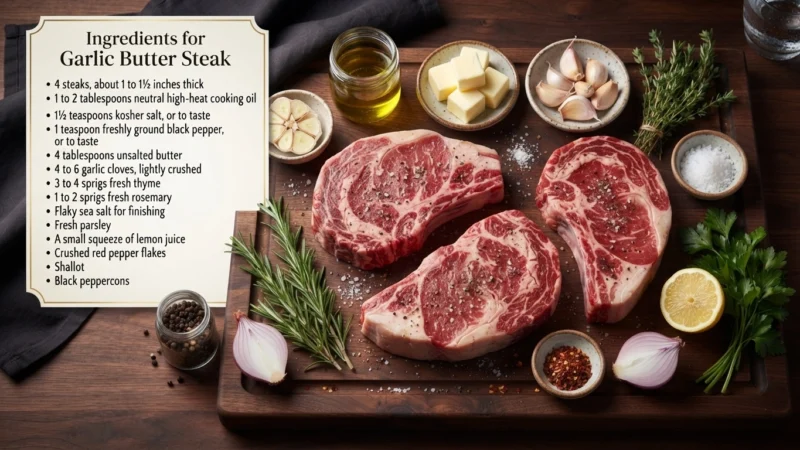
Ingredients for Garlic Butter Steak
For four servings, you will need approximately:
- 4 steaks, about 1 to 1½ inches thick
- 1 to 2 tablespoons neutral high-heat cooking oil
- 1½ teaspoons kosher salt, or to taste
- 1 teaspoon freshly ground black pepper, or to taste
- 4 tablespoons unsalted butter
- 4 to 6 garlic cloves, lightly crushed
- 3 to 4 sprigs fresh thyme
- 1 to 2 sprigs fresh rosemary
Optional:
- Flaky sea salt for finishing
- Fresh parsley
- A small squeeze of lemon juice
- Crushed red pepper flakes
- Shallot
- Black peppercorns
The exact amount of seasoning depends on the size of the steaks and your preferences.
For thick steaks, do not be afraid of properly seasoning the exterior. Some seasoning remains in the pan, while the rest creates the flavorful surface crust.
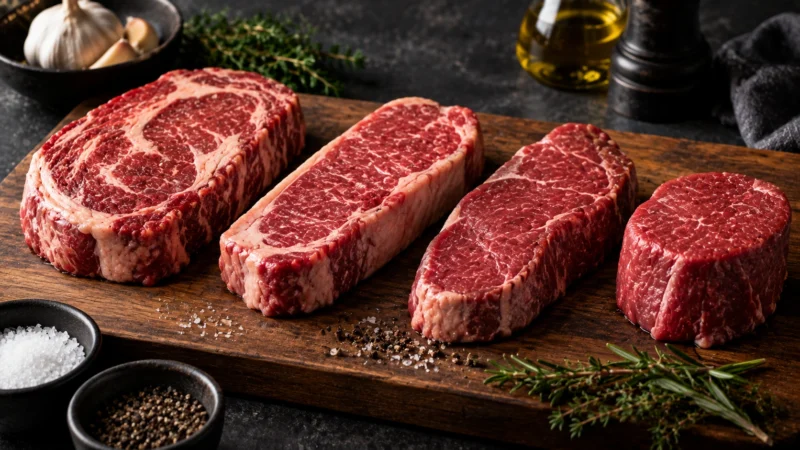
Choosing the Best Steak
The cooking technique matters, but the starting ingredient matters too.
For garlic butter steak, choose steaks that are thick enough to develop a browned exterior while still giving you enough time to cook the center to your preferred doneness.
A steak around 1 to 1½ inches thick is particularly convenient for skillet cooking.
Ribeye
Ribeye is one of the richest choices because of its abundant marbling.
As the steak cooks, some of the intramuscular fat melts and contributes flavor and richness.
Ribeye is especially good with garlic butter because the buttery finish complements the beef’s natural richness.
New York Strip
New York strip is another excellent option.
It typically has a firmer bite than ribeye while remaining tender when properly cooked. It also develops a beautiful crust in a hot skillet.
If you enjoy a pronounced beef flavor without quite as much fat as ribeye, strip steak is an excellent choice.
Sirloin
Sirloin offers a more economical option.
Because it is generally leaner, you should pay close attention to internal temperature. Overcooking a lean steak can make it noticeably drier.
Garlic butter helps add richness to the finished steak.
Filet Mignon
Filet mignon is exceptionally tender and works beautifully with this method.
Because filet mignon has a relatively mild beef flavor and little marbling compared with ribeye, garlic, butter, and herbs provide an especially useful flavor contrast.
Flat Iron Steak
Flat iron steak can also work very well.
It is flavorful and often relatively affordable. Because it is usually thinner than a thick ribeye or strip steak, cooking time will be shorter.
Always judge doneness by temperature rather than blindly following the timing for a thicker steak.
What to Look for When Buying Steak
Look for steaks with a reasonably even thickness.
An extremely thin steak can become well-done internally before you have time to develop the crust you want.
For ribeye and strip steak, visible marbling is desirable because intramuscular fat contributes flavor and juiciness.
Avoid steaks with large areas of excessive surface moisture.
The meat should look fresh and firm, and the surface should not be excessively wet.
If you have the option, thicker steaks are generally easier to cook precisely than very thin steaks.
Should Steak Come to Room Temperature?
You will often hear that steak must sit at room temperature for a long time before cooking.
That advice is frequently overstated.
A steak does not need to become completely room temperature before you sear it. What matters much more is controlling the surface moisture and using a properly heated pan.
You can remove the steak from refrigeration while you prepare the rest of your ingredients. Depending on the size and thickness, allowing it to sit for a short period can reduce the temperature difference between the center and exterior.
However, do not leave raw meat sitting out unnecessarily for extended periods.
The important preparation step is simple:
Take the steaks out, pat them thoroughly dry, and season them shortly before cooking.
How to Prepare the Steak
Remove the steaks from their packaging and place them on a clean surface.
Pat both sides thoroughly dry with paper towels.
This is one of the easiest ways to improve the final result.
Do not skip the edges.
If the steak is thick, stand it on its side later during cooking to brown the fat cap and edges.
Once the steak is dry, season both sides generously with kosher salt and freshly ground black pepper.
You can season immediately before cooking, or salt somewhat earlier if you prefer a more deeply seasoned steak.
If you salt in advance, give the salt enough time to interact with the meat rather than salting only a few minutes before cooking. If you are short on time, seasoning immediately before the steak hits the pan is perfectly practical.
Check Our Ultimate American BBQ Meat Guide: How to Cut Chicken, Steak & Ribs + 8 Easy BBQ Recipes
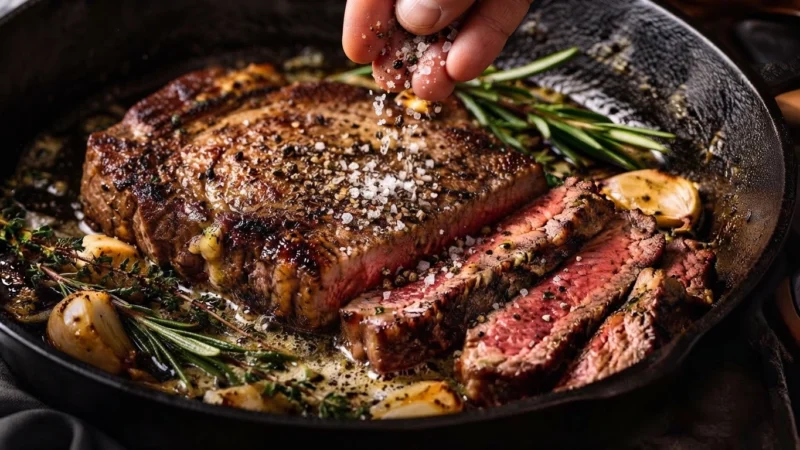
The Best Pan for Garlic Butter Steak
A heavy skillet is ideal.
Cast iron
Cast iron is excellent because it retains a large amount of heat.
When a cold steak enters the pan, the pan temperature drops. A heavy skillet recovers that heat effectively.
Cast iron is particularly useful when you want an aggressive sear.
Stainless steel
Stainless steel also works extremely well.
A properly preheated stainless-steel skillet can produce an excellent crust and makes it easier to monitor browning visually.
Carbon steel
Carbon steel provides many of the same advantages as cast iron while being lighter.
If you already have a well-seasoned carbon-steel pan, it is an excellent choice.
Nonstick
Nonstick cookware is less suitable for extremely high-temperature steak searing.
For this recipe, a heavy cast-iron, carbon-steel, or stainless-steel skillet is preferable.
How Hot Should the Pan Be?
The pan should be hot before the steak goes in.
A common mistake is placing the steak into a lukewarm pan and then gradually increasing the heat.
This encourages prolonged cooking and can make it more difficult to create a deep crust without overcooking the interior.
Heat the skillet over medium-high to high heat until it is properly preheated.
Add a small amount of neutral oil.
The oil should become fluid and shimmer rather than immediately smoking heavily.
You want enough heat to produce strong browning, but not so much that the oil and steak burn instantly.
What Oil Should You Use?
Use a neutral oil with a relatively high smoke point.
Good choices include:
- Avocado oil
- Refined canola oil
- Grapeseed oil
- Refined sunflower oil
- Other neutral high-heat cooking oils
You do not need a large amount of oil.
The purpose is to improve contact between the steak and pan and provide enough fat for efficient browning.
The steak’s own fat will also contribute to the cooking process, particularly with a well-marbled ribeye.
How to Sear Garlic Butter Steak
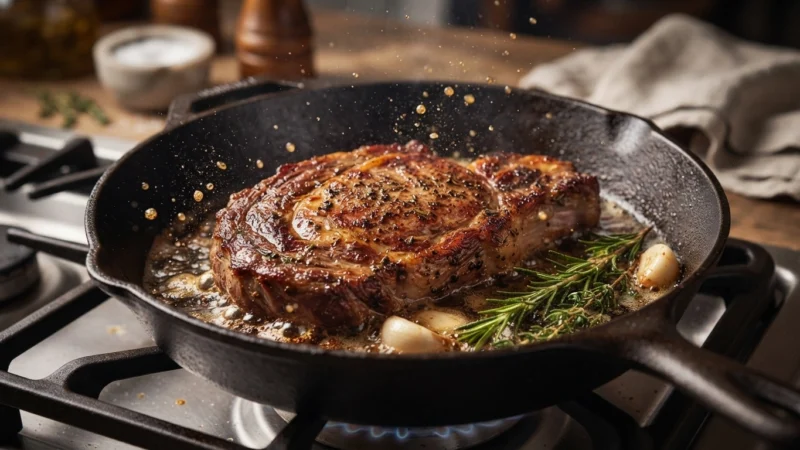
Place the steak carefully into the hot skillet.
You should hear an immediate, energetic sizzle.
Do not move the steak around immediately.
Allow the first side to remain in contact with the pan long enough to develop a crust.
For a steak around 1 to 1½ inches thick, approximately 2 to 3 minutes on the first side is a reasonable starting point, but the exact time depends on the pan, heat, steak thickness, and desired doneness.
Lift an edge carefully to check the color.
You are looking for a deep golden-brown to dark-brown crust rather than a pale gray surface.
Turn the steak and repeat on the other side.
Do You Need to Flip the Steak Only Once?
No.
There is no strict rule that a steak must be flipped only once.
Frequent flipping can actually be useful when you are trying to control the interior temperature while maintaining good browning.
For a thick steak, you can sear one side, turn it, and then turn it periodically as it approaches your target temperature.
The important thing is not the number of flips.
The important things are:
- Strong pan contact
- Good surface browning
- Controlled heat
- Accurate internal temperature
Don’t Forget the Edges
If the steak is thick enough, hold it upright with tongs and briefly sear the edges.
This is particularly useful for steaks with a visible fat cap.
Let the fat render against the hot pan for a short period.
Do not burn it.
The goal is to brown and render the exterior fat, not turn it bitter.
When to Add the Butter
This is one of the most important parts of the recipe.
Do not add the butter at the very beginning over maximum heat.
Butter contains milk solids that can burn relatively quickly.
Instead, once the steak has developed a strong crust on both sides, reduce the heat to medium or medium-low and add:
- Butter
- Garlic
- Thyme
- Rosemary
The butter will begin melting around the steak.
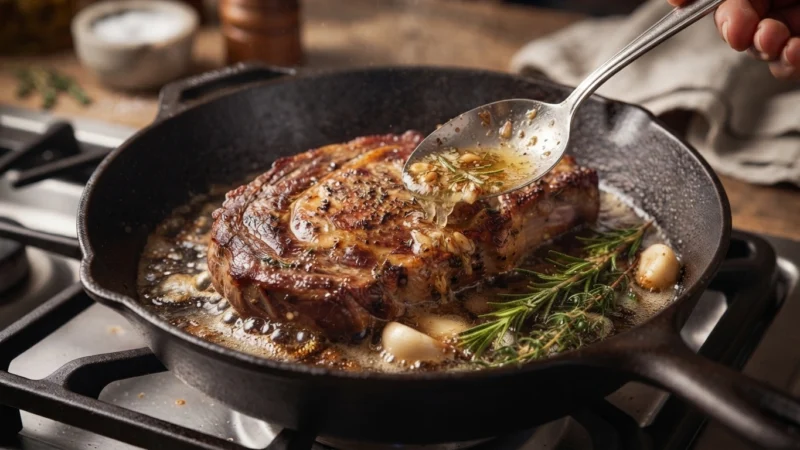
As it foams, it becomes an aromatic cooking liquid that can be spooned over the steak.
How to Make Garlic Butter
Add the butter to the skillet.
Immediately add the lightly crushed garlic cloves and herbs.
Tilt the pan slightly so the melted butter collects on one side.
Use a spoon to repeatedly scoop the butter and pour it over the top of the steak.
Continue basting for roughly 30 seconds to 2 minutes, depending on the thickness and current internal temperature of the steak.
The garlic should become fragrant and lightly golden.
It should not become dark brown or burnt.
If the garlic is browning too aggressively, lower the heat.
Why Basting Works
Basting does more than simply make the steak look glossy.
The melted butter carries the flavors of garlic and herbs across the surface of the meat.
The process also adds another layer of fat and aroma to the browned crust.
Because the steak has already been seared, you are now finishing it with a concentrated layer of flavor rather than trying to use butter as the primary high-temperature cooking fat.
This sequencing makes a major difference.
The Best Internal Temperature for Steak
Cooking time is useful as a rough guide, but internal temperature is much more reliable.
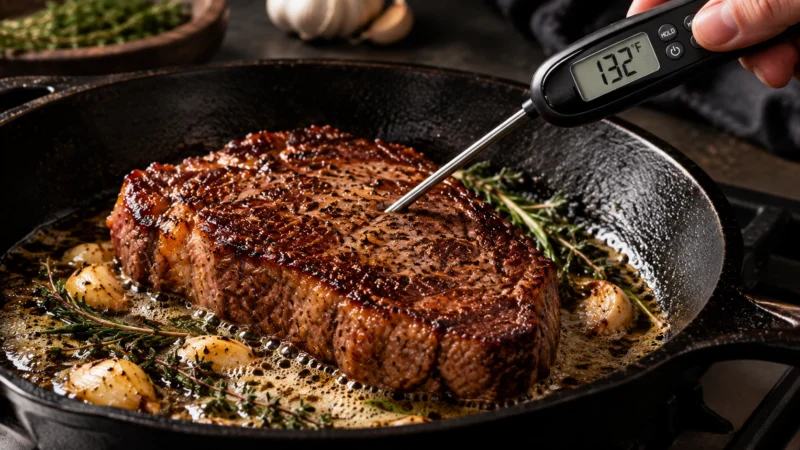
Use an instant-read thermometer inserted horizontally into the thickest part of the steak.
Try to avoid touching the pan or large pockets of fat with the probe because that can produce an inaccurate reading.
As a general guide:
| Doneness | Target final temperature |
|---|---|
| Rare | 120–125°F |
| Medium-rare | 130–135°F |
| Medium | 140–145°F |
| Medium-well | 150–155°F |
| Well-done | 160°F+ |
Temperatures can continue to rise slightly while the steak rests, so many cooks remove the steak a few degrees before the desired final temperature.
The amount of carryover cooking varies depending on steak thickness, starting temperature, cooking method, and how hot the steak is when removed from the pan.
For the best control, monitor the temperature during the final stage rather than relying solely on a fixed number of minutes.
Why Medium-Rare Is So Popular
Medium-rare provides a balance between a browned exterior and a tender, juicy center.
The interior remains noticeably pink and the steak generally retains a tender texture.
However, there is no universally correct level of doneness.
If you prefer medium, cook it to medium.
If your preference is well-done, you can cook it further.
The purpose of temperature guidance is consistency, not telling you how you must eat your steak.
Resting the Steak
Once the steak reaches your desired cooking point, transfer it to a clean plate or cutting board.
Allow it to rest for approximately 5 to 10 minutes, depending on its thickness.
Resting gives the steak time to stabilize after cooking.
It also gives you a few minutes to finish the rest of the meal.
Do not immediately slice into the steak the moment it leaves the pan.
That makes it more difficult to judge the final texture and can result in juices spreading across the cutting board before you serve it.
Should You Cover the Steak While It Rests?
You can loosely tent the steak if necessary, but tightly covering it can trap steam.
For a steak with a carefully developed crust, excessive trapped moisture is not ideal.
A short rest uncovered or very loosely tented is usually sufficient.
How to Slice Garlic Butter Steak
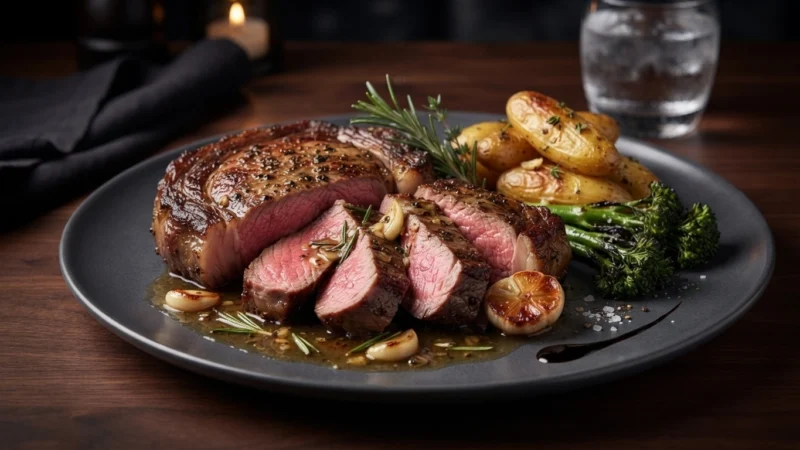
If you are serving the steak whole, simply place it on the plate and spoon some of the remaining garlic butter over it.
If you are slicing it, use a sharp knife and cut across the grain.
The grain refers to the direction in which the muscle fibers run.
Cutting perpendicular to those fibers shortens them and generally produces a more tender bite.
For a particularly thick steak, you can slice it into pieces approximately ½ inch thick.
Finish with a small amount of flaky salt if desired.
Garlic Butter Steak Sauce
One of the best parts of this recipe is that the skillet already contains the beginnings of a sauce.
After the steaks are removed, you may have a small amount of browned fond, garlic, herbs, and butter remaining in the pan.
You can simply spoon this over the steak.
For an even more pronounced sauce, add one or two additional ingredients.
Garlic Butter and Lemon
Add a small squeeze of fresh lemon juice to the finished butter.
The acidity cuts through the richness and creates a brighter flavor.
Do not add too much.
You want the lemon to balance the butter rather than turn the dish into a lemon steak.
Garlic Butter and Shallot
Finely minced shallot can be added during the final stage.
Allow it to soften gently in the butter.
Shallot provides sweetness and additional aromatic depth.
Garlic Butter and Red Pepper
For heat, add a pinch of crushed red pepper flakes.
This works particularly well with ribeye or sirloin.
Garlic Butter and Black Pepper
For a simple variation, increase the amount of freshly cracked black pepper.
The combination of black pepper, garlic, butter, and beef is classic for a reason.
Fresh Herbs vs Dried Herbs
Fresh herbs are particularly effective in this recipe because they quickly release aroma into hot butter.
Good options include:
- Thyme
- Rosemary
- Parsley
- Sage
You can use dried herbs if necessary, but they have a different texture and intensity.
Fresh rosemary and thyme are especially convenient because their sturdy stems can be placed directly into the pan during basting.
Parsley is better added toward the end.
How Much Garlic Should You Use?
The amount of garlic is flexible.
For four steaks, four to six cloves provide a noticeable garlic flavor without completely overwhelming the beef.
If you love garlic, you can use more.
However, remember that the garlic is being cooked in butter and can burn quickly.
Lightly crushing the cloves rather than finely mincing them is useful because larger pieces are easier to manage at high heat.
It also allows the garlic to infuse the butter without producing large quantities of tiny browned garlic particles.
Whole Garlic vs Minced Garlic
Whole or lightly crushed garlic is generally preferable for skillet basting.
Finely minced garlic has more exposed surface area and can burn quickly.
If you want to use minced garlic, add it later and keep the heat lower.
Burned garlic can introduce a bitter flavor that is difficult to correct.
Common Mistakes When Making Garlic Butter Steak
Even a short ingredient list can produce disappointing results if the technique is wrong.
Here are the most common problems.
1. Starting with a Wet Steak
A wet steak steams before it browns.
Always pat the steak dry.
2. Using a Cold Pan
A cold pan encourages slow cooking and weak browning.
Preheat the skillet properly.
3. Adding Butter Too Early
Butter can burn before the steak develops a crust.
Start with a high-heat oil and add butter later.
4. Moving the Steak Constantly
If you constantly slide the steak around, it becomes harder to develop consistent contact with the pan.
Let the first side sear before checking it.
5. Using Too Much Oil
You need only enough oil to lightly coat the cooking surface.
Excess oil can make the pan messy and does not automatically create a better crust.
6. Burning the Garlic
Garlic should become fragrant and lightly golden.
Black garlic is bitter.
Lower the heat as soon as the butter and aromatics become aggressive.
7. Cooking by Time Alone
Two steaks can require very different cooking times.
A thermometer is far more reliable.
8. Cutting the Steak Immediately
Give it time to rest.
9. Slicing With a Dull Knife
A dull knife can crush rather than cleanly slice the meat.
Use a sharp knife.
10. Overcooking Lean Steak
Sirloin and other lean cuts can become dry more quickly than highly marbled steaks.
Pay particular attention to temperature.
Cast Iron vs Stainless Steel for Garlic Butter Steak
Both are excellent.
Cast iron provides strong heat retention and is especially useful for aggressive searing.
Stainless steel responds somewhat more quickly to changes in heat and makes it easy to see the fond developing on the bottom of the pan.
For home cooks, the difference is usually less important than technique.
A well-preheated stainless-steel pan can produce an excellent crust.
A properly maintained cast-iron skillet can do the same.
Use the pan you are comfortable controlling.
Can You Make Garlic Butter Steak Without an Oven?
Yes.
This recipe is designed primarily for stovetop cooking.
For steaks around 1 to 1½ inches thick, you can sear them in the skillet and finish them with garlic butter without transferring them to an oven.
For very thick steaks, an oven finish can provide more even cooking.
Oven-Finished Garlic Butter Steak
For a thick steak, begin by searing both sides in a hot oven-safe skillet.
Once the crust is established, transfer the skillet to a preheated oven.
Cook until the steak approaches your desired internal temperature.
Return the skillet to the stovetop, reduce the heat, add butter, garlic, and herbs, and baste.
This method provides additional control for very thick cuts.
Reverse-Seared Garlic Butter Steak
For exceptionally thick steaks, reverse searing is another excellent method.
The steak is first cooked gently at a low temperature until the interior approaches the desired temperature.
It is then seared very aggressively in a hot skillet.
The garlic butter is added during the final finishing stage.
This method can produce a remarkably even interior with a strong exterior crust.
It is particularly useful for steaks that are more than about 1½ to 2 inches thick.
Garlic Butter Steak on the Grill
Although this recipe is designed for a skillet, the garlic butter can also be used with grilled steak.
Grill the steak until it reaches the desired level of doneness.
Then transfer it to a plate and add garlic-herb butter while it rests.
You can also prepare the garlic butter separately and spoon it over the grilled steak just before serving.
The important distinction is that the butter does not need to be exposed to the strongest direct grilling heat.
Making Garlic Herb Butter in Advance
You can prepare compound garlic butter ahead of time.
Combine softened unsalted butter with:
- Finely minced garlic
- Chopped parsley
- Thyme
- Rosemary
- Black pepper
- A small amount of salt
Mix thoroughly.
Shape the butter into a small log using parchment paper and refrigerate it until firm.
When you cook steak, place a slice of the compound butter on top during the resting period.
This is a convenient alternative to making the butter directly in the skillet.
Garlic Butter Steak With Mushrooms
Mushrooms are an excellent side or skillet accompaniment.
Cook sliced mushrooms separately or after the steak has been removed.
The mushrooms can absorb some of the browned flavors left in the skillet.
Add a small amount of butter and cook until the mushrooms become browned and tender.
A little thyme works particularly well.
If using the same skillet immediately after the steak, be careful not to overcrowd the pan.
Garlic Butter Steak With Onions
Caramelized or deeply browned onions provide sweetness that contrasts with the savory steak.
For best results, cook the onions separately because proper caramelization takes longer than steak searing.
Serve the onions underneath or alongside the steak.
What to Serve With Garlic Butter Steak
A rich steak pairs well with sides that provide contrast in texture and flavor.
Classic options include:
Roasted Potatoes
Crisp roasted potatoes work particularly well because they can absorb some of the garlic butter.
Mashed Potatoes
Creamy mashed potatoes are ideal when you want a rich, traditional steak dinner.
The garlic butter from the skillet can be spooned over the steak and allowed to mingle with the potatoes.
Roasted Vegetables
Try:
- Broccoli
- Asparagus
- Brussels sprouts
- Carrots
- Green beans
- Bell peppers
Simple Salad
A crisp green salad with an acidic vinaigrette can balance the richness of the steak and butter.
Creamed Spinach
Creamed spinach creates a classic steakhouse-style meal.
Grilled Vegetables
Zucchini, peppers, onions, and asparagus all work well.
How to Build a Complete Steak Dinner
For a simple dinner, serve:
Garlic butter steak + roasted potatoes + green vegetables + crisp salad
For a more indulgent meal:
Garlic butter ribeye + mashed potatoes + creamed spinach
For a lighter plate:
Garlic butter sirloin + grilled vegetables + green salad
You can easily adjust the sides depending on the cut and size of the steak.
Check Our Guide Best Steak and Beef Recipes: 15 Easy & Delicious Beef Recipes
Can You Make Garlic Butter Steak With Frozen Steak?
Yes, but fresh or properly thawed steak is easier to manage.
If using frozen steak, thaw it safely in the refrigerator before cooking.
Do not rely on room-temperature thawing for an extended period.
Once thawed, pat the steak extremely dry before seasoning and searing.
The drier the exterior, the easier it is to develop a good crust.
How to Store Leftover Steak
If you have leftover garlic butter steak, allow it to cool appropriately and refrigerate it in a sealed container.
Use refrigerated leftovers within a few days.
For reheating, avoid blasting the steak with very high heat for an extended period.
Gentle reheating can help preserve tenderness.
Alternatively, slice the cold leftover steak thinly and use it in:
- Steak sandwiches
- Salads
- Tacos
- Wraps
- Rice bowls
- Pasta
- Breakfast dishes
Reheating Garlic Butter Steak
The microwave is convenient but can easily overcook steak.
For better results, use gentle heat.
A low oven or covered skillet can warm the steak more gradually.
You can also slice the steak thinly and warm it briefly in a hot sauce or pan.
The goal is to bring it back to serving temperature without cooking the meat substantially further.
How to Make Garlic Butter Steak for a Crowd
If you are cooking several steaks, avoid overcrowding the skillet.
A crowded pan loses heat and creates more steam.
Instead, cook the steaks in batches.
Keep finished steaks warm while you complete the remaining steaks, then prepare the garlic butter in the skillet.
For a large group, an oven-assisted method can be easier because it gives you more control over multiple steaks.
Cooking Different Steaks at the Same Time
If guests prefer different levels of doneness, organize the steaks by desired temperature.
Start with the steaks that need the most cooking and finish the rarest steaks later.
Use a thermometer for each steak.
Do not assume that steaks of the same weight will reach the same internal temperature at exactly the same time.
Thickness is often more important than weight when determining cooking speed.
The Importance of a Sharp Knife
Steak deserves a proper cutting tool.
A sharp kitchen knife makes it easier to slice the steak cleanly without crushing the crust or tearing the meat.
If you are slicing steak for serving, a long, sharp blade can make particularly clean cuts.
Cut perpendicular to the grain and use smooth strokes rather than excessive downward pressure.
https://yashkadesigns.com/95-mm-blade-steak-knife
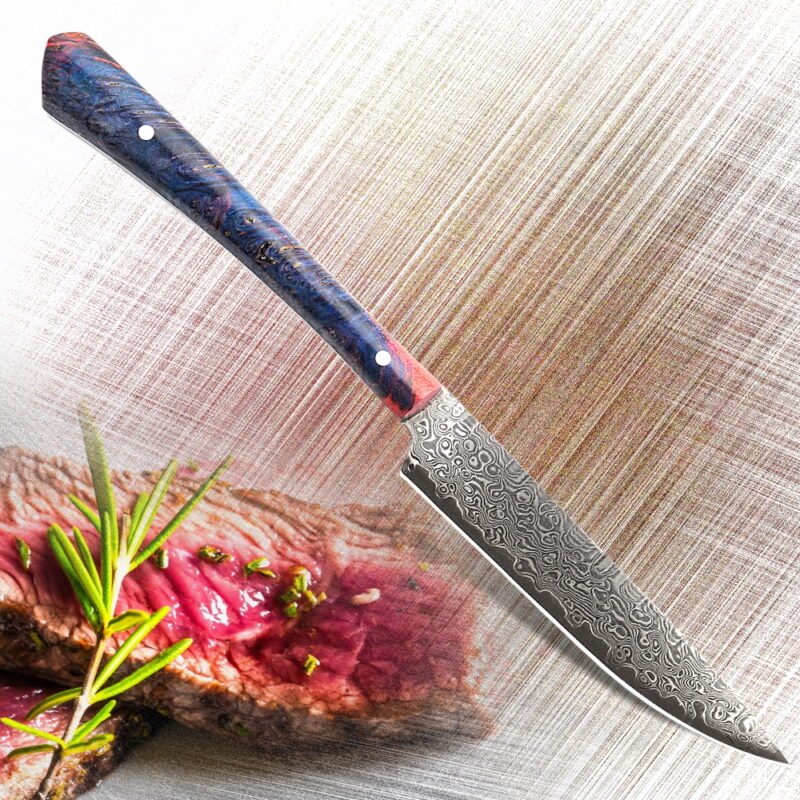
A Note on Steak Knives and Kitchen Knives
A good steak is only part of the dining experience.
The knife should be comfortable, sharp, and appropriate for the task.
If you prepare steaks frequently, maintaining a sharp kitchen knife is useful not only for slicing cooked meat but also for preparing vegetables, trimming ingredients, and handling other parts of the meal.
A properly maintained edge is far more useful than simply choosing a knife because it looks impressive.
How to Get More Flavor Without Marinating
One advantage of this method is that you do not need a long marinade.
The steak gets flavor from several layers:
- Salt and pepper
- High-heat browning
- Rendered beef fat
- Butter
- Garlic
- Fresh herbs
- Optional finishing salt
The browned crust is especially important.
A deeply developed crust contributes complex roasted flavors that cannot simply be replaced by adding more seasoning.
Should You Marinate Steak for Garlic Butter Steak?
Usually, no.
A marinade can be useful for some cuts and recipes, but a well-marbled, tender steak does not require one.
If the goal is a classic steakhouse-style result, keeping the seasoning simple allows the beef to remain the primary flavor.
Garlic butter should complement the steak rather than conceal it.
Can You Use Salted Butter?
Yes.
However, unsalted butter gives you greater control over the total amount of salt.
Because the steak itself is already seasoned, unsalted butter is generally the easier choice.
If you only have salted butter, simply adjust the amount of additional salt.
Can You Use Olive Oil?
Yes, depending on the type and cooking temperature.
For very high-heat searing, many cooks prefer a neutral high-heat oil.
Extra-virgin olive oil can have a pronounced flavor and is better suited to lower or moderate cooking temperatures for many applications.
A neutral oil is the simplest choice for the initial sear, while butter provides the main finishing flavor.
How to Prevent Smoke in the Kitchen
High-heat steak searing can produce smoke.
A few practices help:
- Use a properly heated but not excessively overheated pan.
- Use a thin layer of oil.
- Pat the steak dry.
- Turn on your ventilation hood before cooking.
- Avoid letting oil smoke heavily before adding the steak.
- Reduce the heat once the crust has developed.
- Add butter only after reducing the temperature.
A small amount of smoke during high-heat searing is normal, but heavy smoke indicates excessive heat or burning fat.
What If the Steak Is Browning Too Quickly?
Lower the heat.
You want the crust to develop while the interior gradually reaches your desired temperature.
If the exterior becomes nearly black while the center is still far below the target temperature, the pan is too hot for the thickness of the steak.
You can reduce the heat and continue cooking more gently.
For very thick steaks, an oven finish may be a better solution.
What If the Steak Isn’t Browning?
Several things could be responsible.
The steak may be too wet.
The pan may not be hot enough.
The pan may be overcrowded.
There may be too much liquid in the skillet.
Start by ensuring the steak is thoroughly dry and the pan is properly preheated.
Avoid adding unnecessary liquid before the steak has browned.
Why Is My Garlic Butter Bitter?
The most likely reason is burned garlic or overheated butter.
Garlic can go from golden and fragrant to bitter very quickly.
Once the steak has developed its crust, lower the heat before adding the butter and garlic.
If the garlic begins to darken rapidly, remove the pan from the heat temporarily.
Why Is My Steak Tough?
Several factors can contribute to toughness.
The steak may be a naturally tougher cut.
It may have been overcooked.
It may have been sliced incorrectly.
It may also have been stored or reheated poorly.
Choosing an appropriate steak and cooking it to the correct internal temperature are the first steps.
For steaks with visible muscle grain, cutting across the grain can significantly improve the eating experience.
Why Is My Steak Dry?
Overcooking is one of the most common reasons.
Lean cuts are especially vulnerable.
Use an instant-read thermometer and remove the steak from the heat before it passes your intended final temperature.
Resting the steak also helps produce a more pleasant texture.
Can You Make This Recipe With Filet Mignon?
Absolutely.
Filet mignon is particularly well suited to garlic butter.
Its tenderness makes it excellent for a simple pan-searing technique, while garlic and herbs add flavor to the relatively mild beef.
For a dedicated recipe, see:
Classic Filet Mignon Recipe — Perfectly Seared and Tender
Can You Make This With New York Strip?
Yes.
New York strip is one of the best choices for this technique.
The steak develops a substantial crust while retaining a strong beef flavor.
For a dedicated preparation, see:
The garlic butter method can also be used as a finishing variation.
Can You Make Garlic Butter Steak With Ribeye?
Yes—and ribeye may be one of the best choices.
Its marbling provides plenty of natural richness, while garlic and herbs add aromatic depth.
Because ribeye already contains substantial fat, you do not need a large amount of added oil or butter.
Watch the pan carefully because rendered beef fat can increase the amount of hot fat in the skillet.
Garlic Butter Steak for Beginners
If this is your first time cooking steak in a skillet, focus on five things.
1. Buy a reasonably thick steak
A steak around 1 to 1½ inches is forgiving.
2. Dry it thoroughly
Moisture is the enemy of rapid browning.
3. Preheat the skillet
The pan needs to be hot before the steak goes in.
4. Use a thermometer
This removes much of the guesswork.
5. Add butter at the end
This prevents the butter and garlic from burning before the steak is properly seared.
Follow those five principles and the recipe becomes much easier.
A Simple Timing Guide
Timing varies, but this can serve as a general starting point for a steak around 1 to 1½ inches thick.
Preparation: 5–10 minutes
Initial sear: approximately 2–3 minutes per side
Edge searing: approximately 30–60 seconds as needed
Garlic butter basting: approximately 30 seconds to 2 minutes
Resting: 5–10 minutes
The actual cooking time will depend heavily on the steak’s thickness and your desired doneness.
Do not treat the timing as a substitute for temperature.
Garlic Butter Steak Recipe
Ingredients
- 4 steaks, approximately 1 to 1½ inches thick
- 1 to 2 tablespoons neutral high-heat oil
- 1½ teaspoons kosher salt, or to taste
- 1 teaspoon freshly ground black pepper
- 4 tablespoons unsalted butter
- 4 to 6 garlic cloves, lightly crushed
- 3 to 4 sprigs fresh thyme
- 1 to 2 sprigs fresh rosemary
Instructions
1. Prepare the steaks
Remove the steaks from their packaging.
Pat them thoroughly dry with paper towels.
Season both sides generously with kosher salt and freshly ground black pepper.
2. Preheat the skillet
Place a heavy skillet over medium-high to high heat.
Allow it to become properly hot.
Add the oil and swirl to lightly coat the cooking surface.
3. Sear the first side
Place the steaks into the skillet.
Allow them to sear undisturbed for approximately 2 to 3 minutes, depending on thickness.
Check the underside.
You want a deep golden-brown crust.
4. Turn the steaks
Flip the steaks and sear the second side.
Continue cooking until the second side is deeply browned.
5. Sear the edges
If the steaks are thick enough, use tongs to hold them upright.
Briefly sear the edges, especially any visible fat cap.
6. Lower the heat
Reduce the heat to medium or medium-low.
This is important before adding the butter.
7. Add garlic butter
Add the butter, crushed garlic, thyme, and rosemary.
Allow the butter to melt and foam.
8. Baste
Tilt the skillet slightly and use a spoon to repeatedly scoop the melted butter over the steaks.
Continue basting while monitoring the internal temperature.
9. Check doneness
Insert an instant-read thermometer into the thickest part of each steak.
Use approximately 120–125°F for rare, 130–135°F for medium-rare, 140–145°F for medium, 150–155°F for medium-well, and 160°F or higher for well-done.
Remember that the steak can continue cooking slightly after leaving the pan.
10. Rest
Transfer the steaks to a clean plate or cutting board.
Rest for 5 to 10 minutes.
11. Finish and serve
Spoon the remaining garlic butter over the steaks.
Add flaky salt or freshly cracked black pepper if desired.
Serve whole or slice across the grain.
Recipe Notes
Best steak cuts: Ribeye, New York strip, sirloin, filet mignon, or flat iron steak.
Best thickness: Approximately 1 to 1½ inches for straightforward skillet cooking.
Best pan: Cast iron, carbon steel, or heavy stainless steel.
Best cooking fat: Neutral high-heat oil for the initial sear.
Best finishing fat: Unsalted butter.
Best herbs: Thyme and rosemary.
Best way to determine doneness: Internal temperature.
Best way to slice: Across the grain.
Frequently Asked Questions
What is the best steak for garlic butter steak?
Ribeye, New York strip, sirloin, and filet mignon are all excellent choices. Ribeye offers the most richness, while filet mignon provides exceptional tenderness.
Can I use a thin steak?
Yes, but reduce the cooking time significantly. Thin steaks can reach the desired internal temperature very quickly.
Should I put butter in the pan before the steak?
No. For this method, use neutral oil for the initial high-heat sear and add butter later.
How long should I cook garlic butter steak?
For a 1 to 1½-inch steak, start with roughly 2 to 3 minutes per side, then finish while monitoring internal temperature. Actual time varies.
What temperature should steak be for medium-rare?
A commonly used target range is approximately 130–135°F final internal temperature.
How long should steak rest?
Approximately 5 to 10 minutes is a useful general guideline.
Should I cover steak while resting?
You can loosely tent it, but tightly covering it can trap steam and soften the crust.
Can I use dried herbs?
Yes. Fresh thyme and rosemary provide particularly good aroma, but dried herbs can work when fresh herbs are unavailable.
Why add garlic at the end?
Garlic burns easily at high temperatures. Adding it after the steak has developed its crust allows it to flavor the butter without spending the entire cooking time exposed to intense heat.
Can I make garlic butter steak in a stainless-steel pan?
Yes. Stainless steel can produce an excellent crust when properly preheated.
Can I use salted butter?
Yes. Just reduce additional salt accordingly.
Can I make garlic butter steak without oil?
It is possible, particularly with very fatty cuts, but a small amount of neutral oil makes the initial sear easier to control.
Can I cook steak directly in butter?
You can, but butter is more likely to burn during the high-heat searing stage. Using oil first and butter later provides better control.
Should I marinate the steak?
A tender steak does not need a marinade for this recipe. Keeping the seasoning simple allows the beef, crust, garlic, and butter to remain the focus.
Why is my steak not getting a crust?
The most common reasons are a wet steak, insufficient pan temperature, overcrowding, or moving the steak too much before the crust develops.
Why did my garlic burn?
The heat was probably too high or the garlic was added too early. Reduce the heat before adding butter and garlic, and monitor the pan closely.
What should I serve with garlic butter steak?
Roasted potatoes, mashed potatoes, roasted vegetables, asparagus, green beans, mushrooms, creamed spinach, or a crisp salad are all excellent options.
Tips for the Best Garlic Butter Steak
Dry the steak thoroughly. This is one of the simplest improvements you can make.
Use a heavy skillet. Good heat retention makes searing easier.
Do not overcrowd the pan. Cook in batches when necessary.
Wait for the crust. Give the steak enough uninterrupted contact with the pan.
Add butter later. This protects the butter and garlic from burning.
Use fresh garlic. Fresh garlic gives the butter a much more pronounced aroma.
Use a thermometer. It is the easiest way to achieve consistent doneness.
Rest before slicing. Give the steak a few minutes to settle.
Cut across the grain. This can make a significant difference in tenderness.
Taste before adding extra salt. The steak, butter, and seasoning already provide plenty of flavor.
How to Make This Recipe Taste Like a Steakhouse
Restaurant-style steak is not necessarily about using exotic ingredients.
It is largely about technique.
Start with a quality steak.
Dry it thoroughly.
Use a hot, heavy pan.
Develop a strong crust.
Avoid overcooking the center.
Finish with butter, garlic, and herbs.
Rest the steak.
Serve it immediately.
The contrast between the deeply browned exterior and tender center is what makes the dish special.
A small amount of finishing salt can also provide a pleasant textural contrast.
The Role of Garlic Butter
Garlic butter should enhance the steak rather than drown it.
The best version has a clear progression of flavors:
First comes the browned beef crust.
Then the richness of butter.
Then the aroma of garlic.
Finally, the herbal notes from thyme or rosemary.
If the dish tastes overwhelmingly like butter or garlic, reduce the finishing ingredients slightly and let the steak itself become the dominant flavor.
A More Refined Version
For a special dinner, you can make the presentation more refined.
Cook the steak as described.
While it rests, prepare a simple side such as roasted asparagus or crispy potatoes.
Place the steak in the center of the plate.
Spoon a small amount of garlic butter around and over the steak rather than flooding the plate.
Add a few fresh herb leaves.
Finish with a small pinch of flaky salt and freshly cracked black pepper.
The result looks elegant without requiring complicated restaurant techniques.
Garlic Butter Steak Meal Ideas
Classic Steak Dinner
Garlic butter ribeye, mashed potatoes, roasted asparagus, and a simple salad.
Weeknight Dinner
Garlic butter sirloin, roasted potatoes, and green beans.
Special Occasion
Garlic butter filet mignon, crispy potatoes, roasted vegetables, and a light pan sauce.
Summer Dinner
Grilled or pan-seared strip steak, grilled vegetables, and a fresh salad.
Comfort Food Dinner
Garlic butter steak, creamy mashed potatoes, sautéed mushrooms, and roasted carrots.
Final Thoughts
A great garlic butter steak proves that a restaurant-quality dinner does not require a complicated recipe.
The ingredient list is short, but every step matters.
Drying the steak helps create the crust. A hot heavy skillet provides the heat needed for deep browning. Neutral oil protects the initial sear from burning. Butter is added later, when its flavor can be developed without scorching. Garlic and fresh herbs infuse the butter, and repeated basting coats the steak with that aromatic mixture.
Most importantly, cooking by internal temperature gives you control over the final result.
Once you understand these fundamentals, you can apply the same technique to ribeye, New York strip, sirloin, filet mignon, and many other steaks.
The result is a steak with a deeply browned exterior, a tender center, and the rich combination of garlic, butter, and herbs that makes this preparation so popular.
Serve it with roasted potatoes, vegetables, mushrooms, or a simple salad, and you have a complete meal that is straightforward enough for a weeknight but impressive enough for a special dinner.
Dry the steak. Heat the pan. Build the crust. Add the butter. Baste. Check the temperature. Rest. Serve.
That is the foundation of excellent garlic butter steak.
https://yashkadesigns.com/kiritsuke-knives
https://ask.fsis.usda.gov/article/What-is-a-safe-internal-temperature-for-cooking-meat-and-poultry