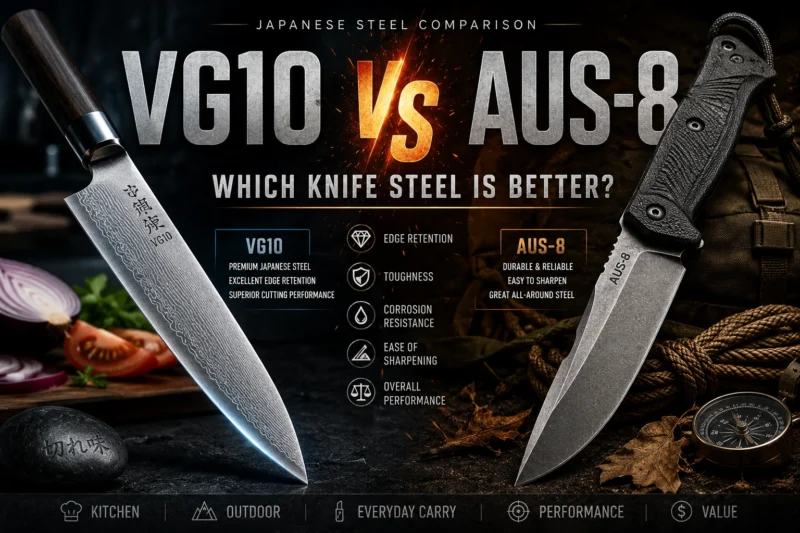
VG10 vs AUS-8 Steel
An Independent Guide
If you’ve been shopping for a quality kitchen knife, folding knife, or outdoor blade, you’ve almost certainly come across VG10 and AUS-8. Both are Japanese stainless steels that have earned strong reputations for reliability, corrosion resistance, and balanced performance. However, despite sharing a common origin, these steels serve different purposes and appeal to different users.
VG10 has become one of the world’s most respected premium kitchen knife steels. It is found in many professional Japanese chef knives thanks to its excellent edge retention, high hardness, and impressive corrosion resistance.
AUS-8, on the other hand, has been a favorite for decades among manufacturers of folding knives, hunting knives, and affordable kitchen knives. It offers outstanding toughness, easy sharpening, and dependable everyday performance without requiring premium pricing.
So which steel should you choose?
The answer depends on how you use your knife.
If maximum sharpness and longer edge retention matter most, VG10 has clear advantages. If you value durability, ease of maintenance, and affordability, AUS-8 remains one of the best budget stainless steels available.
This guide compares every important characteristic, including:
- Chemical composition
- Hardness
- Edge retention
- Toughness
- Corrosion resistance
- Ease of sharpening
- Wear resistance
- Kitchen performance
- Outdoor performance
- Maintenance
- Price and value
- Which users should choose each steel
By the end of this comparison, you’ll know exactly which steel better suits your needs.
Quick Comparison Table VG10 vs AUS-8 Steel
| Feature | VG10 | AUS-8 |
|---|---|---|
| Steel Type | Premium stainless | Mid-range stainless |
| Origin | Japan | Japan |
| Carbon | ~1.0% | ~0.75% |
| Chromium | ~15% | ~14% |
| Typical Hardness | 60–62 HRC | 57–59 HRC |
| Edge Retention | Excellent | Good |
| Toughness | Good | Very Good |
| Corrosion Resistance | Excellent | Excellent |
| Ease of Sharpening | Moderate | Easy |
| Wear Resistance | High | Moderate |
| Price | Higher | Affordable |
| Best Use | Premium kitchen knives | Everyday carry, outdoor, budget kitchen knives |
What Is VG10 Steel?
VG10 is a premium Japanese stainless steel developed by Takefu Special Steel specifically for high-performance cutting tools. Since its introduction, it has become one of the most recognizable steels used in premium Japanese kitchen knives.
Unlike many conventional stainless steels, VG10 contains a carefully balanced combination of:
- High carbon
- Chromium
- Vanadium
- Molybdenum
- Cobalt
Each alloying element contributes to a different aspect of performance. Carbon allows VG10 to achieve high hardness. Chromium provides excellent corrosion resistance. Vanadium forms hard carbides that improve wear resistance and edge stability. Molybdenum increases strength and helps resist corrosion, while cobalt enhances heat treatment response and supports higher hardness.
The result is a steel capable of taking an exceptionally fine edge while maintaining excellent durability in kitchen environments.
Many professional chefs appreciate VG10 because it combines:
- Fine cutting performance
- Long edge retention
- Stainless convenience
- Excellent polish
- Attractive Damascus laminations
Today, VG10 is widely used in premium chef knives, Santoku knives, Nakiri knives, utility knives, and high-end pocket knives.
Check Our Guide VG10 Steel Review
What Is AUS-8 Steel?
AUS-8 is another Japanese stainless steel, produced by Aichi Steel, designed to offer an excellent balance of performance, durability, and affordability.
Unlike VG10, AUS-8 prioritizes toughness and ease of sharpening over maximum hardness.
Its lower carbon content allows manufacturers to heat treat the steel into a range that provides:
- Better impact resistance
- Reduced brittleness
- Easier maintenance
- Faster sharpening
- Lower production costs
For decades, AUS-8 has been a favorite choice for:
- Folding knives
- Hunting knives
- Utility knives
- Survival knives
- Budget-friendly kitchen knives
Many respected knife manufacturers have relied on AUS-8 because it consistently delivers dependable performance without dramatically increasing production costs.
While it cannot match VG10’s wear resistance, AUS-8 often performs better in demanding environments where the blade may experience twisting, impacts, or accidental abuse.
Check Our Guide AUS-8 Steel Review
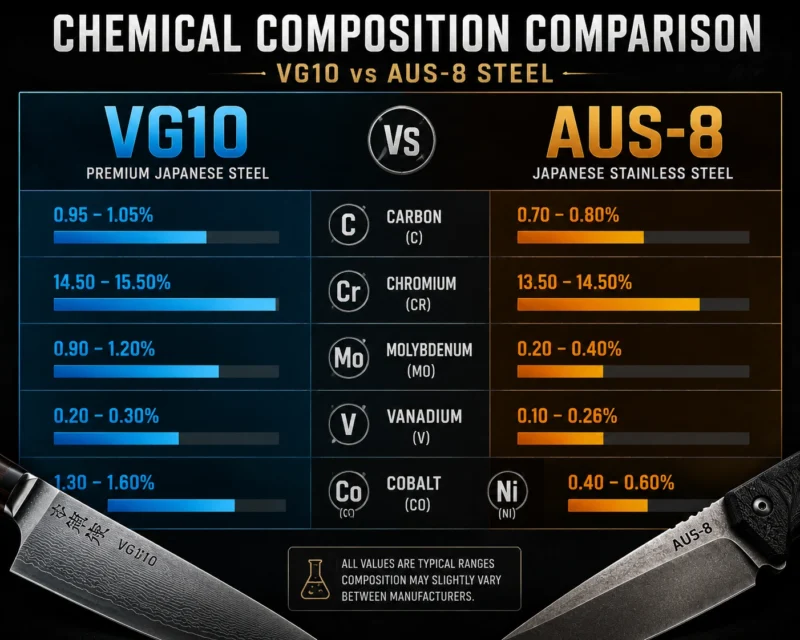
VG10 vs AUS-8 Steel Chemical Composition Comparison
Although both steels are stainless, their alloy compositions reveal why they perform differently.
| Element | VG10 | AUS-8 | Purpose |
|---|---|---|---|
| Carbon | ~1.0% | ~0.75% | Hardness and edge retention |
| Chromium | ~15% | ~14% | Corrosion resistance |
| Molybdenum | ~1.0% | ~0.3% | Strength and corrosion resistance |
| Vanadium | ~0.25% | ~0.25% | Grain refinement and wear resistance |
| Cobalt | ~1.5% | — | Improves hardness during heat treatment |
| Nickel | — | ~0.5% | Toughness and corrosion resistance |
| Manganese | ~0.5% | ~0.5% | Hardenability |
| Silicon | ~0.6% | ~1.0% | Strength and manufacturing |
At first glance, the compositions appear similar, but several important differences significantly affect real-world performance.
Why Higher Carbon Matters
One of the biggest distinctions is carbon content.
VG10 contains approximately 1.0% carbon, while AUS-8 typically contains around 0.75%.
Higher carbon enables:
- Higher hardness
- Better edge retention
- Improved wear resistance
- Finer cutting edges
However, increasing carbon also makes steel less forgiving if heat treatment is not properly controlled.
This is one reason premium manufacturers invest significant effort into optimizing VG10 heat treatment.
The Importance of Chromium
Both steels contain enough chromium to qualify as stainless steels.
VG10’s approximately 15% chromium provides excellent protection against:
- Kitchen acids
- Fruit juices
- Humidity
- Food preparation
- Everyday washing
AUS-8 contains about 14% chromium, which is also excellent.
For normal users, both steels resist rust extremely well when cleaned and dried after use.
In practical terms, corrosion resistance is one area where both steels perform exceptionally well.
Why Cobalt Gives VG10 an Advantage
One of VG10’s defining characteristics is its cobalt content.
Cobalt helps steel achieve:
- Higher hardness
- Better temper stability
- More consistent heat treatment
- Improved edge stability
This allows many manufacturers to harden VG10 into the 60–62 HRC range while maintaining excellent cutting performance.
AUS-8 does not contain cobalt, limiting its achievable hardness without sacrificing toughness.
Vanadium and Carbide Formation
Both steels contain vanadium, but its role differs depending on the overall alloy.
Vanadium forms extremely hard carbides that improve:
- Wear resistance
- Edge stability
- Grain refinement
- Sharpening consistency
In VG10, vanadium works alongside higher carbon and cobalt to create a harder, longer-lasting cutting edge.
In AUS-8, vanadium still improves grain structure but contributes less to overall wear resistance because of the steel’s lower hardness and carbon content.
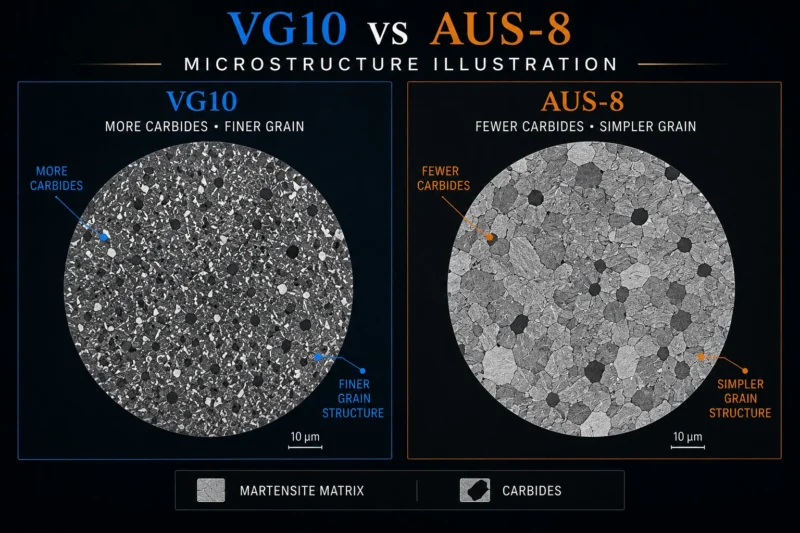
Microstructure Differences
Perhaps the most important difference between these steels lies in their microstructure.
A properly heat-treated VG10 blade develops a fine martensitic structure with evenly distributed chromium and vanadium carbides. This fine carbide distribution allows the blade to achieve excellent sharpness while maintaining good wear resistance and corrosion protection.
AUS-8 also develops a fine-grained martensitic structure, but with fewer hard carbides due to its lower carbon and alloy content. As a result, it sacrifices some edge retention in exchange for increased toughness and easier sharpening.
This difference in carbide volume explains why VG10 typically stays sharp longer, while AUS-8 is quicker to restore once it becomes dull.
VG10 vs AUS-8 Steel Hardness Comparison
Hardness is one of the most influential characteristics of any knife steel because it directly affects edge retention, cutting performance, and durability. It is commonly measured using the Rockwell Hardness Scale (HRC).
Although VG10 and AUS-8 are both Japanese stainless steels, they are typically heat-treated to different hardness levels, giving each steel its own strengths.
| Steel | Typical Hardness |
|---|---|
| VG10 | 60–62 HRC |
| AUS-8 | 57–59 HRC |
At first glance, a difference of two or three HRC points may seem minor. In reality, it has a significant impact on how the knife performs.
VG10’s higher hardness allows it to maintain a finer edge for much longer before dulling. This is especially valuable in precision cutting tasks where consistent sharpness is essential.
AUS-8, with its slightly lower hardness, sacrifices some edge retention in exchange for greater toughness and resilience. Rather than chipping under stress, the edge is more likely to roll slightly, which is generally easier to correct with sharpening.
Why Heat Treatment Matters More Than Steel Alone
Steel composition is only part of the equation. Heat treatment has an enormous influence on final performance.
A premium VG10 knife from a reputable Japanese maker often outperforms a poorly heat-treated VG10 blade by a wide margin. Likewise, a well-treated AUS-8 knife can outperform many cheaper stainless steels despite its modest alloy composition.
Manufacturers adjust heat treatment based on the intended use:
- Kitchen knives: Higher hardness for better slicing.
- Outdoor knives: Slightly lower hardness for increased toughness.
- Folding knives: Balanced hardness for everyday use.
For this reason, always consider the manufacturer’s reputation in addition to the steel type.
Check Our Guide Steel Heat Treatment Explained
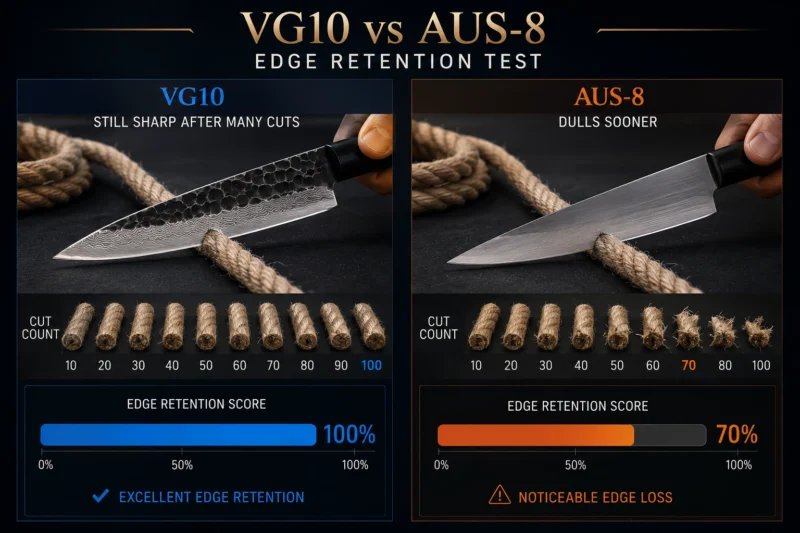
Edge Retention
One of the most common questions buyers ask is:
Which steel stays sharp longer?
In this category, VG10 is the clear winner.
The combination of higher carbon content, increased hardness, cobalt, molybdenum, and vanadium allows VG10 to resist wear far better than AUS-8.
Typical Edge Retention
| Steel | Edge Retention |
|---|---|
| VG10 | Excellent |
| AUS-8 | Good |
Why VG10 Holds an Edge Longer
VG10 benefits from:
- Higher carbon content
- Higher hardness
- More wear-resistant carbides
- Better edge stability
- Improved resistance to abrasive wear
As a result, VG10 can continue making clean cuts long after AUS-8 begins to lose its shaving sharpness.
Professional chefs appreciate this because they can prepare large amounts of food before needing to hone or sharpen the knife.
AUS-8 in Daily Use
AUS-8 dulls faster, but not dramatically faster for average users.
For people who:
- Cook a few meals per week
- Carry an everyday pocket knife
- Go camping occasionally
the difference may not be immediately noticeable.
Many users actually prefer sharpening a knife more often if sharpening is quick and simple.
Wear Resistance
Wear resistance measures how well steel resists gradual abrasion during cutting.
This characteristic becomes important when repeatedly cutting abrasive materials such as:
- Cardboard
- Rope
- Dense vegetables
- Fibrous meat
- Hard cheeses
- Plastic packaging
Wear Resistance Comparison
| Steel | Wear Resistance |
|---|---|
| VG10 | High |
| AUS-8 | Moderate |
VG10’s harder carbides significantly slow edge wear.
This makes it ideal for users who expect long intervals between sharpening sessions.
AUS-8 experiences faster edge wear but compensates with easier maintenance.
Toughness
Toughness refers to a blade’s ability to absorb impacts and resist chipping or breaking.
Contrary to popular belief, the hardest steel is not always the strongest.
Higher hardness often reduces toughness.
Toughness Comparison
| Steel | Toughness |
|---|---|
| VG10 | Good |
| AUS-8 | Very Good |
AUS-8 performs exceptionally well in this category.
Its lower hardness allows the blade to flex slightly under stress rather than chip.
This makes AUS-8 particularly suitable for:
- Hunting knives
- Survival knives
- Camp knives
- Utility knives
- Everyday carry folders
VG10 is still reasonably tough, but it is designed primarily as a high-performance cutting steel rather than a heavy-duty impact steel.
Edge Stability
Edge stability describes how well a very thin edge survives real-world use.
VG10 performs remarkably well thanks to:
- Fine grain structure
- Stable carbides
- Excellent heat treatment response
This allows manufacturers to grind the blade extremely thin without sacrificing cutting performance.
Japanese chef knives made from VG10 often feature exceptionally thin geometries that glide effortlessly through food.
AUS-8 also takes a fine edge, but manufacturers usually grind it slightly thicker because it is intended for more versatile applications.
Corrosion Resistance
Both steels are considered excellent stainless steels.
For normal kitchen use, either steel offers more than enough rust resistance when properly maintained.
Corrosion Resistance Comparison
| Steel | Corrosion Resistance |
|---|---|
| VG10 | Excellent |
| AUS-8 | Excellent |
Both steels resist:
- Moisture
- Kitchen acids
- Fruit juices
- Vegetables
- Humidity
VG10’s slightly higher chromium and molybdenum content provides a small advantage, especially in demanding environments.
However, in everyday use, most owners will notice very little practical difference.
VG10 vs AUS-8 Steel Food Acids and Kitchen Performance
Kitchen knives encounter many acidic ingredients:
- Tomatoes
- Citrus fruits
- Onions
- Vinegar
- Apples
- Wine-based sauces
Fortunately, both VG10 and AUS-8 handle these environments extremely well.
Neither steel requires the constant drying and oiling associated with high-carbon non-stainless steels.
For home cooks, maintenance is straightforward:
- Wash after use
- Dry thoroughly
- Avoid prolonged soaking
- Store in a dry location
Following these simple steps will keep either steel in excellent condition for many years.
Check Our Guide Carbon Steel vs Damascus Steel
VG10 vs AUS-8 Steel Ease of Sharpening
Sharpening is one area where AUS-8 shines.
Sharpening Comparison
| Steel | Sharpening Difficulty |
|---|---|
| VG10 | Moderate |
| AUS-8 | Easy |
VG10’s harder carbides require:
- Better sharpening stones
- More patience
- More precise technique
It rewards the effort with an exceptionally refined and long-lasting edge.
AUS-8 sharpens quickly, even with basic whetstones or compact field sharpeners.
For beginners learning freehand sharpening, AUS-8 is one of the most forgiving stainless steels available.
Burr Formation
During sharpening, a burr forms as metal folds over the edge.
AUS-8 develops a burr rapidly and removes it easily, making sharpening straightforward even for inexperienced users.
VG10 may take longer to raise a burr, and careful deburring is essential to achieve its full cutting potential.
Once properly sharpened, however, VG10 can reach an impressively keen edge that excels at precise slicing.
Edge Refinement
Both steels are capable of becoming very sharp.
VG10, thanks to its fine grain structure and higher hardness, can generally achieve a more refined and polished edge. This makes it particularly well-suited for precision kitchen tasks such as slicing fish, trimming herbs, or making thin vegetable cuts.
AUS-8 also sharpens to a keen edge, but its lower hardness means that ultra-fine edges tend to lose their peak sharpness more quickly. For everyday utility work, however, this difference is rarely a disadvantage.
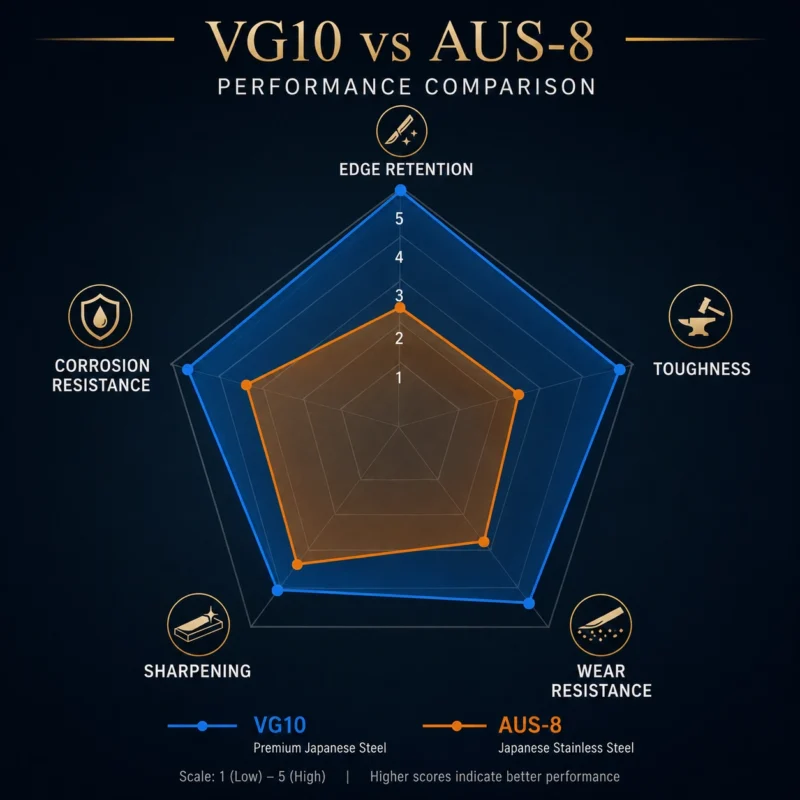
VG10 vs AUS-8 Steel Performance Ratings
| Property | VG10 | AUS-8 |
|---|---|---|
| Edge Retention | ⭐⭐⭐⭐⭐ | ⭐⭐⭐☆☆ |
| Toughness | ⭐⭐⭐⭐☆ | ⭐⭐⭐⭐⭐ |
| Corrosion Resistance | ⭐⭐⭐⭐⭐ | ⭐⭐⭐⭐⭐ |
| Wear Resistance | ⭐⭐⭐⭐⭐ | ⭐⭐⭐☆☆ |
| Ease of Sharpening | ⭐⭐⭐☆☆ | ⭐⭐⭐⭐⭐ |
| Fine Edge Capability | ⭐⭐⭐⭐⭐ | ⭐⭐⭐⭐☆ |
| Maintenance | ⭐⭐⭐⭐☆ | ⭐⭐⭐⭐⭐ |
| Overall Kitchen Performance | ⭐⭐⭐⭐⭐ | ⭐⭐⭐⭐☆ |
Which Steel Wins These Categories?
After comparing the core performance characteristics, here’s a quick summary:
VG10 excels in:
- Longer edge retention
- Higher hardness
- Better wear resistance
- Finer cutting performance
- Superior edge refinement
- Premium kitchen applications
AUS-8 excels in:
- Greater toughness
- Easier sharpening
- Better resistance to edge damage from impacts
- Lower maintenance effort during sharpening
- Better value for budget-conscious buyers
Both steels offer excellent corrosion resistance, making them dependable choices for everyday kitchen and outdoor use.
VG10 vs AUS-8 Steel Real-World Cutting Performance
Laboratory specifications and chemical compositions are useful, but they only tell part of the story. The true value of a knife steel becomes apparent when it is used daily in the kitchen, outdoors, or on the job.
VG10 and AUS-8 are both proven performers, yet they excel in different environments.
VG10 is designed to maximize cutting efficiency and maintain a razor-sharp edge for extended periods. AUS-8 focuses on reliability, durability, and ease of maintenance.
The better choice depends less on which steel is “stronger” and more on how you intend to use your knife.
VG10 in the Kitchen
VG10 has become one of the most popular premium kitchen knife steels in the world, especially among Japanese manufacturers.
Its combination of high hardness, fine grain structure, and excellent corrosion resistance makes it ideal for precision food preparation.
VG10 performs exceptionally well when slicing:
- Tomatoes
- Onions
- Herbs
- Fish
- Boneless meat
- Fruits
- Soft vegetables
The blade glides through food with minimal resistance, producing clean cuts rather than crushing ingredients. This helps preserve texture and presentation—qualities highly valued by professional chefs.
Because VG10 holds its edge so well, cooks can prepare large quantities of food before sharpening becomes necessary.
Best Kitchen Tasks for VG10
- Fine vegetable slicing
- Sushi preparation
- Sashimi
- Push cutting
- Precision chopping
- Dicing onions
- Julienning vegetables
- Carving cooked meats
If your primary goal is maximum cutting performance in the kitchen, VG10 is clearly the superior option.
AUS-8 in the Kitchen
Although AUS-8 is often associated with folding knives and outdoor tools, it also performs well in the kitchen.
Its advantages include:
- Easy maintenance
- Good corrosion resistance
- Fast sharpening
- Affordable pricing
Many home cooks appreciate AUS-8 because it is forgiving.
If the edge becomes dull after several meals, restoring sharpness takes only a few minutes.
This makes AUS-8 an excellent choice for:
- Family kitchens
- Student apartments
- Vacation homes
- Backup kitchen knives
- General food preparation
While it doesn’t maintain peak sharpness as long as VG10, many users find the difference insignificant for everyday cooking.
VG10 vs AUS-8 Steel Outdoor Performance
Outdoor knives face very different challenges than kitchen knives.
Instead of slicing vegetables all day, they may encounter:
- Rope
- Wood
- Plastic
- Leather
- Cardboard
- Game processing
- Camp chores
These tasks place greater stress on the edge.
Here, toughness becomes more important than maximum hardness.
Why AUS-8 Excels Outdoors
AUS-8 offers:
- Better impact resistance
- Less chance of chipping
- Easier field sharpening
- Reliable performance under rough use
If you accidentally strike a staple, bone, or small rock while camping, AUS-8 is generally more forgiving than VG10.
Many experienced outdoorsmen intentionally choose slightly softer steels because they are easier to maintain far from home.
VG10 vs AUS-8 Steel Hunting Knife Performance
Hunters often need a knife capable of processing an entire animal without becoming excessively dull.
Both steels perform well, but each has different strengths.
VG10
Advantages:
- Longer edge retention
- Cleaner slicing
- Excellent skinning performance
- Less frequent sharpening
Potential drawback:
- Higher hardness can make edge chips more likely if the blade is twisted against bone.
AUS-8
Advantages:
- Excellent toughness
- Better resistance to accidental impacts
- Easier touch-ups in the field
- Lower replacement cost
For hunters who carry a compact sharpening stone, AUS-8 remains an excellent practical choice.
Check Our Guide Best Hunting Knife Features Explained
VG10 vs AUS-8 Steel Everyday Carry (EDC)
Pocket knives experience a wide variety of cutting tasks.
One day they open packages.
The next day they cut rope, zip ties, cardboard, or plastic.
Sometimes they are used in ways they were never intended.
VG10 for EDC
VG10 offers:
- Excellent edge retention
- Premium cutting performance
- Attractive polished finish
- Long intervals between sharpening
However, some users prefer not to expose a premium steel to rough utility work.
AUS-8 for EDC
AUS-8 has been one of the most popular folding knife steels for decades because it offers an outstanding balance of qualities:
- Tough
- Reliable
- Easy to sharpen
- Affordable
- Stainless
- Durable
For everyday pocket knives, AUS-8 remains one of the most practical choices available.
Blade Geometry Matters More Than Steel Alone
One mistake many buyers make is assuming steel alone determines cutting performance.
In reality, blade geometry often has an even greater impact.
A thin VG10 blade will naturally cut better than a thick VG10 blade.
Likewise, a well-designed AUS-8 knife with a thin grind may outperform a poorly ground VG10 knife in slicing tasks.
Important factors include:
- Blade thickness
- Grind type
- Edge angle
- Blade height
- Primary bevel geometry
- Thickness behind the edge
This is why two knives made from the same steel can feel completely different during use.
Check Our Guide Blade Geometry Explained
VG10 vs AUS-8 Steel Heat Treatment Differences
Heat treatment is arguably the single most important step in knife manufacturing.
Even the best steel performs poorly if heat treated incorrectly.
VG10 Heat Treatment
Premium manufacturers typically harden VG10 to:
60–62 HRC
Benefits include:
- Excellent edge retention
- Fine cutting performance
- Stable edge
- High wear resistance
Because VG10 responds well to precise heat treatment, reputable Japanese makers can produce blades with remarkable consistency.
AUS-8 Heat Treatment
Most manufacturers harden AUS-8 to:
57–59 HRC
This range intentionally favors:
- Toughness
- Flexibility
- Ease of sharpening
- Resistance to chipping
Some companies choose slightly different hardness levels depending on whether the knife is intended for kitchen, hunting, or tactical use.
Maintenance Requirements
Fortunately, both steels are stainless and require relatively little maintenance compared with high-carbon steels.
To maximize blade life:
- Wash after each use.
- Dry thoroughly before storage.
- Avoid prolonged soaking in water.
- Do not place quality knives in the dishwasher.
- Use a wooden or plastic cutting board.
- Hone kitchen knives regularly.
- Sharpen before the edge becomes excessively dull.
These simple habits help preserve edge performance and prevent unnecessary wear.
Price Comparison
Price is another major difference between VG10 and AUS-8.
VG10
Typically found in:
- Premium Japanese chef knives
- Damascus kitchen knives
- High-end folding knives
Because of its alloy composition and more demanding heat treatment, VG10 usually commands a higher price.
AUS-8
Often appears in:
- Budget-friendly folding knives
- Outdoor knives
- Utility knives
- Entry-level kitchen knives
Its lower manufacturing cost makes it one of the best values in stainless knife steels.
VG10 vs AUS-8 Steel Value for Money
Choosing the better value depends on your priorities.
Choose VG10 if you want:
- Longer edge retention
- Premium kitchen performance
- Higher hardness
- Better slicing ability
- Fewer sharpening sessions
Choose AUS-8 if you want:
- Lower purchase price
- Easy sharpening
- Toughness
- Reliable everyday performance
- Excellent value
Both steels provide excellent performance for their intended applications, making them worthwhile choices at their respective price points.
Which Steel Is Better for Beginners?
If you are purchasing your first quality knife, AUS-8 is often the more forgiving option.
Reasons include:
- Easier to sharpen
- Lower replacement cost
- Tougher edge
- Less intimidating maintenance
- Excellent all-around performance
AUS-8 allows beginners to develop sharpening skills without worrying as much about damaging an expensive blade.
Which Steel Is Better for Professional Chefs?
Professional chefs typically prioritize:
- Long-lasting sharpness
- Fine cutting ability
- Precision
- Consistent performance
For these reasons, VG10 is generally the preferred choice.
Its ability to hold a razor-sharp edge through long prep sessions reduces downtime and delivers cleaner, more precise cuts.
Many premium Japanese chef knives feature VG10 cores clad with softer stainless steel, combining excellent cutting performance with added durability and corrosion resistance.
Check Our Guide How to Choose a Custom Knife Maker
VG10 vs AUS-8 Steel: Best Uses at a Glance
| Application | Winner | Why |
|---|---|---|
| Professional kitchen | VG10 | Superior edge retention and fine cutting performance |
| Home kitchen | VG10 | Longer-lasting sharpness with excellent corrosion resistance |
| Budget kitchen knives | AUS-8 | Lower cost and easy maintenance |
| Everyday carry (EDC) | AUS-8 | Tough, reliable, and quick to sharpen |
| Camping | AUS-8 | Better impact resistance and field serviceability |
| Hunting | AUS-8 | Toughness and easy touch-ups outdoors |
| Food prep and slicing | VG10 | Cleaner cuts and higher wear resistance |
| Value for money | AUS-8 | Excellent overall performance at an affordable price |
VG10 Pros and Cons
Like any knife steel, VG10 has strengths and limitations. Understanding both sides helps determine whether it fits your cutting style and maintenance preferences.
Pros
✓ Excellent edge retention
VG10 stays sharp considerably longer than AUS-8 and many other mid-range stainless steels. For cooks who prepare meals daily, this means fewer sharpening sessions and more consistent performance.
✓ High hardness
Typically hardened to 60–62 HRC, VG10 supports very thin, precise edges that excel at slicing.
✓ Outstanding corrosion resistance
With approximately 15% chromium and added molybdenum, VG10 resists staining and rust exceptionally well when cared for properly.
✓ Fine grain structure
VG10 can take an extremely refined edge, making it ideal for precision kitchen work such as slicing fish, vegetables, and boneless meats.
✓ Premium appearance
Many manufacturers use VG10 as the core steel in Damascus-clad knives, giving blades an attractive layered finish while retaining excellent cutting performance.
Cons
✗ More difficult to sharpen
Compared to AUS-8, VG10 requires more time and better sharpening technique.
✗ Higher cost
Premium heat treatment and alloy composition make VG10 knives noticeably more expensive.
✗ Less forgiving under abuse
Although VG10 has good toughness, it is not intended for heavy prying, chopping through bone, or impact-heavy tasks.
AUS-8 Pros and Cons
AUS-8 has remained popular for decades because it offers an excellent balance of performance and affordability.
Pros
✓ Easy to sharpen
One of AUS-8’s biggest advantages is how quickly it can be restored to a sharp edge.
✓ Excellent toughness
Its moderate hardness makes it resistant to chipping and ideal for everyday use.
✓ Outstanding value
AUS-8 provides dependable performance at a much lower price than premium steels.
✓ Very good corrosion resistance
The steel handles kitchen moisture, humidity, and outdoor conditions with ease.
✓ Versatile
AUS-8 performs well in kitchen knives, hunting knives, pocket knives, and utility blades.
Cons
✗ Lower edge retention
It loses peak sharpness faster than VG10.
✗ Moderate wear resistance
Frequent cutting of abrasive materials results in faster edge wear.
✗ Lower maximum hardness
AUS-8 cannot achieve the same level of edge stability as VG10.
VG10 vs AUS-8 Steel: Side-by-Side Summary
| Category | Winner |
|---|---|
| Edge Retention | VG10 |
| Hardness | VG10 |
| Wear Resistance | VG10 |
| Fine Edge Capability | VG10 |
| Corrosion Resistance | Tie |
| Toughness | AUS-8 |
| Ease of Sharpening | AUS-8 |
| Outdoor Performance | AUS-8 |
| Value for Money | AUS-8 |
| Premium Kitchen Performance | VG10 |
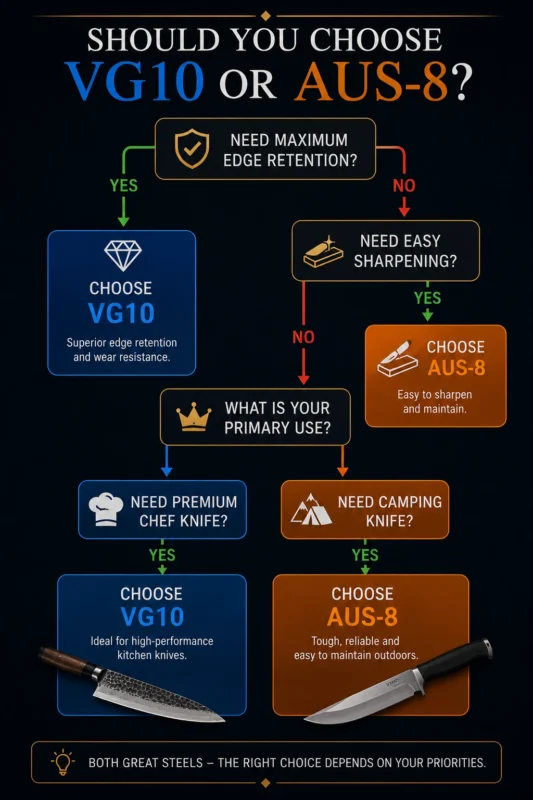
Frequently Asked Questions
Is VG10 better than AUS-8?
For most kitchen applications, yes. VG10 offers higher hardness, longer edge retention, and superior wear resistance. However, AUS-8 is tougher, easier to sharpen, and often a better choice for everyday carry or outdoor knives.
Does VG10 rust?
VG10 is a stainless steel with excellent corrosion resistance. While no steel is completely immune to corrosion, normal washing, drying, and storage are usually sufficient to prevent rust.
Is AUS-8 a good knife steel?
Absolutely. Although it has been available for many years, AUS-8 remains one of the best budget-friendly stainless steels. Its combination of toughness, corrosion resistance, and easy sharpening makes it a dependable choice for everyday users.
Which steel stays sharp longer?
VG10 holds its edge significantly longer because of its higher hardness and greater wear resistance.
Which steel is easier to sharpen?
AUS-8 is noticeably easier to sharpen. Even beginners can achieve excellent results using basic whetstones or guided sharpening systems.
Which steel is better for chefs?
Professional chefs generally prefer VG10 because it delivers longer-lasting sharpness and excellent cutting precision during extended food preparation.
Which steel is better for camping?
For camping, hiking, and survival tasks, AUS-8 is often the better choice due to its higher toughness and ease of field sharpening.
Is VG10 worth the extra money?
If you value edge retention, precise cutting, and premium kitchen performance, the higher cost of VG10 is usually justified. If your priorities are affordability and easy maintenance, AUS-8 offers excellent value.
Common Myths
Myth 1: Harder steel is always better.
Reality: Hardness improves edge retention, but excessive hardness can reduce toughness. A well-balanced steel is often more practical than the hardest available.
Myth 2: AUS-8 is outdated.
Reality: While newer steels such as CPM MagnaCut, CPM S35VN, and CPM S45VN offer higher performance, AUS-8 remains popular because it is reliable, affordable, and easy to maintain.
Myth 3: VG10 never chips.
Reality: VG10 has good toughness, but like any harder steel, it can chip if used improperly—for example, by twisting the blade, striking bone, or prying.
Myth 4: Steel is the only factor that matters.
Reality: Knife performance also depends on:
- Heat treatment
- Blade geometry
- Grind type
- Thickness behind the edge
- Edge angle
- Manufacturing quality
A well-designed AUS-8 knife can outperform a poorly made VG10 knife in many real-world tasks.
Who Should Choose VG10?
VG10 is an excellent choice for:
- Professional chefs
- Serious home cooks
- Japanese knife enthusiasts
- Users who value long edge retention
- Those willing to spend more for premium performance
If your knife is primarily used for food preparation and precision slicing, VG10 is one of the best stainless steels in its class.
Who Should Choose AUS-8?
AUS-8 is ideal for:
- Beginners
- Everyday carry (EDC) users
- Campers and hikers
- Hunters
- Budget-conscious buyers
- Anyone who sharpens their own knives regularly
Its forgiving nature and excellent value make it a practical steel for a wide range of applications.
| Category | Winner |
|---|---|
| Edge Retention | 🏆 VG10 |
| Toughness | 🏆 AUS-8 |
| Sharpening | 🏆 AUS-8 |
| Kitchen | 🏆 VG10 |
| Outdoor | 🏆 AUS-8 |
| Value | 🏆 AUS-8 |
Final Verdict: VG10 vs AUS-8 Steel
Both VG10 and AUS-8 have earned their reputations as dependable Japanese stainless steels, but they are designed with different priorities in mind.
VG10 is the better choice if your focus is maximum cutting performance. Its higher hardness, superior wear resistance, and longer edge retention make it ideal for premium kitchen knives and precision slicing. Although it costs more and requires a bit more effort to sharpen, many users find the improved performance well worth the investment.
AUS-8, by contrast, emphasizes versatility and practicality. It may not hold an edge as long as VG10, but it offers excellent toughness, easy sharpening, dependable corrosion resistance, and an affordable price. These qualities have kept it popular in folding knives, hunting knives, and everyday utility blades for decades.
Rather than asking which steel is universally better, the more useful question is which steel best matches your needs.
Choose VG10 if you want:
- Long-lasting sharpness
- Excellent slicing performance
- A premium kitchen knife
- Superior wear resistance
Choose AUS-8 if you want:
- A durable all-purpose knife
- Easy sharpening
- Better toughness
- Outstanding value for money
Both steels can provide years of reliable service when paired with good heat treatment, quality craftsmanship, and proper maintenance. Ultimately, the best knife is the one that suits your tasks, your budget, and your sharpening habits.
VG10 vs AUS-8 Steel Key Takeaways
- VG10 offers better edge retention, higher hardness, and superior wear resistance.
- AUS-8 is tougher, easier to sharpen, and typically more affordable.
- Both steels provide excellent corrosion resistance for kitchen and outdoor use.
- Heat treatment and blade geometry are just as important as the steel itself.
- Choose VG10 for premium kitchen performance and AUS-8 for dependable everyday versatility.
This article is for independent informational purposes only and is not affiliated with, sponsored by, or endorsed by any steel manufacturer. All product names, trademarks, and registered trademarks are the property of their respective owners.
VG10 vs AUS-8 Steel