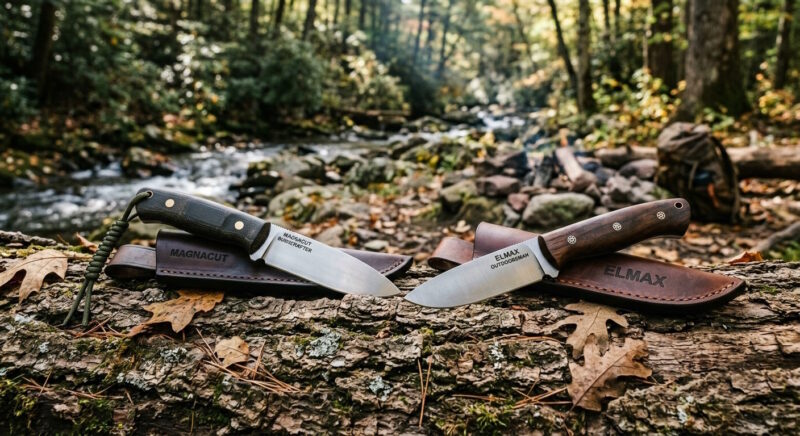
MagnaCut vs Elmax Steel Comparison
An Independent Guide
Introduction
If you’re shopping for a premium knife, chances are you’ve encountered two highly respected names: CPM MagnaCut and Elmax. Both are powder metallurgy stainless steels known for outstanding performance, excellent corrosion resistance, and premium cutting ability. They are used in high-end folding knives, hunting knives, fixed blades, and custom knives from some of the world’s most respected manufacturers.
At first glance, these steels appear very similar. Both offer excellent edge retention, both are stainless, and both have earned reputations for being among the best all-around knife steels available. However, when you take a closer look at their metallurgy and real-world performance, important differences begin to emerge.
MagnaCut is one of the newest premium knife steels on the market. It was designed using advanced computational metallurgy to solve the traditional compromises between toughness, corrosion resistance, and edge retention.
Elmax has been a favorite among knife makers for many years. Often described as a “stainless D2,” Elmax combines excellent wear resistance, good toughness, and strong corrosion resistance into a balanced steel that performs exceptionally well in both folding and fixed-blade knives.
So which steel is better?
The answer depends on how you use your knife. Whether you’re looking for the ultimate everyday carry (EDC) folder, a dependable hunting knife, or a hard-use outdoor blade, understanding the strengths and weaknesses of each steel will help you make the right choice.
In this comprehensive comparison, we’ll examine MagnaCut and Elmax side by side, covering their chemical composition, hardness, wear resistance, toughness, corrosion resistance, sharpening characteristics, and real-world cutting performance.
Meet the Contenders
What Is MagnaCut?
CPM MagnaCut is a premium stainless powder metallurgy steel introduced in 2021.
Unlike many earlier stainless steels, MagnaCut was designed specifically for knives rather than adapted from industrial tooling applications.
- Exceptional toughness
- Excellent corrosion resistance
- Outstanding edge stability
- High wear resistance
- Easy sharpening compared to traditional super steels
The result is a steel that many knife enthusiasts now consider one of the most balanced stainless steels ever created.
MagnaCut is now offered by leading manufacturers.
Its popularity continues to grow as more manufacturers adopt it across their premium product lines.
Check Our Guide MagnaCut Steel Review
What Is Elmax?
Elmax is a premium stainless powder metallurgy steel.
Originally developed for industrial tooling applications requiring high wear resistance and corrosion resistance, Elmax quickly gained recognition among knife makers because of its excellent balance of properties.
Elmax is frequently described as a “stainless version of D2,” although modern metallurgy gives it much finer carbides and significantly better overall performance.
Today, Elmax is widely used by many manufacturers.
For years, Elmax has been considered one of the finest premium stainless steels available for high-performance knives.
Check Our Guide ELMAX Steel Review
History of Both Steels
Elmax
Elmax predates MagnaCut by many years.
Using third-generation powder metallurgy technology, Elmax quickly became popular because it delivered:
- Better toughness than many high-carbide steels
- Excellent wear resistance
- High corrosion resistance
- Fine edge stability
Before steels like MagnaCut entered the market, Elmax was widely regarded as one of the best all-around stainless knife steels.
MagnaCut
MagnaCut represents a completely different generation of metallurgy.
Rather than modifying an existing industrial steel, MagnaCut was engineered specifically for knife performance using computer-assisted alloy design.
Its objective was ambitious:
Create a stainless steel that performs like a high-toughness carbon steel while maintaining premium corrosion resistance.
Judging by its widespread adoption, MagnaCut has largely achieved that goal.
Powder Metallurgy: Why It Matters
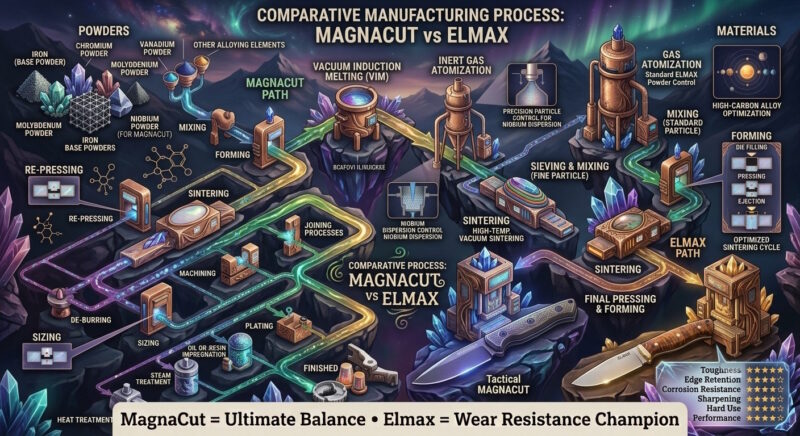
Both MagnaCut and Elmax are manufactured using powder metallurgy (PM), an advanced process that produces steels with a much finer and more uniform carbide structure than conventional ingot steels.
The PM process includes:
- Melting the alloy
- Atomizing the molten steel into microscopic powder particles
- Compressing the powder
- Hot isostatic pressing to create dense steel billets
Benefits include:
- Smaller carbides
- Better toughness
- Improved edge stability
- More consistent heat treatment
- Better polishability
Powder metallurgy is one of the primary reasons both steels outperform traditional stainless steels such as 440C or AUS-8.
Chemical Composition Comparison
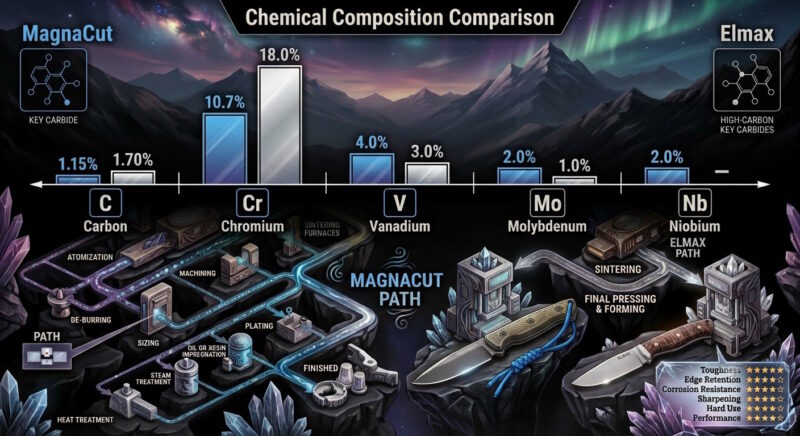
| Element | MagnaCut | Elmax |
|---|---|---|
| Carbon | 1.15% | 1.70% |
| Chromium | 10.70% | 18.00% |
| Vanadium | 4.00% | 3.00% |
| Molybdenum | 2.00% | 1.00% |
| Niobium | 2.00% | — |
| Silicon | 0.20% | 0.80% |
Although Elmax contains significantly more chromium and carbon, MagnaCut’s alloy was intentionally optimized to maximize “free chromium” by reducing the formation of large chromium carbides.
This unique chemistry is one of MagnaCut’s defining advantages.
Understanding the Alloy Elements
Carbon
Elmax contains approximately 1.70% carbon, substantially more than MagnaCut’s 1.15%.
Higher carbon promotes:
- Greater carbide volume
- Higher wear resistance
- Improved edge retention
However, excessive carbide formation can reduce toughness.
MagnaCut intentionally uses less carbon to maintain an exceptional balance between wear resistance and impact strength.
Chromium
At first glance, Elmax appears to dominate with approximately 18% chromium, compared with MagnaCut’s 10.7%.
However, total chromium content can be misleading.
Much of Elmax’s chromium becomes tied up in chromium carbides.
MagnaCut was engineered so that more chromium remains dissolved in the steel matrix, improving corrosion resistance without sacrificing toughness.
Vanadium
Both steels rely heavily on vanadium carbides.
Vanadium contributes:
- Wear resistance
- Fine edge stability
- Abrasion resistance
MagnaCut contains slightly more vanadium, giving it excellent cutting performance despite its lower overall carbide volume.
Niobium
One of MagnaCut’s biggest advantages is the addition of approximately 2% niobium.
Niobium helps:
- Refine grain size
- Improve toughness
- Increase edge stability
- Reduce large carbide formation
Elmax does not contain niobium, making this a notable difference between the two steels.
Hardness (HRC)
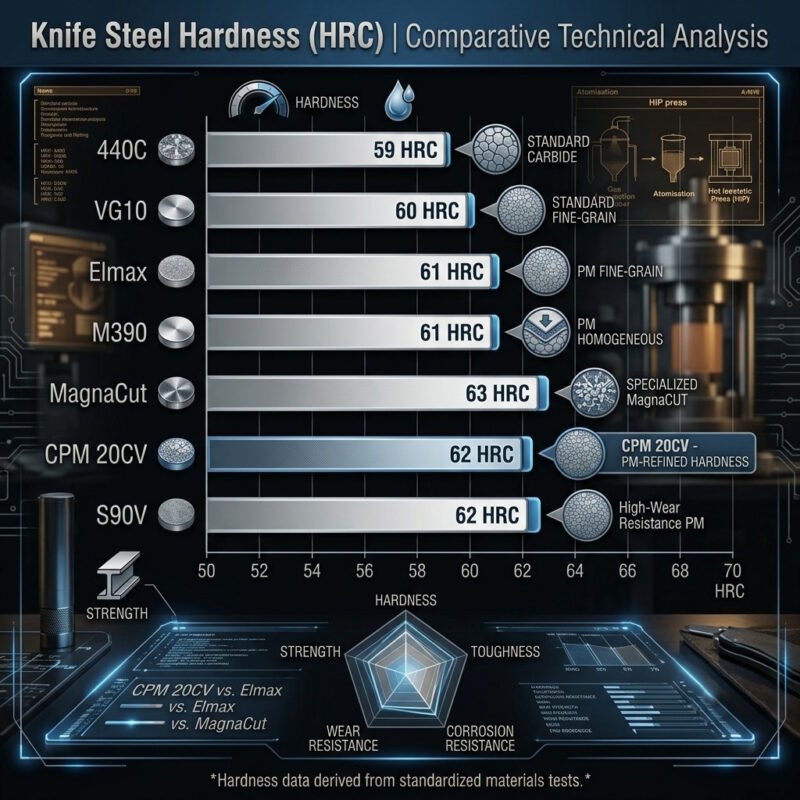
Typical production hardness:
| Steel | Typical HRC |
| Elmax | 60–62 |
| MagnaCut | 61–64 |
Custom makers often push both steels slightly higher, but MagnaCut generally offers more flexibility while maintaining excellent toughness.
Higher hardness can improve:
- Edge retention
- Wear resistance
- Fine cutting performance
However, hardness alone does not determine overall knife performance.
Check Our Guide What Is HRC? Understanding Rockwell Hardness
Edge Retention
Edge Retention Comparison
| Steel | Rating |
|---|---|
| VG10 | ⭐⭐⭐⭐ |
| Elmax | ⭐⭐⭐⭐⭐ |
| MagnaCut | ⭐⭐⭐⭐☆ |
| M390 | ⭐⭐⭐⭐⭐⭐ |
| CPM 20CV | ⭐⭐⭐⭐⭐⭐ |
| S90V | ⭐⭐⭐⭐⭐⭐⭐ |
Edge retention measures how long a knife continues cutting effectively before requiring sharpening.
Elmax
Elmax has long been respected for its excellent edge retention.
Its higher carbide volume provides:
- Excellent abrasion resistance
- Long-lasting slicing performance
- Reliable cutting during prolonged use
It performs especially well when cutting:
- Rope
- Cardboard
- Leather
- Plastic
- Fibrous materials
MagnaCut
MagnaCut also delivers excellent edge retention, although it achieves this differently.
Rather than relying on very large carbide volume, MagnaCut emphasizes:
- Fine carbide distribution
- High edge stability
- Efficient cutting geometry
Many users report that MagnaCut maintains a “working edge” exceptionally well during mixed cutting tasks.
Wear Resistance
Wear resistance refers to how well a steel withstands abrasive materials over time.
Elmax
Because of its higher carbon content and larger carbide volume, Elmax has traditionally been known for outstanding wear resistance.
It performs exceptionally well in long-duration cutting applications where abrasion is the primary source of edge wear.
MagnaCut
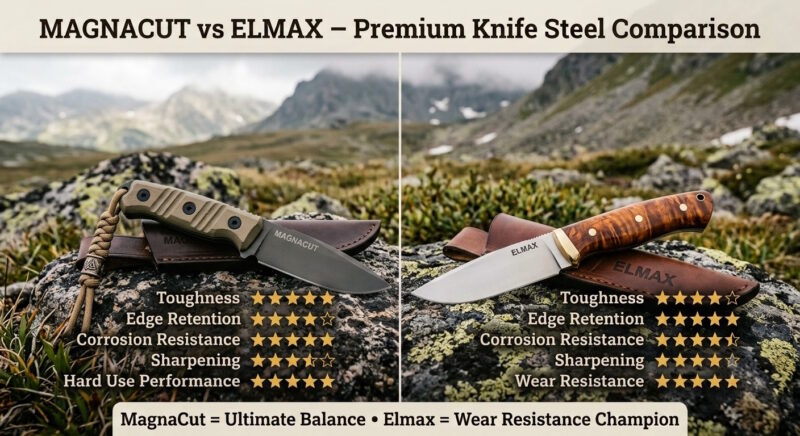
MagnaCut provides excellent wear resistance while maintaining significantly better toughness.
Although laboratory tests may show Elmax with a slight advantage in pure abrasion resistance, the difference during everyday knife use is generally modest.
For most users, cutting technique and heat treatment will influence performance more than the steel choice alone.
Toughness
Toughness Comparison
| Steel | Rating |
|---|---|
| M390 | ⭐⭐⭐⭐ |
| Elmax | ⭐⭐⭐⭐☆ |
| MagnaCut | ⭐⭐⭐⭐⭐ |
| CPM CruWear | ⭐⭐⭐⭐⭐ |
| CPM 3V | ⭐⭐⭐⭐⭐⭐ |
This is one of the most significant differences between these steels.
Toughness measures a blade’s resistance to:
- Chipping
- Cracking
- Breaking
- Impact damage
MagnaCut
MagnaCut ranks among the toughest stainless knife steels ever developed.
Its optimized carbide structure allows it to tolerate heavy impacts while maintaining excellent cutting performance.
Advantages include:
- Superior chip resistance
- Excellent hard-use capability
- Better survival and bushcraft performance
- Outstanding edge stability
Elmax
Elmax offers good toughness for a high-carbide stainless steel.
However, it cannot match MagnaCut under demanding conditions involving impacts or twisting forces.
For normal everyday cutting, Elmax performs extremely well.
For harder outdoor use, MagnaCut holds a clear advantage.
Corrosion Resistance
Corrosion Resistance Comparison
| Steel | Rating |
|---|---|
| D2 | ⭐⭐⭐ |
| Elmax | ⭐⭐⭐⭐☆ |
| M390 | ⭐⭐⭐⭐☆ |
| MagnaCut | ⭐⭐⭐⭐⭐ |
| LC200N | ⭐⭐⭐⭐⭐⭐ |
| Vanax | ⭐⭐⭐⭐⭐⭐ |
Both steels are classified as premium stainless steels.
MagnaCut
MagnaCut demonstrates remarkable corrosion resistance despite containing considerably less chromium than Elmax.
Its optimized chemistry keeps more chromium available to protect the steel against rust.
It performs exceptionally well in:
- Marine environments
- Saltwater exposure
- Humid climates
- Food preparation
Many knife experts now rank MagnaCut among the most corrosion-resistant premium knife steels currently available.
Elmax
Elmax has long been recognized for excellent stainless performance.
It resists:
- Rust
- Staining
- Sweat
- Moisture
- Food acids
with minimal maintenance.
For most users, Elmax provides more than enough corrosion resistance for everyday carry and outdoor use.
Performance Summary So Far
After examining their metallurgy, it becomes clear that both steels belong in the premium category, but they prioritize performance differently.
Elmax focuses on outstanding wear resistance, excellent edge retention, and reliable stainless performance, making it a superb choice for users who value long-lasting cutting efficiency.
MagnaCut takes a more modern approach by balancing wear resistance with dramatically improved toughness and exceptional corrosion resistance. Instead of maximizing a single property, it delivers outstanding performance across nearly every category.
Sharpening: Which Steel Is Easier to Maintain?
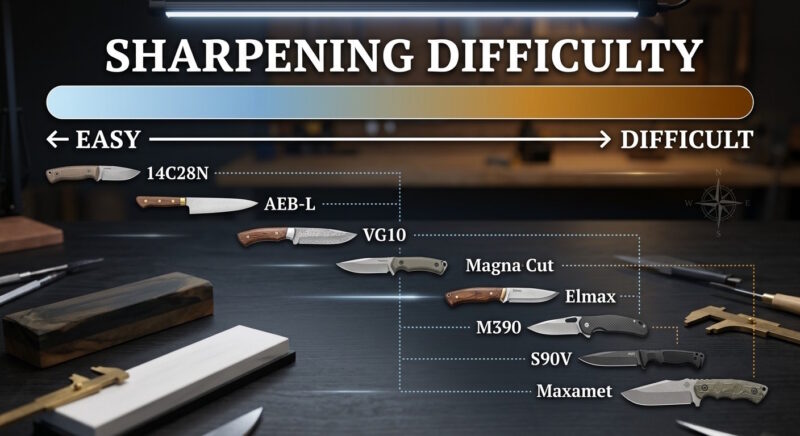
No matter how long a knife stays sharp, every blade eventually requires maintenance. Ease of sharpening is often overlooked when comparing premium steels, yet it has a significant impact on long-term ownership.
Both MagnaCut and Elmax are considerably more wear-resistant than budget stainless steels, but their sharpening characteristics differ slightly.
Sharpening MagnaCut
One of MagnaCut’s greatest achievements is combining excellent edge retention with surprisingly user-friendly sharpening.
Benefits include:
- Forms a clean, consistent burr
- Responds well to diamond stones
- Excellent edge refinement
- Fine grain structure produces razor-sharp edges
- Less stubborn than many high-carbide “super steels”
Although MagnaCut contains hard vanadium and niobium carbides, its optimized carbide distribution makes it easier to sharpen than many steels with similar performance.
Diamond or CBN stones provide the fastest results, but quality ceramic systems also work very well.
Sharpening Elmax
Elmax has earned an excellent reputation among knife enthusiasts because it sharpens more easily than many premium stainless steels while still delivering outstanding edge retention.
Advantages include:
- Predictable sharpening behavior
- Excellent polished edge
- Consistent burr formation
- Responds well to guided sharpening systems
Because Elmax contains a higher volume of chromium carbides than MagnaCut, reprofiling can sometimes require slightly more effort, especially if significant edge damage is present.
Sharpening Verdict
Both steels sharpen well compared with ultra-high wear steels like S90V or Maxamet.
Winner: MagnaCut (slight advantage)
Heat Treatment: Why the Manufacturer Matters
The steel itself is only one part of the equation. Heat treatment determines how well that steel performs in the finished knife.
Poor heat treatment can reduce:
- Edge retention
- Toughness
- Corrosion resistance
- Overall durability
Even two knives made from the same steel may perform differently depending on the manufacturer’s heat treatment process.
Check our Guide Steel Heat Treatment Explained
MagnaCut
Typical production hardness:
61–64 HRC
Custom makers occasionally push MagnaCut to approximately 65 HRC, while still maintaining excellent toughness.
The steel performs exceptionally well across a broad hardness range, allowing manufacturers to tailor it for:
- Heavy-duty outdoor knives
- Premium EDC folders
- Kitchen knives
- Hunting knives
Elmax
Typical production hardness:
60–62 HRC
Elmax also responds well to professional heat treatment and has been refined through many years of production.
Properly heat-treated Elmax delivers:
- Excellent edge retention
- Reliable toughness
- Outstanding corrosion resistance
For either steel, purchasing from a reputable manufacturer is just as important as choosing the alloy itself.
Real-World Cutting Performance
Laboratory testing is valuable, but everyday users care most about how a knife performs during actual cutting tasks.
Let’s compare both steels in practical use.
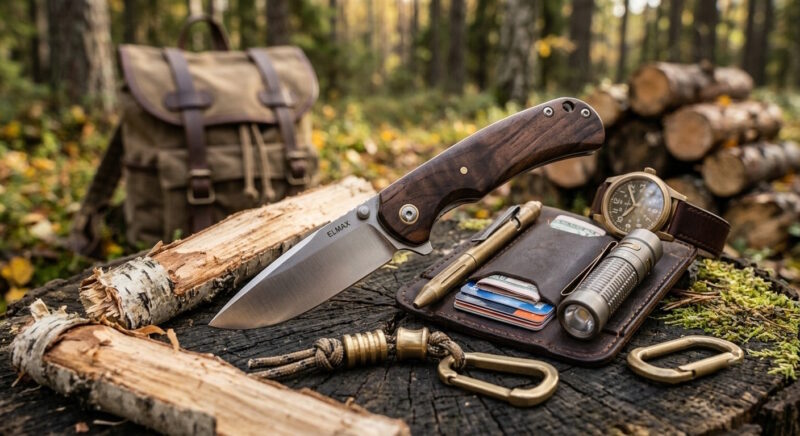
Everyday Carry (EDC)
Most EDC users regularly cut:
- Cardboard
- Plastic packaging
- Rope
- Zip ties
- Food
- Tape
MagnaCut
MagnaCut excels because it combines:
- Excellent slicing performance
- High toughness
- Outstanding corrosion resistance
- Excellent edge stability
Even if the knife encounters accidental twisting or hard materials, MagnaCut remains remarkably resistant to edge damage.
Elmax
Elmax also performs extremely well as an EDC steel.
Its strengths include:
- Excellent slicing
- Long-lasting edge
- Reliable stainless performance
- Attractive polished finish
For typical daily cutting, many users would struggle to notice a significant difference between the two steels.
Winner: Slight advantage to MagnaCut
Hunting Knives
Hunters need blades capable of processing game without losing sharpness while also resisting accidental chipping around joints or bone.
MagnaCut
Advantages:
- Higher toughness
- Better chip resistance
- Excellent corrosion resistance when exposed to blood and moisture
Check Our Guide Best Hunting Knife Features Explained
Elmax
Advantages:
- Outstanding slicing ability
- Long-lasting edge during skinning
- Excellent stainless properties
Although Elmax performs extremely well, MagnaCut’s superior toughness provides greater confidence during demanding field work.
Winner: MagnaCut
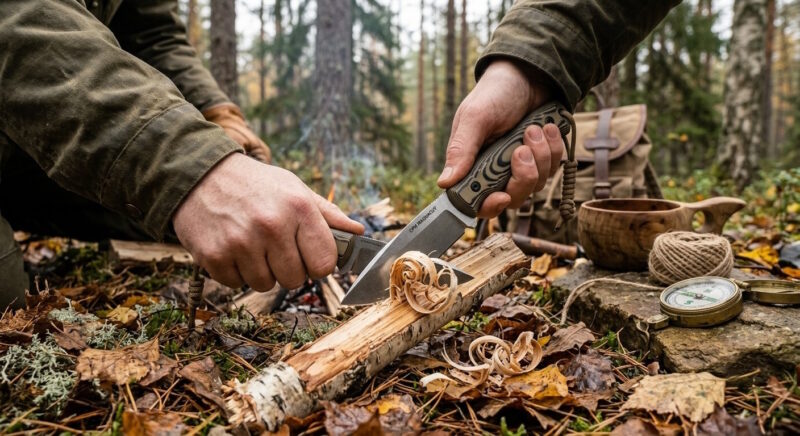
Bushcraft and Survival
Bushcraft tasks often include:
- Feather sticking
- Wood carving
- Camp preparation
- Light batoning
- Shelter construction
These activities place considerable stress on the blade.
MagnaCut
This is where MagnaCut truly shines.
Its exceptional toughness allows it to tolerate impacts and lateral forces that could chip more wear-focused steels.
Elmax
Elmax can certainly perform bushcraft tasks, but it is optimized more toward slicing than heavy impact work.
Winner: MagnaCut
Kitchen Knives
Both steels make excellent kitchen knives thanks to their stainless properties.
MagnaCut
Strengths include:
- Outstanding corrosion resistance
- Excellent edge stability
- Fine cutting performance
- Easy maintenance
Elmax
Strengths include:
- Very fine polished edge
- Excellent slicing
- Long-lasting sharpness
- Proven kitchen performance
For professional chefs and serious home cooks, either steel performs exceptionally well.
Winner: Tie
Marine and Humid Environments
Saltwater and humidity quickly reveal weaknesses in corrosion resistance.
MagnaCut
MagnaCut’s optimized alloy design provides some of the best corrosion resistance available among premium stainless knife steels.
It performs exceptionally well in:
- Coastal environments
- Fishing
- Boating
- Diving
- Tropical climates
Elmax
Elmax also performs very well but may require slightly more care after prolonged saltwater exposure.
Winner: MagnaCut
Side-by-Side Performance Comparison
| Property | MagnaCut | Elmax | Winner |
|---|---|---|---|
| Edge Retention | ⭐⭐⭐⭐☆ | ⭐⭐⭐⭐⭐ | Elmax |
| Wear Resistance | ⭐⭐⭐⭐☆ | ⭐⭐⭐⭐⭐ | Elmax |
| Toughness | ⭐⭐⭐⭐⭐ | ⭐⭐⭐⭐ | MagnaCut |
| Corrosion Resistance | ⭐⭐⭐⭐⭐ | ⭐⭐⭐⭐☆ | MagnaCut |
| Sharpening Ease | ⭐⭐⭐⭐☆ | ⭐⭐⭐⭐ | MagnaCut |
| Hard-Use Capability | ⭐⭐⭐⭐⭐ | ⭐⭐⭐⭐ | MagnaCut |
| Fine Edge Stability | ⭐⭐⭐⭐⭐ | ⭐⭐⭐⭐☆ | MagnaCut |
| Overall Balance | ⭐⭐⭐⭐⭐ | ⭐⭐⭐⭐☆ | MagnaCut |
Advantages of MagnaCut
MagnaCut has rapidly become one of the most sought-after premium knife steels because it offers exceptional performance across nearly every category.
Pros
- Outstanding toughness
- Excellent corrosion resistance
- High edge stability
- Excellent all-around performance
- Easier sharpening than many premium steels
- Outstanding outdoor performance
- Ideal for hard-use knives
Advantages of Elmax
Elmax remains one of the finest premium stainless steels ever produced.
Pros
- Excellent wear resistance
- Outstanding edge retention
- High corrosion resistance
- Very fine cutting edge
- Beautiful polished finish
- Proven long-term reliability
- Widely available
Disadvantages of MagnaCut
No steel is perfect.
Cons
- Usually more expensive
- Availability still depends on manufacturer
- Premium pricing on many knife models
Disadvantages of Elmax
Cons
- Slightly lower toughness
- More susceptible to edge chipping during abusive use
- Less optimized for hard outdoor tasks
- Older steel design compared with MagnaCut
MagnaCut vs Elmax: Which Steel Should You Buy?
Choose MagnaCut if:
- You need maximum toughness.
- You frequently use your knife outdoors.
- You hunt, camp, or practice bushcraft.
- You live in a humid or coastal environment.
- You want one of the most balanced stainless steels available.
Choose Elmax if:
- You prioritize wear resistance.
- You mainly perform slicing tasks.
- You enjoy a highly refined cutting edge.
- You want a proven premium stainless steel with an excellent track record.
Frequently Asked Questions
Is MagnaCut better than Elmax?
For overall balance, yes. MagnaCut generally offers better toughness and corrosion resistance while maintaining excellent edge retention. Elmax, however, has a slight advantage in wear resistance.
Which steel holds an edge longer?
Elmax typically performs slightly better in prolonged abrasive cutting because of its higher carbide volume. During everyday use, the practical difference is often small.
Which steel is tougher?
MagnaCut is noticeably tougher and better suited to demanding outdoor and survival applications.
Which steel is easier to sharpen?
Both sharpen well, but MagnaCut generally has a slight advantage because of its optimized carbide structure and excellent edge stability.
Is Elmax still a premium knife steel?
Absolutely. Despite newer steels entering the market, Elmax remains one of the best premium stainless steels available and continues to be used in many high-end production and custom knives.
Final Verdict: MagnaCut vs Elmax
MagnaCut vs Elmax – At a Glance
| Category | Winner |
|---|---|
| Toughness | 🏆 MagnaCut |
| Corrosion Resistance | 🏆 MagnaCut |
| Wear Resistance | 🏆 Elmax |
| Edge Retention | 🏆 Elmax |
| Sharpening | 🏆 MagnaCut |
| Bushcraft | 🏆 MagnaCut |
| Hunting | 🏆 MagnaCut |
| Everyday Carry | 🤝 Tie |
Choosing between MagnaCut and Elmax is not about finding a bad option—both steels are exceptional. The decision comes down to which performance characteristics matter most for your intended use.
Elmax has earned its reputation through years of dependable performance. It offers excellent wear resistance, long-lasting edge retention, and very good corrosion resistance, making it an outstanding choice for everyday carry knives and precision cutting tools.
MagnaCut builds on those strengths while significantly improving toughness and corrosion resistance. Rather than maximizing one characteristic, it achieves an exceptional balance across all major performance categories.
If your knife will see demanding outdoor use, hunting, bushcraft, survival tasks, or regular exposure to moisture, MagnaCut is the stronger overall choice.
If your primary goal is long-lasting slicing performance in an everyday carry knife and you appreciate a steel with a long history of success, Elmax remains an outstanding option.
Final Recommendation
- Choose MagnaCut if you want the most balanced premium stainless knife steel available today.
- Choose Elmax if you prioritize wear resistance and exceptional slicing performance in a proven, high-end stainless steel.
Both represent the very best of powder metallurgy technology and will provide years of outstanding service when paired with quality heat treatment and proper maintenance.
This article is for independent informational purposes only and is not affiliated with, sponsored by, or endorsed by any steel manufacturer. All product names, trademarks, and registered trademarks are the property of their respective owners.
https://yashkadesigns.ecrater.com/c/2444223/blade-handles
MagnaCut vs Elmax Steel Comparison