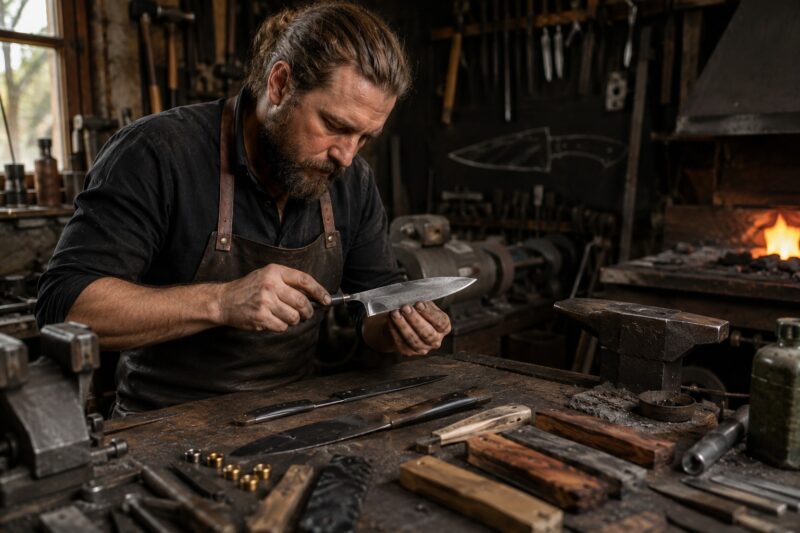
Custom Knife Maker
An Independent Guide
In a world filled with mass-produced knives, custom knife makers offer something truly special: craftsmanship, individuality, and attention to detail that simply cannot be replicated on a factory production line. Whether you are looking for a custom kitchen knife, hunting knife, bushcraft knife, or collector’s piece, choosing the right maker is one of the most important decisions you can make.
A custom knife is more than just a cutting tool. It is an investment in quality, performance, and artistry. However, not all custom knife makers are equal. Some focus on aesthetics, others prioritize performance, and the best makers successfully combine both.
This guide will help you understand what to look for when choosing a custom knife maker and how to ensure you receive a knife that meets your expectations.
Why Choose a Custom Knife Instead of a Factory Knife?
Factory knives certainly have their place. They are widely available and often less expensive than handmade alternatives. However, custom knives provide advantages that many knife enthusiasts consider worth the investment.
A handmade knife is typically crafted by an individual maker or a small workshop. Every detail receives personal attention, from steel selection to heat treatment and final sharpening.
Benefits include:
- Superior craftsmanship
- Better quality control
- Unique designs
- Custom handle materials
- Personalized specifications
- Higher attention to blade geometry
- Collectible value
For many buyers, owning a knife made by a skilled craftsman creates a stronger connection to the tool.
Define Your Intended Use First
Before selecting a maker, determine exactly how the knife will be used.
Different makers specialize in different knife styles.
Kitchen Knives
If you cook frequently, look for makers specializing in:
- Chef knives
- Gyuto knives
- Santoku knives
- Nakiri knives
- Kiritsuke knives
- Petty knives
Kitchen knife makers often focus on thin blade geometry and exceptional cutting performance.
Hunting Knives
Hunters should prioritize:
- Durability
- Corrosion resistance
- Comfortable grip
- Easy field maintenance
Bushcraft and Outdoor Knives
Outdoor knives require:
- Tough steel
- Strong blade construction
- Reliable handle materials
- Practical sheath options
Collector Knives
Collectors may place greater emphasis on:
- Rare materials
- Damascus patterns
- Mosaic pins
- Artistic craftsmanship
Understanding your intended use helps narrow your search significantly.
Examine the Maker’s Portfolio
A professional custom knife maker should have a strong portfolio.
Review:
- Website galleries
- Etsy listings
- Social media profiles
- Customer photographs
Pay attention to consistency.
One impressive knife does not prove long-term quality. A portfolio containing dozens or hundreds of well-executed knives demonstrates experience and reliability.
Look closely at:
- Grind symmetry
- Handle fit and finish
- Blade polish
- Spine finishing
- Choil finishing
- Overall craftsmanship
Small details often reveal the skill level of a maker.
Understand Steel Selection
Steel is the heart of any knife.
A reputable maker should clearly explain what steel is used and why.
Popular kitchen knife steels include:
9Cr18MoV
A stainless steel known for:
- Good edge retention
- Corrosion resistance
- Easy maintenance
VG10
Popular among Japanese-style knives.
Advantages include:
- Excellent sharpness
- Good edge retention
- Stainless properties
Check Our Guide VG10 Steel Review
AEB-L
Highly regarded for:
- Fine grain structure
- Excellent toughness
- Outstanding cutting performance
Check Our Guide AEB-L Steel Review
High Carbon Steels
Examples include:
- 1095
- 52100
- O1
These steels can achieve exceptional edges but require more maintenance.
A trustworthy maker should be transparent about steel choices.
Ask About Heat Treatment
Many knife enthusiasts consider heat treatment more important than steel selection itself.
Even premium steel performs poorly if improperly heat treated.
A skilled maker should understand:
- Hardening
- Tempering
- Cryogenic treatment (when applicable)
- Target hardness ranges
Do not hesitate to ask questions.
Professional makers are usually happy to discuss their process.
Check Our Guide Different Heat Treatment Methods Explained
Evaluate Blade Geometry
Blade geometry greatly affects cutting performance.
Many buyers focus only on steel and appearance, overlooking geometry.
Factors include:
- Blade thickness
- Distal taper
- Edge angle
- Grind style
Well-designed geometry often has a larger impact on performance than steel type.
For kitchen knives, thinner geometry typically provides superior cutting efficiency.
Inspect Handle Construction
A knife handle influences comfort, balance, and long-term durability.
Quality handle materials may include:
- Walnut
- Rosewood
- Ebony
- Desert Ironwood
- Stabilized wood
- Micarta
- G10
- Carbon fiber
Examine photographs carefully.
Look for:
- Smooth transitions
- Tight fitment
- Proper finishing
- Clean pin installation
Poor handle construction can shorten a knife’s lifespan.
Consider Handle Style
Different makers may specialize in different handle styles.
Western Handles
Features:
- Full tang construction
- Scales attached with pins
- Familiar ergonomics
Japanese Wa Handles
Features:
- Lightweight construction
- Hidden tang
- Excellent balance
- Traditional aesthetics
Both styles have advantages.
The best choice depends on personal preference.
Check Our Guide Japanese Wa Handles
Read Customer Reviews
Reviews often reveal valuable information.
Look beyond star ratings.
Pay attention to comments regarding:
- Sharpness
- Communication
- Packaging
- Delivery experience
- Long-term durability
Consistent positive feedback over many years is a strong indicator of quality.
Communication Matters
One of the biggest benefits of buying from a custom maker is direct communication.
A good maker should be:
- Responsive
- Honest
- Transparent
- Knowledgeable
You should feel comfortable asking questions before purchasing.
Professional communication often reflects professional craftsmanship.
Beware of Red Flags
Certain warning signs should prompt caution.
Unrealistic Claims
Be skeptical of statements such as:
- “Never needs sharpening”
- “Unbreakable steel”
- “Best knife in the world”
No knife is perfect.
Lack of Details
Avoid makers who cannot clearly explain:
- Steel type
- Heat treatment
- Handle materials
Poor Photography
While photography alone does not determine quality, clear and detailed images often indicate professionalism.
Handmade vs Resold Imports
Unfortunately, some sellers market imported knives as handmade products.
Signs of genuine craftsmanship include:
- Work-in-progress photos
- Shop photos
- Consistent design language
- Detailed product descriptions
- Direct maker interaction
Authentic custom makers are usually proud to share their process.
Understand Pricing
Custom knives vary significantly in price.
Factors affecting cost include:
- Materials
- Labor
- Experience
- Reputation
- Complexity
A higher price does not automatically guarantee better quality.
However, extremely low prices may indicate shortcuts or imported products.
Focus on value rather than simply finding the cheapest option.
Consider Long-Term Support
A quality maker stands behind their work.
Ask whether they offer:
- Sharpening services
- Repairs
- Warranty support
- Maintenance advice
Long-term customer support demonstrates confidence in craftsmanship.
Look for Consistency
Consistency is one of the strongest indicators of a skilled maker.
Examine multiple examples of their work.
Ask yourself:
- Are grinds consistent?
- Are handles symmetrical?
- Is the finishing uniform?
- Do customer photos match listing photos?
Consistency separates experienced makers from beginners.
Why Handmade Knives Are Worth the Investment
A well-made custom knife can provide decades of reliable service.
Unlike disposable consumer products, handmade knives are often passed from one generation to the next.
Beyond performance, they carry a story:
- The maker’s craftsmanship
- The materials selected
- The hours invested
- The unique character of the finished knife
For many owners, this connection makes a custom knife far more meaningful than a factory-made alternative.
Check Our Guide How a Handmade Knife Is Made
Final Thoughts
Choosing a custom knife maker requires more than simply finding an attractive knife online. By evaluating craftsmanship, steel selection, heat treatment, blade geometry, handle construction, reviews, and communication, you can make a confident purchasing decision.
The best custom knife maker is not necessarily the most famous or the most expensive. Instead, it is the maker whose craftsmanship, experience, and design philosophy align with your needs.
Take your time, ask questions, study examples of their work, and focus on long-term quality. A well-made handmade knife can become one of the most satisfying and dependable tools you will ever own.
Custom Knife Maker
Frequently Asked Questions
How do I choose a good custom knife maker?
Look for a maker with a strong portfolio, positive customer reviews, clear communication, and transparency about materials, steel selection, and heat treatment. Consistent craftsmanship across multiple knives is often the best indicator of quality.
Are custom handmade knives worth the price?
Yes. Handmade knives typically offer superior craftsmanship, better quality control, premium materials, and unique designs that are difficult to find in mass-produced knives. Many custom knives can last for decades with proper care.
What steel is best for a custom knife?
The best steel depends on your intended use. Popular options include 9Cr18MoV, VG10, AEB-L, 52100, and 1095 carbon steel. Each offers different advantages in edge retention, toughness, corrosion resistance, and ease of sharpening.
What should I ask a custom knife maker before buying?
Ask about the steel type, heat treatment process, blade hardness, handle materials, maintenance requirements, lead time, and warranty or repair options. A professional maker should be happy to answer these questions.
How can I tell if a knife is truly handmade?
Genuine custom makers usually provide workshop photos, process images, detailed product descriptions, and direct communication. Consistent craftsmanship and a clear explanation of the manufacturing process are also good signs.
What handle materials are commonly used on custom knives?
Popular handle materials include stabilized wood, walnut, ebony, desert ironwood, micarta, G10, carbon fiber, bone, and horn. The best choice depends on your preferences for appearance, durability, and maintenance.
Are Damascus knives better than regular steel knives?
Damascus steel is often valued for its beautiful layered patterns. Performance depends primarily on the core steel, heat treatment, and blade geometry rather than the Damascus pattern itself.
What is more important: steel or heat treatment?
Most experienced knife enthusiasts agree that proper heat treatment is more important than steel selection alone. Even premium steel can perform poorly if heat treated incorrectly.
How long does a custom knife last?
A well-made custom knife can last a lifetime and may even be passed down through generations. Regular maintenance, proper storage, and occasional sharpening help maximize longevity.
Should I buy a custom kitchen knife or a factory-made knife?
If you value craftsmanship, cutting performance, personalized design, and long-term quality, a custom kitchen knife is often worth the investment. Factory knives are generally more affordable but may not offer the same level of attention to detail.
https://yashkadesigns.com/diy-blades-and-handles
Custom Knife Maker
https://www.etsy.com/shop/YashkaDesigns?section_id=26205996
Custom Knife Maker
This article is for independent informational purposes only and is not affiliated with, sponsored by, or endorsed by any steel manufacturer. All product names, trademarks, and registered trademarks are the property of their respective owners.