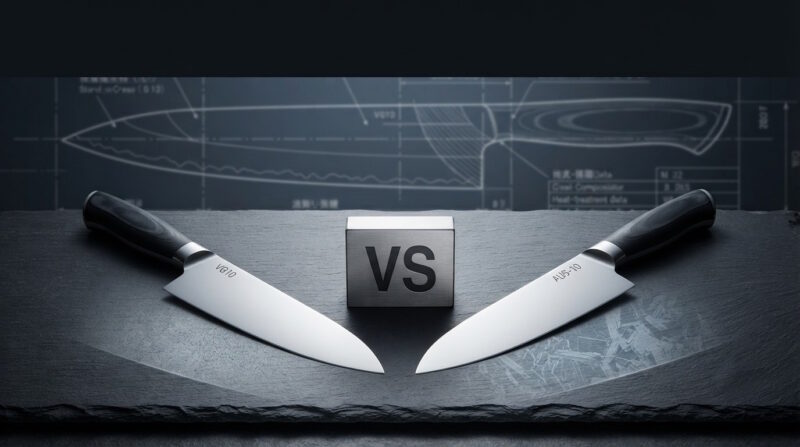
VG10 vs AUS10 Steel: The Complete Comparison Guide
An Independent Guide
When comparing modern Japanese stainless knife steels, VG10 vs AUS10 is one of the most common questions among knife enthusiasts, home cooks, and outdoor users. Both steels are respected for their excellent balance of hardness, corrosion resistance, and cutting performance, making them popular choices for kitchen and everyday cutting tools.
At first glance, the two steels appear very similar. Both belong to the family of high-carbon stainless steels, both can achieve impressive hardness, and both offer excellent resistance to rust. However, their chemical compositions and performance characteristics differ enough that each steel excels in different situations.
Understanding these differences can help you choose a knife that matches your cutting style, maintenance preferences, and intended use.
In this comprehensive guide, we’ll compare VG10 and AUS10 across every important category, including:
- Chemical composition
- Hardness
- Edge retention
- Toughness
- Corrosion resistance
- Sharpening difficulty
- Wear resistance
- Food preparation performance
- Outdoor and everyday carry applications
- Long-term durability
- Maintenance requirements
By the end of this article, you’ll know exactly which steel better suits your needs.
Quick Comparison: VG10 vs AUS10
| Feature | VG10 | AUS10 |
|---|---|---|
| Steel Type | Stainless | Stainless |
| Carbon | High | High |
| Chromium | Very High | High |
| Vanadium | Yes | Yes |
| Cobalt | Yes | Usually No |
| Typical Hardness | 60–62 HRC | 58–61 HRC |
| Edge Retention | Excellent | Very Good |
| Toughness | Good | Very Good |
| Corrosion Resistance | Excellent | Excellent |
| Ease of Sharpening | Moderate | Easy to Moderate |
| Wear Resistance | Excellent | Very Good |
| Best For | Precision cutting | Everyday versatility |
Although the chart provides a quick overview, real-world performance depends on much more than a few specifications.
Let’s examine each steel in greater detail.
What Is VG10 Steel?
VG10 is a premium Japanese stainless steel developed specifically for high-performance cutting tools. It has earned a reputation for combining excellent edge retention with impressive corrosion resistance while maintaining enough toughness for demanding kitchen use.
Its balanced chemistry allows manufacturers to heat treat it to relatively high hardness without making the blade excessively brittle.
One of the defining characteristics of VG10 is its ability to take an extremely fine edge. This makes it especially attractive for users who appreciate precise slicing and clean cuts.
Typical characteristics include:
- Excellent edge stability
- High hardness
- Outstanding corrosion resistance
- Fine grain structure
- Good polishability
- Reliable long-term performance
Because of these qualities, VG10 has become one of the benchmark stainless steels against which many other knife steels are compared.
Check Our Guide VG10 Steel Review
What Is AUS10 Steel?
AUS10 is another premium Japanese stainless steel designed to deliver a well-balanced combination of hardness, toughness, and corrosion resistance.
Compared with lower-alloy stainless steels, AUS10 generally offers improved wear resistance and edge retention while remaining easier to sharpen than many ultra-hard premium steels.
Its chemistry favors versatility rather than maximizing any single property.
As a result, AUS10 is appreciated by users looking for:
- Strong everyday cutting performance
- Excellent rust resistance
- Good toughness
- Straightforward maintenance
- Easy resharpening
Many users describe AUS10 as a steel that performs consistently across a wide variety of cutting tasks without demanding excessive maintenance.
Check Our Guide AUS-10 Steel Review: Is AUS-10 a Good Knife Steel?
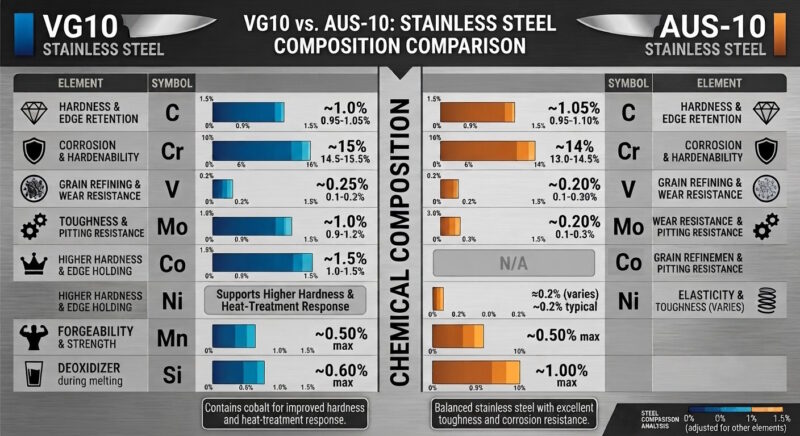
Chemical Composition Comparison
Although both steels are Japanese stainless alloys, their compositions differ enough to influence their overall performance.
VG10 Chemical Composition
Approximate composition:
| Element | Percentage |
|---|---|
| Carbon | 0.95–1.05% |
| Chromium | 14.5–15.5% |
| Molybdenum | 0.9–1.2% |
| Vanadium | 0.2–0.35% |
| Cobalt | 1.3–1.5% |
| Manganese | ~0.5% |
| Silicon | ~0.6% |
Several alloying elements contribute unique benefits.
Carbon
Carbon increases hardness and supports excellent edge retention.
Chromium
Chromium creates a protective oxide layer that greatly improves corrosion resistance.
Vanadium
Vanadium promotes the formation of small, hard carbides that increase wear resistance and help maintain a sharp cutting edge.
Molybdenum
Molybdenum contributes additional corrosion resistance while improving high-temperature stability during heat treatment.
Cobalt
One feature that distinguishes VG10 from many similar steels is the addition of cobalt.
Cobalt enhances the steel’s response to heat treatment, helping achieve higher hardness while maintaining a refined microstructure.
AUS10 Chemical Composition
Approximate composition:
| Element | Percentage |
|---|---|
| Carbon | 0.95–1.10% |
| Chromium | 13–14.5% |
| Molybdenum | 0.1–0.3% |
| Vanadium | 0.1–0.3% |
| Nickel | Small amount |
| Manganese | Small amount |
| Silicon | Small amount |
Although the carbon content is similar to VG10, the balance of alloying elements differs.
AUS10 contains slightly less chromium and molybdenum while emphasizing an overall composition that provides a favorable balance between hardness and toughness.
The result is a steel that often feels more forgiving during heavy use while still maintaining excellent cutting performance.
How Chemical Composition Affects Performance
The differences between VG10 and AUS10 become clearer when examining how their alloying elements influence real-world use.
Carbide Formation
Both steels form chromium and vanadium carbides.
These carbides increase:
- Wear resistance
- Edge stability
- Cutting efficiency
VG10 typically develops a slightly higher carbide volume because of its alloy balance.
This contributes to its reputation for superior edge retention.
Grain Structure
A fine grain structure allows the edge to become thinner and sharper.
Proper heat treatment enables both steels to achieve refined grain structures.
VG10 is especially well known for taking an exceptionally polished, razor-like edge suitable for precision slicing.
AUS10 also develops a fine edge but often sacrifices a small amount of maximum sharpness in exchange for greater toughness.
Corrosion Resistance
Both steels qualify as excellent stainless steels.
The high chromium content forms a passive oxide layer that protects against rust in normal environments.
Kitchen users can expect excellent corrosion resistance when basic cleaning practices are followed.
Even in humid climates, both steels perform exceptionally well.
Hardness Comparison
Hardness is usually measured using the Rockwell Hardness Scale (HRC).
Typical hardness ranges are:
VG10
60–62 HRC
AUS10
58–61 HRC
Although the numerical difference appears small, one or two HRC points can noticeably influence edge retention and sharpening characteristics.
Higher hardness generally provides:
- Longer-lasting sharpness
- Better wear resistance
- Improved edge stability
However, increasing hardness often reduces toughness.
This trade-off explains why VG10 usually outperforms AUS10 in edge retention while AUS10 frequently handles impacts and twisting forces slightly better.
Check Our Guide What Is HRC? Understanding Rockwell Hardness
Heat Treatment Matters More Than Steel Alone
One of the biggest misconceptions among knife buyers is assuming that steel composition alone determines performance.
In reality, heat treatment often has an even greater influence.
A properly heat-treated AUS10 blade can outperform a poorly heat-treated VG10 blade in edge retention, toughness, and durability.
Factors that influence final performance include:
- Austenitizing temperature
- Quenching process
- Tempering cycles
- Cryogenic treatment (when used)
- Final hardness target
These manufacturing variables determine carbide distribution, grain refinement, residual stress, and overall blade performance.
For this reason, two knives made from the same steel may perform noticeably differently despite having identical chemical compositions.
Check Our Guide Different Heat Treatment Methods Explained
Why These Two Steels Are Frequently Compared
VG10 and AUS10 occupy a similar position within the premium stainless steel category.
Both aim to provide:
- High corrosion resistance
- Excellent cutting performance
- Good toughness
- Long service life
- Reasonable maintenance requirements
Rather than representing opposite ends of the performance spectrum, they are two closely matched steels with different priorities.
VG10 leans toward maximum edge retention and refined cutting performance.
AUS10 emphasizes balance, toughness, and easier maintenance.
Understanding these priorities is the key to selecting the right steel for your specific cutting tasks.
VG10 vs AUS10 Steel: Performance Comparison
Now that we’ve examined the chemistry and basic characteristics of both steels, it’s time to look at what matters most in everyday use. Laboratory data and alloy composition provide useful information, but a knife’s true value is revealed through repeated cutting, sharpening, and long-term reliability.
Although VG10 and AUS10 belong to the same class of premium Japanese stainless steels, they achieve their performance in slightly different ways. VG10 prioritizes maximum edge stability and wear resistance, while AUS10 focuses on balancing cutting performance with toughness and ease of maintenance.
Let’s compare them category by category.
https://yashkadesigns.com/diy-blank-blade-aus-10-japanese-steel-utility-knife
VG10
⭐⭐⭐⭐☆
AUS-10
⭐⭐⭐⭐☆
Edge Retention
Winner: VG10
Edge retention refers to how long a knife stays sharp before it needs sharpening. It is one of the most important characteristics for anyone who uses a knife regularly.
Several factors affect edge retention:
- Hardness
- Carbide volume
- Heat treatment
- Edge geometry
- Cutting material
VG10 generally has the advantage because it is commonly hardened to 60–62 HRC and contains an alloy balance that supports greater wear resistance.
VG10 Performance
VG10 is capable of maintaining a very fine edge through long food preparation sessions and repeated everyday cutting tasks.
Users often notice that VG10 continues making clean slices long after many conventional stainless steels begin to lose their bite.
Its refined carbide structure also helps maintain aggressive cutting performance during extended use.
Typical strengths include:
- Excellent slicing endurance
- Stable fine edge
- Consistent cutting feel
- Slow edge wear
AUS10 Performance
AUS10 also offers impressive edge retention.
Although it usually loses its razor edge slightly sooner than VG10, it often continues cutting efficiently because the edge dulls gradually rather than suddenly.
Many users appreciate this predictable wear pattern because touch-up sharpening quickly restores peak performance.
Advantages include:
- Very consistent wear
- Reliable everyday sharpness
- Easy touch-up maintenance
- Long useful working edge
Practical Example
Imagine preparing dinner for a large family several times each week.
Over months of regular use:
- VG10 may require complete sharpening less frequently.
- AUS10 may benefit from occasional quick touch-ups but remains easy to maintain.
The actual difference is often smaller than many buyers expect.
Toughness
Winner: AUS10
Toughness describes a steel’s ability to resist:
- Chipping
- Cracking
- Breaking
- Edge damage from impacts
Harder steels generally sacrifice some toughness in exchange for better edge retention.
Because AUS10 is commonly heat treated slightly softer, it usually handles shock loads better.
VG10 Toughness
VG10 has respectable toughness for a hard stainless steel.
However, extremely thin edges combined with high hardness can become vulnerable if the knife is:
- Twisted during cutting
- Used against frozen foods
- Struck against hard materials
- Misused as a pry tool
Under normal kitchen conditions, these issues are uncommon.
AUS10 Toughness
AUS10’s slightly lower hardness provides greater flexibility under stress.
This makes it more forgiving during demanding use.
Examples include:
- Dense vegetables
- Hard squash
- Thick meat joints
- Outdoor food preparation
Small accidental impacts are also less likely to produce microchips.
Corrosion Resistance
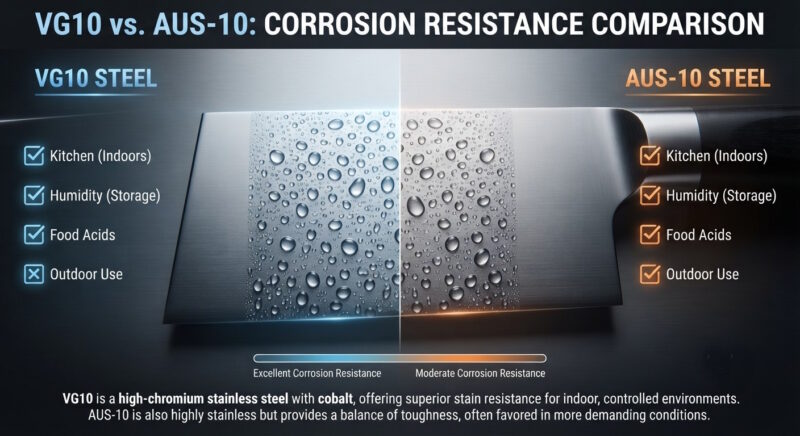
Result: Tie
Both steels offer outstanding corrosion resistance.
Their chromium content creates a passive oxide layer that protects against oxidation and staining.
For normal users, both steels perform exceptionally well in:
- Home kitchens
- Professional kitchens
- Humid environments
- Outdoor cooking
Neither steel requires the intensive maintenance associated with high-carbon non-stainless steels.
VG10 Against Corrosion
VG10’s slightly higher chromium and molybdenum content provides excellent protection.
Even acidic foods such as:
- Tomatoes
- Citrus fruits
- Apples
- Onions
rarely cause problems if the knife is washed and dried after use.
AUS10 Against Corrosion
AUS10 performs nearly identically in everyday conditions.
With routine cleaning, rust is rarely a concern.
Many users choose AUS10 specifically because it offers premium stainless performance without demanding constant attention.
Best Practices
Regardless of steel, good habits include:
- Hand washing
- Drying immediately
- Avoiding prolonged exposure to saltwater
- Avoiding dishwasher cycles
- Storing knives in a dry location
These simple practices dramatically increase service life.
Wear Resistance
Winner: VG10
Wear resistance measures how effectively steel resists gradual abrasion during cutting.
It directly influences edge retention over thousands of cutting cycles.
VG10 generally demonstrates superior wear resistance because of:
- Higher hardness
- More effective carbide formation
- Refined heat treatment response
This becomes noticeable during prolonged cutting sessions.
Materials That Accelerate Wear
All knife edges wear faster when cutting abrasive materials such as:
- Cardboard
- Rope
- Fibrous vegetables
- Herbs
- Thick fruit skins
VG10 maintains its edge slightly longer under these demanding conditions.
AUS10 remains competitive but typically reaches the point of resharpening sooner.
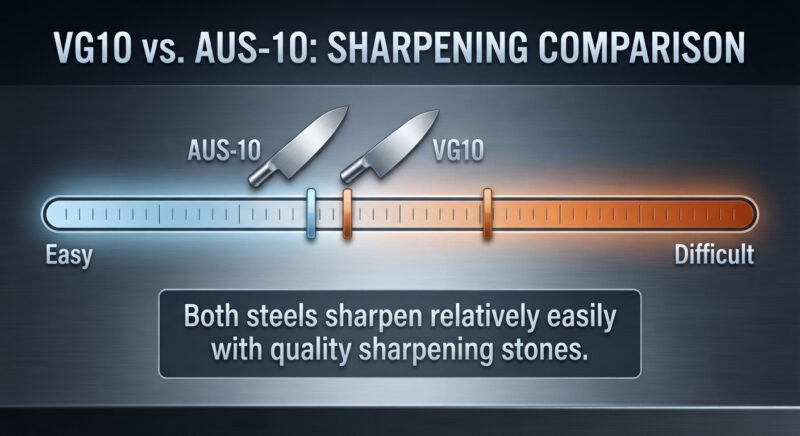
Ease of Sharpening
Winner: AUS10
Every knife eventually becomes dull.
Ease of sharpening determines how quickly the original edge can be restored.
VG10 Sharpening
VG10’s higher wear resistance means sharpening requires:
- More patience
- Slightly more abrasion
- Careful angle control
Fortunately, VG10 responds well to quality sharpening stones.
Once sharpened correctly, it can achieve exceptional sharpness.
AUS10 Sharpening
AUS10 is noticeably easier for many users.
Benefits include:
- Faster burr formation
- Easier edge refinement
- Shorter sharpening sessions
- Less effort during maintenance
This makes AUS10 attractive for beginners learning freehand sharpening.
Maximum Sharpness
Winner: VG10
Maximum sharpness differs from edge retention.
A steel may become incredibly sharp even if it loses that sharpness relatively quickly.
VG10 is famous for accepting extremely refined edges.
Thanks to its fine grain structure, it supports:
- Clean push cuts
- Precision slicing
- Thin food preparation cuts
- Excellent shaving sharpness
Professional cooks often appreciate this refined cutting feel.
AUS10 Maximum Sharpness
AUS10 also sharpens extremely well.
Most users will find it capable of reaching razor-level sharpness.
However, under magnification, VG10 often supports a slightly finer, more stable apex.
The difference is subtle but noticeable for experienced sharpeners.
Edge Stability
Winner: VG10
Edge stability refers to how well a very thin cutting edge maintains its shape during use.
A stable edge:
- Deforms less
- Chips less at appropriate hardness
- Maintains cutting precision longer
VG10 performs exceptionally well here.
This explains why it remains popular for knives designed for precise slicing.
Rolling vs Chipping
Knife edges usually fail in one of two ways.
Edge Rolling
The edge bends instead of breaking.
Advantages:
- Easy to repair
- Simple touch-up sharpening
- Less material removal
AUS10 is somewhat more likely to roll under abuse.
Edge Chipping
Tiny pieces break away from the edge.
Repair requires:
- More sharpening
- More steel removal
- Additional maintenance
VG10 is slightly more susceptible to microchipping if used improperly at high hardness.
Fortunately, normal cutting tasks rarely create this problem.
Cutting Performance in the Kitchen
Both steels excel in food preparation.
However, their personalities differ.
Check Our Guide What Is San Mai Steel?
VG10 During Food Preparation
VG10 shines during precision work such as:
- Slicing fish
- Preparing vegetables
- Fine herb work
- Fruit preparation
- Thin protein slicing
Its refined edge produces exceptionally smooth cuts with minimal resistance.
Many users describe the cutting sensation as effortless.
AUS10 During Food Preparation
AUS10 feels slightly more forgiving.
It handles a wide variety of kitchen tasks confidently, including:
- Daily meal preparation
- Large vegetables
- General slicing
- Dicing
- Chopping
Although ultimate sharpness may be marginally lower than VG10, many users will never notice the difference in everyday cooking.
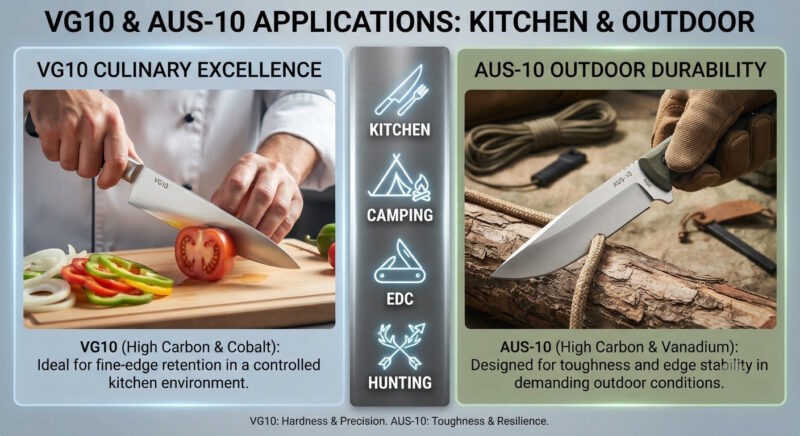
Outdoor and Everyday Utility
Kitchen performance tells only part of the story.
Many knives made from these steels are also used outdoors.
Tasks may include:
- Food preparation
- Rope cutting
- Cardboard
- Camping chores
- Light wood processing
Here, AUS10’s additional toughness becomes an advantage.
It tolerates occasional lateral stress better than harder VG10 blades.
VG10 still performs extremely well but rewards careful cutting technique.
Noise, Feel, and Cutting Feedback
An often-overlooked aspect of knife performance is cutting feedback.
VG10 typically delivers a crisp, precise feel that reflects its higher hardness and refined edge.
AUS10 offers a smoother, slightly more forgiving cutting sensation, particularly when working through denser materials.
Neither feeling is objectively better—it comes down to personal preference and the type of cutting you do most often.
VG10 vs AUS10 Steel: Durability, Maintenance, and Long-Term Performance
By now, it should be clear that both VG10 and AUS10 are excellent stainless steels capable of delivering years of reliable service. The remaining question is how they perform over the long term. Durability is about more than edge retention—it also includes resistance to damage, ease of maintenance, sharpening life, and how the steel behaves after years of regular use.
In this section, we’ll examine the long-term ownership experience and separate common myths from reality.
Long-Term Durability
Result: Tie (Different Strengths)
Durability depends on several factors working together:
- Steel composition
- Heat treatment
- Blade geometry
- Cutting technique
- Maintenance habits
Both VG10 and AUS10 can last for decades when properly cared for.
The difference is not whether one steel is durable and the other is not. Instead, each steel resists wear and damage in a different way.
VG10 Long-Term Characteristics
VG10 tends to:
- Stay sharp longer
- Resist abrasive wear extremely well
- Maintain a refined cutting edge
- Require less frequent full sharpening
However, because it is often hardened to a higher level, it benefits from careful use. Repeated impacts against hard materials may eventually lead to small edge chips if the blade is very thin.
AUS10 Long-Term Characteristics
AUS10 generally:
- Tolerates minor impacts better
- Is easier to restore after heavy use
- Requires more frequent sharpening
- Resists accidental misuse slightly better
For many everyday users, these characteristics make AUS10 feel exceptionally dependable.
Edge Geometry Matters More Than Many People Think
A common mistake is assuming steel alone determines cutting performance.
In reality, blade geometry often has a greater impact.
Important factors include:
- Edge angle
- Blade thickness
- Primary grind
- Blade height
- Behind-the-edge thickness
For example:
A thin AUS10 blade can easily outperform a thick VG10 blade during food preparation simply because it passes through material with less resistance.
Likewise, a properly ground VG10 knife can feel dramatically sharper than another VG10 knife with a thicker edge.
Whenever comparing steels, remember that geometry and heat treatment work together.
Thin Edges vs Thick Edges
Both steels perform well with relatively thin cutting edges.
VG10
Supports very fine edge angles.
Typical advantages include:
- Outstanding slicing
- Excellent push cutting
- Very clean food separation
- High precision
The trade-off is that very thin edges should not be subjected to twisting or impact.
Check Our Guide Best Blade Thickness for Different Uses
AUS10
Can also support thin edges but is often left slightly thicker to maximize durability.
Benefits include:
- Better impact resistance
- Greater versatility
- More forgiving cutting behavior
Many users appreciate this balanced approach for general-purpose knives.
Sharpening Frequency
One of the biggest ownership differences is how often sharpening becomes necessary.
VG10
Typical sharpening interval:
Longer.
Because the edge wears slowly, complete sharpening sessions are less frequent.
Instead, many users simply perform occasional touch-ups.
AUS10
Typical sharpening interval:
Slightly shorter.
The edge gradually loses peak sharpness earlier than VG10, but sharpening takes noticeably less time.
For many owners, this creates an appealing maintenance cycle:
- Sharpen quickly
- Return to work
- Repeat as needed
Which Steel Holds a Razor Edge Longer?
VG10 usually retains a shaving-sharp edge longer.
Its higher hardness and improved wear resistance delay edge rounding during extended cutting.
This is especially noticeable during:
- Long vegetable preparation
- Professional kitchen work
- Frequent daily use
However, AUS10 continues performing well even after its razor edge fades.
Many users find that it maintains a useful “working edge” for a surprisingly long time.
Resistance to Microchipping
Microchipping refers to tiny fractures that appear along the cutting edge.
These chips are often invisible without magnification but can affect cutting smoothness.
VG10
At higher hardness levels, VG10 has a slightly greater chance of developing microchips if:
- Cutting frozen foods
- Twisting the blade
- Striking bone
- Contacting ceramic or stone surfaces
With proper cutting technique, microchipping is rarely an issue.
AUS10
AUS10’s additional toughness helps reduce this risk.
Instead of chipping, the edge is somewhat more likely to roll, which is generally easier to correct through sharpening.
Performance in Different Cutting Tasks
Every knife is used differently.
Let’s compare both steels across common applications.
| Cutting Task | VG10 | AUS10 |
|---|---|---|
| Vegetables | Excellent | Excellent |
| Fruit | Excellent | Excellent |
| Herbs | Excellent | Excellent |
| Meat | Excellent | Excellent |
| Fish | Outstanding | Excellent |
| Rope | Very Good | Very Good |
| Cardboard | Excellent | Very Good |
| Camping Food Prep | Excellent | Excellent |
| General Utility | Very Good | Excellent |
As the table shows, both steels perform exceptionally well in everyday situations.
Maintenance Requirements
One reason these steels remain popular is their relatively simple maintenance.
Both require only basic care.
Recommended routine:
- Wash by hand.
- Dry immediately after cleaning.
- Avoid prolonged exposure to acidic residue.
- Store in a dry environment.
- Sharpen before the edge becomes excessively dull.
Following these habits greatly extends blade life regardless of steel type.
Can They Rust?
Both steels are classified as stainless.
However, “stainless” does not mean “rust-proof.”
Rust can still develop if a knife is:
- Left wet for extended periods
- Exposed to saltwater
- Stored while dirty
- Left with food residue overnight
Fortunately, both VG10 and AUS10 offer excellent resistance to corrosion under normal conditions.
How They Age Over Time
After several years of regular use, both steels generally develop:
- Minor cosmetic scratches
- Slight polishing from repeated sharpening
- A more refined cutting feel
Unlike carbon steels, neither steel develops a protective patina.
Instead, their appearance changes gradually through normal wear.
Many users appreciate this because the blade continues looking clean with minimal effort.
Common Myths About VG10 and AUS10
Myth 1: Higher Hardness Always Means a Better Knife
Not necessarily.
Higher hardness often improves edge retention, but it may reduce toughness.
The best hardness depends on how the knife will be used.
Myth 2: VG10 Is Superior in Every Situation
VG10 excels in edge retention and fine cutting.
However, AUS10 offers advantages in toughness and ease of sharpening.
Neither steel dominates every category.
Myth 3: AUS10 Is Only a Mid-Level Steel
This misconception likely comes from comparisons with lower-alloy steels in the AUS family.
In reality, AUS10 is a premium stainless steel capable of excellent performance when properly heat treated.
Myth 4: Stainless Steel Never Rusts
All stainless steels can corrode under unfavorable conditions.
Proper maintenance remains essential.
Myth 5: Steel Alone Determines Knife Quality
Steel is only one part of the equation.
Overall knife performance also depends on:
- Heat treatment
- Blade geometry
- Grind quality
- Edge finish
- Manufacturing precision
- User maintenance
These factors often influence performance more than small differences in alloy composition.
Performance Ratings
The following ratings summarize the typical characteristics of properly heat-treated VG10 and AUS10 blades.
| Category | VG10 | AUS10 |
|---|---|---|
| Edge Retention | 9.5/10 | 8.8/10 |
| Toughness | 8.3/10 | 9.0/10 |
| Corrosion Resistance | 9.5/10 | 9.4/10 |
| Wear Resistance | 9.3/10 | 8.7/10 |
| Ease of Sharpening | 7.8/10 | 9.2/10 |
| Maximum Sharpness | 9.7/10 | 9.1/10 |
| Edge Stability | 9.4/10 | 8.9/10 |
| Overall Versatility | 9.2/10 | 9.3/10 |
These ratings are intended as a practical comparison rather than absolute measurements. Actual performance can vary depending on heat treatment, blade design, sharpening angle, and intended use.
VG10 vs AUS10 Steel: Which One Should You Choose?
After comparing chemistry, hardness, toughness, corrosion resistance, edge retention, sharpening, and long-term durability, one conclusion becomes clear:
Neither VG10 nor AUS10 is universally better. Instead, each steel excels in different situations.
Your ideal choice depends on how you use your knife, how often you’re willing to sharpen it, and which characteristics you value most.
Choose VG10 If…
VG10 is the better option if your priorities include:
- Maximum edge retention
- Extremely fine cutting performance
- High wear resistance
- Precision slicing
- Longer intervals between sharpening
- Razor-sharp edges
VG10 particularly rewards users with good cutting habits. If you avoid twisting the blade, cutting through bone, or using the knife for tasks beyond its intended purpose, it offers exceptional long-term performance.
It is especially well suited for:
- Home cooking enthusiasts
- Professional chefs
- Precision vegetable preparation
- Fish and meat slicing
- Fine kitchen work
- Users comfortable with sharpening
Choose AUS10 If…
AUS10 is an excellent choice if you prefer:
- Greater toughness
- Easier sharpening
- Excellent corrosion resistance
- Balanced everyday performance
- Lower maintenance effort
- Versatility across many cutting tasks
Its forgiving nature makes it appealing to users who want reliable performance without worrying about squeezing every last bit of edge retention from the blade.
AUS10 works particularly well for:
- Everyday kitchen use
- Outdoor cooking
- Camping
- Utility cutting
- Home cooks
- Beginners learning sharpening
Side-by-Side Summary
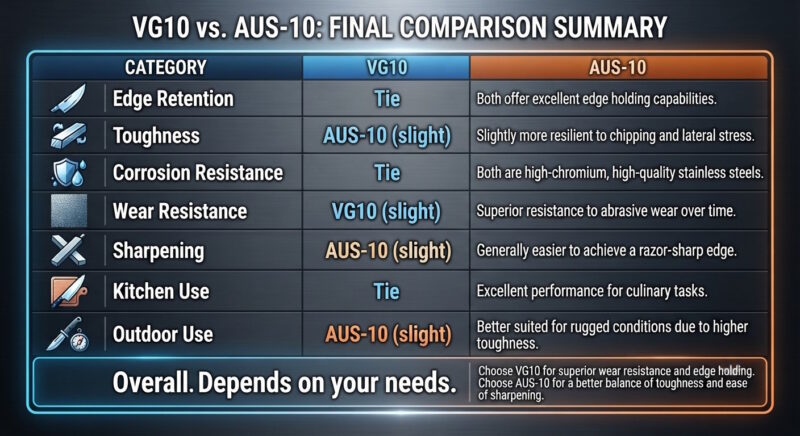
| Category | Winner |
|---|---|
| Edge Retention | VG10 |
| Toughness | AUS10 |
| Wear Resistance | VG10 |
| Corrosion Resistance | Tie |
| Ease of Sharpening | AUS10 |
| Maximum Sharpness | VG10 |
| Edge Stability | VG10 |
| Everyday Versatility | AUS10 |
| Precision Cutting | VG10 |
| Ease of Maintenance | AUS10 |
Which Steel Is Better for Kitchen Knives?
For kitchen knives, both steels perform exceptionally well, but they appeal to different types of users.
VG10
Ideal for cooks who:
- Want the sharpest possible edge
- Prefer longer sharpening intervals
- Value clean, effortless slicing
- Frequently prepare vegetables, herbs, fish, and boneless meats
AUS10
Excellent for users who:
- Cook daily
- Prefer easy maintenance
- Want quick sharpening sessions
- Need a durable all-purpose kitchen knife
For the average home kitchen, the performance gap is much smaller than many online discussions suggest.
Which Steel Is Better for Outdoor Use?
Outdoor tasks often place greater stress on a knife than kitchen work.
Examples include:
- Food preparation at camp
- Rope cutting
- Cardboard
- Plastic packaging
- General utility work
Because these tasks sometimes involve minor impacts and lateral force, AUS10’s additional toughness gives it a slight advantage.
VG10 remains highly capable but benefits from more careful use.
Which Steel Is Better for Beginners?
For someone purchasing a first quality knife, AUS10 is often easier to live with.
Reasons include:
- Easier sharpening
- More forgiving edge
- Excellent rust resistance
- Strong overall durability
- Lower risk of edge damage from accidental misuse
VG10 is also beginner-friendly but rewards users who develop good cutting and sharpening techniques.
Which Steel Is Better for Experienced Users?
Experienced knife owners frequently appreciate VG10 because they can take full advantage of its strengths.
Proper sharpening and careful technique allow VG10 to deliver:
- Outstanding cutting performance
- Longer-lasting sharpness
- Highly refined edges
- Excellent slicing efficiency
For enthusiasts who enjoy maintaining their knives, VG10 can be especially satisfying.
Value for Money
When comparing knives of similar design and quality, both steels provide excellent value.
Instead of focusing only on the steel name, consider:
- Heat treatment quality
- Blade geometry
- Grind consistency
- Handle ergonomics
- Overall construction
- Intended use
A well-made AUS10 knife can easily outperform a poorly manufactured VG10 knife.
The steel is only one component of the finished product.
Buying Tips
Before choosing between VG10 and AUS10, ask yourself a few practical questions.
How often will the knife be used?
Daily users may appreciate VG10’s longer-lasting edge, while occasional users may prefer the easier maintenance of AUS10.
Do you sharpen your own knives?
If yes, either steel is an excellent option.
If no, AUS10 may be slightly easier to maintain between professional sharpening sessions.
What will you cut most often?
For precise food preparation and fine slicing, VG10 has a slight advantage.
For general-purpose work with occasional tougher tasks, AUS10 is an excellent all-round performer.
Do you value maximum sharpness or maximum durability?
VG10 favors ultimate cutting performance.
AUS10 favors balance and forgiveness.
Frequently Asked Questions
Is VG10 better than AUS10?
VG10 generally offers better edge retention, higher wear resistance, and the ability to achieve an exceptionally refined edge.
AUS10 provides greater toughness and is easier to sharpen.
The better choice depends on your priorities rather than one steel being objectively superior.
Is AUS10 a premium knife steel?
Yes.
AUS10 is considered a premium stainless steel capable of excellent hardness, corrosion resistance, toughness, and overall cutting performance when properly heat treated.
Which steel stays sharp longer?
VG10 typically holds its edge longer due to its higher hardness and greater wear resistance.
Which steel is easier to sharpen?
AUS10 is generally easier to sharpen because it offers slightly lower wear resistance and forms a burr more quickly during sharpening.
Which steel resists rust better?
Both steels offer excellent corrosion resistance.
With normal care, either steel performs exceptionally well in kitchen and outdoor environments.
Can both steels become razor sharp?
Yes.
Both VG10 and AUS10 can achieve an extremely sharp edge.
VG10 often supports a slightly finer and longer-lasting apex, while AUS10 reaches excellent sharpness with less sharpening effort.
Does hardness alone determine knife quality?
No.
Heat treatment, blade geometry, edge angle, grind quality, and manufacturing precision all have a significant influence on real-world performance.
Final Verdict
The VG10 vs AUS10 comparison demonstrates how closely matched modern Japanese stainless steels can be. Both alloys deliver excellent cutting performance, impressive corrosion resistance, and long service life when paired with proper heat treatment and thoughtful blade design.
If your priority is maximum edge retention, exceptional wear resistance, and a finely refined cutting edge, VG10 is the stronger choice. Its ability to stay sharp for extended periods makes it particularly attractive for precision kitchen work and users who appreciate high-performance cutting tools.
If you value balanced performance, greater toughness, easier sharpening, and dependable versatility, AUS10 is an outstanding option. It handles a wide range of everyday tasks with confidence and is forgiving enough for users of all experience levels.
Ultimately, the difference between these steels is far smaller than the quality of the finished knife. A carefully designed blade with excellent heat treatment and proper edge geometry will outperform a poorly executed knife regardless of the steel used.
Rather than asking which steel is universally better, the more useful question is which steel better matches your cutting style and maintenance preferences. For most users, either VG10 or AUS10 will provide years of reliable service, making both excellent choices in the premium stainless steel category.
Key Takeaways
- VG10 offers longer edge retention and superior wear resistance.
- AUS10 provides better toughness and easier sharpening.
- Both steels have excellent corrosion resistance.
- VG10 is ideal for precision slicing and extended cutting sessions.
- AUS10 excels as a versatile, easy-to-maintain everyday steel.
- Heat treatment and blade geometry have a greater impact on performance than small differences in alloy composition.
- Both steels are capable of delivering decades of reliable service with proper care.
This article is for independent informational purposes only and is not affiliated with, sponsored by, or endorsed by any steel manufacturer. All product names, trademarks, and registered trademarks are the property of their respective owners.