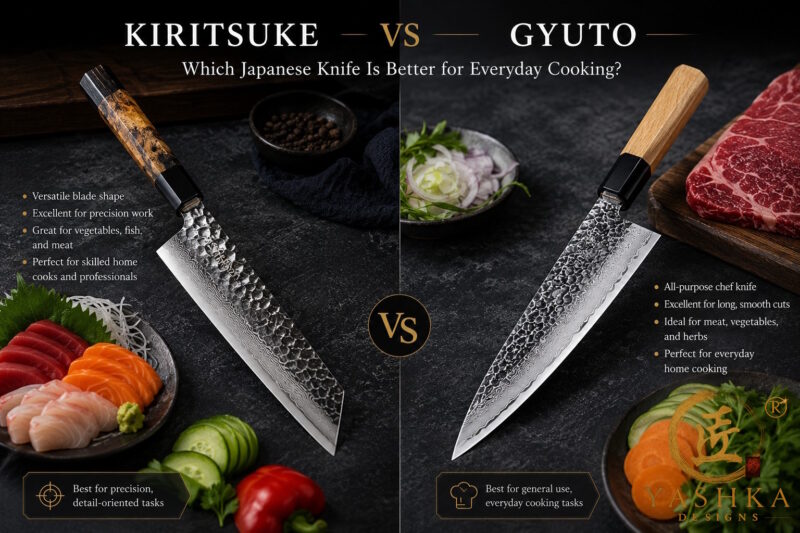
Kiritsuke vs Gyuto
An Independent Guide
Japanese kitchen knives have earned a reputation for exceptional sharpness, precision, and craftsmanship. Among the most sought-after styles are the Kiritsuke and the Gyuto. While both are versatile chef knives capable of handling a wide range of kitchen tasks, they offer different cutting experiences and are designed with different users in mind.
If you’re trying to decide between a Kiritsuke and a Gyuto, this guide will help you understand the key differences, strengths, and ideal uses for each knife.
What Is a Gyuto?
The Gyuto is often described as the Japanese equivalent of a Western chef’s knife. Originally developed to handle larger cuts of meat, it has evolved into the most versatile knife in Japanese kitchens.
A typical Gyuto features:
• A gently curved cutting edge
• A pointed tip for precision work
• Blade lengths ranging from 180mm to 270mm
• Excellent versatility for daily cooking
The Gyuto is designed to perform nearly every kitchen task efficiently, making it one of the best choices for both professional chefs and home cooks.
Best Uses for a Gyuto
A Gyuto excels at:
• Slicing meat
• Chopping vegetables
• Dicing onions
• Mincing herbs
• Portioning fish
• General meal preparation
Because of its curved edge profile, the Gyuto works exceptionally well with a rocking cutting motion familiar to many Western cooks.
What Is a Kiritsuke?
The Kiritsuke is one of the most visually striking knives in Japanese cutlery. Traditionally, it was reserved for executive chefs in professional Japanese kitchens.
The most recognizable feature of a Kiritsuke is its angular reverse tanto tip, often referred to as a “K-tip.”
A Kiritsuke typically features:
• A flatter blade profile
• A long cutting edge
• An aggressive pointed tip
• Elegant and premium aesthetics
The Kiritsuke combines characteristics of both the Yanagiba and Usuba, making it a highly capable multi-purpose knife.
Best Uses for a Kiritsuke
A Kiritsuke performs exceptionally well for:
• Precision slicing
• Push cutting
• Fine vegetable work
• Fish preparation
• Detailed knife techniques
Its flatter profile encourages a more traditional Japanese cutting style compared to the rocking motion often used with a Gyuto.
Key Differences Between Kiritsuke and Gyuto
Although these knives may appear similar at first glance, several important differences affect how they perform in the kitchen.
Blade Profile
The Gyuto features a noticeable curve along the edge, making it ideal for rocking cuts.
The Kiritsuke has a flatter edge profile, which promotes push-cutting and slicing motions.
For cooks who frequently rock the blade while chopping herbs or vegetables, the Gyuto often feels more natural.
Tip Design
The Gyuto uses a traditional chef knife tip.
The Kiritsuke’s reverse tanto tip provides greater precision and control during delicate work.
Many chefs prefer the Kiritsuke when performing intricate cuts or preparing garnishes.
Learning Curve
The Gyuto is generally easier to master.
Its forgiving design works well for beginners and experienced cooks alike.
The Kiritsuke demands slightly more technique and control but rewards skilled users with exceptional precision.
Visual Appeal
Both knives are beautiful, but the Kiritsuke often stands out as the more dramatic and premium-looking option.
Its aggressive profile and distinctive tip make it a favorite among collectors and enthusiasts.
Which Knife Is Better for Home Cooks?
For most home cooks, the Gyuto remains the safest and most practical choice.
Why?
Because it handles virtually every kitchen task with ease:
• Vegetables
• Meat
• Fish
• Herbs
• Fruits
A high-quality Gyuto can easily become the only knife many home cooks need.
The comfortable learning curve also makes it an excellent introduction to Japanese cutlery.
Which Knife Is Better for Experienced Users?
For cooks who enjoy refining their knife skills, the Kiritsuke offers several advantages.
Its flatter profile allows for cleaner push cuts.
Its K-tip provides outstanding precision.
Its appearance adds an undeniable sense of craftsmanship and prestige.
Many knife enthusiasts eventually add a Kiritsuke to their collection after becoming comfortable with Japanese knife techniques.
Performance Comparison
Vegetable Preparation
Winner: Kiritsuke
The flatter profile creates excellent board contact and produces clean, precise cuts.
General Kitchen Tasks
Winner: Gyuto
Its versatility and adaptability make it suitable for almost everything.
Precision Work
Winner: Kiritsuke
The K-tip excels at intricate tasks and detailed knife work.
Ease of Use
Winner: Gyuto
Most users adapt to a Gyuto immediately.
Aesthetics
Winner: Kiritsuke
While subjective, many knife enthusiasts consider the Kiritsuke one of the most beautiful knife designs ever created.
Steel Matters More Than Shape
When choosing between a Kiritsuke and a Gyuto, blade steel is just as important as blade shape.
Premium steels such as:
• VG10
• AUS10
• 14C28N
• D2
• Damascus steel laminates
can significantly affect edge retention, corrosion resistance, and overall performance.
A well-made Gyuto in premium steel will outperform a poorly made Kiritsuke, and vice versa.
Always pay attention to craftsmanship, heat treatment, and steel quality.
Check Our Guide D2 Steel Review
Check Our Guide 14C28N and Other Swedish Knife Steels Review
Handmade Knives vs Factory Production
One of the biggest differences in today’s knife market is the distinction between handmade and mass-produced knives.
Handcrafted knives often offer:
• Better finishing
• More attention to detail
• Unique handle materials
• Superior balance
• Distinctive character
For chefs, collectors, and enthusiasts, a handmade knife provides a level of individuality that factory production rarely matches.
Which Knife Should You Choose?
Kiritsuke vs Gyuto
Choose a Gyuto if:
• You are buying your first Japanese knife.
• You want maximum versatility.
• You use a rocking cutting motion.
• You want one knife for nearly every task.
Choose a Kiritsuke if:
• You appreciate premium craftsmanship.
• You prefer push-cutting techniques.
• You enjoy precision knife work.
• You want a knife with a distinctive appearance.
Check Our Guide Custom Knife vs Factory Knife
Final Verdict Kiritsuke vs Gyuto
Both the Kiritsuke and the Gyuto represent the best qualities of Japanese knife design. Neither knife is objectively better—the right choice depends on your cooking style, experience level, and personal preferences.
For most home cooks, a Gyuto offers unmatched versatility and ease of use. For enthusiasts, collectors, and experienced users, the Kiritsuke delivers exceptional precision and a truly iconic design.
Whether you choose a Gyuto or a Kiritsuke, investing in a quality handmade knife will elevate your cooking experience and provide years of reliable performance.
At Yashka Designs, we believe every knife should combine beauty, balance, and functionality. A carefully crafted Japanese-inspired blade is more than a kitchen tool—it’s an extension of the chef who uses it.
Kiritsuke vs Gyuto
https://yashkadesigns.com/kiritsuke-knives
https://yashkadesigns.ecrater.com/c/2444219/kiritsuke-knives
Kiritsuke vs Gyuto
What is the difference between a Kiritsuke and a Gyuto?
A Gyuto is a versatile Japanese chef knife with a curved edge that works well for most kitchen tasks. A Kiritsuke features a flatter profile and a distinctive K-tip designed for precision slicing and push-cutting techniques.
⸻
Is a Kiritsuke knife good for beginners?
A Kiritsuke can be used by beginners, but most home cooks find a Gyuto easier to learn because of its versatile design and familiar cutting motion.
⸻
Which knife is better for everyday cooking?
For everyday cooking, the Gyuto is often the better choice because it handles vegetables, meat, fish, and general meal preparation with ease.
⸻
Kiritsuke vs Gyuto
Why do chefs use Kiritsuke knives?
Many chefs prefer Kiritsuke knives because they offer exceptional precision, a long flat cutting edge, and an elegant design suitable for advanced knife techniques.
⸻
Can a Kiritsuke replace a Gyuto?
Yes, a Kiritsuke can perform many of the same tasks as a Gyuto. However, the Gyuto is generally more forgiving and versatile for daily use.
⸻
Which knife is better for vegetables?
Both knives work well for vegetables, but the Kiritsuke’s flatter edge profile often provides cleaner push cuts and better board contact.
Kiritsuke vs Gyuto
Related Handmade Japanese Knives
• Handmade Kiritsuke Knives
• Handmade Gyuto Knives
• Damascus Chef Knives
• Custom Japanese Kitchen Knives
Kiritsuke vs Gyuto
Kiritsuke vs Gyuto
Kiritsuke vs Gyuto
Kiritsuke vs Gyuto
Kiritsuke vs Gyuto
Kiritsuke vs Gyuto
This article is for independent informational purposes only and is not affiliated with, sponsored by, or endorsed by any steel manufacturer. All product names, trademarks, and registered trademarks are the property of their respective owners.