European Kitchen Knives
An Independent Guide
Introduction: Why Knife Geometry and Tradition Matter
The culinary arts rely heavily on two pillars: fresh ingredients and precision kitchen cutlery. In any kitchen, the
knife is an extension of the chef’s hand. While Asian-style knives have surged in popularity due to their intricate
aesthetic, it is essential not to overlook the classic workhorses of Western gastronomy. European kitchen knives
have set the global industry standard for durability, ergonomics, and versatility for centuries.
Forged in historic cutlery capitals like Germany, and France, Western knives are engineered for
heavy-duty kitchen environments. Unlike their delicate Eastern counterparts, which require meticulous care and
specialized techniques, a high-quality European blade handles everything from cutting through dense root
vegetables to separating cartilage and joints with ease.
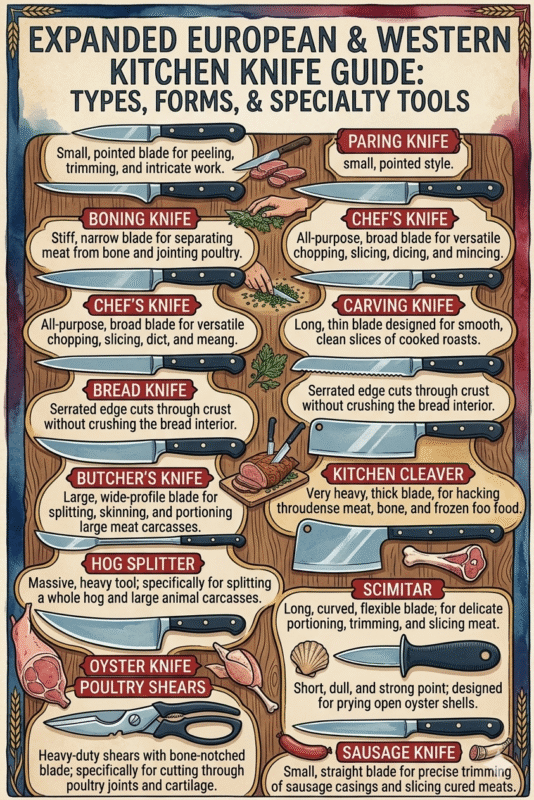
This comprehensive guide dives deep into the anatomy of a Western blade, classifies the 10 essential knife profiles
shown in our professional infographic, and outlines how to build a timeless knife collection that will endure for
decades.
The Anatomy of a European Kitchen Knives Blade: German vs. French Traditions
The signature performance of Western kitchen knives stems from their engineering. European cutlery is
characterized by a heavier build, a balance that tilts toward the handle, and integrated safety components designed
for prolonged use.
A definitive feature of the traditional German knife is the bolster—the thick steel transition between the blade and
the handle. The bolster flows down into a full heel, protecting the chef’s fingers from slipping onto the edge while
European Kitchen Knives: The Ultimate Guide 1
serving as a vital counterweight. The French cutlery school presents a sleeker profile: the cutting edge features a
straighter line, and the tip aligns more closely with the center axis of the blade.
Classic European knives prioritize a Full Tang construction, meaning the blade steel extends continuously through
the entire length of the handle, secured by three flush rivets. This creates an incredibly durable, impact-resistant
design that eliminates structural weak points.
Check Our Guide Carbon Steel vs Stainless Steel Knives: Which Is Better?
The Physics of Cutting: Toughness vs. Extreme Hardness of European Kitchen Knives
When selecting professional cutlery, the steel’s hardness rank on the Rockwell scale (HRC) dictates how it
performs. This is where Western and Eastern methodologies diverge completely.
Japanese blades are often hardened to extreme levels (61–65 HRC). While this makes them incredibly sharp, it also
renders them brittle and prone to chipping if they strike bone or a hard surface. Conversely, European kitchen
knives optimize for structural toughness and elasticity, tempering the steel to a flexible 56–58 HRC range. The
industry benchmark is a robust German formula: X50CrMoV15 (a chrome-molybdenum-vanadium alloy).
This metallurgy ensures that under heavy friction, the microscopic edge simply rolls slightly rather than microchipping.
It can be brought back to a razor-sharp alignment within seconds using a honing steel. The relationship
between edge longevity S, material toughness V, and the total sharpening angle pha is modeled as follows:
S = k \cdot rac{V}{\sin( pha)}
With a standard total edge angle of 35^{\circ}–40^{\circ} (17.5^{\circ}–20^{\circ} per side), European knives
maximize impact resistance and general utility.
Check Our Guide What Is HRC? Understanding Rockwell Hardness in Kitchen Knives
A Complete Breakdown: 10 Essential European Kitchen Knives Profiles
Let’s break down the classic knife profiles featured in our infographic, analyzing their specific roles in modern food
preparation.
Chef’s Knife (The Essential Workhorse)
The undisputed king of the kitchen workstation. Featuring a broad blade ranging from 8 to 10 inches, it is
instantly recognizable by the curved slope of its edge, often called the “belly.” This curved geometry
facilitates a continuous “rocking” motion on the cutting board, making it ideal for dicing large batches of
vegetables, slicing meats, and chopping herbs swiftly.
Paring Knife (The Detail Specialist)
The counter-balance to the massive chef’s knife. It features a short, nimble 3-to-4-inch blade with a precise
tip. Designed primarily for off-board intricate work, it excels at peeling fruits, coring vegetables, trimming
blemishes, and performing delicate tasks where absolute control is required.
Bread Knife (The Serrated Specialist)
A long, rigid blade lined with prominent scalloped serrations. It acts exactly like a hand saw. The teeth
puncture the hard, caramelized crust of sourdoughs, baguettes, or pastries without exerting downward
pressure, keeping the soft, airy interior from compressing or tearing apart. It is also excellent for slicing waxy
skins like tomatoes.
Boning Knife (The Butchery Core)
A narrow, stiff blade with a distinct upward swoop near the heel. Engineered specifically to separate raw meat
from bone, tendon, and connective tissue. The narrow profile minimizes drag against muscle fibers, while the
stiff spine gives the chef the leverage required to maneuver tightly around complex bone structures.
Carving/Slicing Knife (The Presentation Tool)
A long, low-profile knife built to slice cooked meats like prime rib, roast turkey, or baked hams into uniform,
clean slices. The elongated blade allows for single-stroke pulls, which prevents the meat from tearing. Its
narrow surface area reduces friction, preserving precious juices within the meat.
Butcher’s Knife (The Primal Cutter)
A robust tool that curves dramatically upward into a broad tip (resembling a scimitar). It is designed to dress
carcasses, segment large primal cuts, and skin game. The weight distribution helps split large muscle groups
cleanly in a single sweep.
Kitchen Cleaver (The Heavy-Duty Impact Tool)
The heaviest blade in Western cutlery, boasting a thick spine (up to 5mm) and a wide rectangular face. The
cleaver is built exclusively for high-impact chopping. It drives cleanly through dense bones, thick frozen
meats, and stubborn joints. It features an obtuse, durable edge angle optimized for force rather than thin
slicing.
Fillet Knife (The Seafood Master)
Often confused with a boning knife, a true fillet knife has a significantly thinner profile and a highly flexible blade. It is tailor-made to glide seamlessly over the delicate rib cages of fish, separate flesh from
skin, and contour around organic shapes with absolute fluid grace.
Building the Ultimate Collection: The European Kitchen Knives “Chef’s Trio” Rule
Kitchen retail stores often market excessive 15-piece knife block sets. However, professional chefs know that a vast
majority of daily culinary tasks can be handled flawlessly by just three core knives. This industry philosophy is
known as the “Chef’s Trio”:
The Anchor: An 8-inch European Chef’s Knife for 80% of your slicing and chopping needs.
The Utility: A 5-to-6-inch Boning or Utility Knife for handling poultry and smaller proteins.
The Finisher: A 3.5-inch Paring Knife for detail peeling and delicate scoring.
Specialized pieces like bread saws, heavy cleavers, and ultra-flexible fish fillet knives should be integrated as
individual investments, tailored directly to your personal cooking frequency and menu choices.
“Invest in quality over quantity. A single perfectly balanced, fully forged chef’s knife will yield a safer, more
enjoyable culinary experience than an array of cheap, un-honed utility blades.”
Knife Maintenance of European Kitchen Knives: Protecting Your Investment
While European stainless steel is celebrated for its incredible resistance to stains and physical corrosion, adhering
to basic care protocols will keep your edge pristine:
Never use the dishwasher! Aggressive detergent salts and high temperatures strip handles of moisture and
rapidly dull the sharp micro-edge. Wash your knives by hand with mild dish soap and warm water, and dry them
immediately.
Use appropriate cutting surfaces. Avoid glass, marble, stone, or ceramic plates. These rigid surfaces collapse
the fine apex of the blade instantly. Use premium wooden cutting boards (preferably end-grain) or high-density
food-grade plastics.
Check Our Guide Kitchen Knife Care Guide
Conclusion: A Legacy on Your Countertop
Store correctly. Do not drop loose cutlery into kitchen drawers where metal blades hit against one another.
Utilize wall-mounted magnetic strips, in-drawer cork slots, or wooden counter blocks to protect the exposed
edges.
Choosing European kitchen knives is an investment in time-tested engineering. Their robust steel composition,
ergonomic full-tang rivets, and integrated protective bolsters make them dependable companions for home cooks
and executive chefs alike. Use our custom infographic as a reference guide to expand your toolkit, focus on proper
care, and elevate your culinary journey!
European Kitchen Knives
https://yashkadesigns.com/exclusive-chef-knives
https://yashkadesigns.ecrater.com/c/2444221/boning-knives
European Kitchen Knives
European Kitchen Knives
European Kitchen Knives
European Kitchen Knives