Wootz Steel
An Independent Guide
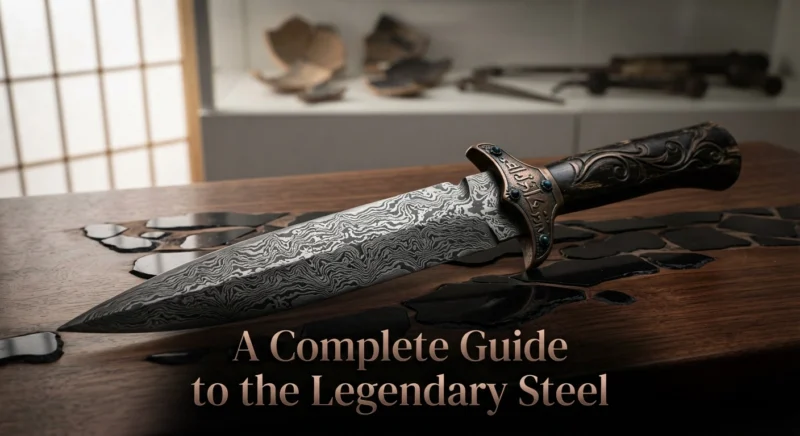
Wootz steel is one of the most famous materials in the history of blades. For centuries, swords made from this unusual crucible steel were associated with exceptional craftsmanship, beautiful watered patterns, and a level of performance that fascinated craftsmen and scientists long after the original production traditions had disappeared.
Today, the word wootz is often mixed together with terms such as Damascus steel, bulat, crucible steel, and pattern-welded Damascus. Modern knife marketing has made the situation even more confusing. A blade with a swirling pattern may be described as Damascus, but that does not necessarily mean it has anything in common with historical wootz.
The distinction matters because wootz is not simply a decorative pattern. Traditional wootz was a particular type of high-carbon crucible steel, and its characteristic appearance came from its internal metallurgical structure. The pattern was created by the distribution and transformation of carbides during production and forging rather than by welding together alternating strips of different steels.
This makes wootz fundamentally different from most modern Damascus knives.
At the same time, the legendary reputation of wootz needs some qualification. Historical blades could certainly be remarkable, but not every wootz blade was automatically superior to every other steel. Carbon content, impurities, forging, heat treatment, blade geometry, and the skill of the smith all mattered.
This guide explains what wootz actually was, where it came from, how it was made, why its pattern developed, how it differs from modern Damascus, and what the word bulat means in the history of crucible steel.
1. What Is Wootz Steel?
Wootz is a historical form of crucible steel, traditionally associated particularly with South Asia.
The simplest definition is:
Wootz is a high-carbon crucible steel whose characteristic surface pattern results from its internal carbide structure and subsequent forging and finishing.
That definition immediately separates wootz from most modern pattern-welded Damascus.
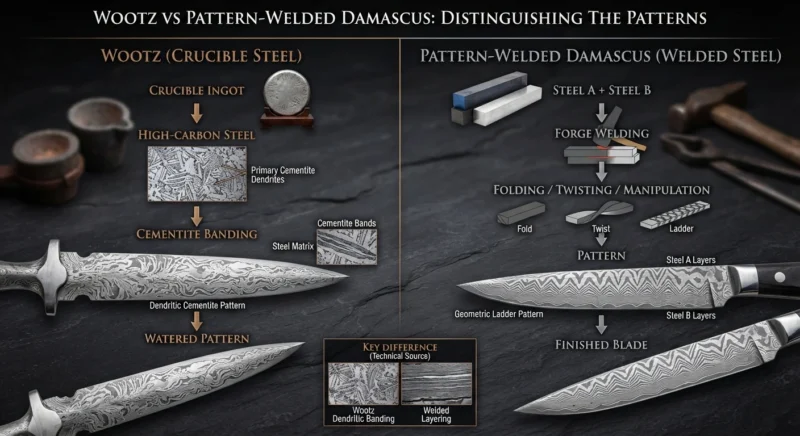
In pattern welding, a smith starts with separate pieces or layers of iron and steel, forge-welds them together, and manipulates the billet by folding, twisting, cutting, or other techniques. The visible pattern corresponds to the welded layers.
Wootz works differently.
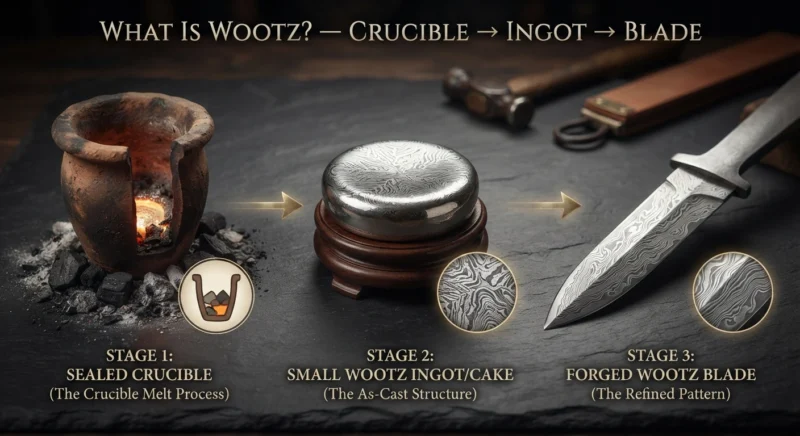
Traditional crucible steelmaking involved placing iron or steel-making materials together with a carbon source inside a closed crucible and heating the charge until a high-carbon steel ingot was produced. Depending on the historical process, the starting materials, temperatures, crucible construction, and carbon source could vary.
The resulting ingot was not normally the finished sword blade. It was a small cake or ingot of steel that had to be carefully forged into the desired shape.
This forging stage was critical.
Historical wootz could contain a high concentration of carbon, often around the range associated with hypereutectoid or ultra-high-carbon steel. Modern investigations of historical blades have found carbon contents commonly around approximately 1–1.6% in many examples, although historical wootz production was not a single standardized recipe.
At these carbon levels, iron carbide, known as cementite (Fe₃C), becomes extremely important to the microstructure.
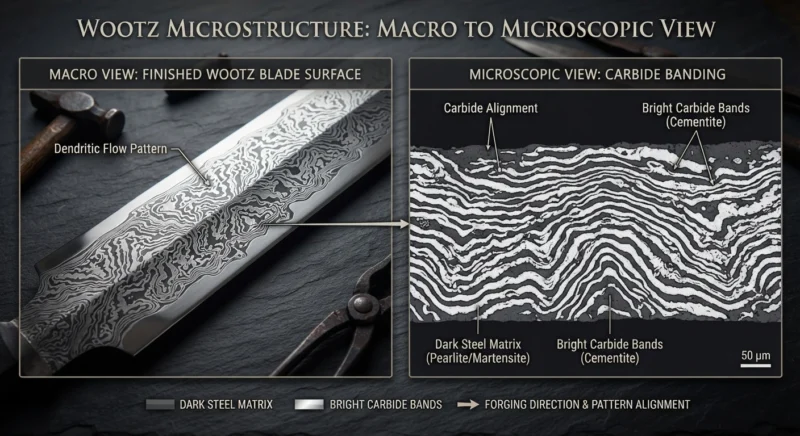
When the material was produced and subsequently forged under suitable conditions, the cementite could become concentrated into bands or networks. After polishing and etching, these structures became visible as the famous watered or flowing pattern.
That is why the pattern is more than decoration.
It is an expression of the steel’s internal structure.
Wootz is not simply “steel with a Damascus pattern”
This distinction is worth emphasizing.
A modern knife can have a beautiful Damascus pattern without being wootz. Conversely, a historical crucible-steel blade can be wootz even though its pattern looks very different from the high-contrast swirls seen on modern Damascus kitchen knives.
The manufacturing route is the key distinction.
Wootz:
- Crucible-produced steel
- High carbon content
- Cast as an ingot or cake
- Carefully forged
- Pattern associated with carbide distribution
- Historically associated with India, Persia, Central Asia, and the broader Islamic world
Pattern-welded Damascus:
- Multiple pieces or layers of steel/iron
- Forge-welded together
- Pattern manipulated mechanically
- Modern versions commonly use different steel alloys
- Pattern comes from the welded composite structure
Both can be excellent blade materials, but they are not the same process.
Check Our Guide What Is Damascus Steel? History, Benefits, and Why It Remains Popular Today
2. What Does “Bulat” Mean?
Bulat is a historical term associated with crucible steel in the Persianate, Central Asian, and Russian worlds.
The word is closely related to terms derived from Persian pulad/fulad, meaning steel. In Russian, булат (bulat) became associated with the legendary patterned steel used for blades.
The terminology is complicated because different languages and regions used different words for related materials.
Depending on historical context, terms such as:
- wootz
- ukku
- pulad
- fulad
- bulat
- bulad
- jauhar
- Indian steel
- Damascus steel
can appear in discussions of high-carbon crucible steels.
They should not automatically be treated as perfectly interchangeable technical terms.
Wootz and bulat
A useful modern distinction is:
Wootz generally refers to the Indian/South Asian crucible-steel tradition and the material that became the basis of many famous patterned Damascus blades.
Bulat is a later and geographically broader term, particularly associated with Persian, Central Asian, and Russian traditions of crucible steel and patterned blade steel.
In practical knife discussions, however, the two words are often used almost interchangeably.
That is why a modern maker may describe a blade as wootz, bulat, or wootz Damascus even though the historical terminology was considerably more complicated.
The safest approach is to ask what the maker means by the term.
Does “bulat” mean:
- historically reconstructed wootz?
- modern crucible steel?
- a particular high-carbon alloy?
- a decorative steel made to reproduce a wootz-like pattern?
The word alone does not answer those questions.
3. The History of Wootz Steel
The history of wootz stretches across several regions and centuries, which makes it difficult to reduce to a single invention story.
The most important point is that crucible steel technology developed in multiple historical contexts, while the particular wootz tradition became strongly associated with the Indian subcontinent.
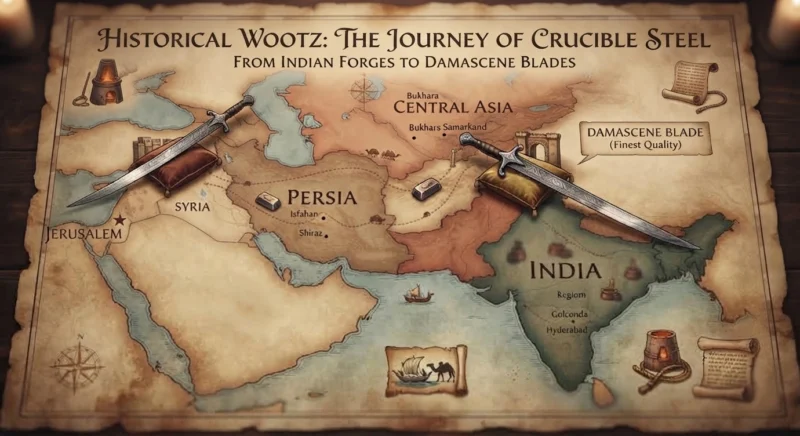
Archaeological and historical research points to ancient crucible-steel production in South Asia, with later production and trade networks connecting India with the Middle East, Persia, and Central Asia.
Small crucible-steel ingots could be transported over long distances. Swordsmiths did not necessarily produce the steel themselves. A specialized metallurgical producer could make the steel cakes, while a different craftsman purchased the material and forged it into blades.
This division of labor is important for understanding why the finished swords became associated with places such as Damascus.
The “Damascus” connection
The name Damascus steel creates a common historical misunderstanding.
It is tempting to assume that Damascus was where the original steel was invented.
The historical picture is more complicated.
Indian crucible steel was traded westward, and swordsmiths in the Middle East and Central Asia used imported crucible-steel ingots to produce blades. Damascus became one of the most famous centers associated with these weapons.
As a result, Western writers eventually used “Damascus steel” for the material.
In other words, the famous blade could be made in one region from steel produced in another.
This is similar to many historical luxury materials: the location where a finished product became famous is not necessarily the location where the underlying material was invented.
Wootz and the development of metallurgy
Wootz also played an important role in the history of modern metallurgy.
European scientists and metallurgists became fascinated by Damascus blades in the eighteenth and nineteenth centuries. Their efforts to understand the material contributed to the study of steel composition, microstructure, heat treatment, and phase transformations.
The mystery surrounding Damascus steel was therefore not merely a story about swords.
It became part of the development of modern materials science.
4. Where Did Wootz Originate?
The short answer is:
Wootz is strongly associated with ancient South India, but the exact origin and earliest date of crucible-steel production remain subjects of archaeological research.
South India contains important evidence for ancient iron and steel production, and later wootz production became associated with regions including parts of present-day Tamil Nadu, Karnataka, Andhra Pradesh, and Telangana.
Sri Lanka also developed important crucible-steel traditions.
This does not mean there was one single “wootz factory” from which all later production descended.
Instead, the technology appears to have existed within a broader network of metallurgical traditions.
Why the origin question is complicated
There are several reasons.
First, archaeological evidence is incomplete.
Second, crucible-steel production could leave relatively limited physical remains compared with large industrial furnaces.
Third, historical terminology was inconsistent.
A text may refer to “Indian steel,” “steel cakes,” or another regional name without giving us enough information to determine exactly which production technology was used.
Fourth, crucible steel was not necessarily invented once and then copied everywhere.
Different societies could develop related technologies independently or adapt techniques they acquired through trade.
For that reason, it is better to say that South Asia was a major and historically important center of wootz production than to claim that every form of ancient crucible steel originated from one specific workshop or location.
India and Sri Lanka
Sri Lanka deserves special attention.
Archaeological work has documented ancient iron and steel production on the island, including crucible-steel traditions. Research has suggested that Sri Lankan production may have had a partly independent development rather than simply being a direct copy of South Indian production.
This is another reason the history of wootz is better understood as a network of technological traditions than as a single straight line.
5. How Traditional Wootz Was Made
Traditional wootz production was fundamentally different from the production of modern pattern-welded Damascus.
The basic idea was to produce steel inside a crucible.
A simplified reconstruction looks like this:
- Prepare iron or steel-making material.
- Add a controlled carbon source.
- Place the charge inside a suitable crucible.
- Seal the crucible.
- Heat it to very high temperatures.
- Allow carbon to enter the iron.
- Produce a high-carbon steel ingot.
- Cool the ingot under controlled conditions.
- Carefully forge the ingot into a blade.
- Polish and etch the blade to reveal the structure.
The actual historical processes were much more complicated.
Different regions used different raw materials and production methods.
Some traditions involved carburizing relatively pure iron with organic materials. Others used different combinations of iron and carbon-rich materials. Historical accounts also describe different furnace designs and crucible arrangements.
The crucible was essential
The crucible created a controlled environment.
Instead of trying to refine iron in an open furnace and then repeatedly forge it into steel, the crucible allowed the metal to absorb carbon while protected from the surrounding atmosphere.
At sufficiently high temperatures, the metal could become liquid.
This is one of the important characteristics of crucible steel.
The process allowed the producer to create a relatively homogeneous high-carbon steel ingot compared with many earlier bloomery products.
Carbon was both the advantage and the challenge
High carbon was essential to producing the characteristic material.
But too much carbon could make steel extremely difficult to forge and potentially brittle.
This created a narrow processing window.
The producer needed enough carbon to create the desired steel and carbide structure, but the resulting ingot still had to be worked without destroying the desired microstructure or cracking the material.
This is one reason historical wootz production required specialized knowledge.
6. Why Wootz Develops Its Famous Pattern
This is the most important metallurgical section of the entire subject.
The famous wootz pattern does not come from layers of different steels being forge-welded together.
Instead, the pattern comes from the distribution of phases within the steel.
The most famous component is cementite, Fe₃C, an iron-carbide phase.
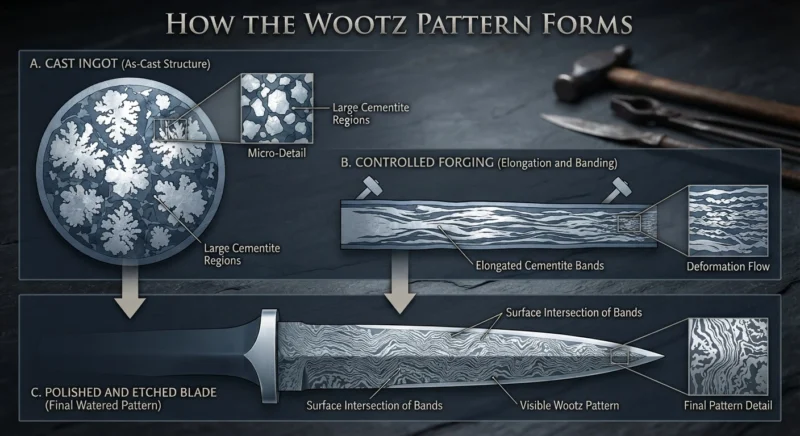
In suitable high-carbon wootz, cementite can form as relatively large particles or networks during solidification. Subsequent forging and thermal treatment can break up and redistribute this carbide structure.
Under appropriate conditions, the carbide particles become aligned into bands.
When the finished blade is polished and etched, the different microstructural regions react differently with the etchant.
The result is the characteristic contrast between light and dark areas.
From microstructure to visible pattern
Think of the process as three levels:
Level 1 — Chemistry
The steel contains a high concentration of carbon and other elements.
↓
Level 2 — Microstructure
Carbon combines with iron to form cementite and other structures. Alloying and impurity elements influence how these structures develop.
↓
Level 3 — Visible pattern
Forging and heat treatment redistribute the microstructure into bands. Polishing and etching make those bands visible.
The beautiful surface pattern is therefore a metallurgical fingerprint.
Why the pattern can look like flowing water
The pattern is not a simple straight line.
Forging stretches and deforms the internal structures. The resulting carbide bands can develop flowing, ribbon-like, or watered shapes.
Historical examples can show:
- fine waves
- large watery bands
- ladder-like structures
- rosette-like features
- flowing parallel lines
- complex “watered silk” patterns
The exact appearance depends on the original material and the forging process.
Pattern is connected to microstructure
This is one of the reasons genuine wootz is so interesting.
If you grind deeply into a modern surface coating, the pattern disappears.
With genuine patterned wootz, the pattern is related to the internal structure of the material.
That does not mean every visible pattern is proof of genuine wootz. Pattern-welded steel also has an internal structure that produces its visible pattern.
But the type of structure is different.
How Does the Wootz Pattern Form?
One of the most fascinating features of Wootz steel is its characteristic watered or “Damascus” pattern. Unlike modern pattern-welded Damascus, this pattern is not created by forge-welding alternating layers of different steels. It develops from the internal microstructure of a single crucible-steel ingot and is gradually shaped by forging and heat treatment.
The visible pattern is essentially a metallurgical record of what happened inside the steel during solidification, heating, forging, and cooling.
The Pattern Begins During Solidification
Traditional Wootz was a very high-carbon crucible steel, commonly around 1–1.6% carbon in studies of historical and reconstructed material. At these carbon levels, the steel is classified as hypereutectoid steel. As the molten steel cools and begins to solidify, its elements do not remain perfectly uniform throughout the ingot. Instead, solidification produces a dendritic structure, with subtle differences in chemical composition between the developing dendrite regions and the spaces between them.
This process is called microsegregation.
Certain alloying or impurity elements can become concentrated preferentially in the interdendritic regions. In different Wootz materials, researchers have identified elements such as vanadium, chromium, manganese, phosphorus, and others as potentially important to the formation and preservation of the characteristic structure. The exact chemistry was not identical in every historical Wootz-producing region, which is one reason why ancient blades do not all have exactly the same pattern. (ScienceDirect)
The important point is that the original ingot can contain a chemical and structural “map” that is invisible to the naked eye.
Cementite Is Central to the Classic Pattern
The most important phase associated with the classic Wootz pattern is cementite, an iron-carbon compound with the chemical formula Fe₃C.
In suitable high-carbon Wootz compositions, cementite particles can exist within the steel’s iron-rich matrix. Some of these particles are relatively coarse, while others are much finer. During processing, their size, distribution, and alignment can change significantly.
Scientific studies of Wootz and reconstructed Damascus blades have shown that the characteristic surface pattern is associated with bands or clusters of cementite particles. These bands are not simply layers that were present as perfectly formed stripes in the original ingot. Instead, the structure develops and becomes more strongly organized during subsequent thermal and mechanical processing. (ScienceDirect)
This distinction is important. The famous pattern is not simply “cast into” the steel like a decorative design.
What Happens During Forging?
After casting, the Wootz ingot must be forged into a usable blade. This is where the original microstructure begins to change dramatically.
The ingot is heated and mechanically deformed. Repeated heating and cooling cycles cause cementite particles to partially dissolve and re-form. At appropriate temperatures, smaller particles can dissolve while larger particles grow. Because the original ingot contains regions with slightly different concentrations of alloying elements, this process does not necessarily occur uniformly throughout the material.
Research by Verhoeven and colleagues found strong evidence that very small amounts of carbide-forming elements can encourage cementite to coarsen preferentially in particular regions of the steel. In suitable compositions, this produces aligned bands of cementite particles during the thermal cycling associated with forging. (ScienceDirect)
The forging operation then stretches these regions in the direction of deformation.
A useful way to visualize this is to imagine a three-dimensional structure containing slightly different zones. When that structure is repeatedly compressed and elongated by forging, the zones become stretched into elongated sheets or bands. The resulting microstructure is directional rather than random.
This is one reason the finished Wootz pattern often has a flowing, watered appearance.
Why Does the Pattern Look Like Waves or Water?
The visible pattern on a blade is not necessarily the same shape as the three-dimensional cementite structure inside the steel.
A blade is a three-dimensional object, while the pattern is observed on a two-dimensional surface. The visible design is produced where the blade surface intersects the internal bands of cementite-rich material.
This is somewhat analogous to cutting through a piece of wood: the three-dimensional structure inside the material can produce very different visual patterns depending on the direction and position of the cut.
Research using modern metallographic techniques has shown that the intersection of coarse carbide bands with the blade surface contributes directly to the characteristic watered appearance of Wootz. (ScienceDirect)
Consequently, the forging direction, amount of deformation, blade geometry, and the exact location of the surface can all influence how the final pattern appears.
Why Are the Cementite Bands Not Simply Present from the Beginning?
This is one of the most interesting aspects of Wootz metallurgy.
Early explanations suggested that the characteristic carbide structure could be produced directly during solidification, with cementite forming between the dendrites of the original casting. Later experimental work demonstrated that this explanation is too simple.
Research on reconstructed Wootz showed that the original segregation of alloying elements in the cast ingot provides important conditions for later band formation, while repeated thermal cycling during forging promotes the selective growth and alignment of cementite particles. In other words, the casting establishes the chemical conditions, but subsequent processing helps transform those conditions into the recognizable banded structure. (ScienceDirect)
There is also evidence from studies of ancient blades that coarse cementite particles may survive repeated forging and influence the formation of later cementite during cooling. This means that the final structure can be the result of several overlapping metallurgical processes rather than one single event. (ScienceDirect)
Heat Treatment Can Make or Break the Pattern
The pattern is also highly sensitive to heat treatment.
Cementite is not a completely inert decoration embedded permanently in the steel. At sufficiently high temperatures, it can dissolve into the austenite. If the steel is heated too aggressively or held at an unsuitable temperature for too long, the cementite structure responsible for the visible pattern can be greatly reduced or even effectively erased.
Experimental studies on reconstructed Damascus material have demonstrated that cementite bands can disappear after complete austenitization. Under appropriate subsequent thermal cycling, however, cementite can precipitate again in a banded morphology if the conditions preserve the underlying chemical segregation. (ScienceDirect)
This helps explain why producing attractive Wootz is not simply a matter of making a high-carbon steel and forging it into a blade. The thermal history is critical.
The smith must work within a relatively narrow range of conditions where the steel can be forged while preserving and developing the desired carbide structure.
Why Does Etching Reveal the Pattern?
Before finishing, the Wootz pattern may be subtle or difficult to see.
Polishing creates a smooth surface, but the different microstructural regions still interact with light differently. Etching then selectively attacks the steel matrix and changes the appearance of regions with different compositions and microstructures.
Cementite-rich areas and the surrounding iron-based matrix do not respond identically to polishing and etching. The resulting difference in reflectivity and surface texture makes the previously microscopic structure visible as contrasting bands, waves, or watered markings.
The acid therefore reveals the pattern rather than creating it.
This distinction is important: etching cannot manufacture a genuine Wootz pattern in an otherwise uniform steel. It exposes differences that already exist in the blade’s microstructure.
Why Every Wootz Blade Looks Different
There was never one universal Wootz recipe that produced exactly one standardized pattern.
Historical Wootz was produced over a very large geographical area and across many centuries. The raw materials, carbon content, trace elements, crucible conditions, cooling rates, forging practices, temperatures, and heat treatments could all vary.
Even small differences in the concentration of carbide-forming elements can affect the development of cementite bands. Modern reproduction studies have demonstrated that elements such as chromium can play an important role in producing the layered microstructure under suitable conditions. (Wiley Online Library)
The result is that two ingots can both qualify as Wootz while producing substantially different patterns after forging and finishing.
Some blades display fine, closely spaced waves. Others show larger watery bands, rosettes, ladder-like features, or more subtle patterning. The appearance depends on the underlying microstructure and how that structure was transformed by forging and heat treatment.
Wootz Pattern Formation in One Sequence
The entire process can therefore be simplified into a chain:
Crucible melting → solidification and microsegregation → formation of carbide/cementite structure → repeated heating and forging → selective carbide coarsening and alignment → heat treatment → polishing → etching → visible Wootz pattern.
This is fundamentally different from pattern-welded Damascus, where the visible pattern is deliberately created by stacking, forge-welding, deforming, and manipulating different pieces or layers of steel.
In Wootz, the pattern is a consequence of the internal metallurgical structure of the steel itself.
That is what makes genuine Wootz particularly interesting from a materials-science perspective. The finished watered pattern is not merely a decorative surface treatment. It is the visible expression of a complex microstructure that began forming when the molten steel first solidified and continued to evolve throughout forging and heat treatment.
There is still some debate over the precise contribution of individual alloying and impurity elements and the relative importance of different stages of carbide formation in historical Wootz. Modern research therefore does not reduce the phenomenon to a single universal mechanism. What is well established is the central role of high carbon content, cementite or carbide structures, chemical segregation, thermal cycling, forging, and controlled finishing in producing the characteristic Wootz appearance.
Check Our Guide Cu-Mai, Mokume-gane and Titanium Damascus
7. Wootz vs Damascus Steel — Are They the Same?
The answer depends on how the term Damascus steel is being used.
Historically, the phrase has been used for more than one type of patterned blade steel.
Today, however, it is useful to distinguish between:
Historical wootz Damascus
A high-carbon crucible steel whose characteristic pattern results from carbide structures developed within the steel.
Pattern-welded Damascus
A composite made by forge-welding different steels or iron/steel components and manipulating them to create a pattern.
Both can be called “Damascus.”
That is the source of much of the confusion.
Why modern knife buyers encounter the problem
In today’s knife market, “Damascus” usually means pattern-welded steel.
A typical modern Damascus billet might contain two steels with different alloying compositions. The billet is welded, forged, manipulated, and etched.
The resulting blade can be beautiful and functional.
But it is not automatically wootz.
Wootz is a different technology
A simplified comparison:
Wootz
- Crucible steel
- High carbon
- Single steel ingot rather than a stack of welded layers
- Cementite-rich microstructural pattern
- Historically associated with Indian steel and Middle Eastern blades
Pattern-welded Damascus
- Forge-welded composite
- Often multiple steel alloys
- Pattern deliberately manipulated through forging
- Contrast revealed through etching
- Dominant form of “Damascus” in modern knife making
The two should not be treated as synonyms when discussing metallurgy.
8. Wootz vs Modern Damascus
Modern Damascus is not necessarily inferior simply because it is different.
That is an important distinction.
A properly made modern pattern-welded blade can have excellent properties.
Its performance depends on:
- the steels selected
- carbon content
- alloy composition
- billet quality
- welding quality
- heat treatment
- blade geometry
- edge thickness
- grinding
- final hardness
The number of visible layers does not automatically determine performance.
Likewise, the presence of a spectacular wootz pattern does not automatically make a blade superior.
Different sources of pattern
With modern Damascus, the pattern is engineered by manipulating the welded billet.
With wootz, the pattern originates from the internal solidification and deformation behavior of the high-carbon steel.
This produces two very different metallurgical stories.
Different visual signatures
Modern Damascus often produces:
- bold waves
- twists
- ladders
- raindrop patterns
- mosaics
- geometric designs
Wootz more commonly produces:
- fine watering
- flowing bands
- crystalline-looking structures
- subtle waves
- “watered silk” effects
Of course, modern makers can produce many variations, so appearance alone should never be treated as definitive proof of the manufacturing method.
9. Wootz vs Crucible Steel
This comparison is slightly different because wootz is itself a type of crucible steel.
Think of it this way:
Crucible steel is the broader category; wootz is a historically important patterned high-carbon form within that category.
Crucible steel means the steel was produced through melting or refining inside a crucible rather than through the conventional bloomery route alone.
But not every crucible steel was wootz.
Different crucible-steel traditions existed in different regions and periods.
Some produced high-carbon steel without the distinctive watered pattern associated with wootz Damascus blades.
Why this distinction matters
A steel can be:
- crucible steel without being wootz
- wootz and therefore crucible steel
- modern crucible steel inspired by wootz
- pattern-welded Damascus that is not crucible steel
This is similar to the difference between a broad manufacturing category and a specific historical material tradition.
Wootz is best understood as a special subset
When discussing knives, a useful hierarchy is:
Crucible steel
→ historical Indian/South Asian traditions
→ wootz
→ patterned wootz used for famous Damascus blades
Modern crucible steels may follow related principles without reproducing the exact historical material.
10. What Made Historical Wootz Blades Special?
Historical wootz blades earned an extraordinary reputation.
There were real metallurgical reasons for this.
High-carbon steel can achieve high hardness when properly processed.
The cementite structure could contribute to wear resistance and edge behavior.
The blades could also have a combination of hardness and useful mechanical properties that made them attractive for weapons.
But there is an important difference between saying:
Historical wootz had unusual metallurgical characteristics.
and saying:
Every wootz sword was dramatically better than every other sword.
The second statement is not supported by the evidence.
The role of microstructure
Wootz could contain carbide structures that affected:
- hardness
- wear resistance
- edge stability
- deformation behavior
- fracture behavior
The distribution of the carbides mattered.
Large continuous carbide networks could increase brittleness, while carefully controlled structures could produce a better balance.
This is one of the central lessons of wootz metallurgy:
more carbide does not automatically mean better steel.
Blade geometry mattered too
A sword is not simply a piece of steel.
Performance depends on:
- blade thickness
- cross-section
- edge geometry
- curvature
- heat treatment
- forging quality
- grain structure
- final polishing
A remarkable steel cannot compensate for poor blade design.
Historical swordsmiths understood this through practical experience even without modern metallurgy terminology.
11. Was Wootz Actually Superior to Other Steels?
This is where the legend needs some careful qualification.
Wootz was certainly special, but “superior” is too broad a statement without defining what is being measured.
Superior in what?
- hardness?
- edge retention?
- toughness?
- corrosion resistance?
- ease of sharpening?
- resistance to impact?
- ability to take a very fine edge?
Different steels optimize different properties.
Historical advantages
Wootz offered an unusual combination of:
- high carbon
- high hardness potential
- distinctive microstructure
- excellent wear resistance under suitable conditions
- highly valued visual appearance
This made it extremely desirable for blades.
But high carbon has a cost
High-carbon steels can become less forgiving.
If carbide networks become excessive or impurities such as phosphorus are present at problematic levels, toughness can suffer.
Historical ore quality therefore mattered.
Modern steelmaking has an enormous advantage here because composition can be controlled much more precisely.
Modern steels can outperform historical wootz in specific properties
Modern powder metallurgy and alloy steels can be designed for specific combinations of:
- toughness
- wear resistance
- corrosion resistance
- edge retention
- stability
- heat-treatment consistency
So it would be misleading to claim that historical wootz is inherently better than modern knife steels simply because it is ancient or legendary.
Its importance is historical and metallurgical, not merely competitive.
12. Why Traditional Wootz Production Disappeared
The disappearance of traditional wootz is one of the most fascinating parts of its history.
There was no single universally accepted reason.
Several factors probably contributed.
Changing raw materials
Traditional crucible steelmaking depended on specific combinations of:
- iron sources
- carbon sources
- furnace conditions
- crucible materials
- temperature control
- local craftsmanship
Changes in raw materials could make the traditional process more difficult.
Industrial steelmaking
The nineteenth century brought increasingly efficient industrial steel production.
Large-scale steelmaking could produce much larger quantities of standardized material at lower cost.
Traditional small-batch crucible production became increasingly difficult to compete with.
Loss of specialized knowledge
The process was not simply a written recipe.
Much of the knowledge existed as practical craft experience:
- how to prepare the charge
- how much carbon to use
- how to construct the crucible
- how to judge temperature
- how long to hold the charge
- how to cool the ingot
- how to forge the high-carbon steel without cracking it
When production centers declined, parts of this knowledge disappeared.
Changes in weapon technology
Industrial-era warfare also reduced demand for traditional swordmaking.
As firearms became more important and military technology changed, there was less economic justification for maintaining specialized sword-steel traditions.
The combination of industrialization, changing markets, changing weapon technology, and the loss of specialized production knowledge contributed to the disappearance of the traditional industry.
13. Can Wootz Steel Be Made Today?
Yes.
Modern metallurgists and bladesmiths have demonstrated that wootz-like crucible steels can be produced today.
The difficulty is not simply melting iron and adding carbon.
The challenge is reproducing the right:
- composition
- impurity balance
- solidification behavior
- carbide structure
- thermal history
- forging schedule
- heat treatment
A modern maker can produce a crucible steel with a beautiful watered pattern, but reproducing a particular historical blade exactly is much more difficult.
Experimental archaeology
Researchers have spent decades investigating historical wootz.
Some experiments have successfully reproduced characteristic carbide structures and visible patterns.
Scientific investigation has included:
- metallography
- chemical analysis
- neutron diffraction
- neutron imaging
- microscopy
- experimental forging
- historical reconstruction
These techniques have helped demonstrate that the pattern is connected to real microstructural features rather than an unexplained surface phenomenon.
Why reproduction remains difficult
Historical recipes are incomplete.
Even when a historical text describes a process, we may not know:
- exact ore chemistry
- trace-element levels
- furnace temperature
- cooling rate
- crucible atmosphere
- forging temperature
- number of forging cycles
- exact heat-treatment schedule
Two makers following the same general recipe could therefore produce noticeably different steel.
14. Modern Wootz and “Wootz-Style” Steel
The modern market contains several different products that may be described as wootz.
They should not all be assumed to be identical.
Historical reconstruction
A maker attempts to reproduce the metallurgy of historical wootz as closely as possible.
This is the most historically focused category.
Modern crucible wootz
A contemporary maker uses crucible melting and carefully controlled composition to produce a steel with wootz-like microstructure and pattern.
The result may be inspired by historical material without being an exact reproduction.
Wootz-style steel
The phrase may be used more loosely for a steel that visually resembles historical wootz.
This is where buyers should be careful.
“Wootz-style” does not necessarily mean historical wootz metallurgy.
Why terminology matters
A knife advertised as:
“Wootz-inspired”
is making a different claim from:
“Modern crucible wootz”
and both are different from:
“18th-century Indian wootz blade”
The more specific the historical claim, the more evidence should be available.
15. Does a Wootz Pattern Prove a Knife Is Genuine Wootz?
No.
A visible watered pattern alone is not sufficient proof.
Pattern-welded Damascus can create patterns that resemble wootz.
Other steels can also be manipulated or etched to create decorative patterns.
A genuine wootz identification requires more than looking at the surface.
What specialists can examine
Depending on the situation, experts may investigate:
- chemical composition
- carbon content
- alloying elements
- carbide morphology
- carbide distribution
- microstructure
- forging history
- historical provenance
- manufacturing method
Advanced analysis can provide much stronger evidence than visual inspection.
What a buyer can do
Ask the maker:
- Is this crucible steel?
- Was the steel made as a cast ingot?
- What is the approximate carbon content?
- What alloying elements are present?
- Is the pattern produced by carbide banding?
- Is it pattern-welded?
- Is the material a historical reproduction or a modern interpretation?
- Can the maker explain the production process?
A serious maker should be able to explain the material without relying entirely on phrases such as “ancient secret” or “lost Damascus technology.”
Be cautious with historical claims
A modern blade cannot normally be assumed to contain ancient wootz simply because its pattern resembles a museum sword.
There is a major difference between:
“Made using modern wootz metallurgy.”
and:
“Made from original ancient wootz.”
The second claim requires extraordinary provenance.
16. Wootz Steel in Modern Knives
Wootz remains a niche material in modern knife making.
It is particularly attractive for:
- custom chef knives
- collector knives
- art knives
- historical reproductions
- high-end hunting knives
- swords
- traditional-style blades
Its appeal comes from the combination of metallurgy and appearance.
Unlike a conventional stainless steel blade, wootz can display a pattern that is closely connected to the material’s internal carbide structure.
Wootz kitchen knives
Wootz can be used for kitchen knives, but the buyer should understand that it is not a modern stainless steel.
Traditional or modern wootz-type materials can have:
- relatively high carbon
- limited corrosion resistance
- visible patina
- high hardness potential
- specialized sharpening requirements
For a kitchen knife, maintenance can therefore be more demanding than with a modern stainless steel.
Wootz as a collector material
For collectors, the historical connection may be more important than simple cutting performance.
A wootz knife can represent:
- ancient metallurgical technology
- experimental archaeology
- traditional craftsmanship
- historical swordmaking
- the development of modern metallurgy
That makes it interesting even when modern steels outperform it in some measurable property.
17. How to Recognize Genuine Wootz
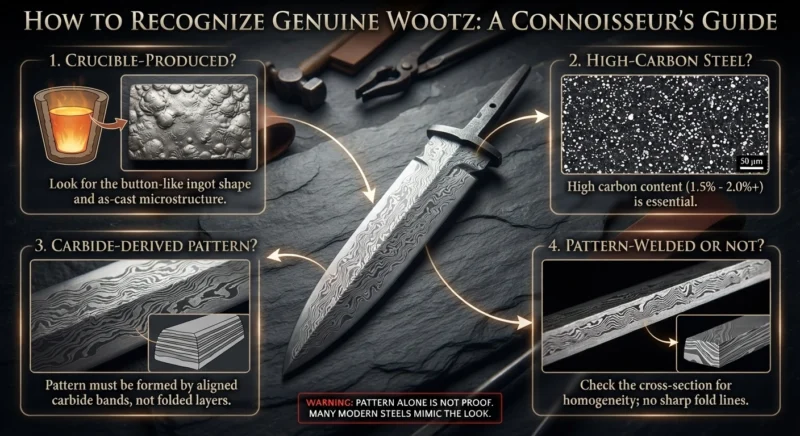
There is no reliable “look at the pattern and you will know” test.
Still, there are several clues.
1. Ask about the manufacturing process
The maker should be able to explain that the steel originated from a crucible-produced ingot rather than a stack of forge-welded sheets.
2. Look at the pattern
Wootz often has a more organic, fine, watery pattern rather than the dramatic geometric patterns common in modern Damascus.
But this is only a clue.
It is not proof.
3. Ask about the steel chemistry
A serious maker should know at least the approximate composition.
A high-carbon composition is expected, although exact historical compositions varied.
4. Ask how the pattern was created
This is perhaps the most useful question.
If the maker says:
“Two steels were forge-welded together and twisted.”
you are looking at pattern-welded Damascus.
If the maker describes:
“crucible melting → cast ingot → controlled forging → carbide banding”
that is consistent with wootz metallurgy.
5. Look for metallurgical evidence
For expensive historical reproductions or museum-level work, metallographic analysis can provide much stronger evidence.
A surface photograph cannot replace microstructural analysis.
18. Care and Maintenance of Wootz Blades
Care depends on the exact alloy used today, but traditional-style wootz should generally be treated as a high-carbon, non-stainless steel unless the maker specifically states otherwise.
That means moisture deserves attention.
Keep the blade dry
After use:
- Wash or wipe the blade.
- Dry it completely.
- Apply a suitable food-safe protective oil if appropriate.
- Store it somewhere dry.
Do not leave a carbon-steel blade wet in a sink.
Expect patina
Patina is not necessarily damage.
Carbon steel can naturally develop darker or grayish surface coloration as it reacts with its environment.
On a patterned wootz blade, patina can alter the contrast between the carbide-rich regions and the steel matrix.
Some collectors prefer the original polished-and-etched appearance, while others appreciate natural aging.
Avoid aggressive polishing
Aggressive abrasives can alter the visible pattern.
If the pattern has been revealed through controlled polishing and etching, unnecessary polishing may reduce contrast or remove the finish.
Avoid harsh chemicals
Strong acids or inappropriate cleaning chemicals can damage the finish.
If the blade has a deliberately etched wootz pattern, maintenance should be conservative.
Sharpening
Use a controlled sharpening system appropriate for high-carbon steel.
Avoid overheating the edge during powered sharpening.
The edge is already a carefully heat-treated region, and excessive heat can change its microstructure.
19. Wootz vs Cu-Mai vs Mokume-gane vs Damascus
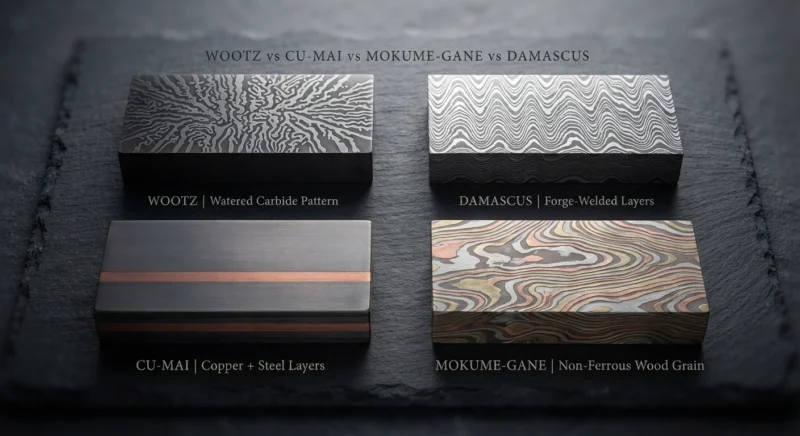
These four materials can all produce visually striking patterns, but they are fundamentally different.
| Material | Basic construction | Where the pattern comes from | Typical knife application |
|---|---|---|---|
| Wootz | High-carbon crucible steel | Carbide-rich microstructure | Blade |
| Modern Damascus | Forge-welded steels | Welded layers manipulated during forging | Blade |
| Cu-Mai | Steel with copper-containing layers | Layered steel/copper construction | Blade |
| Mokume-gane | Bonded contrasting metals | Deformed and selectively worked metal layers | Handles, fittings, decorative components |
Wootz vs modern Damascus
This is the most important comparison.
Wootz is a crucible steel.
Modern Damascus is usually pattern-welded steel.
The patterns can look similar, but the internal structures are fundamentally different.
Wootz vs Cu-Mai
Cu-Mai incorporates copper into a layered steel construction.
Wootz does not get its pattern from copper layers.
Its characteristic appearance comes from carbide structures within high-carbon steel.
Cu-Mai can therefore show strong copper-colored lines, while wootz usually has a more subtle gray, silver, or dark watered appearance.
Wootz vs mokume-gane
Mokume-gane is primarily a decorative non-ferrous metalworking tradition.
It can use copper, silver, gold, brass, shakudō, shibuichi, and other compatible metals.
It is not a blade steel in the same sense as wootz.
The name itself refers to the wood-grain appearance created by manipulating layered metals.
Wootz vs crucible steels
Wootz is a particular historical type of crucible steel.
Therefore:
All wootz is crucible steel, but not all crucible steel is wootz.
This is one of the simplest ways to remember the distinction.
20. Frequently Asked Questions
Is wootz the same as Damascus steel?
Not exactly.
Historical Damascus blades were often made from wootz crucible steel, which is why the terms became associated with each other. However, modern “Damascus” usually refers to pattern-welded steel, which is produced differently.
Is wootz steel made by folding steel?
Traditional wootz was not made by repeatedly folding welded layers like modern pattern-welded Damascus.
The steel was produced as a crucible ingot and then carefully forged.
Why does wootz have a pattern?
The pattern is associated with carbide structures, especially cementite, that develop during solidification and are modified during forging and thermal treatment.
Polishing and etching reveal the structure.
Is wootz stronger than modern steel?
There is no simple yes-or-no answer.
Wootz can have excellent hardness and wear characteristics, but modern steels can be specifically engineered for combinations of hardness, toughness, corrosion resistance, and wear resistance that historical steels could not consistently match.
Is wootz stainless?
Traditional wootz should generally not be considered stainless.
Its high-carbon composition and historical production methods did not provide the chromium levels normally associated with modern stainless steels.
Does real wootz have to show a pattern?
Historically produced crucible steel did not necessarily produce the dramatic visible pattern associated with famous Damascus blades.
The characteristic pattern depends on composition, solidification, forging, and finishing.
Therefore, the absence of a dramatic pattern does not automatically prove that a crucible steel is not genuine.
Can wootz be made today?
Yes.
Modern researchers and bladesmiths have reproduced wootz-like crucible steels and characteristic carbide patterns.
However, reproducing the exact material of a particular historical blade is considerably more difficult.
What is bulat steel?
Bulat is a historical term associated with patterned crucible steel, particularly in Persian, Central Asian, and Russian contexts.
It is closely related to the Persian terminology for steel and is commonly associated with wootz-type materials.
Is bulat the same as wootz?
The terms overlap strongly in modern usage, but their historical contexts are different.
“Wootz” is particularly associated with Indian/South Asian crucible steel, while “bulat” became a broader term in Persianate, Central Asian, and Russian traditions.
Is wootz better than Damascus?
That comparison is not useful without defining what “better” means.
Wootz and modern pattern-welded Damascus are different materials made through different processes.
The performance of either depends heavily on composition, heat treatment, geometry, and workmanship.
Is every wootz knife a historical knife?
No.
Most modern wootz knives are newly made using modern materials and modern reproduction techniques.
A modern knife can be genuine wootz in the sense that it is made from a modern wootz-type crucible steel, without being made from ancient steel.
Can you tell genuine wootz from a photograph?
Usually not with confidence.
A photograph can provide clues, but definitive identification requires information about the manufacturing process and, for high-confidence analysis, metallurgical examination.
Why was Damascus steel so famous?
The famous Damascus blades combined several things:
- high-carbon steel
- advanced crucible metallurgy
- skilled forging
- useful mechanical properties
- distinctive surface patterns
- rarity
- long-distance trade
- cultural prestige
The combination made them exceptional luxury weapons in their historical context.
Did ancient smiths know why the pattern appeared?
Probably not in the language of modern metallurgy.
They possessed practical knowledge of materials, temperatures, forging, and processing that could be transmitted through craft traditions without knowledge of modern concepts such as phase diagrams, cementite, diffusion, or carbide precipitation.
A smith did not need to know the microscopic mechanism in order to control it successfully.
What caused the original wootz tradition to disappear?
There was probably no single cause.
Industrial steel production, changing weapon technology, changing markets, raw-material changes, and the loss of specialized craft knowledge all likely contributed.
Is wootz still relevant to modern knife making?
Yes, particularly for custom knives, historical reproductions, collectors, and makers interested in traditional metallurgy.
Its greatest modern value is not simply that it is “old.”
Wootz is an important example of how sophisticated material properties can emerge from carefully controlled processing even without modern scientific theory.
Conclusion: Why Wootz Still Matters
Wootz steel occupies a unique position in the history of blades.
It was not simply an ancient version of modern Damascus, and it was not merely a decorative steel with a mysterious pattern.
It was a sophisticated form of crucible metallurgy in which composition, melting, solidification, forging, thermal treatment, and finishing interacted to create a distinctive high-carbon material.
Its famous pattern is particularly important because it reveals something about the steel’s internal structure.
That is the fundamental difference between understanding wootz as a material and simply admiring it as decoration.
The steel became famous through a combination of metallurgical properties, craftsmanship, trade, cultural prestige, and the remarkable appearance of the finished blades. Over time, the word “Damascus” became attached to several different types of patterned steel, creating much of the terminology confusion that remains today.
Modern pattern-welded Damascus can be excellent.
Modern wootz can also be excellent.
Cu-Mai and mokume-gane can produce completely different but equally fascinating visual effects.
None of these materials needs to be confused with another to be valuable.
For knife enthusiasts, the most useful lesson is therefore simple:
Do not judge a patterned blade only by its appearance. Ask how the material was made, what its composition is, how it was heat-treated, and where the visible pattern actually comes from.
With wootz, the pattern is not merely decoration.
It is a window into the history and microstructure of one of the most fascinating steels ever made.
https://onlinelibrary.wiley.com/doi/abs/10.1111/j.1600-0692.2004.00672.x