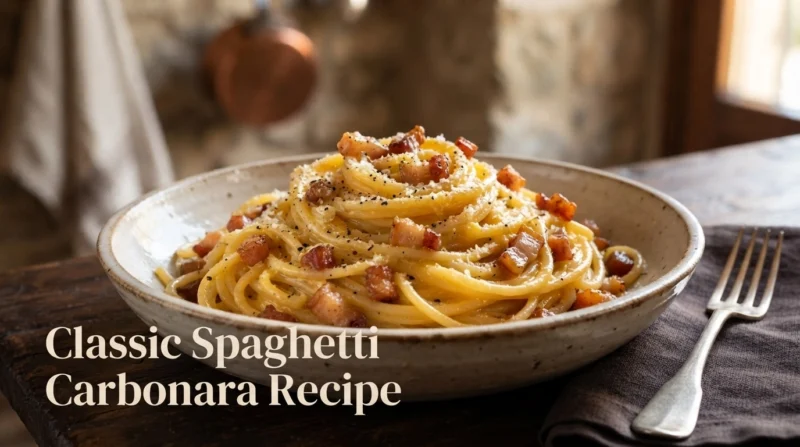
Spaghetti Carbonara
Classic Carbonara is one of those dishes that looks deceptively simple. The ingredient list is short, the cooking time is quick, and there is no complicated sauce to prepare. Yet a truly good Carbonara requires careful timing and a little technique.
The goal is a pasta dish with a silky, creamy-looking sauce that coats every strand of spaghetti, with crisp pieces of cured pork, plenty of freshly ground black pepper, and a rich savory flavor from Pecorino Romano and egg.
The important point is that traditional Carbonara does not need cream. Its creamy texture comes from the combination of egg, finely grated cheese, rendered pork fat, and starchy pasta water. When these ingredients are combined correctly, they create a smooth sauce without turning the eggs into scrambled eggs.
This recipe explains the entire process step by step, including how to control the temperature, how much pasta water to reserve, how to combine the eggs and cheese, and what to do if the sauce becomes too thick or starts to scramble.
What Is Classic Carbonara?
Carbonara is a traditional Italian pasta dish associated with Rome and the Lazio region.
The classic preparation is built around a small number of ingredients:
- spaghetti or another long pasta
- guanciale
- eggs
- Pecorino Romano
- freshly ground black pepper
- salt for the pasta water
That is essentially the dish.
There is no need for heavy cream, butter, garlic, onions, or a complicated sauce.
The simplicity is exactly what makes Carbonara so satisfying. Each ingredient has a specific job.
The guanciale provides rich pork flavor and rendered fat. The egg creates the body of the sauce. Pecorino Romano provides saltiness, sharpness, and savory depth. Black pepper adds warmth and fragrance. Pasta water supplies the starch and moisture needed to turn everything into a smooth coating.
Because there are so few ingredients, quality and technique matter.
Check Our Guide Best Italian Pasta Recipes: 15 Authentic & Easy Pasta Recipes for Every Occasion
Why Carbonara Can Be Difficult
Carbonara is not technically complicated, but it is very sensitive to temperature.
The most common problem is overheating the eggs.
If you put the egg mixture directly into a very hot pan over high heat, the eggs can cook too quickly. Instead of becoming a smooth sauce, they turn into small pieces of scrambled egg.
The opposite problem can also happen.
If the pan is too cool and you do not use enough heat or pasta water, the sauce may remain thick, sticky, or uneven instead of becoming silky.
The goal is to use residual heat and controlled temperature.
The hot pasta cooks the egg mixture gently while the rendered pork fat and starchy pasta water help emulsify everything into a sauce.
This is why the final mixing stage deserves as much attention as boiling the pasta.
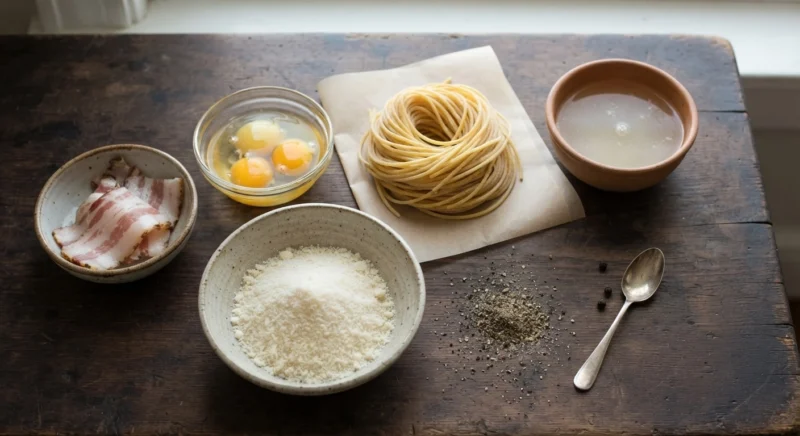
Ingredients
For 4 servings
Pasta
- 400 g spaghetti
- Water for cooking the pasta
- Salt for the pasta water
Carbonara Sauce
- 150 g guanciale, cut into small strips or cubes
- 4 large eggs
- 2 large egg yolks
- 100–120 g finely grated Pecorino Romano
- 1–2 teaspoons freshly ground black pepper
- About 250 ml reserved pasta water, as needed
These quantities give you a rich Carbonara with enough sauce to coat approximately 400 g of pasta.
You may not need all of the reserved pasta water. It is better to reserve more than you think you will need because the sauce can be adjusted gradually.
Understanding the Ingredients
Guanciale
Guanciale is cured pork jowl or cheek.
It is traditionally used in Roman pasta dishes and is particularly important in Carbonara because it contains enough fat to render beautifully while providing an intense pork flavor.
As the guanciale cooks slowly, the fat melts into the pan.
That rendered fat becomes part of the sauce.
If guanciale is unavailable, pancetta is a practical substitute. Bacon can also be used, although it has a smokier flavor and therefore produces a dish that is less traditional.
If authenticity is your priority, use guanciale.
Pecorino Romano
Pecorino Romano is a hard sheep’s milk cheese with a strong, salty, savory flavor.
It is an important part of traditional Carbonara.
Grate it very finely.
This is more important than many beginners realize.
Large pieces of cheese do not melt as easily and can create lumps in the sauce. Very finely grated cheese combines much more smoothly with the egg and pasta water.
A microplane-style grater or very fine box-grater surface works particularly well.
Eggs
The eggs are the foundation of the Carbonara sauce.
Whole eggs provide structure and moisture, while additional yolks make the sauce richer and more luxurious.
There is no single universally agreed ratio of whole eggs to yolks, but the combination used here gives you a sauce that is rich without being excessively heavy.
The important thing is not simply the number of eggs.
It is how you combine them with the cheese, pasta water, and hot pasta.
Black Pepper
Freshly ground black pepper is not just a garnish.
It is part of the flavor structure of Carbonara.
For the best result, grind the pepper freshly.
You can use a generous amount because the pepper provides a pleasant contrast to the richness of the egg, cheese, and pork.
For even more fragrance, briefly toast some of the pepper in the rendered guanciale fat.
Pasta
Spaghetti is the classic choice for this recipe.
The long strands provide plenty of surface area for the sauce to cling to.
You can also use other long pasta shapes, but spaghetti makes an excellent traditional starting point.
The most important thing is to cook the pasta properly and avoid overcooking it.
Carbonara is best with pasta that remains firm enough to provide a pleasant bite.
Before You Start: Prepare Everything
Carbonara moves quickly once the pasta is ready.
This is not the kind of recipe where you should begin looking for the cheese after the spaghetti has finished cooking.
Prepare everything first.
- Cut the guanciale.
- Grate the Pecorino Romano.
- Crack the eggs into a bowl.
- Separate the additional yolks.
- Grind the black pepper.
- Put a large pot of water on the stove.
- Have a large mixing bowl ready.
- Keep a measuring cup or ladle nearby for pasta water.
This preparation is sometimes called mise en place.
It simply means having your ingredients prepared and ready before you begin cooking.
For Carbonara, it makes the difference between a calm final assembly and a rushed one.
Step 1: Prepare the Guanciale
Cut the guanciale into small strips or cubes.
Aim for pieces that are large enough to remain noticeable when you eat the pasta but small enough to become crisp around the edges.
A piece roughly 5–10 mm thick works well.
Do not cut the guanciale extremely thin.
Very thin pieces can become hard and dry before you have enough rendered fat in the pan.
Place the guanciale into a cold large skillet or sauté pan.
Then turn the heat to medium-low.
Why Start Guanciale in a Cold Pan?
Starting the guanciale in a cold pan allows the fat to render gradually.
This is preferable to dropping the pork into an already smoking-hot pan.
Slow rendering gives the fat time to melt while the meat gradually develops a golden, crisp exterior.
You want two things at the end:
- crisp or pleasantly browned pieces of guanciale
- a pool of flavorful rendered fat in the pan
If the pan becomes extremely hot, the outside can brown too quickly while the interior remains chewy and the fat has not rendered as evenly.
Patience helps here.
Step 2: Render the Guanciale
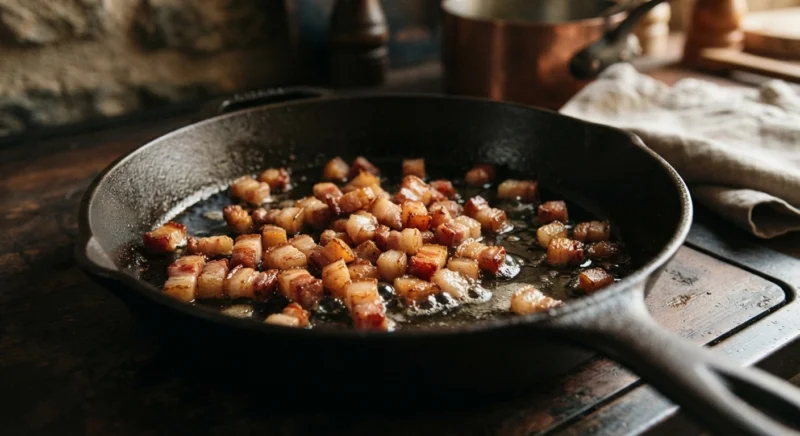
Cook the guanciale over medium-low heat for approximately 7–10 minutes.
Stir occasionally.
You should gradually see fat collecting in the pan.
The pieces should become golden and crisp around the edges.
Do not rush this stage.
If the guanciale is browning too quickly, reduce the heat.
If it is barely changing after several minutes, increase the heat slightly.
The correct visual cue is more important than the exact time.
You want the guanciale cooked through and nicely browned, but not burnt.
Once ready, turn the heat to low or remove the pan from the burner temporarily.
Do not discard the rendered fat.
It is an essential part of the sauce.
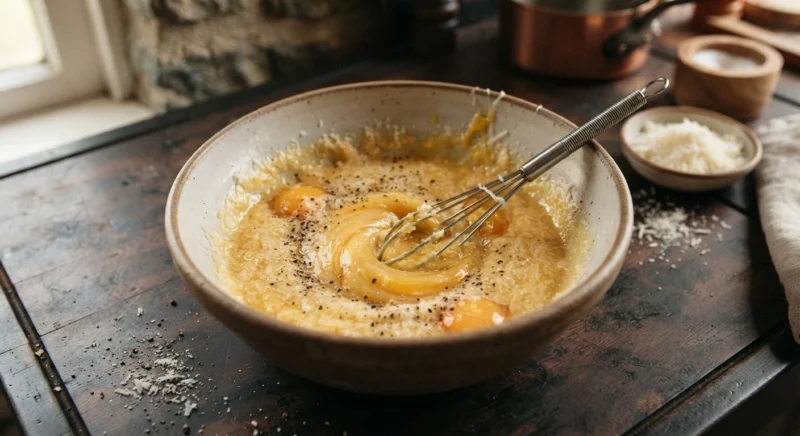
Step 3: Prepare the Egg and Cheese Mixture
While the guanciale cooks, combine the eggs and cheese.
In a medium bowl, add:
- 4 whole eggs
- 2 egg yolks
- finely grated Pecorino Romano
- freshly ground black pepper
Whisk thoroughly.
The mixture should become thick and relatively uniform.
At this point it will not look like a sauce.
It will look more like a thick cheese-and-egg paste.
That is perfectly normal.
Do not add cream.
The richness will come from the eggs, cheese, and pork fat.
Why Finely Grated Cheese Matters
Imagine trying to melt a handful of large cheese chunks into a hot mixture.
Some pieces would melt quickly while others would remain intact.
Now imagine the same amount of cheese grated into very fine particles.
The increased surface area allows the cheese to combine much more easily with the egg and pasta water.
This is one of the simplest ways to improve Carbonara.
Grate the cheese as finely as practical.
Step 4: Bring the Pasta Water to a Boil
Bring a large pot of water to a strong boil.
Salt the water generously, but remember that Pecorino Romano and guanciale are already salty.
You do not need to make the water overwhelmingly salty.
Add the spaghetti and stir during the first minute to prevent the strands from sticking together.
Cook according to the package instructions, but begin tasting the pasta before the recommended time is complete.
You want the spaghetti to be al dente.
That means cooked through but still firm enough to offer resistance when you bite it.
What Does Al Dente Actually Feel Like?
Beginners sometimes interpret al dente as undercooked pasta.
It should not be hard or crunchy.
Instead, the center should still have a slight firmness.
When you bite the spaghetti, it should feel cooked but not soft and mushy.
This matters because the pasta will continue cooking slightly during the final mixing stage.
If you cook it until completely soft in the pot, it can become too tender by the time the Carbonara is finished.
Step 5: Reserve Plenty of Pasta Water
This is one of the most important steps in the entire recipe.
Before draining the spaghetti, reserve at least 250 ml of the cooking water.
If possible, reserve even more.
The pasta water contains starch released from the spaghetti during cooking.
That starchy liquid helps bind the fat, egg, cheese, and pasta together.
It also allows you to control the consistency of the sauce.
Do not rely on plain tap water later.
The starch in pasta water is an important part of the final texture.
Step 6: Warm the Egg Mixture Carefully
You do not need to cook the egg mixture separately.
Instead, the hot pasta will provide the necessary heat.
However, adding a small amount of hot pasta water to the egg-and-cheese mixture can help loosen it.
Take a few tablespoons of pasta water and slowly whisk it into the egg mixture.
Do this gradually.
You do not want to pour a large amount of boiling water into the eggs all at once.
The goal is to gently warm and loosen the mixture.
This process also makes it easier to combine the eggs with the pasta later.
Step 7: Transfer the Pasta
When the spaghetti is ready, do not leave it sitting in the colander for several minutes.
Transfer it directly into the skillet containing the rendered guanciale fat.
The pasta should still be hot.
Toss the spaghetti thoroughly so the strands become coated with the pork fat.
If the skillet is extremely hot, remove it from the heat first.
You want the pan warm, not violently hot.
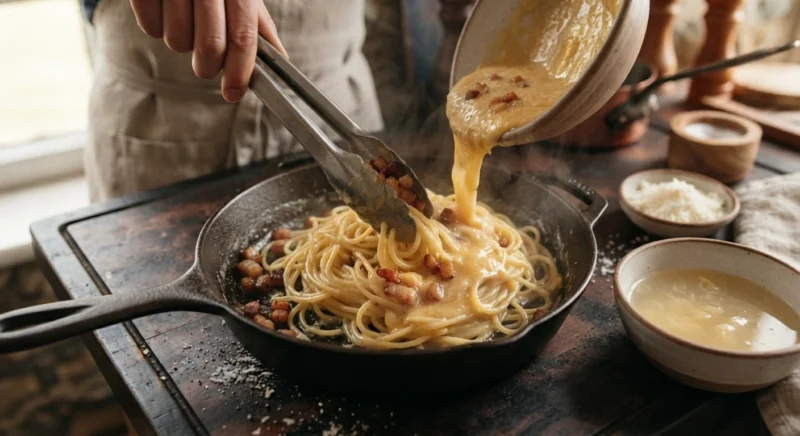
Step 8: Add the Egg and Cheese Mixture
This is the critical moment.
Take the skillet off direct heat if you have not already done so.
Add the egg-and-cheese mixture to the hot spaghetti.
Immediately begin tossing.
Use tongs to lift and turn the pasta repeatedly.
The hot pasta will gently heat the egg mixture.
The rendered guanciale fat will combine with the eggs and cheese.
The pasta water will loosen the mixture and help create an emulsion.
The Most Important Carbonara Technique
Think of this stage as building a sauce rather than simply pouring something over pasta.
Keep the pasta moving.
Lift it.
Turn it.
Toss it.
Coat the strands.
Add a small splash of pasta water when needed.
Then toss again.
You are looking for a sauce that becomes smooth and glossy.
The sauce should cling to the spaghetti rather than pool heavily at the bottom of the pan.
How to Know When Carbonara Is Ready
Look at the pasta rather than relying only on a timer.
Properly finished Carbonara should have:
- a glossy appearance
- a smooth coating on the spaghetti
- no visible pieces of cooked egg
- no large lumps of cheese
- enough sauce to coat the strands
- crisp pieces of guanciale distributed throughout
- freshly ground black pepper visible throughout the dish
The sauce should look creamy even though there is no cream in it.
That is the hallmark of properly prepared Carbonara.
If the Sauce Is Too Thick
This is extremely common.
Do not panic.
Add one tablespoon of reserved pasta water.
Toss vigorously.
Then evaluate again.
If necessary, add another tablespoon.
Continue gradually until the sauce becomes silky.
Do not pour in a large amount at once.
It is much easier to thin the sauce gradually than to repair a sauce that has become watery.
If the Sauce Is Too Thin
Continue tossing the hot pasta for a short time.
The residual heat will help the sauce thicken.
You can also add a little more finely grated Pecorino Romano.
However, do not simply dump a large quantity of cheese into the pan.
Too much cheese can make the sauce dense and clumpy.
Use small adjustments.
What If the Eggs Start Scrambling?
If you see small pieces of cooked egg forming, the temperature is too high.
Immediately stop heating the pan.
Move it away from the burner.
Add a small amount of pasta water and toss aggressively.
The situation may be recoverable if the eggs have only begun to set.
The best solution, however, is prevention.
Remember:
Carbonara needs heat, but it does not need high direct heat.
The hot pasta provides enough heat to cook the eggs gently.
Why Carbonara Does Not Need Cream
Cream is sometimes added to restaurant-style or home-style versions of Carbonara, but it is not necessary for the traditional technique.
The creamy texture comes from emulsification.
You have several components:
- egg
- cheese
- rendered pork fat
- starchy pasta water
When they are combined properly, the result is a smooth sauce.
The sauce may look cream-colored and luxurious, but that does not mean it contains cream.
In fact, adding cream can make the dish heavier and can hide some of the distinctive flavors of Pecorino Romano and guanciale.
Common Carbonara Mistakes
Mistake 1: Using Too Much Heat
This is probably the most common technical mistake.
High heat cooks the eggs too quickly.
Better approach
Remove the pan from direct heat before adding the egg mixture.
Use the heat already stored in the pasta and pan.
Mistake 2: Not Reserving Pasta Water
Without pasta water, it becomes much harder to control the sauce.
Better approach
Always reserve more than you think you need.
You can discard the excess after the Carbonara is finished.
Mistake 3: Adding Cold Pasta
If pasta sits around for several minutes before being combined with the sauce, it loses heat and becomes harder to emulsify properly.
Better approach
Coordinate your timing so the pasta goes directly from the cooking water into the sauce.
Mistake 4: Using Coarsely Grated Cheese
Large cheese pieces may not melt smoothly.
Better approach
Grate the Pecorino as finely as possible.
Mistake 5: Cooking the Guanciale Too Aggressively
Burnt pork fat tastes bitter.
Better approach
Render the guanciale gradually over moderate heat.
Mistake 6: Adding Cream Automatically
Cream is not required to make Carbonara creamy.
Better approach
Use egg, cheese, pork fat, and starchy pasta water.
Mistake 7: Adding Too Much Pasta Water
Pasta water is useful, but too much can make the sauce thin.
Better approach
Add it one tablespoon or small splash at a time.
Mistake 8: Not Tossing Enough
Simply stirring once or twice is not enough.
Better approach
Keep the pasta moving during the final mixing stage.
A Simple Temperature Strategy for Beginners
If you are nervous about scrambling the eggs, use this method.
Once the pasta is cooked:
- Turn off the burner.
- Transfer the hot pasta to the skillet with the guanciale.
- Toss for 15–20 seconds.
- Remove the skillet completely from the burner.
- Add the egg-and-cheese mixture.
- Toss continuously.
- Add pasta water gradually.
- Keep tossing until glossy.
This gives you much more control.
You can always return the pan to very gentle heat for a few seconds if necessary.
It is much easier to add heat than to undo scrambled eggs.
The Importance of Timing
Carbonara is best understood as a sequence.
The guanciale should be ready before the pasta finishes.
The egg mixture should be ready before the pasta finishes.
The cheese should already be grated.
The serving plates should be nearby.
The pasta water should be reserved before draining.
Then the final assembly happens quickly.
This is why restaurant cooks can make Carbonara look effortless.
The secret is preparation.
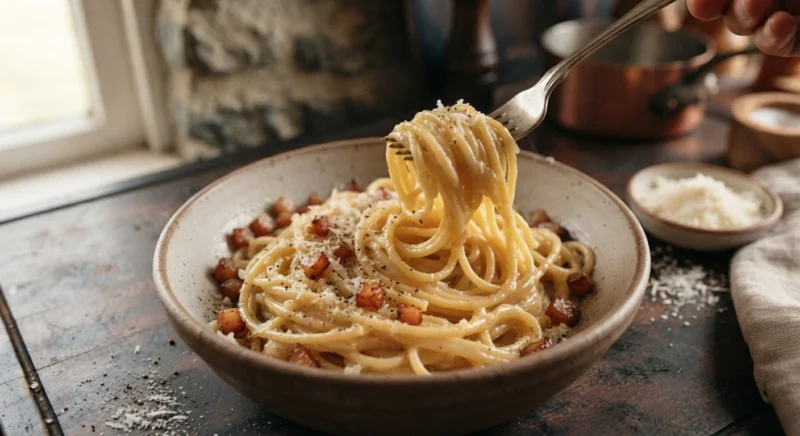
Serving Classic Carbonara
Carbonara should be served immediately.
Transfer the pasta to warm plates or bowls.
Finish with:
- freshly ground black pepper
- a light dusting of Pecorino Romano
- a few crisp pieces of guanciale
Do not drown the pasta in cheese.
The finished dish should remain balanced.
The first bite should give you pasta, rich egg-and-cheese sauce, salty pork, and pepper.
Check Our Guide Classic Chicken Parmesan Recipe
How Much Carbonara Sauce Should There Be?
A common beginner mistake is thinking that Carbonara should contain a large amount of liquid sauce.
It should not.
The sauce is meant to coat the pasta.
When you twirl a forkful of spaghetti, the sauce should cling to the strands.
There may be a small amount of sauce visible at the bottom of the bowl, but the dish should not resemble pasta swimming in a cream sauce.
A good Carbonara is rich and glossy rather than watery.
Choosing the Right Pasta
Spaghetti is the traditional choice, but the technique works with several pasta shapes.
Long shapes such as:
- spaghetti
- bucatini
- linguine
work especially well.
Short shapes can also work, but long pasta makes the classic experience particularly satisfying.
Bucatini is an especially interesting variation because the hollow center carries some of the sauce.
Can You Use Bacon?
Yes, if guanciale is unavailable.
But understand that the flavor will change.
Traditional guanciale is not heavily smoked.
Many bacon varieties have a strong smoky flavor, which can dominate the egg and cheese.
Pancetta is generally closer in flavor to guanciale.
If using bacon, choose a good-quality unsweetened bacon and avoid varieties with strong additional flavors.
Can You Use Parmesan?
You can, although Pecorino Romano is the traditional choice.
Parmesan has a somewhat different flavor profile and is generally less sharp and salty.
If you prefer its flavor, it can work.
You can also combine Parmesan and Pecorino.
However, if your goal is classic Roman-style Carbonara, Pecorino Romano is the better choice.
Can Carbonara Be Made With Only Whole Eggs?
Yes.
The additional yolks in this recipe make the sauce richer and silkier, but whole eggs can be used.
If you use only whole eggs, the final sauce may be slightly lighter.
The important thing is to avoid overcooking them.
Can Carbonara Be Made Ahead?
Carbonara is one of those dishes that is significantly better when eaten immediately.
The sauce continues to thicken as it cools.
Refrigerated Carbonara can become dense and sticky, and reheating it can cause the eggs to become more firmly cooked.
For the best result, prepare only as much as you intend to eat.
If you do have leftovers, store them in a sealed container in the refrigerator and use them within a short period.
Reheat gently rather than blasting them with high heat.
How to Reheat Leftover Carbonara
If you have leftovers, place them in a skillet over low heat.
Add a small splash of water.
Warm gently while tossing.
The goal is to loosen the sauce without aggressively cooking the eggs.
A microwave can work in a pinch, but it is much easier to overheat the sauce that way.
If you know in advance that you will have leftovers, slightly undercook the pasta the first time.
Carbonara Food Safety
Because Carbonara contains eggs, proper food handling is important.
Use fresh eggs and keep them refrigerated until needed.
Avoid leaving the finished dish at room temperature for an extended period.
If serving Carbonara to people who need to avoid undercooked eggs, consider using pasteurized eggs.
The cooking process in Carbonara is designed to gently heat the egg mixture, but the exact internal temperature can vary depending on the amount of pasta, pan, and technique.
Beginner Knife Technique for Carbonara
Although Carbonara does not require much knife work, there are still a few useful skills involved.
The guanciale should be cut into relatively uniform pieces.
Uniform pieces cook at approximately the same rate.
If some pieces are tiny and others are very large, the small pieces may become hard before the large pieces have rendered properly.
Use a stable cutting board.
Keep your fingertips curled slightly inward when holding the guanciale.
Keep the knife blade controlled and avoid rushing.
A sharp chef’s knife is safer and more precise than a dull one because it requires less force.
When cutting fatty cured pork, wipe the blade if it becomes excessively greasy.
This helps maintain control.
How to Get Better Browning on the Guanciale
Good browning is about temperature and moisture.
If the guanciale is crowded into a very small pan, it can steam rather than brown.
Use a large enough skillet so the pieces have some space.
Start with moderate heat and allow the fat to render.
Once enough fat has accumulated, the pieces will begin frying gently in their own rendered fat.
At this stage, you can adjust the heat slightly upward if necessary.
Watch carefully.
The difference between beautifully browned guanciale and burnt guanciale can happen quickly toward the end.
Why the Sauce Is an Emulsion
The technical explanation is useful because it makes the recipe easier to understand.
Fat and water naturally resist mixing.
Yet Carbonara contains both:
- rendered pork fat
- water from the pasta
The egg yolks contain emulsifying compounds that help stabilize the mixture.
The starch in the pasta water also contributes to the sauce’s body.
When you toss everything together, you are essentially creating a temporary emulsion that coats the pasta.
This is why vigorous tossing matters.
You are not simply mixing ingredients.
You are helping create the texture of the sauce.
How to Control the Final Texture
Think of the sauce as a sliding scale.
Too thick
Add pasta water.
Too thin
Keep tossing and allow the residual heat to work.
Add a little more cheese if necessary.
Grainy
The mixture may have overheated or the cheese may not have incorporated properly.
Reduce the heat and add a small amount of pasta water while tossing.
Scrambled
The temperature was too high.
Remove from heat immediately.
The more carefully you control temperature, the smoother the result will be.
How to Make Carbonara More Peppery
Carbonara should have noticeable black pepper.
For a stronger pepper flavor, use freshly cracked pepper rather than pre-ground pepper.
You can add some pepper to the egg-and-cheese mixture and toast a little more in the guanciale fat.
Briefly warming the pepper in the fat releases its aromatic compounds.
Be careful not to burn it.
Burnt pepper becomes bitter.
Why You Should Not Add Garlic
Garlic is delicious with many pasta dishes, but traditional Carbonara does not require it.
Adding garlic changes the flavor profile.
The classic dish is intentionally restrained.
The main flavors are:
- pork
- Pecorino
- egg
- pepper
- pasta
Keeping the ingredient list short allows each component to remain recognizable.
Why You Should Not Add Onions
The same principle applies to onions.
Onion can create a delicious pasta dish, but it changes Carbonara into something else.
If you want a traditional version, leave it out.
Carbonara vs. Creamy Bacon Pasta
These dishes are often confused.
A creamy bacon pasta might use:
- cream
- bacon
- garlic
- onions
- Parmesan
- herbs
There is nothing wrong with that.
But it is not traditional Carbonara.
Classic Carbonara is defined partly by its simplicity.
Understanding the difference allows you to appreciate both styles without confusing them.
A Practical Timeline
Here is a simple timeline for preparing the dish efficiently.
0:00
Put pasta water on to boil.
0:05
Cut guanciale and grate Pecorino.
0:10
Start cooking the guanciale.
0:12
Prepare the egg-and-cheese mixture.
0:15
Add spaghetti to boiling water.
0:20
Check the pasta.
0:22
Reserve pasta water.
0:23
Transfer pasta to the guanciale pan.
0:24
Add egg mixture.
0:25
Toss and adjust with pasta water.
0:26
Serve immediately.
The exact timing will depend on your pasta and stove, but the sequence is what matters.
Scaling the Recipe
The recipe can easily be scaled.
For two people, use approximately:
- 200 g spaghetti
- 75 g guanciale
- 2 whole eggs
- 1 additional yolk
- 50–60 g Pecorino Romano
- black pepper to taste
For six people, increase the ingredients proportionally.
When making a very large batch, temperature control becomes more difficult.
For best results, avoid overcrowding a small skillet.
If necessary, cook and combine the pasta in batches.
What Makes Restaurant Carbonara Taste Better?
The biggest differences usually come down to technique rather than secret ingredients.
Restaurant-quality Carbonara benefits from:
- Good guanciale.
- Freshly grated Pecorino.
- Freshly ground pepper.
- Properly cooked pasta.
- Enough reserved pasta water.
- Controlled heat.
- Immediate serving.
You do not need an elaborate ingredient list.
You need good timing.
Troubleshooting Guide
My Carbonara tastes too salty.
The most likely causes are heavily salted pasta water, salty guanciale, or too much Pecorino.
Next time, use a little less salt in the pasta water.
You can also increase the amount of pasta slightly if the sauce is already prepared.
My Carbonara tastes bland.
Increase the freshly ground black pepper and Pecorino gradually.
Make sure the guanciale is properly browned.
Also remember that good Carbonara relies on quality ingredients. Mild cheese and low-quality cured pork can produce a less flavorful result.
My Carbonara is watery.
Continue tossing.
If it remains too thin, allow some of the excess moisture to evaporate with very gentle residual heat.
Do not immediately add large amounts of cheese.
My Carbonara is dry.
Add pasta water one tablespoon at a time and toss.
The pasta water is your primary tool for adjusting the sauce.
My cheese has clumped together.
The cheese may have been added under conditions that were too hot or it may have been grated too coarsely.
Finely grate the cheese and control the temperature more carefully.
My eggs scrambled.
The pan was too hot.
Next time, remove the pan from direct heat before adding the egg mixture.
My guanciale is burnt.
The heat was too high or the cooking continued too long.
Start at medium-low and watch the pieces carefully toward the end.
The Most Important Lessons
If you remember only a few things from this recipe, remember these:
1. Prepare everything before the pasta is ready.
Carbonara comes together quickly.
2. Cook the guanciale slowly.
You want rendered fat and crisp edges.
3. Grate the Pecorino very finely.
This makes the sauce smoother.
4. Reserve plenty of pasta water.
You need it to control the consistency.
5. Do not add the eggs over high heat.
Residual heat is your friend.
6. Keep tossing.
The sauce needs movement to emulsify properly.
7. Add pasta water gradually.
Small adjustments give you much better control.
8. Serve immediately.
Carbonara is at its best while hot and silky.
Classic Carbonara Recipe
Ingredients
- 400 g spaghetti
- 150 g guanciale
- 4 large eggs
- 2 egg yolks
- 100–120 g finely grated Pecorino Romano
- 1–2 teaspoons freshly ground black pepper
- Salt for pasta water
- Approximately 250 ml reserved pasta water
Instructions
1. Prepare the ingredients
Cut the guanciale into small strips or cubes. Finely grate the Pecorino Romano. Crack the eggs into a bowl and add the extra yolks.
2. Make the egg mixture
Add the Pecorino and freshly ground black pepper to the eggs. Whisk until thoroughly combined.
3. Cook the guanciale
Place the guanciale in a cold large skillet. Cook over medium-low heat for approximately 7–10 minutes, stirring occasionally, until the fat has rendered and the pieces are golden and crisp.
4. Cook the spaghetti
Bring a large pot of salted water to a boil. Cook the spaghetti until al dente according to the package instructions.
5. Reserve pasta water
Before draining, reserve at least 250 ml of pasta water.
6. Combine pasta and guanciale
Transfer the hot spaghetti directly into the skillet with the rendered guanciale fat. Toss thoroughly.
7. Add the egg mixture
Remove the skillet from direct heat. Add the egg-and-cheese mixture and immediately toss the spaghetti continuously.
8. Adjust the sauce
Add reserved pasta water one tablespoon or small splash at a time while tossing until the sauce becomes smooth, glossy, and creamy-looking.
9. Finish
Add the crisp guanciale throughout the pasta. Taste and adjust the black pepper if necessary.
10. Serve
Serve immediately with a little additional Pecorino Romano and freshly ground black pepper.
Final Thoughts
Classic Carbonara is a perfect example of how a small number of ingredients can produce an extraordinary dish when technique is correct.
There is no complicated sauce to prepare and no long list of ingredients to manage.
The real skill is controlling heat.
Cook the guanciale slowly enough to render the fat without burning it. Cook the pasta until it is properly al dente. Reserve the starchy pasta water. Then combine the hot pasta with the egg, cheese, pepper, and rendered pork fat away from direct high heat.
If you get those steps right, the result should be rich, glossy, peppery, savory, and deeply satisfying.
Most importantly, the sauce should be creamy without containing cream.
That is the beauty of classic Carbonara: simple ingredients, careful technique, and excellent timing.
https://www.accademiaitalianadellacucina.it/it/search/node/carbonara