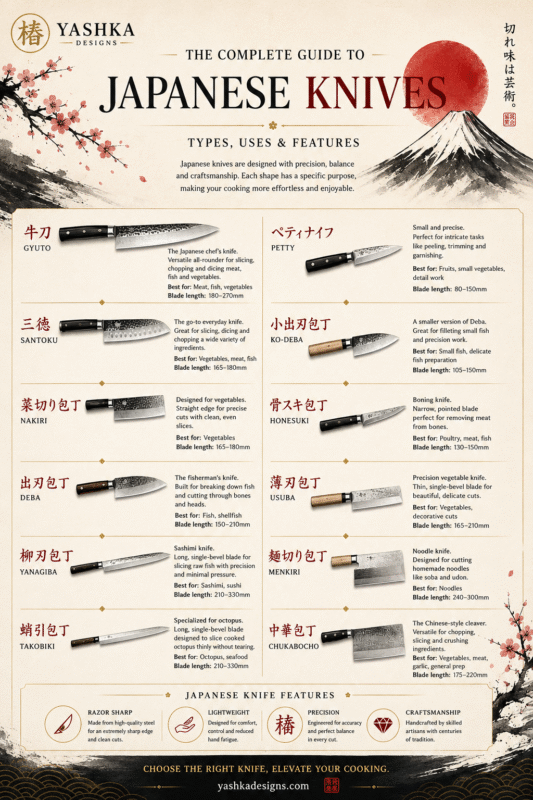
Everything You Need to Know About Japanese Knives
The Ultimate Guide to Japanese Knives
Japanese knives are widely respected by chefs, culinary professionals, and home cooks around the world. Known for their razor-sharp edges, exceptional craftsmanship, and elegant design, Japanese kitchen knives combine centuries of tradition with modern performance.
Whether you are building your first knife collection or upgrading your kitchen tools, understanding the different types of Japanese knives can help you choose the right blade for your cooking style.
In this guide, we’ll explore the most popular Japanese knife types, their uses, blade characteristics, and how to choose the perfect Japanese knife for your kitchen.
⸻
Why Japanese Knives Are So Popular
Japanese knives stand out because of their precision and craftsmanship. Unlike many Western knives, Japanese blades are often thinner, harder, and sharper, allowing for cleaner and more accurate cuts.
Professional chefs prefer Japanese knives for several reasons:
• Extremely sharp edges
• Lightweight and balanced design
• Superior cutting precision
• Beautiful handcrafted finishes
• Long-lasting edge retention
Many traditional Japanese knives are inspired by centuries-old swordsmith techniques passed down through generations.
⸻
Types of Japanese Knives
Gyuto Knife – The Japanese Chef’s Knife
The Gyuto is one of the most versatile Japanese kitchen knives. Often compared to a Western chef’s knife, the Gyuto is designed for slicing meat, chopping vegetables, and performing everyday kitchen tasks.
Best Uses:
• Meat slicing
• Vegetable prep
• Fish cutting
• General cooking
Blade Length:
180mm–270mm
The Gyuto is an excellent all-purpose knife for both beginners and professional chefs. Its curved edge allows smooth rocking motions while maintaining the thin precision Japanese knives are known for.
⸻
Santoku Knife – The Everyday Kitchen Favorite
The Santoku knife has become one of the most popular Japanese knives worldwide. The name “Santoku” translates to “three virtues,” referring to slicing, dicing, and chopping.
Compared to the Gyuto, the Santoku has a shorter and flatter blade, making it ideal for precise up-and-down cutting motions.
Best Uses:
• Vegetables
• Fish
• Boneless meat
• Everyday meal prep
Blade Length:
165mm–180mm
If you want a single knife for daily cooking, the Santoku is one of the best Japanese knives to own.
⸻
Nakiri Knife – Perfect for Vegetables
The Nakiri is a traditional Japanese vegetable knife featuring a straight-edge rectangular blade. It is specifically designed for clean vegetable cuts without tearing delicate ingredients.
Best Uses:
• Vegetables
• Herbs
• Precise slicing
• Fine chopping
Blade Length:
165mm–180mm
The flat edge ensures the entire blade contacts the cutting board, creating extremely clean cuts and reducing food damage.
For plant-based cooking or vegetable-heavy meal prep, the Nakiri is an outstanding choice.
⸻
Deba Knife – Heavy-Duty Fish Preparation
The Deba knife is a traditional Japanese fish butcher knife. It features a thick, heavy blade capable of cutting through fish bones and heads while still maintaining precision.
Best Uses:
• Whole fish preparation
• Filleting fish
• Seafood breakdown
• Poultry butchering
Blade Length:
150mm–210mm
Although powerful, the Deba should not be used on large hard bones. It is specially designed for seafood preparation and remains a favorite among sushi chefs.
⸻
Yanagiba Knife – The Sushi & Sashimi Specialist
The Yanagiba is one of the most iconic Japanese knives. Its long, slender blade is designed for slicing raw fish in a single smooth motion.
This minimizes pressure on delicate fish and preserves texture and presentation.
Best Uses:
• Sushi
• Sashimi
• Raw fish slicing
• Precision slicing
Blade Length:
210mm–330mm
The Yanagiba is essential for professional sushi chefs and serious Japanese cuisine enthusiasts.
⸻
Petty Knife – Small but Versatile
The Petty knife is similar to a utility or paring knife. Compact and lightweight, it is ideal for smaller kitchen tasks requiring precision.
Best Uses:
• Fruit cutting
• Peeling
• Trimming
• Garnishing
Blade Length:
80mm–150mm
A Petty knife complements larger knives perfectly and is often used for detailed work where a chef’s knife feels too large.
⸻
Honesuki Knife – Japanese Boning Knife
The Honesuki is a specialized Japanese boning knife traditionally used for poultry preparation.
Its triangular shape and stiff blade provide excellent control around joints and bones.
Best Uses:
• Chicken butchering
• Poultry prep
• Meat trimming
• Deboning
Blade Length:
130mm–150mm
Unlike flexible Western boning knives, the Honesuki offers more rigidity for precise cuts.
⸻
Usuba Knife – Traditional Vegetable Precision
The Usuba is a professional Japanese vegetable knife commonly used in traditional Japanese cuisine.
It features a thin single-bevel edge that creates ultra-clean cuts and decorative vegetable presentations.
Best Uses:
• Decorative vegetable cuts
• Fine slicing
• Professional Japanese cuisine
Blade Length:
165mm–210mm
Because of its single-bevel design, the Usuba requires more skill than beginner-friendly knives like the Nakiri.
⸻
Takobiki Knife – Regional Sashimi Knife
The Takobiki is a Tokyo-style sashimi knife similar to the Yanagiba but with a squared tip.
It is traditionally used for slicing octopus and delicate seafood.
Best Uses:
• Octopus
• Sashimi
• Fine seafood slicing
Blade Length:
210mm–330mm
This knife is less common internationally but highly respected in traditional Japanese kitchens.
⸻
Chukabocho – The Japanese Cleaver
The Chukabocho is the Japanese version of a Chinese cleaver. Despite its large appearance, it is surprisingly versatile and agile.
Best Uses:
• Vegetable chopping
• Meat slicing
• Garlic crushing
• Ingredient transfer
Blade Length:
175mm–220mm
It combines power with precision and is widely used in Asian kitchens.
⸻
Japanese Knife Steel Types
One reason Japanese knives perform so well is the steel quality.
Common Japanese knife steels include:
High Carbon Steel
• Extremely sharp
• Excellent edge retention
• Requires maintenance to prevent rust
Stainless Steel
• Rust resistant
• Easier to maintain
• Great for beginners
Damascus Steel
• Layered steel construction
• Beautiful wave patterns
• Combines strength and aesthetics
Many premium Japanese knives combine hard core steel with softer outer layers for durability and performance.
⸻
How to Choose the Best Japanese Knife
When buying a Japanese knife, consider the following:
Your Cooking Style
• Home cooks often prefer Santoku or Gyuto knives
• Sushi chefs need Yanagiba knives
• Vegetable-focused cooking benefits from Nakiri knives
Blade Size
Longer blades are great for slicing, while shorter blades provide more control.
Maintenance
High-carbon knives require more care but offer exceptional sharpness.
Handle Style
Japanese knives may feature:
• Western-style handles
• Traditional Wa-handles
Wa-handles are lighter and improve balance for precision cutting.
Check our Guide Best Kitchen Knives for Groomsmen Gifts
⸻
Caring for Japanese Knives
Proper care extends the life of your knife.
Essential Knife Care Tips
• Hand wash only
• Dry immediately after use
• Avoid frozen foods or hard bones
• Use wooden or soft cutting boards
• Sharpen regularly with whetstones
Never place Japanese knives in the dishwasher, as harsh detergents and heat can damage the blade and handle.
Check our Guide Japanese Gyuto Knife Guide
⸻
Final Thoughts
Japanese knives are more than kitchen tools — they are a blend of craftsmanship, tradition, and performance.
Whether you choose a versatile Gyuto, a precise Yanagiba, or a vegetable-focused Nakiri, investing in a quality Japanese knife can completely transform your cooking experience.
Understanding the different types of Japanese knives allows you to select the right blade for your needs and appreciate the artistry behind Japanese knife-making.
Explore our collection of premium Japanese kitchen knives and discover the perfect balance of sharpness, precision, and beauty for your kitchen.
Yashka Designs